
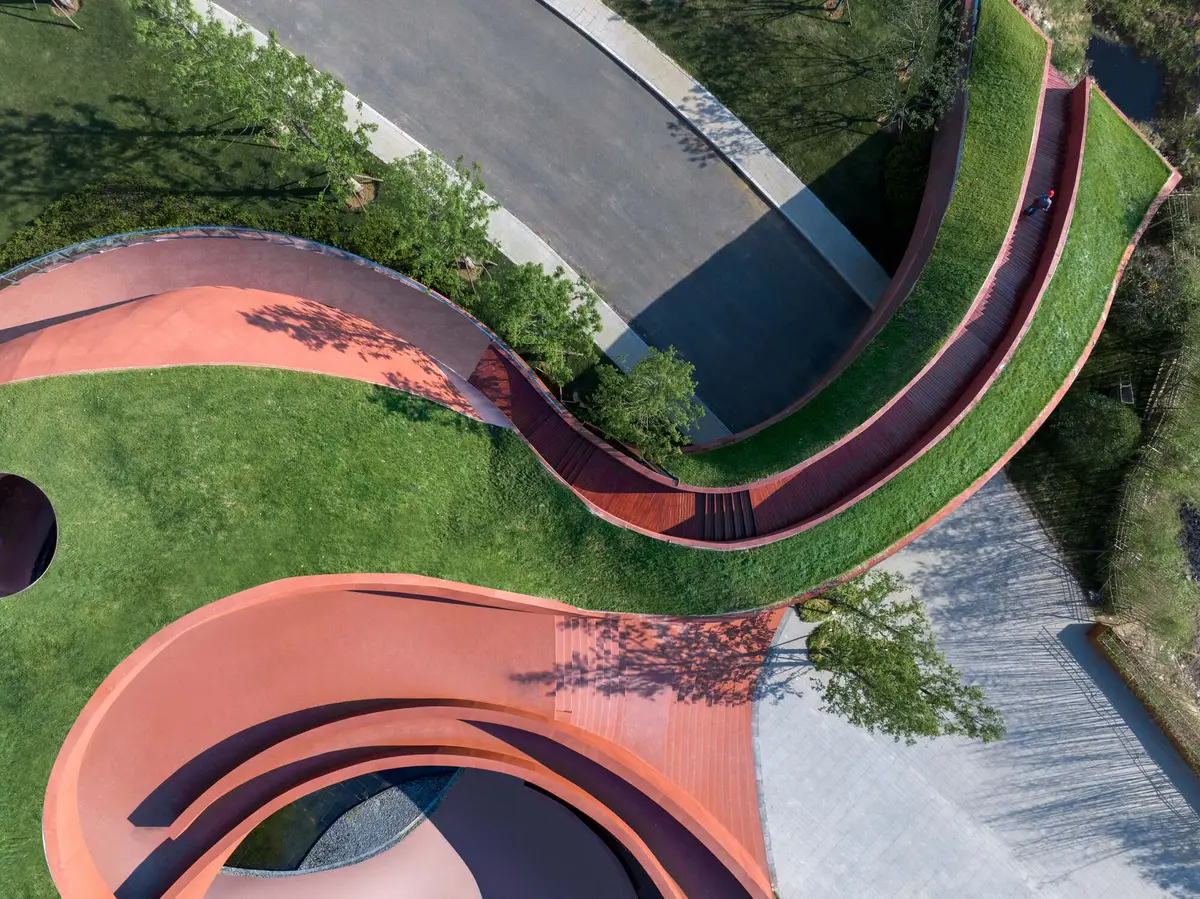
Change Architects Sculpt a Terracotta Shell into the Hillside at Chaohu Natural and Cultural Center
A 1,500-square-meter cultural center in Hefei, China, emerges from the earth as a worm-eaten, planted landscape building.


Buildings that claim to "grow from the landscape" are common enough to be suspicious. Most simply sit on a hillside and call it integration. The Chaohu Natural and Cultural Center, designed by change architects at the foot of Juzhang Mountain in Hefei, Anhui province, earns the claim through a more literal and stranger conceit: the building's form is projected from the contour of the mountain itself, and its openings are modeled on the tunnels left by worms burrowing through earth. It is not a metaphor. The architects used the silhouette of the surrounding hundred-meter ridgeline to generate the plan and elevation of undulating concrete shells, then punched through them with organic voids that serve as skylights, courtyards, and the very boundary between inside and outside.
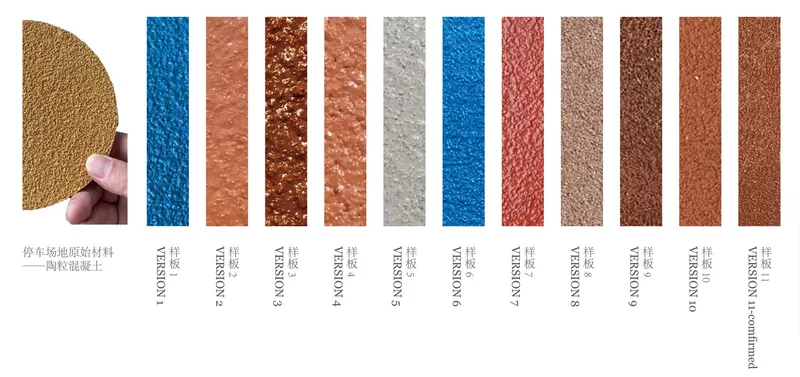
Completed in 2022 as the core public facility for OCT Group's Bantang Hot Spring Town development, the center houses a community hub, restaurant, and performance space across 1,500 square meters. What makes it genuinely interesting is not just the biomorphic shape but the structural ambition: a steel-framed shell clad in terracotta-colored glass-reinforced concrete, sprayed in lightweight concrete to achieve tolerances that conventional formwork could not, then topped with a planted green roof engineered with anti-skid partitions to keep vegetation alive on slopes. The roof itself spans a municipal road, acting as a footbridge that stitches the northern and southern halves of the site together. The result is part landform, part infrastructure, part building, and entirely committed to the premise that architecture can dissolve into topography without losing programmatic clarity.
A Roofscape That Is Also a Landscape
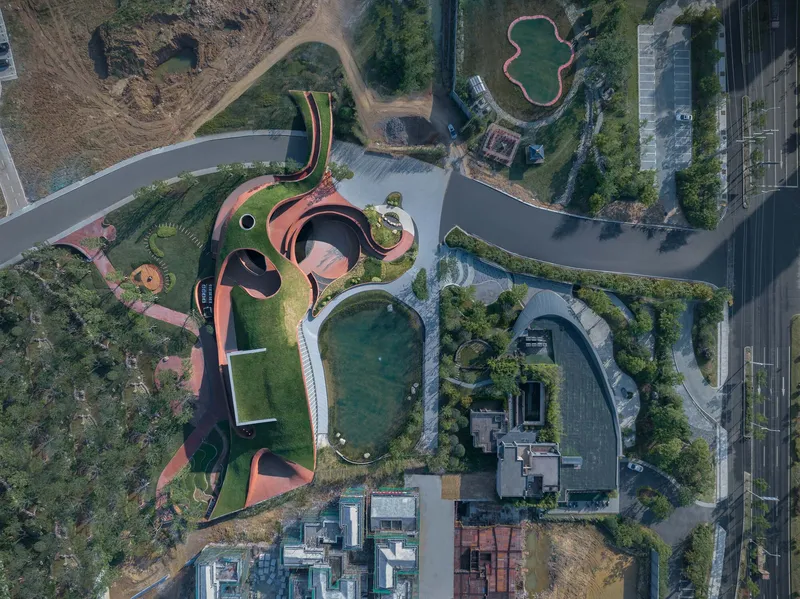
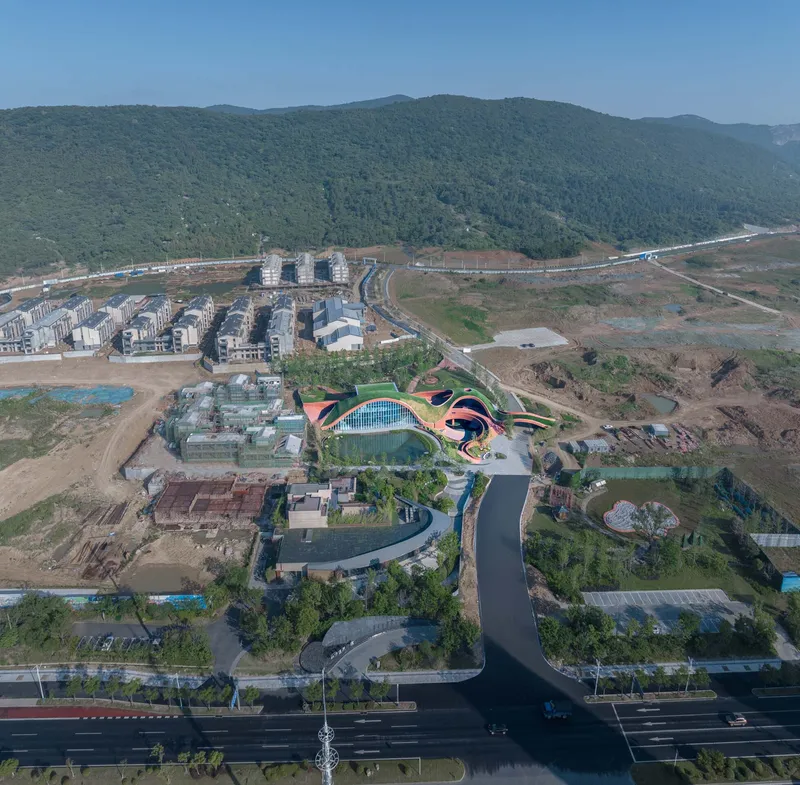
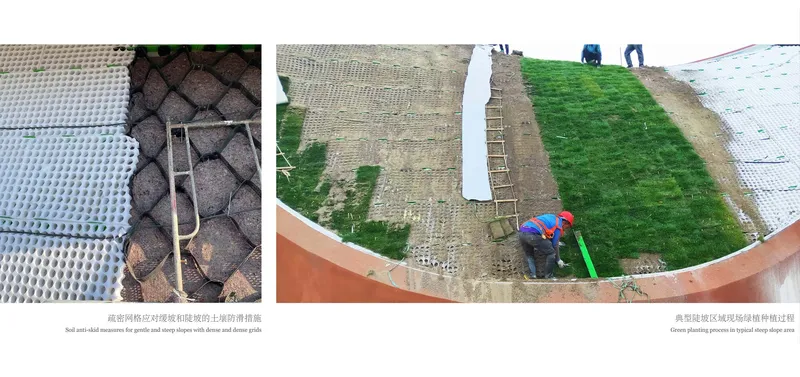
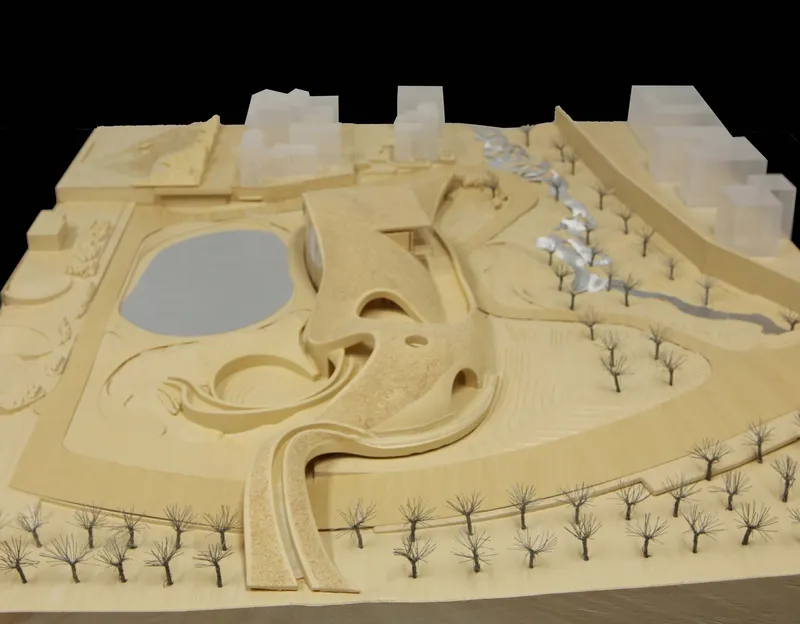
From above, the building reads less as a structure and more as a geological event. Three lobed volumes ribbon across the site, their terracotta surfaces curving up from ground level to form mounds punctured by circular and elliptical openings. The planted roof sections, maintained through a calculated system of formula soil layered into mesh drainage partitions, blur the line between architecture and terrain. Gentle slopes receive large-mesh anti-skid treatment; steeper pitches get denser perforations. It is a pragmatic solution to a poetic ambition.
The aerial views reveal the full scope of the spatial strategy. Two shells intersect, one enclosing the functional program, the other creating what the architects call a "gray space," a neutral zone that generates a public platform and double-height volume perpendicular to the main dome. Between the shells, reflecting pools, timber-decked paths, and sunken courtyards create a flowing sequence of outdoor rooms that are as programmatically rich as anything under cover.
Wormholes as Thresholds
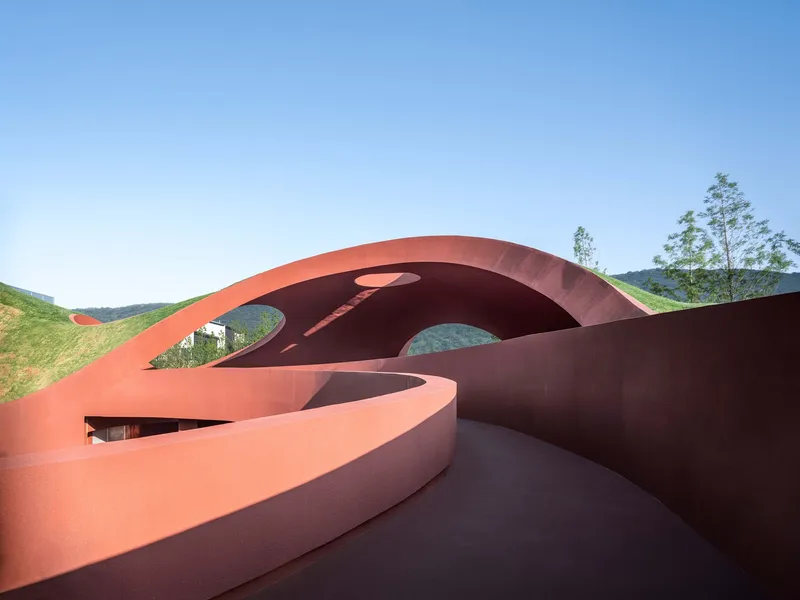
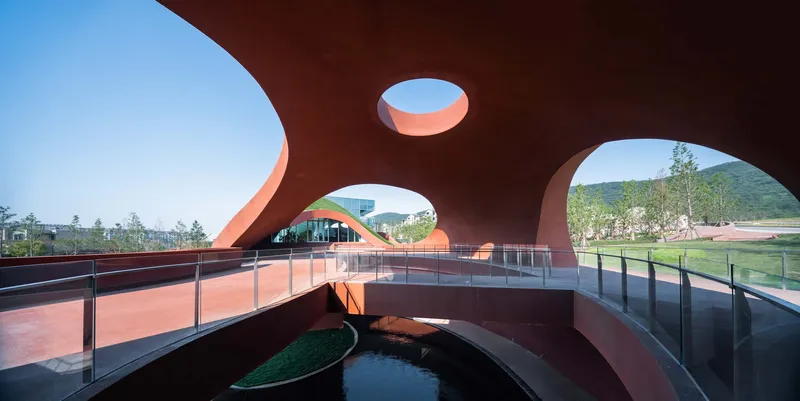
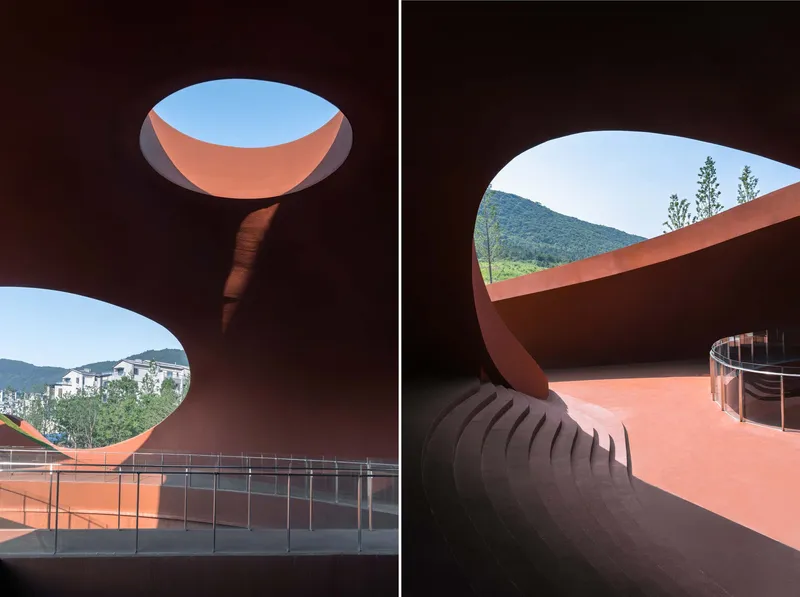
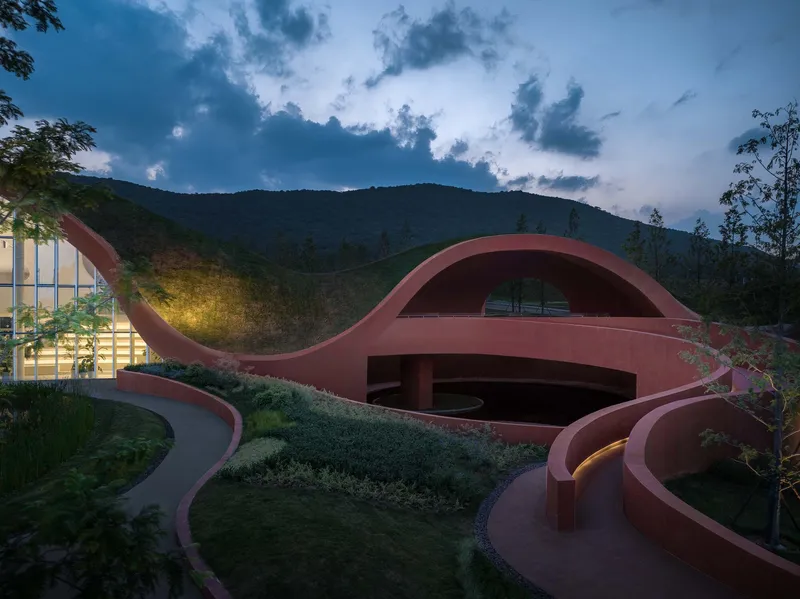
The circular and oval perforations in the roof are not decorative. They are the conceptual spine of the project: openings derived from the idea of wormholes formed as organisms burrow through soil, defining where building ends and sky begins. Standing beneath them, you look up through terracotta rings to mountain ridges and clouds. The effect is deliberately primitive, closer to a cave oculus than a skylight. Each aperture frames a specific view, whether of Juzhang Mountain to the north or the canopy of surrounding trees.
These voids also work hard as environmental devices. They draw daylight deep into covered terraces, ventilate the spaces below, and prevent the continuous roof plane from feeling oppressive. The terracotta surfaces around their edges catch sun and shadow in constantly shifting patterns, lending warmth and variation to what could otherwise be a monolithic form.
Thresholds and Procession
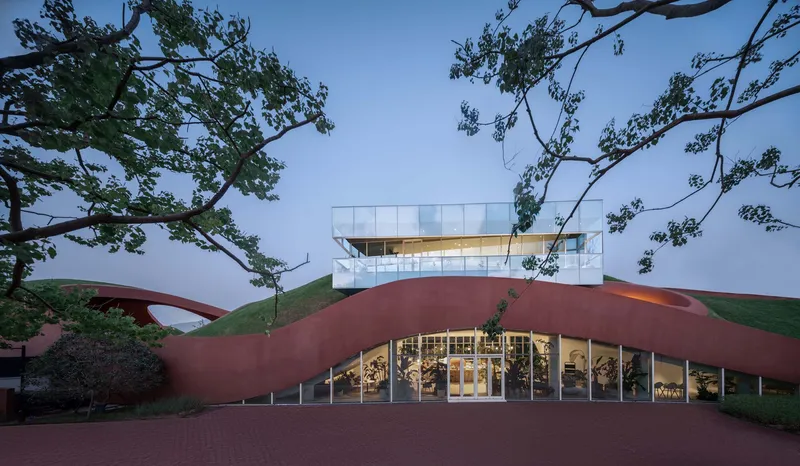
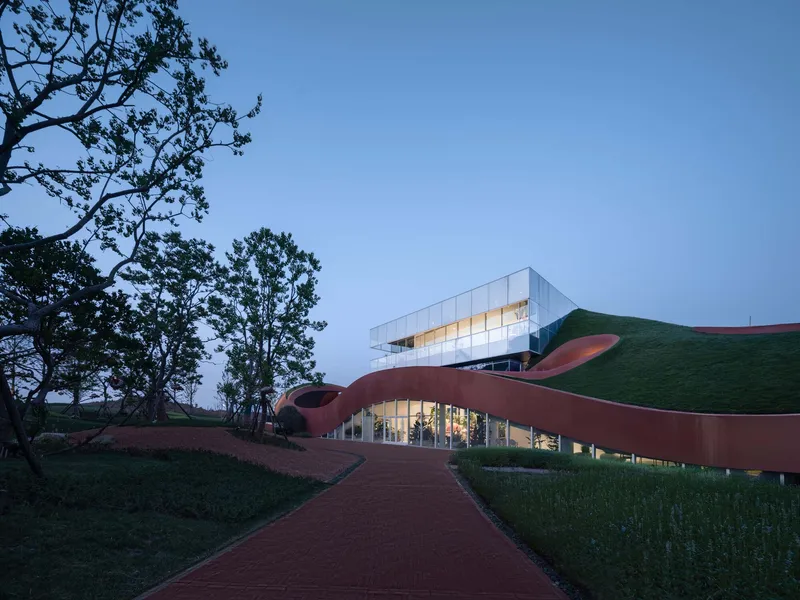
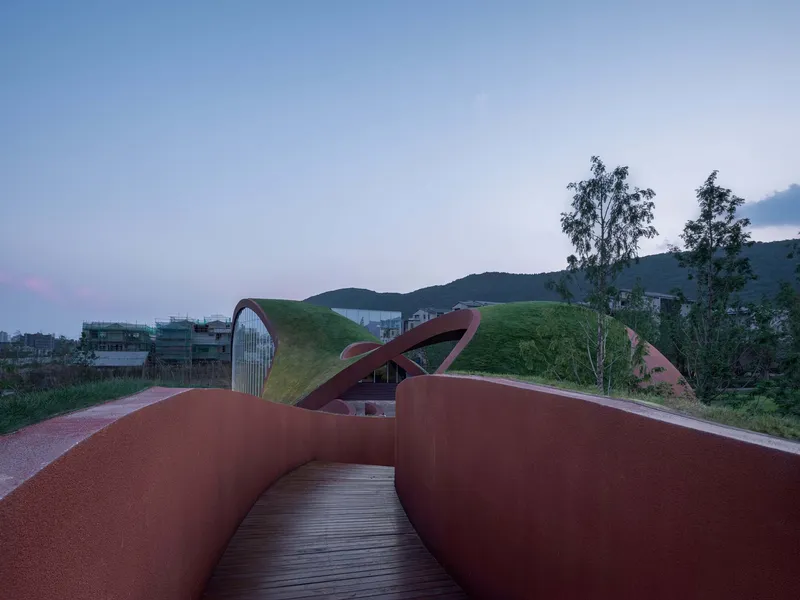
Arrival is choreographed as a slow unfolding rather than a frontal gesture. A timber-decked ramp threads between terracotta walls at a half-level, leading visitors gradually up and into the domed interior. The main entrance presents a glazed facade beneath a sweeping canopy, but it is only one of several ways in. Landscape steps set within an open square offer another entry, facing the road-spanning roof above. The approach paths wind through the undulating forms, compressing and releasing views of the surrounding hills and water features.
The procession recalls the traditions of Chinese garden design, where sequential framing is more important than a single reveal. Here the frames are carved from concrete rather than composed of walls and lattice screens, but the principle is the same: movement through space as a curated experience of landscape.
The Red Underworld
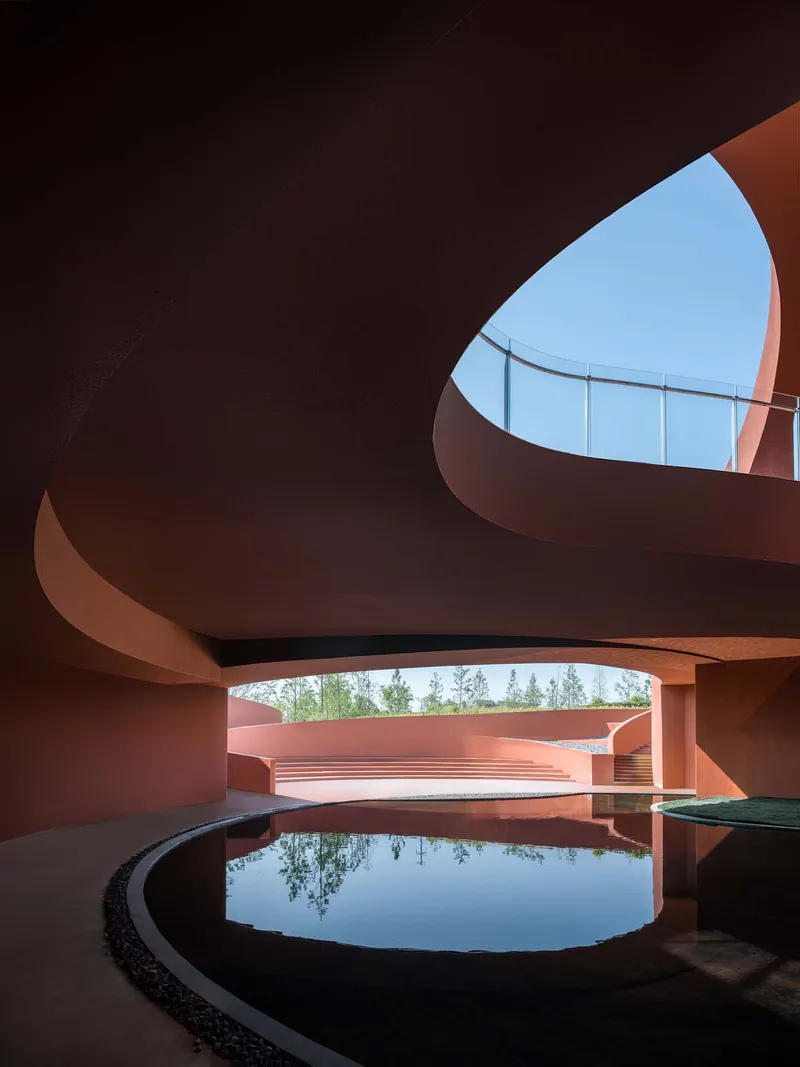
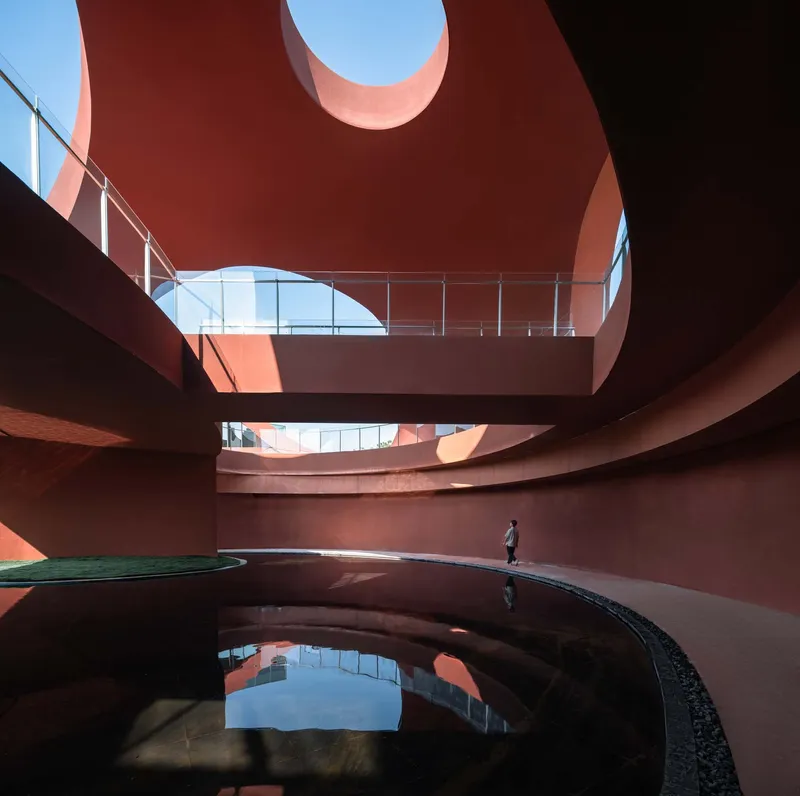
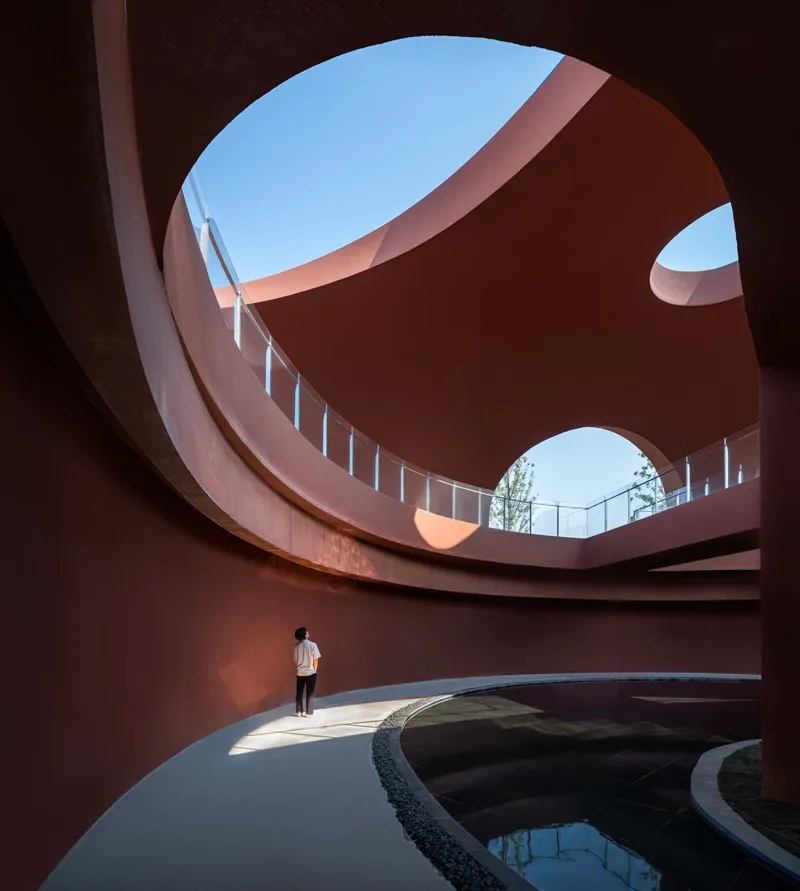
Beneath the planted roofscape, the interior world is saturated in the same terracotta-red concrete. Circular reflecting pools mirror the curved soffits above. Sweeping bridges cross water features at various levels, connecting upper terraces to sunken amphitheaters. The palette is relentless, and that is the point: the continuity of color between roof, wall, floor, and water reinforces the illusion that the building has been hollowed from a single mass of earth.
The quality of light under these shells is remarkably varied. Direct sun enters through the wormhole openings as sharp cones of brightness. Ambient light filters in from the glazed facades at the periphery. The result is a gradient from deep shadow at the center to transparency at the edges, a spatial condition that makes each pocket of the building feel distinct even within the continuous form.
Water as Architecture
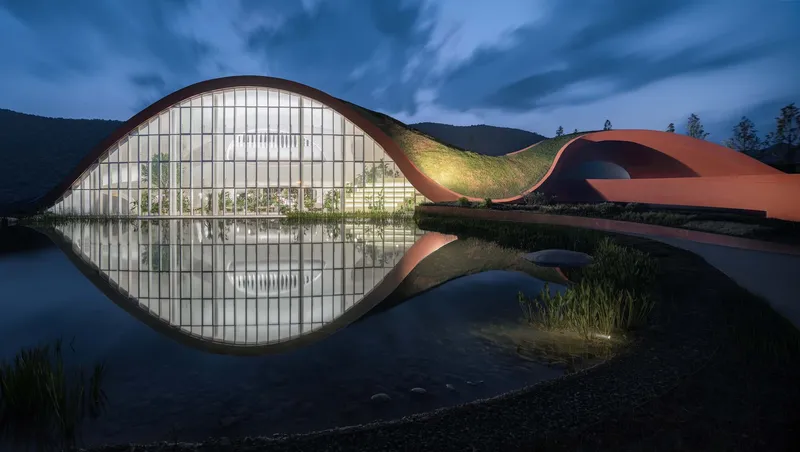
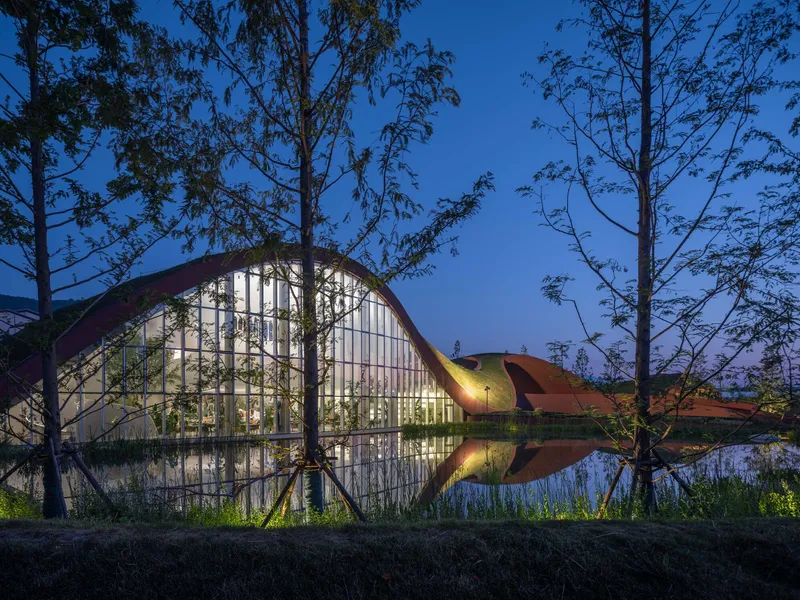
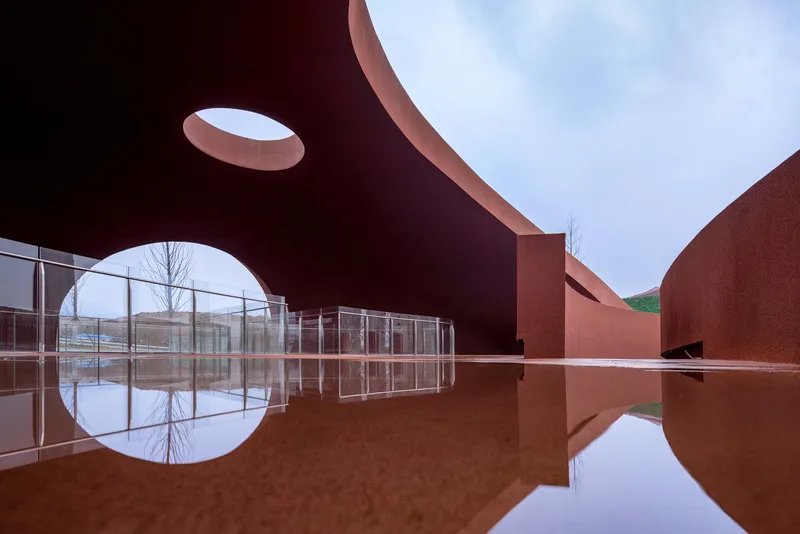
The reflecting pools and ponds are not landscape afterthoughts; they are structural to the experience. At twilight, the glazed facades and arched roofs double in the still water, extending the building's silhouette into the ground plane. Interior pools under the curved soffits perform a similar trick, bouncing terracotta-tinted light back up onto the undersides of the shells. The building seems to float and sink at the same time.
The relationship to the site's existing water features, including natural pools at the foot of the mountain, is deliberate. Rather than redirecting drainage, the design absorbs water into its spatial logic, using it as a mirror, a threshold, and a climatic moderator beneath the massive thermal mass of the concrete roof.
Interior Clearings
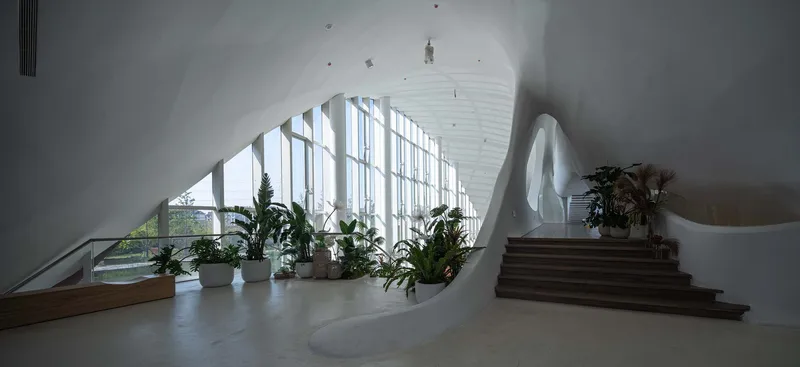
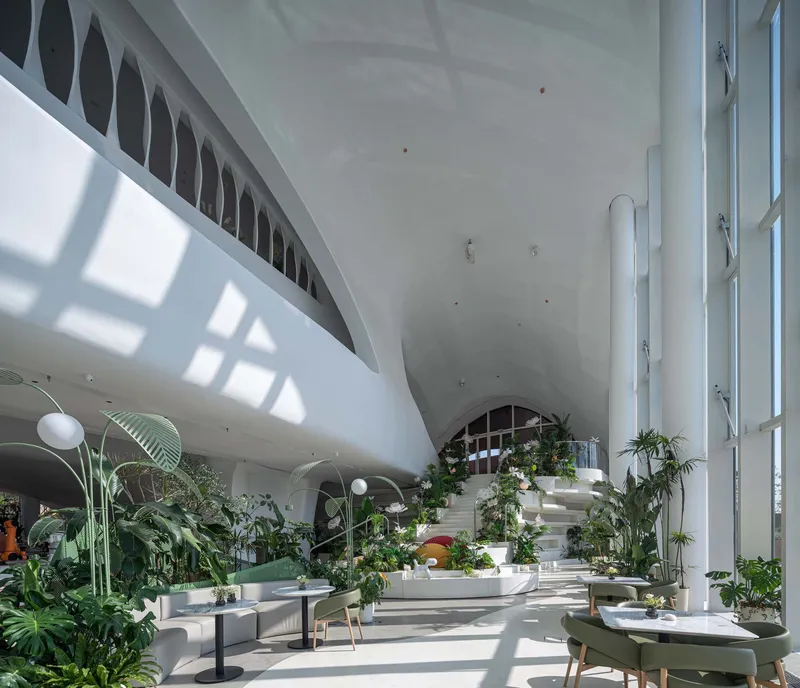
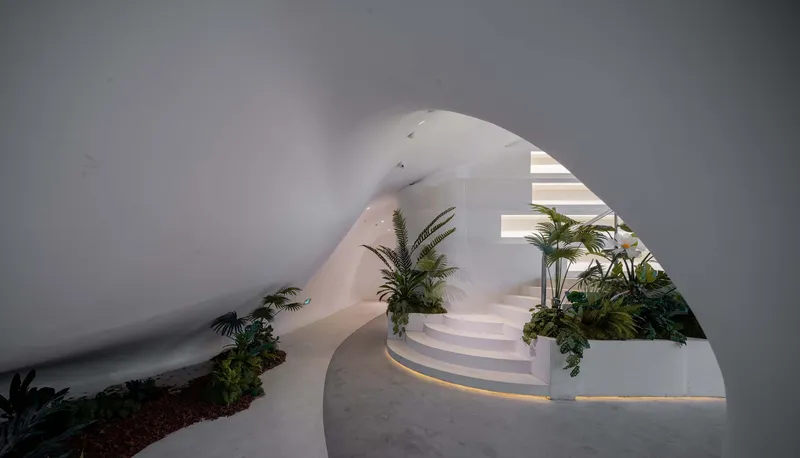
Where the exterior celebrates raw concrete and terracotta earthiness, the enclosed interior spaces shift to white plaster, timber, and floor-to-ceiling glazing. The vaulted ceilings remain, but the palette lightens dramatically, creating rooms that feel like clearings within the larger landform. Potted plants scattered across polished floors reinforce the idea of inhabiting a landscape rather than a conventional building. Curved timber staircases ascend past planted beds, their organic geometry echoing the shell structure beyond the glass.
The contrast between interior and exterior materiality is the project's most conventional move, but it works. The warm, light-filled restaurant and community spaces offer respite from the sculptural intensity outside. They also ensure the building functions as a comfortable public facility and not merely as an architectural spectacle.
Building the Shell
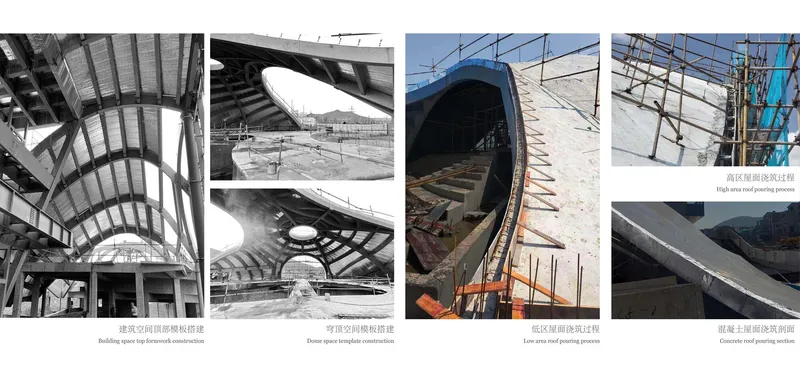
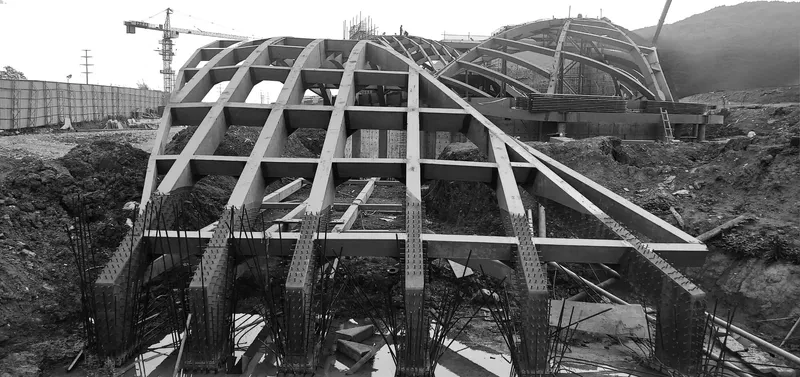
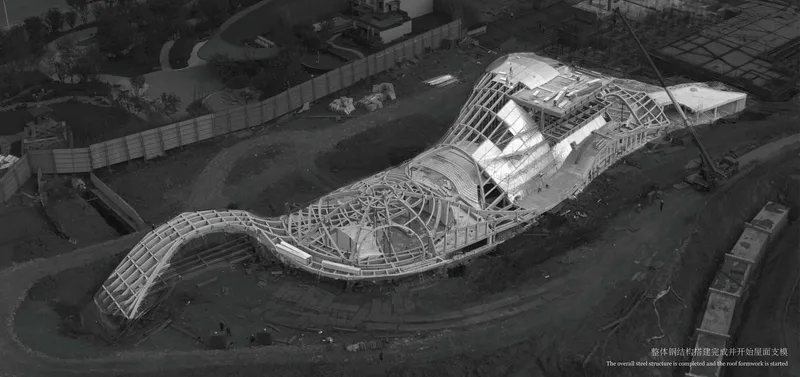
The construction photographs are as compelling as the finished project. The exposed steel ribs, visible before cladding, reveal the engineering required to achieve these fluid forms. The structure is fundamentally a steel frame, with ribbed formwork shaping the vaulted volumes. After the frame was erected, two finishing systems were applied: GRC hanging boards combined with in-situ poured concrete for the primary shell, and lightweight sprayed concrete for the veneer layers. Both methods were chosen specifically because they are malleable enough to match the streamlined shapes while reducing the tolerance demands that rigid formwork would impose.
The sequence from bare steel skeleton to finished landform is a reminder that organic architecture is often the most structurally demanding kind. Every curve here was engineered, every oculus reinforced. The green roof installation, visible in progress with workers laying mesh drainage layers and sod, adds another layer of technical complexity to what already reads as one of the more ambitious small-scale shell structures completed in recent years.
Amphitheater and Performance
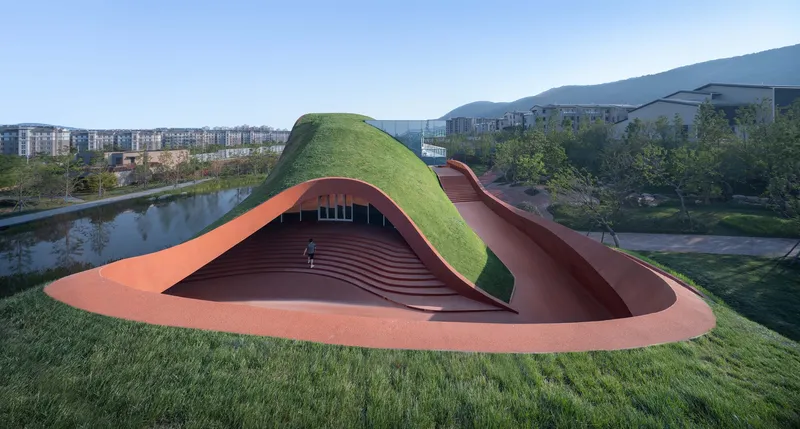
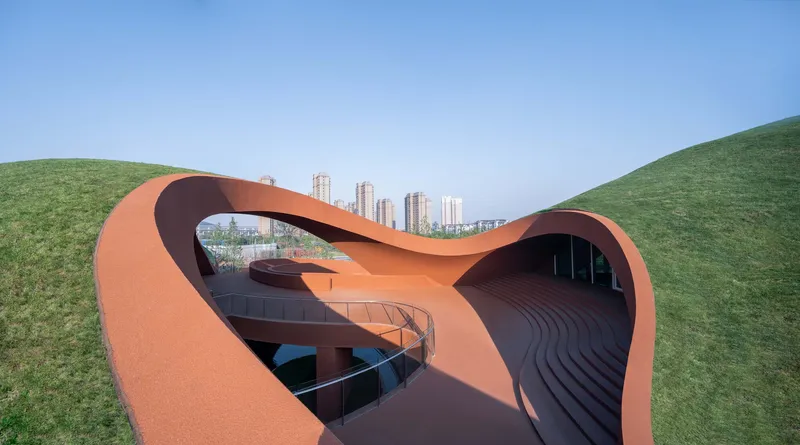
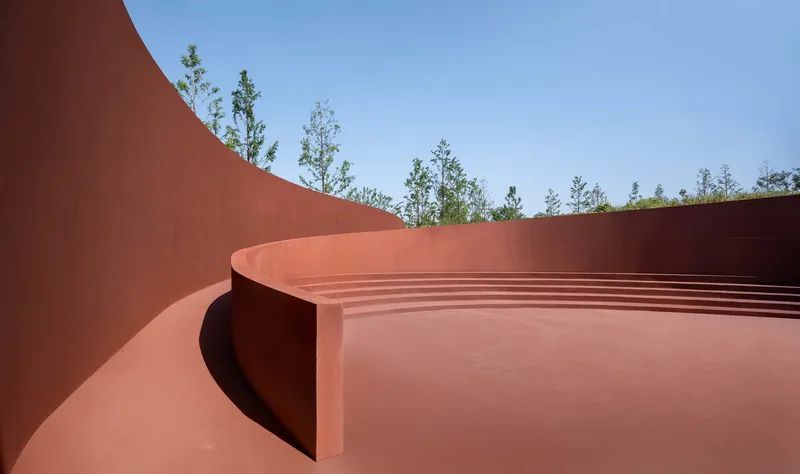
A sunken amphitheater, framed between two grass-covered mounds and edged by a reflecting pool, is one of the project's most successful moments. Timber seating descends beneath a planted canopy that provides shade without enclosure. A ribbon staircase connects the amphitheater to the upper terraces, creating a continuous public promenade that moves between seated gathering and open walkway. The stepped terraces within curved red walls offer a more intimate variant, scaled for small performances or casual gathering.
These outdoor rooms demonstrate something important about the design: the building's sculptural ambition does not come at the expense of usable public space. The shells create enclosure, shade, and acoustic reflection. The openings provide ventilation and views. The program fits naturally within the topographic logic rather than being forced into it.
Plans and Drawings
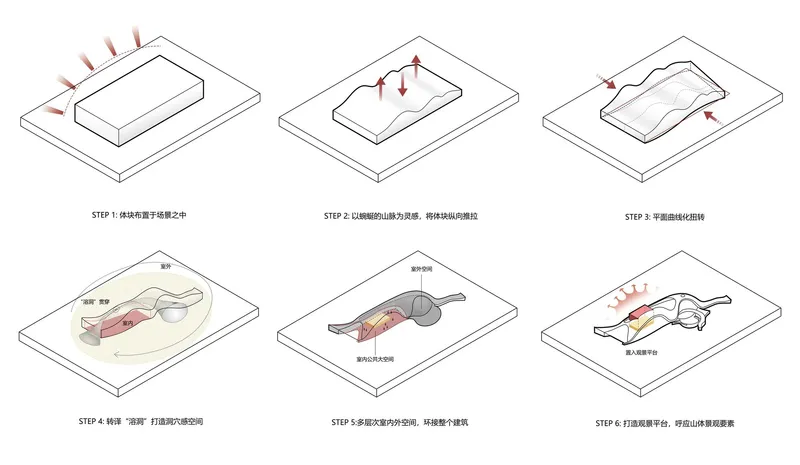
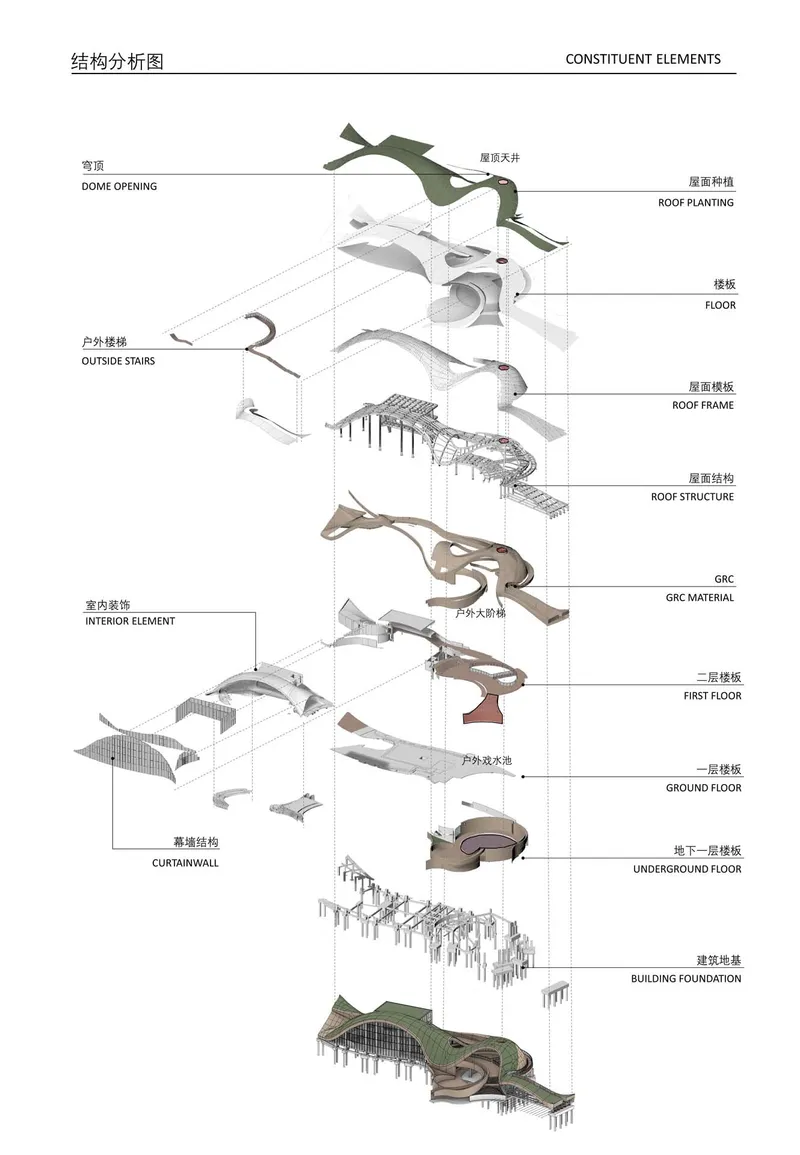
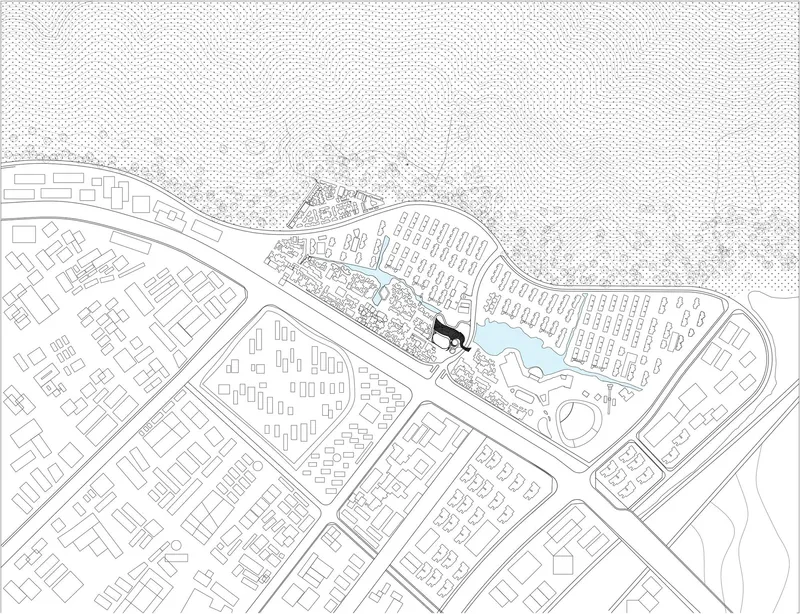
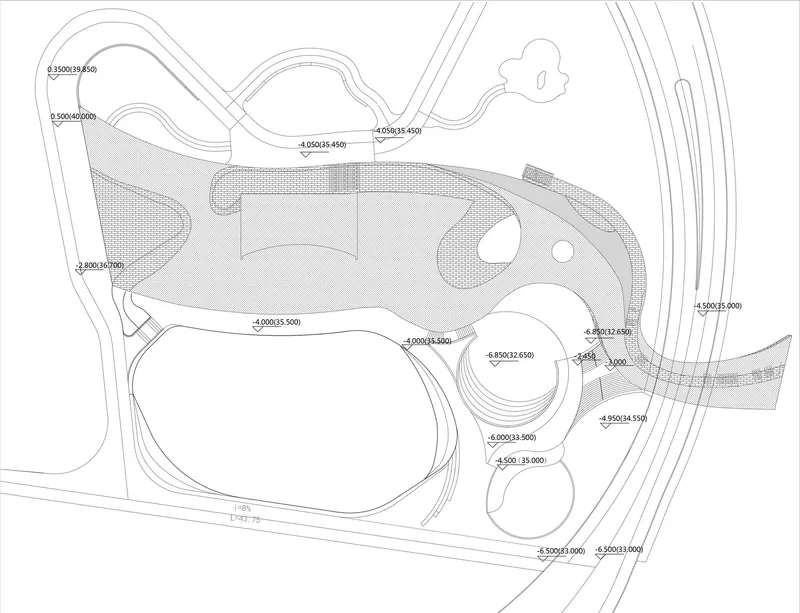
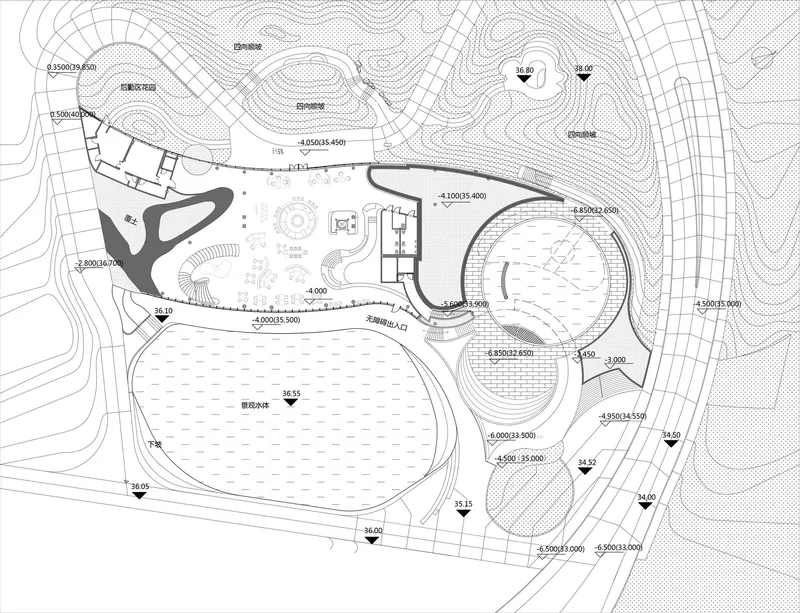
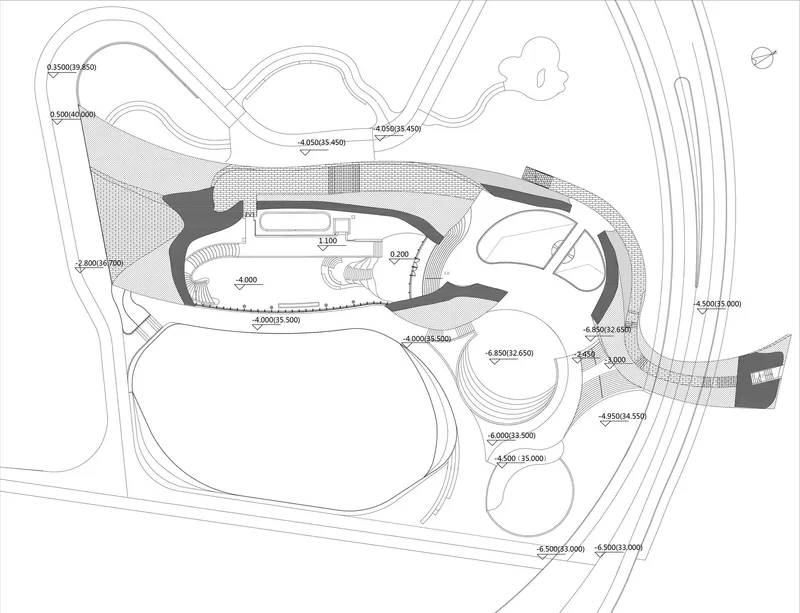
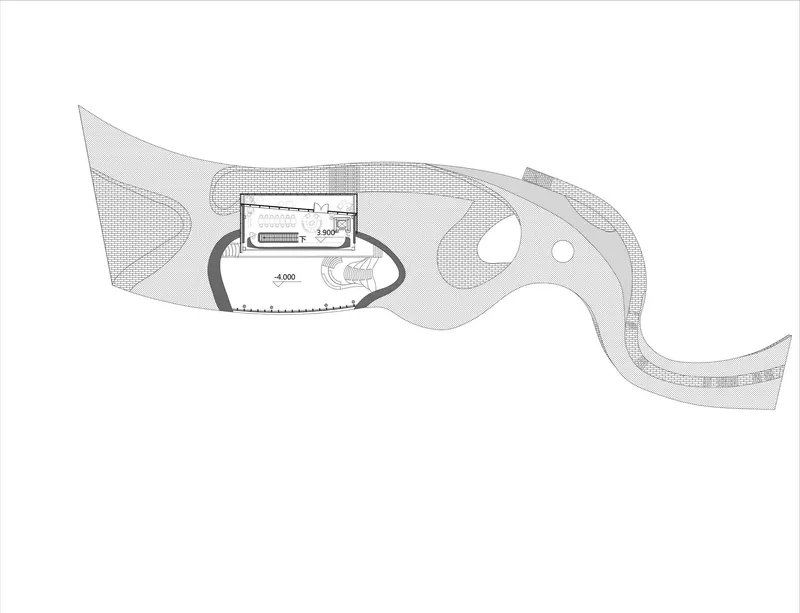


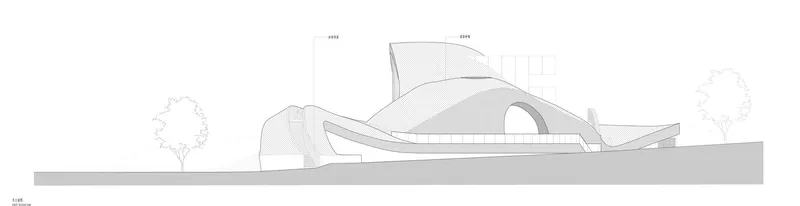
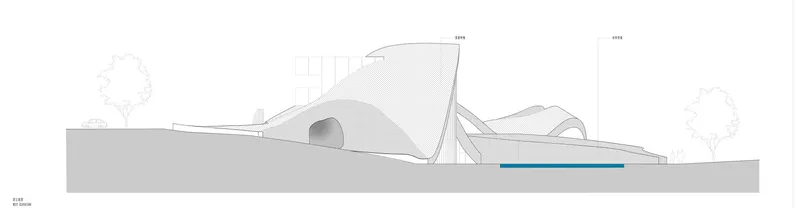
The isometric construction sequence is particularly revealing, illustrating in six steps how the fluid shell is formed over conventional floor plates. The exploded axonometric breaks the building down from foundation to roof planting, exposing every layer of the sandwich: structural steel, concrete shell, waterproofing, soil, and vegetation. The site plans show how the three lobed volumes sit within the topographic contours of the mountain's lower slopes, their curves aligned with the natural terrain rather than the surrounding street grid. Sections cut through the arched structures reveal the ribbed vaulting and the spatial relationship between reflecting pools, double-height interiors, and the perforated roof above.
Why This Project Matters
The Chaohu Natural and Cultural Center belongs to a growing lineage of landscape buildings, structures that aspire to merge with their sites rather than stand upon them. What separates it from most attempts is the rigor of its formal logic. The mountain contour generates the silhouette. The wormhole metaphor produces the openings. The planted roof completes the ecological integration. None of these moves are arbitrary; each follows from a clearly stated design principle, and the construction techniques, from sprayed lightweight concrete to engineered anti-skid planting beds, were developed specifically to realize them.
At 1,500 square meters, the project is modest in scale but outsized in ambition. It demonstrates that a community facility, a restaurant, an amphitheater, and a pedestrian bridge can be folded into a single continuous landform without sacrificing legibility or comfort. For a development project at the edge of a hot spring resort town, that is a remarkable achievement. Change architects have produced a building that does not merely reference its mountain context but attempts, with considerable technical conviction, to become part of it.
Chaohu Natural and Cultural Center by change architects, located in Hefei, Anhui Province, China. 1,500 m². Completed in 2022. Photography by Qingshan Wu.
About the Studio
Share Your Own Work on uni.xyz
If projects like this are the kind of work you want to make, uni.xyz is a place to publish your own, find collaborators, and enter design competitions.


Popular Articles
Popular articles from the community


Faces of the Soviet Avant-Garde: Turning Moscow's Street Names into an Open-Air Museum
A network of sculptural installations across a Moscow residential district transforms forgotten architect names into spatial encounters with cultural memor

Extended Shell: Retrofitting Kolkata's Balconies as Living Urban Thresholds
A modular retrofit system recovers the social and environmental intelligence of Kolkata's historic verandas for contemporary Park Street residents.
Tsunami Convergenics: Turning Catastrophic Ocean Forces into Underwater Housing Infrastructure
A speculative underwater settlement off the coast of Onagawa, Japan, treats tsunamis and typhoons as energy sources rather than threats.

Cloaked Colonization: A Mobile Underwater Habitat That Moves Like a Fish
Micah Abaya's shortlisted EHC Pacific entry reimagines ocean settlement as a dispersed network of self-sustaining architectural organisms.

Similar Reads
You might also enjoy these articles

Bao Huynh Watercolor Atelier: A Serene Art Retreat in Hội An
Bao Huynh Watercolor Atelier in Hội An blends multifunctional art spaces, sustainable design, local materials, and family-friendly living in a serene environment.

Atelier Macri Concept Store Interior Design by CASE-REAL
Atelier Macri store features a "ko" counter, walnut wood details, cork displays, blending retail, gallery, and seamless customer experiences.

Manuel Vargas Izquierdo Stadium and High-Performance Sports Center: Architectural Excellence in Jalpa de Méndez
The Manuel Vargas Izquierdo Stadium blends sustainable design, inclusive sports facilities, and cultural-inspired architecture, revitalizing Jalpa de Méndez’s public spaces.

KAKR Buluh Awar Hall: Revitalizing Community and Ecology Through Bamboo Architecture
Community built bamboo hall revitalizes Buluh Awar village, empowering youth, restoring ecology, celebrating vernacular craftsmanship through sustainable architecture and culture.

Explore Cultural Center Competitions
Discover active competitions in this discipline

Challenge to design a portable theatre

Challenge to design a portable music platform

Challenge to design an open learning module for the elderly

Bring back Drive In's
Comments (0)
Please login or sign up to add comments
No comments yet. Be the first to comment!