
Charge for Change: Turning Fuel Pumps into Civic Energy Hubs
A modular urban infrastructure proposal where cyclists generate power, electric vehicles recharge, and reward points make sustainability habitual.


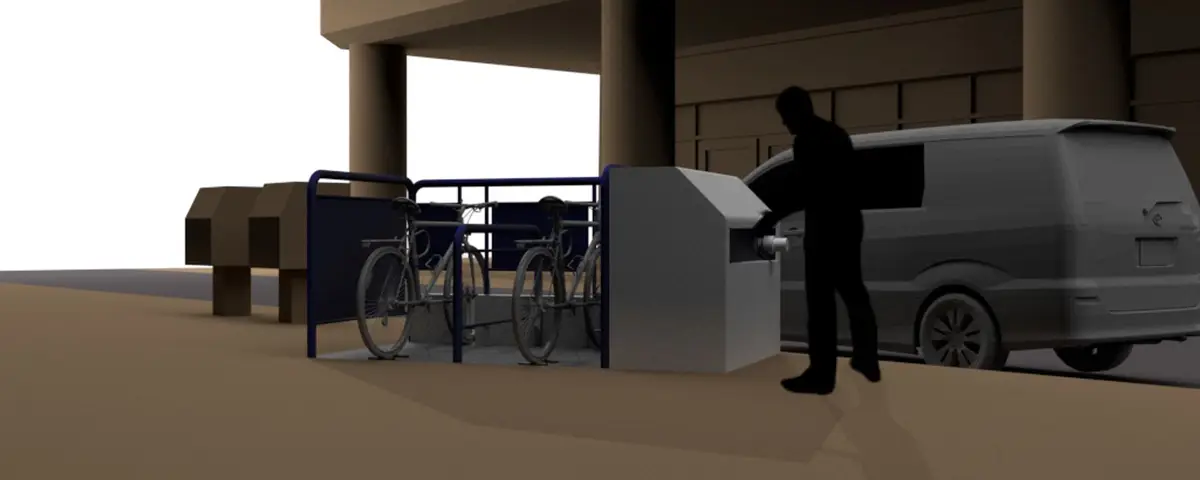
What if the fuel pump, one of the most single-minded typologies in urban infrastructure, could become a site of civic participation? That is the provocation at the center of Charge for Change, a proposal that replaces the petroleum forecourt with a modular network of energy hubs where electric vehicles recharge, cyclists park and repair their bikes, and ordinary pedestrians pedal stationary cycles to generate electricity in exchange for redeemable reward points. It is a compact thesis on how architecture can turn passive consumers of energy into active producers of it.
Designed by Gunraagh Singh Talwar and Sarthak Ahuja, the project targets the sidewalk and urban furniture zone as its site of intervention. Rather than proposing a single flagship building, the designers envision a modular kit of parts, built from M.S. pipes, polycarbonate sheets, galvanized tin, and L-section steel frames, that can repeat along streetscapes and plug into existing city infrastructure. An integrated app manages everything from bicycle locking mechanisms to point distribution, binding the physical architecture to a digital service layer.
Three User Groups, One Interconnected Ecosystem
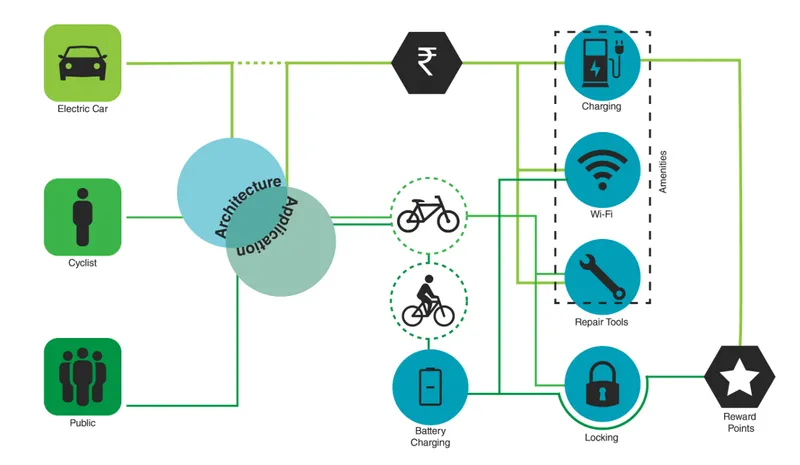
The connectivity diagram maps the relationships between the hub's three constituencies. Electric car owners access charging stations fitted with digital touch panels, Wi-Fi, and repair tools. Cyclists gain secure parking with automatic locking and on-site repair kits. The public, meanwhile, is invited to hop on stationary bicycles whose dynamos feed energy through AC/DC converters into lithium-ion battery packs. Each watt generated earns points redeemable for amenities at the hub. The diagram makes clear that this is not a vending machine for electricity; it is a feedback loop where human effort, digital management, and stored energy circulate continuously.
What elevates the concept beyond a smart charging station is its insistence on social exchange. By incentivizing physical effort with a tangible reward system, the design converts sustainable behavior from an abstract moral imperative into a visible, repeatable urban ritual. The fuel pump, historically a place you stop at reluctantly, becomes a place you choose to engage with.
Modular Kiosks Scaled for the Sidewalk
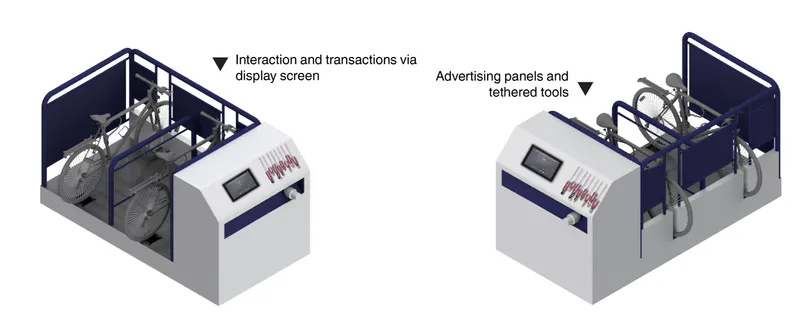
The isometric rendering reveals the physical language of the proposal: two bicycle parking kiosks flanked by display screens and tool stations, compact enough to occupy the furniture zone of a standard sidewalk. The structures use polycarbonate cladding over an M.S. pipe frame, keeping the assembly light, weather-resistant, and easy to fabricate off-site. Each kiosk integrates a touch-sensitive panel for app interaction, a secure locking bay, and a repair tool station, consolidating multiple functions into a footprint no larger than a bus shelter.
Modular repetition is the key scalability strategy here. Talwar and Ahuja propose that units can be arrayed in series along a street edge, multiplying capacity without requiring custom engineering for each location. The galvanized tin and L-section steel components are standard construction materials, which keeps fabrication costs predictable and allows municipal agencies or private operators to deploy hubs incrementally.
The Dynamo Interface: Where Pedal Meets Power
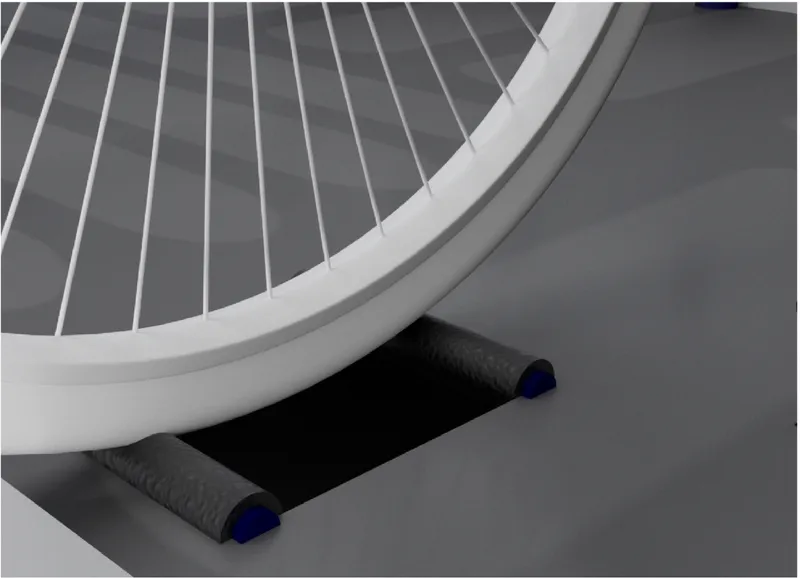
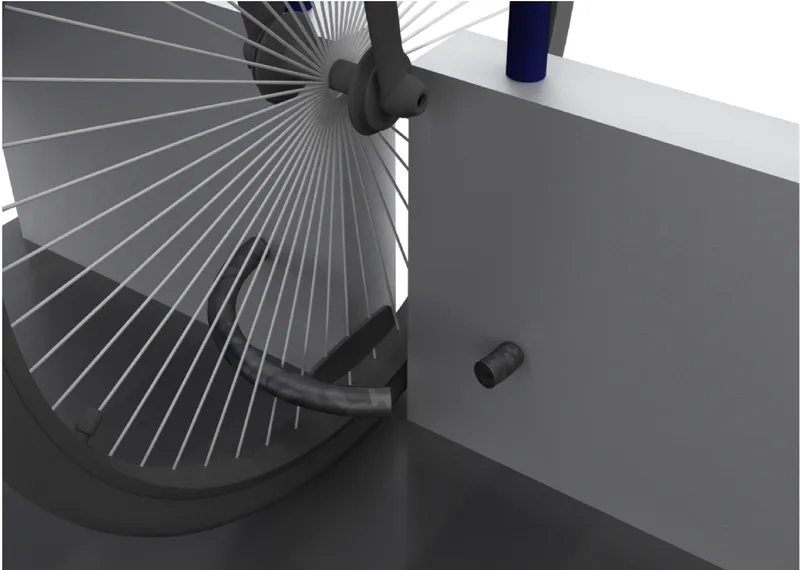
Two detail photographs zoom into the physical mechanism that makes the public energy generation concept tangible. A white bicycle wheel rests on twin black foam rollers, the friction point where pedaling motion converts into rotational energy for the dynamo. The second image isolates the hub and spokes alongside repair tools laid on the ground, suggesting the maintenance ecosystem that surrounds each station. These are not glamorous renders; they are close-up, material-level studies that demonstrate how the energy chain begins at the tire-roller interface and flows through converters into lithium-ion storage.
The honesty of these images matters. By showing foam rollers, bare spokes, and hand tools rather than polished marketing visuals, the designers signal that this proposal is grounded in buildable, maintainable technology. A dynamo and a set of rollers are inexpensive, replaceable components, reinforcing the project's argument that sustainable infrastructure does not require exotic engineering.
Material Precision Behind the Blue Accents
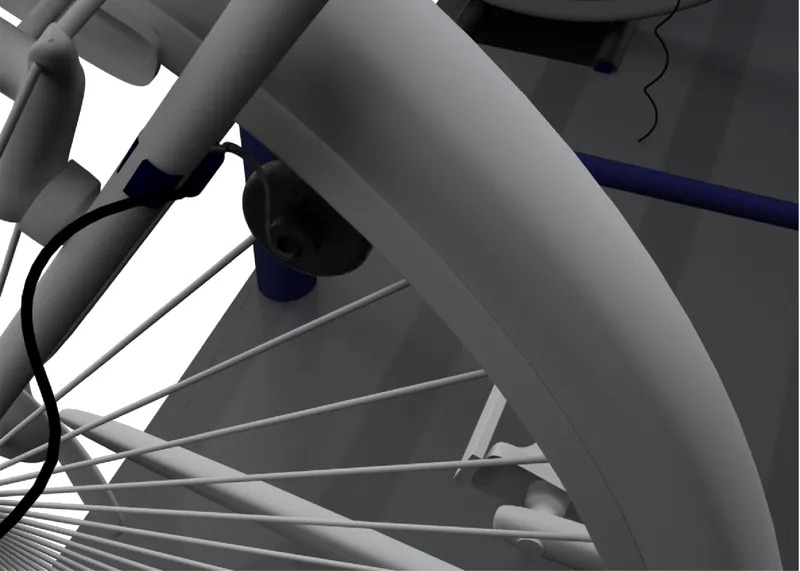
An angled view through a bicycle frame highlights the blue accent components that serve as visual identifiers across the kiosk system. The color coding is subtle but deliberate: it distinguishes the energy-generating stations from ordinary bike racks and signals to users that this is an interactive public amenity, not just street furniture. The spoke pattern and hub detail also underscore the designers' attention to the bicycle as both a vehicle and a micro-power plant, worthy of the same infrastructural care given to automobiles at a conventional filling station.
Why This Project Matters
Charge for Change takes a familiar urban typology, the fuel pump, and asks what it should become in a post-petroleum city. The answer is not simply an EV charger with a new facade. It is a participatory energy hub where architecture, digital systems, and human kinetic effort converge. By designing for electric vehicles, cyclists, and pedestrians simultaneously, Talwar and Ahuja refuse the car-centric assumptions that have shaped mobility infrastructure for a century.
The proposal's real strength lies in its replicability. Modular construction from standard steel and polycarbonate, a scalable app-driven management layer, and a reward system that turns energy production into a social habit: these are decisions that make deployment feasible beyond a single prototype site. If cities are serious about decarbonizing mobility, they will need infrastructure that does more than serve vehicles. They will need architecture that recruits citizens as collaborators. Charge for Change sketches a credible version of that future.
View the Full Project
About the Designers
Designers: Gunraagh Singh Talwar, Sarthak Ahuja
Enter a Design Competition on uni.xyz
uni.xyz runs architecture and design competitions year-round that reward proposals with spatial conviction and real site intelligence.
Project credits: Charge for Change by Gunraagh Singh Talwar, Sarthak Ahuja.


Popular Articles
Popular articles from the community


Temporary Home for Dogs: A Reversed Zoo Rethinks Animal Shelter Architecture
In Bucharest, a sinuous corridor and freed landscape flip the logic of containment, designing a shelter that works to make itself unnecessary.
Tsunami Convergenics: Turning Catastrophic Ocean Forces into Underwater Housing Infrastructure
A speculative underwater settlement off the coast of Onagawa, Japan, treats tsunamis and typhoons as energy sources rather than threats.

Opera by the Sea Estonia: Three Shells Dissolving Architecture into Tallinn's Coastline
A winning opera house proposal replaces monumental form with interconnected shells that blur the boundary between building, park and Baltic Sea.

The Amber Palace Opera: A Geological Fiction Surfaces on Tallinn's Baltic Waterfront
Pierre Brillard reimagines a Baltic legend as a public landscape, opera house, and waterfront promenade rooted in Tallinn's coastal identity.

Similar Reads
You might also enjoy these articles

Play: Fragments of Their World: Remembered Architecture Rebuilt as a Modular Playground for Refugee Camps
Tom Gardner abstracts domes, arches and towers from the homelands of displaced families into a kit of child-scaled play parts for camp settlements.
REBIRTH: A Circular Settlement Where Afghan Widows and Their Children Rebuild Life Together
A shortlisted Resile entry turns the circle into a protective ring of timber and brick, gathering homes, classrooms and gardens around a shared landscape.
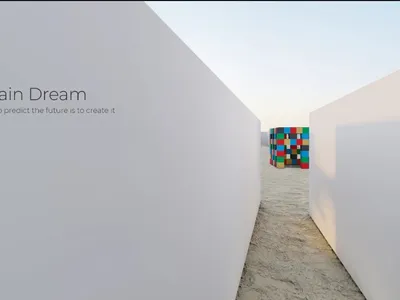
The Main Dream: A Recycled Plastic Kit That Lets Refugee Children Build Their Own Playground
Thirty-centimetre interlocking cubes that connect on three axes turn play into construction, letting children author the spaces they occupy.

Lunar Spiral: A Fibonacci-Driven Moon Settlement Rising from Shackleton Crater
Golden-spiral geometry organises buried infrastructure and orbiting habitable spheres into a lunar base designed to grow as life on the Moon expands.

Explore Urban Energy Competitions
Discover active competitions in this discipline

Design challenge to equip cities with modern furniture

Packaging challenge - Design meets sustainability
Comments (0)
Please login or sign up to add comments
No comments yet. Be the first to comment!