
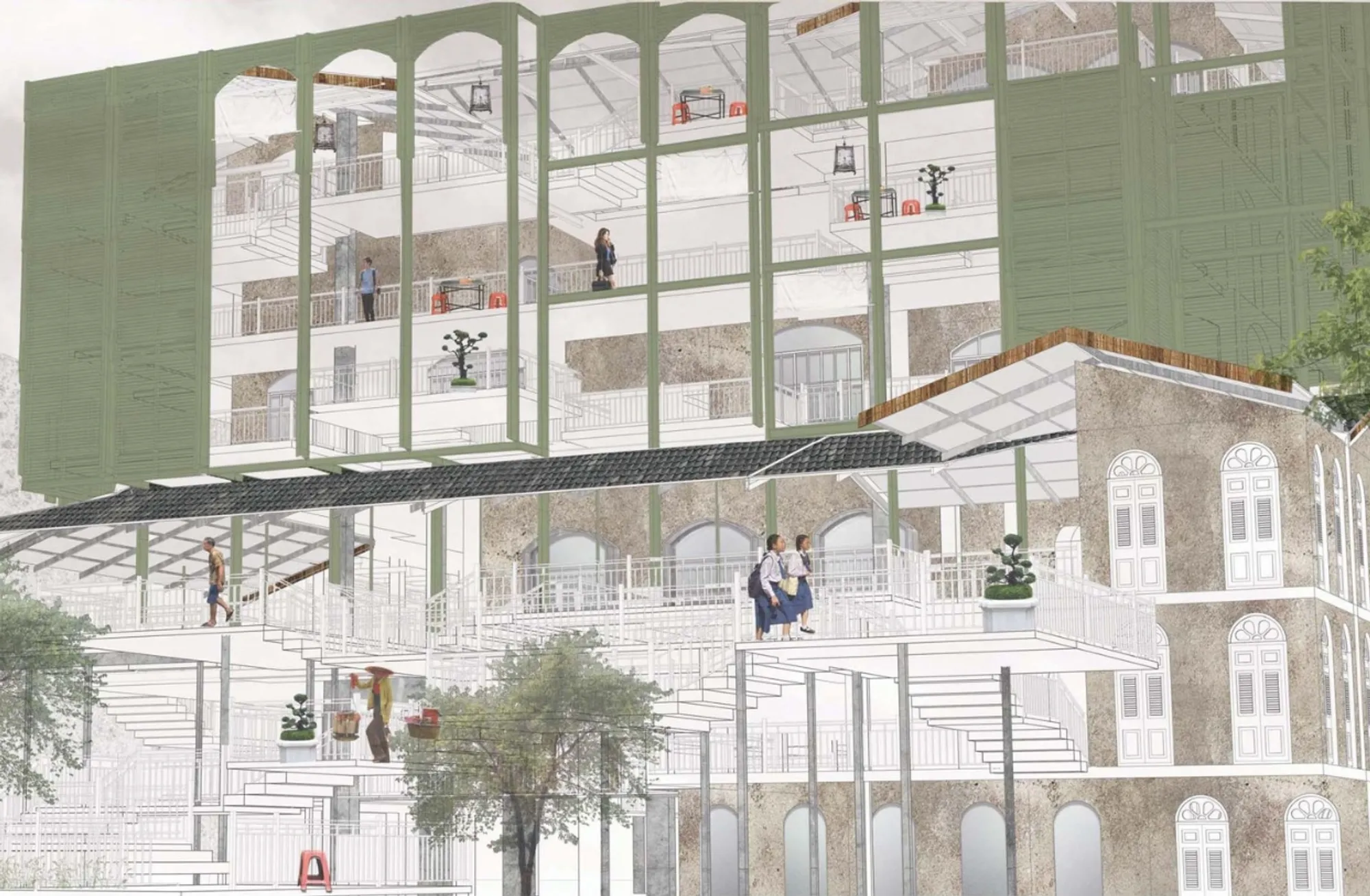
Charoenkrung Workforce Education Centre by Thale Kangkhao
An adaptive reuse architecture project transforming Bangkok’s historic Charoenkrung district into a future-ready workforce education hub.

Bangkok is entering an era shaped by automation, artificial intelligence, and rapid technological disruption. As digital transformation accelerates, Thailand’s working class faces increasing pressure to adapt to new economic structures. The Charoenkrung Workforce Education Centre, designed by Thale Kangkhao, responds to this challenge through a powerful model of adaptive reuse architecture: bridging heritage, community, and future skills development within one integrated civic framework.
Located in the historic Charoenkrung district along the Chao Phraya River, the project reimagines an existing market structure into a multi-layered education and public engagement hub. Rather than replacing the past, the proposal preserves and transforms it, positioning adaptive reuse architecture as a social equalizer in the 21st century.
Context: Charoenkrung as Bangkok’s Creative Transition Zone
Charoenkrung has been identified by the Thai government as part of a new “Creative District” strategy aimed at stimulating innovation and creative industries. However, rapid redevelopment risks excluding local, low- and middle-income communities who form the backbone of the district’s economy.
The site, measuring approximately 5,025.5 square meters: is embedded within a dense urban fabric of traditional shophouses, local vendors, and long-standing family businesses. While the area is rich in cultural heritage, it now stands at a crossroads between preservation and technological modernization.
The Charoenkrung Workforce Education Centre intervenes at this critical moment. Through adaptive reuse architecture, it converts an existing market environment into a hybrid educational infrastructure that supports both local business owners and emerging office workers.
Concept: Working as Learning
At the heart of the project lies the idea of “Working as Learning.” The thesis argues that education in the 21st century cannot be separated from real-world practice. Inspired by social constructivism and contextual learning theories, the architecture creates spatial environments where learning happens through doing.
Instead of isolating classrooms from daily life, the design integrates:
- Local market activity
- Business incubation spaces
- Digital fabrication and training labs
- Multi-purpose public areas
- Office and collaborative workspaces
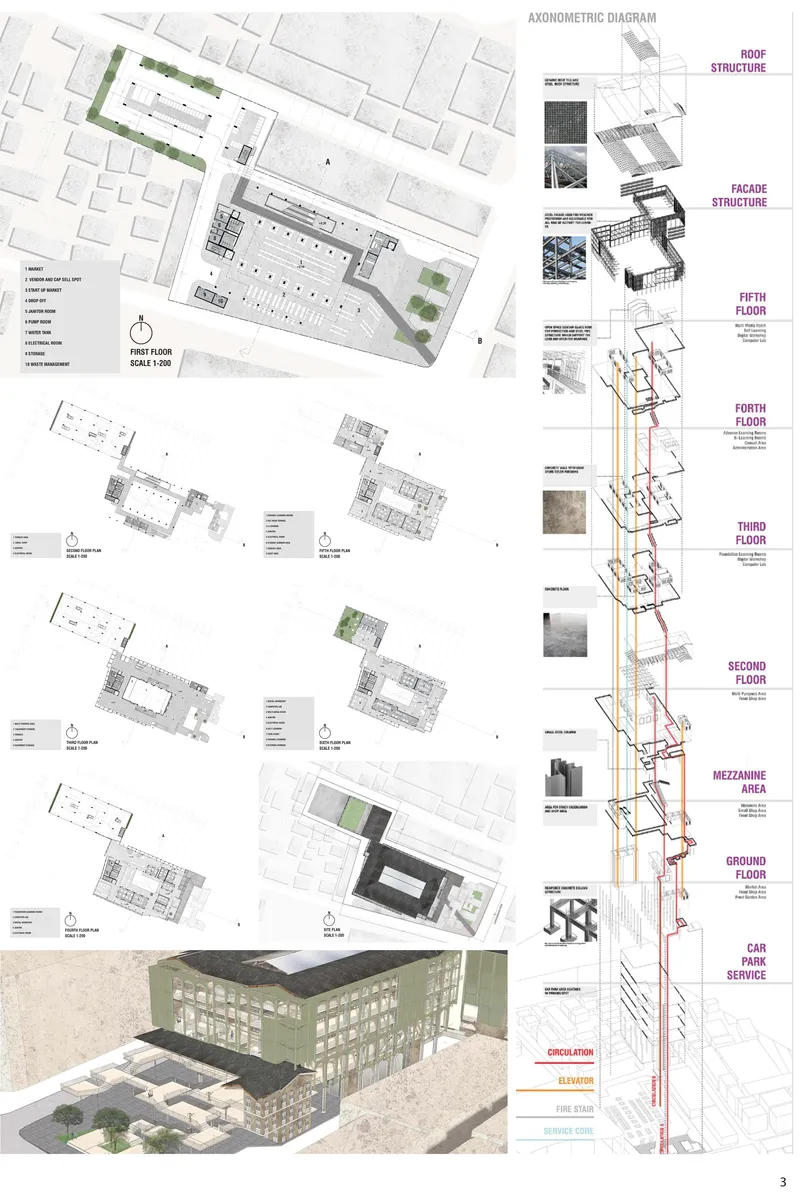
The architectural program is distributed vertically, layering public, service, and learning areas across multiple floors. Circulation systems: elevators, fire stairs, and service cores, are clearly articulated in the axonometric diagrams, emphasizing transparency and accessibility.
Architectural Strategy: Layering Old and New
The development process unfolds in six stages:
- Maintain and study the existing market fabric.
- Introduce a new educational program.
- Transform and adapt spatial modules.
- Attach and integrate both systems.
- Apply the hybrid architecture to the site.
- Develop the final architectural expression.
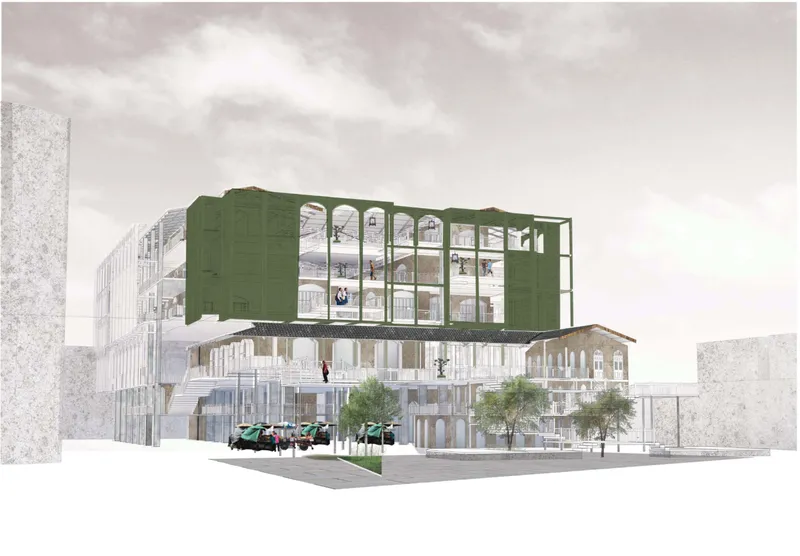
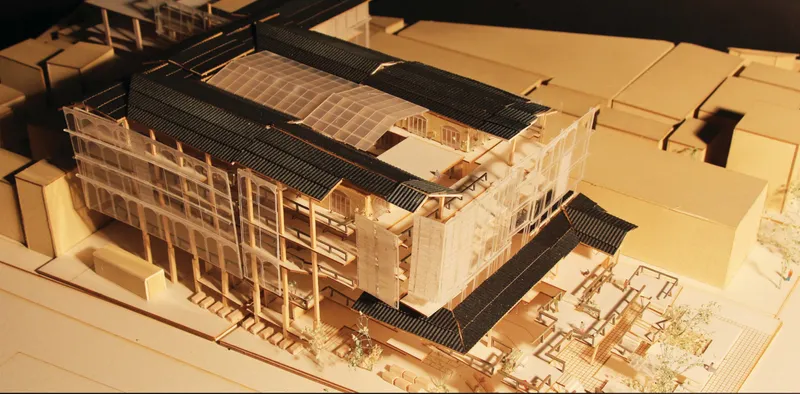
The result is a carefully balanced composition of preserved historic facades and contemporary structural interventions. The green façade screen system functions as both environmental control and symbolic identity: representing growth, renewal, and technological transition.
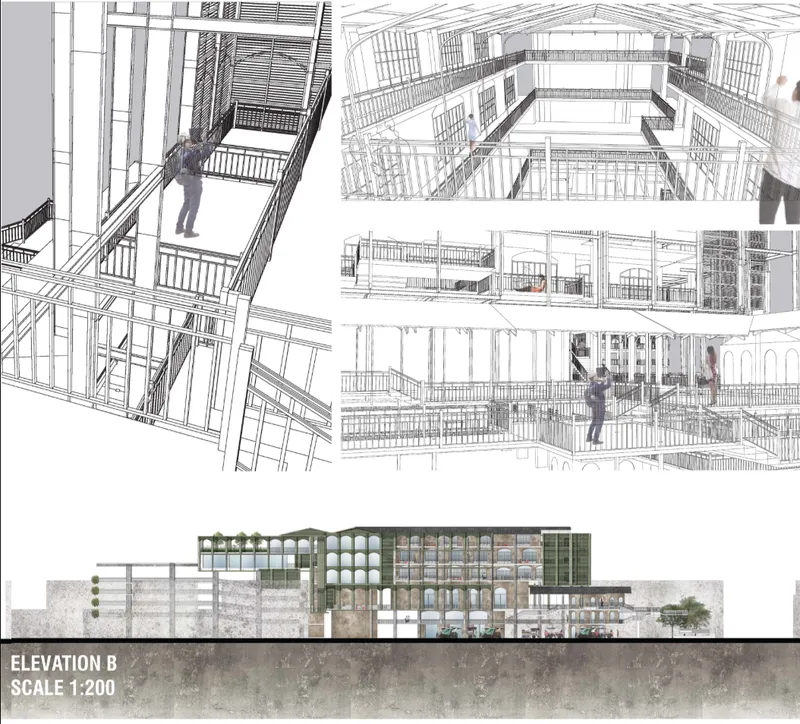
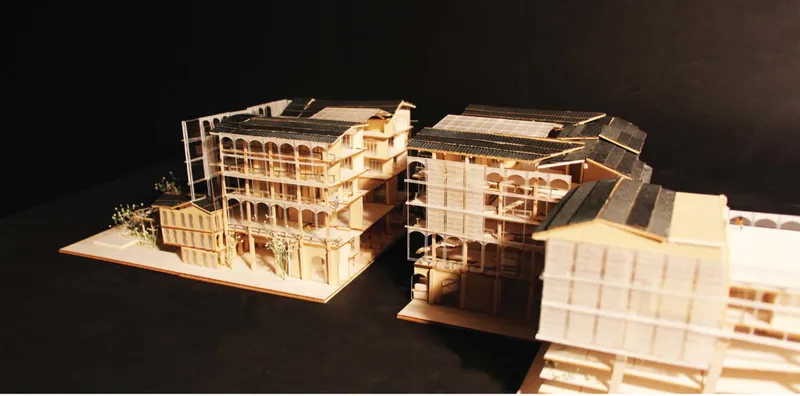
Elevations and sections reveal a porous structure: open terraces, arched windows referencing local architecture, and elevated learning decks overlooking the market below. The building becomes an urban mediator, neither fully commercial nor purely institutional.
Program Distribution: Education Meets Economy
The program area is divided into three primary zones:
- Learning Area (50%) – Classrooms, digital labs, skill development workshops.
- Public Area (30%) – Market plaza, shared community spaces, exhibition zones.
- Service Area (20%) – Circulation, utilities, and operational support.
Upper levels accommodate specialized training facilities and business incubation labs, while lower floors maintain active market functions. This ensures economic continuity while enabling workforce transformation.
By embedding new skills training within an existing commercial ecosystem, the project avoids technological gentrification and instead promotes inclusive economic resilience.
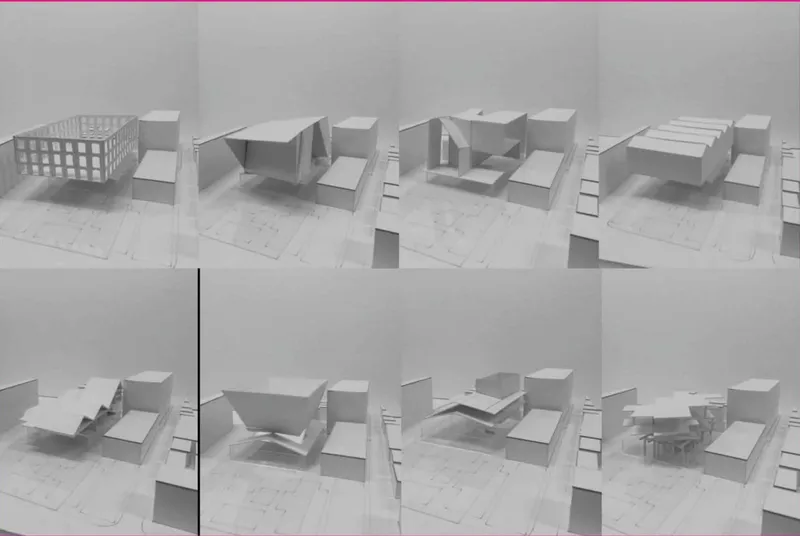
Spatial Experience and Human Scale
The interior perspectives show elevated walkways, layered balconies, and open atriums that encourage visual connectivity between floors. Users: local vendors, office workers, students, and entrepreneurs, share overlapping paths.
The architectural language remains light yet structured. Timber-toned model studies reveal an emphasis on modular systems and adaptable floor plates, allowing the building to evolve alongside technological change.
Rather than imposing a futuristic icon, the project operates as a responsive framework, rooted in context yet forward-looking in ambition.
Social Impact: Bridging the Technology Divide
In the short term, the Charoenkrung Workforce Education Centre provides accessible learning environments for local businesses and workers adapting to automation and AI-driven industries.
In the long term, it addresses broader social inequality by equipping Thailand’s largest working demographic with the tools required to survive and thrive in the digital economy.
Through adaptive reuse architecture, the project reframes redevelopment as empowerment rather than displacement.
Architecture as a Catalyst for Equality
The Charoenkrung Workforce Education Centre demonstrates how adaptive reuse architecture can extend beyond aesthetics and sustainability, it can function as an economic and social catalyst.
By integrating market life, education, and innovation within a preserved historic framework, Thale Kangkhao proposes a model for future urban districts across Southeast Asia.
This is not merely a building. It is a platform for transition, where tradition meets technology, and where architecture becomes an instrument for inclusive progress in the 21st century.



Popular Articles
Popular articles from the community


UNA Barbara e Valentim Plants Four CLT Bungalows in a Fragile Ceará Landscape
Prefabricated eucalyptus timber cabins touch down lightly on the sandy, biodiverse coast of Barroquinha, Brazil.
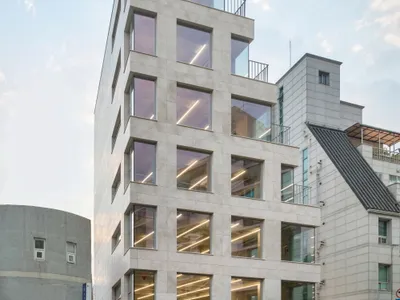
Simplex Architecture Steps a Seoul Mid-Rise Tower to Negotiate Between Low-Rise Commerce and High-Rise Housing
In Seocho-dong, a gridded stone tower of terraces and sunken courtyards mediates between two radically different urban scales.
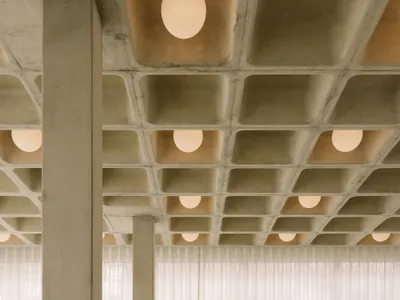
RHO Converts a Berlin Spree-Side Industrial Courtyard into Enkime's 1,000 m² Agency Headquarters
A social media agency's new home in Charlottenburg trades glossy branding for concrete waffle ceilings, glazed tile, and sheer curtains.
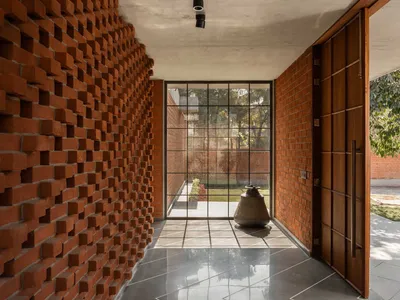
Vaissnavi Shukl Wraps a Single-Storey Ahmedabad Home Around a Courtyard That Breathes
Malhaar Residence uses perforated brick, translucent canopies, and an L-shaped plan to turn a quiet suburban plot into an inward world.


Similar Reads
You might also enjoy these articles
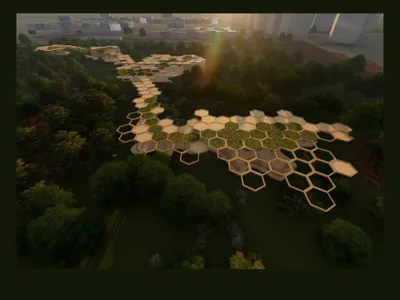
Eco Chapel: A Green Architecture Pavilion Designed in Symbiosis with the Forest
Eco Chapel uses green architecture to weave prayer, learning and reuse into a forest pavilion shaped by modular hexagonal canopies for life.
Kaffeebühnen: Coffee Shop Architecture Designed as a Civic Stage Between Vienna’s City and Park
Kaffeebühnen turns coffee shop architecture into a civic stage, linking Vienna’s park edge, urban life, warm timber yards, and coffee craft.
Healing Façade: Sustainable Architecture for Reforestation, Community, and Sacred Ecology in Ethiopia
Healing Façade reimagines sustainable architecture as a living wall that restores soil, catches water and renews Ethiopia's forest churches.


Urban Forest: A Vertical Ecosystem for 5,000 Workers in Singapore's Changi Business Park
Radially stacked pods and layered green decks turn a 7-acre plot into 47 acres of ecological workspace projected for 2040.


Explore Research Competitions
Discover active competitions in this discipline




The Global Benchmark for Architecture Dissertation Awards


Challenge to design public laboratory
Comments (0)
Please login or sign up to add comments
No comments yet. Be the first to comment!