
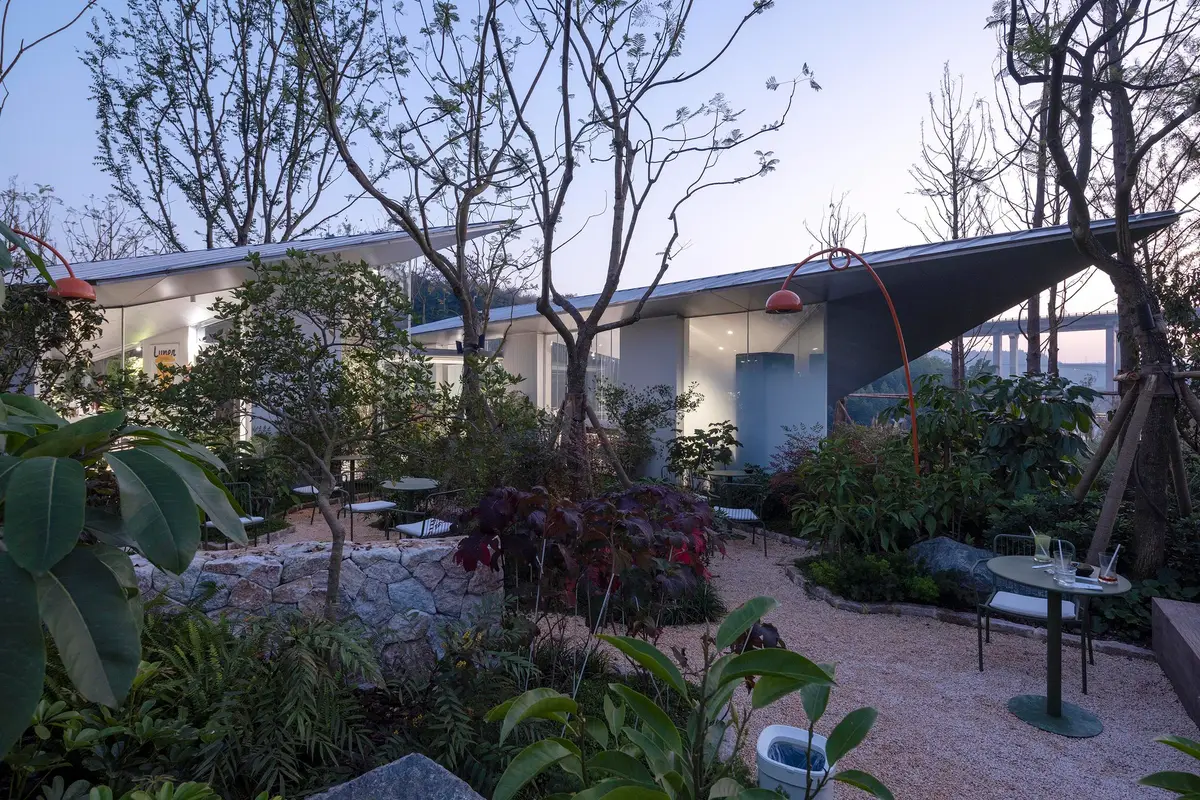
A Café Built Like a Landscape in Chongqing
Wide Horizon and Epiphany Architects fold roof planes into Chongqing's terrain, making a 200 m² café feel like a geological event.


Chongqing is a city that never sits flat. Its terrain buckles and folds, rivers carve through mountainsides, and infrastructure stacks vertically in ways that would seem absurd anywhere else. That geological restlessness is precisely what makes it one of the most architecturally charged cities in China, and it's the reason a 200 square meter café here can carry ambitions that would feel overblown in a flatter context. Luxerivers Café, designed by Wide Horizon in collaboration with Epiphany Architects, doesn't fight the terrain. It mimics its logic.
Lead architect Zhuoxin Fang has produced a building that reads less like a café and more like a carefully folded landform. Two angular roof planes hover above glass volumes and planted courtyards, creating a layered sequence of interior and exterior spaces that dissolve the boundary between building and garden. The result is a project where the architecture is almost entirely in the roof and the ground, with everything in between given over to transparency and plant life.
Folded Roofs Over Open Ground
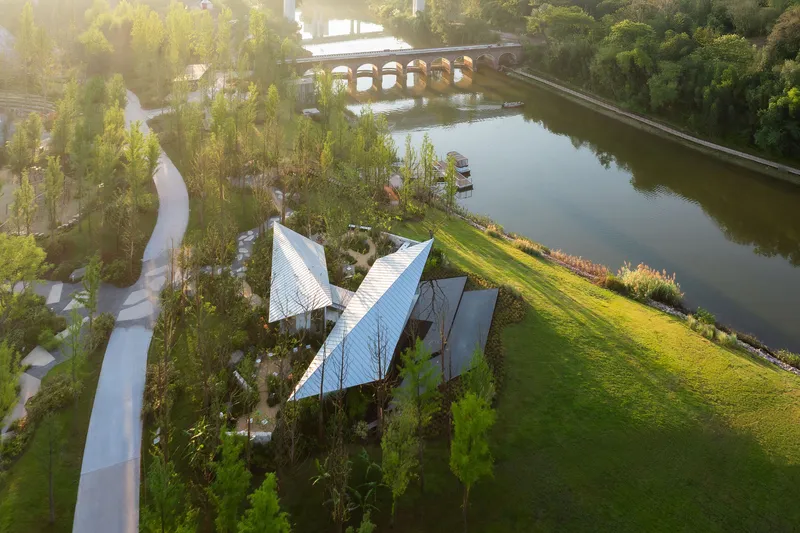

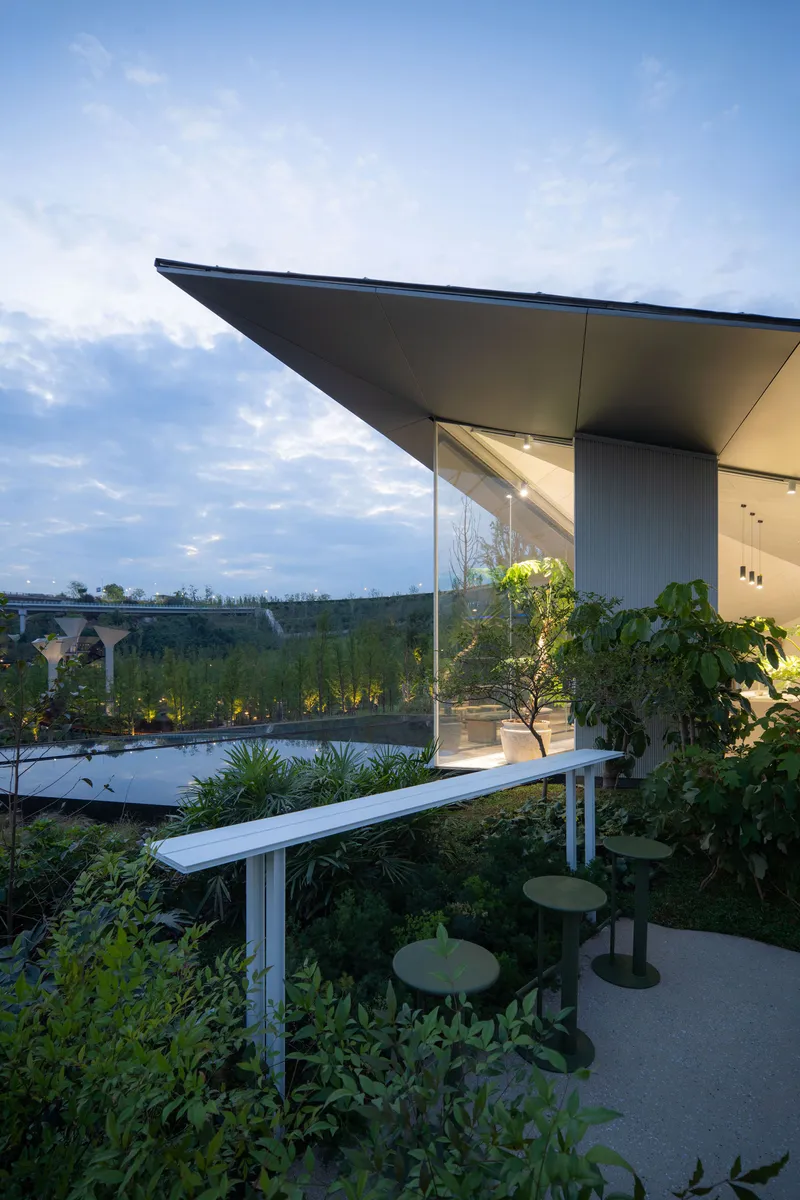
The most immediate gesture here is the roof. Seen from above or at a distance, the building registers as a pair of angled planes that slope, pitch, and cantilever over the site like geological strata displaced by some tectonic event. These are not decorative forms. The angles create deep overhangs that shelter outdoor terraces, direct rainwater away from courtyards, and frame specific views of the adjacent pond and planted slopes.
At dusk, the cantilevered edges glow faintly against the landscape, giving the building a presence that is simultaneously monumental and low slung. The rooflines never rise high enough to compete with the surrounding trees, which means the café embeds itself into its site rather than announcing itself above it. For a commercial project, that restraint is notable.
Glass Walls and the Dissolution of Enclosure
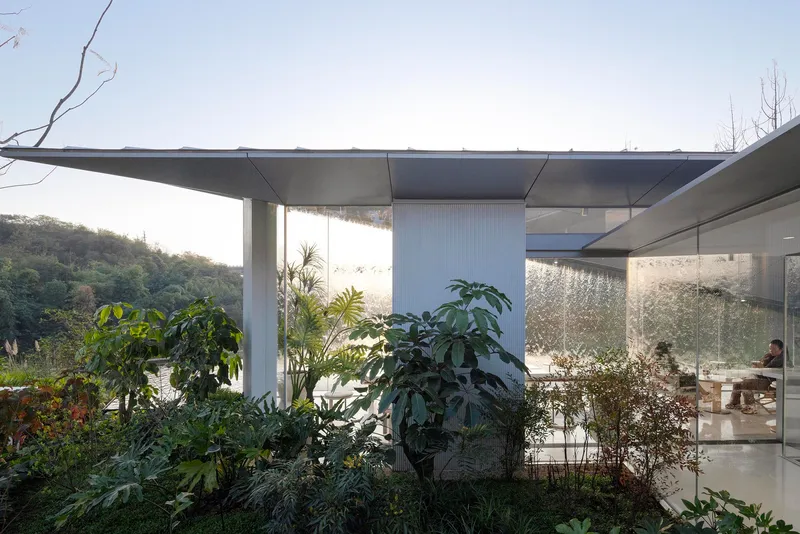
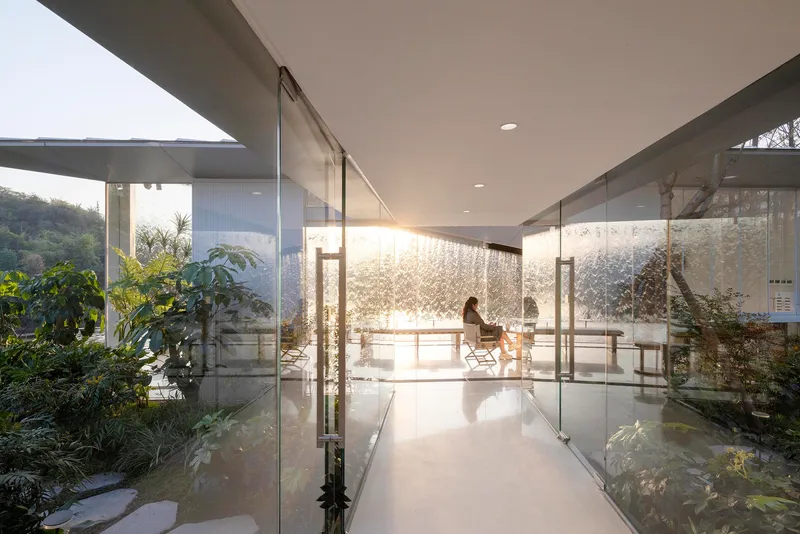
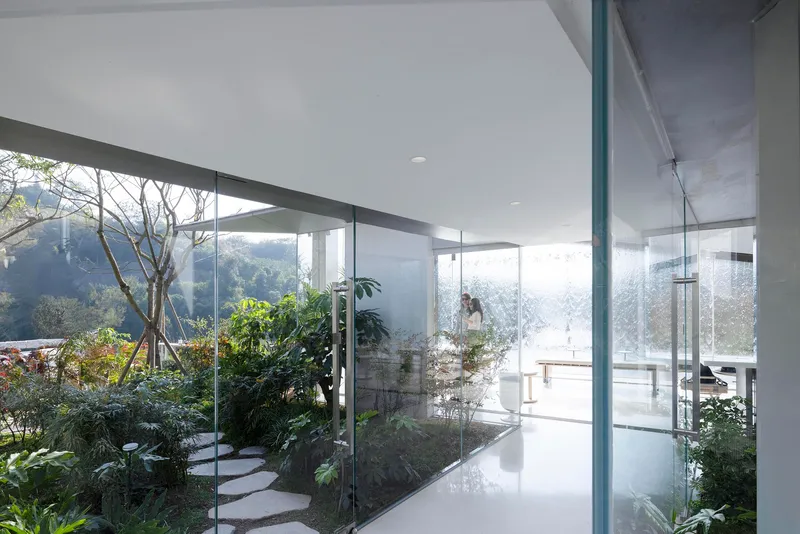
Between the heavy roof and the carefully graded ground, the walls effectively disappear. Floor-to-ceiling glazing wraps the interior on all sides, turning every seat into a garden view. Corridors become glass-walled passages flanked by planted courtyards with stepping stones, and the distinction between circulation and destination blurs entirely. You are always moving through landscape, even when technically indoors.
The deep concrete overhangs do critical work here, providing solar shading that makes this much glass viable in Chongqing's humid subtropical climate. Without them, the interiors would be greenhouses. With them, the spaces stay cool and shaded while maintaining full visual connection to the courtyards.
Water as an Architectural Material


Water is everywhere in this project. A cascading water feature runs along one exterior wall, visible from interior seating through the glass and audible as a persistent ambient layer. Beyond the building's footprint, a tranquil pond reflects the rooflines and catches golden hour light. Even the stepping stone paths through the courtyards suggest wading through a stream.
The decision to foreground water is directly tied to Chongqing's identity as a city defined by the confluence of the Yangtze and Jialing rivers. Fang doesn't replicate the scale of those waterways; instead, the project miniaturizes the city's hydrological drama into something intimate and tactile. You don't just see the water. You hear it, walk over it, sit beside it.
Courtyards as Rooms

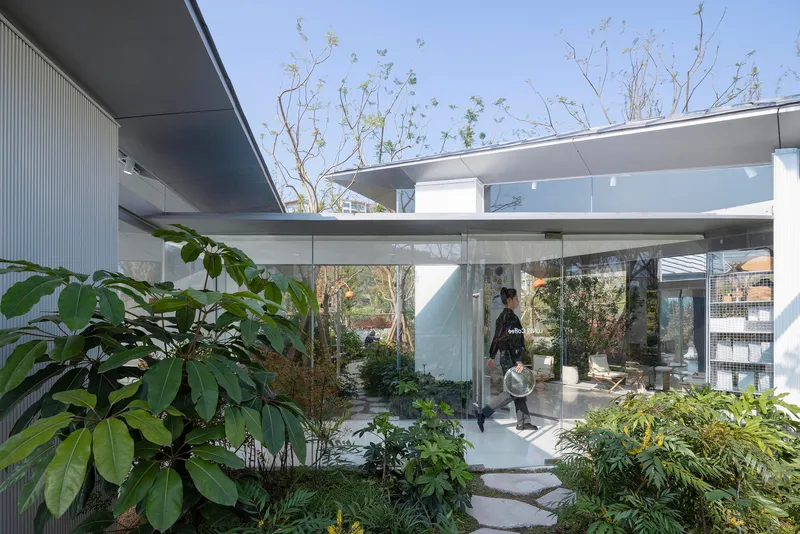
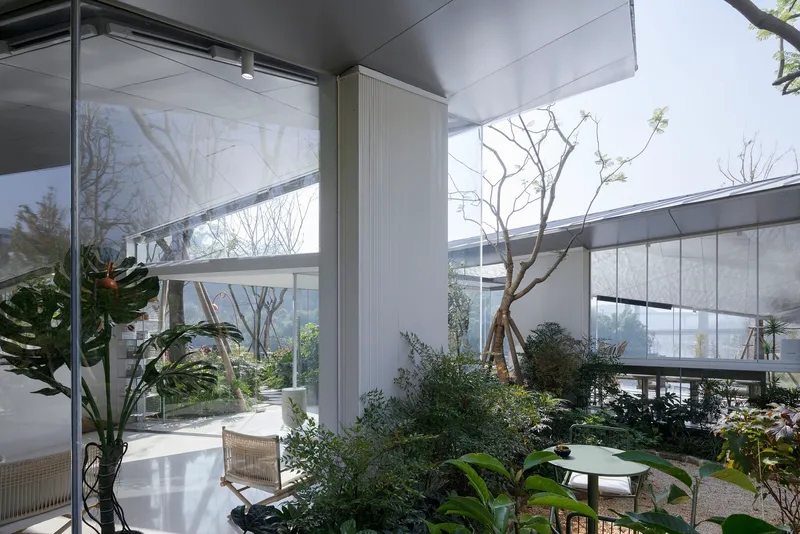
The planted courtyards are not leftover space between built volumes. They are the primary rooms of the project. Mature trees, ground cover, and stone paths give each courtyard a distinct character: one feels like a woodland clearing, another like a private garden for a single table beneath bare branches. The glass enclosures treat these gardens as visual centerpieces, centering views on them from every angle.
One courtyard accommodates a round table set beneath an open tree canopy, where the glass roof lets in light while the surrounding walls provide a sense of enclosure. It's the kind of space that might take an hour to notice in a larger building but here, at 200 square meters, becomes the defining experience. This is a café that puts its best square meters outdoors and dares you to linger there.
Interior Life at the Counter
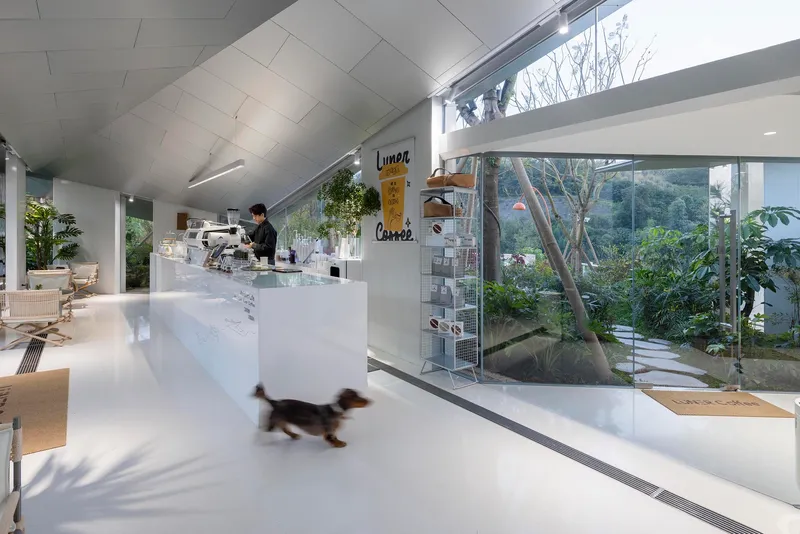
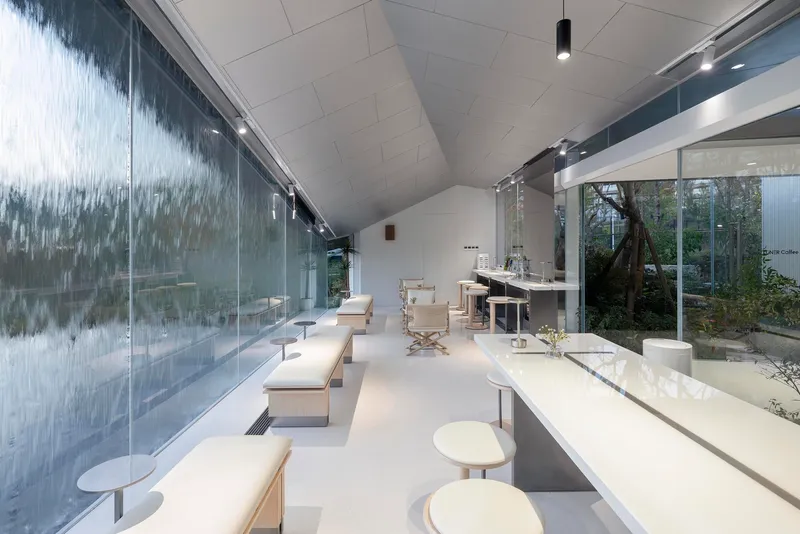
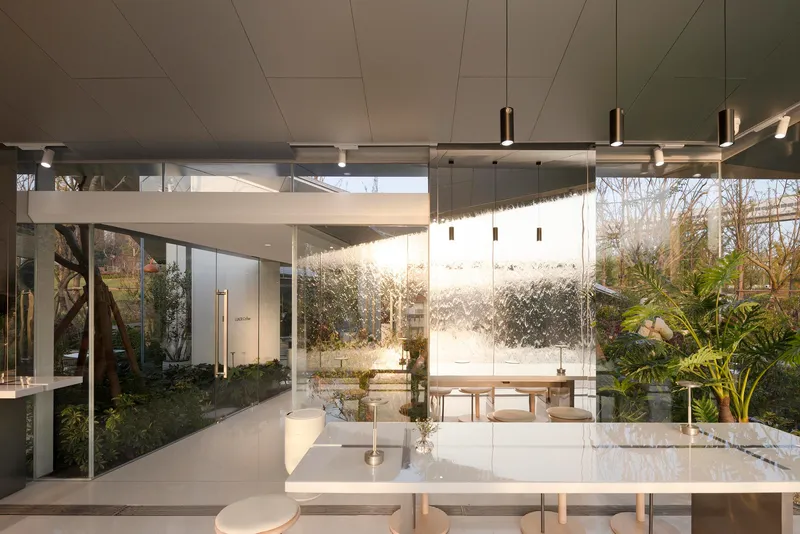
The actual café counter sits in a bright, high-ceilinged volume with polished floors and white surfaces, a deliberate contrast to the organic textures outside. A barista works behind a clean counter while a small dog trots across the floor: the image captures the unpretentious daily life the space is designed to hold. There is nothing sacred about the architecture here. It invites the mess and warmth of everyday use.
Elsewhere, a gallery-like space with a vaulted ceiling and textured glass wall catches reflected garden light, creating a quieter zone for sitting and reading. The interior program is minimal, just counter, seating, and a few transitional moments, but the spatial variety achieved through ceiling height, light quality, and adjacency to different courtyards gives each zone its own mood.
Reading the Site: Haze and Infrastructure


One image in the project documentation pulls back to show layered bridges crossing a river under heavy morning haze, the Chongqing skyline dissolving into mist behind them. It's a powerful contextual frame: this is a city where infrastructure and topography are inseparable, where bridges, tunnels, and elevated roads are as much a part of the landscape as the mountains themselves. The café responds to that condition not by replicating its density but by offering its opposite, a space of silence, ground-level horizontality, and uninterrupted garden views.
The stone retaining walls and corrugated metal roofing visible at certain points acknowledge the rougher material palette of Chongqing's hillside construction. The project doesn't pretend it's somewhere else. Its refinement comes from careful detailing of common materials, not from importing an alien aesthetic.
Plans and Drawings

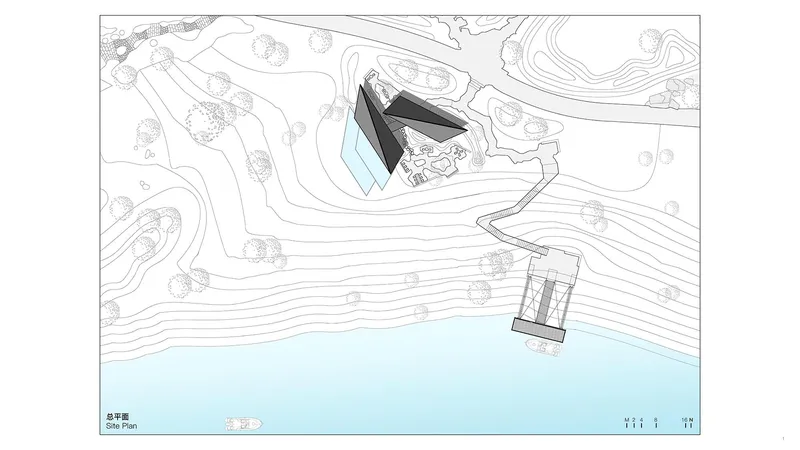
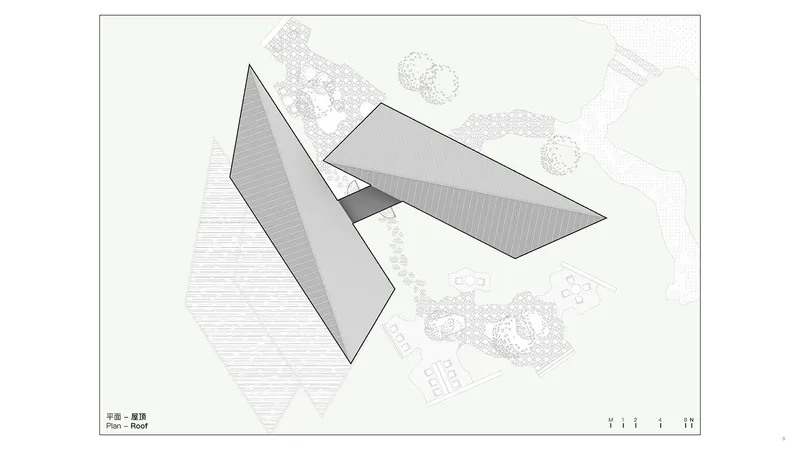
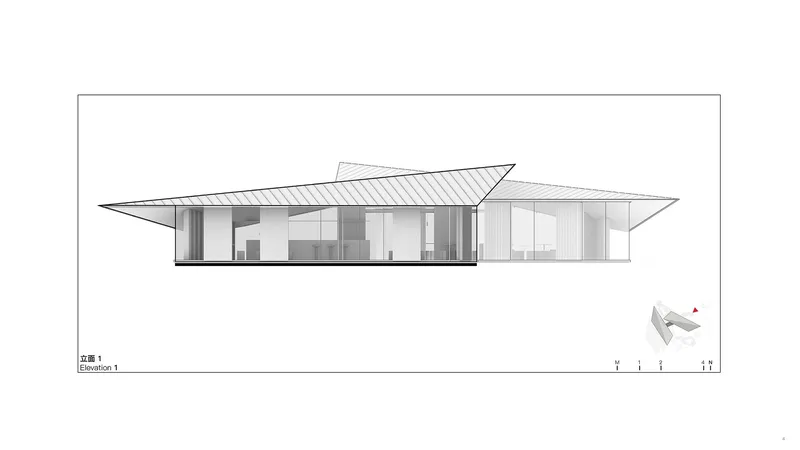
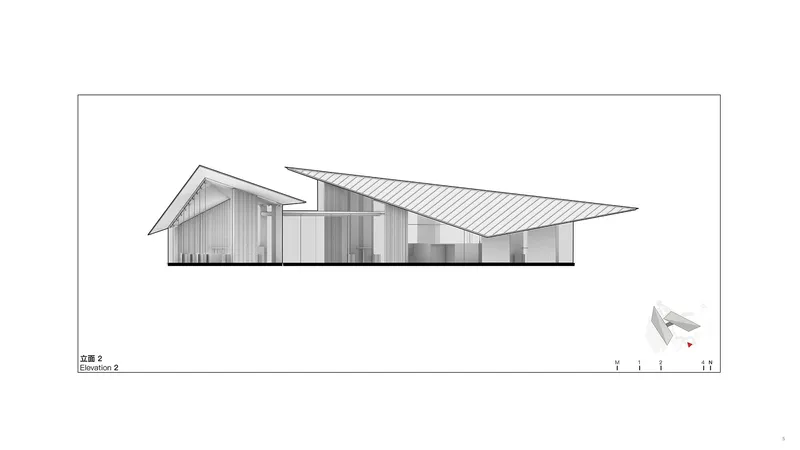
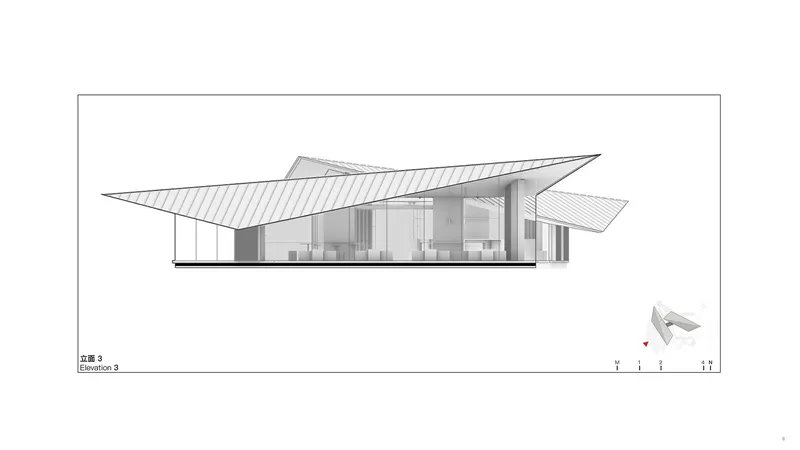
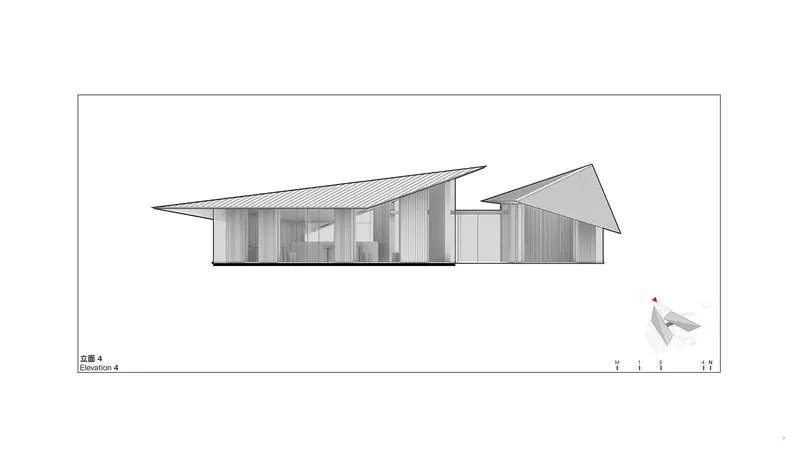
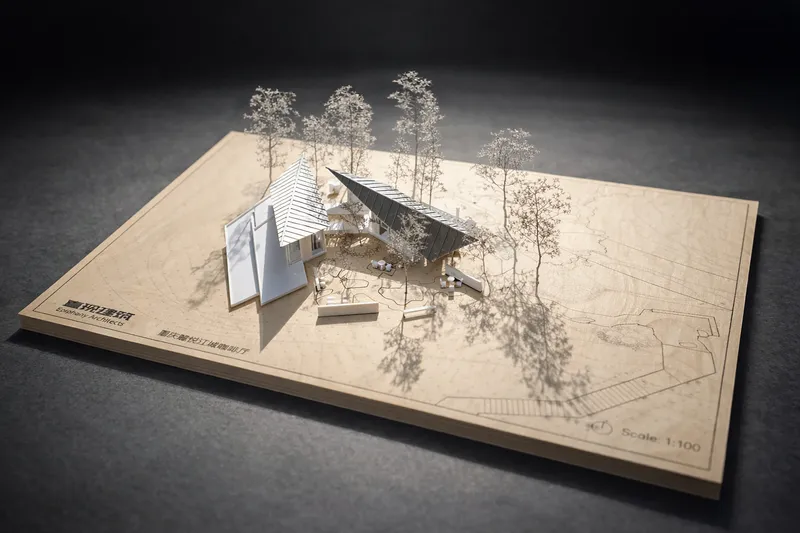
The site plans reveal the building's angular footprint clearly: two volumes organized around a central courtyard, sitting adjacent to landscaped terraces that step down toward the waterfront edge. The roof plan shows the two folded planes as distinct geometric operations, each angled differently to the site, hovering above the tree canopy like displaced tectonic plates.
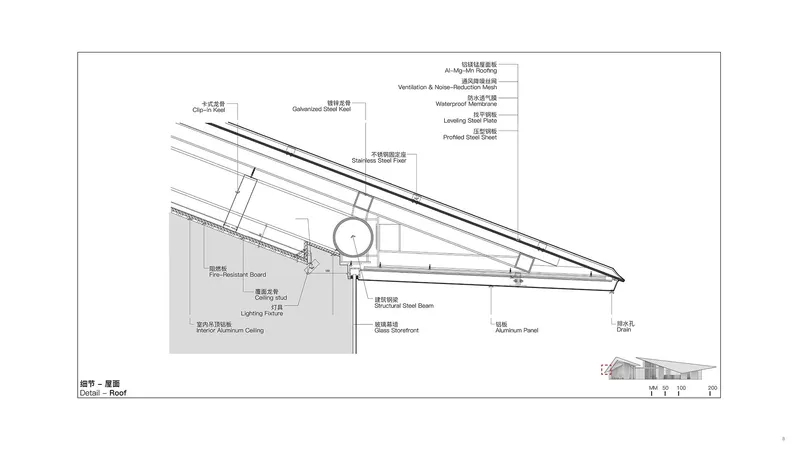
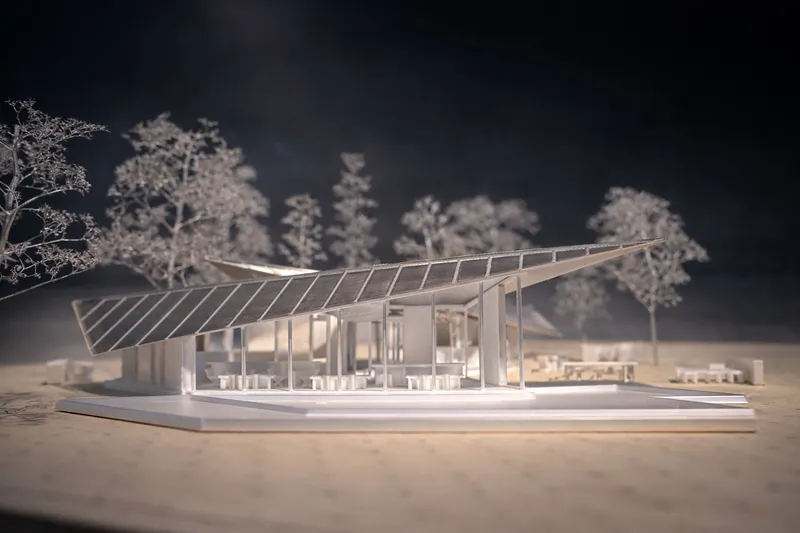
The elevations are instructive. Each one tells a different story: one shows a sweeping horizontal canopy over transparent interiors, another reveals a gabled timber-clad volume connected to an angular wing. The detail section of the roof assembly, with its layered insulation, waterproofing membrane, and structural beams, confirms that the dramatic roof forms are carefully engineered, not sculptural gestures bolted onto a standard structure. The physical models, photographed with miniature trees casting long shadows, capture the spatial ambition of the project at a glance.
Why This Project Matters
Small commercial projects often get reduced to interior styling exercises, especially cafés. Luxerivers Café does something different. It treats 200 square meters as a legitimate architectural problem, one that demands engagement with site, climate, material, and structure. The folded roofs are not arbitrary. The courtyards are not decoration. The glass is not a default. Every move responds to Chongqing's specific conditions: its heat, its humidity, its topographic complexity, and its cultural relationship with water.
What Zhuoxin Fang and the teams at Wide Horizon and Epiphany Architects have produced is proof that scale is not a prerequisite for seriousness. A café can be a landscape project. A roof can be a geological argument. And a city as intense as Chongqing can still generate moments of stillness, if the architecture knows where to fold and where to open.
Chongqing Luxerivers Café by Wide Horizon + Epiphany Architects, lead architect Zhuoxin Fang. Chongqing, China. 200 m², completed 2025. Photography by PrismImage and Arch-Exist.
About the Studio
Wide Horizon + Epiphany Architects
Share Your Own Work on uni.xyz
If projects like this are the kind of work you want to make, uni.xyz is a place to publish your own, find collaborators, and enter design competitions.


Popular Articles
Popular articles from the community


Juan García Correa, John González and Claudia Rueda Sink a Circular Amphitheater into a Manizales Engineering Building
On the La Nubia campus in Manizales, Colombia, the S1 Building folds labs and offices into a hillside of ramped lawns that double as a campus route.

Architekt Andreas Gruber Scatters 23 Dark Timber Chalets Across a South Tyrolean Forest Edge
In Molini di Tures, Amonti Chalets breaks a resort into a hamlet of gabled timber houses, with parking, storage and services pushed into the slope.

David Macias Steps a Doorless Stone and Plaster House Down a Tropical Colombian Hillside
In the humid hills of Colombia, Threshold House replaces the front door with an open void and terraces its 850 m² down the slope instead of fighting it.

David Ortega Stacks a Two-Story Mexico City Penthouse Around a Steel Stair and a Pergola-Shaded Roof Terrace
In Colonia Roma, a 300 m² penthouse uses oak joinery, a planted steel stair and a slatted roof pergola to make a new-build apartment feel like a house.

Similar Reads
You might also enjoy these articles


LAVA Architecten Gives Vocational Education a Sawtooth-Roofed Face on a Mechelen School Campus
In Mechelen, Belgium, a 2,053 m² STEM school on a 6×6 m grid turns workshops and classrooms into rooms that can be rearranged as teaching changes.

KEMA Studio Turns a Derelict Marvila Attic into a 60 m² Lighthouse Apartment Above Lisbon
In Lisbon's Marvila district, a rebuilt roof, four skylights and two plywood volumes turn an unlivable attic into a bright home facing the Tagus.

Pixel Gardens: One Repeated Module Stacked Into a Terraced Social Housing Tower for Famagusta
Salem Bader's shortlisted housing tower builds a vertical neighbourhood from one repeated module, offsetting units to carve terraces, light and air.

Bao Huynh Watercolor Atelier: A Serene Art Retreat in Hội An
Bao Huynh Watercolor Atelier in Hội An blends multifunctional art spaces, sustainable design, local materials, and family-friendly living in a serene environment.

Comments (0)
Please login or sign up to add comments
No comments yet. Be the first to comment!