

Chris Dyson and Buchanan Studio Merge Five Derelict Spitalfields Houses into an Artist's Live-Work Compound
Maison Colbert combines a deep excavated gallery, glass atrium, and layered domestic spaces behind a restored Victorian terrace in East London.


Nikolaus Pevsner once called them 'mean dwellings.' Five semi-derelict, four-story terraced houses on a Spitalfields side street, their Victorian shopfronts crumbling and their rooms long emptied. That Chris Dyson Architects and Buchanan Studio saw potential in this row is not surprising; both practices have deep experience working within London's historic fabric. What is surprising is the scale of the transformation. Maison Colbert is not a careful restoration of five houses. It is a radical consolidation of them into a single 6,000-square-foot compound for artist Philip Colbert and writer-filmmaker Charlotte Colbert, one that buries a 185-square-meter gallery five meters beneath the street while preserving the rhythmic terrace above.
The project's real intelligence lies in how it manages the tension between public and private, between the artists' need to exhibit and their need to live. The ground floor operates as semi-public space; the topmost floor holds four bedrooms. Between those poles, circulation weaves through a sequence of interlocking volumes with dramatic shifts in height: double-height living rooms, a glass-roofed atrium, a triple-height courtyard. The house never settles into a single register. It is always pulling you from one spatial condition into the next.
A Terrace Rebuilt from Within


The structural logic of the project is almost surgical. Internal walls between the five houses were removed to create generous lateral spaces that no single narrow terrace house could offer, yet the street-facing facade retains the quintuple rhythm of the original row. New shopfronts reinterpret the Victorian pattern without mimicking it, and the original gable wall along Cobb Street has been preserved. Salvaged bricks were cleaned and reused for the rear facade, and original doors and fireplace surrounds were recycled back into the interiors. The exposed brick walls that appear throughout the living spaces are not decorative choices; they are the actual bones of the building, left legible.
The fireplace in the main living room, framed by raw brickwork and overlooked by a round porthole window, captures the project's philosophy. Nothing here is a replica. The house wears its history as material fact, layered with contemporary interventions that are clearly distinct: steel frames, black zinc dormers, glass roofs. You always know which century you are standing in.
The Glass Atrium and Vertical Garden

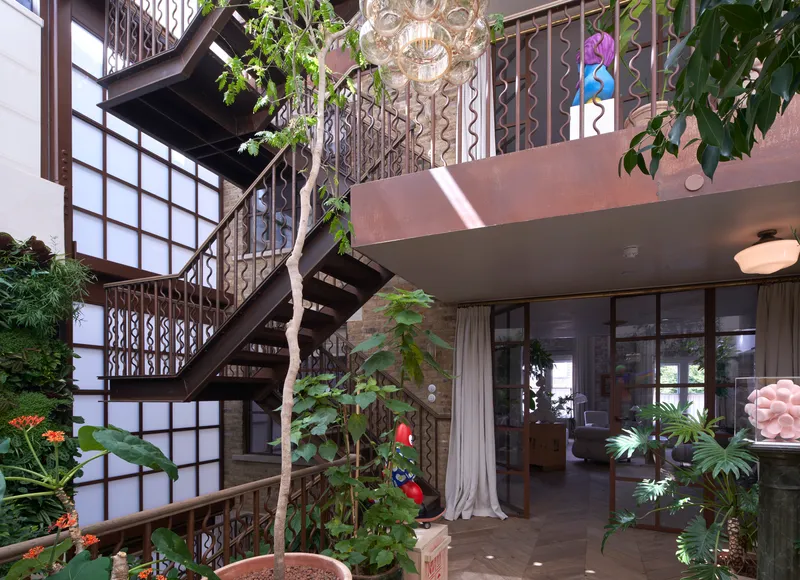

A rear extension houses the garden atrium, the spatial fulcrum around which the entire house pivots. Covered by a pitched glass roof, this multi-level volume contains a vertical green wall, cantilevered balconies with wave-pattern metal railings, and a dark timber staircase that stitches the floors together. Glass block walls admit translucent light while maintaining enclosure. Sculptural figures perch among the planters, blurring the line between domestic garden and gallery installation.
The atrium solves a practical problem: how to get daylight deep into a plan that is essentially five houses wide but only one room deep. But it does more than that. It provides a breathing space, a vertical garden room that you pass through repeatedly as you move between the home's many levels. Every floor reads the atrium differently, from the ground-level courtyard experience to the upper balcony overlooking the treetops below.
Layered Living Rooms


The double-height living spaces are where the Colberts' artistic sensibility and the architects' spatial ambitions converge most vividly. Globe pendant lights float at mid-height. A rocket mural presides over one wall. An eye-motif coffee table sits beneath a metal balcony railing. None of this reads as eccentric decoration layered onto a neutral box, because the architecture itself refuses neutrality. Round porthole windows punch through brick walls, offering unexpected views between rooms and floors. Ornamental plaster moldings, inspired by an archaeological dig on the site that uncovered Romanesque fragments, give certain rooms a historicist depth that feels earned rather than applied.
The conservatory space, with its gridded windows and ceiling-mounted greenery, channels the spirit of a Victorian palm house while operating as an extension of the living quarters. Linen curtains diffuse light through tall sash windows. The whole domestic sequence oscillates between enclosure and openness, between intimate nooks and soaring volumes, never allowing the eye or the body to rest in one condition for long.
A Gallery Buried Five Meters Deep


Below the house, five meters of excavation yield a 185-square-meter gallery that operates as a genuinely professional exhibition space. White walls, polished concrete floors, track lighting, exposed ceiling beams: the vocabulary is deliberately neutral, a counterpoint to the layered domesticity above. Large steel-framed clerestory windows bring daylight down to this subterranean level, a detail that prevents the gallery from feeling bunker-like. White structural columns and steel beams are left exposed, giving the space an industrial frankness.
Building services are exposed in the gallery but concealed in the residential interiors, a decision that marks the boundary between the two programs with clarity. The gallery is not a basement with art on the walls. It is a distinct institution embedded beneath a domestic superstructure, with its own spatial logic and its own quality of light.
The Gallery Infrastructure


The infrastructure of the gallery level reads honestly. Corrugated metal decking, pendant fixtures, and linear fluorescent tubes mounted on painted ceiling joists give the space the raw utility of a commercial gallery without pretending to be anything grander. Steel and glass partition walls subdivide the floor while maintaining visual continuity. This is a space built to accommodate changing installations, not to upstage them.
Circulation as Architecture
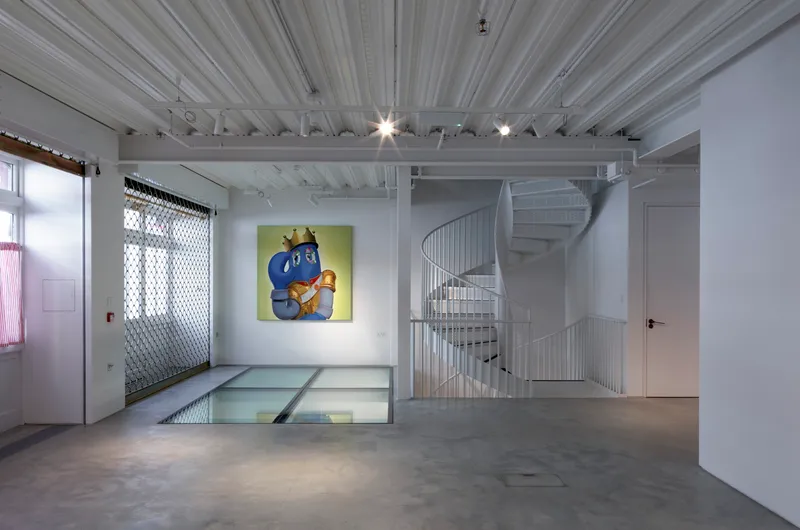
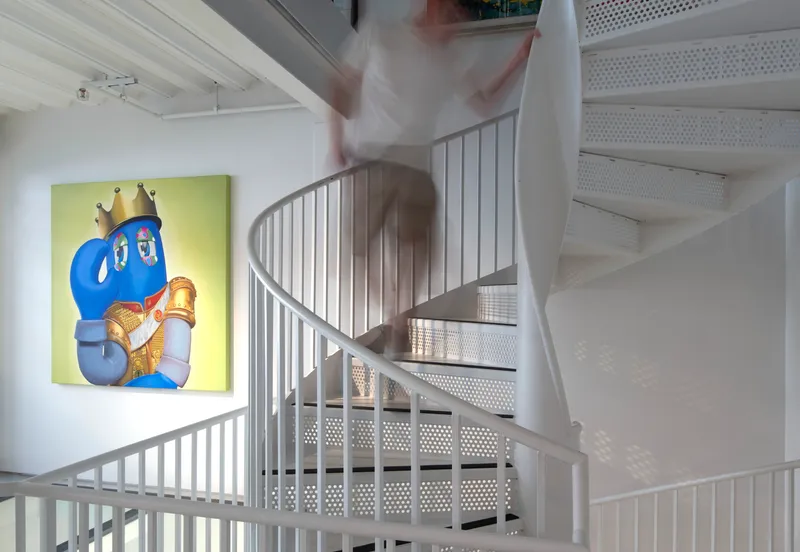

In a building that combines five houses, a basement gallery, and a multi-level atrium, circulation is not an afterthought. It is the primary architectural experience. White spiral staircases with perforated metal treads and vertical bar railings connect the gallery to the upper floors, their lightweight construction reading as insertions within the heavier masonry shell. A bespoke lift with a custom car interior offers an alternative route. The spiral stairs appear repeatedly throughout the house, each one calibrated to its context: adjacent to steel-framed windows in one location, behind mesh railings overlooking floor openings in another.
The wave-pattern balusters on the dark timber staircase in the atrium offer a different character entirely, more sculptural and ornamental. The house gives you multiple ways to move through it, each route offering a different sequence of spatial experiences. This is choreography as much as architecture.
Private Quarters at the Top


The bedrooms occupy the uppermost floor, reached after ascending through the full gradient of the house from semi-public to private. Salvaged timber floors ground these rooms in the building's material history. One bedroom features built-in shelving beneath a skylight, its red furnishings and books creating a warm retreat. Another pairs green cabinetry with a playful cactus wall decoration beneath white paneled ceilings. The master bedroom incorporates wood panelling that recalls the elegant interiors of the Huguenot-built houses that define Spitalfields' architectural heritage.
Black zinc dormers, added along the existing roof pitch and following the rhythm of the fenestration below, bring additional light into these top-floor rooms. The steel-framed folding doors at the rear open onto a planted terrace, granting the private quarters their own relationship with the outdoors, separate from the communal atrium below.
Why This Project Matters
Maison Colbert challenges the assumption that live-work spaces for artists must be either converted industrial sheds or purpose-built white cubes. Here, the live-work program is threaded through a historic terrace with surgical precision. The gallery operates at professional standards beneath the street. The domestic spaces above offer genuine warmth and complexity. Neither program compromises the other. The vertical hierarchy from public exhibition to private bedroom is clean and legible, yet the spatial experience between those poles is anything but simple.
More broadly, the project demonstrates that combining multiple small historic buildings into a single coherent whole does not require erasing their identity. The five-house rhythm is preserved on the street. Salvaged materials reappear throughout the interiors. The architectural history of Spitalfields, from Huguenot wood panelling to Victorian shopfronts to Romanesque fragments unearthed during construction, is woven into a building that is unmistakably contemporary. Chris Dyson Architects and Buchanan Studio have produced something rare: a building where ambition and restraint are not in tension but in alignment.
Maison Colbert by Chris Dyson Architects and Buchanan Studio. Spitalfields, United Kingdom. 6,000 sq ft. Completed 2022. Photography by Edmund Sumner.
About the Studio
Share Your Own Work on uni.xyz
If projects like this are the kind of work you want to make, uni.xyz is a place to publish your own, find collaborators, and enter design competitions.


Popular Articles
Popular articles from the community


David Ortega Stacks a Two-Story Mexico City Penthouse Around a Steel Stair and a Pergola-Shaded Roof Terrace
In Colonia Roma, a 300 m² penthouse uses oak joinery, a planted steel stair and a slatted roof pergola to make a new-build apartment feel like a house.

Jaramillo Van Sluys Arquitectura and Urbanismo Turn a Demolished Registry Lot in Quito into an Orchard Plaza
In Quito's Centro Histórico, a 2,800 m² plaza exposes the San Agustín convent wall and redraws its lost Augustinian orchard in volcanic stone.

Juan García Correa, John González and Claudia Rueda Sink a Circular Amphitheater into a Manizales Engineering Building
On the La Nubia campus in Manizales, Colombia, the S1 Building folds labs and offices into a hillside of ramped lawns that double as a campus route.

longwave studio Reorganizes a 112 m² Tainan Apartment Around the Daily Routines of a Family and Two Cats
In Tainan, Taiwan, birch plywood, rust-red furniture and a freestanding plaster wall link arrival, storage, work and family life in one apartment.

Similar Reads
You might also enjoy these articles


LAVA Architecten Gives Vocational Education a Sawtooth-Roofed Face on a Mechelen School Campus
In Mechelen, Belgium, a 2,053 m² STEM school on a 6×6 m grid turns workshops and classrooms into rooms that can be rearranged as teaching changes.

KEMA Studio Turns a Derelict Marvila Attic into a 60 m² Lighthouse Apartment Above Lisbon
In Lisbon's Marvila district, a rebuilt roof, four skylights and two plywood volumes turn an unlivable attic into a bright home facing the Tagus.

Pixel Gardens: One Repeated Module Stacked Into a Terraced Social Housing Tower for Famagusta
Salem Bader's shortlisted housing tower builds a vertical neighbourhood from one repeated module, offsetting units to carve terraces, light and air.

Bao Huynh Watercolor Atelier: A Serene Art Retreat in Hội An
Bao Huynh Watercolor Atelier in Hội An blends multifunctional art spaces, sustainable design, local materials, and family-friendly living in a serene environment.

Explore Cultural Architecture Competitions
Discover active competitions in this discipline

Challenge to design mud housing for contemporary communities

Bring back Drive In's
Comments (0)
Please login or sign up to add comments
No comments yet. Be the first to comment!