
Christ & Gantenbein Bring Baroque Glamour to a 1906 Oxford Street Office Lobby
A Grade II listed London landmark gets a lobby where chrome columns, checkered marble, and bespoke ceramics rewrite corporate arrival.


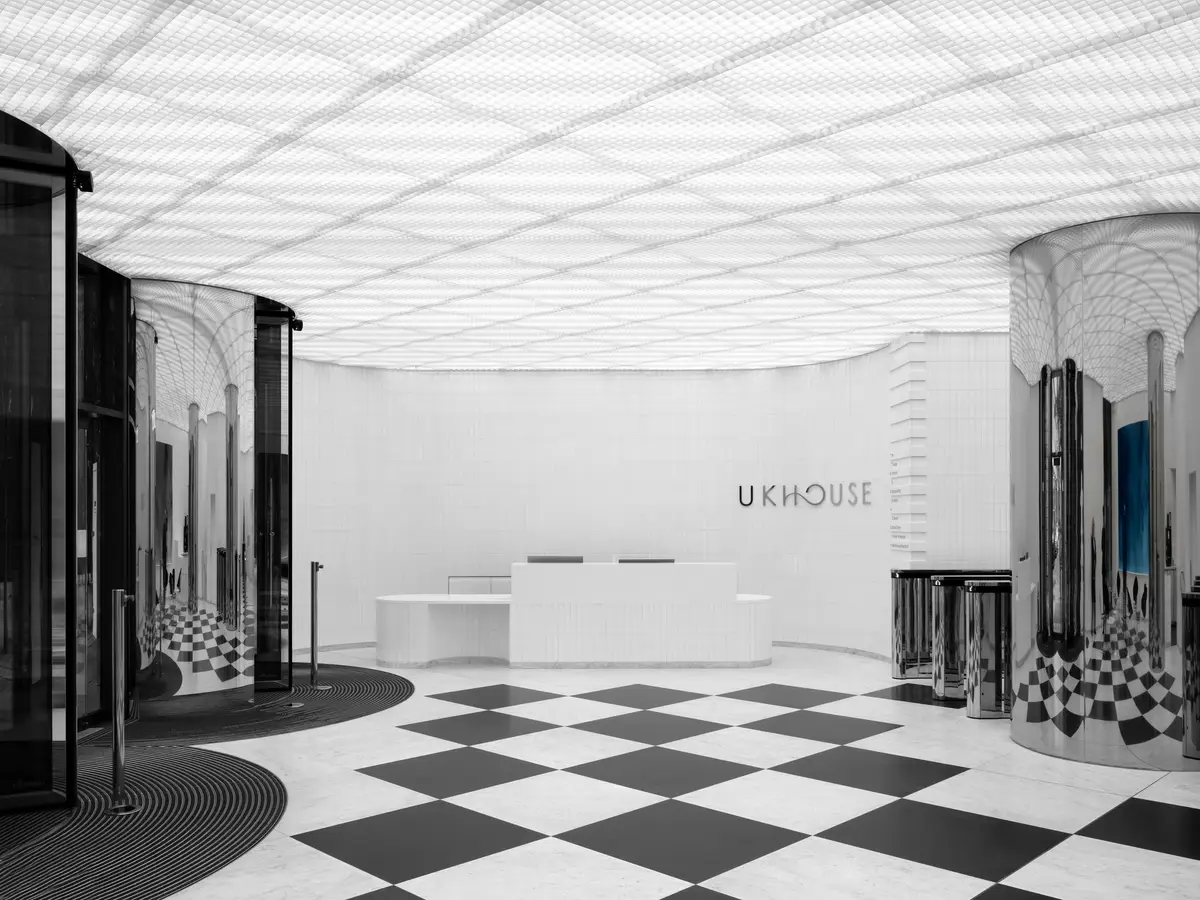
Corporate lobbies rarely earn a second glance. They exist to process bodies, not to welcome them. But Christ & Gantenbein's intervention at UK House on Oxford Street treats the threshold as the most important room in the building. The 1,270 m² project, completed in 2022, threads through the ground floor and basement of a Grade II listed Edwardian structure that was awkwardly retrofitted into an office block during the 1970s. Two original facades survive, their playful baroque and Edwardian ornament now echoed in the curving walls, chrome surfaces, and theatrical floor patterns of the interior.
What makes the project genuinely interesting is how it collapses historical quotation and contemporary slickness into a single spatial register. The lobby does not pastiche the building's baroque references; it absorbs them into a language of polished metal, bespoke ceramic tile, and geometric furniture that feels like a film set designed by someone who has studied both Borromini and Kubrick. The result is a corporate space that actually has personality, a quality in desperately short supply along this stretch of central London.
Entering Through Chrome
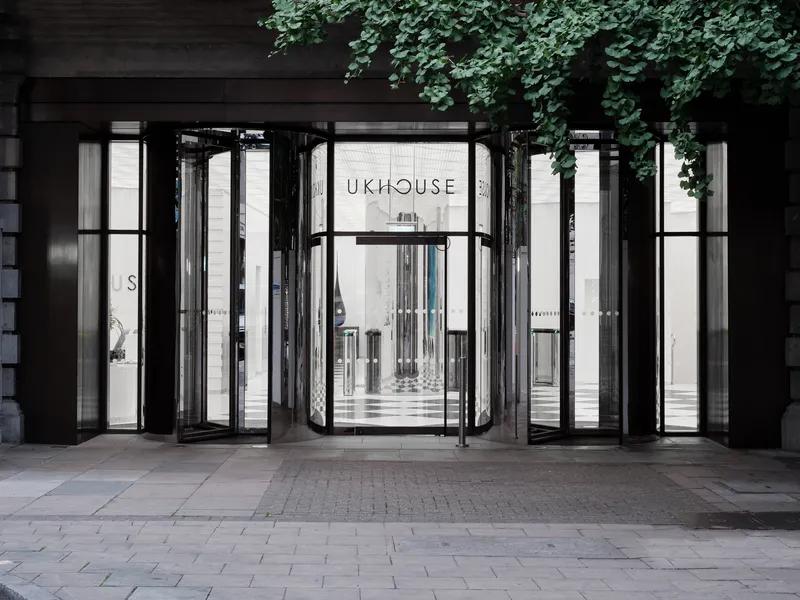


The street entrance is framed by bronzed metal and draped in overhanging ivy, a deliberate softening of the corporate register before you even step inside. Chrome-plated revolving doors form the real threshold: their curved panels catch light and reflection, establishing a visual kinship with the mirrored cylindrical columns waiting beyond. It is a neat trick. The revolving door becomes not just a functional barrier but the first act in a sequence of reflective surfaces that makes the lobby feel larger and more ambiguous than its footprint suggests.
The Checkered Ground Plane


Black and white stone, laid in a bold checkered pattern, runs across the main lobby floor and shifts into concentric rings around the base of each chrome column. The pattern is unashamedly theatrical. It borrows from the long tradition of European palace floors and baroque church naves where geometry on the ground plane was used to orchestrate movement and ceremony. Here, the concentric rings pull your eye to the columns and give each one a gravitational field, turning structural elements into spatial events.
In the basement, the pattern morphs into black and white stripes rendered in epoxy, a harder-wearing surface suited to bicycle traffic and changing rooms. The shift in material is pragmatic, but the graphic continuity between levels keeps the identity of the project intact as you move downstairs.
Walls That Curve and Glow
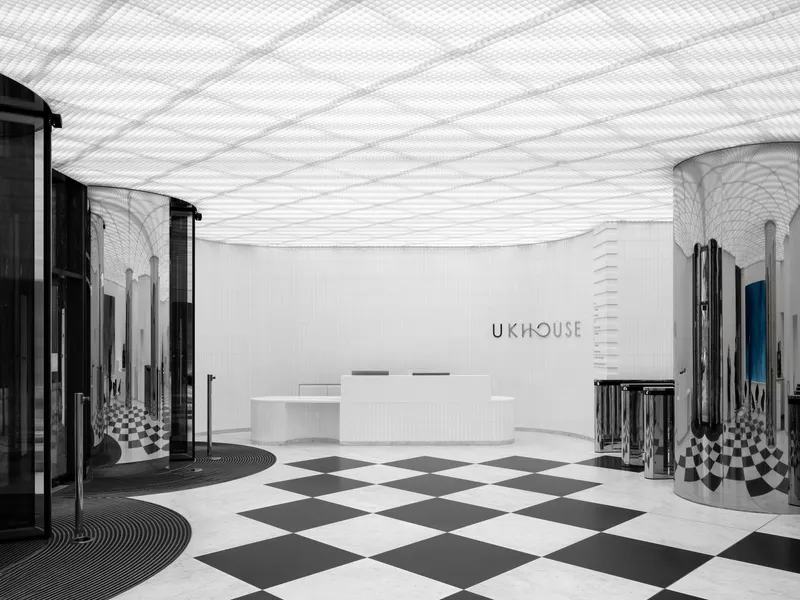


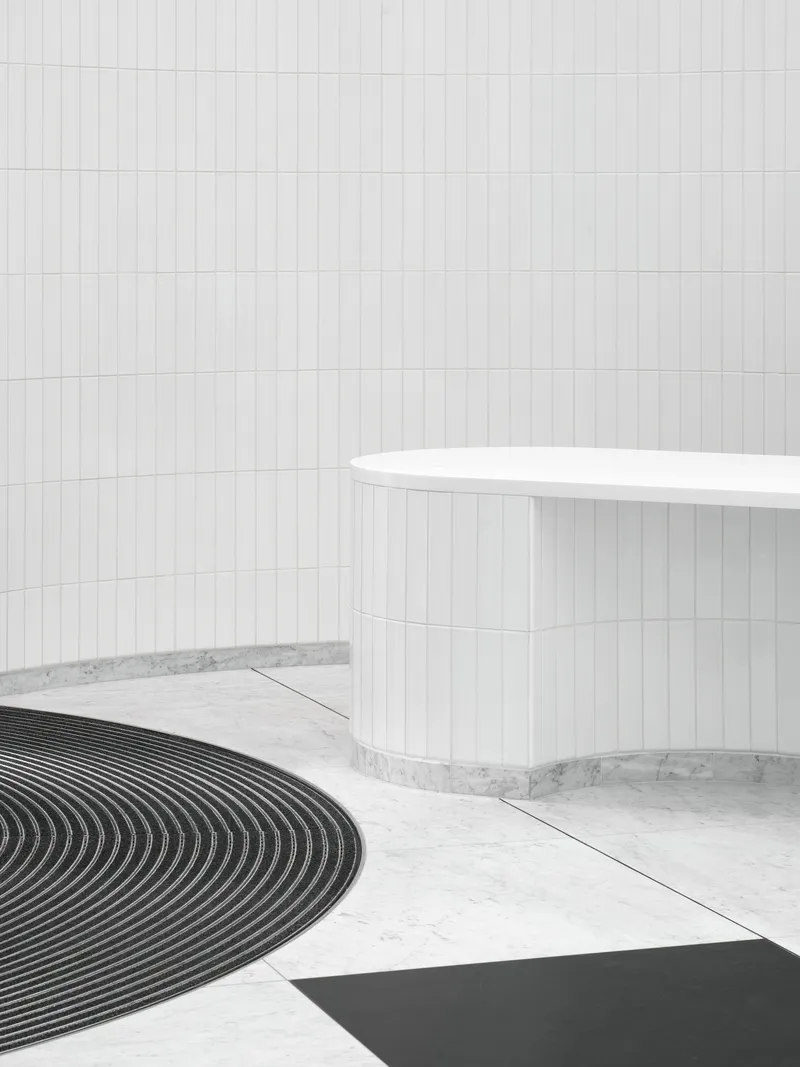
The lobby walls curve into apse-like endings, a direct response to the baroque forms of UK House's surviving facades. These curves prevent the kind of dead-end collisions that plague rectangular lobbies: rather than hitting a flat wall, you are guided around a gentle bend. Bespoke ceramic tiles cover these surfaces, richly textured but tonally restrained, offering a haptic quality that chrome and marble alone would not provide. Above, a suspended metal grill ceiling casts intricate shadow patterns that shift with the angle of natural light, adding a temporal dimension to the space.
Reception and Bespoke Objects

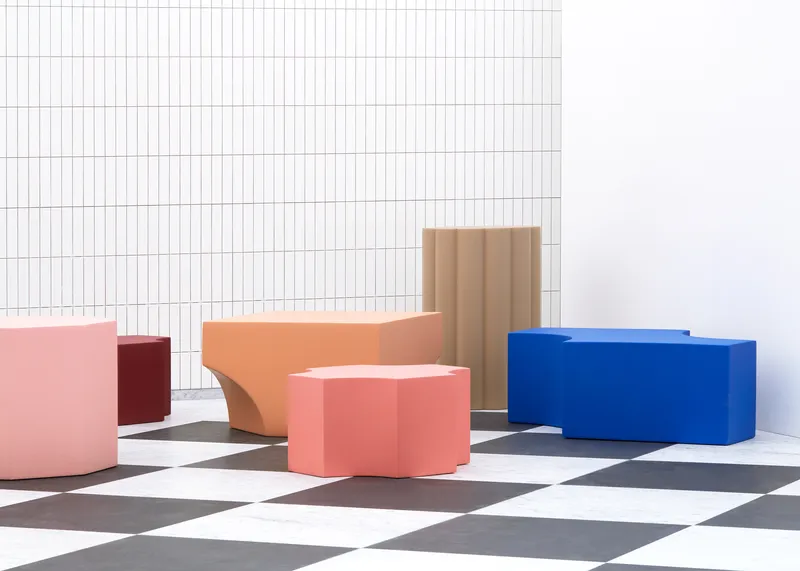
Christ & Gantenbein designed an informal constellation of bespoke objects for the lobby: a white cylindrical reception desk, a bench, and multi-functional geometric seating blocks in pink, coral, and blue. These pieces refuse to behave like standard corporate furniture. The colored blocks, positioned on the checkered floor in bright sunlight, look more like a de Chirico painting than an office amenity. They invite a moment of pause, even play, in a building type that normally discourages both.
The reception desk sits on a curved black ribbed floor mat that meets a terrazzo base trim, a small detail that distinguishes the desk's territory from the broader lobby without building any physical barrier. It is a subtle piece of spatial choreography.
Art and the Blue Wall

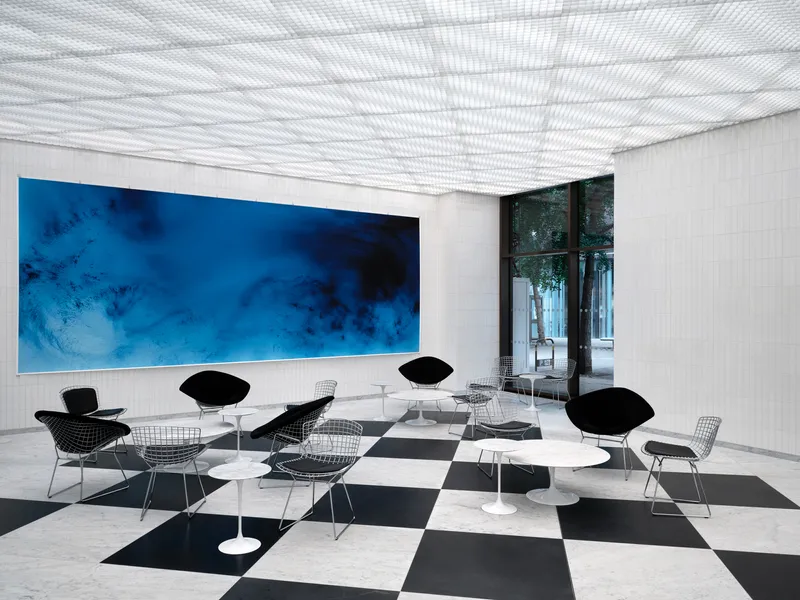

An artwork by Wolfgang Tillmans occupies the right wall of the lobby, hung against the white ceramic tile. Tillmans is an interesting choice: his work oscillates between the documentary and the abstract, and here it introduces a moment of visual complexity that resists the lobby's otherwise controlled palette. Elsewhere, blue-tiled walls appear in corridors and ancillary spaces, deepening the color register as you move away from the main entrance. The blue is not decorative filler; it signals a shift in program, marking the transition toward more informal zones like the seating nooks with their wire mesh chairs.
Below Ground: The Cyclist's Lobby
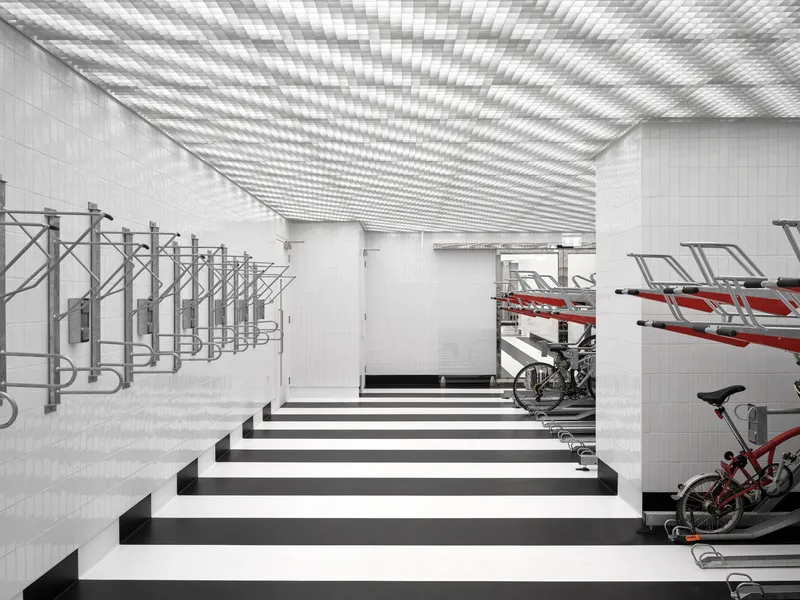
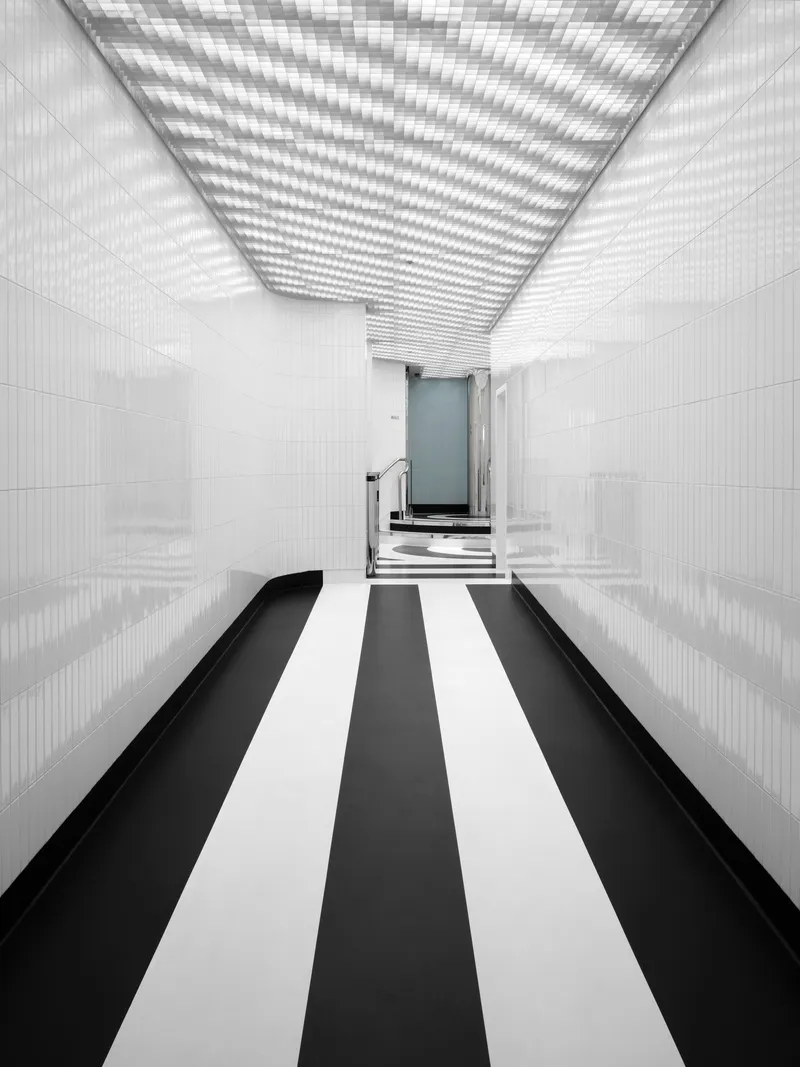
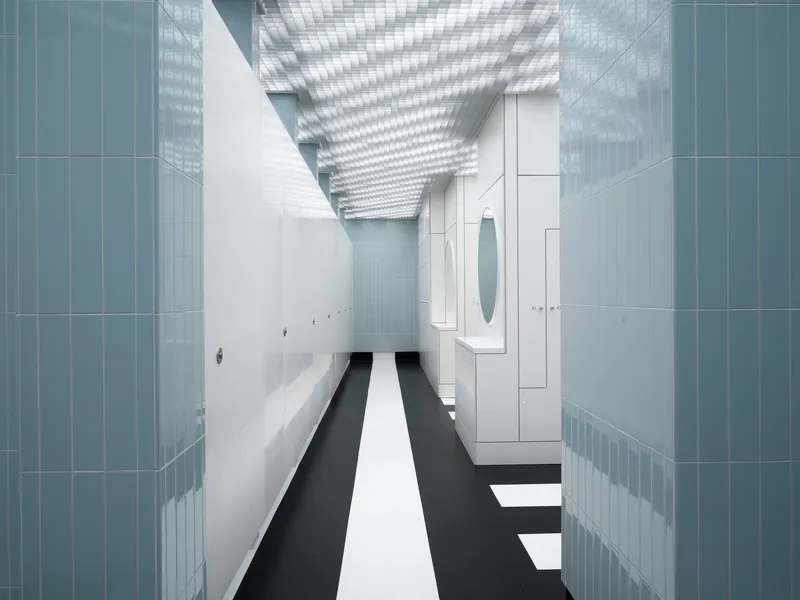
The basement level, connected by new staircases and elevators, functions as a changing lobby for tenants who arrive by bicycle. Vertical bike racks, showers, and lockers occupy purpose-built rooms, but the design refuses to treat this level as backstage. Striped floors, a perforated ceiling casting linear shadows, and blue tile walls maintain the same graphic intensity found upstairs. The circular accents that define the changing lobby echo the concentric floor patterns at ground level, creating a vertical continuity of identity that gives cyclists the same quality of arrival as those who walk in from Oxford Street.
Ceiling as Light Instrument
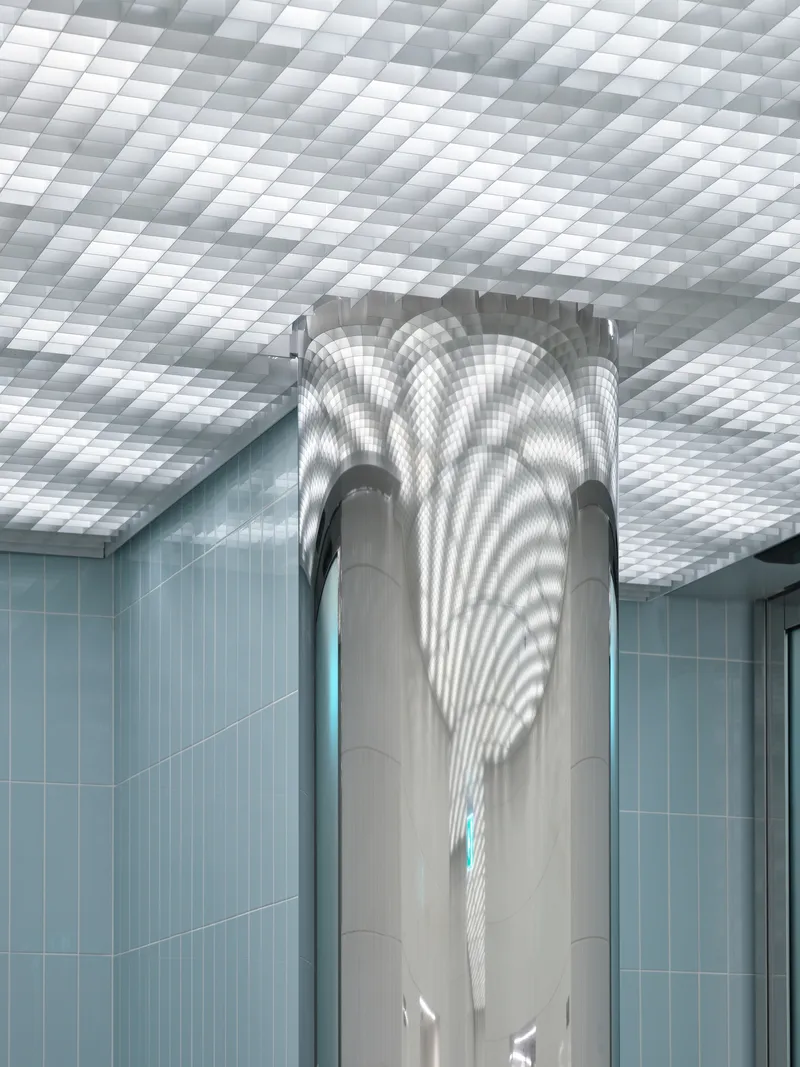


Throughout the project, the ceiling does heavy atmospheric work. A coffered translucent ceiling in one section washes the pale blue tiled walls with diffused light, while a pyramidal grid in another zone creates a greenhouse-like brightness overhead. Linear lighting tracks follow the primary spatial axes, reinforcing the directionality of each corridor and room. The effect is that even deep interior spaces feel illuminated from above, countering the basement's potential for gloom.
The suspended metal grill in the main lobby deserves particular attention. It functions as a screen that breaks direct downlighting into a delicate mesh of shadows on the checkered floor, creating a layered visual depth. The ceiling is never just a ceiling here; it is an active participant in the spatial experience.
Plans and Drawings


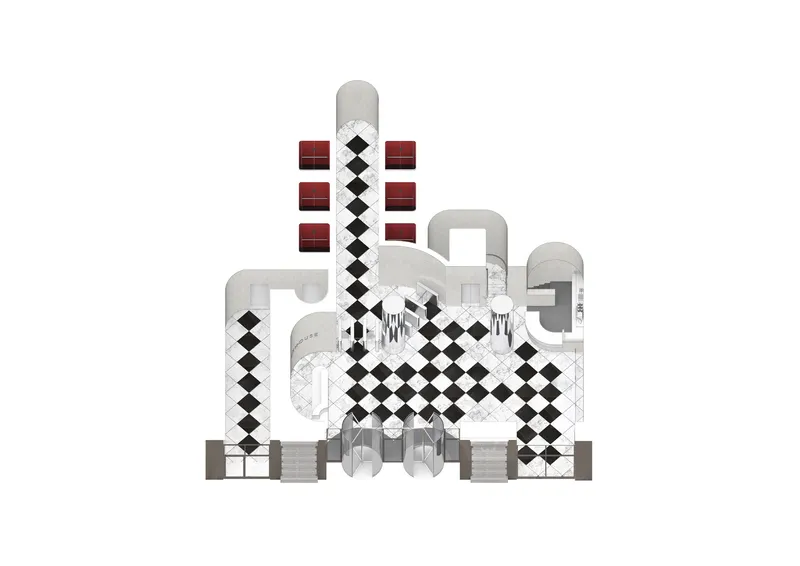
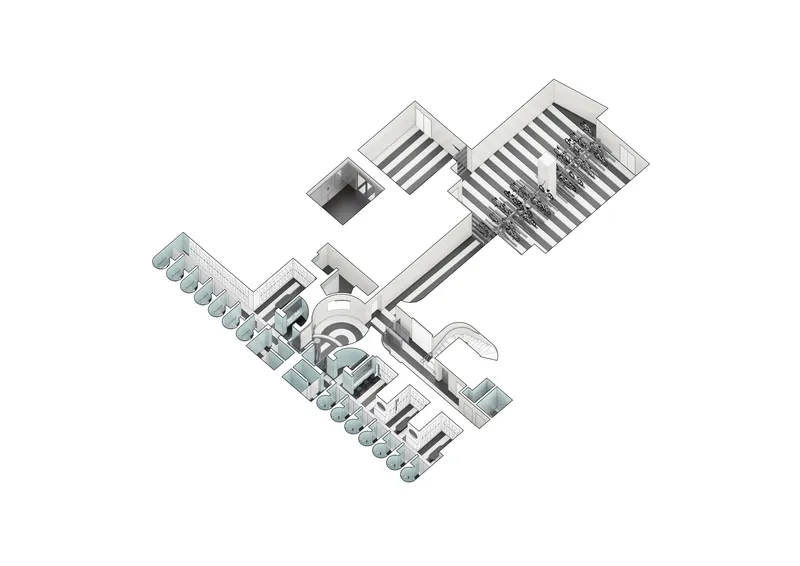

The plans reveal the project's negotiation with an irregular existing footprint. A large central hall anchors the ground floor, flanked by service rooms and the curved apse-like volumes that define the lobby's edges. The upper-level plan shows rooms surrounding a central void, a spatial strategy that channels natural light down through the section. The axonometric drawing is perhaps the most telling: it exposes the layered sequence from an arcaded wing through a central rotunda to a stepped courtyard, confirming that the project's theatricality is not merely surface deep but genuinely spatial.
Why This Project Matters
UK House Lobby matters because it demonstrates that corporate interior architecture can be culturally ambitious without being pretentious. Christ & Gantenbein have not simply decorated an existing shell; they have re-read the building's baroque heritage and translated it into a contemporary material language of chrome, ceramic, and patterned stone. The result is a lobby that performs its utilitarian role (processing hundreds of daily arrivals, accommodating cyclists, housing a reception desk) while simultaneously creating a genuinely memorable interior experience on one of London's most commercially relentless streets.
The project also offers a quiet lesson about listed buildings. Rather than treating the surviving Edwardian facades as untouchable relics to be preserved behind glass, the architects allowed their formal logic to permeate the new work. Curves, symmetries, and ornamental impulses flow from the exterior into the lobby's walls, floors, and furniture. It is a form of preservation that is generative rather than static, proving that the best way to honor a historic building might be to let it inform something genuinely new.
UK House Lobby, designed by Christ & Gantenbein, London, United Kingdom. 1,270 m². Completed 2022. Photography by Thomas Adank.
About the Studio
Gantenbein
Share Your Own Work on uni.xyz
If projects like this are the kind of work you want to make, uni.xyz is a place to publish your own, find collaborators, and enter design competitions.


Popular Articles
Popular articles from the community


Opera on the Sea: Driftwood Logic Shapes a Timber Opera House on Estonia's Coast
Trevor Orgill's opera house translates the entangled drift of floating timber into a civic building where wood, water, and music converge.


FCC Arquitectura Expands a Portuguese Granite House with a Board-Marked Concrete Wing
In Portugal, JV House pairs a cleaned-up whitewashed and granite dwelling with a timber-shuttered concrete extension, courtyards and a garden pool.

The Amber Palace Opera: A Geological Fiction Surfaces on Tallinn's Baltic Waterfront
Pierre Brillard reimagines a Baltic legend as a public landscape, opera house, and waterfront promenade rooted in Tallinn's coastal identity.

David Ortega Stacks a Two-Story Mexico City Penthouse Around a Steel Stair and a Pergola-Shaded Roof Terrace
In Colonia Roma, a 300 m² penthouse uses oak joinery, a planted steel stair and a slatted roof pergola to make a new-build apartment feel like a house.

Similar Reads
You might also enjoy these articles

LAVA Architecten Gives Vocational Education a Sawtooth-Roofed Face on a Mechelen School Campus
In Mechelen, Belgium, a 2,053 m² STEM school on a 6×6 m grid turns workshops and classrooms into rooms that can be rearranged as teaching changes.

KEMA Studio Turns a Derelict Marvila Attic into a 60 m² Lighthouse Apartment Above Lisbon
In Lisbon's Marvila district, a rebuilt roof, four skylights and two plywood volumes turn an unlivable attic into a bright home facing the Tagus.

Pixel Gardens: One Repeated Module Stacked Into a Terraced Social Housing Tower for Famagusta
Salem Bader's shortlisted housing tower builds a vertical neighbourhood from one repeated module, offsetting units to carve terraces, light and air.

Bao Huynh Watercolor Atelier: A Serene Art Retreat in Hội An
Bao Huynh Watercolor Atelier in Hội An blends multifunctional art spaces, sustainable design, local materials, and family-friendly living in a serene environment.

Explore Parliament House Competitions
Discover active competitions in this discipline

Challenge to design mud housing for contemporary communities

Challenge to reimagine the Iron Throne

Photograph architecture without architects

Illustrate the lost glory of Angkor Wat - Render Challenge
Comments (0)
Please login or sign up to add comments
No comments yet. Be the first to comment!