

Christoph Hesse Architects Builds a Tiny Coal Museum from Briquettes for documenta fifteen
A 16-square-meter pavilion made entirely of coal briquets confronts fossil fuel dependency on Kassel's main public square.


At just 16 square meters, the Coal Museum is less a building than a provocation. Erected on Friedrichsplatz, the central public square of Kassel, for documenta fifteen in 2022, it is constructed almost entirely from coal briquettes, the kind you might buy for a backyard barbecue. Christoph Hesse Architects took a raw material synonymous with industrial pollution and carbon emissions and stacked it into a small, inhabitable monument. The result is a pavilion that smells of its own argument.
The concept is deceptively simple but precisely calibrated. A solid black block of coal sits on the cobblestones, and out of it a clover-shaped void has been carved. Vegetation colonizes the walls and roof, as though the green landscape of the nearby Karlswiese park has been symbolically stamped into the fossil mass. Visitors step inside and find themselves surrounded by the very substance driving the climate crisis, framed by plants that represent the alternative. It is a meeting point, a reflecting space, and a piece of material rhetoric all at once.
A Dark Mass on the Plaza
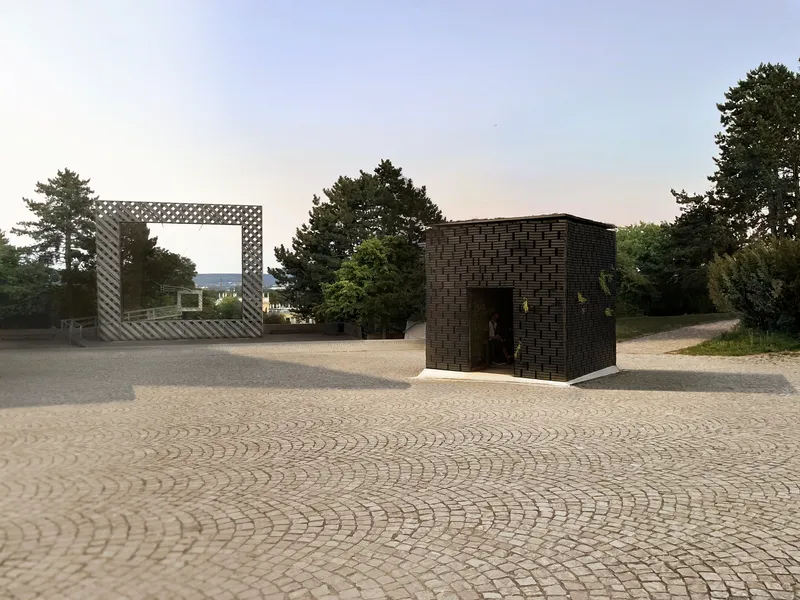
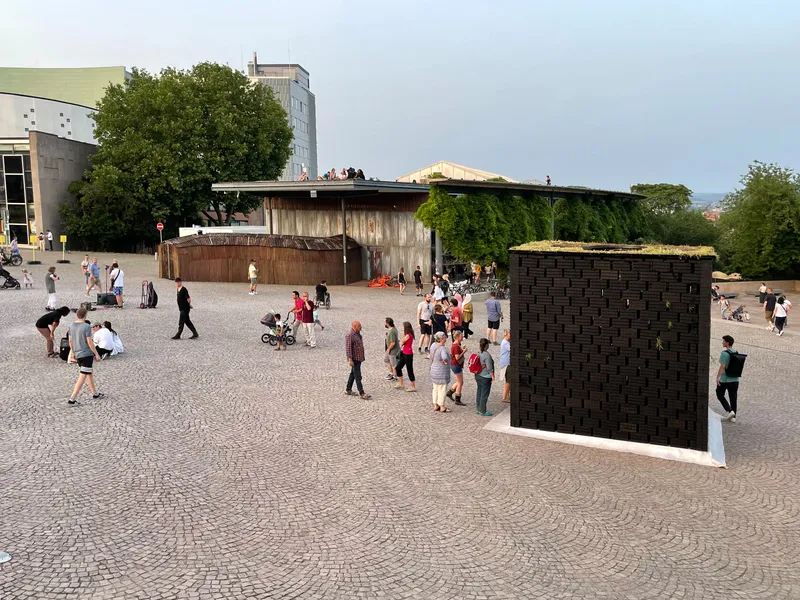
Friedrichsplatz is one of the largest public squares in Germany, a formal civic space defined by neoclassical facades and ordered paving. The Coal Museum drops into this context like a meteorite. The two dark volumes, one clad in a basketweave coal briquette pattern and the other in woven timber slats, read as alien objects against the pale stone and trees. At dusk, the contrast intensifies: the pavilion absorbs light while everything around it reflects it.
The scale matters. This is not a grand gesture but a compact, almost domestic intrusion into public space. At 16 square meters, it demands proximity. You cannot take it in from a distance the way you might a monument. You have to walk up to it, smell it, touch it. The decision to place it on Kassel's most visible square turns everyday foot traffic into an audience.
Woven from Fuel

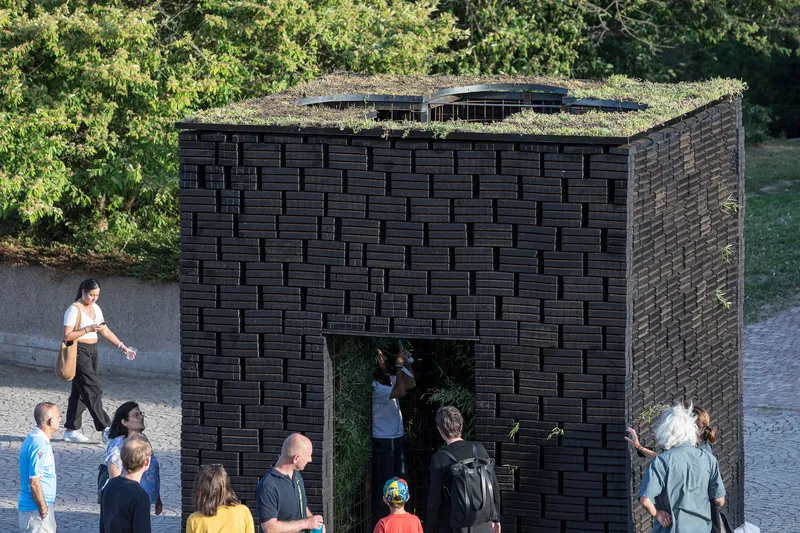

The facade is the message. Coal briquettes are arranged in a basketweave bond that gives the walls a textile quality, softening what could otherwise feel blunt or monolithic. The patterning introduces shadow, depth, and a kind of craft that elevates an industrial fuel product into an architectural surface. Sections of timber slat cladding alternate with the coal, adding warmth and structural logic to the composition.
Planted pockets interrupt the facade, with greenery pushing through gaps in the cladding. The planted roof crowns the dark volume with a living layer. The juxtaposition is deliberate and unsubtle, which is exactly the point. You do not build a meditation on renewable energy from polished concrete and diffuse lighting. You build it from the problem itself.
Entering the Void

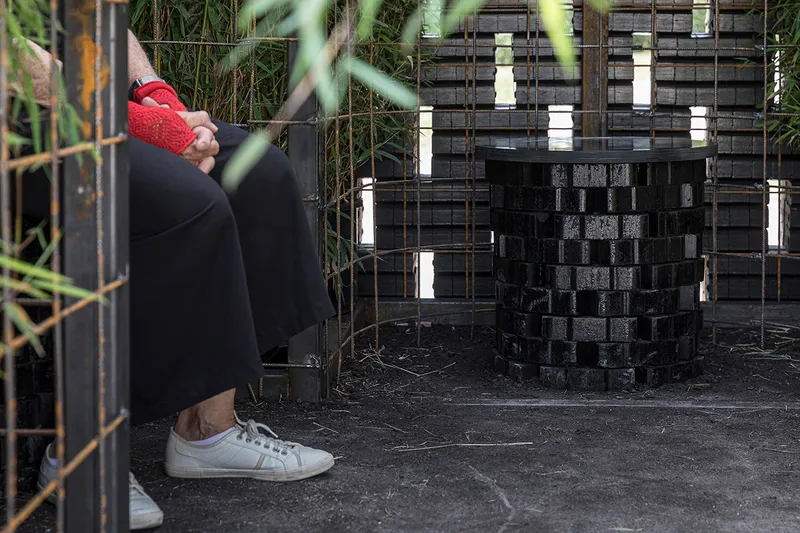
The arched doorway is generously proportioned relative to the pavilion's footprint, inviting visitors inside without hesitation. Once through, the interior reveals itself as a carved-out negative: light filters through gaps in the woven walls, and vegetation is visible in the periphery. The effect is somewhere between a grotto and a greenhouse.
The scale of the interior forces intimacy. Two or three visitors fill the space, making every encounter a conversation. For a project created within the framework of documenta fifteen, curated by the Indonesian collective ruangrupa with an emphasis on collectivity and shared resources, this spatial intimacy is not incidental. The Coal Museum functions as a meeting point precisely because it cannot hold a crowd.
Green Against Black
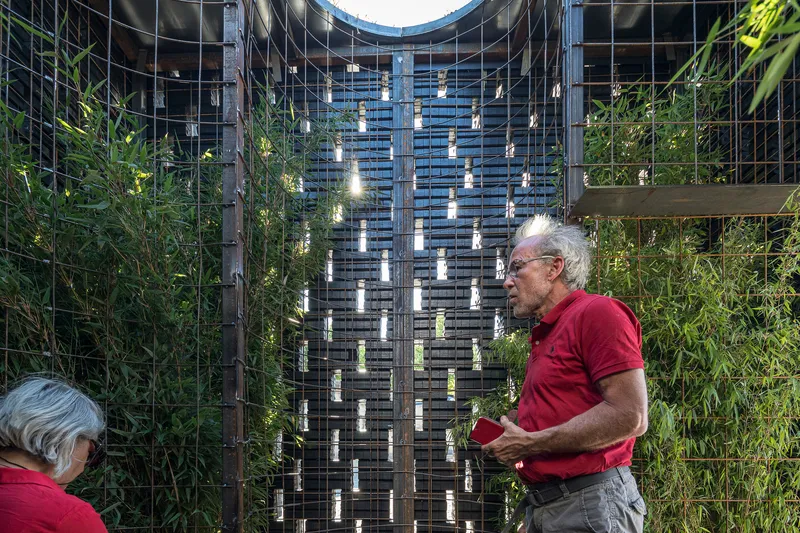

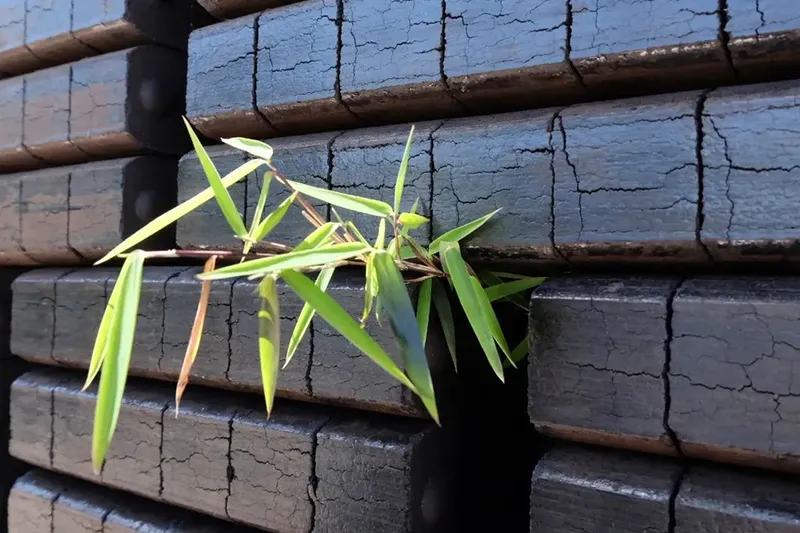
Looking upward from inside, the clover-shaped roof opening frames the sky and the vertical planted screens that flank the central space. The geometry is precise: a quatrefoil cut that echoes Gothic tracery but is filled with living plants rather than stained glass. Bamboo stems push through gaps in the charred timber cladding, blurring the line between structure and garden.
The planted walls are not decorative greenwashing. They are the counterargument embedded in the architecture. Coal is stacked to form the enclosure; plants colonize and eventually overtake it. The building stages its own obsolescence, suggesting a future in which the fossil material it celebrates will be nothing more than a curiosity in a museum. Which, of course, is exactly what this is.
Plans and Drawings

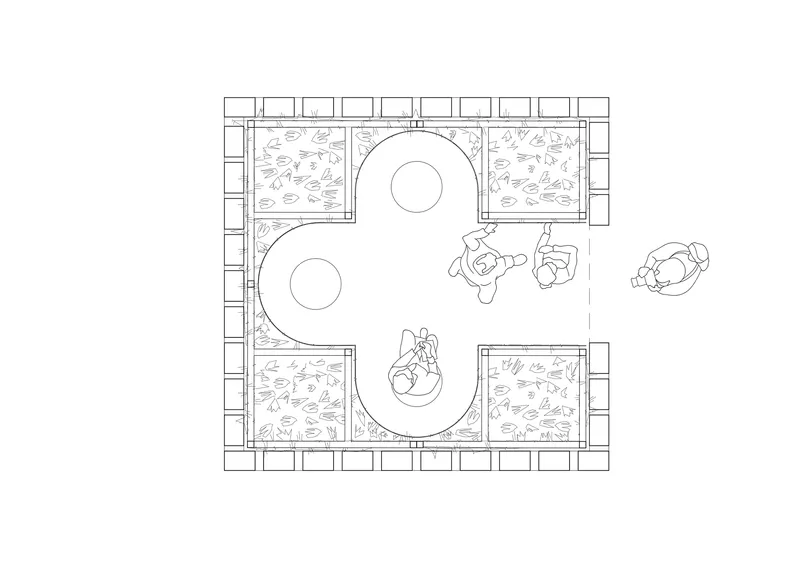

The site plan reveals how the pavilion sits within the broader geometry of Friedrichsplatz, an intentional disruption on an otherwise ordered ground plane. The floor plan clarifies the clover-shaped interior, with planted corners that soften the cubic exterior envelope. In section, the vertical plantings are legible as distinct layers flanking the central coal panels, and the proportions confirm how compact the overall volume truly is.
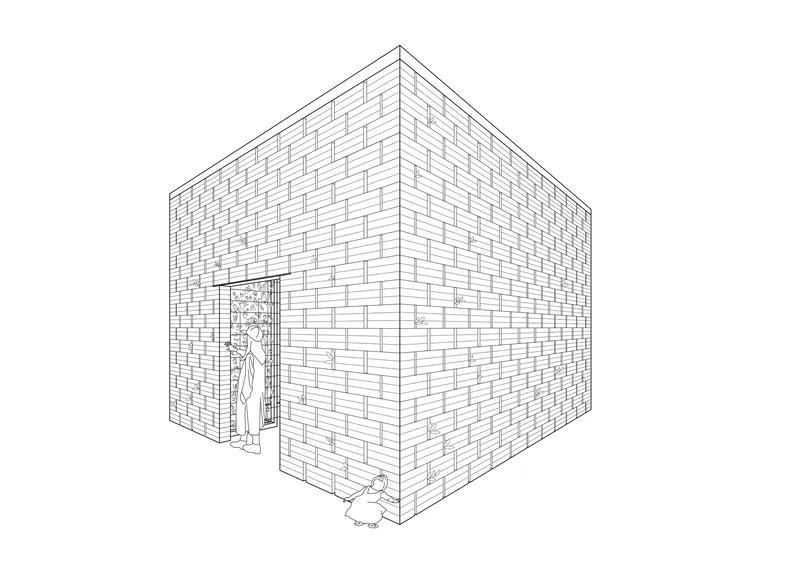

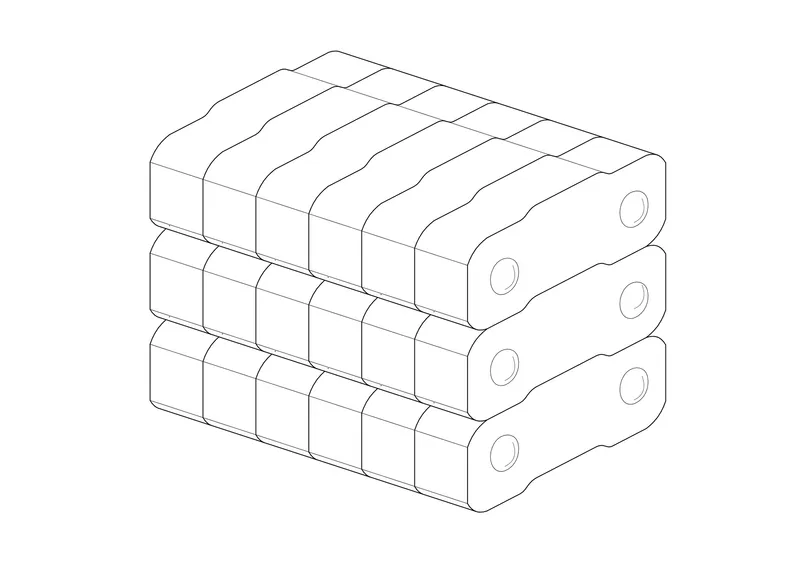
The axonometric drawings are the most revealing. The exploded view shows a masonry base supporting suspended planting systems and a quatrefoil roof opening, making the construction logic transparent. A separate isometric of stacked cylindrical modules, likely the coal briquette units themselves, exposes the elemental repetition that gives the facade its woven character. These drawings do what good architectural representation should: they make the construction argument as clear as the conceptual one.
Why This Project Matters
The Coal Museum matters because it refuses to separate material from meaning. Architecture frequently invokes sustainability through performance metrics, photovoltaic panels, and certification stamps. Christoph Hesse Architects took the opposite approach: they built a structure from the very substance the world needs to stop burning and placed it on a public square where thousands of people would encounter it daily. The argument is literal, physical, and impossible to ignore.
It also demonstrates that architectural provocation does not require massive scale or budget. Sixteen square meters, a single material, and a clear idea produced one of the most talked-about interventions at documenta fifteen. In a discipline that too often equates impact with size, the Coal Museum is a useful reminder that a well-placed, well-built small thing can carry more weight than a building ten times its footprint.
Coal Museum by Christoph Hesse Architects, Kassel, Germany. 16 m². Completed 2022. Photography by Laurian Ghinitoiu.
About the Studio
Share Your Own Work on uni.xyz
If projects like this are the kind of work you want to make, uni.xyz is a place to publish your own, find collaborators, and enter design competitions.


Popular Articles
Popular articles from the community


Architekt Andreas Gruber Scatters 23 Dark Timber Chalets Across a South Tyrolean Forest Edge
In Molini di Tures, Amonti Chalets breaks a resort into a hamlet of gabled timber houses, with parking, storage and services pushed into the slope.

Jaramillo Van Sluys Arquitectura and Urbanismo Turn a Demolished Registry Lot in Quito into an Orchard Plaza
In Quito's Centro Histórico, a 2,800 m² plaza exposes the San Agustín convent wall and redraws its lost Augustinian orchard in volcanic stone.

GROUP A Strips a 1969 Rotterdam Harbor Headquarters to Its Frame and Wraps It in Timber Louvers
In Rotterdam's M4H harbor district, Ferro Offices reuses a 1969 frame, adds one timber storey and reaches BREEAM-NL Outstanding.

Cube Design Draws an Ecological Corridor Between Two Shenzhen Hills with the Nankai Building
Beside Shenzhen's container docks, the Nankai Building pairs stacked balconies with a climbing green screen to connect two hillsides across its height.

Similar Reads
You might also enjoy these articles


LAVA Architecten Gives Vocational Education a Sawtooth-Roofed Face on a Mechelen School Campus
In Mechelen, Belgium, a 2,053 m² STEM school on a 6×6 m grid turns workshops and classrooms into rooms that can be rearranged as teaching changes.

KEMA Studio Turns a Derelict Marvila Attic into a 60 m² Lighthouse Apartment Above Lisbon
In Lisbon's Marvila district, a rebuilt roof, four skylights and two plywood volumes turn an unlivable attic into a bright home facing the Tagus.

Pixel Gardens: One Repeated Module Stacked Into a Terraced Social Housing Tower for Famagusta
Salem Bader's shortlisted housing tower builds a vertical neighbourhood from one repeated module, offsetting units to carve terraces, light and air.

Bao Huynh Watercolor Atelier: A Serene Art Retreat in Hội An
Bao Huynh Watercolor Atelier in Hội An blends multifunctional art spaces, sustainable design, local materials, and family-friendly living in a serene environment.

Explore Cultural Architecture Competitions
Discover active competitions in this discipline

Challenge to design a portable theatre

Challenge to design a portable music platform

Challenge to design an open learning module for the elderly

Bring back Drive In's
Comments (0)
Please login or sign up to add comments
No comments yet. Be the first to comment!