
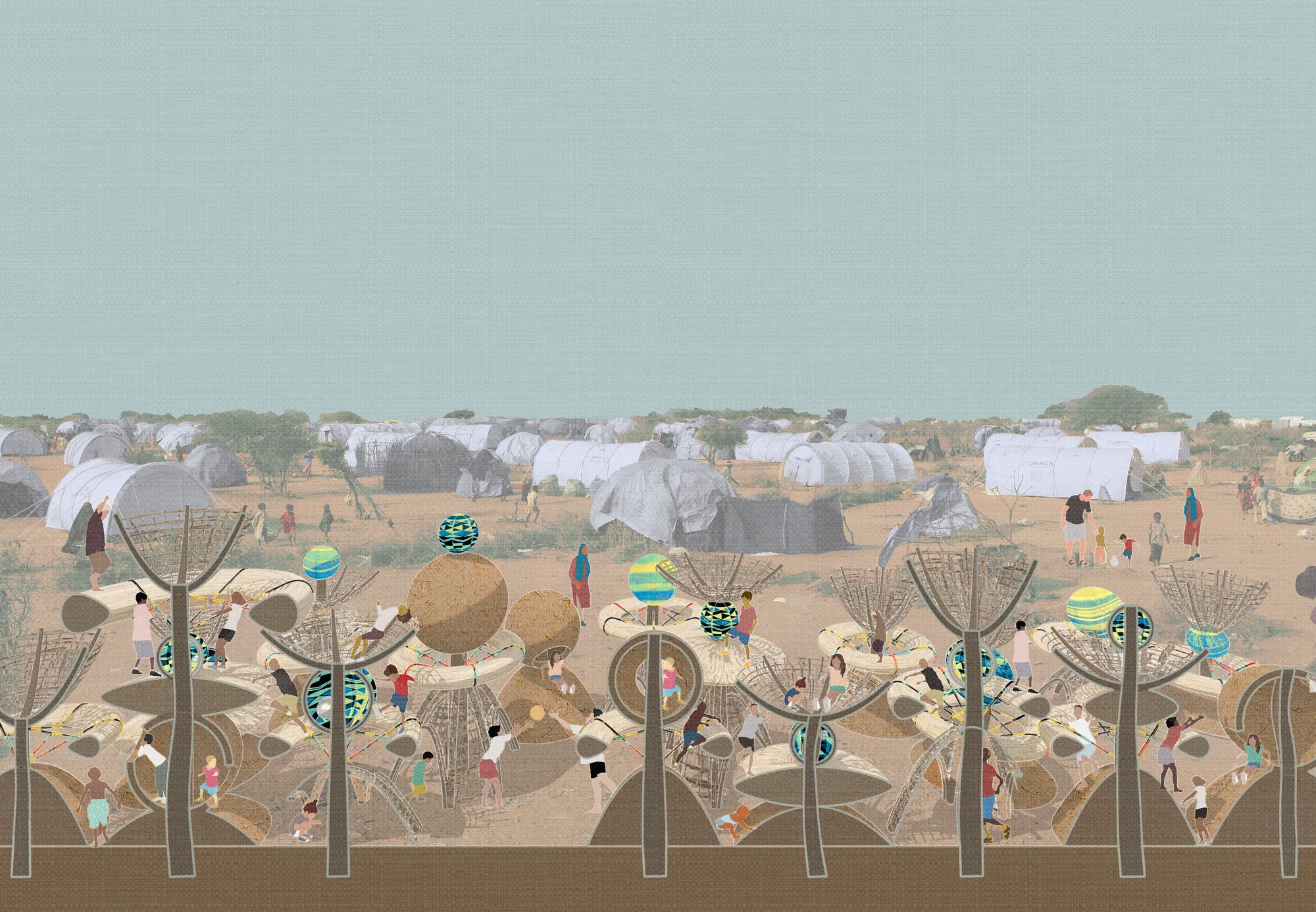
Circles of Life
Playgrounds that strengthen and reconnect the vulnerable refugee community and to rebuild the personal identity of the children in the camps.

Most Somali children growing up in refugee camps in Dadaab have never seen their homeland. They were born and raised in the camps, only to pick up fragmented memories and unclear self-identity from their parents and grandparents. Therefore, the provision of playgrounds in the camps not only aims to contribute to essential balanced developments of the children, but it should also help create a sense of belonging for the camp children and, in turn, bring together and strengthen the vulnerable community ultimately.
Reference to the vernacular
Because of that, the design of the playgrounds refers to vernacular
Somali architecture, Aqals to be exact, in terms of form and construction. They are mainly built with locally available materials and craftsmanship that have been passed on for generations. Materials are not abundant in refugee camps, as the refugees struggle to live. Using local materials, namely wood branches and twigs, earth, reed and grass thatch, and fabrics. They cost virtually nothing as they have been collected from nearby since there are settlements. They are also very environmentally friendly, as they require almost no embodied energy to produce, and leave no trace after demolition.
Built by the community for the community
These play structures are constructed like vernacular Somali huts. Some are made by building a frame of wood and weaving a network of twigs on it, then some are plaster with clay; The others are made of thatch bundles or fabric weaved by the Somali people. This brings us to a more important aspect of the design -- They can be built by the community for the community themselves. Instead of buying foreign materials and products, We can use the donations to hire the refugees themselves to build the structures. Men can erect wooden structures on the sites, while women and children can help with the fabric weaving and earth plastering. Such Engagement will strengthen the community as people work together to benefit their children. Moreover, as the construction method is similar to their cultural practice, it helps the children to inherit the know-how -- and their Identity as Somali people.
Reimagining the modular system
A modular system is needed for the adaptation of the various site conditions in the refugee camps. This design reimagines the modules to be components on columns. First, wooden columns of 2 to 4 meters tall are erected, and then circular elements, such as spheres, cones, disks, and torus, are mounted on the columns. creating totems of concentric circular elements. Different from an ordinary modular system, these columns do not physically connect or form a 3D grid. Instead, they are placed 2m apart from each other in any direction, which creates a zig-zag negative space between them. It is difficult to climb up one column on its own, but it is much easier for children to climb among columns.
The modular systems fit different corners in the camp simply by having different numbers of columns. In the alleyways among dwellings, they can be arranged in 3 columns minimum. For spaces near a school or secondary community centre points, medium clusters of 7-15 columns can be arranged. Lastly, for each of the three refugee camps, there can be a large cluster near the town centre that consists of 25+ columns. Such playgrounds double as a plaza for daily meet and greet and cultural activities, right next to the buzzing markets.
Play experience
With multiple columns, we can create a variety of experiences for the children. They need to crawl, run, climb, jump, balance, slide, and sometimes they need to collaborate to navigate among the columns. Some spaces are as small as 400mm apart, some are more than a meter. It then creates many loops of paths in a 3D space that, though challenging, children can make their way through. There are high points and low points. There are flat grounds and slanted, small surfaces that are difficult to stay on. The different textures of materials stimulate their senses. We believe that such structures are essential for the children's growth, not only does it train them to be physically stronger, but also to be imaginative and collaborative, even competitive at times.
By providing a playground, we hope that it can contribute to the comprehensive balanced development of the children through rich experiences. On top of that, It is also a means to strengthen and reconnect the vulnerable community and to rebuild the personal identity of the children.


Popular Articles
Popular articles from the community

A Contemporary Take on Iranian Residential Architecture
A modern interior design in Mashhad that reinterprets brick, light, and spatial flow to create a warm, contemporary residential architecture.
Solar Steam: A Climate-Responsive Architecture That Redefines the Monument
A climate-responsive memorial architecture that transforms heat, decay, and time into a living system reflecting humanity’s ecological impact.
Gads Hill Early Learning Center by JGMA: Adaptive Reuse Shaping Community-Focused Educational Architecture
Adaptive reuse transforms fragmented structure into vibrant early learning center with playful façade, natural light, and community-focused sustainable design.
Inverted Architecture Installation by Studio Link-Arc: Exploring the Intersection of Architecture and Living Organisms
Inverted Architecture Installation by Studio Link-Arc blends mycelium, sustainability, inverted design, ecological cycles, and urban adaptive architecture in Shenzhen.
Similar Reads
You might also enjoy these articles
ORACLE: A Sustainable Memorial Architecture Responding to Climate Urgency
A sustainable memorial architecture in Cairo that transforms climate urgency into spatial experience, urging collective reflection and action
Suspended: Reimagining Paris Through Adaptive Reuse Architecture
A suspended intervention transforms abandoned Paris railways into inclusive, adaptive reuse architecture bridging heritage, mobility, and public life.
Solar Steam: A Climate-Responsive Architecture That Redefines the Monument
A climate-responsive memorial architecture that transforms heat, decay, and time into a living system reflecting humanity’s ecological impact.
Rolly: A Modular Approach to Urban Regeneration Architecture on Paris’ Petite Ceinture
A modular urban regeneration architecture project transforming Paris’ abandoned railway into a dynamic, movable and community-driven public space

Explore Architecture Competitions
Discover active competitions in this discipline




The International Standard for Design Portfolios


The Global Benchmark for Architecture Dissertation Awards


The Global Benchmark for Graduation Excellence

Challenge to design a portable theatre
Comments (0)
Please login or sign up to add comments
No comments yet. Be the first to comment!