
Clara Crous Builds Her Own Home in a Catalan Village, and It's All Timber and Plywood
A 235 square meter house in Vilamacolum, Spain, where an architect's personal ambitions shape every beam, shelf, and mezzanine.


Architects building for themselves is a special genre. The constraints are personal rather than diplomatic, the budget is their own, and every decision carries the weight of living with it indefinitely. For Clara Crous Arquitectura, House in Pradet is that project: architect Clara Crous and her partner Carles claimed the last available plot on a street in Vilamacolum, a small village in Catalonia's Alt Empordà region, and set about constructing a 235 square meter home that treats timber not as a material accent but as the entire structural and spatial vocabulary.
What makes the house worth studying is the way it deploys a limited palette of plywood, exposed timber beams, and polished concrete to create a surprising variety of spatial conditions. A double-height living volume anchored by a ladder stair, mezzanines that hover beneath exposed joists, bedrooms carved into niches of built-in shelving: every room reads as a variation on the same tectonic theme without ever feeling repetitive. The house is elevated on columns, organized around courtyard gardens, and oriented to capture the particular quality of afternoon light that defines the Empordà plain. It is a house that knows exactly where it is.
The Double-Height Heart
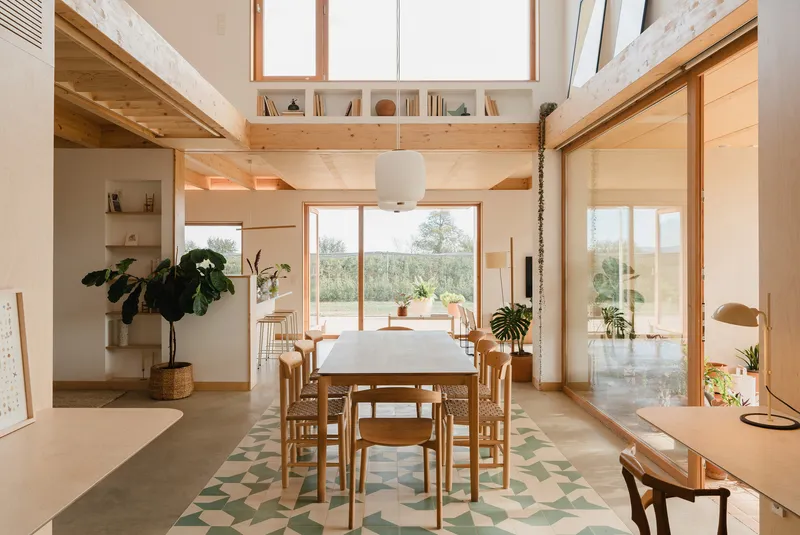
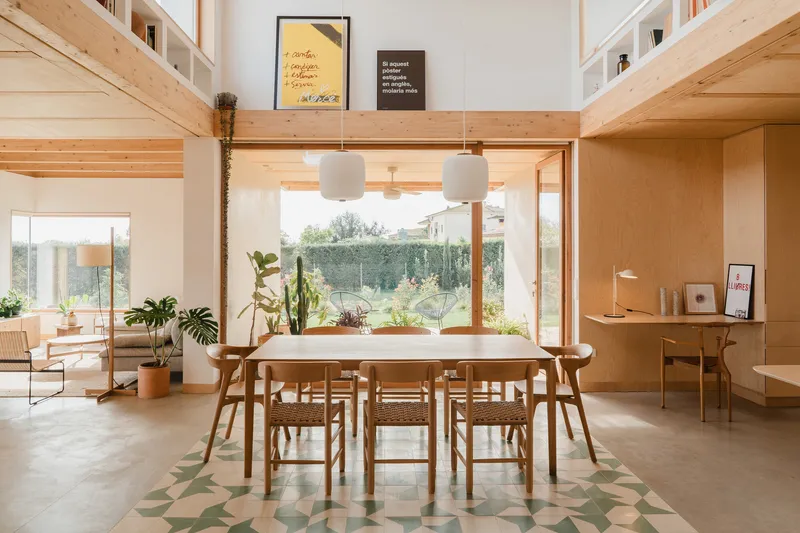
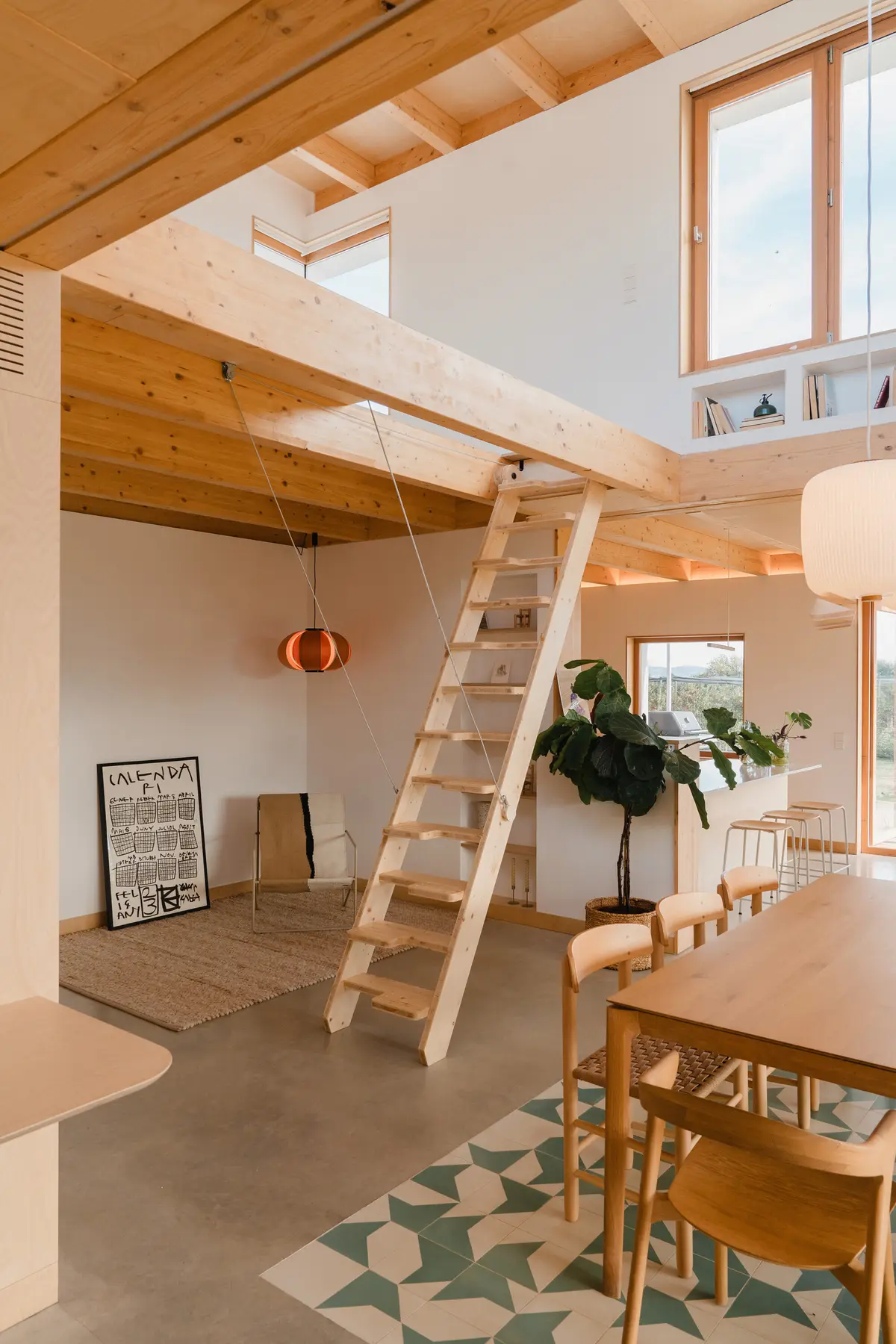
The central living and dining volume is the spatial engine of the house. A double-height space frames the timber structure as openly as possible: exposed beams run the full span, clerestory windows wash light down from above, and a geometric tile rug anchors a dining table beneath pendant lights. The proportions are generous but not lofty. The timber frame keeps the scale warm, and the clerestory prevents the room from feeling like a barn.
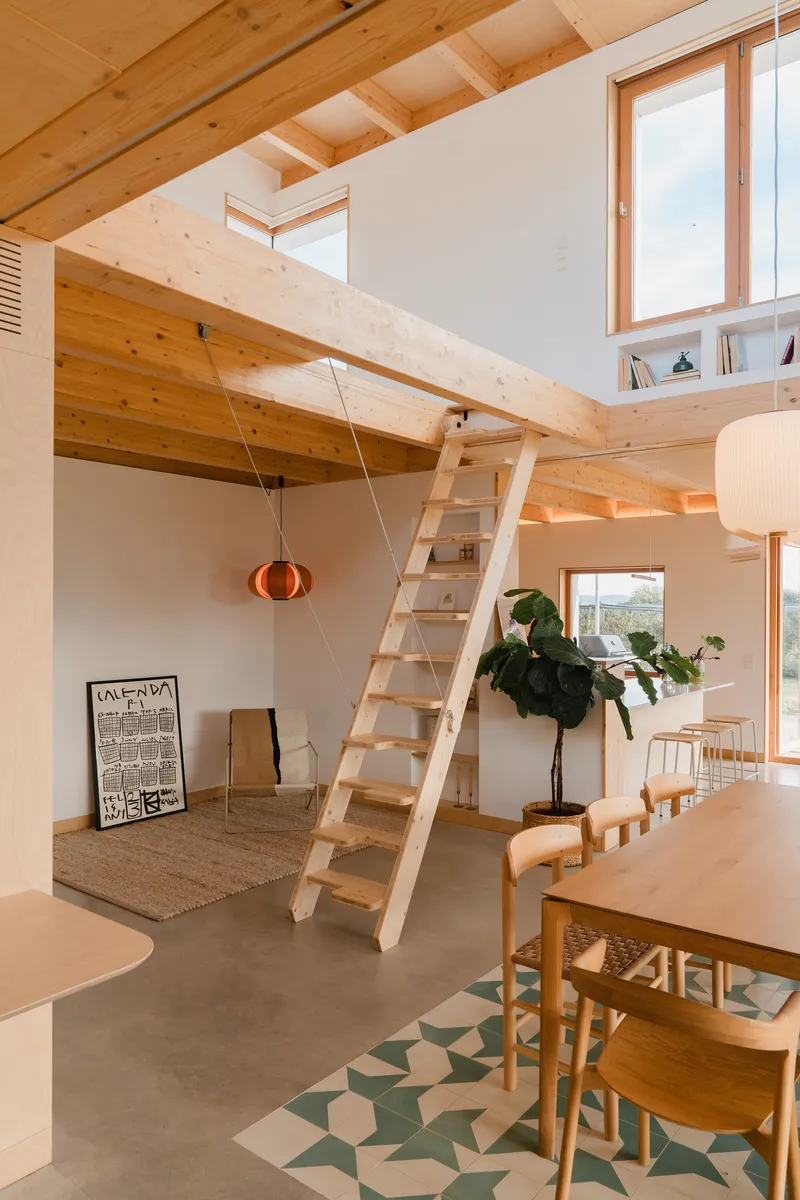
The ladder stair ascending to the mezzanine divides this volume without closing it. You can see through the open treads from the dining area to the upper level, maintaining visual continuity across the section. It is a move that does a lot with very little: one stair, one void, two connected atmospheres.
Plywood as a Complete Language
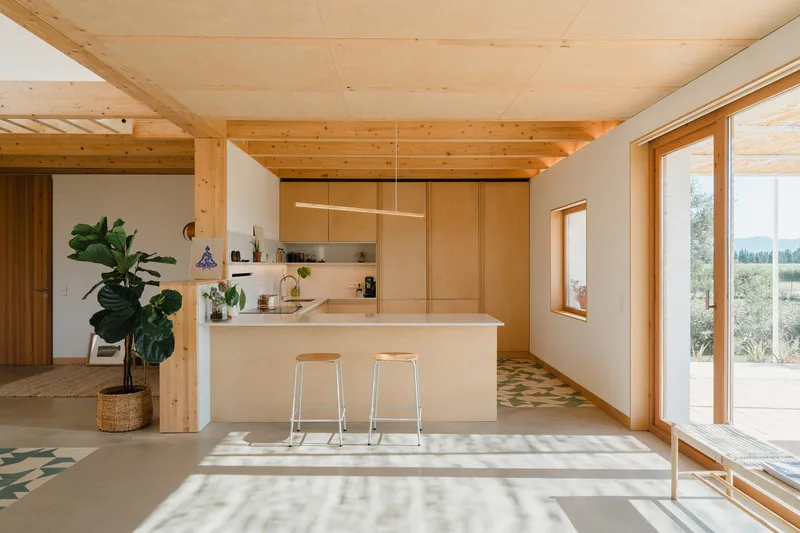
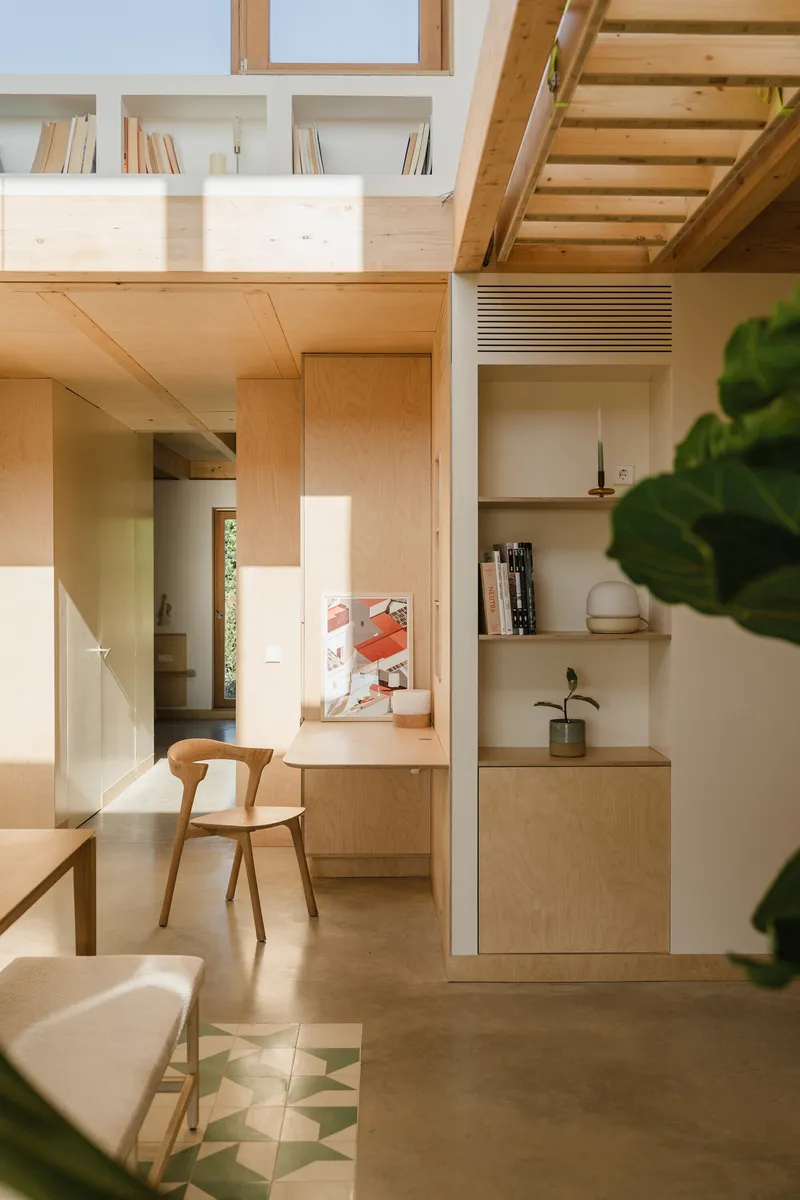
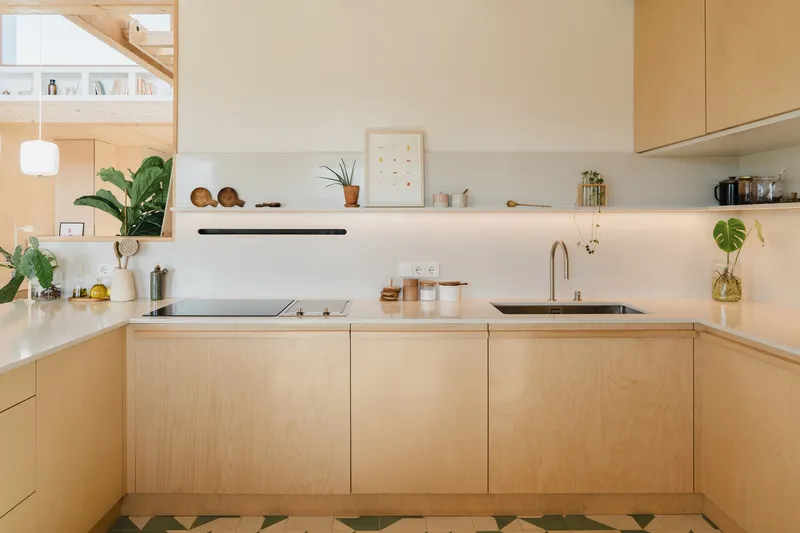
Plywood is everywhere in this house, and it works because Crous uses it with discipline. Kitchen cabinetry, ceiling panels, stair treads, mezzanine floors: all read as parts of a single system rather than isolated applications. The pale wood shifts in tone under changing light, warmer under pendants at evening, cooler beneath the clerestories at midday. Against white walls and polished concrete floors, the plywood provides just enough texture to keep surfaces from going flat.
In the kitchen, a substantial island sits beneath the joisted ceiling, its timber cabinetry meeting geometric floor tiles at a clean threshold where tile gives way to concrete. The transition is deliberate: the tiles signal domestic territory, the concrete signals circulation. Small material decisions like these accumulate into a house that feels considered at every scale.
The Mezzanine and the Ladder Stair
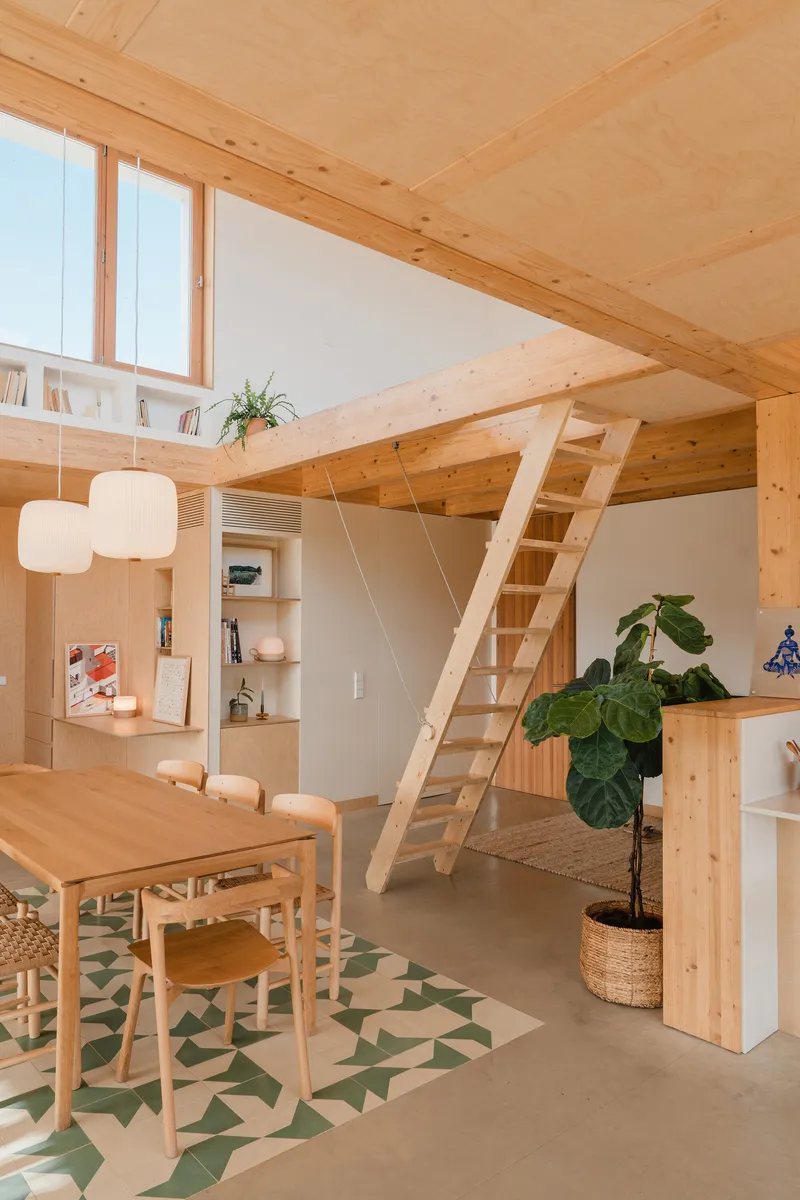
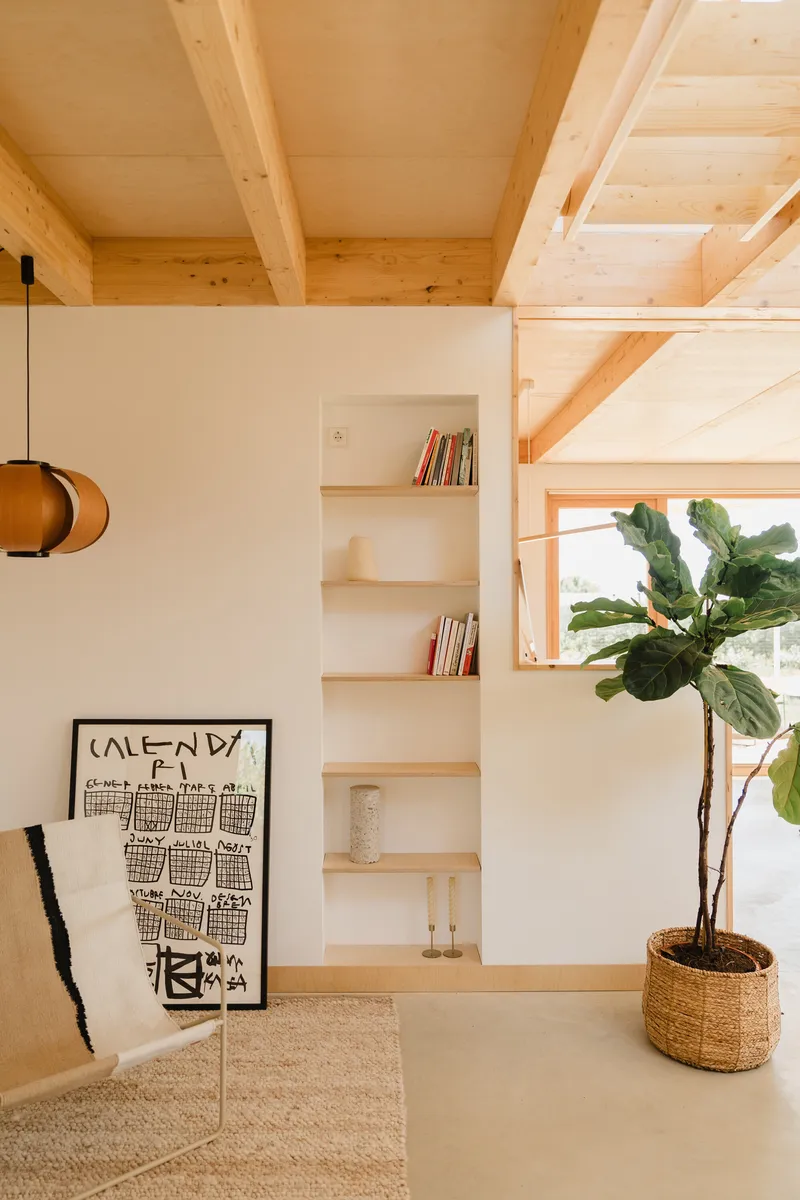
The timber ladder stair is both the most visually striking and most spatially efficient element in the house. Lean and steep, it occupies a fraction of the floor area a conventional stair would claim. Beneath it, Crous carved out a built-in shelving unit that turns residual space into display storage, with a potted fiddle-leaf fig providing a bit of green counterpoint to all the wood.
At the top, the mezzanine tucks under the plywood ceiling and exposed joists, creating a compressed loft condition that contrasts sharply with the double height below. The shift between expansion and compression gives the house a sectional rhythm you don't often find in buildings this modest in size.
Bedrooms as Timber Niches
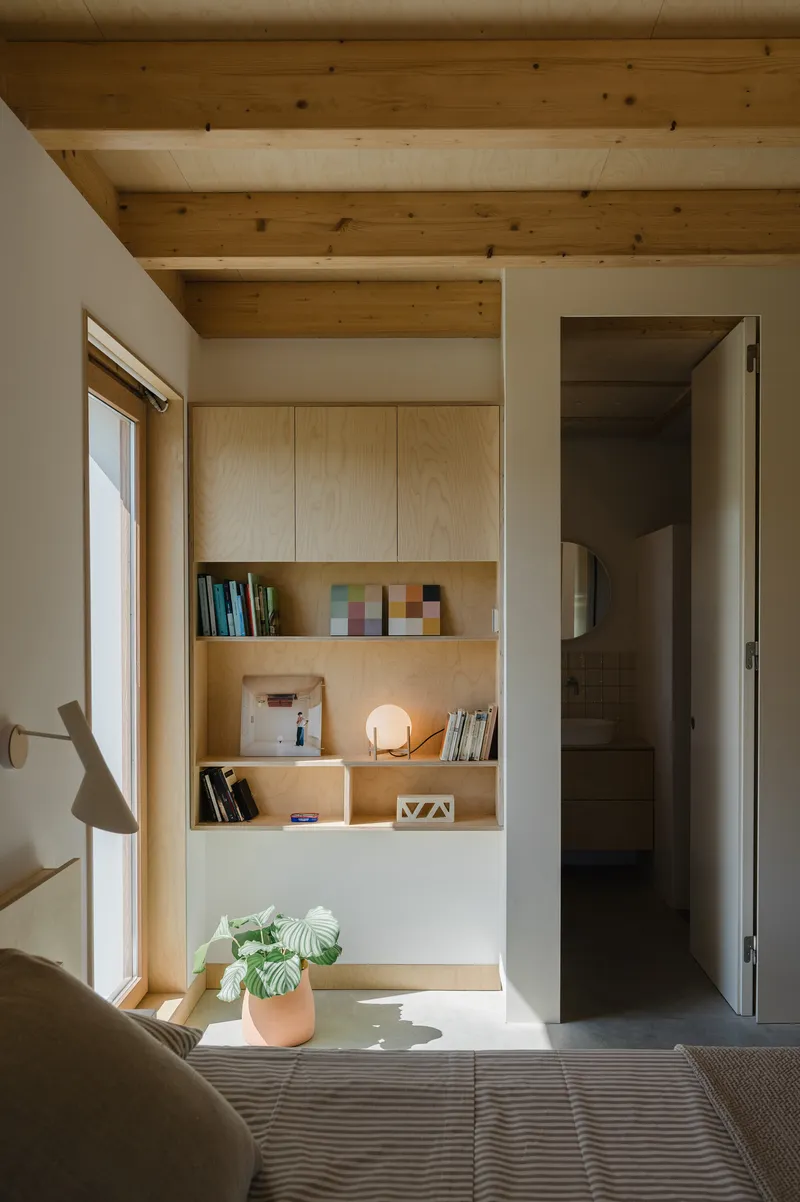
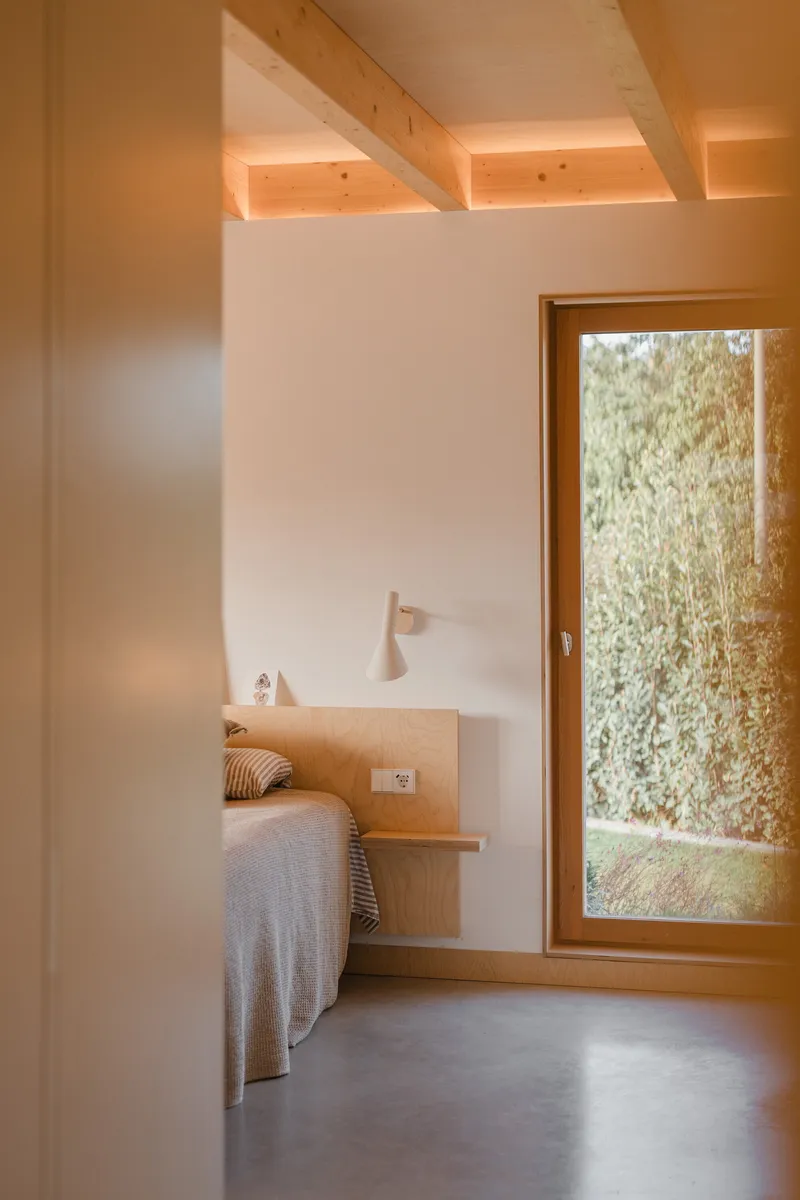
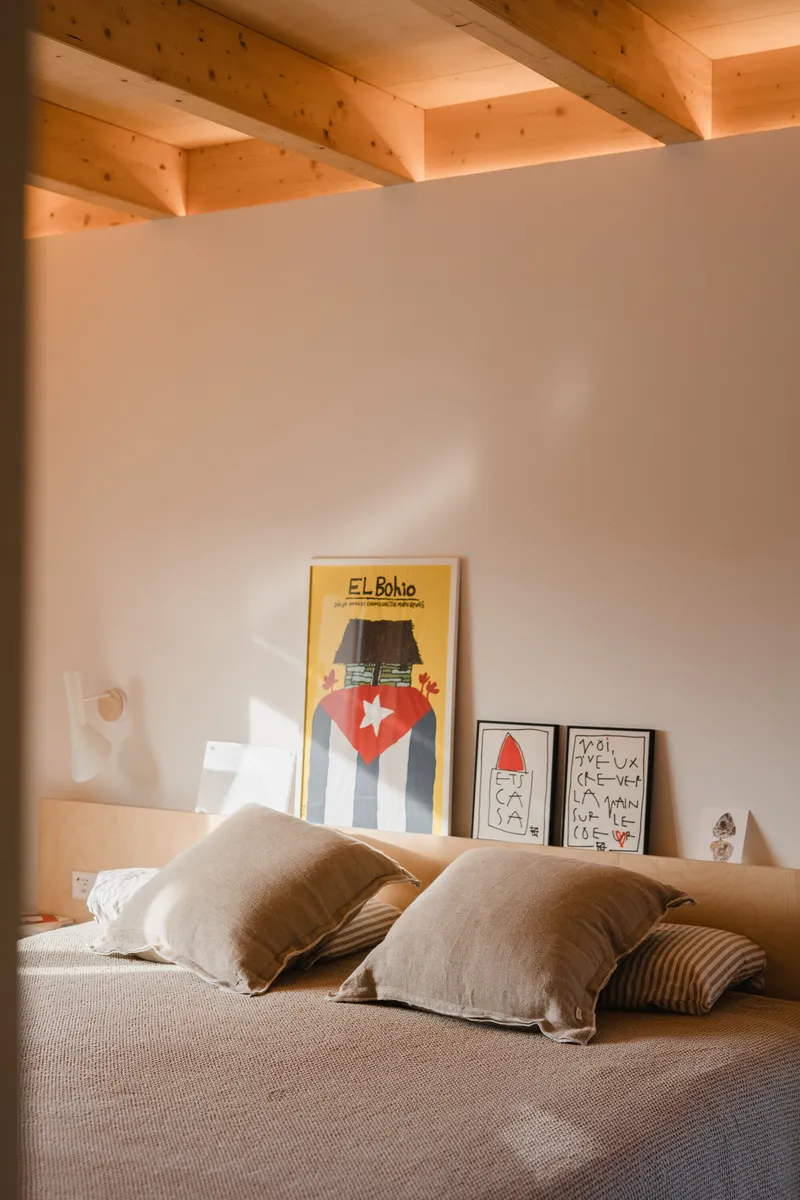
The bedrooms are quieter versions of the same material logic. Plywood bed frames, built-in shelving niches, and timber-beamed ceilings establish a consistent language, while garden-facing windows introduce afternoon sunlight that rakes across surfaces and changes the character of each room over the course of the day. One bedroom features a headboard wall with framed posters beneath exposed joists, lit by indirect cove lighting that softens the wood tones at night.
What works here is the restraint. Every bedroom relies on the same narrow set of materials and details, so the differentiating factor is light and orientation rather than decoration. It is a quietly confident approach that trusts the architecture to create atmosphere.
Built-In Details and Work Spaces
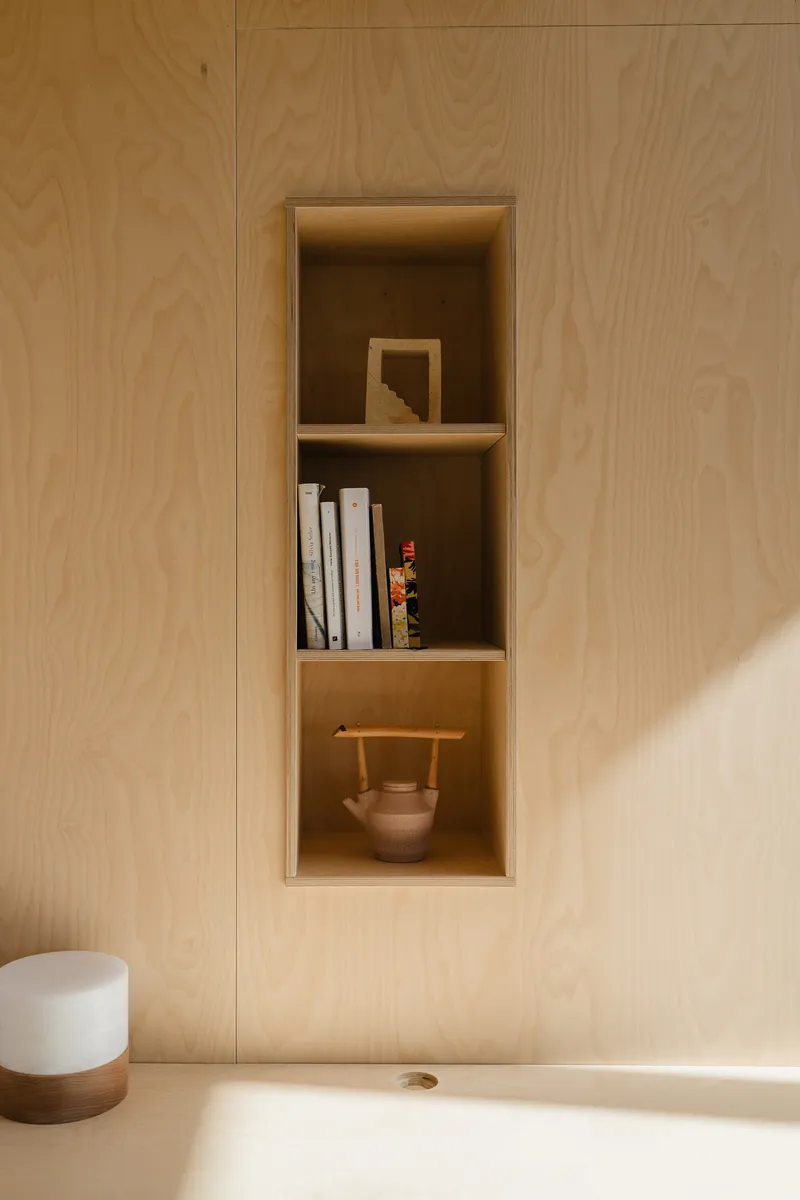
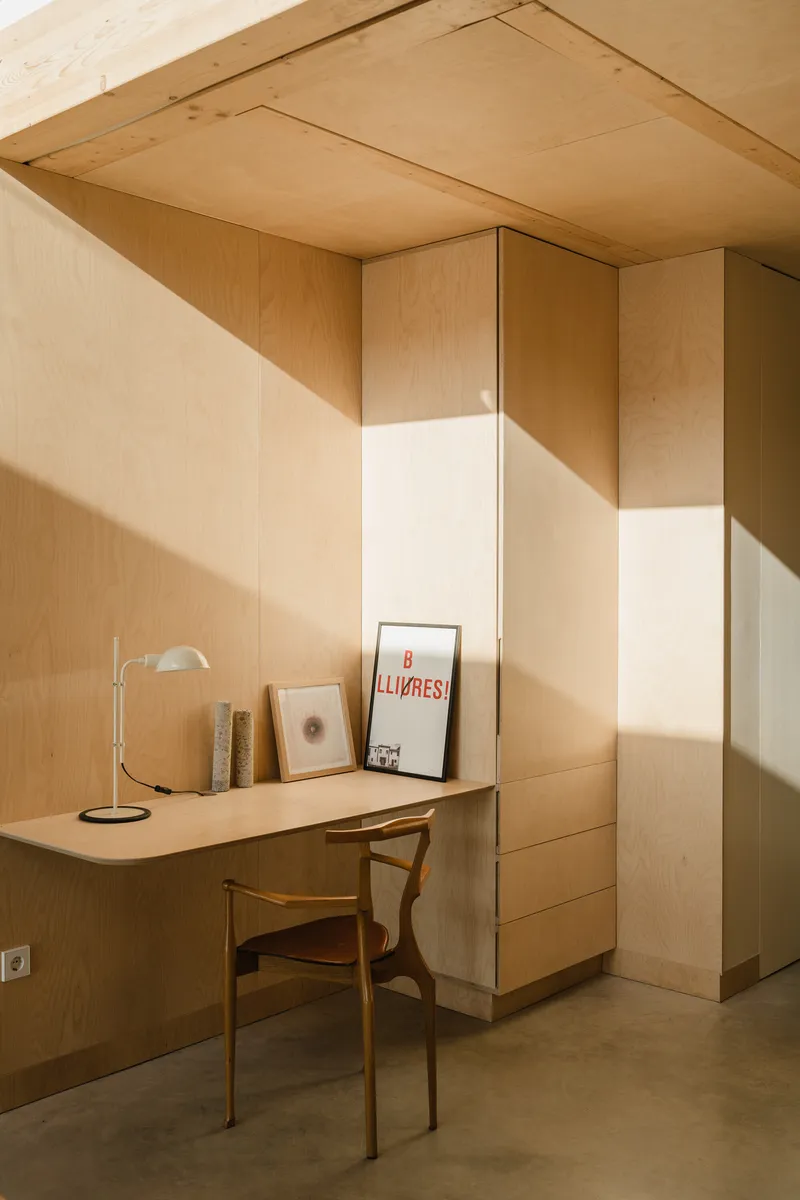
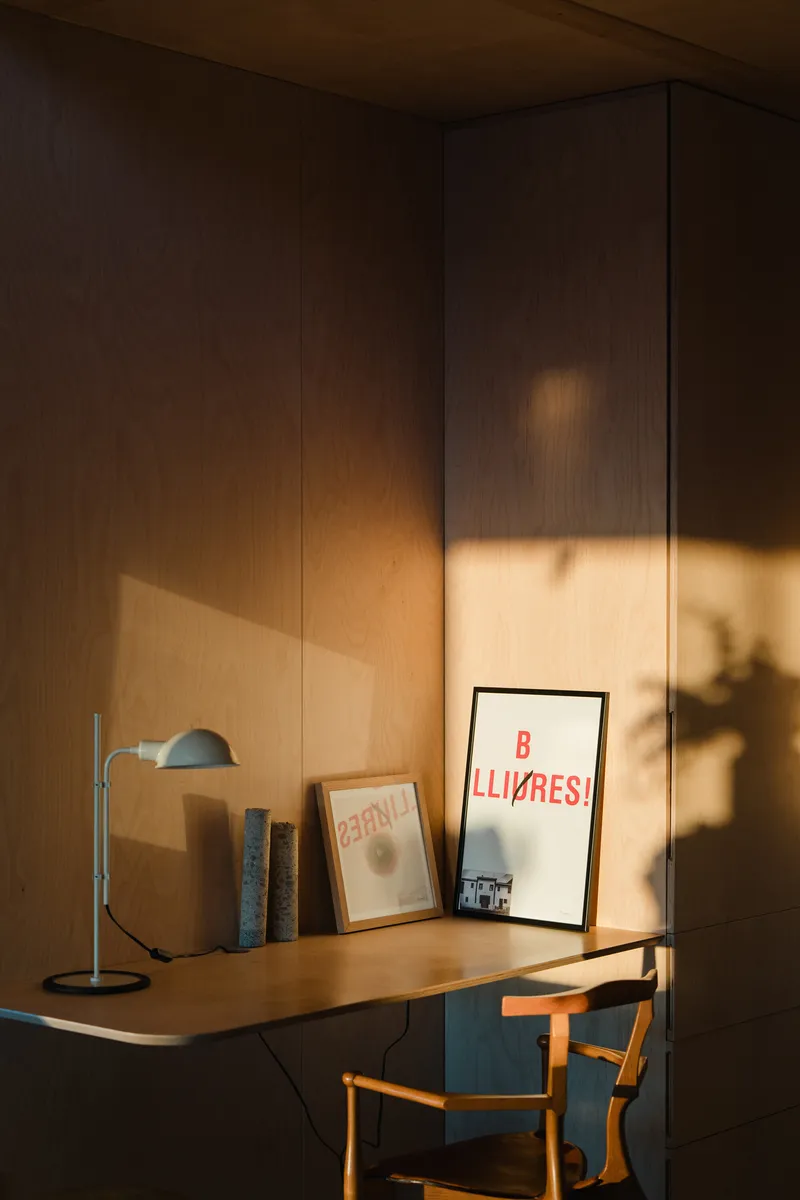
The built-in shelving and desk alcoves throughout the house reveal a careful attention to how people actually use their homes. A plywood desk tucked under the exposed timber ceiling catches warm diagonal sunlight; a shelving niche holds books and ceramics within a pale wood wall panel. These are not afterthoughts or furniture choices but integral parts of the architecture, milled from the same material and aligned with the same logic as the structure.
The desk alcove with framed prints and a desk lamp, lit by golden evening light, is the kind of space that only works because the architect oriented it precisely. It looks accidental; it isn't.
Bathrooms and Light Wells
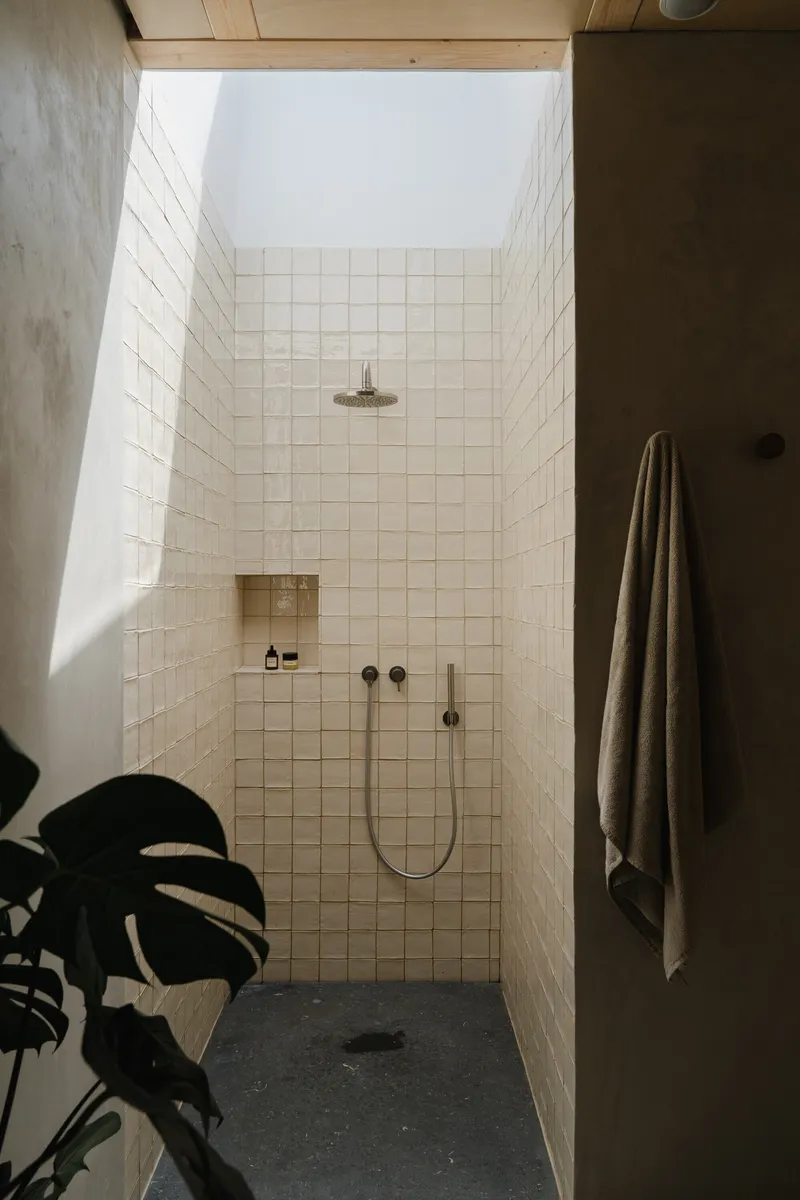
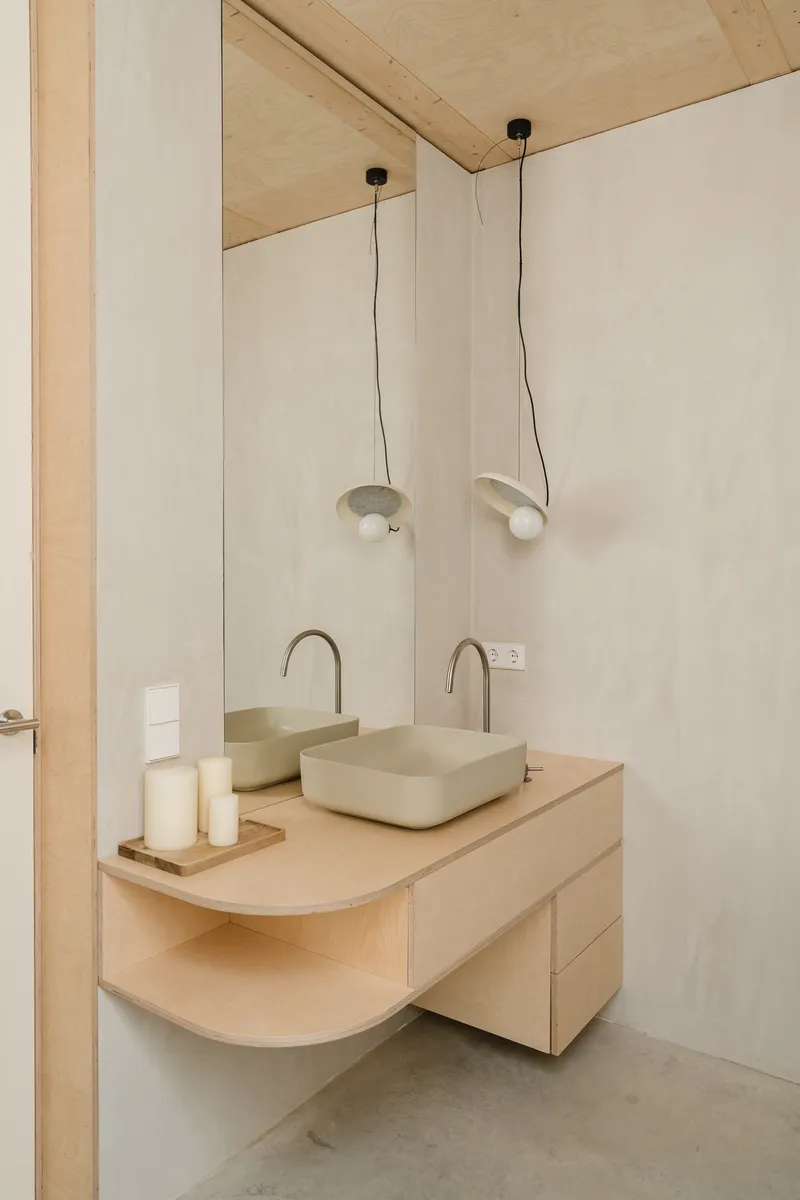
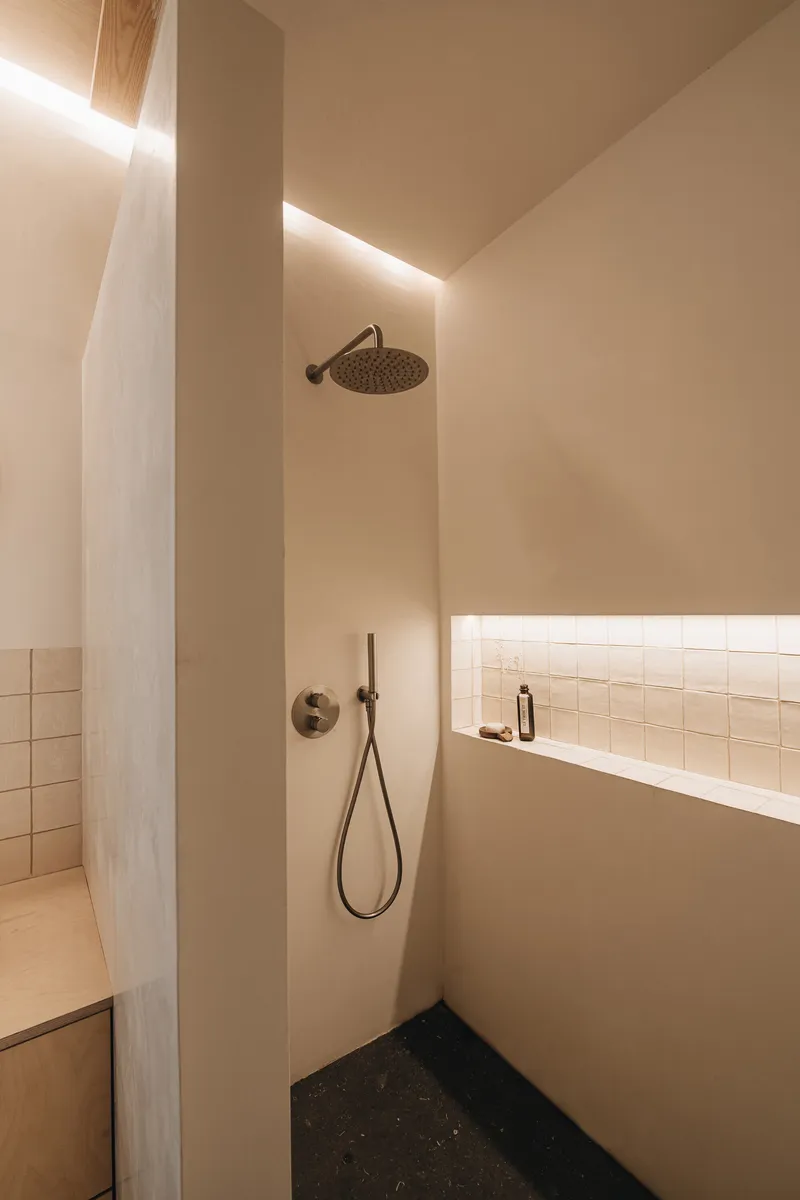
The bathrooms offer the sharpest material contrast in the house. White tiles, polished plaster walls, and vessel sinks in pale green introduce a cooler palette that departs from the pervasive warmth of wood. A skylight above the shower enclosure brings in overhead light and the silhouette of a monstera plant, turning a utilitarian space into something almost tropical.
The vanity with twin vessel sinks sits beneath a curved plywood counter, its pendant lights suspended from the exposed plywood ceiling. It is a moment where the timber language of the house meets the wet-room requirements of a bathroom, and the result is surprisingly seamless. Concealed linear lighting at the ceiling of the shower corner is a subtle detail that prevents the polished plaster from falling into shadow.
The Outdoor Rooms
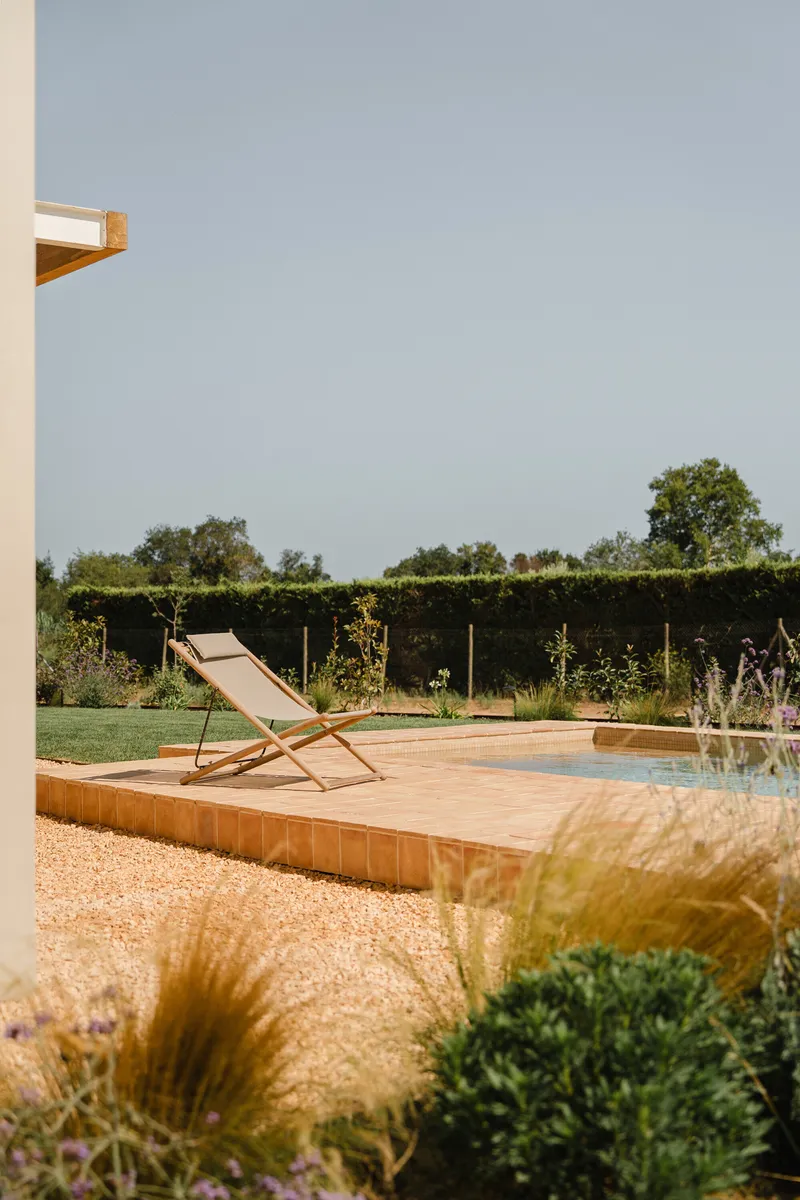
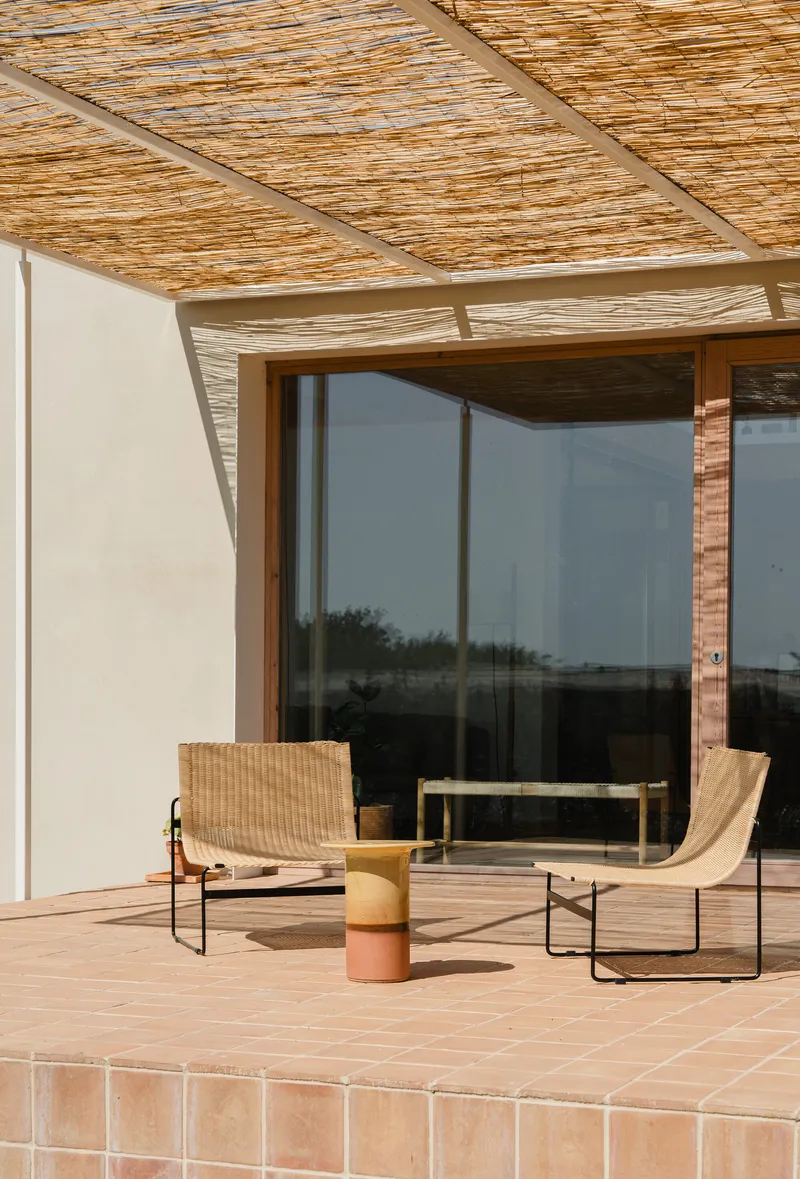
Catalan village houses have always been about the threshold between inside and outside, and House in Pradet handles that threshold with particular care. A timber deck terrace sits beside a gravel garden and hedgerow, providing a raw counterpoint to the polished interior. Woven rattan chairs gather beneath a bamboo slat pergola, filtered light casting striped shadows across the terrace floor. Full-height glazed doors collapse the boundary entirely.
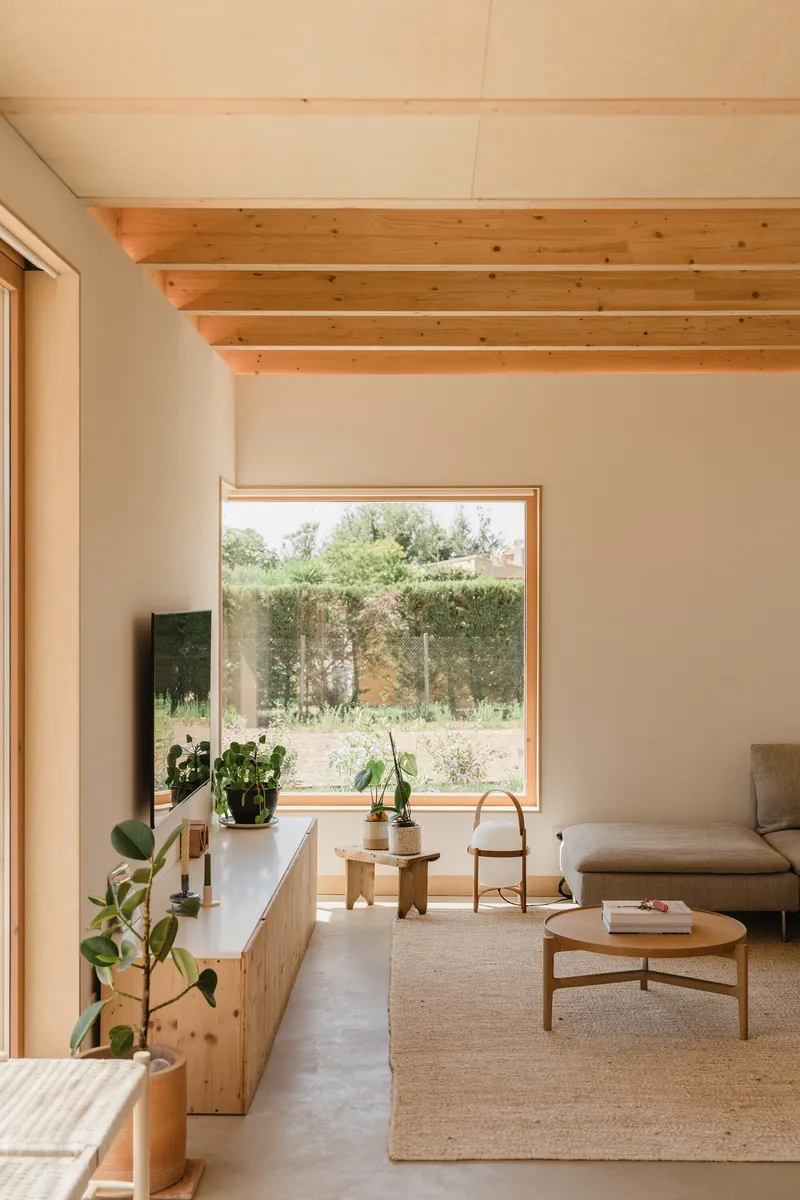
Inside, a picture window in the living room frames the hedgerow and planted garden as a single composed view, low and horizontal, pulling the landscape into the room without sacrificing enclosure. It is a window that acts like a painting: fixed, deliberate, and silent.
Pendant Lights and Vessel Sinks
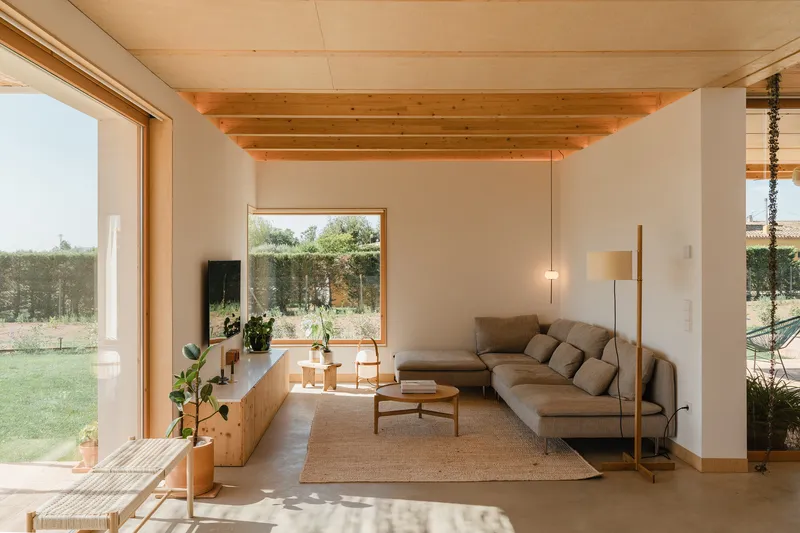
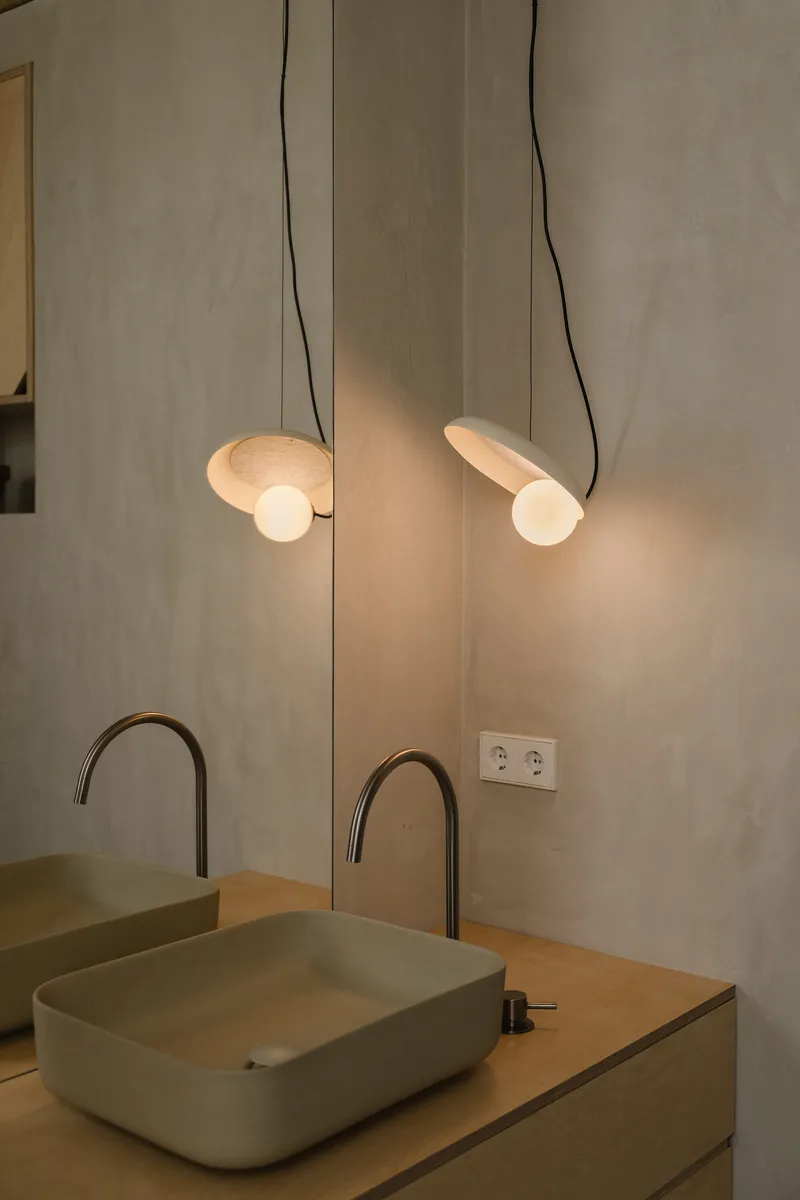
Small moments define the experiential quality of this house. The close-up of illuminated pendant lights above pale green vessel sinks with arched faucets is the kind of image that tells you an architect chose every fixture personally. In the living room, a large window framing the grassy lawn beyond sits beneath exposed timber ceiling beams, each beam casting a shadow that shifts across the wall as the sun moves. These are details that reward daily attention, the domestic equivalent of architecture that ages well.
Plans and Drawings
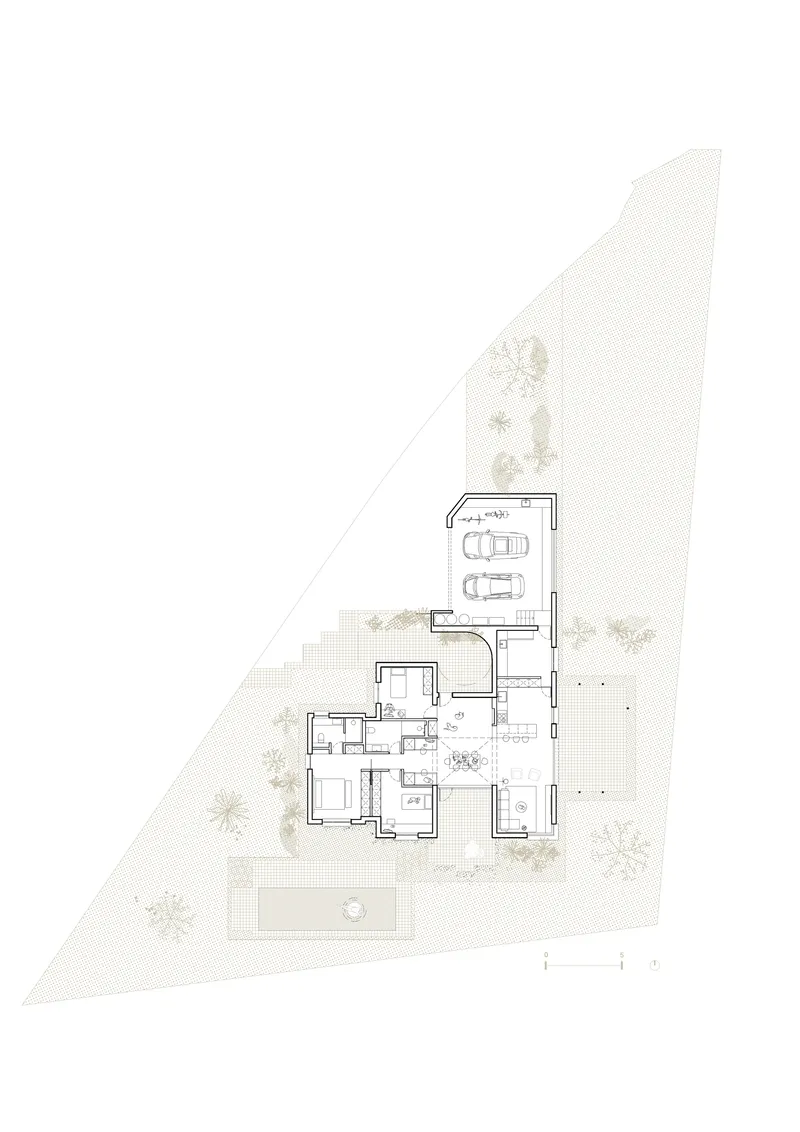
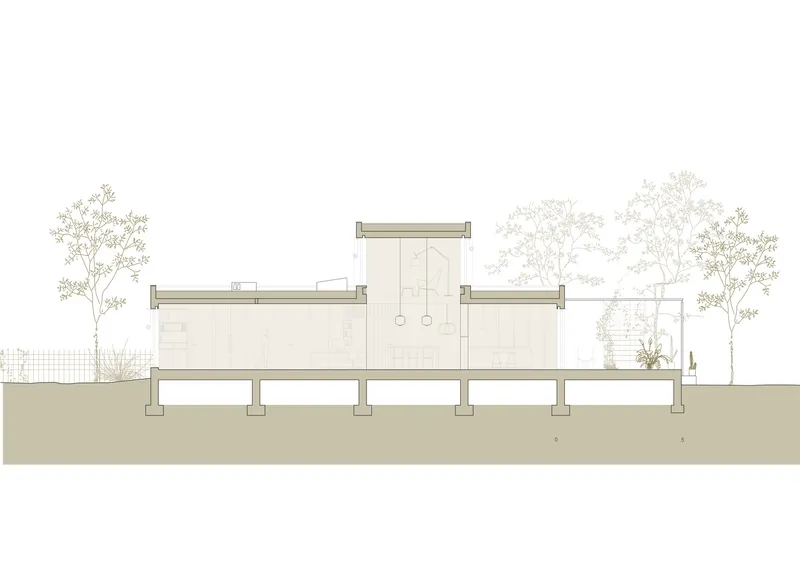
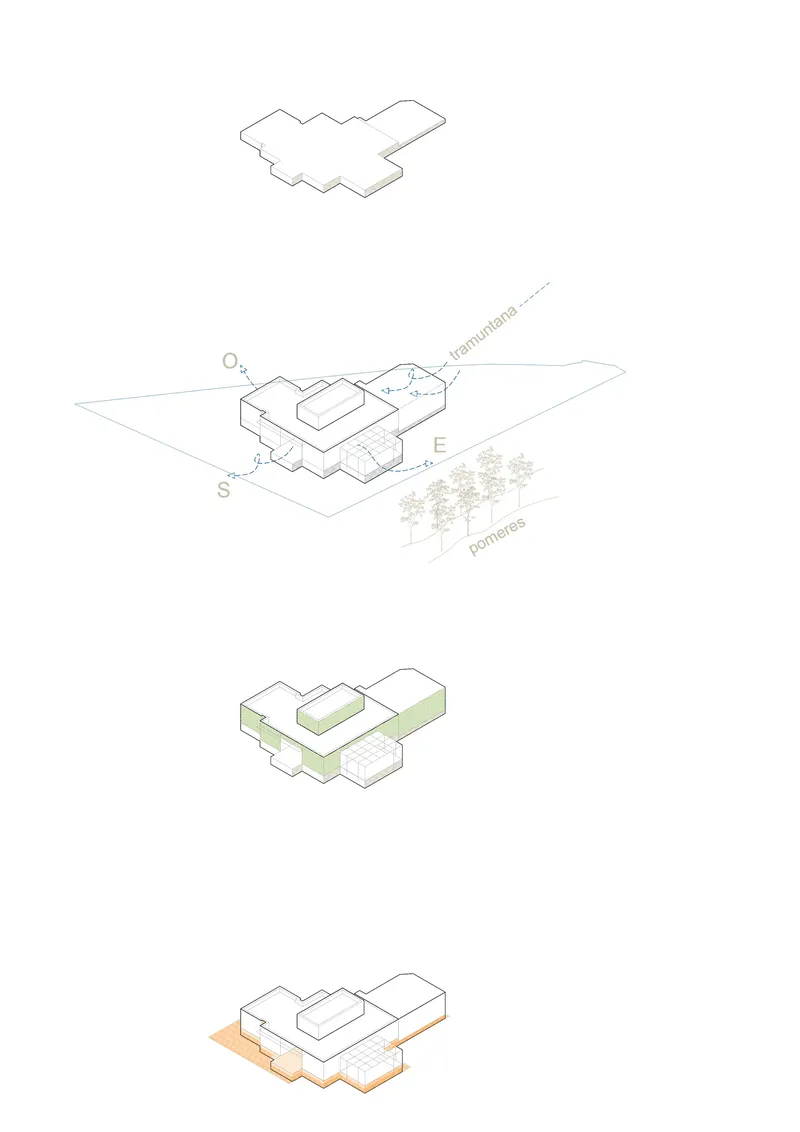
The site plan reveals the organizational logic: the residence, a garage, a courtyard, and a pool are arranged around the plot to maximize garden exposure and privacy from the street. The section drawing shows the house elevated on columns, its volumes lifted above the ground plane with trees providing a layered screen. The relationship between the ground and the elevated floor is a key spatial move, creating shaded areas beneath the house and separating domestic life from the terrain.
The axonometric sequence is especially useful. It peels back layers of the project, from roofscape through site context with labeled orientations down to courtyard gardens and terraced base levels. Reading it from top to bottom, you understand how the project negotiates its village plot: tight to the street, open to the garden, layered in section.
Why This Project Matters
House in Pradet matters because it demonstrates that a disciplined material palette, applied consistently from structure to furniture, can generate genuine spatial richness in a modest house. Crous did not reach for unusual technologies or extravagant geometries. She used timber, plywood, concrete, and careful orientation to build a home that is complex in section, warm in atmosphere, and specific to its Catalan village context. The result is a house that could only be built by someone who planned to live in it.
For architects interested in self-built or self-designed homes, the project offers a useful lesson in commitment. Committing to one material family, committing to exposed structure as spatial character, committing to built-in details rather than freestanding furniture: these are decisions that simplify construction and amplify architecture. In Vilamacolum, on the last available plot, Crous proved that constraint is the best client.
House in Pradet by Clara Crous Arquitectura, Vilamacolum, Spain. 235 m², completed 2024. Photography by Montse Capdevila.
About the Studio
Share Your Own Work on uni.xyz
If projects like this are the kind of work you want to make, uni.xyz is a place to publish your own, find collaborators, and enter design competitions.


Popular Articles
Popular articles from the community


David Ortega Stacks a Two-Story Mexico City Penthouse Around a Steel Stair and a Pergola-Shaded Roof Terrace
In Colonia Roma, a 300 m² penthouse uses oak joinery, a planted steel stair and a slatted roof pergola to make a new-build apartment feel like a house.

Cube Design Draws an Ecological Corridor Between Two Shenzhen Hills with the Nankai Building
Beside Shenzhen's container docks, the Nankai Building pairs stacked balconies with a climbing green screen to connect two hillsides across its height.


Aquadapt: An Underwater Habitat That Rewrites Its Rooms by the Hour
Curved modules ring the seabed while one shell shifts from breakfast room to cinema, farm and football pitch as residents' needs change.

ETEH Reworks the Shared Spaces of São Domingos School in Brazil Around Timber, Color and Hanging Plants
At São Domingos School in Brazil, 436 m² of hall, refectory and library are recast with timber joinery, a yellow and blue code and trailing greenery.

Similar Reads
You might also enjoy these articles

LAVA Architecten Gives Vocational Education a Sawtooth-Roofed Face on a Mechelen School Campus
In Mechelen, Belgium, a 2,053 m² STEM school on a 6×6 m grid turns workshops and classrooms into rooms that can be rearranged as teaching changes.

KEMA Studio Turns a Derelict Marvila Attic into a 60 m² Lighthouse Apartment Above Lisbon
In Lisbon's Marvila district, a rebuilt roof, four skylights and two plywood volumes turn an unlivable attic into a bright home facing the Tagus.

Pixel Gardens: One Repeated Module Stacked Into a Terraced Social Housing Tower for Famagusta
Salem Bader's shortlisted housing tower builds a vertical neighbourhood from one repeated module, offsetting units to carve terraces, light and air.

Bao Huynh Watercolor Atelier: A Serene Art Retreat in Hội An
Bao Huynh Watercolor Atelier in Hội An blends multifunctional art spaces, sustainable design, local materials, and family-friendly living in a serene environment.


Comments (0)
Please login or sign up to add comments
No comments yet. Be the first to comment!