

Clark University’s Center for Media Arts, Computing, and Design: A Future-Ready Hub for Innovation and Creative Technology
Clark University’s CMACD is a flexible, tech-driven academic hub merging media arts, game design, and computing in a sustainable, collaborative environment.


Designed by award-winning architecture firm Ayers Saint Gross, the Center for Media Arts, Computing, and Design (CMACD) at Clark University stands as a landmark facility blending game design, computing, digital media, and the arts into one collaborative academic environment. Completed in 2023, the 70,000-square-foot building establishes a new standard for interdisciplinary learning, advanced technology integration, and sustainable campus development in Worcester, Massachusetts.
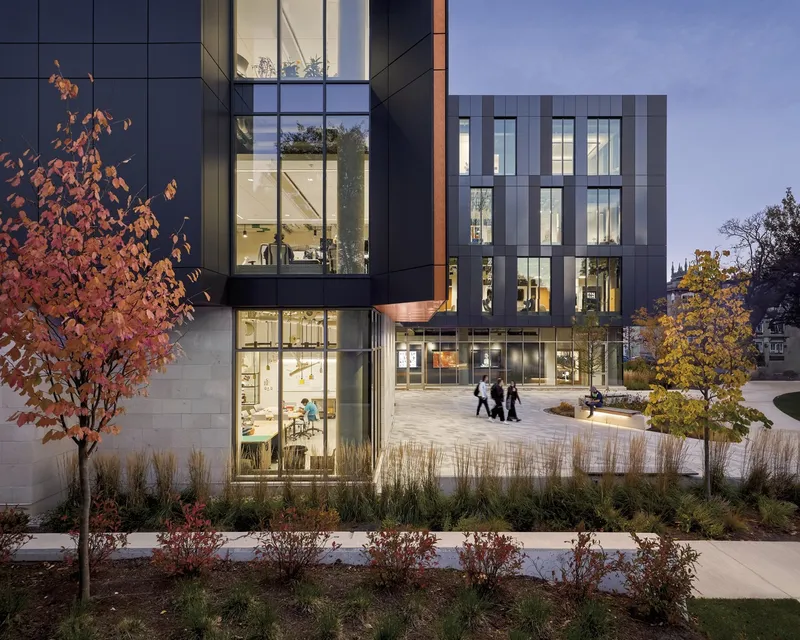
A Cross-Disciplinary Hub for Creative Learning
The CMACD was conceived to unite the university’s emerging technology and design programs — including the recently acquired Becker School of Design & Technology, one of the nation’s top game design schools — with the Departments of Computer Science and Visual & Performing Arts. The result is a dynamic, future-ready academic center that allows students and faculty to collaborate, innovate, and experiment across shared disciplines.
From early concept to final design, Ayers Saint Gross engaged a wide group of faculty, students, researchers, and industry partners. This inclusive approach ensured the building responds to diverse learning styles, evolving technological needs, and the university’s academic goals for next-generation digital education.
Flexible, Inclusive, and Technology-Driven Spaces
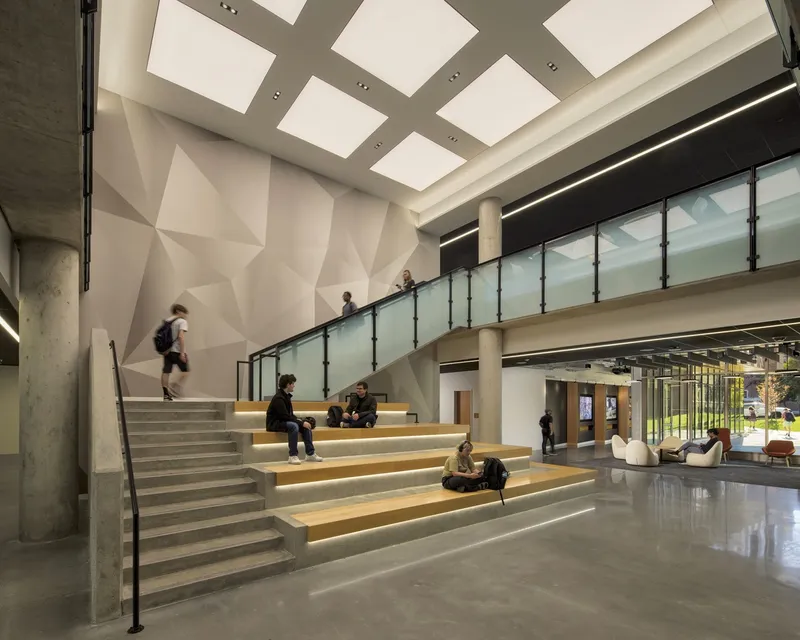
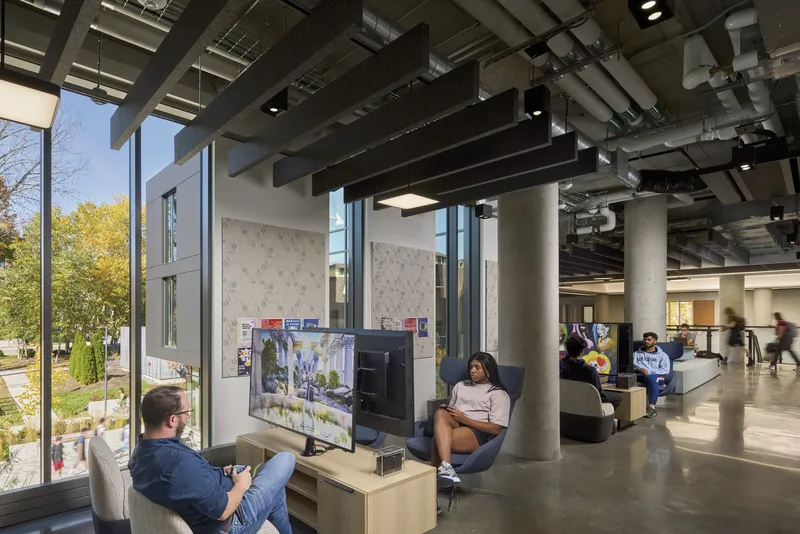
The Center prioritizes accessibility, adaptability, and inclusivity, offering flexible learning environments that support hands-on and experiential teaching methods. Strategic glass reveals and open sightlines create visual connections between floors and departments, encouraging transparency and cross-disciplinary interaction.
Key program spaces include:
- Digital Media Gallery showcasing student work through immersive, high-resolution displays
- Video Game Library for research, study, and play-testing
- Robotics Lab & Data Science Lab supporting advanced computing and engineering exploration
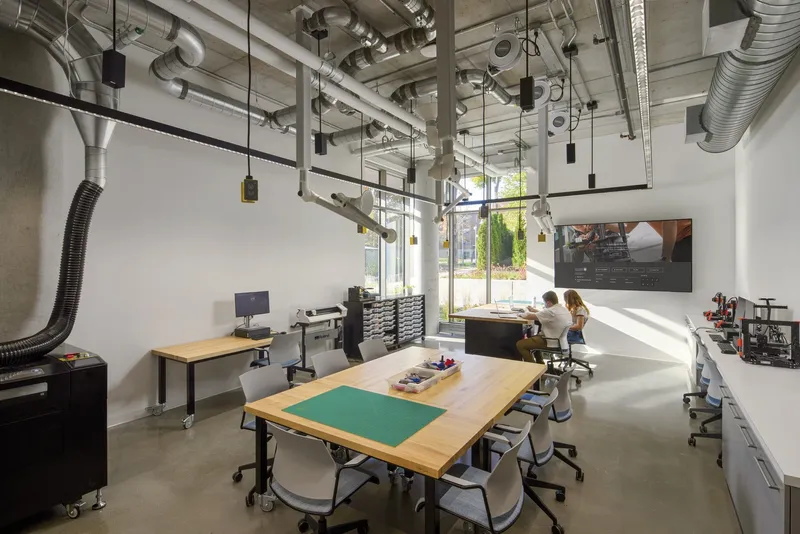
- Maker Space & Incubator Space for prototyping, fabrication, and entrepreneurship
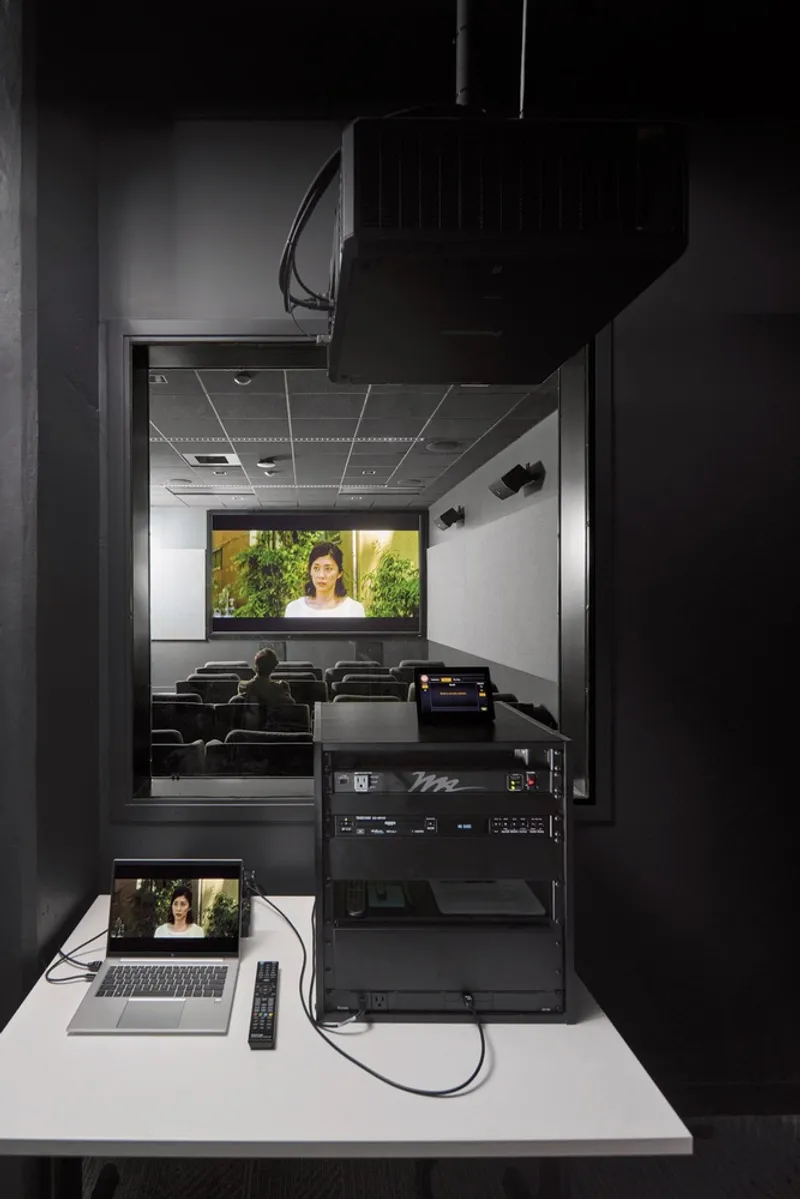
- A/V Production & Recording Studios designed for film, sound, and digital content creation
- Flexible Classrooms & Collaboration Zones with adaptive technology, real-time visualization tools, and interactive learning features
Each space is designed to evolve with changing technologies, allowing Clark University to continue expanding its digital and creative programs in the decades ahead.
Architectural Identity Rooted in Campus Context
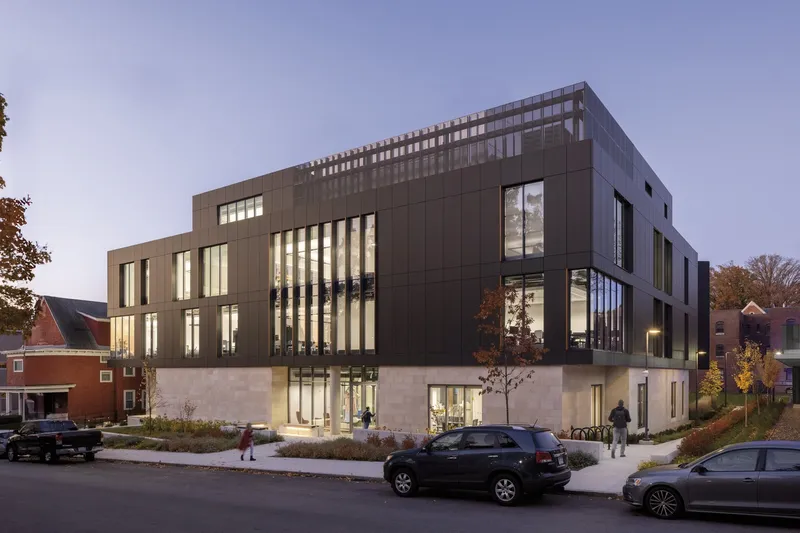
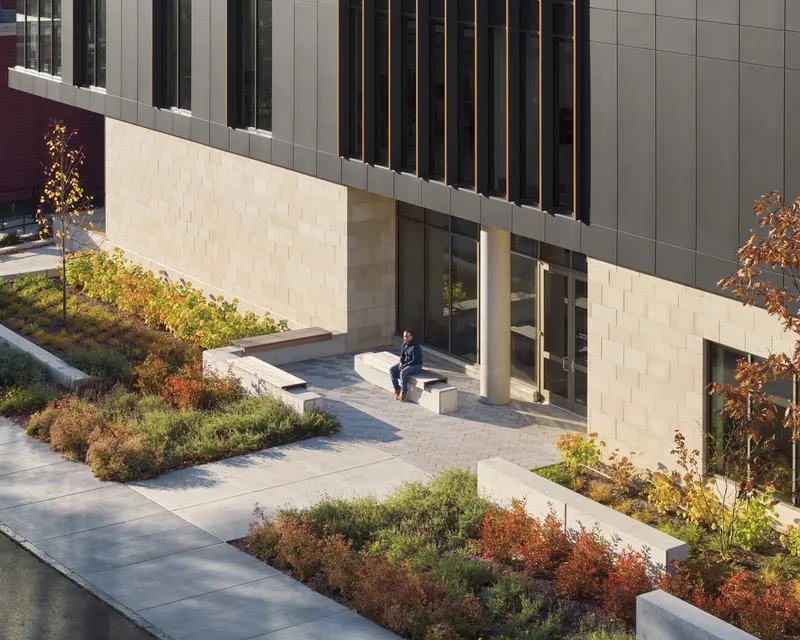
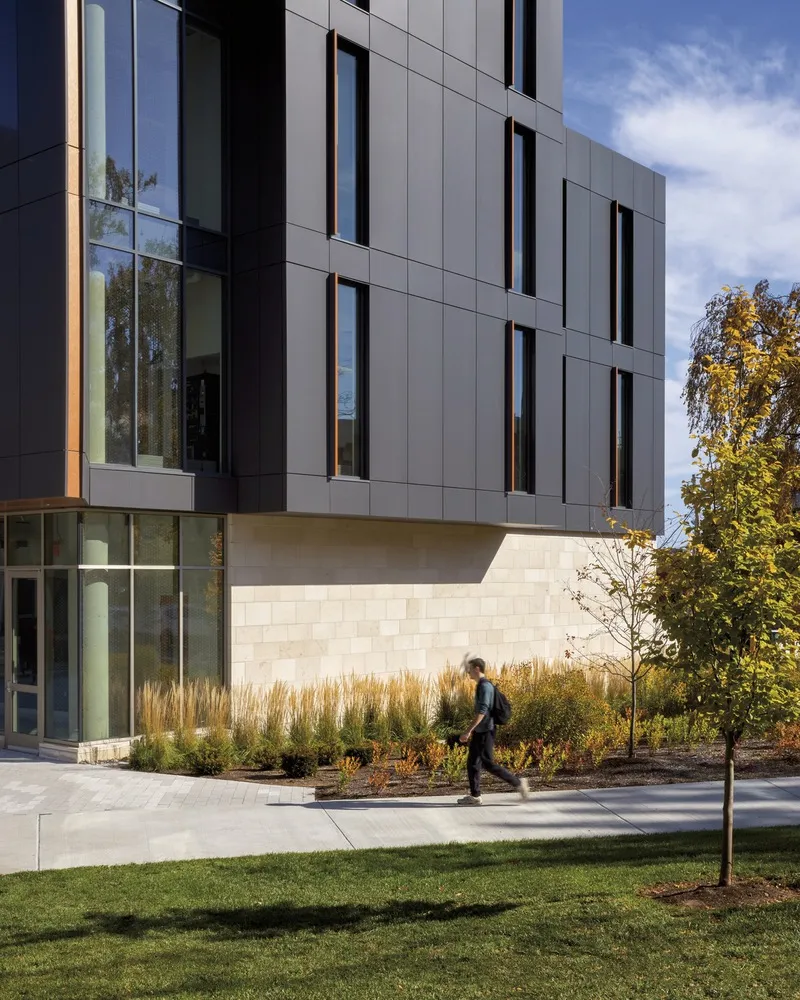
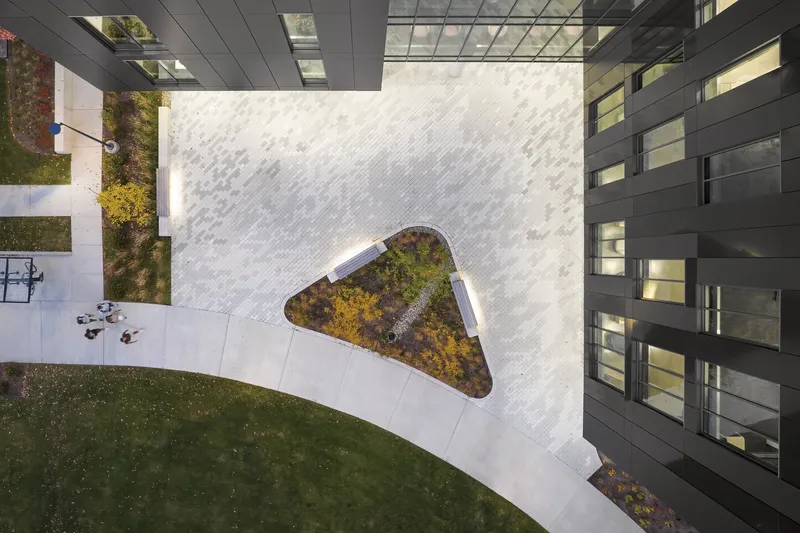
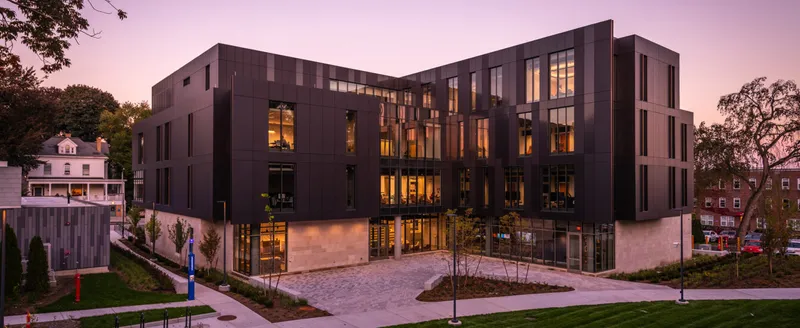
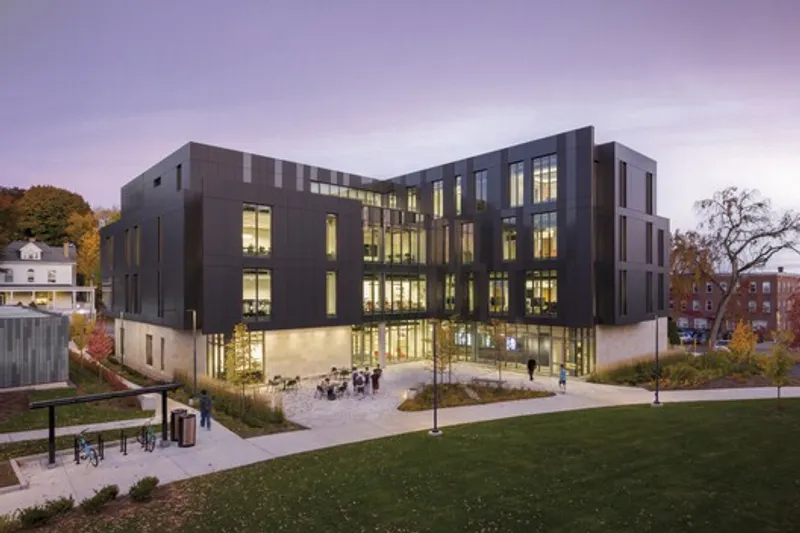
The building’s exterior features a contemporary palette of matte black composite metal panels accented with glossy highlights. Copper cladding frames major entrances, adding warmth, while the honed limestone base visually connects the building to the historic campus fabric.
Inside, the architectural language is intentionally neutral — polished concrete, minimalist finishes, and a restrained color palette — creating a gallery-like backdrop that allows student creativity to take center stage. Additional design elements include:
- Acoustically optimized spaces with specialized flooring and wall panels
- Carpet patterns inspired by circuit boards, reflecting the facility’s technological focus
- Pixel-like glazing frit patterns that reference digital media and computing
- Floor-to-ceiling windows maximizing daylight and supporting biophilic design principles
These choices balance technical performance with aesthetic impact, creating an inspiring and adaptable learning environment.
Site Sensitivity and Campus Integration
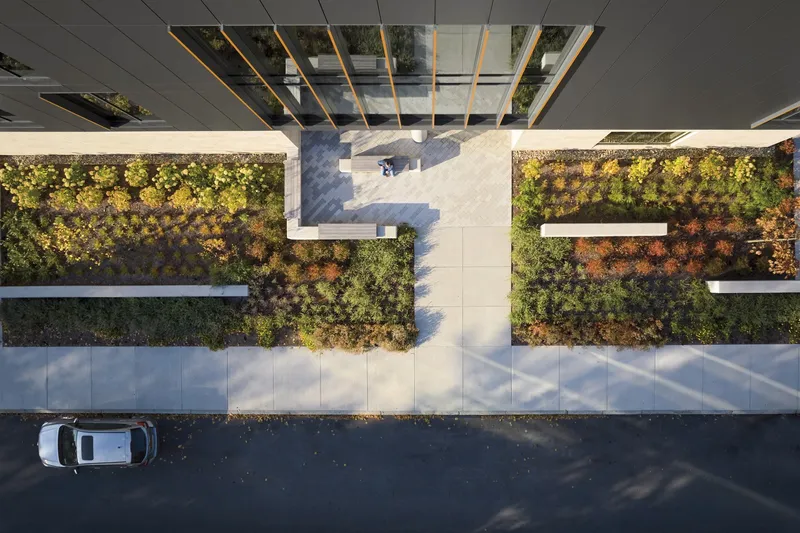
Ayers Saint Gross tailored the building’s massing and urban presence to fit harmoniously within the campus and its residential surroundings. The upper floors are recessed, allowing the five-story structure to read visually as three stories, preserving neighborhood scale. Transparent ground-floor elements and landscaped outdoor areas further strengthen the connection between the university and community.
The outdoor spaces feature:
- Cast-in-place concrete seat walls
- Wood-topped benches with integrated lighting
- Plantings that maintain visual interest year-round
These landscape choices echo the building’s linear architectural rhythm and provide inviting places for social interaction, study, and events.
A LEED Gold Sustainable Landmark
The CMACD is one of the university’s most sustainable buildings, earning LEED Gold certification through a combination of energy efficiency, responsible land use, and material conservation.
Key sustainability features include:
- Geothermal well field supplying operational energy with zero on-site combustion
- Green roof reducing heat island effect and improving stormwater performance
- Efficient irrigation system reducing outdoor water use by 51%
- Low-flow fixtures reducing indoor water consumption by 22%
- 18% reduction in embodied carbon through responsible material sourcing
- Low-emitting materials and ample daylight supporting healthy indoor air quality
Transforming the former parking lot into a high-performance academic facility demonstrates Clark University’s commitment to environmental stewardship and long-term campus resilience.
Shaping the Next Generation of Innovators
As home to one of the nation’s premier game design and technology programs, the Center for Media Arts, Computing, and Design provides Clark University with a flexible, future-focused learning environment that empowers students to push creative boundaries. By integrating architecture, technology, and pedagogy, Ayers Saint Gross has delivered a building that not only supports today’s academic needs but anticipates the innovations of tomorrow.
All photographs are works of Kroo Photography


Popular Articles
Popular articles from the community


Architekt Andreas Gruber Scatters 23 Dark Timber Chalets Across a South Tyrolean Forest Edge
In Molini di Tures, Amonti Chalets breaks a resort into a hamlet of gabled timber houses, with parking, storage and services pushed into the slope.

Juan García Correa, John González and Claudia Rueda Sink a Circular Amphitheater into a Manizales Engineering Building
On the La Nubia campus in Manizales, Colombia, the S1 Building folds labs and offices into a hillside of ramped lawns that double as a campus route.

Jaramillo Van Sluys Arquitectura and Urbanismo Turn a Demolished Registry Lot in Quito into an Orchard Plaza
In Quito's Centro Histórico, a 2,800 m² plaza exposes the San Agustín convent wall and redraws its lost Augustinian orchard in volcanic stone.

Cube Design Draws an Ecological Corridor Between Two Shenzhen Hills with the Nankai Building
Beside Shenzhen's container docks, the Nankai Building pairs stacked balconies with a climbing green screen to connect two hillsides across its height.

Similar Reads
You might also enjoy these articles


Hodi-Mandai Geram
Project Function: Preservation and revitalization of the Intangible heritage and socio-spatial identity of the Hodi by Housing, Cultural Memory Center, Sacred Grove, landscape, local tourism economy


Olio Towers: A Mid-Rise for Performers That Fuses Housing, Rehearsal, and Stage
Located blocks from Houston's Theater District, this modular tower stacks living units around a central performance atrium.

Oasis: Modular Green Housing Carved into Dhaka's Urban Fabric
A shortlisted Plugin Housing entry reclaims unauthorized settlements in Dhaka with stepped concrete volumes, green roofs, and ventilation-driven design.

Black Hole: A Floating Megastructure for the Post-Physical Era
Emiliano Mazzarotto envisions a spherical, self-scaling arena where e-sports, digital hotels, and holographic stadiums replace traditional public space.

Explore Art Center College Of Design Competitions
Discover active competitions in this discipline

Challenge to reimagine the Iron Throne

Photograph architecture without architects

Illustrate the lost glory of Angkor Wat - Render Challenge

Design challenge to reuse E-waste
Comments (0)
Please login or sign up to add comments
No comments yet. Be the first to comment!