

CM Design Stacks Weathering Steel and Concrete into a Retail Landmark on a Former Factory Site in Tianjin
A four-story commercial building in Tianjin's Jin 1 PARK reinterprets industrial heritage with raw materials and elevated terraces.


The Tianjin First Machine Tool Factory once occupied this stretch of the city's landscape, churning out precision equipment for decades. Now, as part of the broader Jin 1 PARK redevelopment, CM Design has planted a compact, 809-square-meter retail building on the former industrial grounds, one that refuses to pretend its site was ever a blank slate. The Jinyi Landmark rises four stories through mature trees, clad in weathering steel panels that will continue to oxidize and shift in tone over the years, echoing the rust and patina of the machinery that came before it.
What makes the project interesting is not just its material palette, which is admittedly striking, but the way it distributes outdoor space vertically. Each level peels away from the building mass to offer terraces, balconies, and cantilevered platforms. The ground floor lifts on pilotis, dissolving the boundary between park and building. A bold red steel frame crowns the rooftop, visible from a distance and legible as a signal of the site's new public identity. The result is a building that functions as both a retail destination and a piece of infrastructure for the surrounding park.
Industrial Memory in Raw Materials
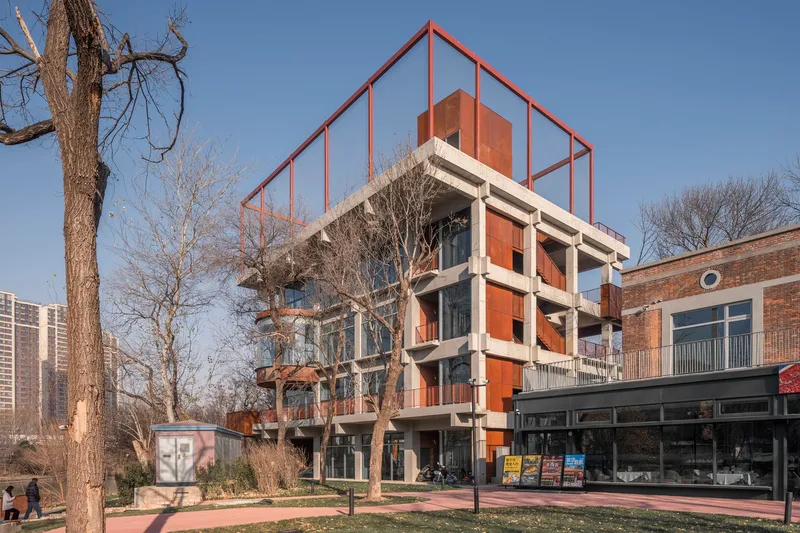

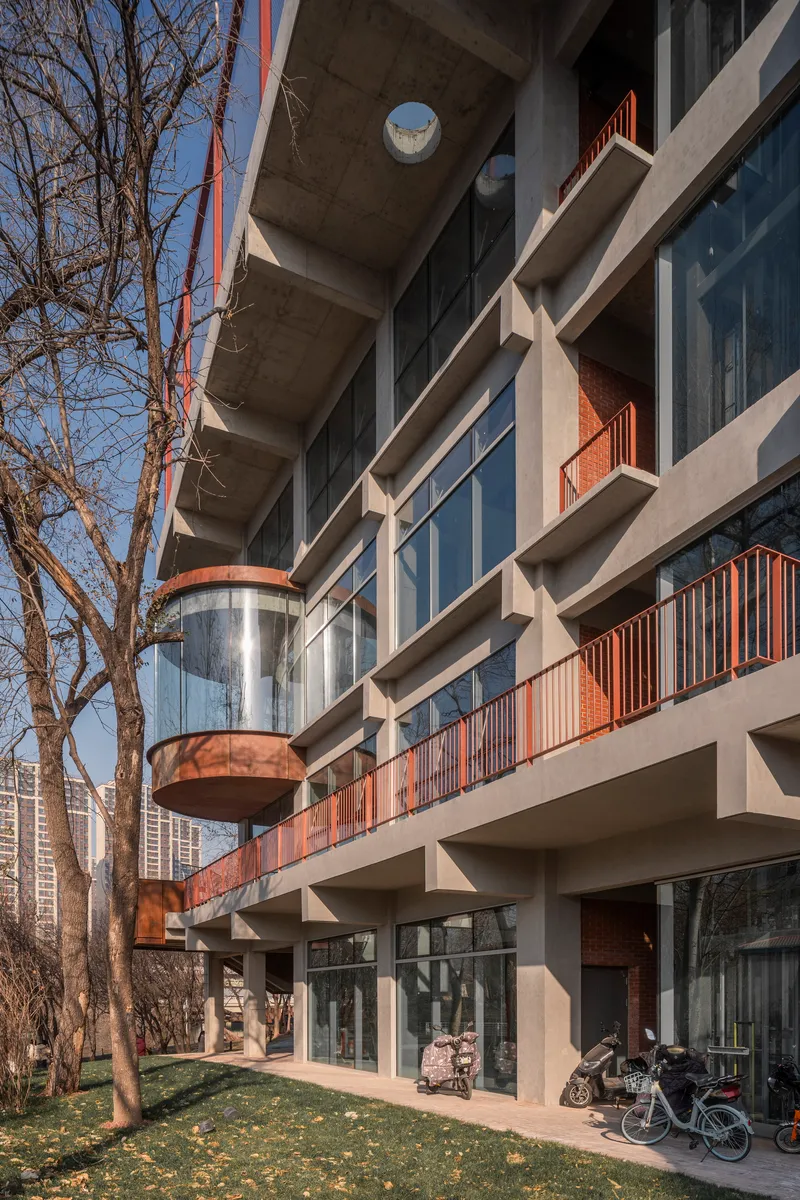
The exterior reads as a straightforward confrontation between two dominant materials: poured-in-place concrete and weathering steel. The structural grid of columns and floor slabs is left exposed, creating a visual rhythm that recalls the post-and-beam frameworks of the factory buildings that once stood nearby. Corrugated metal railings and steel balcony panels wrap the upper floors, their rust-orange surfaces a deliberate counterpoint to the cool grey of the concrete.
Afternoon light plays a key role here. Diagonal shadows from surrounding trees fall across the steel panels, animating what could otherwise be a static facade. The building absorbs its context rather than standing apart from it, and the decision to let the corten develop naturally means the facade will continue to evolve season by season.
Pilotis and the Dissolving Ground Plane


The ground level is almost entirely open. Concrete columns carry the weight of the upper floors, freeing the base to operate as a covered passage between the park and the building's commercial program. Children play beneath the cantilevered mass, families drift through, and the planted courtyard beyond is visible through the structural grid. It is a generous move for a retail building, sacrificing leasable ground-floor area in favor of public accessibility.
A stepped weathering steel platform at one entrance creates a threshold that is more landscape than architecture, blurring the line between the park's topography and the building's interior. The pilotis strategy also serves a practical purpose in Tianjin's climate, providing shade in summer and a sheltered route in rain.
Vertical Landscapes and Cantilevered Terraces

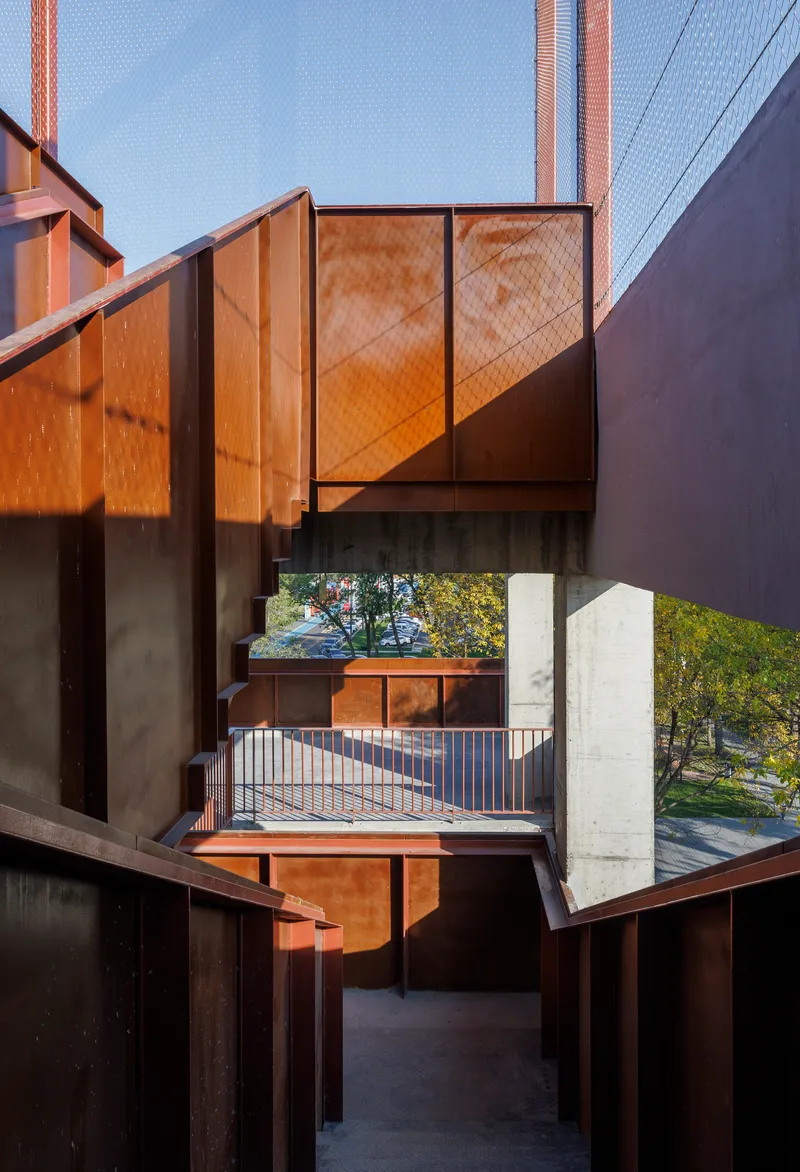
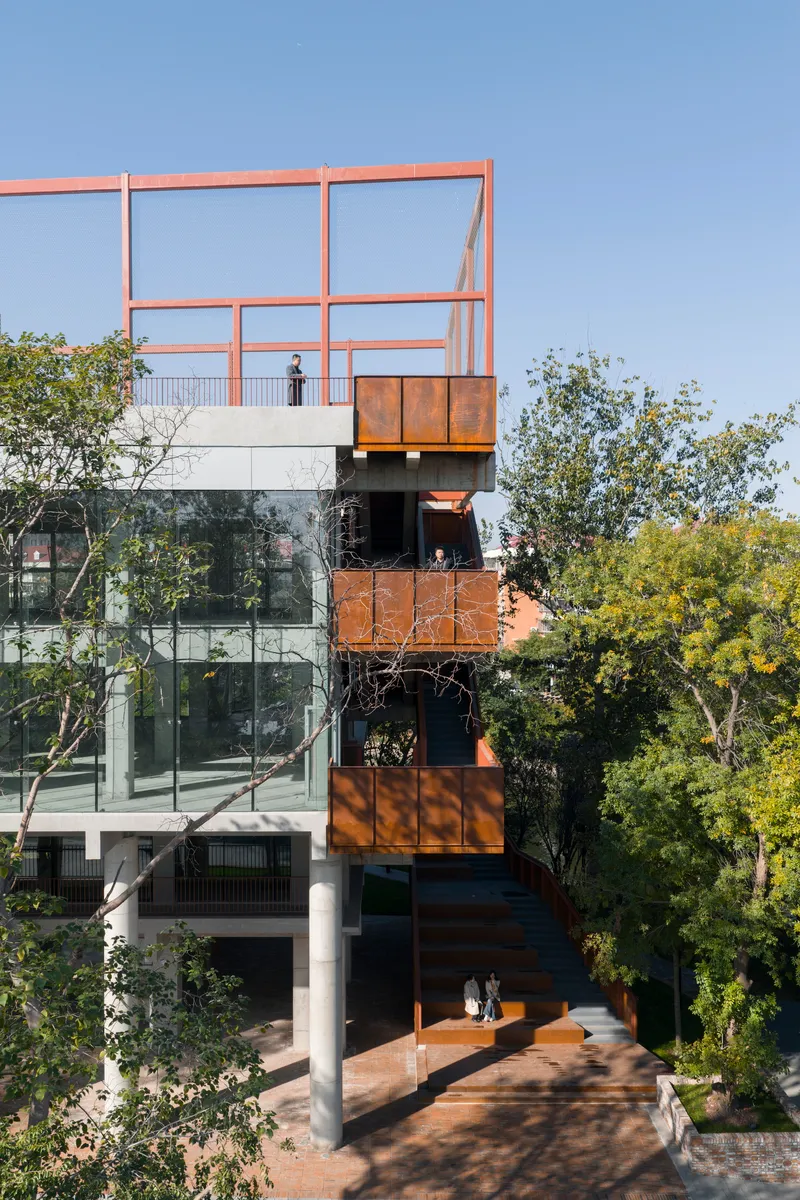
Each floor pushes balconies and terraces outward, some of them cantilevered well beyond the structural grid. The stacking of these volumes creates a layered section that reads differently from every angle. From below, the exposed concrete slabs and steel railings frame the sky. From across the park, the building appears to be a series of inhabited shelves nestled among the tree canopy.
The weathering steel balcony enclosures are not uniform. Some are solid panels, others perforated or corrugated, introducing variation in transparency and shadow. At dusk, when interior lighting begins to glow behind the glass walls, the framed views through the stacked balconies become a sequence of illuminated stages, lending the building a theatrical quality that suits its role as a commercial landmark.
The Red Crown and Rooftop Identity

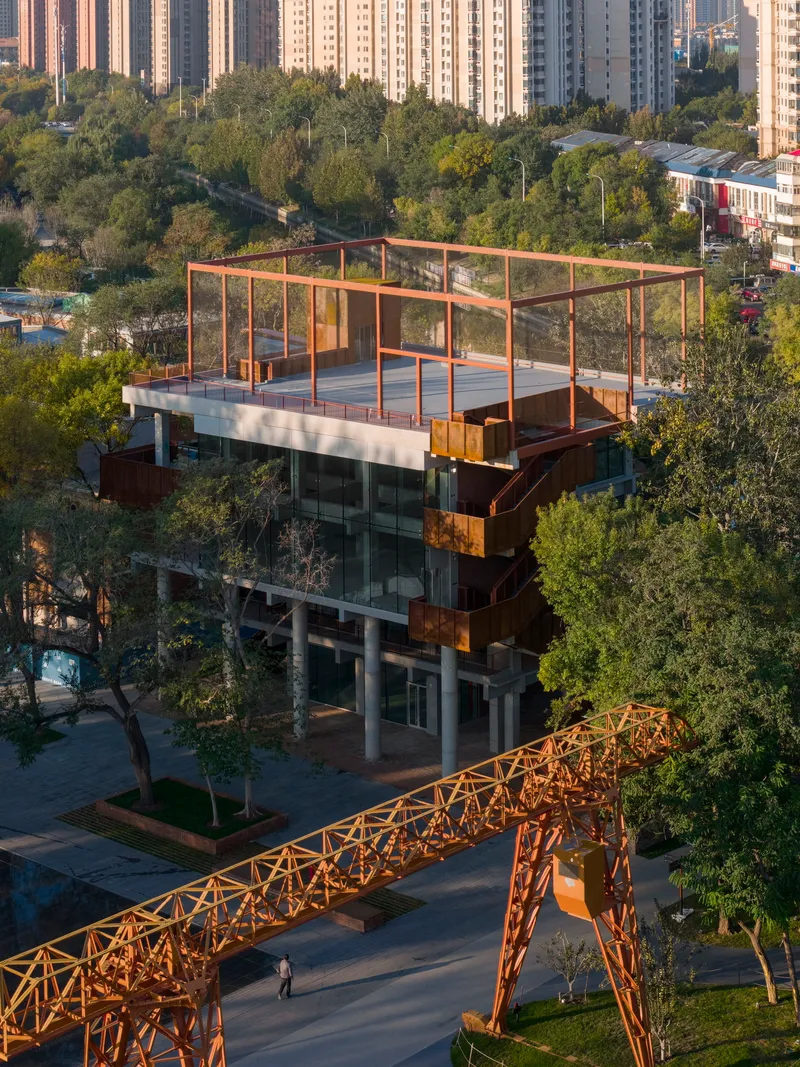

The most visible gesture is the red-painted steel frame that sits atop the building. It is not enclosure; it is pure structure and signal. The open frame allows sky and weather to pass through while anchoring the building's profile against the backdrop of Tianjin's residential towers. From the aerial views, the rooftop terrace it defines is generous, offering an outdoor platform surrounded by park greenery with the Hai River and highway infrastructure stretching into the distance.
The red frame also serves as a wayfinding device at the urban scale. In a district that is still defining its identity as a post-industrial cultural zone, a color this assertive cuts through the visual noise of surrounding apartment blocks. It is a simple move, but an effective one: paint the top red, and the building becomes legible from a kilometer away.
Circulation as Architecture


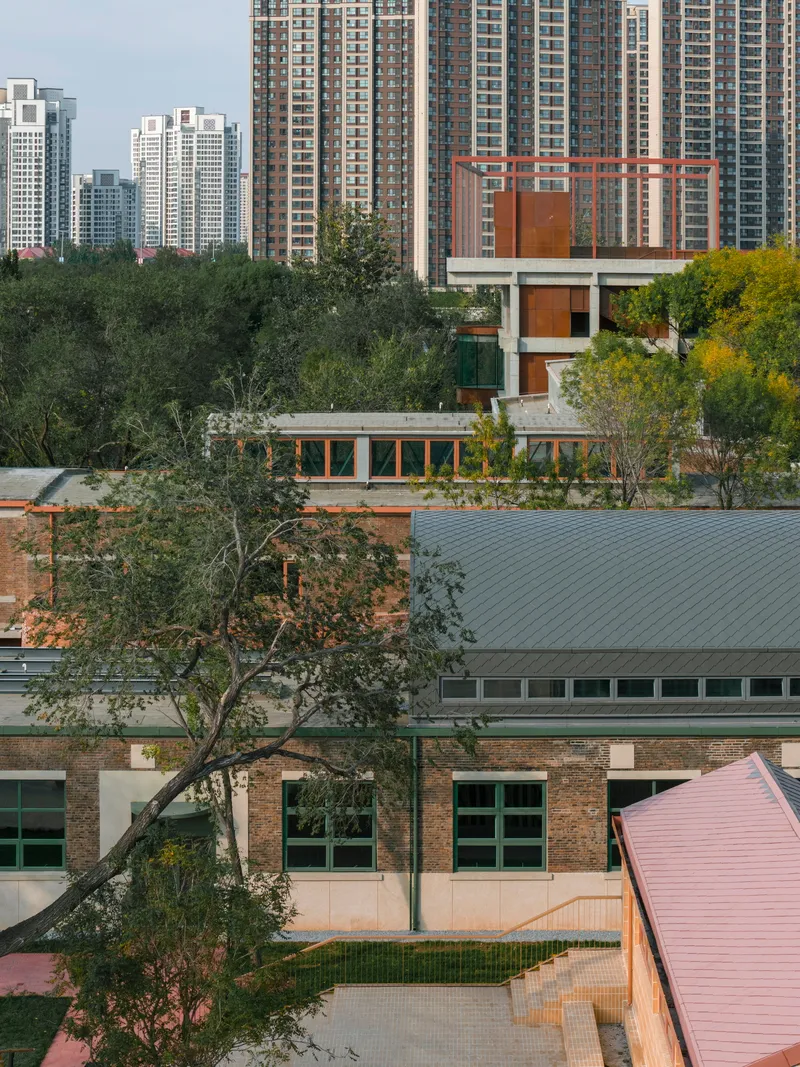
External staircases are treated not as fire escapes tacked onto the back of the building but as primary architectural elements. A wide staircase with weathering steel cladding wraps one corner beneath the tree canopy, while a cantilevered stair with red steel railings emerges above the treetops at the opposite end. A glass elevator shaft punctuates the facade, visible from the street as a vertical slot of transparency within the heavy material palette.
By pulling circulation to the exterior, CM Design achieves two things: the interior commercial floors remain open and unobstructed, and the act of moving between levels becomes part of the experience of the park itself. Ascending the building, you are always among the trees, always aware of the surrounding landscape.
Context and the Canopy

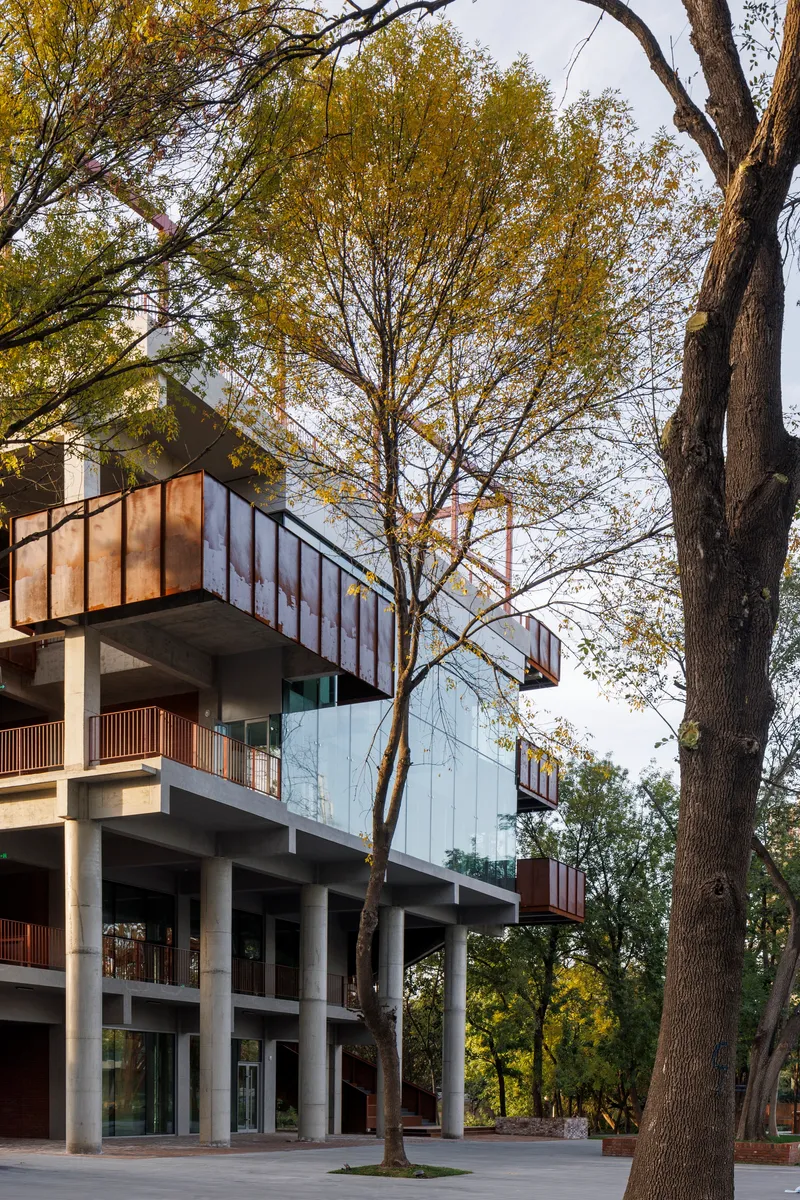
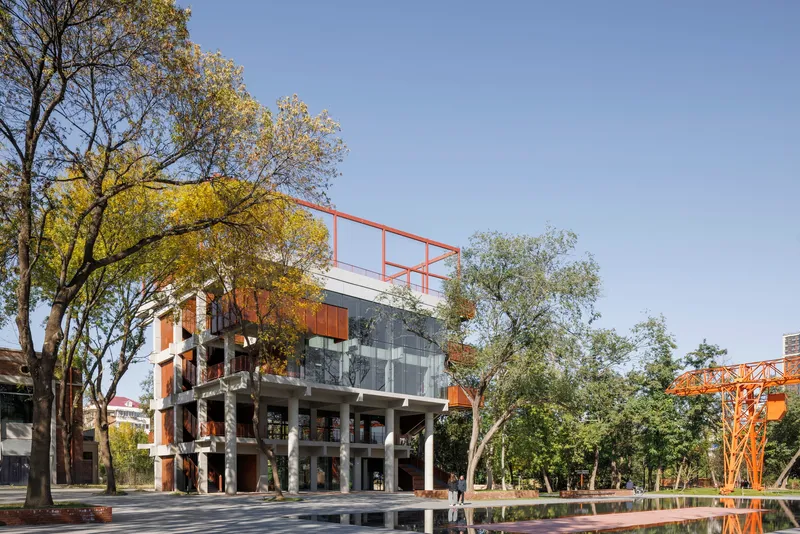
The relationship between the building and its mature trees is not incidental. The garden-facing facade, with its deep pilotis and stacked balconies, is designed to be seen through foliage. In autumn, the warm tones of the steel panels merge with the surrounding leaves. In winter, bare branches create a graphic overlay against the building's grid. The architects clearly calibrated the facade's depth and setback to allow mature canopies to remain intact, treating existing trees as collaborators rather than obstacles.
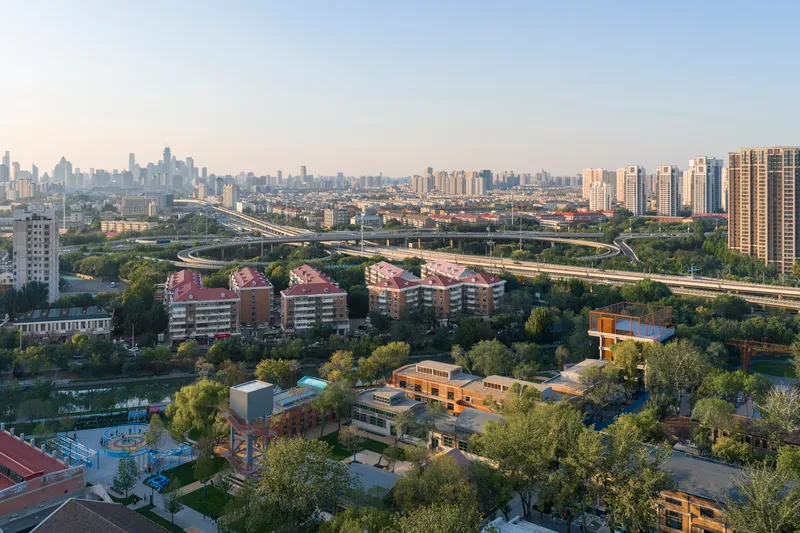
The aerial views at dusk reveal the broader ambition. Jinyi Landmark sits within a planted campus surrounded by the dense residential fabric of Tianjin. It functions as a node within Jin 1 PARK, drawing people from the surrounding neighborhood into a landscape that only a few years ago was an abandoned factory compound.
Plans and Drawings


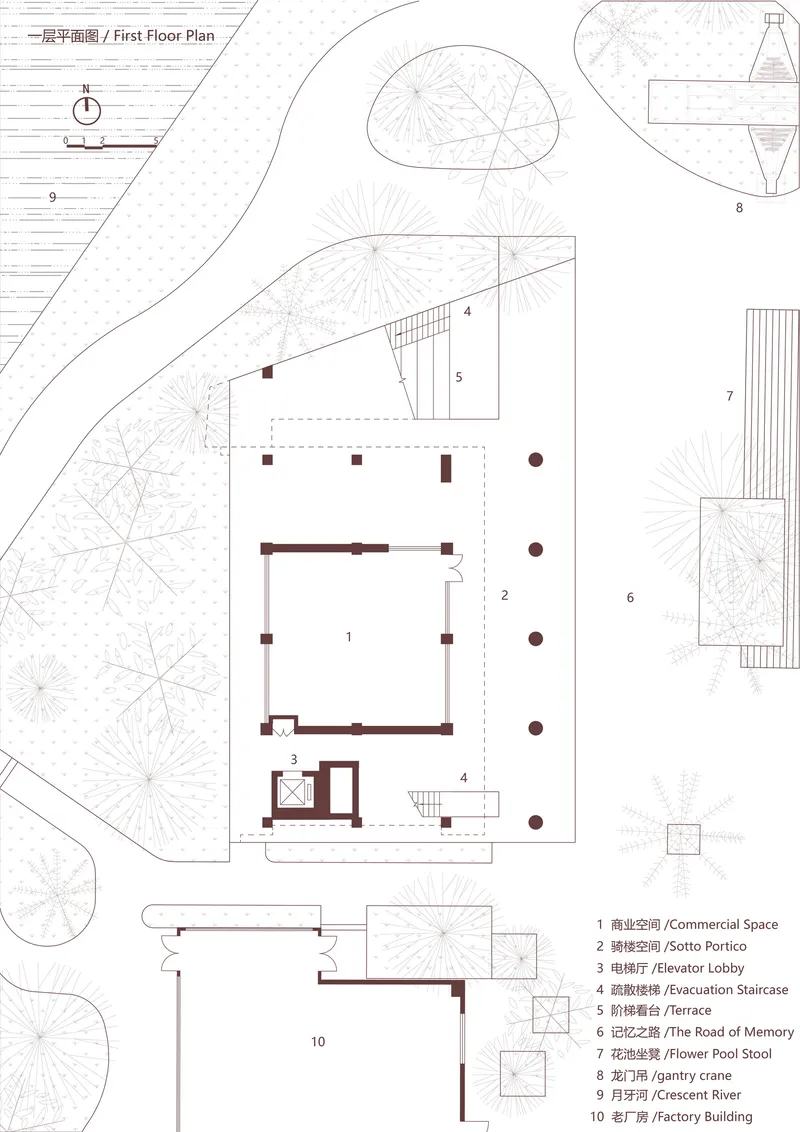
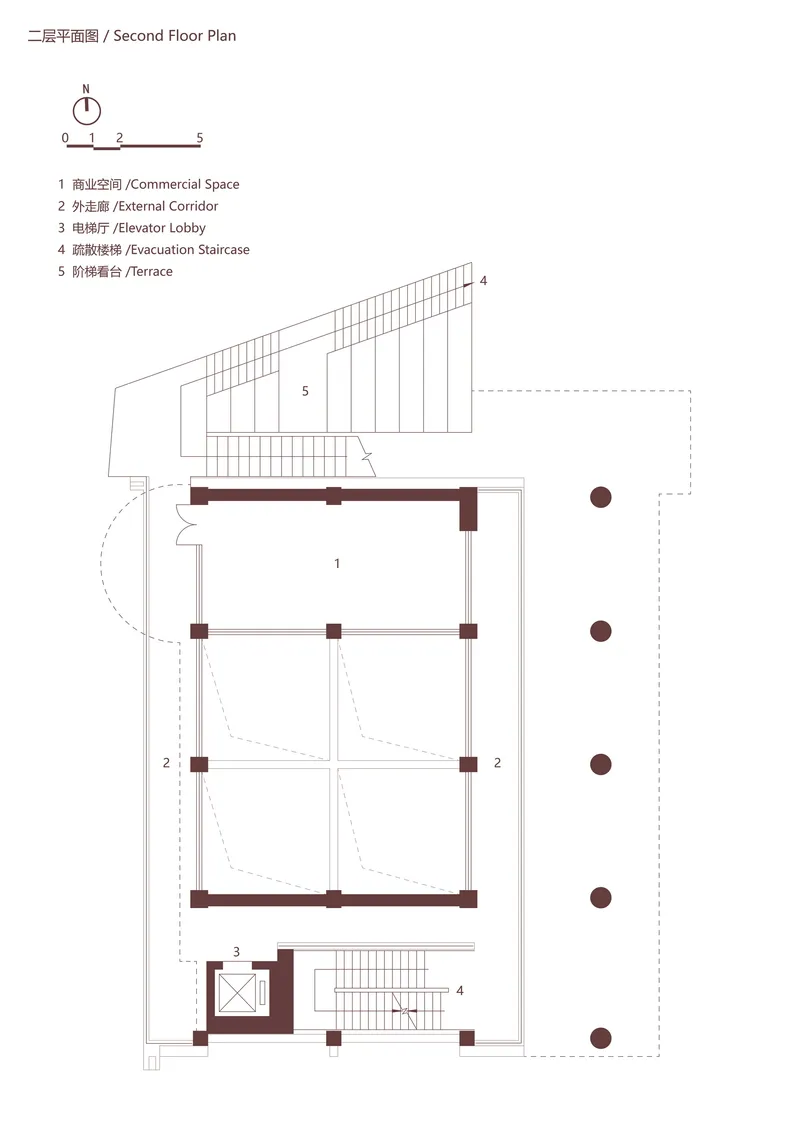

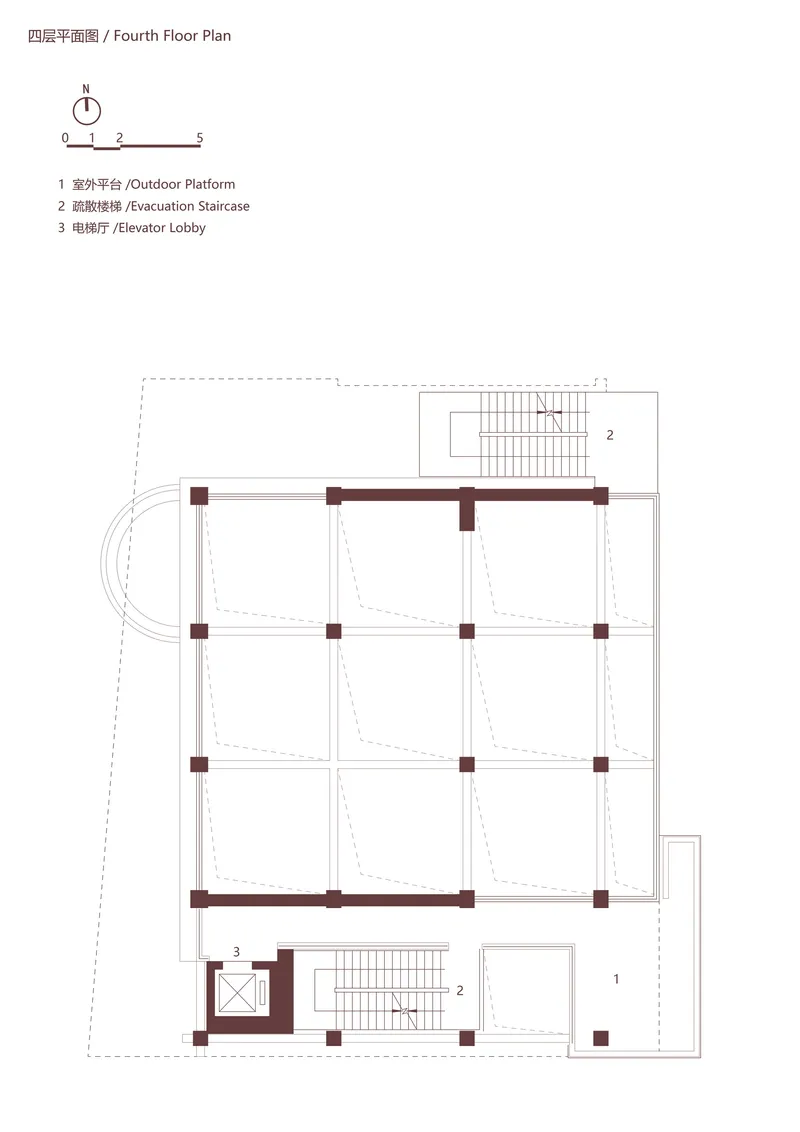


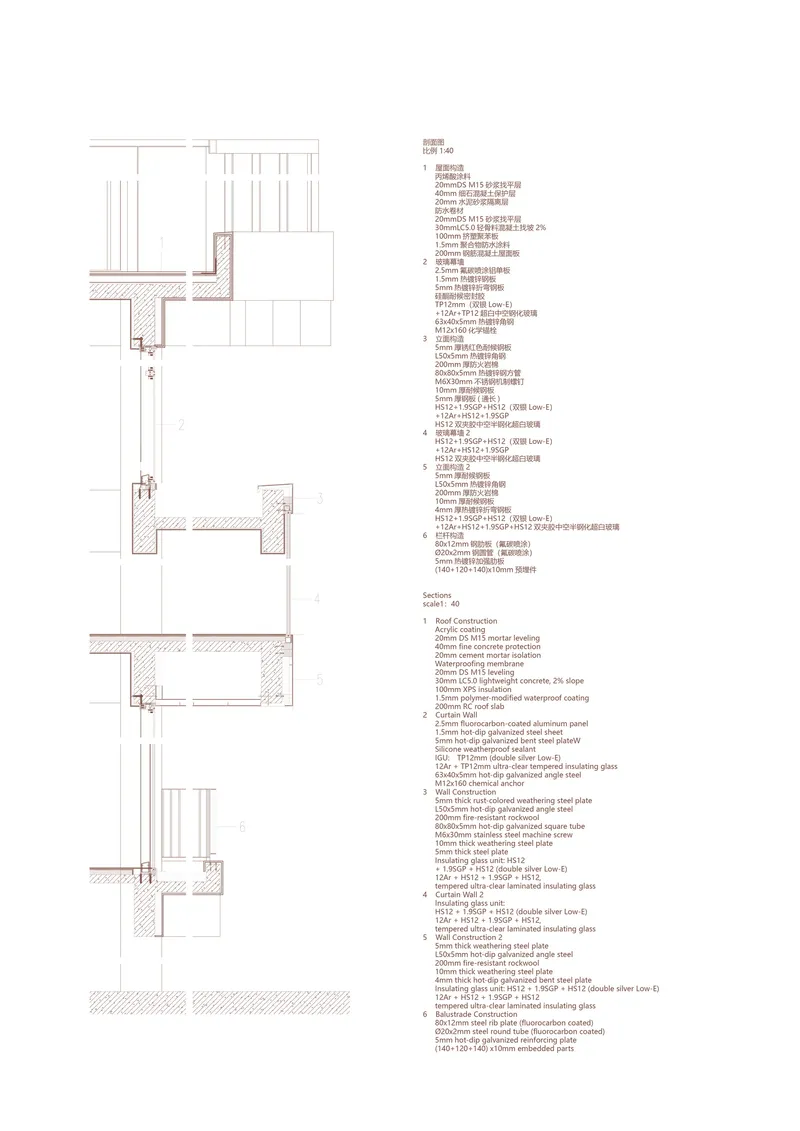


The drawings and models reveal a rigorous design process. The site plan marks the building's compact footprint in red within the surrounding urban grid, establishing its role as a point of intensity within the larger park. Axonometric diagrams trace the progression from site analysis through spatial massing to final material assembly in six stages, showing how program was stacked, circulation was externalized, and the red crown was lifted into place.
The floor plans confirm the strategy of pushing usable outdoor space to each level: curved terraces on the third floor, an expansive outdoor platform on the fourth, and a rooftop plaza punctuated by circular skylights. The section drawings reveal the building's true complexity, with the staircase weaving through all four levels and the roof frame standing proud above the topmost slab. Construction details document the wall assemblies with precision, showing layered insulation and waterproofing membranes that ensure the raw materiality of the exterior is backed by careful technical performance.
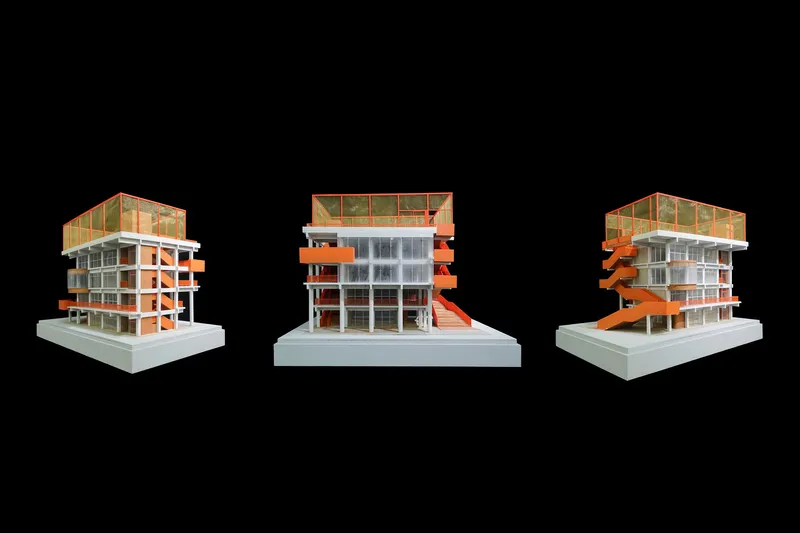
The physical models, built in timber with orange external stairs, are particularly revealing. They strip the design back to its structural logic: a post-and-beam frame with cantilevered floor plates and arched openings at ground level. The models make legible what the photographs sometimes obscure, namely that this building is fundamentally a frame, and everything else, the steel panels, the glass walls, the terraces, is infill.
Why This Project Matters
Retail architecture in China's rapidly redeveloping industrial zones often defaults to one of two modes: either a slick glass box that erases the site's history, or a heavy-handed preservation exercise that embalms it. CM Design's Jinyi Landmark does neither. It builds something new that speaks the material language of its industrial predecessor, without pretending to be old. The weathering steel will continue to change, the concrete will acquire grime and character, and the red frame will fade and be repainted. The building is designed to age, which is a rare and welcome quality in a typology that usually chases permanent newness.
More importantly, the building takes the idea of a retail landmark seriously as a piece of public infrastructure. The open ground floor, the external staircases, the generous terraces at every level: these are not marketing amenities but genuine contributions to the park around it. At just 809 square meters, Jinyi Landmark is modest in scale, but its ambition to function as both commercial vessel and civic marker gives it an outsized presence in the emerging landscape of Jin 1 PARK.
Jinyi Landmark by CM Design, with landscape design by Shenzhen Aoya Design Co., Ltd. Located in Tianjin, China. 809 m². Completed 2025. Photography by Weiqi Jin and Guowei Liu.
About the Studio
Share Your Own Work on uni.xyz
If projects like this are the kind of work you want to make, uni.xyz is a place to publish your own, find collaborators, and enter design competitions.


Popular Articles
Popular articles from the community


longwave studio Reorganizes a 112 m² Tainan Apartment Around the Daily Routines of a Family and Two Cats
In Tainan, Taiwan, birch plywood, rust-red furniture and a freestanding plaster wall link arrival, storage, work and family life in one apartment.

LT2A and OPEN Architectes Thread a Brick and Glass High School Through a Wooded Belgian Campus
In Braine-l'Alleud, a 3,000 m² wing for Collège Cardinal Mercier pairs pale brick with a glazed colonnade, deferring to a small chapel and a dense wood.

GROUP A Strips a 1969 Rotterdam Harbor Headquarters to Its Frame and Wraps It in Timber Louvers
In Rotterdam's M4H harbor district, Ferro Offices reuses a 1969 frame, adds one timber storey and reaches BREEAM-NL Outstanding.

Juan García Correa, John González and Claudia Rueda Sink a Circular Amphitheater into a Manizales Engineering Building
On the La Nubia campus in Manizales, Colombia, the S1 Building folds labs and offices into a hillside of ramped lawns that double as a campus route.

Similar Reads
You might also enjoy these articles


LAVA Architecten Gives Vocational Education a Sawtooth-Roofed Face on a Mechelen School Campus
In Mechelen, Belgium, a 2,053 m² STEM school on a 6×6 m grid turns workshops and classrooms into rooms that can be rearranged as teaching changes.

KEMA Studio Turns a Derelict Marvila Attic into a 60 m² Lighthouse Apartment Above Lisbon
In Lisbon's Marvila district, a rebuilt roof, four skylights and two plywood volumes turn an unlivable attic into a bright home facing the Tagus.

Pixel Gardens: One Repeated Module Stacked Into a Terraced Social Housing Tower for Famagusta
Salem Bader's shortlisted housing tower builds a vertical neighbourhood from one repeated module, offsetting units to carve terraces, light and air.

Bao Huynh Watercolor Atelier: A Serene Art Retreat in Hội An
Bao Huynh Watercolor Atelier in Hội An blends multifunctional art spaces, sustainable design, local materials, and family-friendly living in a serene environment.

Comments (0)
Please login or sign up to add comments
No comments yet. Be the first to comment!