
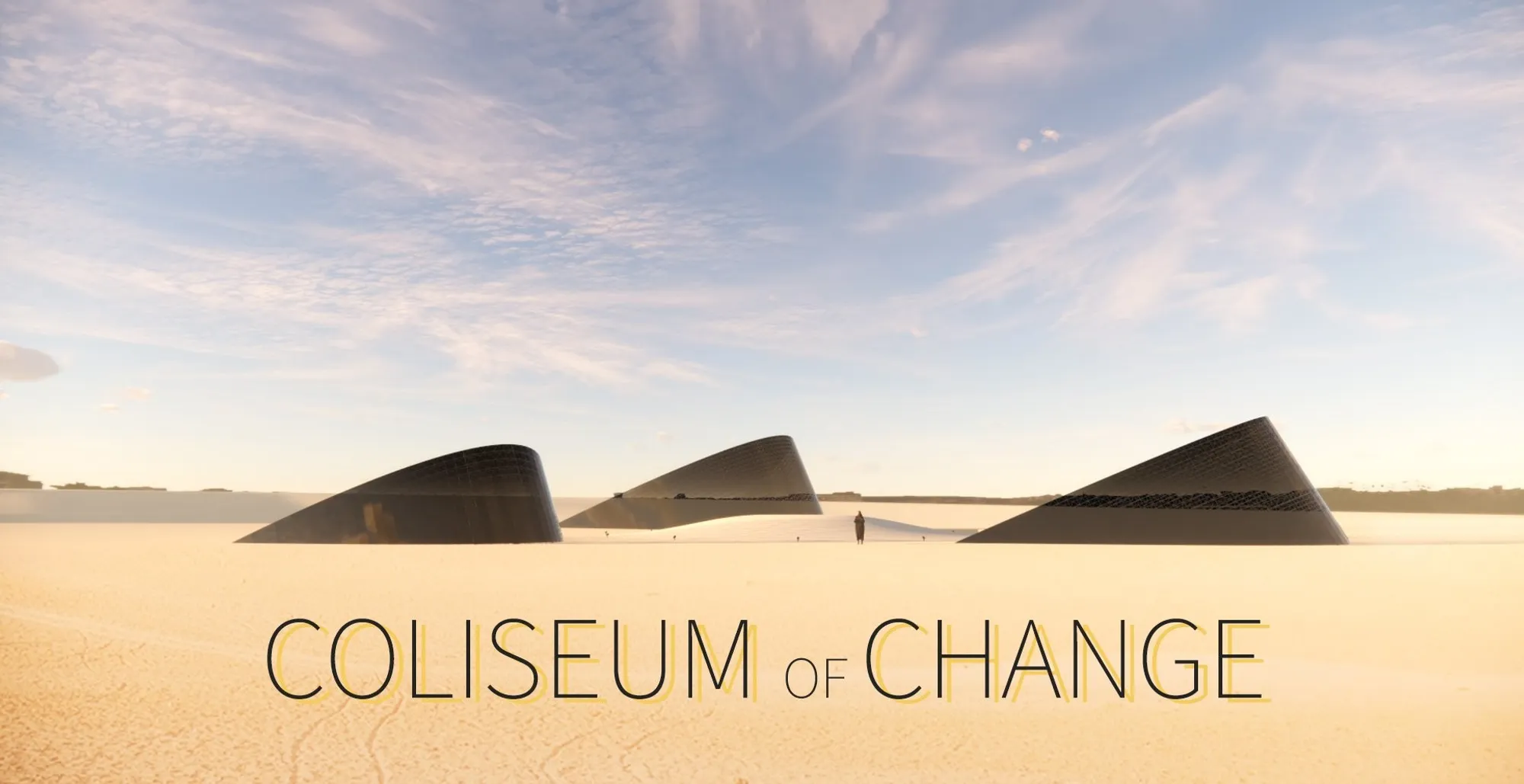
Coliseum of Change: A Climate Responsive Architecture for Awareness and Action
A climate responsive architecture that transforms rising sea levels into spatial narrative, driving awareness, resilience, and collective action


The Coliseum of Change, designed by Andrew Elvio, emerges as a powerful exploration of climate responsive architecture, addressing one of the most urgent global challenges: rising sea levels. Positioned as both a memorial and a functional public auditorium, the project transcends traditional architectural boundaries by merging environmental awareness with spatial experience.
This proposal operates at the intersection of architecture, ecology, and human behavior, presenting a built environment that not only responds to climate change but actively communicates its consequences. It is not merely a structure but a narrative device that translates environmental data into experiential space.

Architecture as a Medium of Climate Awareness
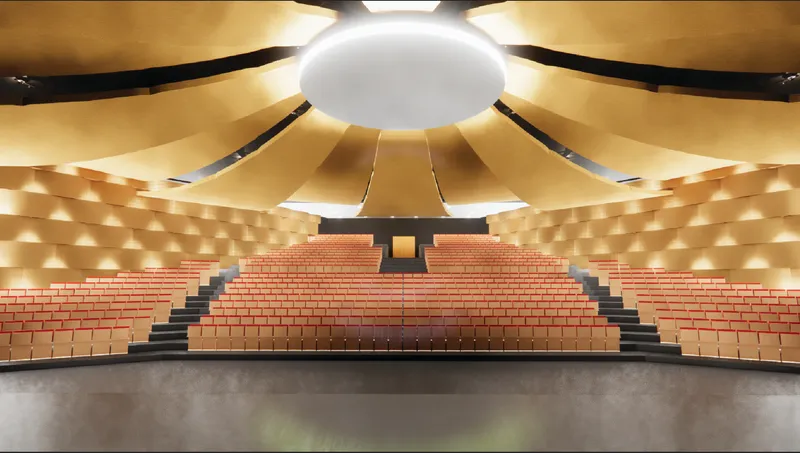
The project is fundamentally driven by the premise that architecture can act as a catalyst for societal transformation. The Coliseum functions as a multi-use auditorium where seminars, performances, and public gatherings take place, enabling the dissemination of ideas, innovation, and environmental awareness.
By embedding this program underground, the design minimizes thermal gain and reduces energy consumption. Only the roof remains exposed, allowing controlled interaction with sunlight. This strategic spatial configuration reflects a deep understanding of passive environmental design principles.
Spatial Representation of Rising Sea Levels
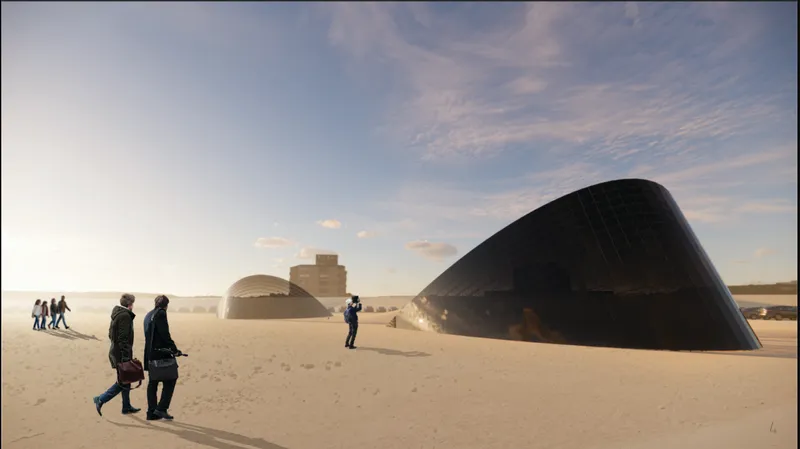
A defining feature of this climate responsive architecture is its symbolic and physical interpretation of sea level rise. The design incorporates three solar panel structures above ground, each representing different stages of a sinking form over time.
These elements are not static. Their perceived geometry changes depending on the viewer’s perspective, creating an illusion of uniformity from certain angles while revealing variation from others. This perceptual shift mirrors the often misunderstood reality of climate change, where the severity of impact varies based on viewpoint and awareness.
Below ground, the auditorium reinforces this narrative. The sunken spatial condition evokes the sensation of descending into a landscape that is gradually being consumed, aligning the user experience with the conceptual framework of environmental instability.
Renewable Energy Integration and Performance
Sustainability is not treated as an add-on but as an integral component of the architectural system. The three surface structures are equipped with solar panels oriented towards optimal sun exposure, ensuring efficient energy generation.
This renewable energy system supports the operational requirements of the auditorium and extends its capacity to supply energy to surrounding areas when not in use. By doing so, the project transitions from a passive memorial into an active infrastructural contributor.
The underground placement of the auditorium further enhances energy efficiency by leveraging the earth’s thermal mass, reducing cooling loads and maintaining stable internal conditions.
Structural and Material Strategy
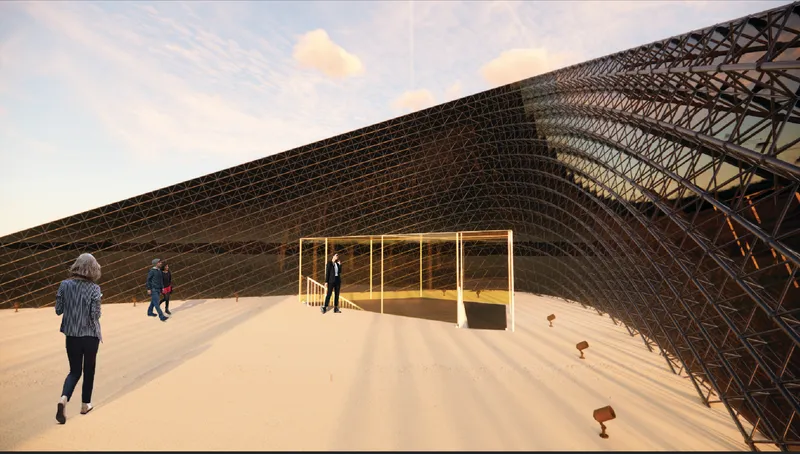
The architectural language is intentionally minimal and universal. The use of steel structures combined with solar panel arrays results in a clean, geometric expression that avoids cultural specificity. This neutrality ensures that the project resonates with a global audience.
The form is derived from the concept of instability. The ground plane appears fractured and sinking, while the tensile and lattice structures above create a contrasting sense of lightness and adaptability. This duality between permanence and fragility reflects the broader tension between human intervention and natural systems.
Experiential and Programmatic Flexibility
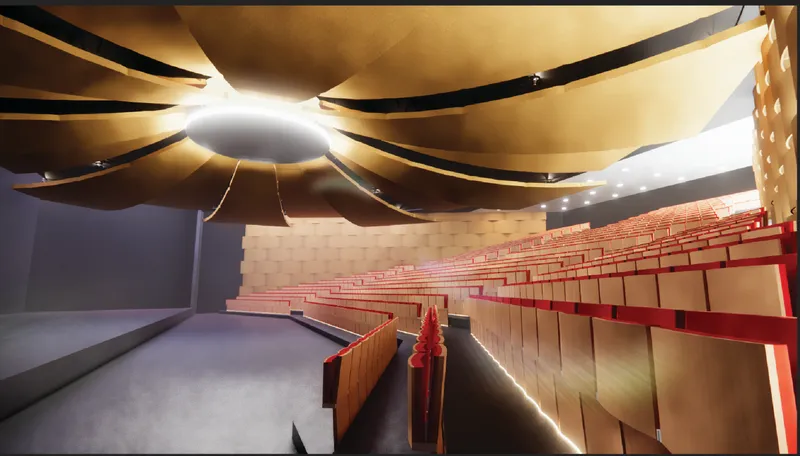
Internally, the auditorium is designed as a flexible performance and gathering space. It accommodates a wide range of activities including lectures, music, theatre, and community events. This adaptability reinforces the project’s role as a platform for continuous dialogue.
The interior ceiling system, articulated through layered radial elements, enhances acoustic performance while visually reinforcing the centrality of collective experience. The spatial organization directs attention toward the stage, emphasizing communication and shared learning.
A Timeless Architectural Statement
One of the most compelling aspects of the Coliseum of Change is its temporal neutrality. The simplicity of its form and reliance on renewable energy ensure its relevance across generations. Unlike trend-driven architecture, this project is grounded in enduring environmental realities.
Its message is clear: the built environment must evolve beyond aesthetics and functionality to address planetary concerns. The project does not propose a solution in isolation but rather initiates a broader conversation about responsibility, adaptation, and resilience.
Global Relevance and Impact
The universality of the design allows it to transcend geographical and cultural boundaries. As a public auditorium, it serves as a hub for international discourse, welcoming diverse audiences and fostering collaboration.
The project’s ability to communicate complex environmental issues through spatial experience makes it particularly effective. It bridges the gap between abstract data and human perception, enabling users to engage with climate change in a tangible way.
The Coliseum of Change stands as a compelling example of climate responsive architecture that integrates environmental performance, symbolic expression, and public engagement. By transforming the narrative of rising sea levels into a spatial and experiential framework, the project redefines the role of architecture in the context of global challenges.
It is a structure that informs, inspires, and provokes action. More importantly, it demonstrates that architecture can move beyond passive observation to become an active participant in shaping a sustainable future.




Popular Articles
Popular articles from the community


Hill & Cross Opera: Sculptural Opera House Architecture Shaped by Tallinn’s Landscape and Identity
Hill & Cross Opera reimagines opera house architecture in Tallinn through its sculptural hill, civic plaza, glass wave and a luminous cross.

Co-Life: Senior Housing Design That Reconnects Older Adults With the City
Co-Life reimagines senior housing design through healing gardens, shared streets, workshops, and a sustainable community across generations.

Riyadh For All: Intergenerational Urban Design for Active Aging in Rabat
Riyadh For All reimagines urban design in Rabat with intergenerational co-living, adaptive courtyards, and Moroccan cultural exchange today.

The Earth Pod: 3D Printed Homes for Resilient Refugee Communities
The Earth Pod reimagines refugee housing through 3D printed homes made from clay, combining resilience, self-sufficiency, and rapid shelter.


Similar Reads
You might also enjoy these articles

Eco Chapel: A Green Architecture Pavilion Designed in Symbiosis with the Forest
Eco Chapel uses green architecture to weave prayer, learning and reuse into a forest pavilion shaped by modular hexagonal canopies for life.
Kaffeebühnen: Coffee Shop Architecture Designed as a Civic Stage Between Vienna’s City and Park
Kaffeebühnen turns coffee shop architecture into a civic stage, linking Vienna’s park edge, urban life, warm timber yards, and coffee craft.
Healing Façade: Sustainable Architecture for Reforestation, Community, and Sacred Ecology in Ethiopia
Healing Façade reimagines sustainable architecture as a living wall that restores soil, catches water and renews Ethiopia's forest churches.


Urban Forest: A Vertical Ecosystem for 5,000 Workers in Singapore's Changi Business Park
Radially stacked pods and layered green decks turn a 7-acre plot into 47 acres of ecological workspace projected for 2040.





Comments (0)
Please login or sign up to add comments
No comments yet. Be the first to comment!