
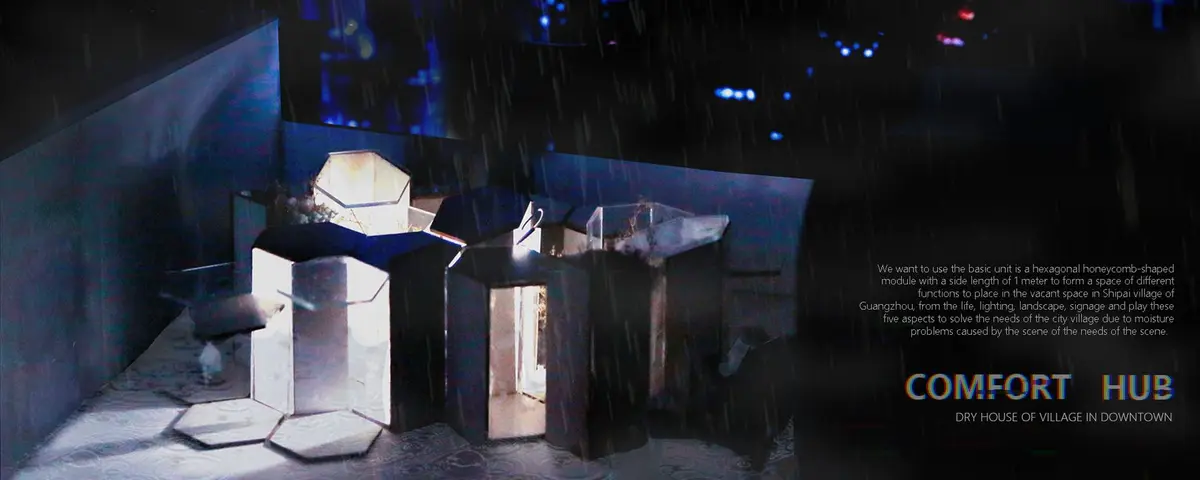
Comfort Hub: Hexagonal Modules That Breathe Life into Guangzhou's Humid Urban Villages
A climate-responsive modular system uses humid air recycling and honeycomb geometry to transform neglected alleys into social micro-hubs.


In the dense heart of Guangzhou, entire neighborhoods exist in a perpetual state of dampness. The "villages in the city" that punctuate China's megacities are hyper-compressed urban zones where narrow alleys block sunlight, trap moisture, and leave residents with few options for outdoor social life. Comfort Hub proposes a precise counterattack: a hexagonal modular system equipped with a passive humid air recycling mechanism, deployable in the leftover spaces of these villages to simultaneously manage humidity, activate dead zones, and give residents a reason to linger rather than rush through.
Designed by Yuru Chen, Summer Wang, Yaqi Liang, and Kai Xue, this shortlisted entry in the Urbanscape: Symbiosis competition targets Shipaijiao, a city village in Guangzhou's Tianhe District. The site is defined by dense building clusters, minimal solar exposure, poor air circulation, and year-round high humidity. The team's response draws equally from bioclimatic engineering and modular spatial design, producing a unit that can adapt to alley widths, commercial frontages, and corner conditions alike.
Reading the Village: Narrow Streets and Trapped Moisture
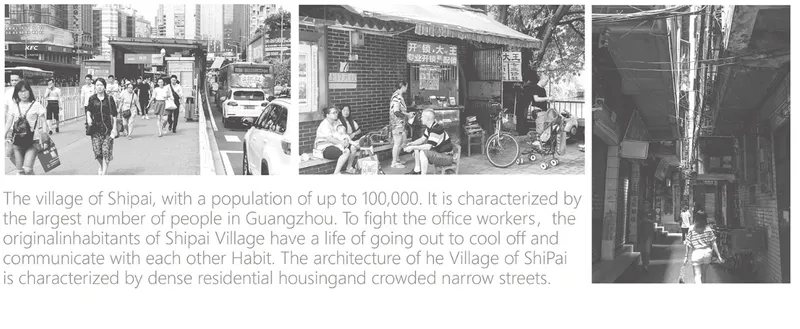
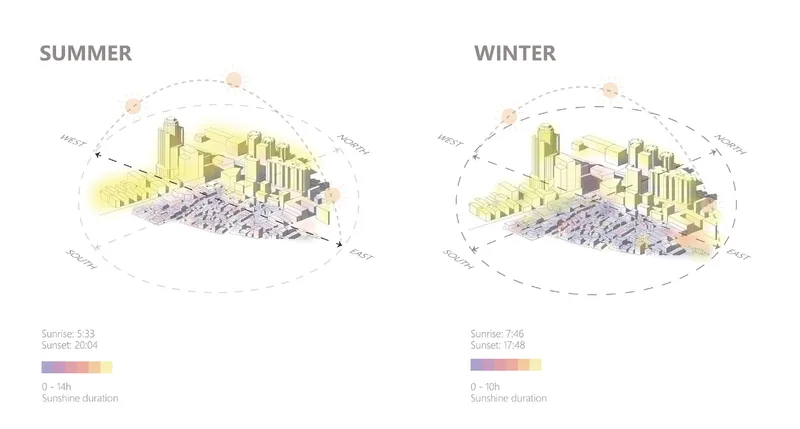
The black and white site photographs reveal the spatial reality the designers are working with: streets barely wide enough for two people to pass, storefronts spilling into alleys, and a traditional urban fabric that has calcified around its own density. These are not spaces that lack activity; they lack the infrastructure to support it comfortably. The accompanying sun study makes the problem measurable. Axonometric diagrams compare summer and winter shadow patterns across the clustered building volumes, plotting seasonal sunlight duration data that confirms what the photographs already suggest: large portions of the village floor receive negligible direct light for much of the year. The combination of low solar exposure and persistently high humidity creates environments where moisture lingers on surfaces, air feels heavy, and the street becomes something to endure rather than enjoy.
Breathing Walls: A Humid Air Recycling System
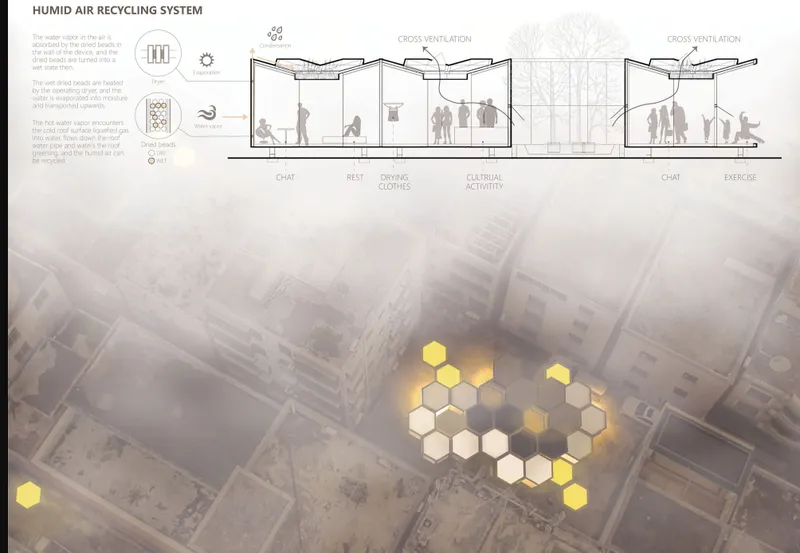
The section drawing lays out the project's bioclimatic core. An undulating roof profile works in concert with cross-ventilation channels and condensation surfaces to passively extract moisture from the air, recycle water vapor, and promote evaporative cooling. The system reuses humidity rather than merely resisting it, turning the village's most persistent environmental liability into a resource. Figures and trees populate the section, grounding the engineering in everyday human scale. The result is a microenvironment that reduces dependence on mechanical ventilation while actively improving air quality for anyone resting, exercising, or simply passing through.
Honeycomb Logic: Hexagonal Modules for Irregular Sites
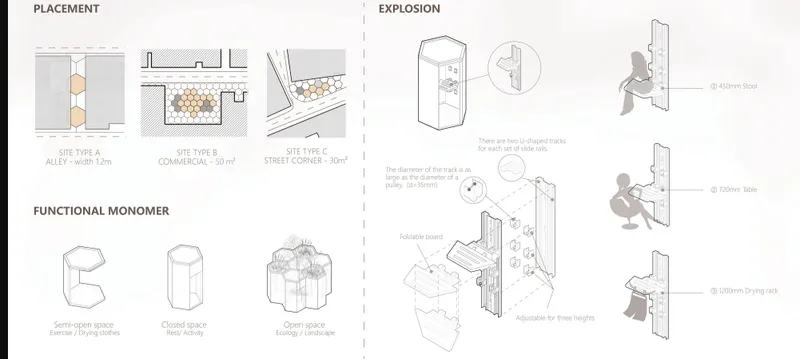
The modular strategy borrows its geometry from honeycombs, and the diagram makes clear why. Exploded axonometrics show how individual hexagonal units aggregate to fill irregular footprints, adapting to three distinct site conditions: narrow alleys (Site A), commercial zones (Site B), and urban corners (Site C). Each module is classified as semi-open, closed, or open, providing tailored microenvironments for different activities. Functional monomers slot in and out, offering rest platforms, exercise stations, ecological landscaping zones, and social gathering spots. Modular furniture, including foldable boards, stools, and racks, keeps the interior compact and reconfigurable. The hexagonal plan avoids the rigid orthogonality that would jam against the village's organic geometry, instead tessellating around obstructions and varying widths.
From Circulation to Activation: Programming the Alley
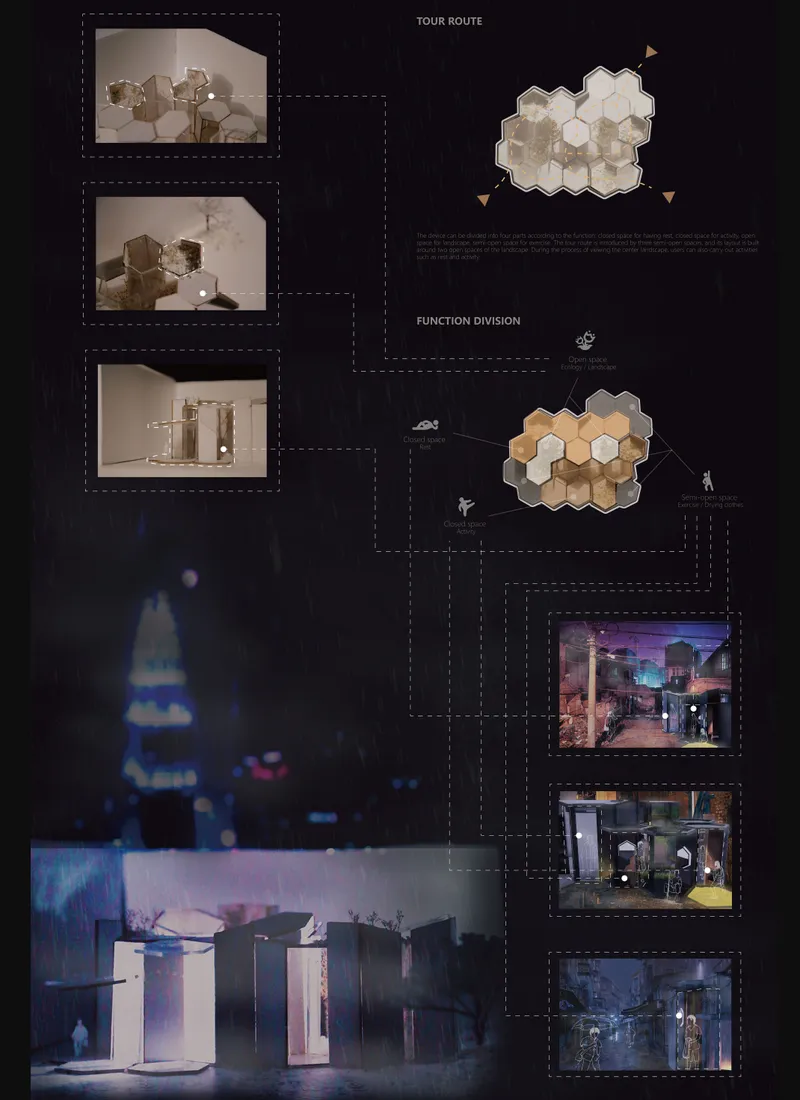
The presentation board consolidates the project's ambition in a single frame. Physical models, hexagonal plan diagrams, and interior renderings annotated with function division labels show how the modules transform passive circulation corridors into active programmatic spaces. The tour route through each unit is carefully sequenced: entering, pausing to rest, exercising, chatting. User profiles, from office workers to children to the elderly, inform the spatial logic. At night, the illuminated structures become beacons in otherwise dark alleys, converting neglected zones into visible, inviting social nodes. The designers envision activities ranging from drying clothes and physical exercise to digital use and cultural engagement, treating the modules as multifunctional extensions of the urban home.
Why This Project Matters
Guangzhou's city villages are home to millions, yet they rarely appear in the architectural conversation about climate adaptation. Comfort Hub forces that conversation by pairing granular environmental data with a design system that is genuinely deployable at the scale these villages demand. The humid air recycling system is not a theoretical flourish; it responds to measured conditions of rainfall, humidity, and restricted airflow, and it does so passively. The hexagonal modularity ensures that the solution does not require wholesale demolition or replanning, fitting instead into the cracks and corners the village already offers.
What distinguishes the proposal is its refusal to separate environmental performance from social life. The same unit that manages humidity also hosts a bench, a drying rack, a small garden. The designers understand that in a city village, comfort is not an abstract metric; it is whether someone can sit outside after dinner without the air feeling like a wet blanket, whether a child has somewhere to play that is not a traffic lane. That integration of climate strategy and lived experience is what makes Comfort Hub a compelling model for the thousands of similar urban pockets across China's rapidly expanding cities.
View the Full Project
About the Designers
Designers: Yuru Chen, Summer Wang, Yaqi Liang, Kai Xue
Enter a Design Competition on uni.xyz
uni.xyz runs architecture and design competitions year-round that reward proposals with spatial conviction and real site intelligence.
Project credits: Comfort Hub by Yuru Chen, Summer Wang, Yaqi Liang, Kai Xue Urbanscape: Symbiosis (uni.xyz).


Popular Articles
Popular articles from the community


Cube Design Draws an Ecological Corridor Between Two Shenzhen Hills with the Nankai Building
Beside Shenzhen's container docks, the Nankai Building pairs stacked balconies with a climbing green screen to connect two hillsides across its height.

GROUP A Strips a 1969 Rotterdam Harbor Headquarters to Its Frame and Wraps It in Timber Louvers
In Rotterdam's M4H harbor district, Ferro Offices reuses a 1969 frame, adds one timber storey and reaches BREEAM-NL Outstanding.

David Macias Steps a Doorless Stone and Plaster House Down a Tropical Colombian Hillside
In the humid hills of Colombia, Threshold House replaces the front door with an open void and terraces its 850 m² down the slope instead of fighting it.

longwave studio Reorganizes a 112 m² Tainan Apartment Around the Daily Routines of a Family and Two Cats
In Tainan, Taiwan, birch plywood, rust-red furniture and a freestanding plaster wall link arrival, storage, work and family life in one apartment.

Similar Reads
You might also enjoy these articles


Vereda Arquitetos Renovates a 40-Square-Meter Apartment Inside Niemeyer's Copan Building
A compact unit in São Paulo's most iconic residential tower gets a material overhaul that pairs exposed concrete with bold blue Formica.

Shakur's House: Exposed Brick as an Interior Organiser in a 168 m² Mashhad Residence
Brick moves indoors in this Mashhad residence, where masonry walls, glass partitions and teal planes sequence a compact home without closing it off.

Day and Night Park: A Time-Based Urban Newsstand in Beijing
A temporary urban newsstand in Beijing blending travel, light, and reading through poetic colors, compact form, and community-focused design.

Modernist Patio Renovation in El Masnou, Barcelona by Oliver Segura Arquitectura + Cebrià Arquitectura
Modernist patio renovation blending tradition and innovation with a movable pool, leveled floors, and Catalan materials in El Masnou.

Explore Vertical City Competitions
Discover active competitions in this discipline

Challenge to design lighting inspired by nature

Render competition to represent the city as a machine

Design challenge to equip cities with modern furniture
Comments (0)
Please login or sign up to add comments
No comments yet. Be the first to comment!