
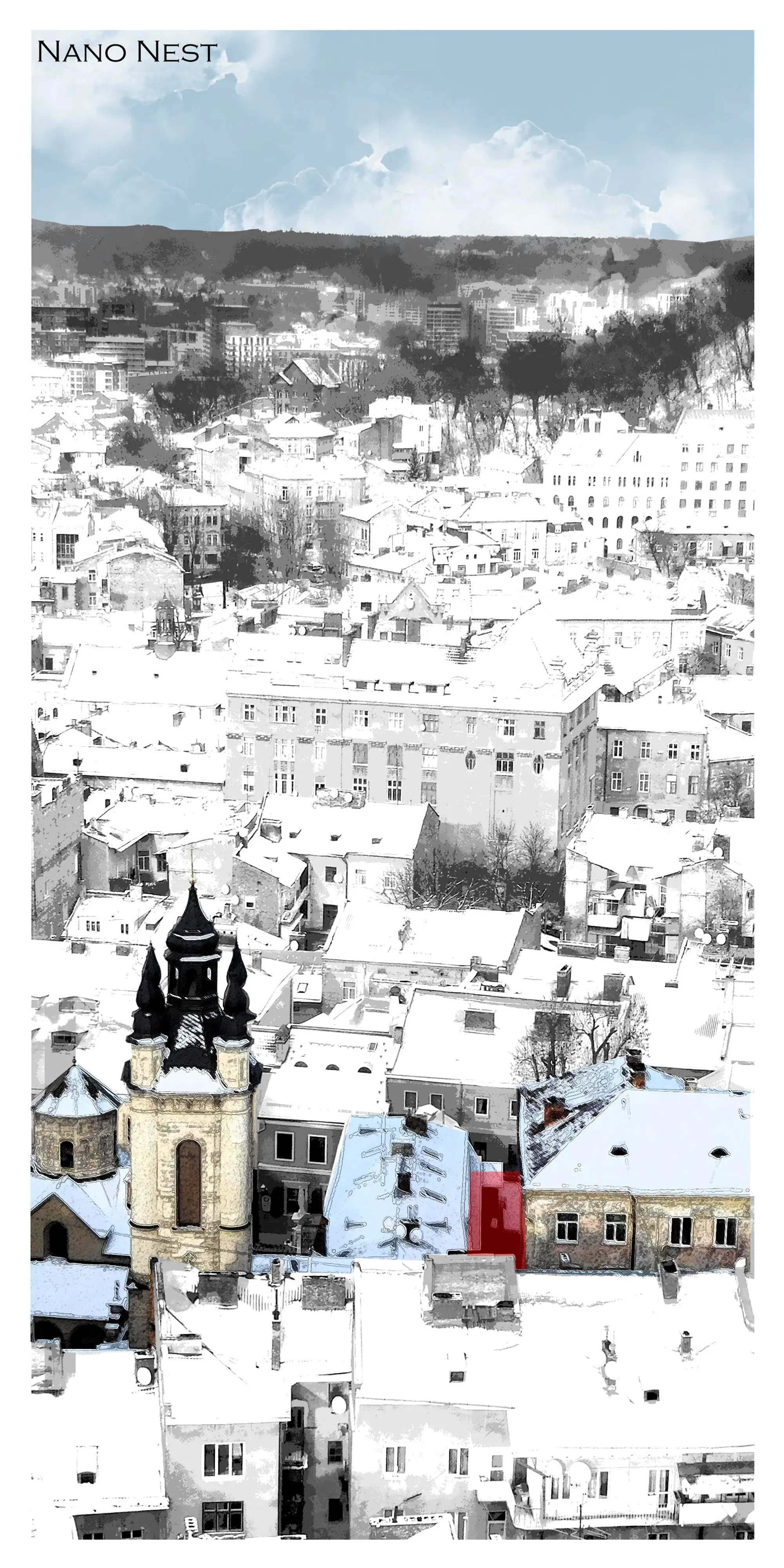
Nano Nest: A Five-Story Family Home Threaded into Lviv's Historic Fabric
Stanislav Bebko's compact infill house stacks generational living across five floors on a narrow heritage plot in western Ukraine.


Squeeze a family of six into a sliver of land between a church bell tower and a weathered apartment block, then ask the architecture to respect both its neighbors and its occupants. That is the provocation at the core of this project: a five-story infill house in Lviv, Ukraine, that treats every square meter as a negotiation between privacy, daylight, heritage, and the daily rhythms of three generations living under one roof.
Designed by Stanislav Bebko, this shortlisted entry for the Nano Nest 2020 competition takes on one of the most challenging briefs in residential design: housing a mother, father, two children, and elderly grandparents on a narrow historic plot in a temperate climate zone with snowy winters and mild summers. The site sits in Lviv's architectural and cultural core, defined by narrow lanes and heritage buildings with distinct Austro-Polish character. Bebko's response is neither nostalgic pastiche nor contextual indifference. It is a measured vertical strategy that reads the city's existing rhythms and builds within them.
Filling the Gap: An Infill Section Between Bell Tower and Block
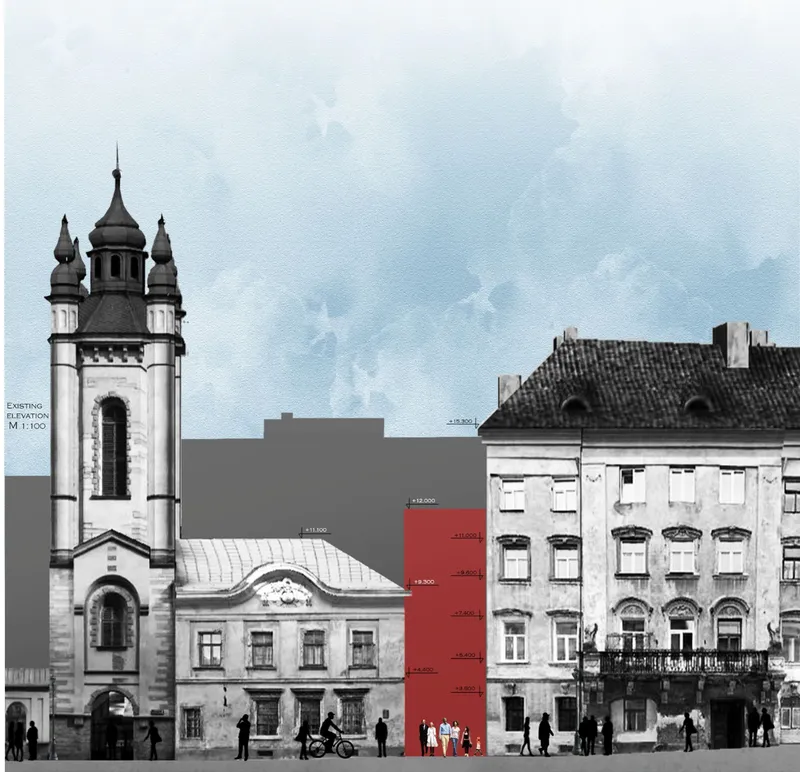
The section drawing immediately reveals the project's primary constraint and opportunity. The house slots into a vertical gap between a bell tower and an adjacent building, its profile shaped by the datum lines of its neighbors. Bebko aligns the new construction with the string courses, window rhythms, and rooflines of surrounding structures so the infill reads as a continuation of the streetscape rather than an interruption. Pedestrians at street level encounter a facade scaled to the lane's proportions, not a miniature tower asserting its independence.
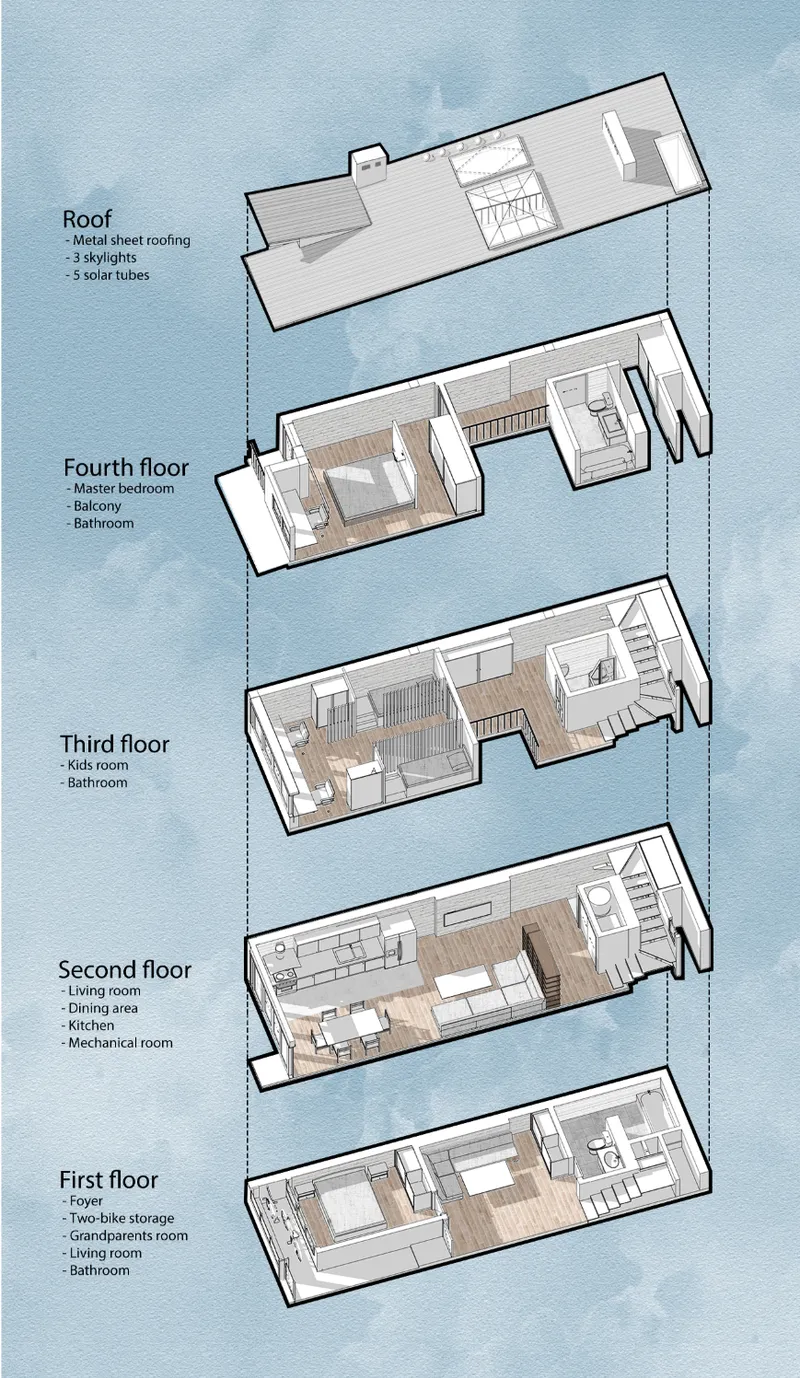
The exploded axonometric unpacks what that section contains: five distinct residential levels, each assigned to a specific household function and generation. The first floor accommodates the elderly grandparents with limited mobility, placing their bedroom, bathroom, foyer, and a two-bike storage zone at grade. The second floor operates as the social core, with an open-plan living room, kitchen, dining area, and mechanical room. The third floor belongs to the children, the fourth to the parents' master suite, and the roof level serves as a passive energy collector equipped with skylights and solar tubes. Stacking these zones vertically is the obvious move on a narrow plot; what makes the scheme work is the calibration of privacy gradients and daylight access at each level.
White Brick, Soft Daylight, and the Social Core
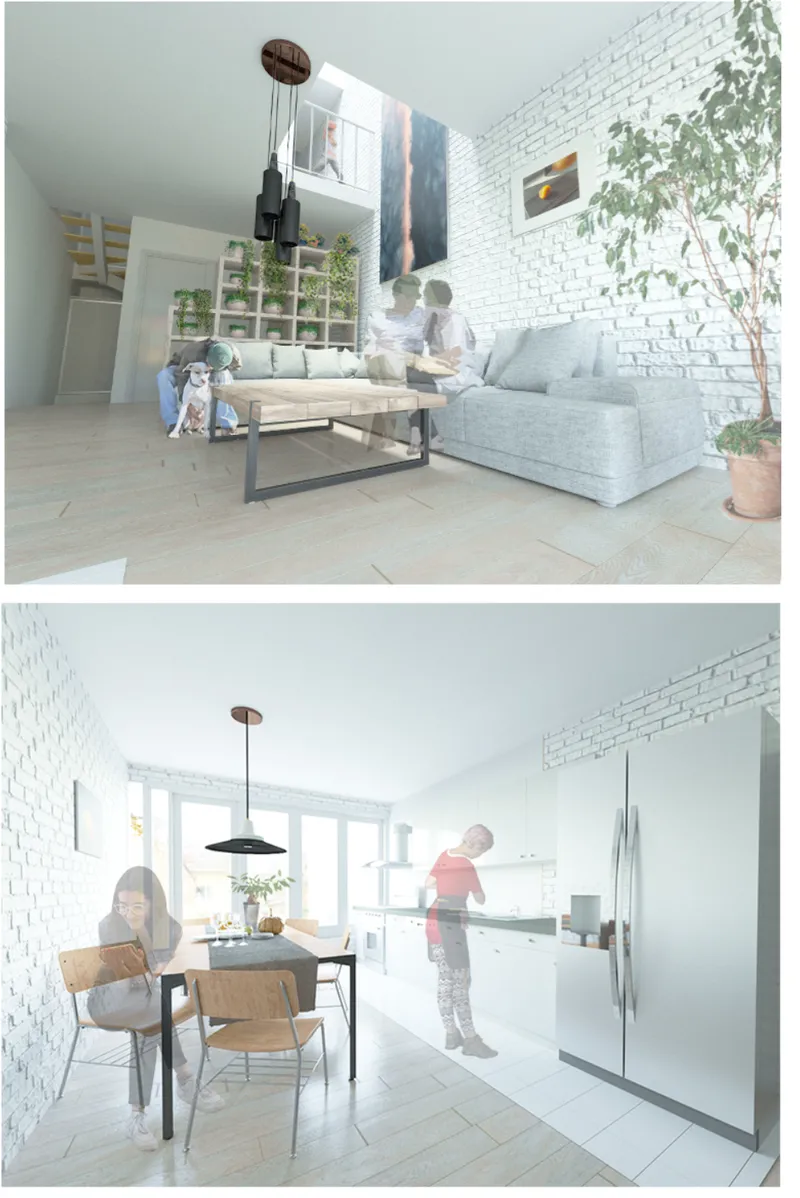
The second-floor living area demonstrates how material restraint and spatial openness can make a compact plan feel generous. White brick walls, locally sourced, line the interior alongside gypsum board and white tiles, producing a light, airy aesthetic that costs very little. Potted plants soften the hard surfaces, and figures in the rendering occupy the space casually, suggesting that the room functions well for daily life rather than just photographic composition. Transparent materials and partial enclosures maintain connectivity between the kitchen and living zones while preserving pockets of intimacy. The daylight filtering into this level relies partly on solar tubes that channel light from the roof down into deeper floor areas, a strategy repeated throughout the house.
Timber Screens and the Privacy of Shared Rooms
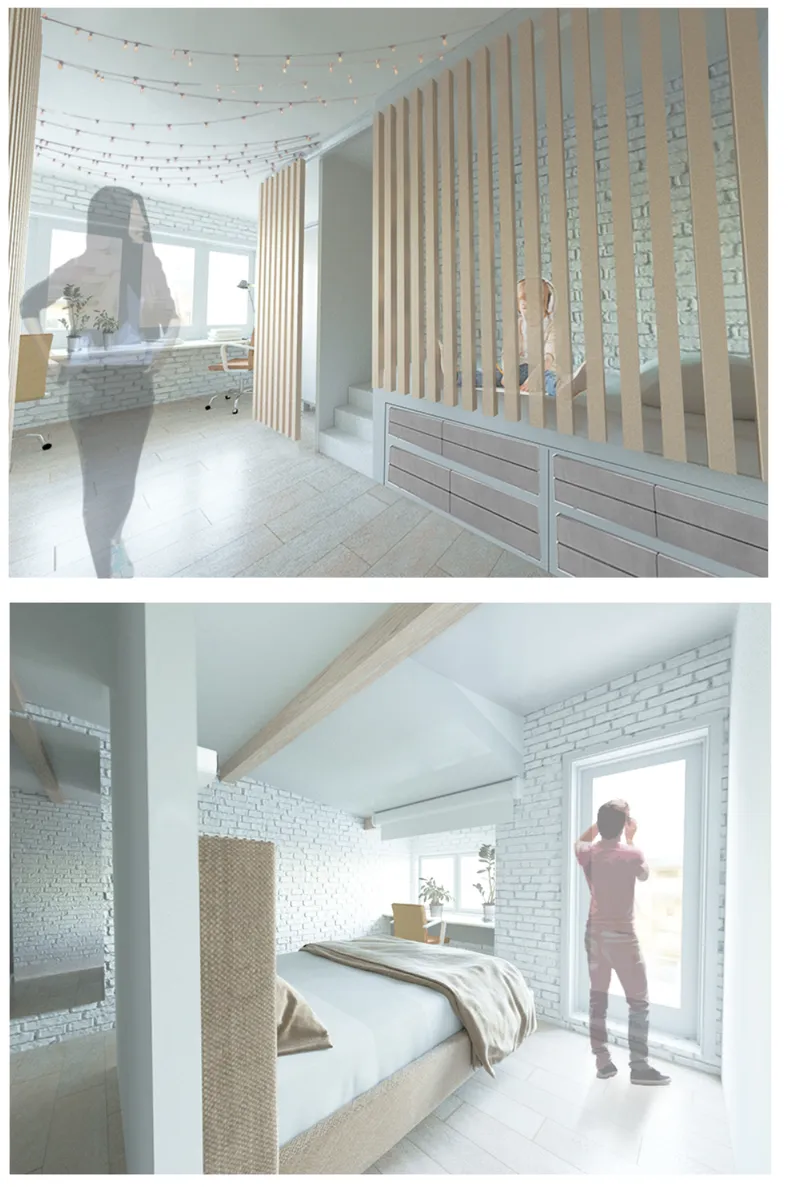
The children's floor introduces wood batten partitions that form flexible zones, allowing siblings to have individual comfort while maintaining the spatial openness that a narrow plan demands. In the bedroom view, a vertical timber screen filters bright natural light at the window edge, creating a layered threshold between interior and exterior. The screen is not merely decorative; it modulates solar gain, provides visual privacy from adjacent buildings, and introduces a warm tonal counterpoint to the white surfaces that dominate the rest of the house. On the fourth floor, the parents' master suite deploys a different privacy device: a walk-in-through wardrobe that functions as a "space within a space," buffering the bedroom from circulation while enabling uninterrupted flow through the plan.
Reading the Section: Daylight Shafts, Ventilation, and Vertical Logic
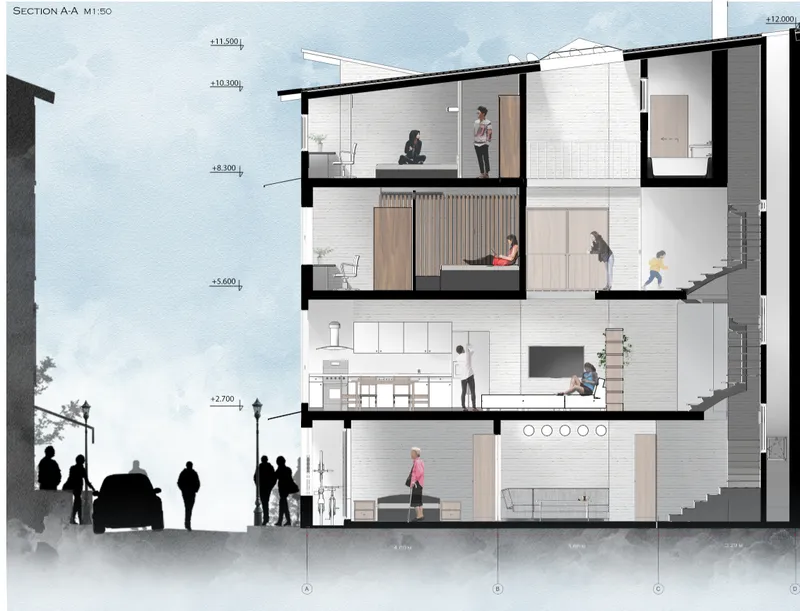

The full building section cuts through all five levels and reveals the environmental infrastructure holding the scheme together. A rear ventilation shaft, coated with reflective paint, improves light diffusion and air circulation across every floor. Zones without access to natural light are strategically reserved for mechanical and storage functions, so no habitable room relies on artificial illumination alone. Sunshades and overhangs on the facade ensure seasonal thermal performance: winter sunlight enters at low angles while summer heat is deflected. These passive strategies reduce reliance on active heating and cooling systems, a meaningful consideration in Lviv's temperate but demanding climate.
The front elevation drawing places the house back in its urban context, its narrow facade flanked by the patina of older buildings and the mass of the church tower. The exposed brick facade and traditional detailing pay homage to Lviv's Austro-Polish architectural language, while modern fenestration patterns signal the building's contemporary program. The structural frame, comprising reinforced concrete columns and flat slabs, uses standard, affordable construction methods. The most expensive features are the skylights and solar tubes, justified by their outsized impact on livability across the deeper floor plates.
Why This Project Matters
Infill housing in historic European cities often falls into one of two traps: either it mimics its surroundings so faithfully that it becomes scenography, or it disrupts them so aggressively that it undermines the streetscape it claims to complete. Bebko's Nano Nest entry navigates between these poles with a clear structural logic and a genuine understanding of who will live inside. Assigning each generation its own floor is a simple organizational idea, but the supporting details, from solar tubes reaching the ground-floor bedroom to the walk-in-through wardrobe on the fourth floor, show a designer thinking through the daily experience of each occupant.
The project also demonstrates that compact housing need not mean austere housing. Locally sourced materials, passive environmental strategies, and standard construction methods keep costs in check without sacrificing spatial quality. For anyone working on tight urban sites in heritage contexts, this scheme offers a useful lesson: respect the existing fabric, stack your program with precision, and let daylight do the heavy lifting.
View the Full Project
About the Designers
Designer: Stanislav Bebko
Enter a Design Competition on uni.xyz
uni.xyz runs architecture and design competitions year-round that reward proposals with spatial conviction and real site intelligence.
Project credits: Nano Nest by Stanislav Bebko Nano Nest 2020 (uni.xyz).




Popular Articles
Popular articles from the community


The Ocean Hive: Sustainable Architecture for a Self-Sufficient Civilization at Sea
The Ocean Hive imagines sustainable architecture at sea, where modular habitats, algae, wave power and ocean waste sustain a growing colony.

Play: Fragments of Their World
Familiar architecture becomes modular playground design, creating safe spaces where displaced children can learn, connect, imagine and play.

The Earth Pod: 3D Printed Homes for Resilient Refugee Communities
The Earth Pod reimagines refugee housing through 3D printed homes made from clay, combining resilience, self-sufficiency, and rapid shelter.

Co-Life: Senior Housing Design That Reconnects Older Adults With the City
Co-Life reimagines senior housing design through healing gardens, shared streets, workshops, and a sustainable community across generations.


Similar Reads
You might also enjoy these articles

Day and Night Park: A Time-Based Urban Newsstand in Beijing
A temporary urban newsstand in Beijing blending travel, light, and reading through poetic colors, compact form, and community-focused design.

Modernist Patio Renovation in El Masnou, Barcelona by Oliver Segura Arquitectura + Cebrià Arquitectura
Modernist patio renovation blending tradition and innovation with a movable pool, leveled floors, and Catalan materials in El Masnou.

Alto Residencial Coop: Cooperative Housing Development in Santiago de Compostela by Carbajo Barrios Arquitectos
A linear cooperative housing complex blending white volumes and perforated metal façades, enhancing community living, natural light, privacy, and urban integration.
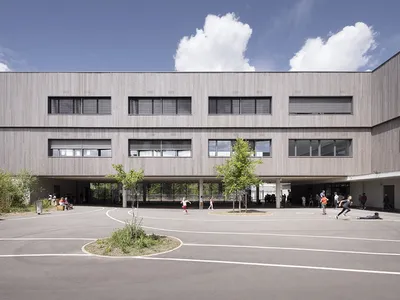
Vil Genis School by BPA ARCHITECTURE – Massy, France
Vil Genis School in Massy, France, features sustainable design, south-facing classrooms, community integration, accessible spaces, and modern educational architecture.


Comments (0)
Please login or sign up to add comments
No comments yet. Be the first to comment!