
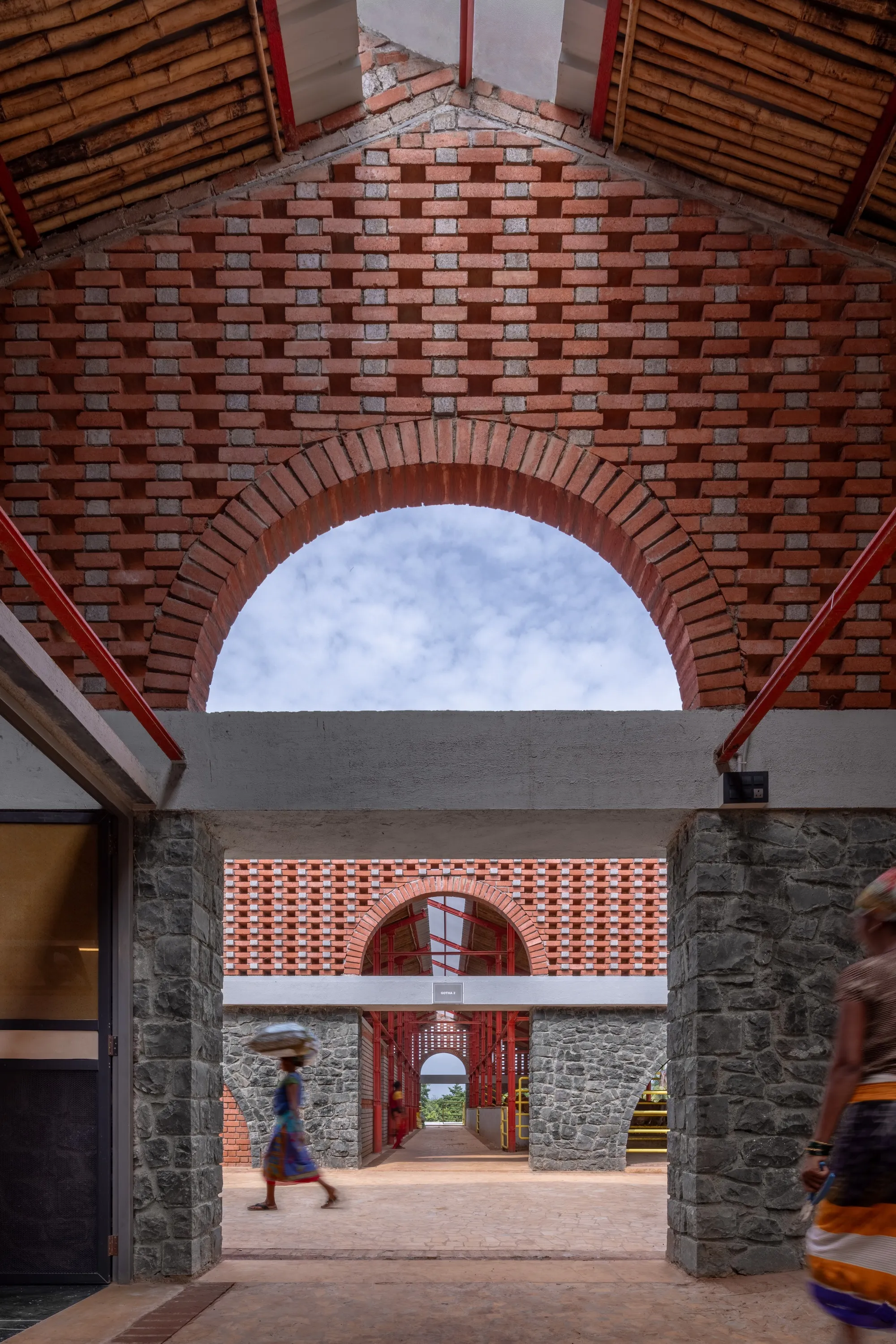
Compartment S4 Builds a 14-Acre Gaushala in a Maharashtra Orchard That Tripled Milk Output
Gaughar reimagines the Indian cowshed as a breathable, craft-rich campus set within a 350-acre fruit orchard in Dahanu, Maharashtra.


A cowshed is rarely asked to do more than keep rain off animals and dung out of sight. Compartment S4 treats the brief differently. Their Gaughar project in Dahanu, Maharashtra, replaces a dilapidated steel shed with a 14-acre campus of basalt, brick, bamboo, and red steel that houses roughly 400 cows, and it does so with the spatial generosity and material conviction most firms reserve for museums. The result is not precious. It is a working livestock facility. But it is also proof that agricultural infrastructure can absorb regional craft, passive climate strategy, and genuine architectural ambition without losing its functional footing.
The numbers back up the conviction. Since completion, milk productivity has tripled and ghee output improved significantly. More striking: no cow has died from illness since the new buildings opened. Those outcomes are not incidental to the architecture. They are consequences of it. Continuous airflow through brick jalis, ridge ventilation that purges warm air, separated circulation for people and cattle, rounded troughs that prevent injury: every detail exists at the intersection of animal welfare and building craft. Gaughar sits within a larger rural campus, commissioned by the Somaiya Foundation, that also includes a tribal school for 600 children and a skill development centre. The cowshed is the newest piece, but arguably the most instructive.
Stone Arcades and Perforated Gables

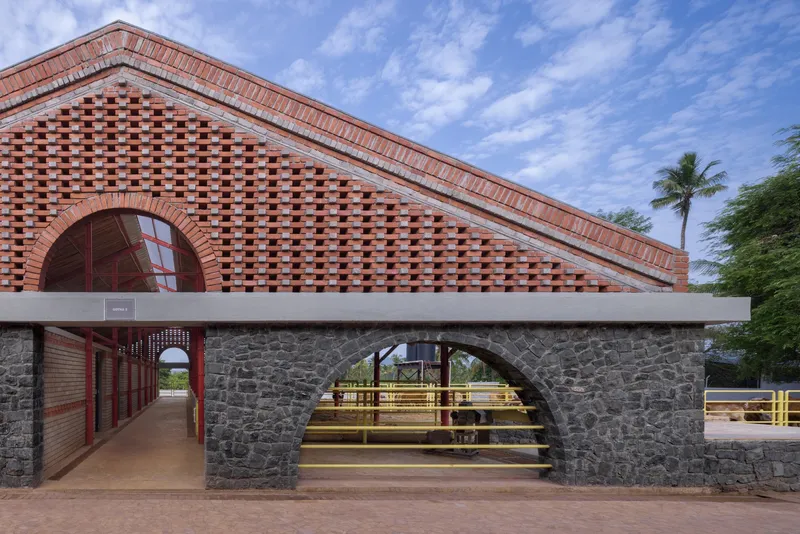

The facades read as a layered composition of three distinct material registers: black basalt stone at the base, exposed brick in the middle, and perforated brickwork at the gable ends. The stone arcades do structural work and create a visual datum that anchors every building to the ground plane. Above them, the chequered brick gables draw from traditional jali screens, allowing air to pass through the upper volume of each shed while casting moving patterns of light onto the floor inside.
The arched openings are not decorative nostalgia. Compartment S4 uses them to revive masonry techniques that are disappearing from contemporary Indian construction. Each arch provides lateral stability to the wall panels while creating generous openings that eliminate the need for mechanical ventilation. The red metal gates and yellow railings introduce a frank industrial palette that keeps the composition honest: this is a farm building, and it does not pretend otherwise.
Red Steel Frame and Bamboo Ceiling


The structural system is direct. A red-painted steel frame carries sloped roofs over long, open bays. The columns sit on stone plinths. Between them, walls of locally sourced basalt and brick infill only where enclosure is needed, leaving generous stretches open to the landscape. The effect is a building that breathes, literally, through its own skeleton.
Overhead, bamboo ceilings woven by artisans from the Dang region give the interiors an unexpected warmth. The bamboo slats modulate light and soften the acoustic environment, making the sheds quieter and less stressful for the animals. Combined with the exposed timber brackets visible at the eaves, the ceiling system creates a layered section that moves from heavy stone at the base to light woven material at the top. It is a legible tectonic hierarchy that also happens to perform well in Dahanu's humid coastal climate.
Light, Air, and the Jali Wall


The brick jalis are the project's signature element. Manufactured in Kesarjan using recycled construction waste, they filter daylight into constantly shifting patterns while pulling cross-ventilation through every shed. The effect inside is immediate: the air moves, the light is soft, and the spaces feel neither dark nor exposed. Skylights punctuate the ridgeline above, releasing hot air upward and drawing cooler air in through the perforated walls below.
Some openings are infilled with sections of block-printed ajrakh fabric, a detail that sounds decorative until you see it in context. The fabric panels are operable, letting staff adjust airflow and light levels on a given day. It is a low-tech responsive facade, calibrated to Dahanu's monsoon climate, that references local textile traditions without turning them into wallpaper.
Circulation and Animal Welfare
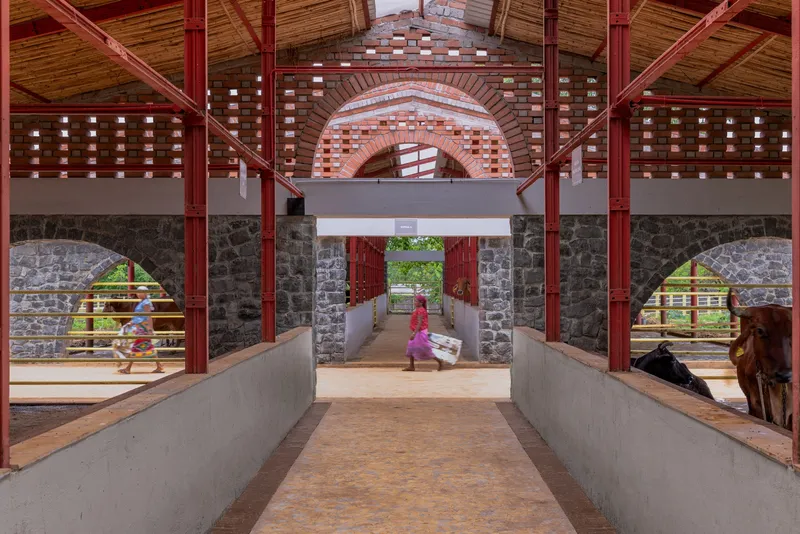

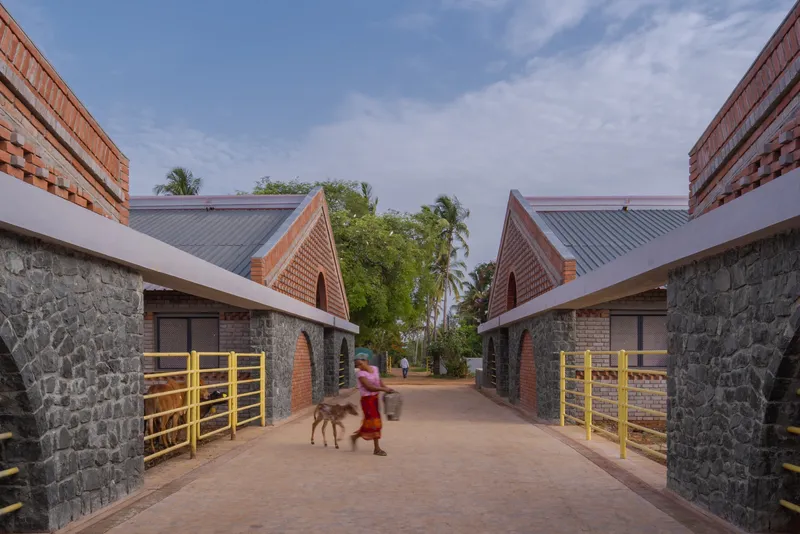
The plan separates people and cattle into distinct but interconnected paths. Gentle ramps accommodate tractor trolleys and allow easier movement of sick or injured animals. Indoor resting areas extend directly into outdoor paddocks, so cows choose freely between shade and open ground. This is not a housing type that confines. It is one that allows.
The covered walkways that link buildings are framed by symmetrical gabled structures with yellow metal railings, creating a campus-scale legibility. You always know where you are. Arched openings frame long views across the site, and the dusk lighting in several of these corridors reveals how carefully the proportions have been controlled. The seven-meter-wide bays are generous enough for trolley access and small enough to keep the bamboo ceiling spans reasonable. Practical geometry, not imposed form.
Interiors: From Cattle Stalls to Sorting Rooms


The livestock shelter interiors are generous, well-lit volumes where red steel columns rise from brick flooring through perforated clerestory walls. Brick flooring improves hygiene; capped MS columns double as scratching surfaces for the animals. These are details that no visitor will notice but every cow will use. The rounded water troughs, referenced from the logic of the matka (a traditional clay pot), reduce sharp edges that could injure animals during feeding.
Ancillary spaces receive equal attention. The sorting room, where workers process feed and materials, sits under the same bamboo ceiling and behind the same brick jali screens. An office overlooking the cattle enclosure gives staff a direct visual connection to the herd through perforated brick partitions. There is no back-of-house here. Every room is treated as part of a single integrated environment.
Landscape and Water


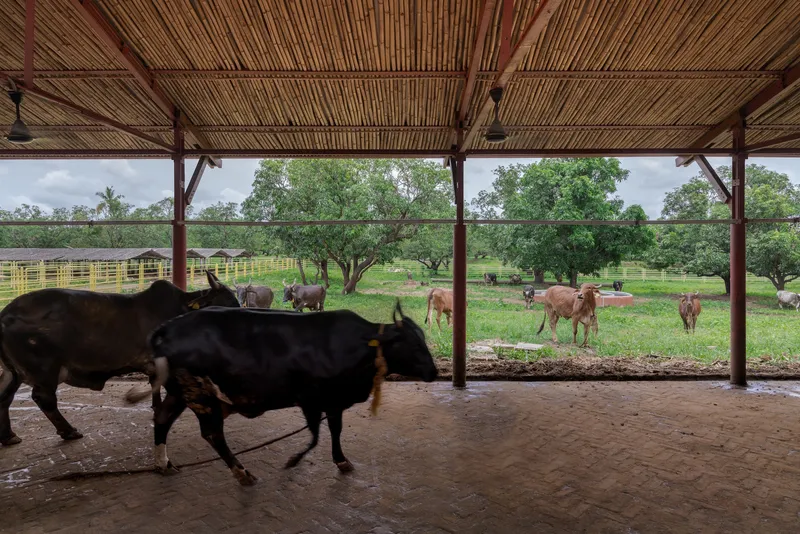
The circular havadas, communal water bodies inspired by matka logic, punctuate the campus with calm geometry. Lined with lime plaster to stay naturally cool, each one centres on a tree that regulates heat and provides shade. The red and grey brick rims give them a finished presence that contrasts with the rougher basalt walls of the sheds.
Beyond the buildings, cattle graze beneath mango and chikoo trees on the 350-acre orchard. The view from inside the shelter, looking out through open bays to a green pasture under monsoon clouds, collapses any remaining distance between architecture and agriculture. The building does not sit on the landscape. It operates within it.
Material Craft Up Close

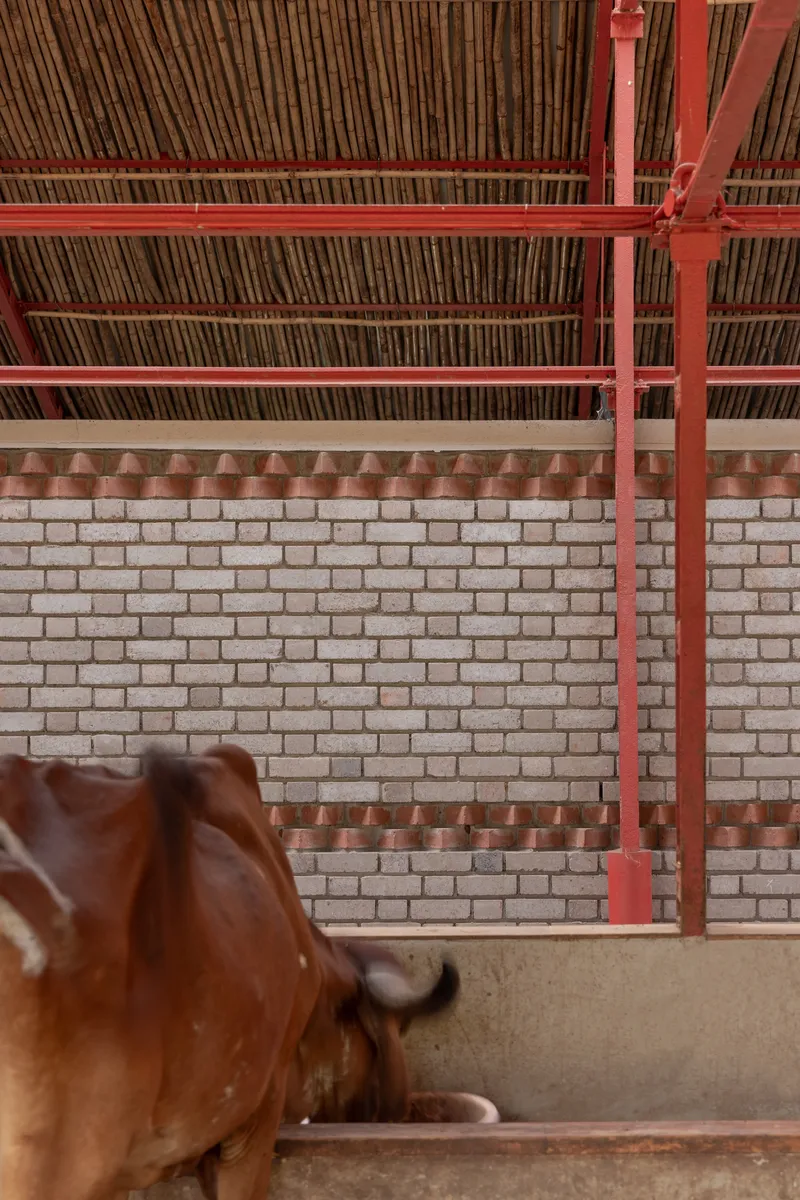

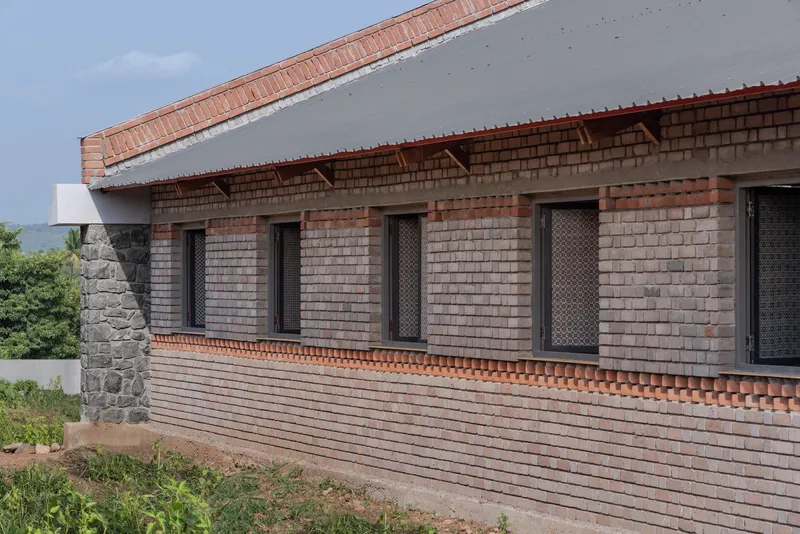
A closer look at the walls reveals the degree of care in the brickwork. Alternating red and grey units form a basketweave texture around arched openings, creating a tactile richness that reads at both arm's length and across the courtyard. The banding on the lower walls, stone transitioning to brick, gives each facade a geological layering that echoes the basalt geology of the Dahanu region itself.
Through the basalt stone columns, courtyard views frame workers, cattle, and the arched brick walls in a single composition. The material palette, just four primary elements (stone, brick, steel, bamboo), is limited enough to be coherent and varied enough to avoid monotony across a 14-acre campus.
Plans and Drawings


The site plan confirms the cruciform layout: three gabled barn structures arranged around shared courtyards, pathways, and the circular havada water features. The axonometric drawing reveals how grazing paddocks, covered shelters, and service zones interlock without competing. Cattle, people, and vehicles each have their own routes through the campus, and the drawings make this separation legible in a way the photographs cannot.
The sections are particularly instructive. The gabled profiles with arched openings show how hot air rises to the ridge and exits through ventilation slots, while cooler air enters at the base through the jali walls. The sectional diagram with material callouts documents the sustainable construction logic: locally sourced stone at the base, recycled-waste bricks in the screens, bamboo at the ceiling, steel only where span demands it. Every material is placed at the height where it performs best.
Why This Project Matters
Agricultural buildings are among the most neglected typologies in contemporary architecture. They are typically procured on cost alone, built from corrugated steel, and designed to last a generation before replacement. Gaughar demonstrates that a different model is possible, one where regional materials, passive climate strategies, and genuine craft investment produce a facility that performs measurably better by every metric that matters: animal health, milk yield, worker comfort, and thermal performance. The threefold increase in milk productivity is not a soft claim. It is a direct consequence of spatial quality.
Compartment S4 has built a project that makes a structural argument for treating livestock architecture as architecture, full stop. The bamboo artisans from Dang, the brick manufacturers in Kesarjan, the basalt quarries nearby: the supply chain is local, the skills are real, and the results are durable. In a discipline that too often reserves its best thinking for cultural and residential commissions, Gaughar is a reminder that the most consequential buildings are sometimes the ones where the clients have four legs.
Gaughar Animal Husbandry by Compartment S4. Dahanu, Maharashtra, India. Completed 2025. Photography by The Space Tracing Company.
About the Studio
Share Your Own Work on uni.xyz
If projects like this are the kind of work you want to make, uni.xyz is a place to publish your own, find collaborators, and enter design competitions.




Popular Articles
Popular articles from the community


The Musturak Paradise: Senior Living Architecture for a Connected Future in Temara, Morocco
The Musturak Paradise reimagines senior living architecture in Temara via private homes, social spaces, culture, community, and shared care.

AL-JANNAH: Sustainable Architecture and Permaculture for Afghan Widows
AL-JANNAH uses sustainable architecture and permaculture to create resilient oasis of housing, learning, work and renewal for Afghan widows.

Riyadh For All: Intergenerational Urban Design for Active Aging in Rabat
Riyadh For All reimagines urban design in Rabat with intergenerational co-living, adaptive courtyards, and Moroccan cultural exchange today.

Co-Life: Senior Housing Design That Reconnects Older Adults With the City
Co-Life reimagines senior housing design through healing gardens, shared streets, workshops, and a sustainable community across generations.


Similar Reads
You might also enjoy these articles

Bao Huynh Watercolor Atelier: A Serene Art Retreat in Hội An
Bao Huynh Watercolor Atelier in Hội An blends multifunctional art spaces, sustainable design, local materials, and family-friendly living in a serene environment.

Atelier Macri Concept Store Interior Design by CASE-REAL
Atelier Macri store features a "ko" counter, walnut wood details, cork displays, blending retail, gallery, and seamless customer experiences.

Manuel Vargas Izquierdo Stadium and High-Performance Sports Center: Architectural Excellence in Jalpa de Méndez
The Manuel Vargas Izquierdo Stadium blends sustainable design, inclusive sports facilities, and cultural-inspired architecture, revitalizing Jalpa de Méndez’s public spaces.

KAKR Buluh Awar Hall: Revitalizing Community and Ecology Through Bamboo Architecture
Community built bamboo hall revitalizes Buluh Awar village, empowering youth, restoring ecology, celebrating vernacular craftsmanship through sustainable architecture and culture.




Comments (0)
Please login or sign up to add comments
No comments yet. Be the first to comment!