

Connecting Work: Modular Units That Plug Into a Living Architectural Network
A scalable framework of self-sufficient workspace modules that reconfigure around evolving workflows, collaboration needs, and hybrid work models.


What if a building could reorganize itself the way a project team does? Connecting Work takes that provocation seriously, proposing a workspace architecture built from self-sufficient modules that plug into a larger network, reconfigure on demand, and grow organically as work culture shifts. Rather than designing a fixed office complex and hoping it stays relevant, the team treats modularity as the generative logic of the entire system: from a single desk to an entire cluster of buildings, every scale is designed to adapt.
The project is a collaboration between Florin Harabagiu, Cristian Duca-Damian, Alexandru Tirca, and Oncica Alina Claudia. Together they have developed a concept that positions architecture not as a container for work but as an active participant in it, responding to rapid technological change, hybrid work models, and the growing demand for interdisciplinary collaboration.
White Volumes, Natural Light, and the Interior Logic of Flexibility
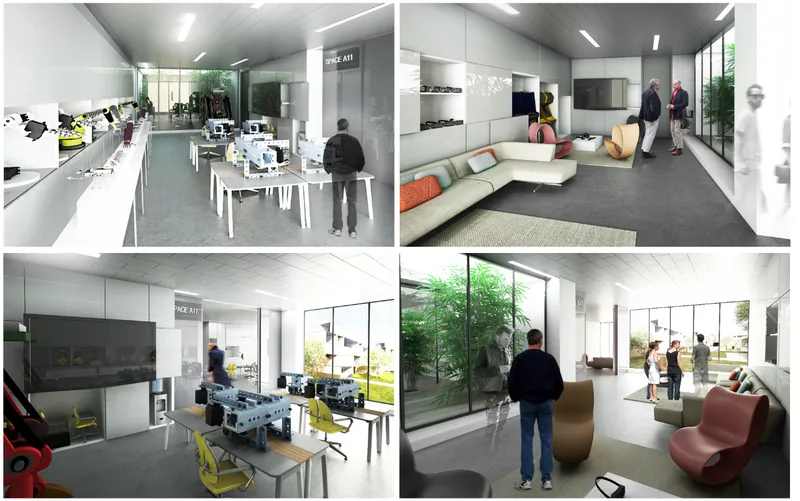
The interior renderings reveal clean, open work zones finished in white surfaces with grey flooring, where figures browse displays under linear ceiling lights. There is a deliberate restraint here: the material palette is neutral enough to recede, letting the spatial configuration and the people inside it become the defining character of each room. Natural lighting is prioritized throughout, and greenery appears as an integrated element rather than an afterthought. The effect is a workspace that feels psychologically supportive, encouraging interaction and creativity without the visual noise of a conventional office.
The interiors suggest a project-based adaptability, where rooms can shift function depending on the workflows they host. Open collaborative zones coexist with more focused display areas, hinting at a spectrum of work modes supported by the same architectural module. It is this interior flexibility that makes the larger modular logic credible: the units are not just stackable boxes but complete micro-environments capable of hosting diverse activities.
Stacked Modules and Vertical Wood Cladding Set Against Open Landscape
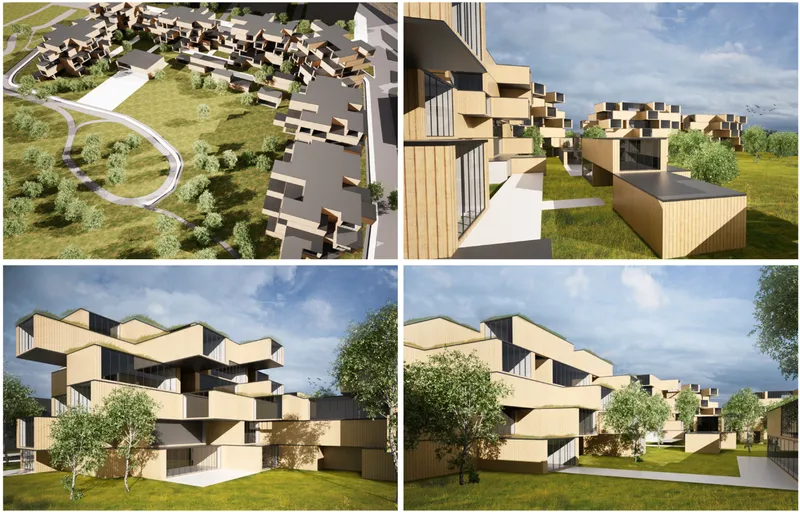
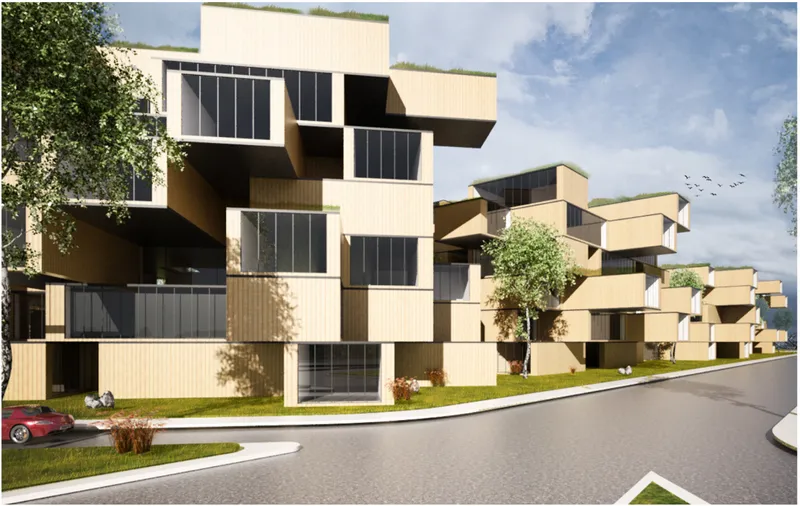
From the outside, the modular volumes become legible as individual units stacked and offset to create a dynamic massing. Vertical wood cladding wraps each module, giving the facades a warm, tactile quality that contrasts with the grassy landscape surrounding them. Aerial views show how the units cluster loosely rather than aligning into a monolithic block, allowing light and air to penetrate between volumes. At street level, protruding balconies extend the inhabited space outward, blurring the boundary between interior work zones and the exterior environment.
The arrangement fosters connectivity between buildings and their surrounding landscapes. The stacking is neither random nor rigidly symmetrical; it reads as an organic accumulation that could plausibly grow or shrink over time. This is where the modularity becomes architectural rather than merely organizational. The design communicates its own adaptability through form, making the scalable logic visible to anyone approaching the complex.
Site Strategy: Green Roofs, Clustered Blocks, and Neighborhoods of Work
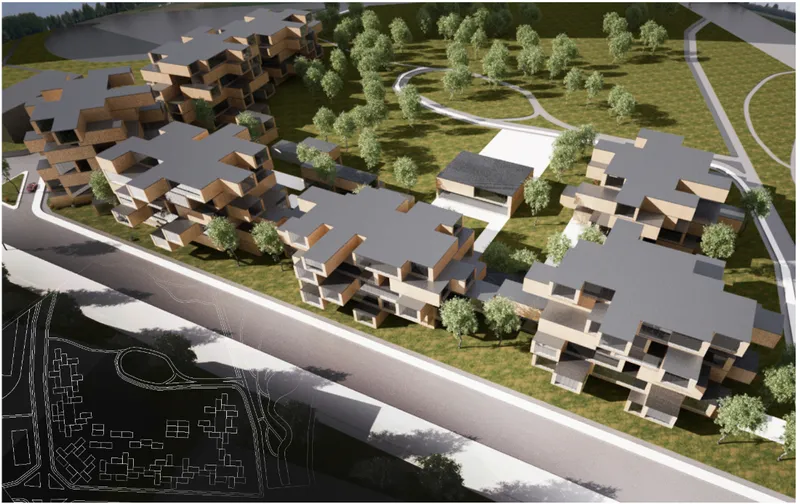
The aerial rendering and overlaid site plan reveal how individual modules aggregate into clustered housing blocks with green roofs, forming what the designers describe as "neighborhoods of work" that grow organically. Open courtyards punctuate the plan, serving as shared green spaces that encourage interaction at the scale of the community rather than the individual office. The green roofs are not decorative; they contribute to an energy-efficient, eco-conscious approach that runs through the project's sustainable architecture strategies.
At this scale, the project operates as urban design as much as architecture. The clusters are spaced to maintain porosity, ensuring that the complex does not become an insular campus but instead integrates with its context. Floor plans outline how interconnected modules shape these neighborhoods, with pathways and shared spaces stitching the clusters together into a coherent whole.
Infrastructure as Architecture: Utility Conduits and the Module Interface
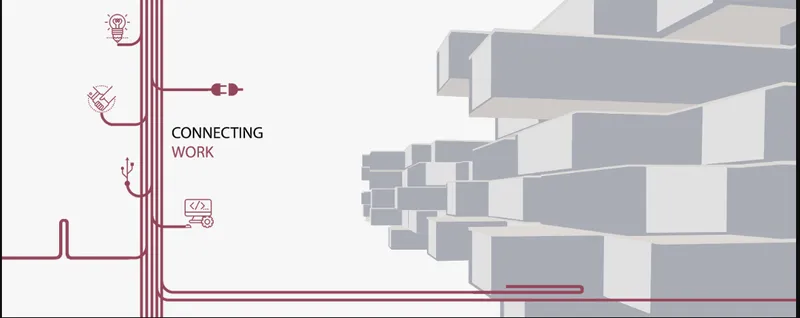
Perhaps the most revealing drawing in the set is the infrastructure diagram, which shows a central conduit connecting to stacked volumetric modules with annotated icons for utilities and services. Here the project makes explicit what is often hidden: the technical backbone that allows modularity to function. Each unit plugs into shared utility networks for power, water, data, and climate control, enabling rapid reconfiguration without the costly re-routing of services that typically makes adaptable architecture impractical.
This diagram elevates the concept from speculative rendering to a system with operational logic. The multi-scalar flexibility the designers describe, from desks to entire office clusters, depends on this kind of infrastructure thinking. Without a clear strategy for how modules connect, disconnect, and reconnect at the level of building services, modularity remains a visual conceit. The diagram argues that the team has thought beyond form.
Why This Project Matters
Connecting Work takes the familiar promise of modular architecture and pushes it toward a genuine systems proposal. By working across scales, from the interior finish of a single workspace to the site plan of an entire neighborhood, the designers demonstrate that adaptability is not a feature bolted on at the end but the structural logic from which everything else follows. The integration of sustainable strategies, including natural light, green roofs, and energy-efficient design, grounds the concept in environmental responsibility rather than purely formal experimentation.
What distinguishes the project is its willingness to show the unglamorous infrastructure that makes modularity real. Too many speculative workspace concepts stop at the rendering; this one includes the conduit diagram. For a generation of designers navigating hybrid work models, shifting collaboration patterns, and the climate crisis simultaneously, that combination of spatial ambition and technical specificity is exactly the kind of thinking the discipline needs more of.
View the Full Project
About the Designers
Designers: Florin Harabagiu, Cristian Duca-Damian, Alexandru Tirca, Oncica Alina Claudia
Enter a Design Competition on uni.xyz
uni.xyz runs architecture and design competitions year-round that reward proposals with spatial conviction and real site intelligence.
Project credits: Connecting Work by Florin Harabagiu, Cristian Duca-Damian, Alexandru Tirca, Oncica Alina Claudia.




Popular Articles
Popular articles from the community


The Earth Pod: 3D Printed Homes for Resilient Refugee Communities
The Earth Pod reimagines refugee housing through 3D printed homes made from clay, combining resilience, self-sufficiency, and rapid shelter.

The Musturak Paradise: Senior Living Architecture for a Connected Future in Temara, Morocco
The Musturak Paradise reimagines senior living architecture in Temara via private homes, social spaces, culture, community, and shared care.

Co-life: Sustainable Architecture for Age-Friendly Community Living
Co-life reimagines sustainable architecture for seniors through courtyards, rammed earth, shared gardens, and spaces designed for belonging.

Riyadh For All: Intergenerational Urban Design for Active Aging in Rabat
Riyadh For All reimagines urban design in Rabat with intergenerational co-living, adaptive courtyards, and Moroccan cultural exchange today.


Similar Reads
You might also enjoy these articles

Lunar Spiral: Space Architecture Shaped by the Mathematics of the Universe
Lunar Spiral reimagines space architecture through Fibonacci geometry, lunar regolith, levitating habitats, and self-sustaining Moon living.
The Main Dream: Modular Architecture for Play, Learning, and Community
A modular playground turns recycled plastic into adaptable spaces where refugee children can play, build, learn, and reconnect.

Play: Fragments of Their World
Familiar architecture becomes modular playground design, creating safe spaces where displaced children can learn, connect, imagine and play.

Wadi Rum Observatory: Desert Architecture Designed for the Night Sky
Wadi Rum Observatory turns desert architecture into a quiet instrument for astronomy, hiding research spaces under Jordan's starlit terrain.
Explore Futuristic Workspaces Competitions
Discover active competitions in this discipline


Challenge to design luxury tourism on rails


Challenge to reimagine the Iron Throne


Photograph architecture without architects


VR headsets Storefront design competition
Comments (0)
Please login or sign up to add comments
No comments yet. Be the first to comment!