
Contacto Atlântico Threads a Zara Store Through a 200-Year-Old Pombaline Block in Lisbon
At Rossio, a 10,000-square-meter retail intervention proves that heritage and commerce can coexist without compromise.


The Baixa Pombalina is not a neighborhood that tolerates carelessness. Built after the 1755 earthquake as one of Europe's earliest exercises in rational urban planning, its blocks are civic artifacts: symmetrical, stone-clad, and loaded with two and a half centuries of accumulated meaning. When Zara selected a building stretching between Praça D. Pedro IV, Praça da Figueira, Rua do Amparo, and Rua da Betesga for a flagship store, the obvious risk was a corporate gut job. What Contacto Atlântico, led by architect André Caiado, delivered instead is closer to urban archaeology in service of retail.
The building once housed Ourivesaria Portugal, the storied Manteigaria União, and the beloved Pastelaria Suíça. Rather than erasing those layers, the project reopens a previously fractured block to the city, stitching together separate commercial fractions into a continuous 10,110-square-meter experience across five above-ground levels and two basements. No volume was added. Pombaline walls, the famous gaiola pombalina timber cage structure, frescoed ceilings, azulejo panels, and paintings by António Lino are not merely preserved but made legible within a functioning retail program. It is an act of restraint that manages, against the odds, to feel generous.
A Block Reopened


Seen from above, the terracotta roofscape reads as a single civic mass, not a retail destination. That is the point. Contacto Atlântico treated the block as a permeable vessel, refusing to produce the sealed commercial box that global fashion brands usually demand. The cream stone facades, red mansard roofs, and wrought iron canopies at street level remain faithful to the Pombaline color palette and proportional logic. At dusk, pedestrians pass beneath the glazed storefronts with no sense of rupture between the 18th-century streetwall and the 21st-century program behind it.
The decision to add zero volume is worth emphasizing. In a market where luxury flagships routinely append glass pavilions or sculptural canopies to announce themselves, this store announces nothing. It simply opens its doors, literally connecting to both adjacent squares and inviting circulation through the block rather than around it.
The Gaiola Lives On
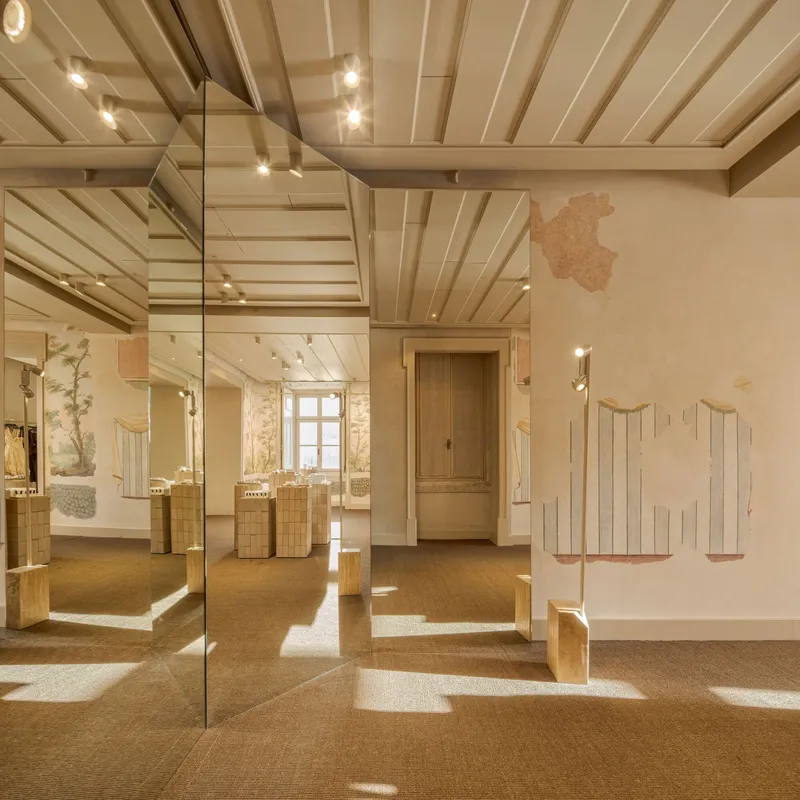


The gaiola pombalina, a modular timber framework embedded within load-bearing masonry, was a structural innovation born from catastrophe. In this project it becomes an interior character. Exposed timber ceiling beams, wooden plank ceilings, and the rhythmic succession of loadbearing walls define the retail galleries with a cadence that no new-build store could replicate. Walking through successive doorways framed by ornamental plasterwork, you are navigating the original structural bays of an 18th-century building, not a scenographic imitation of one.
Interior partitioning uses gypsum drywall, a deliberately reversible system that can be removed without damaging the historic fabric. It is a smart conservation move: the retail layout can evolve over time while the Pombaline skeleton remains untouched. Cork flooring, Lioz stone from Sintra, linen textiles, and lime mortar reinforce a material vocabulary rooted in Portuguese building tradition rather than global retail convention.
Frescoes, Tiles, and the Problem of Beauty in Retail


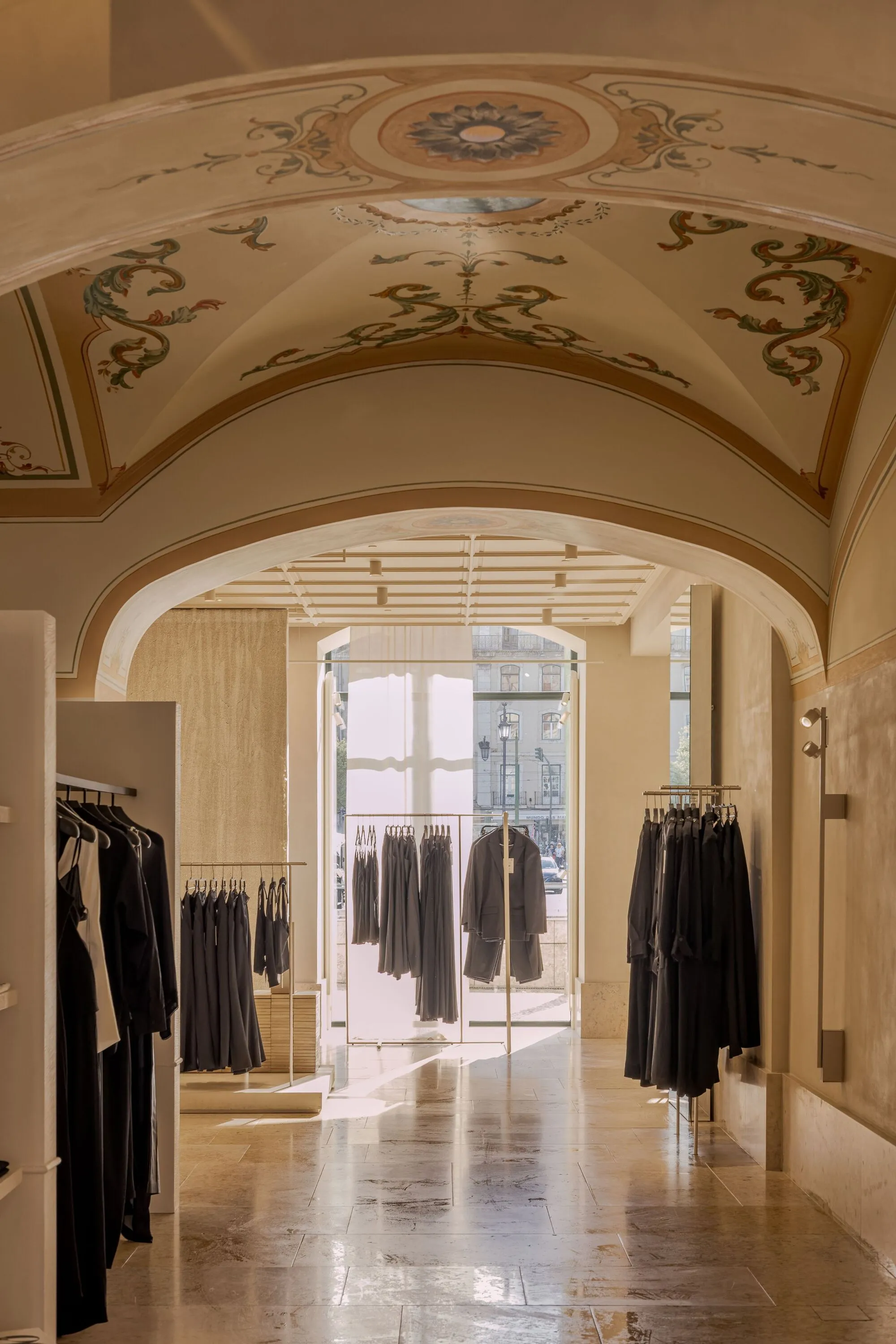
There is an inherent tension in placing a clothing rack beneath a gilded plaster medallion or displaying stacked white plates under a painted dome ceiling. The risk is that heritage becomes backdrop, wallpaper for commerce. Contacto Atlântico navigates this by letting the decorative layers command the vertical plane while the retail fixtures remain low and neutral. Restored stucco ceilings, painted vaults with floral medallions, and gilded borders occupy the zone above eye level, asserting the building's history without competing with merchandise.
The azulejo panels from Viuva Lamego and the multicolored glass tile mosaics are integrated as spatial landmarks rather than museum exhibits. They orient you within the building, marking thresholds and transitions. António Lino's paintings, preserved in situ, function similarly: they remind you that this was someone else's building long before it was a store, and will likely be someone else's again.
Zara Home as Domestic Fiction


The third floor houses Zara Home, and here the design takes its most inventive turn. The retail space is organized as a house with discrete rooms: bedroom, kitchen, living room, bathroom, children's space, and a fragrance area. In a building whose original residential program once produced exactly these rooms, the conceit is less whimsy than historical echo. Tall windows dressed with sheer curtains, woven timber display pedestals, and botanical murals produce an atmosphere that is domestic without being cloying.
A freestanding bathtub sits beneath horizontal slat ceilings and strip lighting. Slatted wood ceilings near tall windows filter natural light. The material palette shifts subtly from the lower floors, trading stone and cork for linen and pale timber, reinforcing the sense that you have moved from public commerce into private habitation. It is a clever spatial argument for the brand, but it only works because the building's proportions already suggest domestic scale.
Coffee, Pastéis, and the Memory of Place


Two food programs inhabit the building. The Pérola do Rossio continues to serve coffee from its original location, an act of continuity that anchors the project in neighborhood memory. On the third floor, the former Manteigaria União space has been reborn as Castro by Zara, a pastry shop serving pastéis de nata beneath a ceiling painting featuring two putti. The frescoed ceiling and limestone-floored gallery that frame the service counter feel more like a Lisbon café from a previous century than anything corporate.
Including food service is not novel for fashion retail. What is unusual here is the specificity. These are not generic cafés appended for lifestyle branding; they are direct continuations of businesses and traditions that already occupied the block. The decision to preserve these programs, rather than maximize sellable floor area, signals that Contacto Atlântico and their client understood the building as a civic asset, not just a lease.
Light and Circulation


Preserved lightwells thread natural light down through the building's core, a technical strategy that doubles as a conservation gesture. Vertical circulation follows the original Pombaline staircases, restored and reintegrated into the new layout. The effect is that moving between floors feels like ascending through a residential building rather than navigating a department store. Selective openings were created to link spaces that had been separated when the block was divided into multiple commercial fractions, improving interior continuity without compromising the structural logic.
At ground level, the arched entrance with its wrought iron canopy establishes a threshold that is ceremonial without being exclusive. Inside, beige upholstered ottomans and pale stone display blocks occupy the retail floor with restraint, allowing the architecture to set the spatial rhythm rather than the merchandising plan.
Plans and Drawings

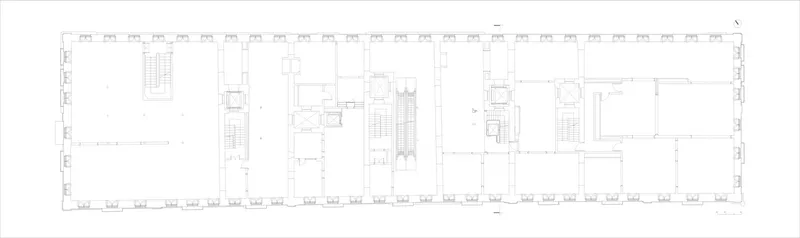

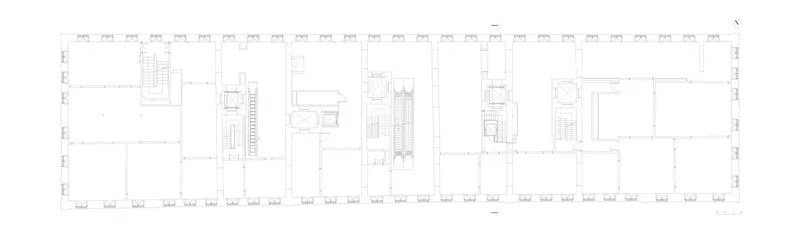

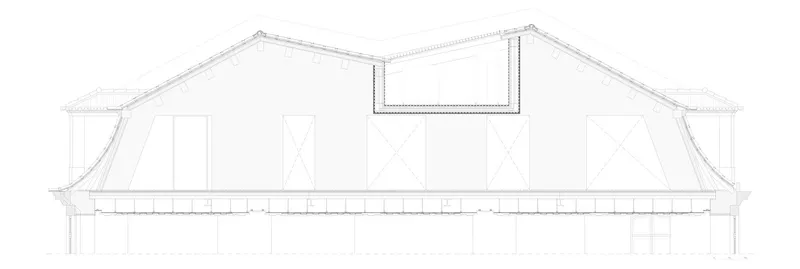
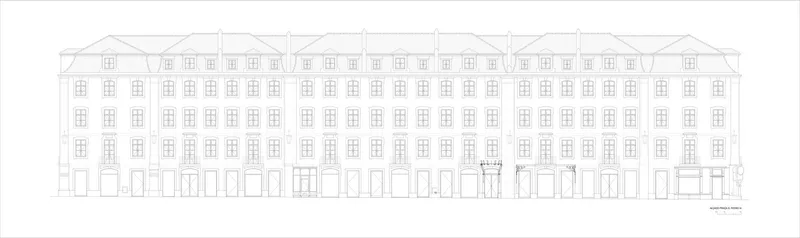
The floor plans reveal the project's fundamental challenge: a long rectangular block with a central circulation spine and repetitive structural bays that had been carved into separate tenancies over decades. Reuniting these fractions into a single continuous layout required surgical precision, threading new connections through existing masonry without breaching the Pombaline structural grid. The sections are particularly telling, showing how four levels of retail stack within the original volume, served by a central staircase that rises through the full height of the building. A curved roof structure with a central skylight appears in one section, suggesting that even in the upper reaches of the building, natural light was treated as a design material rather than an afterthought.
The elevation drawing confirms what the photographs suggest: the facade is essentially untouched. Repeated window patterns and arched ground-floor openings follow Pombaline conventions with no contemporary insertions or graphic branding competing for attention. The restraint is absolute.
Why This Project Matters
Heritage retail projects tend to fall into two traps. The first is the museum approach, where old fabric is so reverentially preserved that the new program feels apologetic and the building becomes a mausoleum with cash registers. The second is the scenographic approach, where historic fragments are extracted and deployed as décor within an otherwise standard commercial fit-out. The Zara at Rossio sidesteps both. It treats the 200-year-old Pombaline structure as a living system, one that can absorb a new program precisely because it was designed, after the earthquake, to be resilient and adaptable.
For a global fast-fashion brand to invest in reversible partitioning, local stone, lime mortar, and the preservation of a neighborhood coffee shop is noteworthy, and the credit belongs to Contacto Atlântico for structuring the project so that these choices felt inevitable rather than indulgent. If Lisbon's Baixa is to remain a living center and not a tourist stage set, it needs exactly this kind of intervention: commercially viable, architecturally literate, and genuinely respectful of the city it inhabits.
Zara Store at Rossio, designed by Contacto Atlântico (lead architect André Caiado). Lisboa, Portugal. 10,110 m². Completed 2023. Photography by Fernando Guerra | FG+SG.
About the Studio
Share Your Own Work on uni.xyz
If projects like this are the kind of work you want to make, uni.xyz is a place to publish your own, find collaborators, and enter design competitions.




Popular Articles
Popular articles from the community


The Musturak Paradise: Senior Living Architecture for a Connected Future in Temara, Morocco
The Musturak Paradise reimagines senior living architecture in Temara via private homes, social spaces, culture, community, and shared care.

Conexión: Biophilic Design Reimagines High-Rise Living in Hong Kong
Conexión reimagines high-rise living in Hong Kong through biophilic design, green facades, shared spaces, daylight, water and nature within.

The Earth Pod: 3D Printed Homes for Resilient Refugee Communities
The Earth Pod reimagines refugee housing through 3D printed homes made from clay, combining resilience, self-sufficiency, and rapid shelter.

EW PARK: Sustainable Architecture Reimagines the Future of Urban Parking
EW PARK reimagines city parking as a modular wooden tower combining automation, solar energy, electric mobility, and adaptable urban design.

Similar Reads
You might also enjoy these articles

Bao Huynh Watercolor Atelier: A Serene Art Retreat in Hội An
Bao Huynh Watercolor Atelier in Hội An blends multifunctional art spaces, sustainable design, local materials, and family-friendly living in a serene environment.

Atelier Macri Concept Store Interior Design by CASE-REAL
Atelier Macri store features a "ko" counter, walnut wood details, cork displays, blending retail, gallery, and seamless customer experiences.

Manuel Vargas Izquierdo Stadium and High-Performance Sports Center: Architectural Excellence in Jalpa de Méndez
The Manuel Vargas Izquierdo Stadium blends sustainable design, inclusive sports facilities, and cultural-inspired architecture, revitalizing Jalpa de Méndez’s public spaces.

KAKR Buluh Awar Hall: Revitalizing Community and Ecology Through Bamboo Architecture
Community built bamboo hall revitalizes Buluh Awar village, empowering youth, restoring ecology, celebrating vernacular craftsmanship through sustainable architecture and culture.


Comments (0)
Please login or sign up to add comments
No comments yet. Be the first to comment!