
Container City Competition
Designing a Modular Lifestyle

The concept behind the project was to use shipping containers to reduce costing and construction time to create student accommodation on leased land of 5 years to maximize building usage. Proven to reduce construction time by up to 40%; shipping containers can help create an environmentally friendly accommodation, increase quality of life, and connect spaces to the surrounding context. By creating affordable temporary student accommodation, we wanted our scheme to be relevant in any given context it is placed in to allow for a multitude of uses and contexts to be placed in to ensure the needs of students are met. The main thesis behind the project is that the containers can be placed in any location for any amount of time.
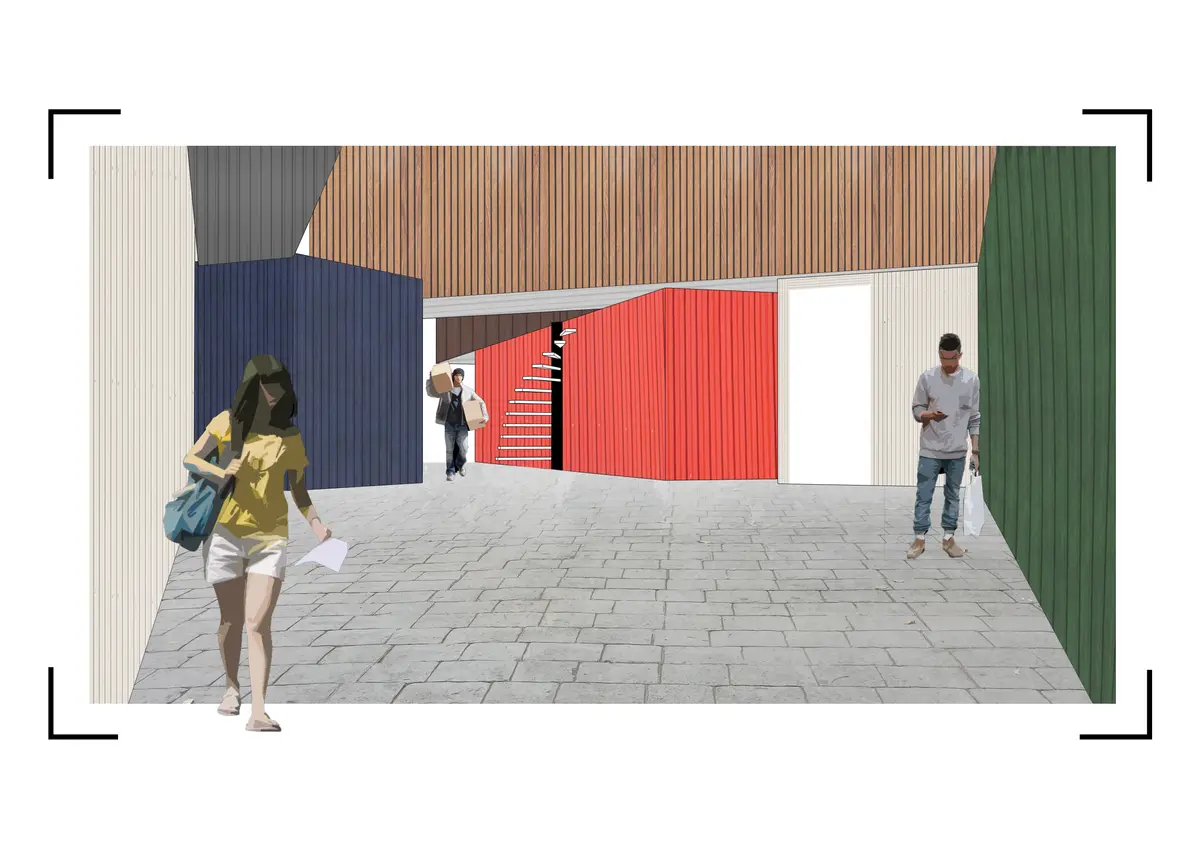
When designing the organization of the containers across various levels, we knew we had to design them in a manner which allowed for clear and easy access or students who will be occupying the spaces. One of the main intents behind the organization of elements was to create smoother circulation and to not allow the natural form of the containers to become restrictions. The design layout we have opted for allows for strategic routes for access to the housing in addition to the community hub whilst allowing privacy for occupants whilst also providing public zones for community engagement. The nature of the layout allows for a sense of exploration by both students and local residents.
Throughout the design process, we have tested many iterations before arriving at the final outcome. The scheme began with a very modular and symmetrical design which was then altered and explored deeper over time to increase the aesthetic appeal. Many iterations of the same design were made in order to test and trial to find the optimal layout. Through this process we were able to identify any issues that may cause further challenges for the occupants and act upon them. This included elements such as circulation, access, comfort and the overall student housing experience. Therefore, through creating multiple iterations, we were able to create a scheme which not only is visually appealing but also meets the needs of students.
Our methods of design investigation ranged from both physical testing and digital exploration as we used physical models and virtual CAD massing to analyze the design possibilities. After this, we opened up the spaces to investigate further and optimize for living. Through our design investigation phase, we took great inspiration from our academic University projects which have allowed us to practice our skills in a range of contexts and scale for different outcomes.
Through creating two student accommodations per shipping container, we had to ensure that the elements within that space were suitable and of user comfort. There were many challenges in regard to the spatial functionality of the containers and how the occupants would use them. However, through precedent research, design testing and creating multiple iterations of the space, we were able to create a defined final design.
In an attempt to keep to the brief and to relate to sustainable design, we kept most of the materials from the shipping containers. Using the containers as the main construction material of the student accommodation, there was not much change required. However, we understood that in order to create a student accommodation from shipping containers, we had to modify and adapt certain elements of the design scheme to provide a unique yet comfortable and relatable experience for the end users. We harvested materials from the containers to cut out to create openings for light and ventilation. This was essential as in order to provide a high quality environment, certain design alterations had to occur.
Additional materials such as wooden panels for the second skin façade of the community hub area are used for aesthetic purposes. By using recycled timber, this sustainable approach not only allows the design to be environmentally friendly, but provides an element of significance to the design scheme to indicate the change of programme.
Laminate flooring within the containers allows for a surface which is scratch, stain, moisture, fade and burn resistant to satisfy the needs of the students as they expect their living accommodations to be of low maintenance as they spend most of their time studying. The decision was also taken to use ceramic tiles for the bathroom. This was made due to precedent research as we chose materials based on student housing examples we came across in projects prior the competition and during the competition to understand which materials would be best for that space.
The objective of this design project was to create temporary student housing accommodation for University students out of shipping containers. By not alternating the spaces too much, we modified the shipping containers to create structures which meet the needs of student housing. Through our container designs we included a single bed, chest of drawers, wardrobe, desk, chair, sink, toilet and wet room shower. It’s a lot of functions to apply to the condensed shipping container. However, through multiple design iterations, we were able to produce a concept which encapsulates all the elements and to provide an optimal student accommodation given the context.
An expansion plan of the project would be to use the scheme in the future for temporary housing . This includes the deployment of student housing shipping containers to house students whilst other accommodations are being built on a larger scale. Our own personal experiences as students played a large role in defining what and how we wanted the project to expand. When we were designing this project, we had in mind the student housing block which is situated by Portsmouth and Southsea train station. During its construction phase, there were multiple delays which led to many students not having their accommodation ready in time to move in for the beginning of the new academic year. This left 80 students with no home. Therefore, our scheme for this competition entry could serve as a solution for issues such as this. Being a modular design, our shipping containers could be used as temporary accommodation for students whilst their rooms are either still in construction or if there's any damage to them. In terms of construction, the containers can be pre-fabricated off site and brought in via truck and moved into position via crane.
The project will transform with the passing time through its ability to expand in any direction to create a student village. With minor modifications, the scheme could become permanent. The unconventional nature of the design allows for further accommodation units to be added to allow expansion of the scheme which will allow a larger population of students to benefit. Through the creation of our design scheme for this competition, we aim to meet the needs of students whilst also considering important factors such as sustainability, longevity and the overall user experience of students.

Popular Articles
Popular articles from the community


Extended Shell: Retrofitting Kolkata's Balconies as Living Urban Thresholds
A modular retrofit system recovers the social and environmental intelligence of Kolkata's historic verandas for contemporary Park Street residents.

Opera on the Sea: Driftwood Logic Shapes a Timber Opera House on Estonia's Coast
Trevor Orgill's opera house translates the entangled drift of floating timber into a civic building where wood, water, and music converge.
Tsunami Convergenics: Turning Catastrophic Ocean Forces into Underwater Housing Infrastructure
A speculative underwater settlement off the coast of Onagawa, Japan, treats tsunamis and typhoons as energy sources rather than threats.

Manzana Morphosis: Stretching Barcelona's Grid into a Living Landscape for 2050
A radical reworking of the Eixample manzana turns density into a tool for generous public space, vertical ecology, and environmental performance.

Similar Reads
You might also enjoy these articles

Shakur's House: Exposed Brick as an Interior Organiser in a 168 m² Mashhad Residence
Brick moves indoors in this Mashhad residence, where masonry walls, glass partitions and teal planes sequence a compact home without closing it off.

Day and Night Park: A Time-Based Urban Newsstand in Beijing
A temporary urban newsstand in Beijing blending travel, light, and reading through poetic colors, compact form, and community-focused design.

Modernist Patio Renovation in El Masnou, Barcelona by Oliver Segura Arquitectura + Cebrià Arquitectura
Modernist patio renovation blending tradition and innovation with a movable pool, leveled floors, and Catalan materials in El Masnou.

Alto Residencial Coop: Cooperative Housing Development in Santiago de Compostela by Carbajo Barrios Arquitectos
A linear cooperative housing complex blending white volumes and perforated metal façades, enhancing community living, natural light, privacy, and urban integration.

Comments (0)
Please login or sign up to add comments
No comments yet. Be the first to comment!