
Container Village - Intersection
The intersection between people and people, space and space

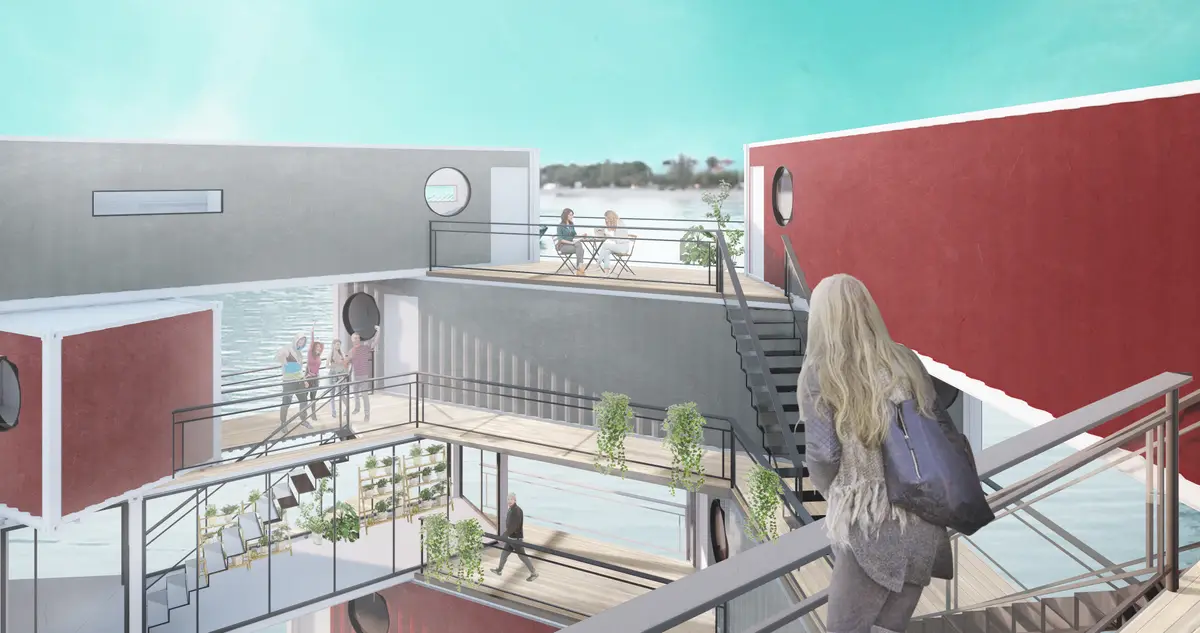
The tempo of life in a modern city is very quick. We are losing social communication in such a fast-paced lifestyle. In this project, we aim to create a kind of passive social communication - without actually meeting someone on a face-to-face basis to have a conversation, we are still in touch with others. The project will provide a space that allows users to be passively involved in social activities visually or aurally, thus enhancing the connection or encouraging closer communication between neighbors. In this project, there will be several exterior public spaces connecting the container living units as the intersection of space. Users will be led to such public spaces to see/hear other social activities or to be seen/heard. Passive social communication in this process can stimulate active social communication, promoting healthy and positive social interaction.
it is said by Denise Scott Brown: “Architecture can’t force people to connect; it can only plan the crossing points, remove barriers, and make the meeting places useful and attractive.” So what we trying to do is to hold the potential to set the stage for chance encounters and social interactions, thus nurturing community building and influencing the fabric of our social culture.
The basic module of this project consists of three 12-meter-long containers stacked together. The middle container is pulled out to create an exterior public space in between. Three containers are connected by rotating shafts allowing the middle container to twist at any angle. To link the exterior public social spaces to generate passive social communication, these modules are connected end to end to form a closed shape. Meanwhile, a large public space is formed in the middle. The “hollow sandwich” spaces will face each other and can be seen from any position in the building. In the final project, 15 containers form two hexagons, with two large courtyards in the middle and several exterior public spaces between levels.
Quality of living
To carefully concern about the social interaction in residents’ life, three levels of activity spaces are set in the project. One is every kitchen and dining space inside the units, students can open their windows to be aware of others while cooking and their neighbors next to the unit may smell and make an invitation to dinner. Then a semi-public space is set between every two units as a shared front yard. It also can be a place where having a meal together. The upper level is set back from the inner courtyard to invite residents at the upper level to join the small group, and have interaction on the hollow spaces among surrounding containers. Third, all the 15 containers enclose two courtyard spaces, one near the entrance and main stairs as a multi-functional plaza, the other surrounded by most living units as a green space. The corridor between these two spaces remains high permeability to ensure interconnection. On Weekends, students can watch outdoor movies or have a party at the multi-functional space with a small impact on the private side.
The footprint area is 700 m2. There are two types of living units for users to choose from – a studio with a single bed of 15 m2 and a loft with a double bed of 29 m2. Some living units have private balconies towards the street.
Spaces
Hollow spaces between levels are made full use of to serve as exterior public corridors or private balconies. Users are led to a central public container and pass by the exterior public spaces to get to their living units. We hope the process of seeing or hearing activities of their neighbors will enhance their social connections. The enclosed form also creates two large courtyards in the middle of each hexagon, becoming a stage of social activities.
Container Utility
The advantage of containers is easy to transport and assemble to a temporary living building. Student housing has the same feature that the residents keep moving in and out, so the variety and importance of social interaction rise in such projects. We tend to use this advantage and keep container form modularized to reduce the time and process of assembling or disassembling. The containers with good rigidity and heat insulation work as living units and laundry in this project and additional steel structure is used on the external corridor and stairs.
Replicability
Four containers interpenetrating together with two hollow spaces can be seen as one basic module. They can be linked to each other like puzzle pieces and form different shapes to suit any site conditions. These modular units have an interest in inner social space and outer urban space, and the hollow provides the interaction between these two kinds of spaces.
In the future expansion the 15-containers-community can be replicated in the same pattern, forming a bigger student community with various social interaction, and provide the choice of in or out, congregated or isolated. This is what the project would like to achieve.

Popular Articles
Popular articles from the community


David Ortega Stacks a Two-Story Mexico City Penthouse Around a Steel Stair and a Pergola-Shaded Roof Terrace
In Colonia Roma, a 300 m² penthouse uses oak joinery, a planted steel stair and a slatted roof pergola to make a new-build apartment feel like a house.

LT2A and OPEN Architectes Thread a Brick and Glass High School Through a Wooded Belgian Campus
In Braine-l'Alleud, a 3,000 m² wing for Collège Cardinal Mercier pairs pale brick with a glazed colonnade, deferring to a small chapel and a dense wood.

GROUP A Strips a 1969 Rotterdam Harbor Headquarters to Its Frame and Wraps It in Timber Louvers
In Rotterdam's M4H harbor district, Ferro Offices reuses a 1969 frame, adds one timber storey and reaches BREEAM-NL Outstanding.

David Macias Steps a Doorless Stone and Plaster House Down a Tropical Colombian Hillside
In the humid hills of Colombia, Threshold House replaces the front door with an open void and terraces its 850 m² down the slope instead of fighting it.

Similar Reads
You might also enjoy these articles


Vereda Arquitetos Renovates a 40-Square-Meter Apartment Inside Niemeyer's Copan Building
A compact unit in São Paulo's most iconic residential tower gets a material overhaul that pairs exposed concrete with bold blue Formica.

Shakur's House: Exposed Brick as an Interior Organiser in a 168 m² Mashhad Residence
Brick moves indoors in this Mashhad residence, where masonry walls, glass partitions and teal planes sequence a compact home without closing it off.

Day and Night Park: A Time-Based Urban Newsstand in Beijing
A temporary urban newsstand in Beijing blending travel, light, and reading through poetic colors, compact form, and community-focused design.

Modernist Patio Renovation in El Masnou, Barcelona by Oliver Segura Arquitectura + Cebrià Arquitectura
Modernist patio renovation blending tradition and innovation with a movable pool, leveled floors, and Catalan materials in El Masnou.


Comments (0)
Please login or sign up to add comments
No comments yet. Be the first to comment!