
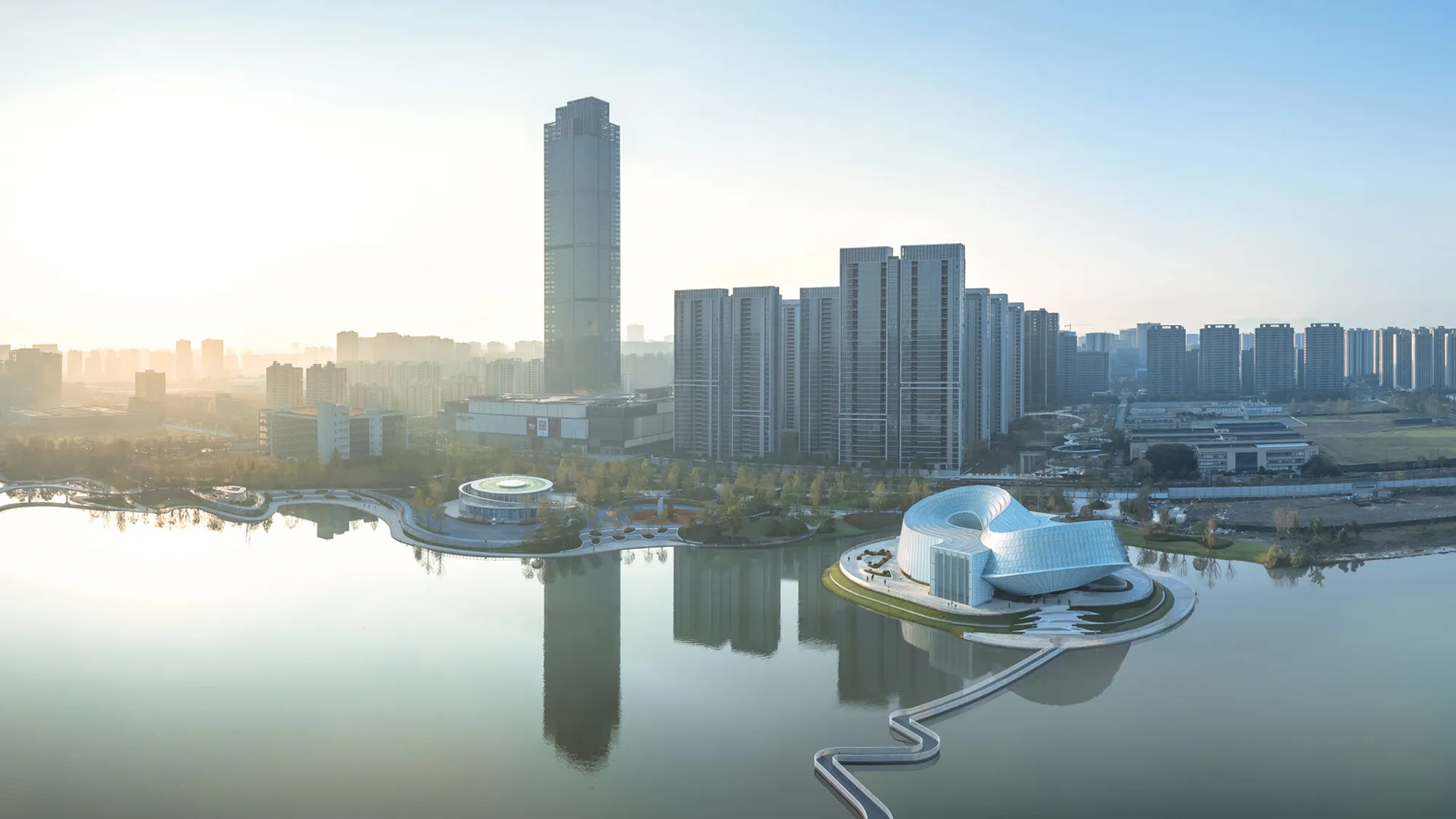
Aedas Sets Three Ribbed Domes on a Lake Island to Create the Yohoo Museum
A trio of interlocking oval volumes rises from an artificial island, wrapping exhibition halls in blue tile and white ribs along a lakefront promenade.


Museums that sit politely on a city block rarely get a second glance. The ones that occupy their own island, connected by a zigzag bridge and wrapped in ribbed ceramic tile, tend to demand more. Aedas designed the Yohoo Museum as a set of three interlocking oval volumes placed on a sliver of land in an urban lake, turning the act of approaching the building into an event as choreographed as anything inside the galleries.
What makes the project genuinely interesting is how it treats the island condition not as a constraint but as a compositional tool. The building does not simply sit on land surrounded by water; it uses the water as foreground, mirror, and moat. Concentric roof terraces descend toward the lake edge, pedestrian bridges reach outward like tentacles, and the facade alternates between opaque ribbed panels and gridded glazing to control what you see and when you see it. The result is a museum that you read differently from every distance and every angle.
Island as Architecture
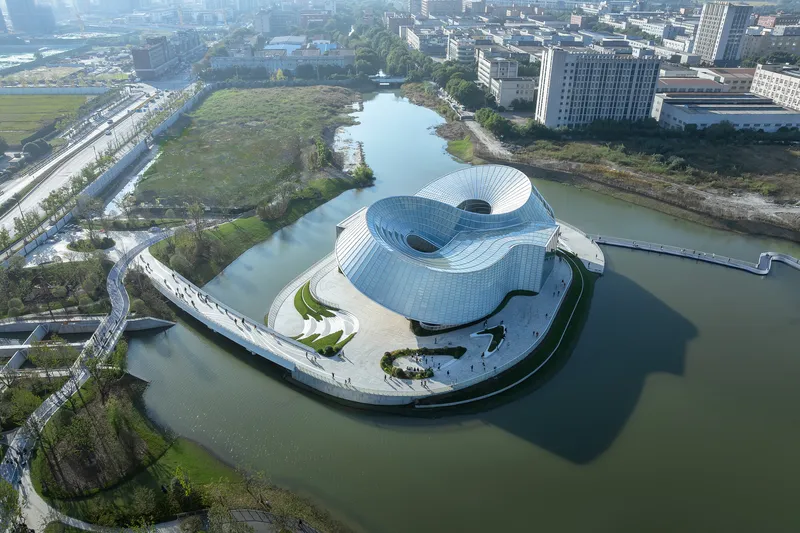
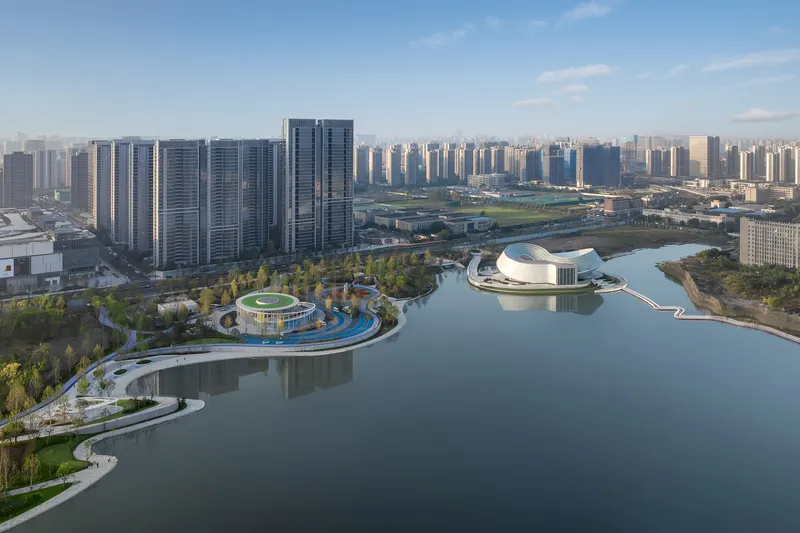
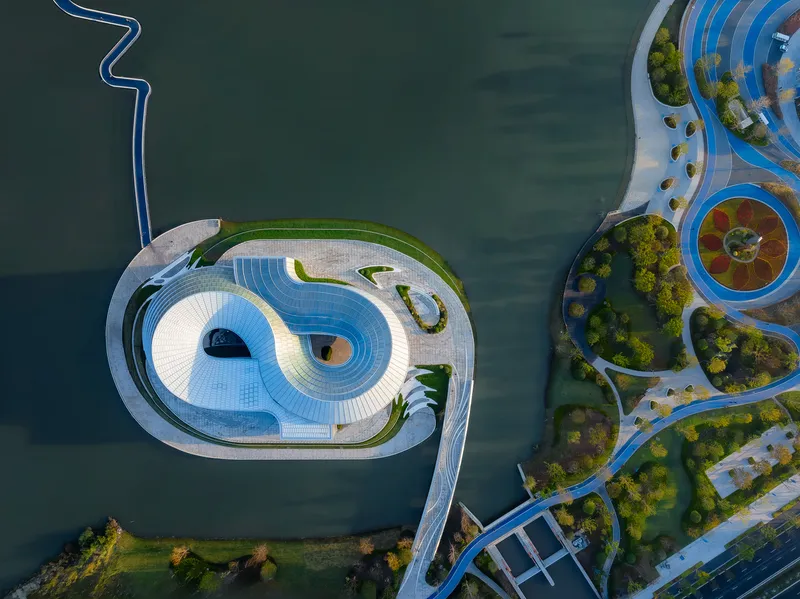
From above, the Yohoo Museum reads less like a building and more like a geological formation. Three oval footprints overlap and fuse, their rooftops stepping down in concentric rings that blur the line between architecture and landscape. Planted islands float in the surrounding water, extending the composition outward so the building never truly ends at a wall.
The aerial views make the strategy legible. Aedas oriented the volumes to create sheltered pockets of public space between them while leaving the perimeter open to the lake on all sides. Pedestrian bridges extend in multiple directions, ensuring that arrival is never a single front door moment but a distributed experience that unfolds differently depending on which path you take.
The Zigzag Bridge and the Promenade
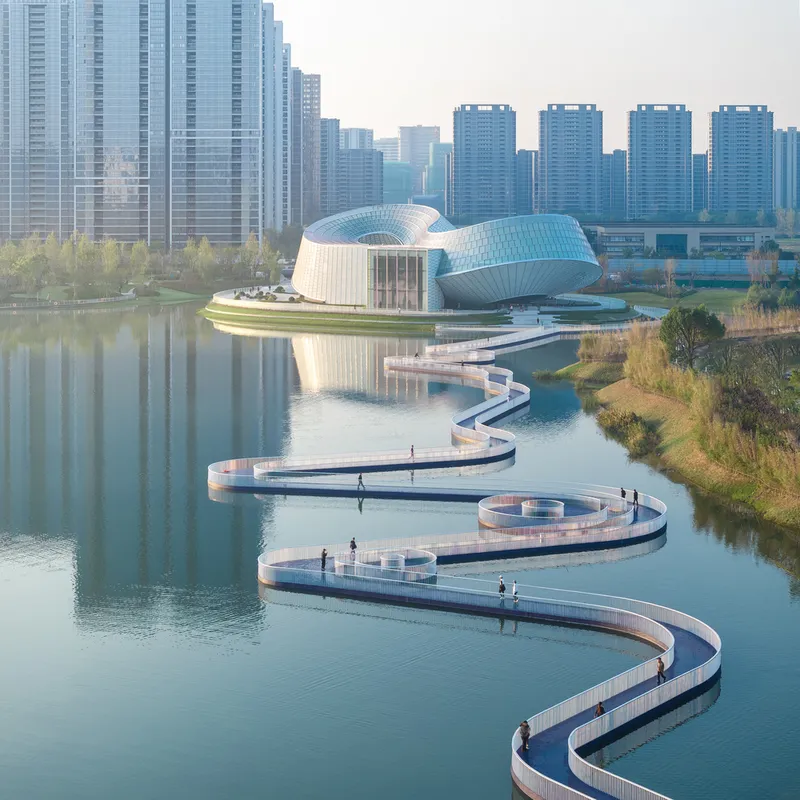
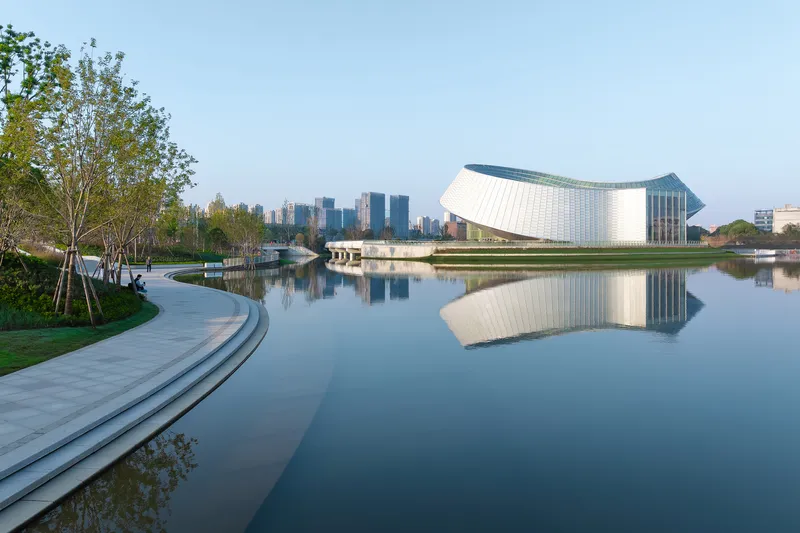
The zigzagging pedestrian bridge is the project's most photogenic gesture, and also its most functional. By folding the path back and forth across the water, Aedas extends what would otherwise be a short crossing into a slow, deliberate sequence. Visitors walk at an angle to the building, catching shifting views of the ribbed facade and the dome profiles as they move. It is processional architecture without a single column.
At water level, the lakeside promenade offers a different register entirely. Stepped concrete seating faces the still water, catching the building's reflection at dusk. The white ribs and blue tiles double in the surface, and the museum briefly becomes symmetrical with its own ghost. It is the kind of public space that works even when the museum is closed.
Facade: Blue Tile, White Ribs, Gridded Glass
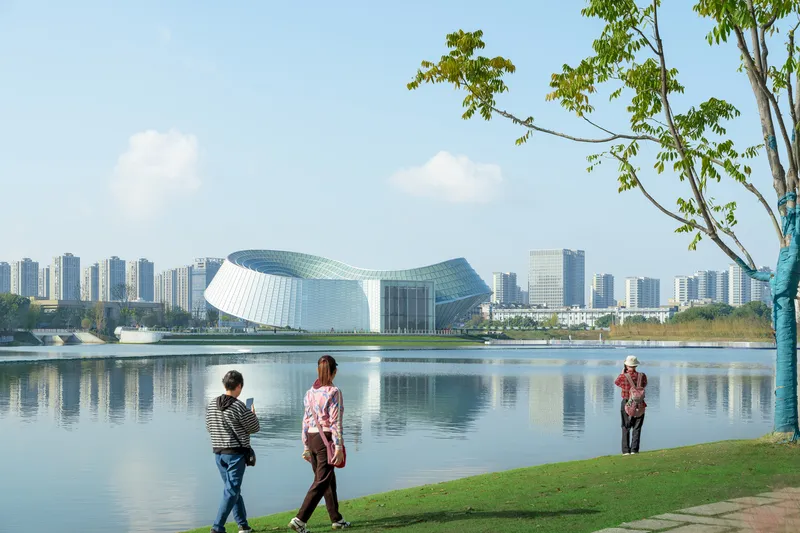
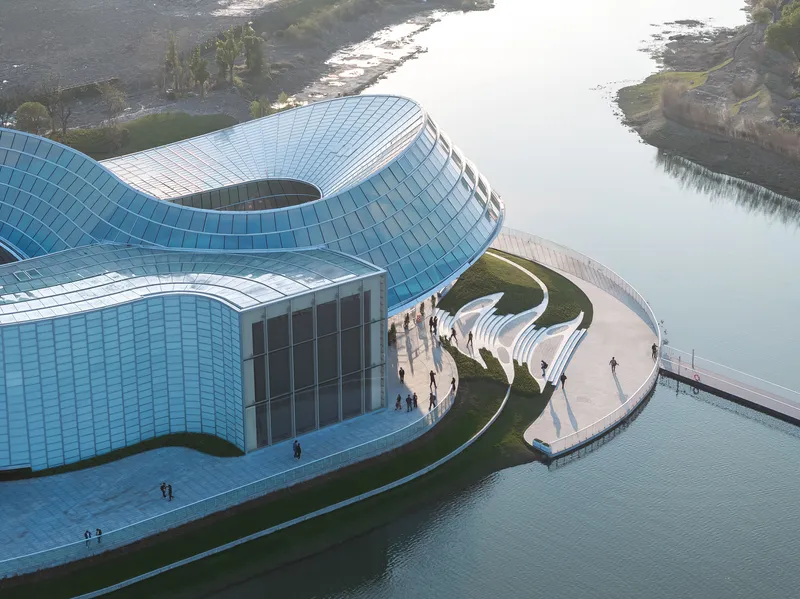
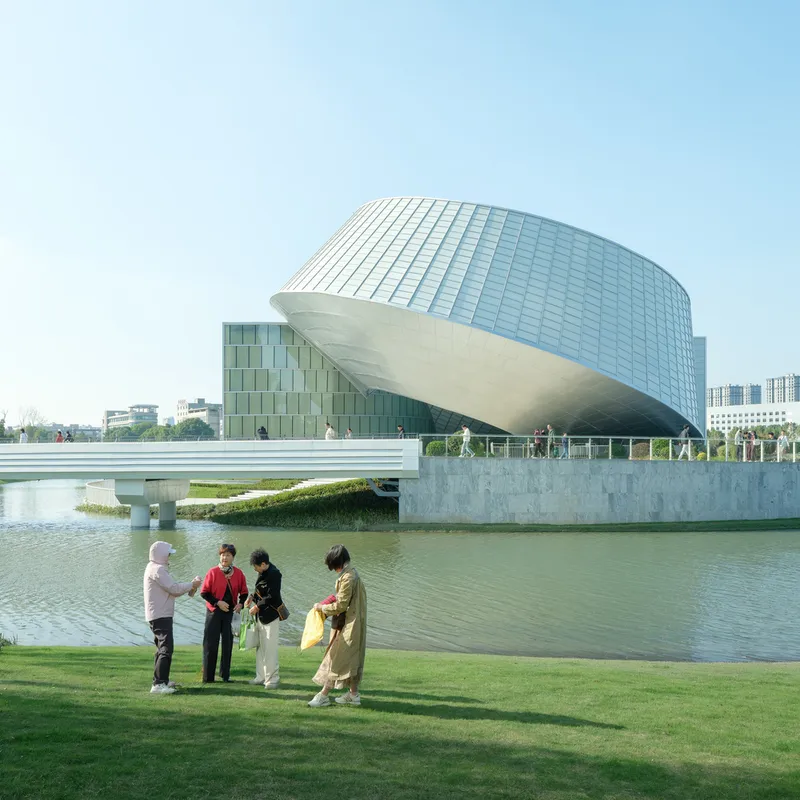
The facade does three things at once. The blue ceramic tiles give the lower volumes a solid, grounded presence that reads well from across the lake. The white ribbed panels on the upper domes catch raking light and create a texture that shifts throughout the day. And the gridded glazing on the dome faces punctures the enclosure with controlled transparency, turning each volume into a lantern at night and a framed viewport during the day.
Aedas clearly designed these surfaces to be read at multiple scales. From a drone altitude the blue roofs pop against the grey water. From the pedestrian bridge the ribs create a rhythmic pattern. Up close, the tile joints, the glass mullions, and the concrete of the base each assert their own materiality. It is a rare case where a building photographs well from every distance without relying on a single signature move.
Plans and Drawings
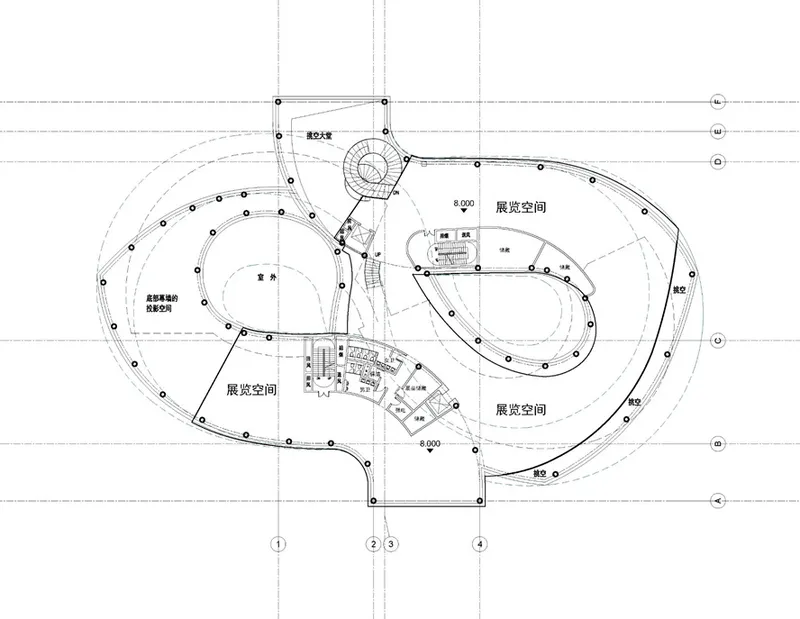
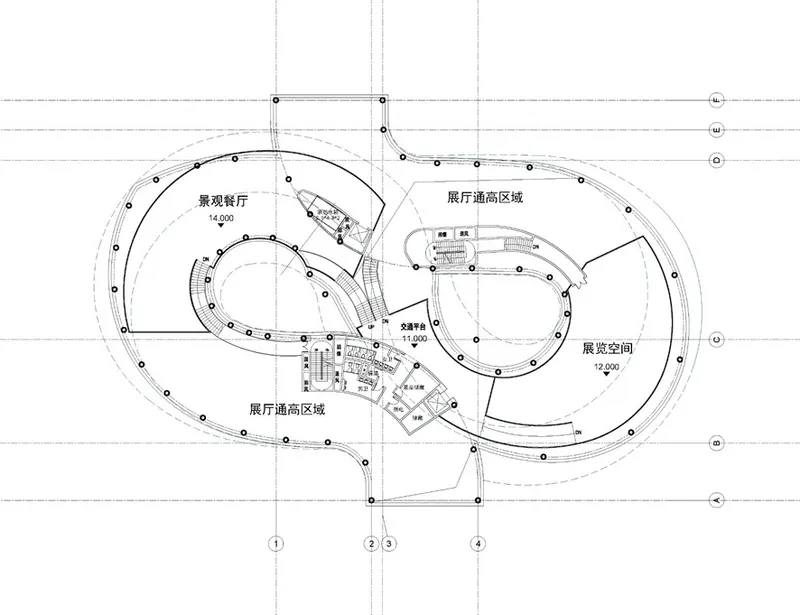
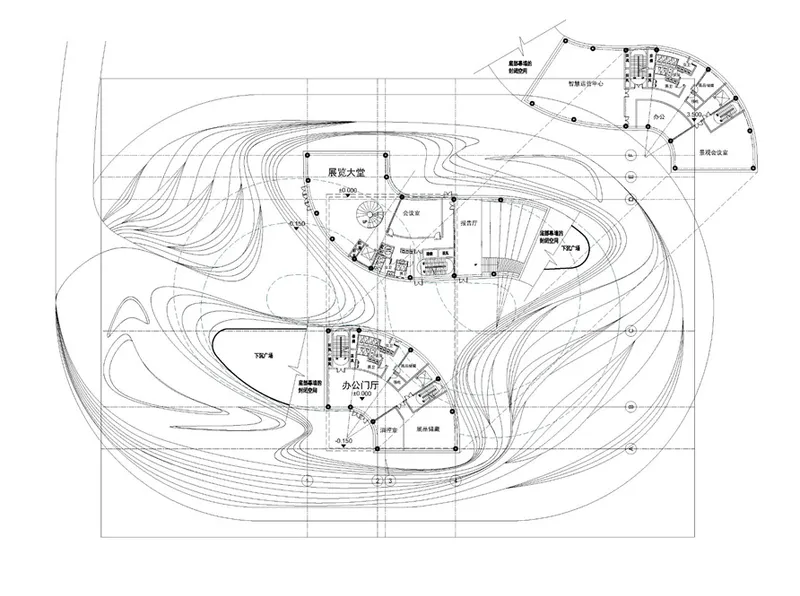
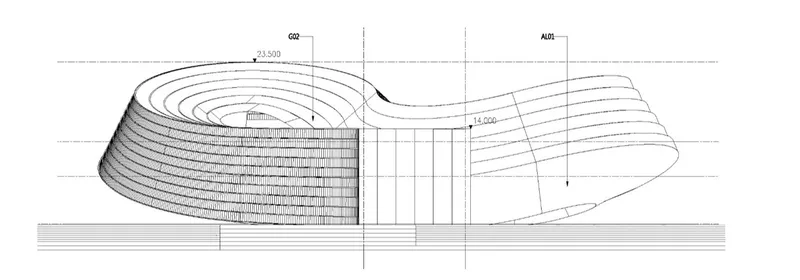
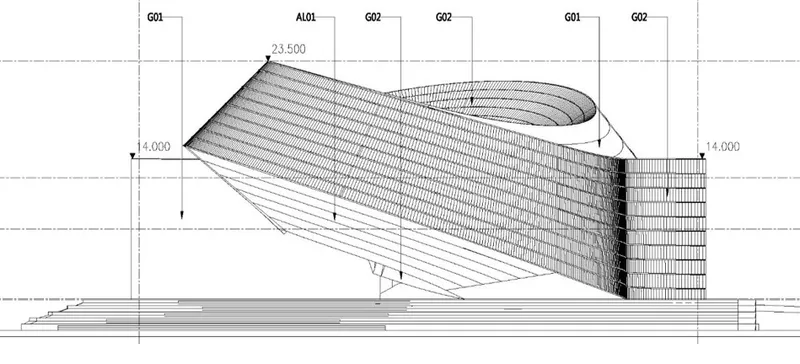
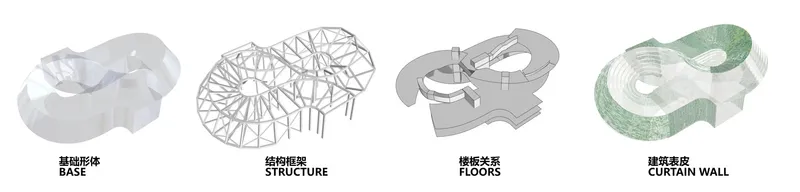
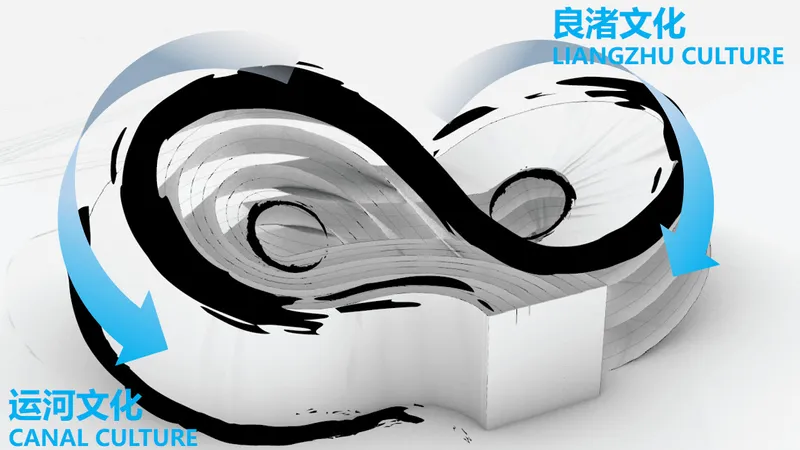
The floor plans confirm what the aerials suggest: three oval volumes share edges and circulation cores, creating a loop that visitors can navigate continuously without backtracking. Exhibition galleries wrap the perimeter of each oval, while dining and support spaces occupy the intersections where volumes overlap. The central cores handle vertical circulation without interrupting the gallery flow.
The section drawing reveals the structural logic behind the flowing rooflines. A layered curved roof structure sits on a relatively flat base, meaning the dramatic silhouette is achieved efficiently. The axonometric breakdowns separate the project into base, structure, floor plates, and curtain wall, showing how each system operates independently. The conceptual diagram of interlocking loops with directional arrows is the clearest statement of intent: this is a building designed around continuous movement, not static rooms.
Why This Project Matters
The Yohoo Museum belongs to a growing family of cultural buildings that treat landscape and infrastructure as inseparable from the architecture itself. The island, the bridges, the promenade, and the concentric terraces are not site amenities bolted on after the floor plan was finished. They are the project. Aedas understood that a museum on an island is only as good as the journey to reach it and the public life that happens around it when you are not inside.
More importantly, the building avoids the trap of the singular iconic gesture. There is no single angle that captures the whole thing, no hero shot that makes every other photograph redundant. Instead, the Yohoo Museum rewards movement and duration. It changes as you approach, as light shifts, as water rises and falls. That kind of spatial generosity is harder to achieve than a striking silhouette, and it is ultimately more valuable to the city it serves.
Yohoo Museum by Aedas. Photography by Terrence Zhang.
About the Studio
Share Your Own Work on uni.xyz
If projects like this are the kind of work you want to make, uni.xyz is a place to publish your own, find collaborators, and enter design competitions.



Popular Articles
Popular articles from the community


The Ocean Hive: Sustainable Architecture for a Self-Sufficient Civilization at Sea
The Ocean Hive imagines sustainable architecture at sea, where modular habitats, algae, wave power and ocean waste sustain a growing colony.

The Musturak Paradise: Senior Living Architecture for a Connected Future in Temara, Morocco
The Musturak Paradise reimagines senior living architecture in Temara via private homes, social spaces, culture, community, and shared care.

Conexión: Biophilic Design Reimagines High-Rise Living in Hong Kong
Conexión reimagines high-rise living in Hong Kong through biophilic design, green facades, shared spaces, daylight, water and nature within.

AL-JANNAH: Sustainable Architecture and Permaculture for Afghan Widows
AL-JANNAH uses sustainable architecture and permaculture to create resilient oasis of housing, learning, work and renewal for Afghan widows.

Similar Reads
You might also enjoy these articles


Hodi-Mandai Geram
Project Function: Preservation and revitalization of the Intangible heritage and socio-spatial identity of the Hodi by Housing, Cultural Memory Center, Sacred Grove, landscape, local tourism economy


Olio Towers: A Mid-Rise for Performers That Fuses Housing, Rehearsal, and Stage
Located blocks from Houston's Theater District, this modular tower stacks living units around a central performance atrium.

Oasis: Modular Green Housing Carved into Dhaka's Urban Fabric
A shortlisted Plugin Housing entry reclaims unauthorized settlements in Dhaka with stepped concrete volumes, green roofs, and ventilation-driven design.

Black Hole: A Floating Megastructure for the Post-Physical Era
Emiliano Mazzarotto envisions a spherical, self-scaling arena where e-sports, digital hotels, and holographic stadiums replace traditional public space.

Explore Architecture Competitions
Discover active competitions in this discipline



Challenge to reimagine the Iron Throne


Photograph architecture without architects


Illustrate the lost glory of Angkor Wat - Render Challenge


Design challenge to reuse E-waste
Comments (0)
Please login or sign up to add comments
No comments yet. Be the first to comment!