
Expressways: Elevated Cycling Corridors That Stitch Cities Back Together
A multi-level transit network reclaims railway corridors for cyclists and pedestrians through continuous architectural infrastructure.


What if the infrastructure that divides cities could be redesigned to reconnect them? Expressways takes the railway corridor, one of the most isolating elements in the urban fabric, and turns it into a continuous, climate-protected cycling network elevated above the tracks. The ground plane is returned to pedestrians. Terminal stations become through-lines. Fragmented transit becomes fluid. It is a proposal built on a simple but radical premise: architectural continuity can replace the segmentation that defines most modern transport systems.
The project was developed by Guillermo Dürig, Iker Sada, Gian Paolo Ermolli, and Jean-Pierre. Their design operates across multiple scales of the city, from underground transit platforms to elevated cycling expressways, proposing a layered approach to urban mobility that merges engineering logic with architectural ambition. The full project is published on uni.xyz.
Underground Platforms and the Diagram of Flow
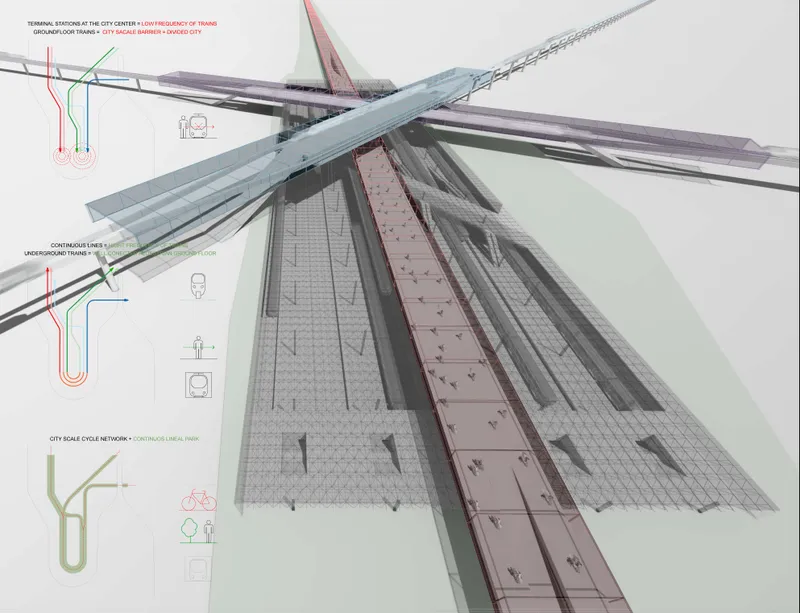
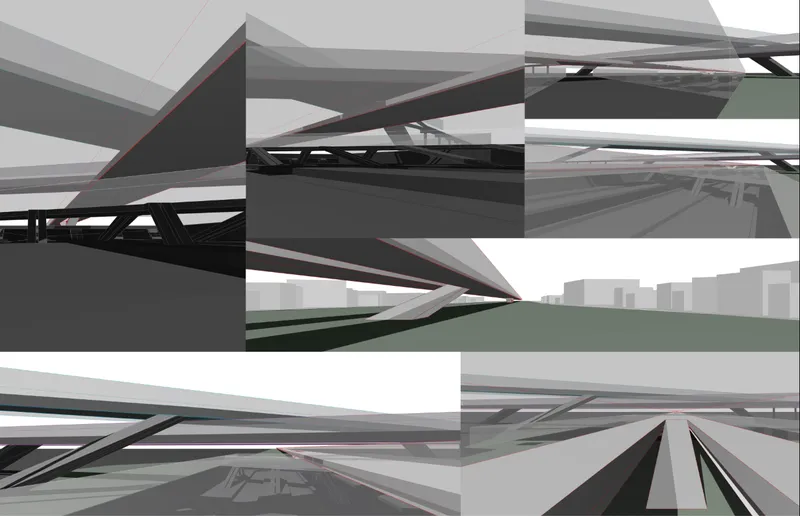
The axonometric drawing reveals the project's underground layer: transit platforms organized beneath intersecting roof canopies, with circulation diagrams mapping passenger movement through the system. What stands out is the clarity of the spatial logic. Rather than treating each station as an isolated object, the designers treat it as a node within a continuous network. The crossing structural beams visible in the composite rendering reinforce this idea, showing how the elevated infrastructure reads from multiple perspectives as a single, connected system rather than a series of discrete structures.
The lightweight structural members and transparent enclosures serve a dual purpose. They protect users from weather while maintaining visual openness, a critical quality for infrastructure that sits above or adjacent to existing rail corridors. The design avoids the heaviness that typically accompanies transit architecture, opting instead for a language of slender profiles and repeated structural rhythms.
The Arched Bridge as Architectural Connector
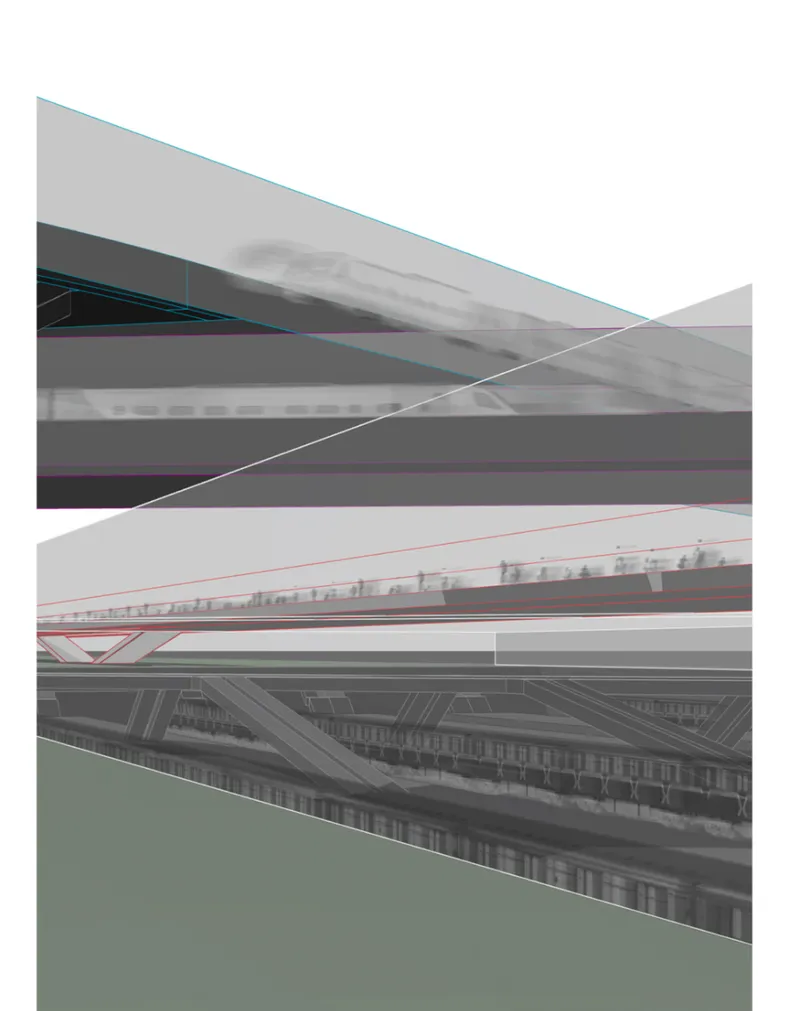
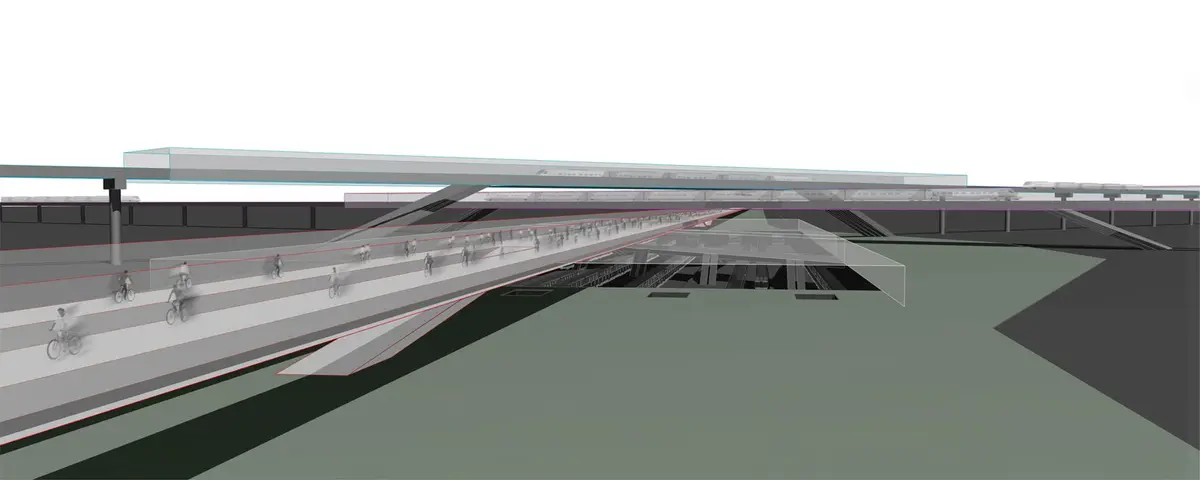
One of the project's most compelling elements is the arched pedestrian bridge that spans the transit tracks, topped with a translucent canopy. The rendering shows this structure not as a utilitarian crossing but as a spatial event: a moment where the cyclist or pedestrian is suspended above the rail infrastructure, sheltered but connected visually to the trains and platforms below. The translucency of the canopy allows daylight to filter through, avoiding the tunnel-like quality that plagues many covered walkways.
The layered section drawing makes the vertical strategy legible. Platform levels, diagonal crossing bridges, and waiting passengers are all visible in a single cut, demonstrating how the project stacks programs without creating confusion. Cyclists occupy the elevated plane, pedestrians move at grade, and rapid transit operates below. Each layer has its own logic but shares structural and spatial resources with the others, a principle the designers call architectural continuity.
A Transit Hub Where Roof Planes Cross
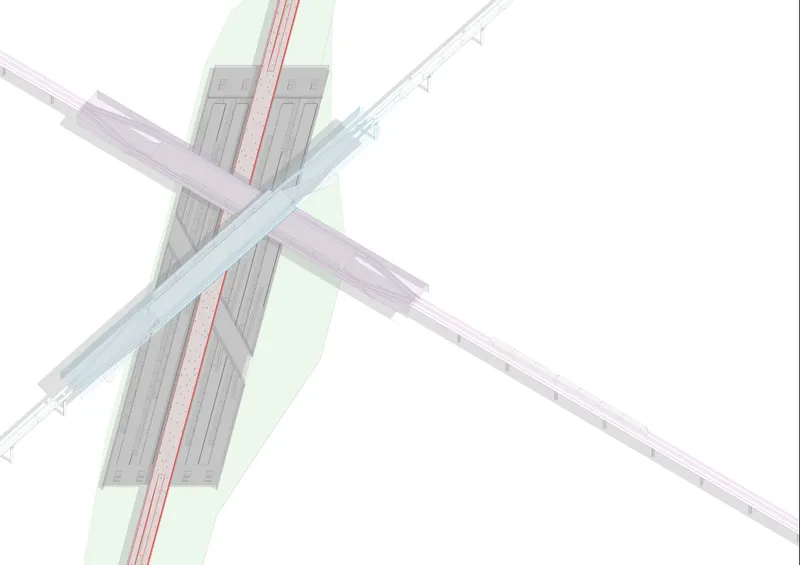
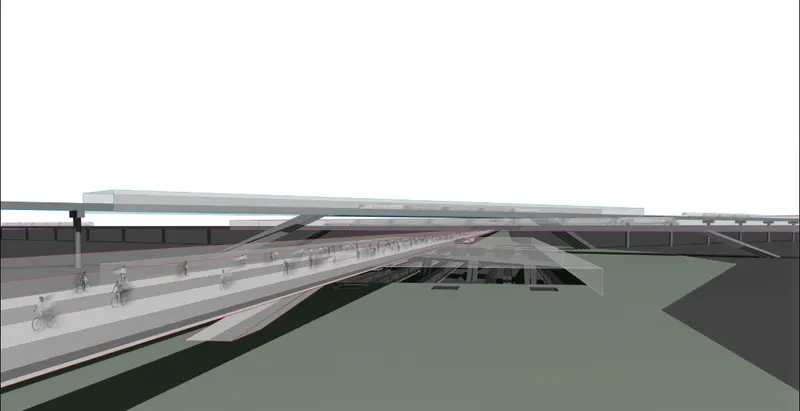
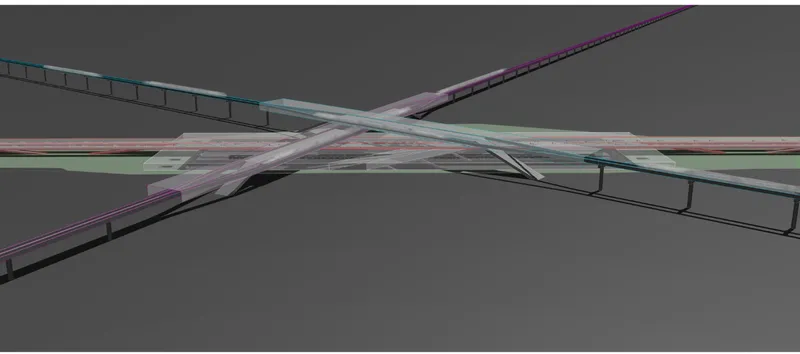
The aerial axonometric view of the transit hub shows crossing roof planes converging over a central platform volume. The geometry is not arbitrary; it tracks the direction of movement through the site, with each plane oriented along a different transit or cycling route. The result is a node that feels both organized and dynamic, where the act of transfer between modes is given architectural expression rather than being hidden inside a generic concourse.
The final section rendering reinforces the project's commitment to lightness. The arched bridge structure over the transit platforms reads as a single, elegant gesture, with the translucent roof canopy allowing the interior to breathe. At ground level, the space beneath the elevated expressway is reclaimed as a walkable, green environment. This is the core payoff of the design strategy: by lifting cyclists and their infrastructure off the ground, the project recovers public space in precisely the zones where cities need it most, along the edges of railway corridors that have historically acted as barriers.
Why This Project Matters
Expressways addresses a problem that every growing city faces: how to increase transit capacity without consuming more land or deepening the divisions that infrastructure creates. The answer proposed by Dürig, Sada, Ermolli, and Jean-Pierre is not a new technology but a new spatial relationship. By layering cycling corridors above existing rail lines and converting dead-end terminal stations into continuous routes, the project extracts more performance from infrastructure that already exists. It is adaptive reuse applied not to a single building but to an entire urban system.
What makes the work convincing is its refusal to treat mobility as a purely engineering problem. The translucent canopies, the arched bridges, the carefully calibrated sections: these are architectural decisions that shape how people experience movement through the city. The project argues that carbon-neutral mobility and spatial quality are not competing goals. They are, in fact, the same goal, and architecture is the discipline best positioned to achieve both simultaneously.
View the Full Project
About the Designers
Designers: Guillermo Dürig, Iker Sada, Gian Paolo Ermolli, Jean-Pierre
Enter a Design Competition on uni.xyz
uni.xyz runs architecture and design competitions year-round that reward proposals with spatial conviction and real site intelligence.
Project credits: Expressways by Guillermo Dürig, Iker Sada, Gian Paolo Ermolli, Jean-Pierre.


Popular Articles
Popular articles from the community


David Macias Steps a Doorless Stone and Plaster House Down a Tropical Colombian Hillside
In the humid hills of Colombia, Threshold House replaces the front door with an open void and terraces its 850 m² down the slope instead of fighting it.

longwave studio Reorganizes a 112 m² Tainan Apartment Around the Daily Routines of a Family and Two Cats
In Tainan, Taiwan, birch plywood, rust-red furniture and a freestanding plaster wall link arrival, storage, work and family life in one apartment.

Architekt Andreas Gruber Scatters 23 Dark Timber Chalets Across a South Tyrolean Forest Edge
In Molini di Tures, Amonti Chalets breaks a resort into a hamlet of gabled timber houses, with parking, storage and services pushed into the slope.

Jaramillo Van Sluys Arquitectura and Urbanismo Turn a Demolished Registry Lot in Quito into an Orchard Plaza
In Quito's Centro Histórico, a 2,800 m² plaza exposes the San Agustín convent wall and redraws its lost Augustinian orchard in volcanic stone.

Similar Reads
You might also enjoy these articles


Aquadapt: An Underwater Habitat That Rewrites Its Rooms by the Hour
Curved modules ring the seabed while one shell shifts from breakfast room to cinema, farm and football pitch as residents' needs change.

Play: Fragments of Their World: Remembered Architecture Rebuilt as a Modular Playground for Refugee Camps
Tom Gardner abstracts domes, arches and towers from the homelands of displaced families into a kit of child-scaled play parts for camp settlements.
REBIRTH: A Circular Settlement Where Afghan Widows and Their Children Rebuild Life Together
A shortlisted Resile entry turns the circle into a protective ring of timber and brick, gathering homes, classrooms and gardens around a shared landscape.
The Main Dream: A Recycled Plastic Kit That Lets Refugee Children Build Their Own Playground
Thirty-centimetre interlocking cubes that connect on three axes turn play into construction, letting children author the spaces they occupy.


Comments (0)
Please login or sign up to add comments
No comments yet. Be the first to comment!