
Coop. M: Living Around a Concrete Cross
Note Architects transforms a 45-year-old Tokyo apartment by turning its most stubborn structural constraint into the organizing logic of home.


A massive cross-shaped concrete beam is not the kind of feature most renovation clients dream about. It cannot be hidden. It should not be disguised. In a 72 square metre apartment inside a 45-year-old Tokyo building, note architects decided to do neither. Instead, they let the beam dictate how the entire home is organized, treating an immovable structural presence as the armature around which daily life arranges itself.
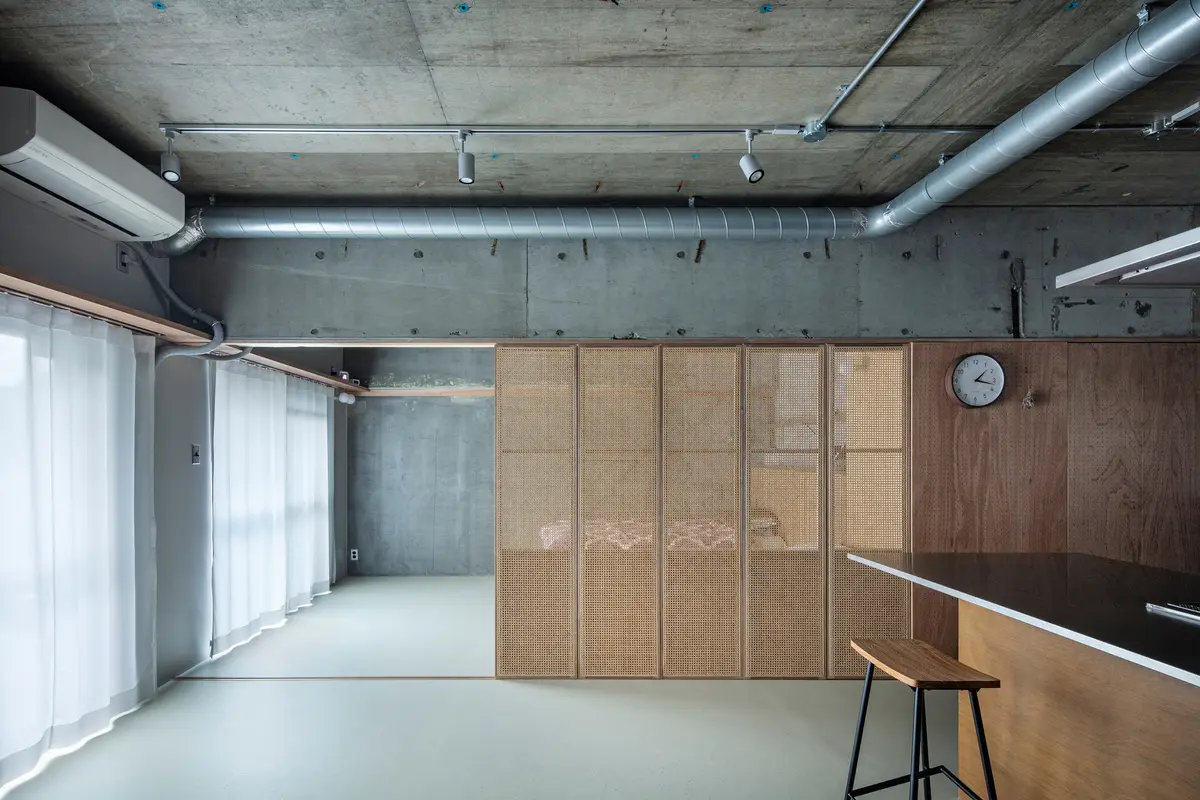
The result is Coop. M, a compact apartment where rawness and warmth coexist without the usual renovation impulse to sand everything smooth. Every surface tells you exactly what it is: concrete stays concrete, plywood stays plywood, cane stays cane. The cross beam, rather than being a problem to solve, becomes the spatial event that gives the plan its character. It divides zones without walls and anchors a system of sliding partitions that allow the apartment to shift between open and enclosed configurations throughout the day.
Structure as Protagonist
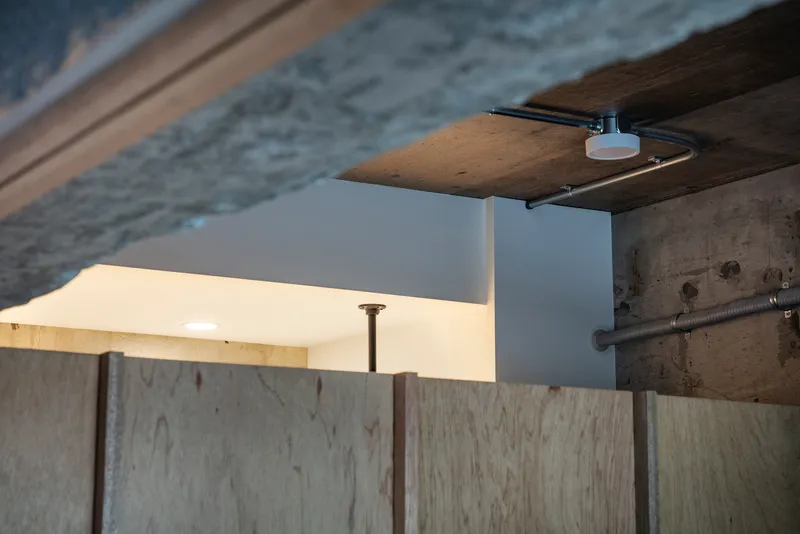
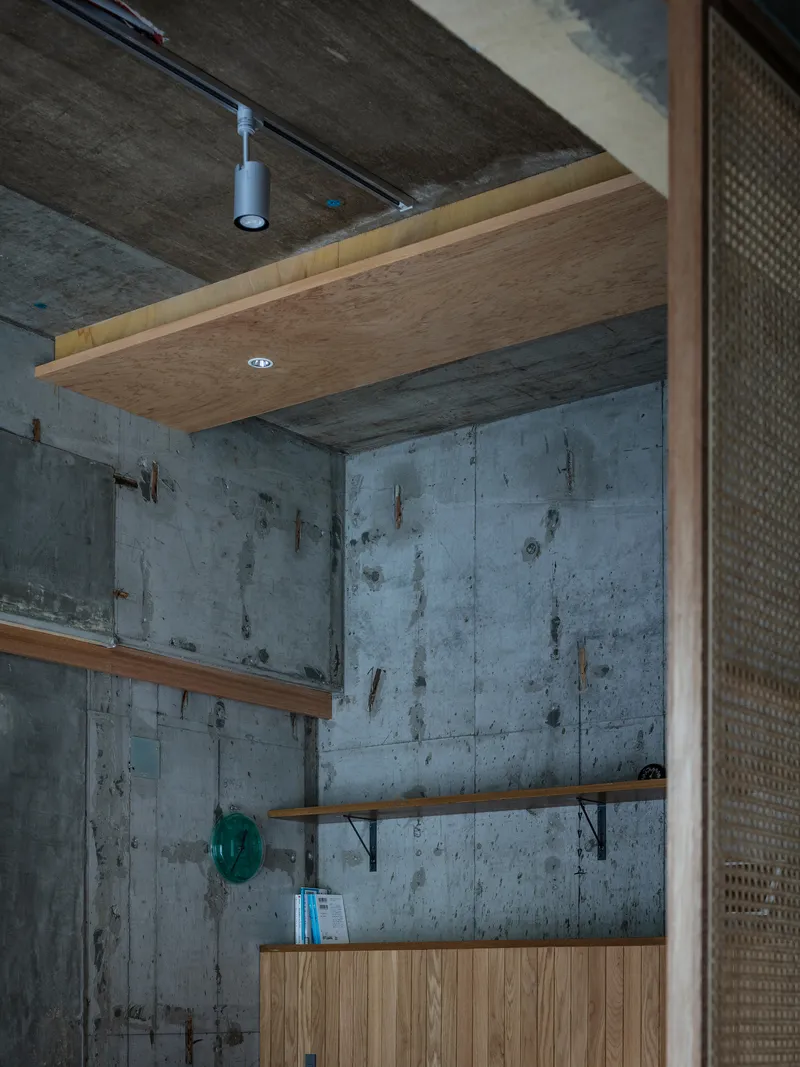
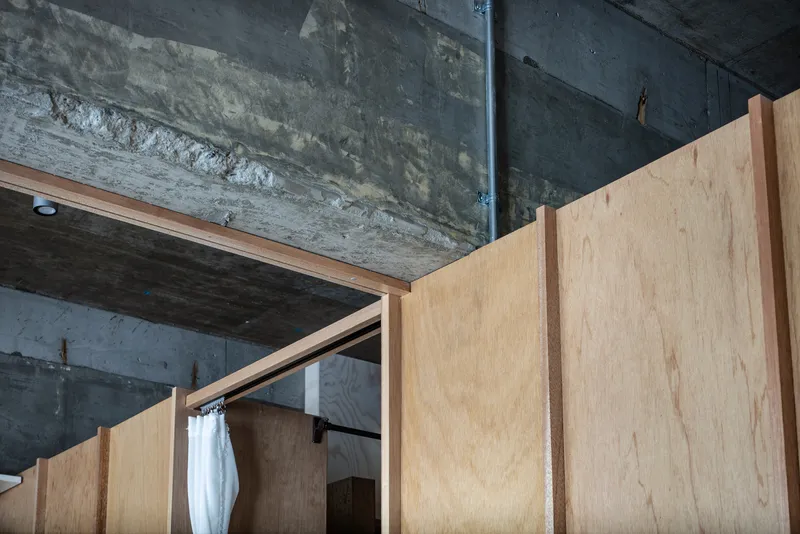
In most apartment renovations, the structural skeleton disappears behind drywall. Here, the exposed concrete ceiling and its dominant cross beam are left fully visible, their surface untouched. A slim task light clips onto the edge where a plywood panel meets the beam, acknowledging the joint rather than concealing it. Suspended timber ceiling panels float beneath the concrete soffit in strategic zones, creating moments of warmth overhead without pretending the raw structure does not exist.
The skylight captured in image 11 reveals how note architects choreograph the meeting of old concrete and new timber. Daylight washes down the rough soffit, making the material contrast feel intentional and even generous. The beam's geometry is not decorative; it genuinely organizes the plan. It tells you where the kitchen ends and the bedroom begins.
The Sliding Wall System
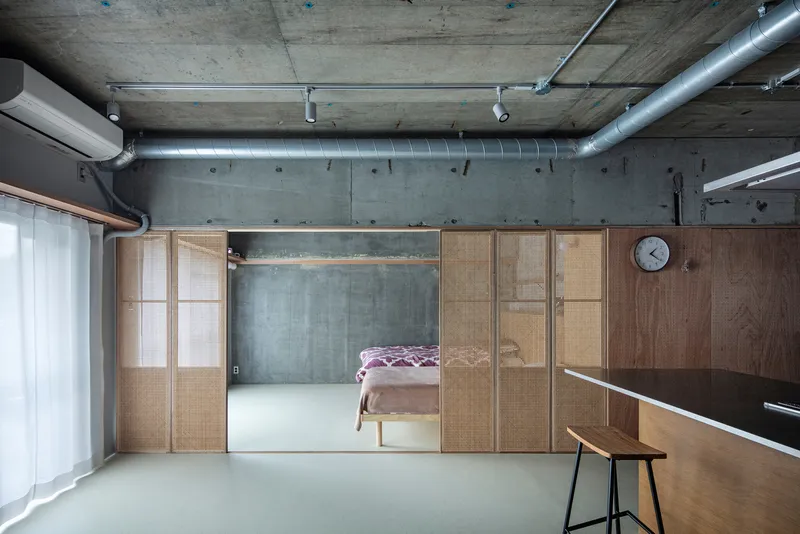
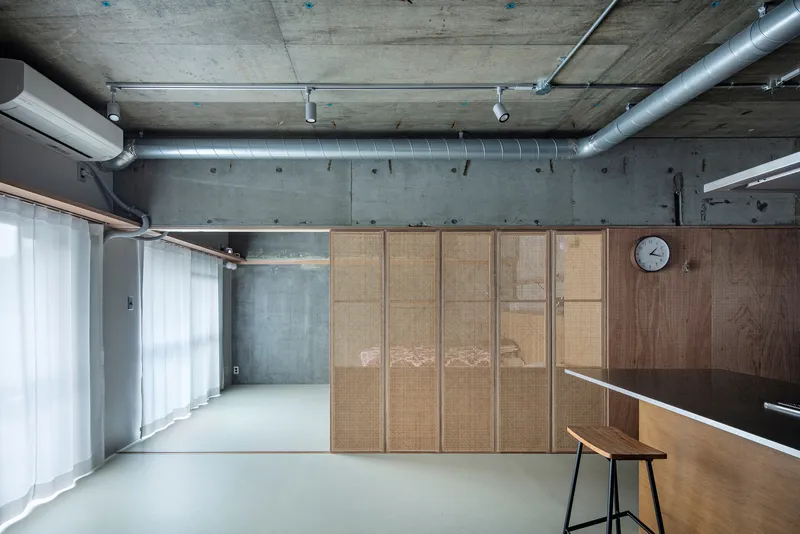
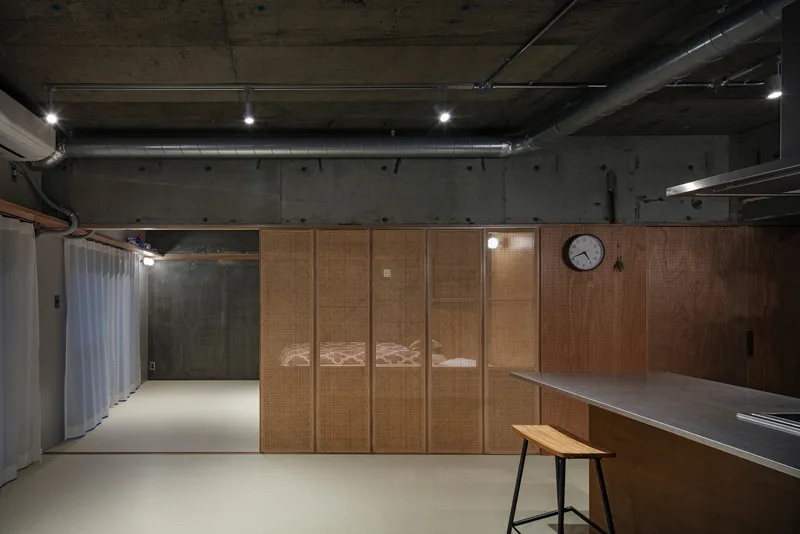
The apartment's most refined move is a series of sliding timber and cane panels that run along tracks beneath the concrete ceiling. When closed, they form a continuous woven surface that gives the sleeping area genuine privacy. When open, the apartment becomes a single flowing space where you can see from the kitchen through to the bedroom alcoves. This is not a novel idea in Japanese residential design, but the material choices here elevate it. The cane inserts soften sound and filter light while maintaining visual texture against the hard concrete backdrop.
A round wall clock appears repeatedly next to these partitions, a small domestic object that grounds the space. It is a useful reminder: this is a home, not an installation. The partitions work because they do not demand attention. They slide, they close, they disappear. The mechanism serves the occupants, not the photograph.
Kitchen and Living Core
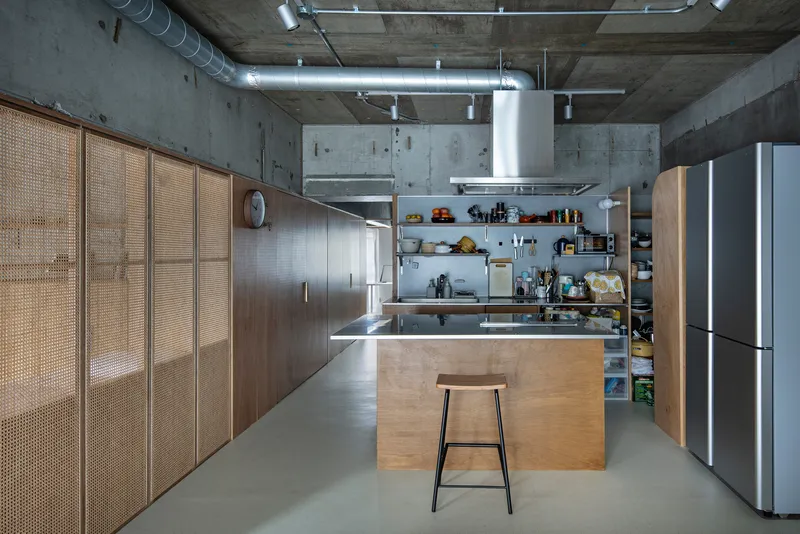
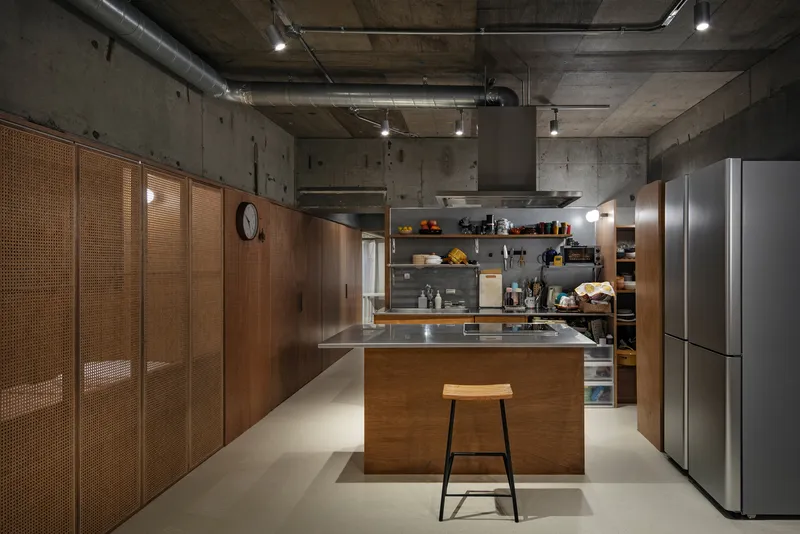
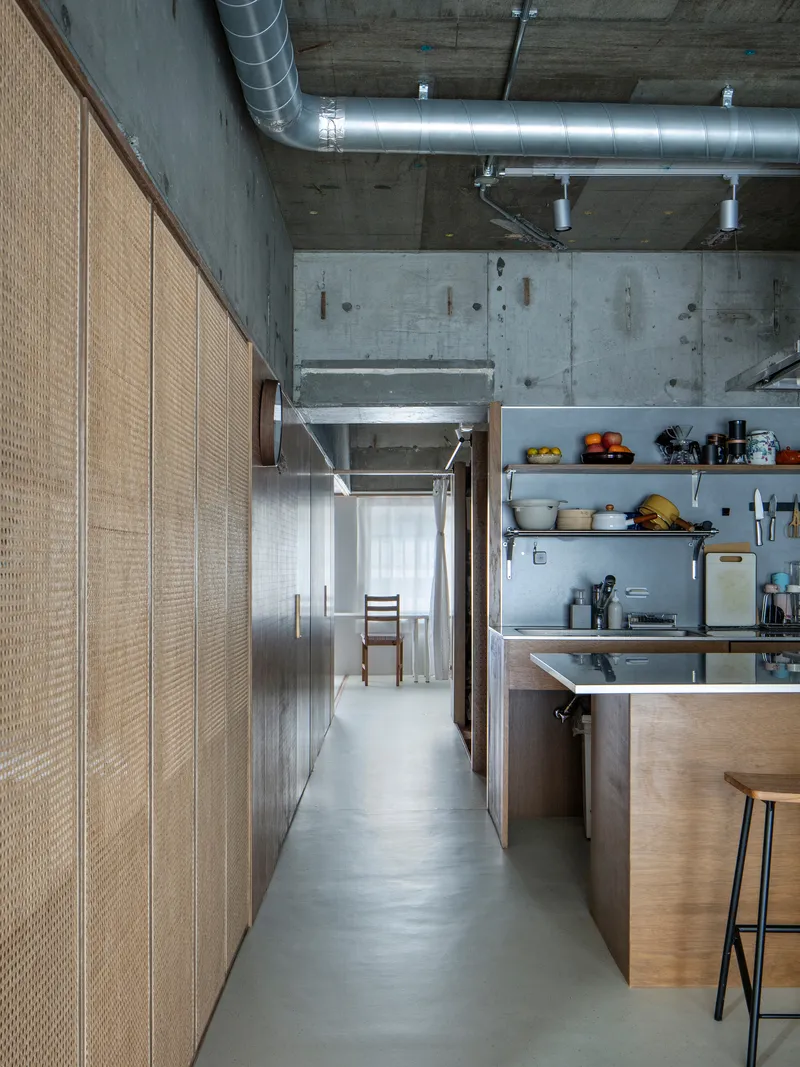
The kitchen island anchors the center of the apartment with a stainless steel countertop that reads as both industrial and precise. A single stool sits at the counter, suggesting this is a space for one or two people, not for entertaining large groups. The suspended ventilation hood hangs from the concrete ceiling with a directness that matches the rest of the palette. There is no attempt to dress it up.
Flanking the kitchen, rattan-fronted storage cabinets line the corridor, their woven texture creating a visual rhythm against the concrete and open shelving. The material strategy is consistent throughout: steel for work surfaces, timber and cane for storage, concrete for structure. Nothing competes. Each material has its job.
Sleeping Zones
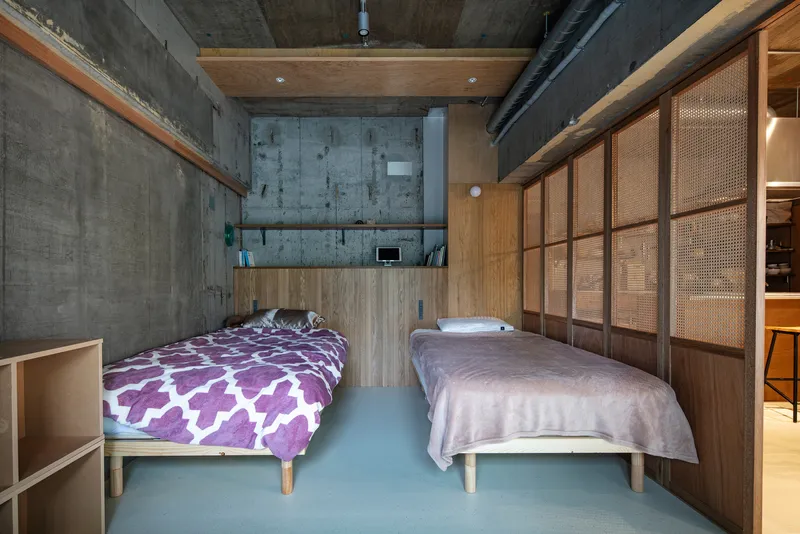
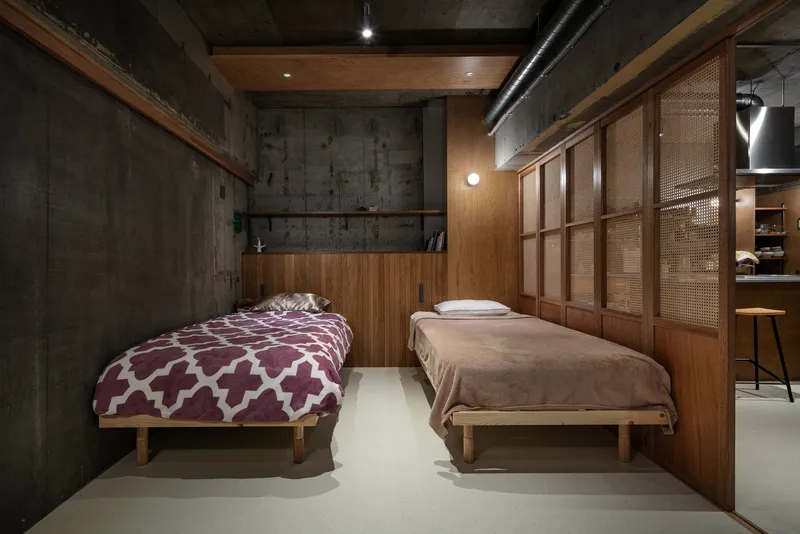
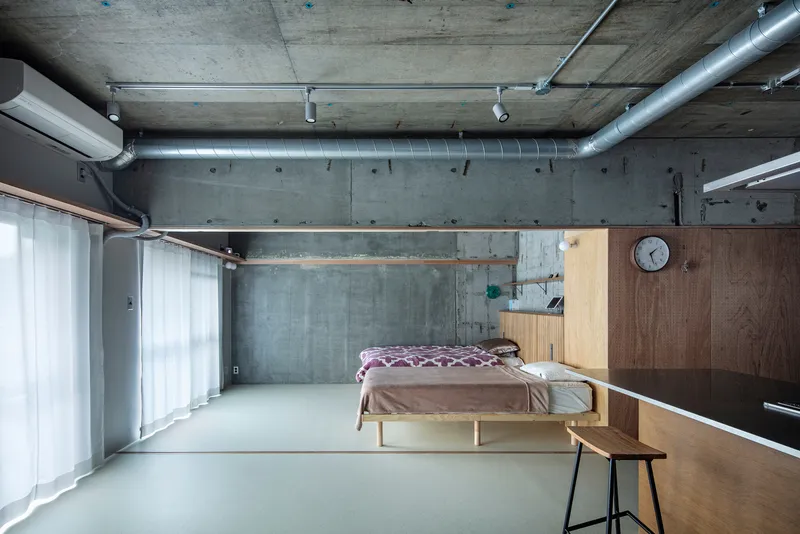
Two platform beds sit low on a pale green resin floor, flanked by the cane-paneled timber storage wall. The sleeping area feels monastic in its restraint: no headboards, no side tables, just the beds and the wall. Track lighting on the exposed ceiling provides adjustable illumination, and the ductwork overhead is left as found. The color of the floor is the only concession to softness, a quiet green that reads as calm without tipping into decorative territory.
What makes these bedrooms work is their relationship to the partition system. They are not fixed rooms. They are zones that can be enclosed or opened depending on need. In 72 square metres, this flexibility is not a luxury; it is a survival strategy.
Corridors and Thresholds
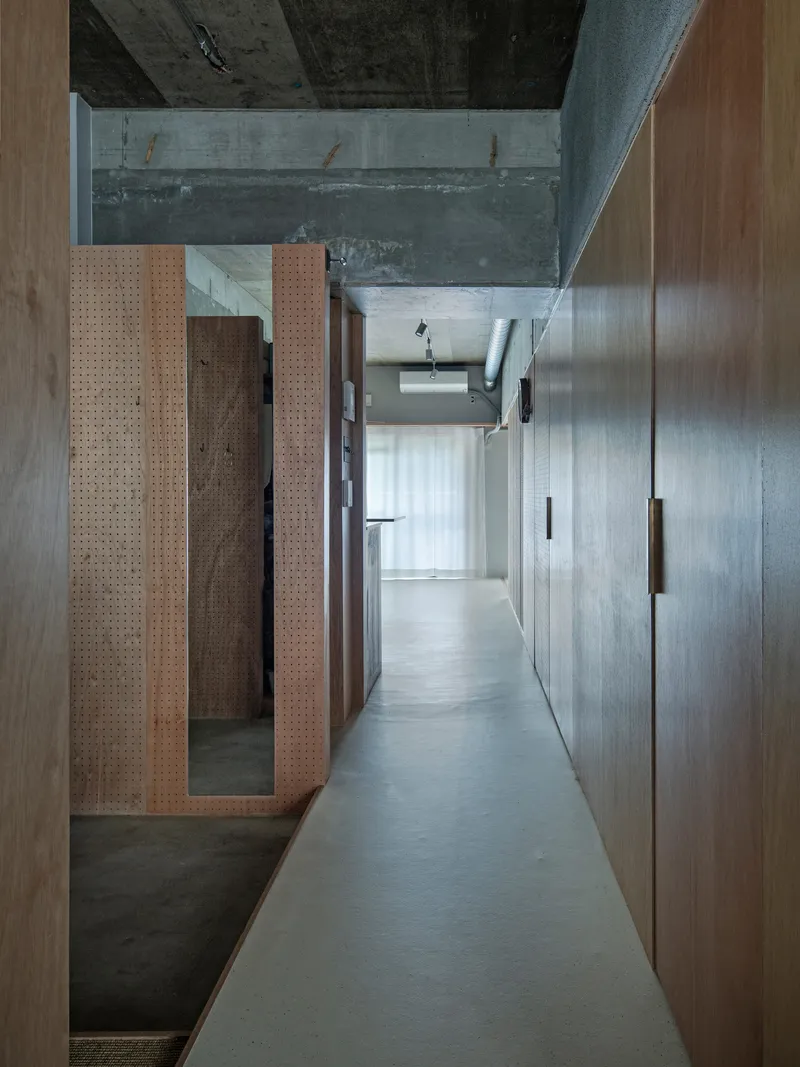
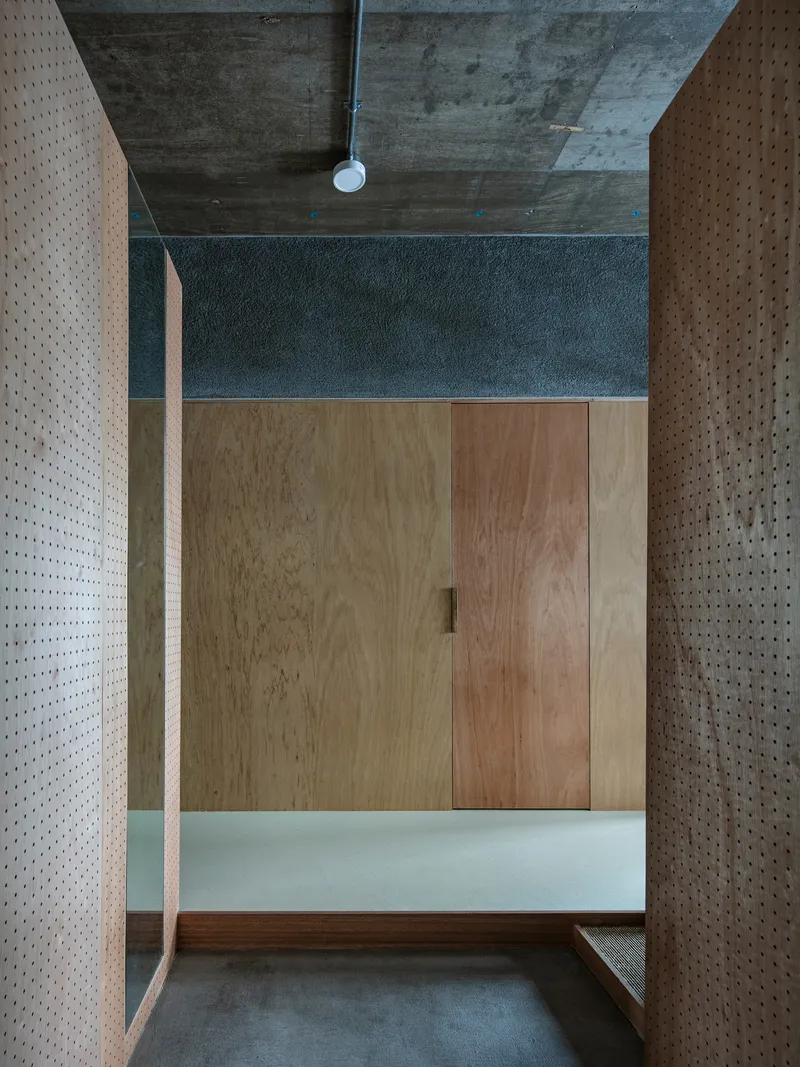
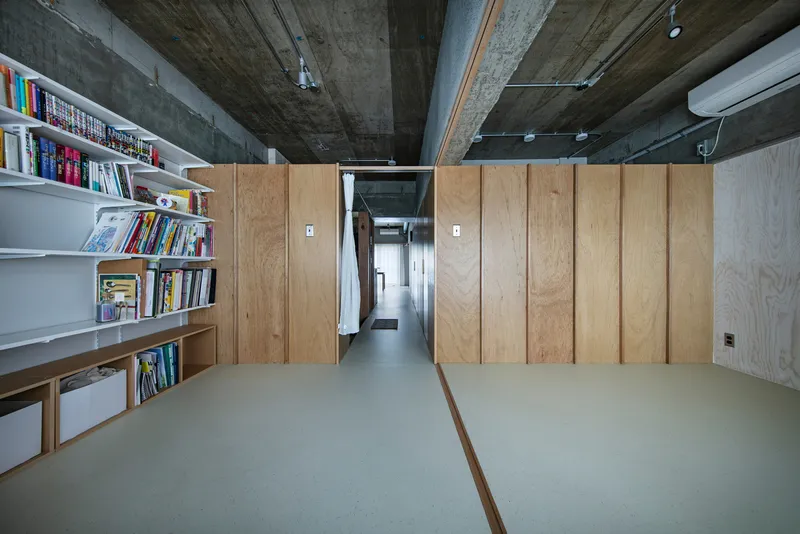
The corridors in Coop. M are narrow, as you would expect in a Tokyo apartment of this vintage and size. But note architects treats them as more than circulation. Perforated pegboard walls line the entryway, creating a surface that can hold hooks, shelves, or nothing at all. The sliding doors at the entry are plywood, their material matching the interior partitions so the transition from public to private is seamless.
Through doorways and openings, you catch layered views of bookshelves, curtained windows, and concrete. Every threshold frames a composition. The backlit curtain at the end of one corridor draws you forward, a simple trick executed well.
Details and Storage
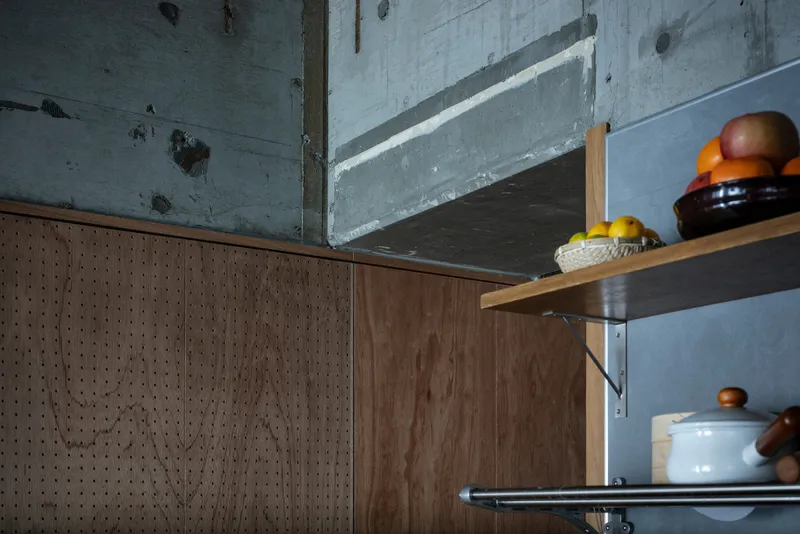
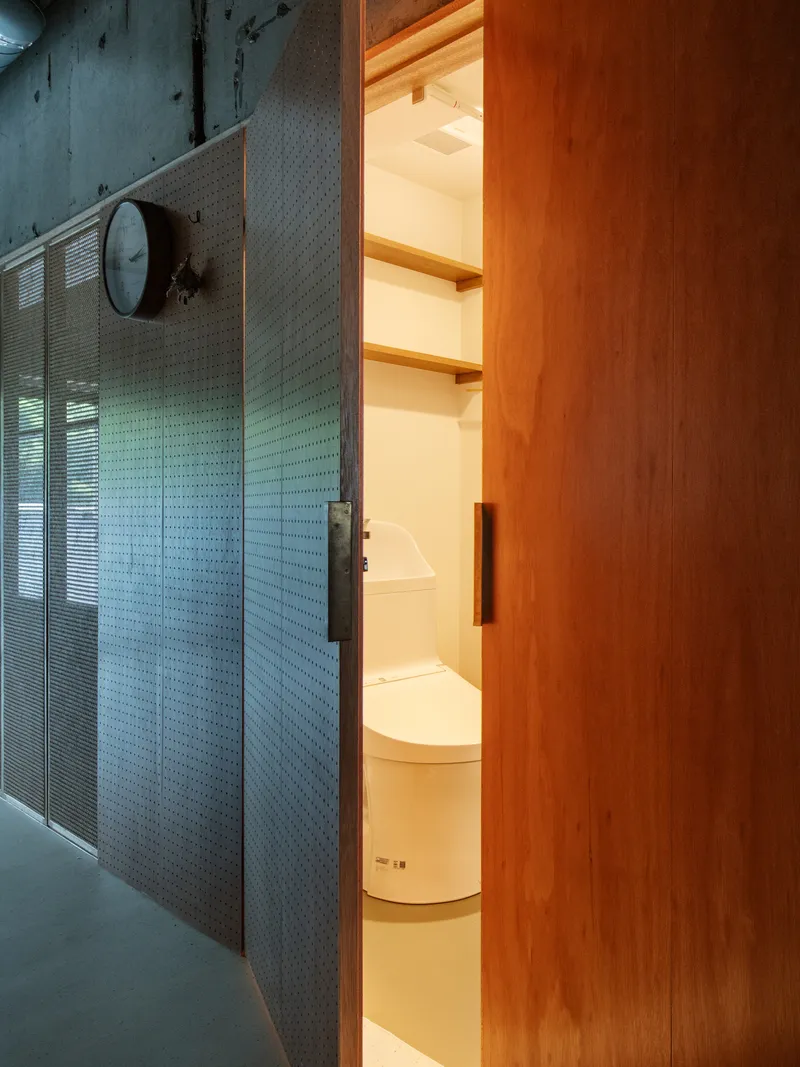
Storage is treated with the same material clarity as the rest of the apartment. Perforated wood cabinet edges meet steel shelves cleanly; ceramic containers sit beneath the concrete beam as if they were always meant to be there. The compact bathroom, glimpsed through a sliding door, features illuminated shelving that makes a tiny space feel considered rather than leftover.
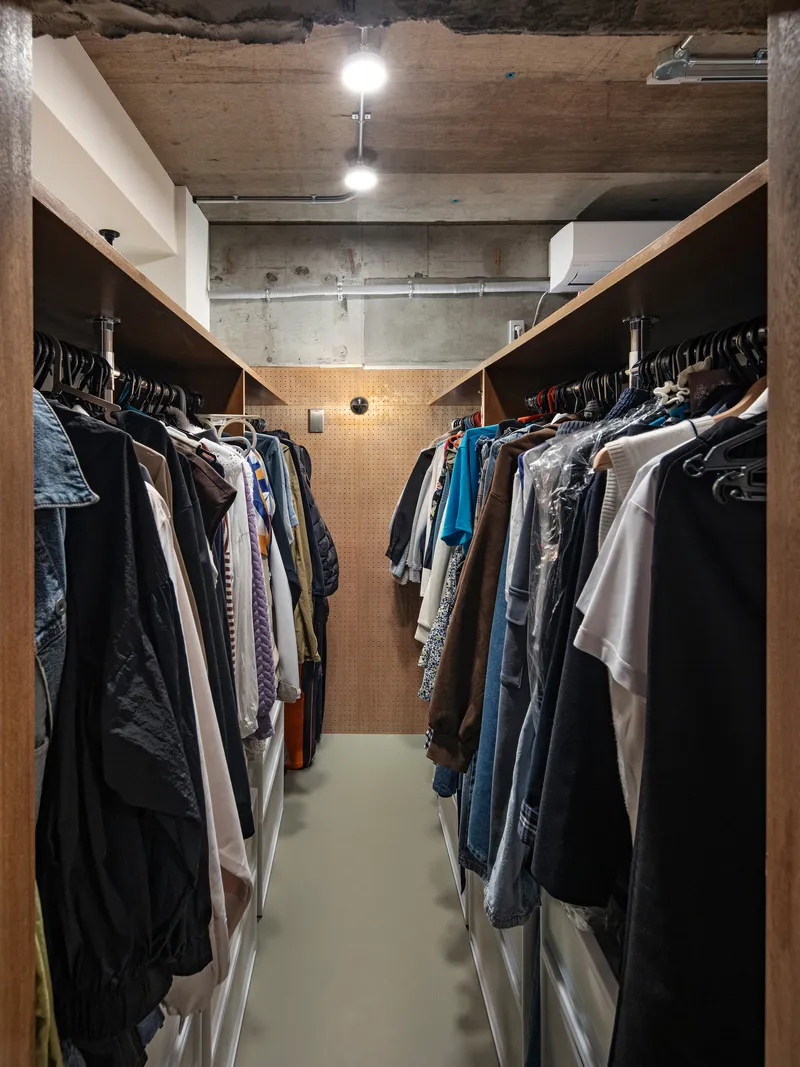
A narrow walk-in closet with garments hanging on both sides confirms the pragmatism of the design. There is no wasted space, but nothing feels cramped. Track lighting on the concrete ceiling keeps things bright without cluttering the walls. In a renovation this small, every centimetre of storage counts, and note architects accounts for all of them.
Work and Daylight
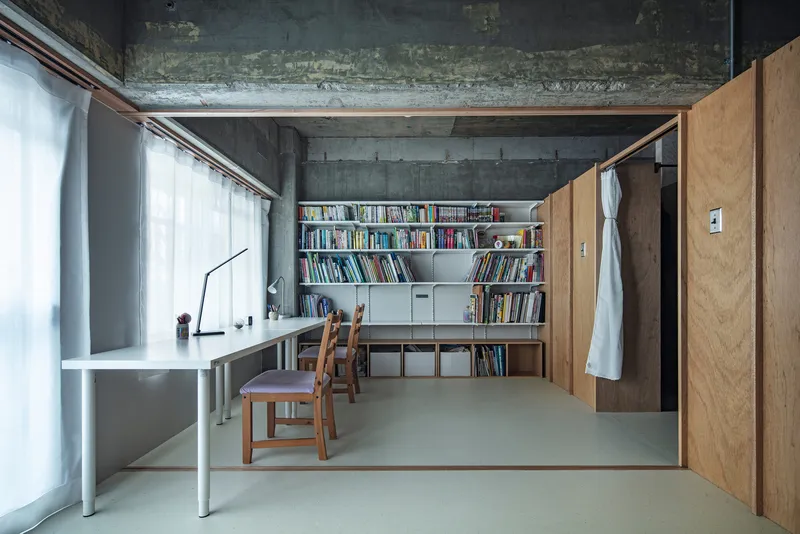
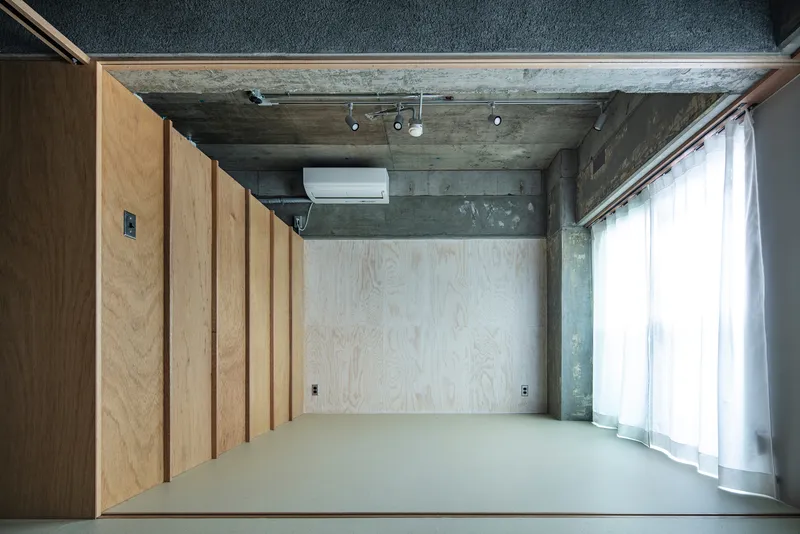
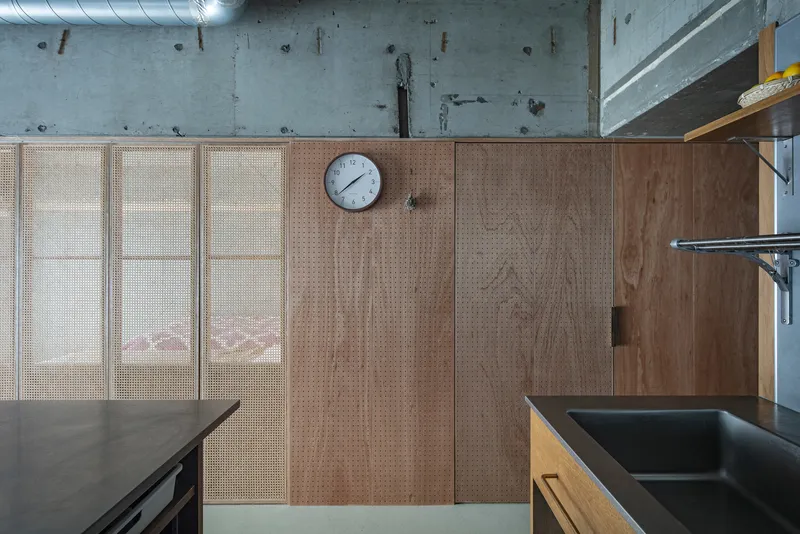
A white desk against raw concrete walls makes for a work area that is stark but functional. An open bookshelf sits within arm's reach, and natural light enters through curtained windows. The sheer curtains diffuse daylight evenly across the grey resin floor, eliminating glare while maintaining a sense of openness. From above, the plywood storage wall and floor read as a continuous tonal field, warm against the cool concrete.
Plans and Drawings
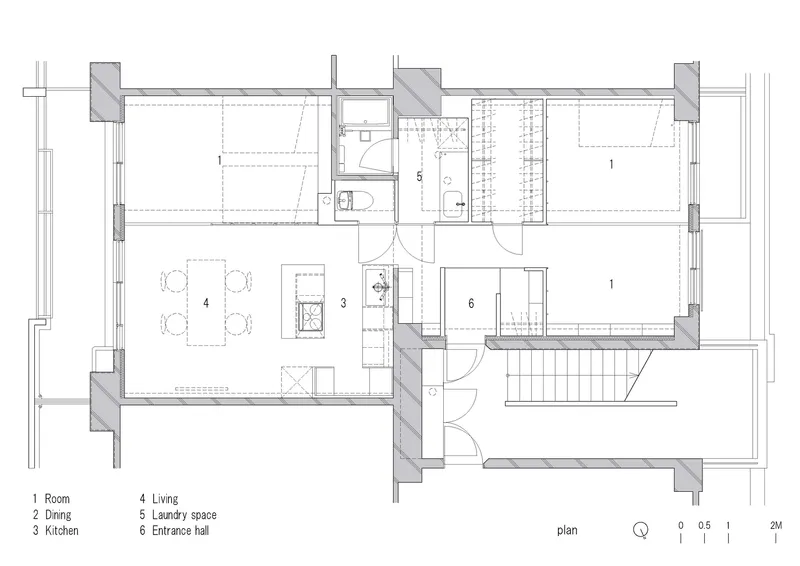
The floor plan reveals how tightly the apartment is organized around its central cross beam. Two sleeping rooms occupy one end, the kitchen and living area the other, with the bathroom and closet tucked along the perimeter. The sliding partition tracks are visible in plan, showing the full range of configurations available. At 72 square metres, the layout leaves no ambiguity: every zone has a purpose, every wall earns its place.
Why This Project Matters
Coop. M makes a convincing case that the best renovation strategy for old concrete buildings is not concealment but confrontation. By accepting the cross beam as a given and building a material system around it, note architects avoids the trap of fighting the existing structure. The result is an apartment that feels honest about its age and its constraints, where the 45-year-old bones of the building are not a liability but a collaborator.
More broadly, the project demonstrates that spatial flexibility in small apartments does not require expensive or complex technology. Sliding cane panels on ceiling tracks, a consistent palette of three or four materials, and a willingness to leave structure exposed: these are modest tools deployed with discipline. In a city where vintage apartment stock is abundant and renovation budgets are real, Coop. M offers a model that is replicable without being generic.
Coop. M by note architects. Tokyo, Japan. 72 m². Completed 2025. Photography by Kenta Hasegawa (OFP).
About the Studio
Share Your Own Work on uni.xyz
If projects like this are the kind of work you want to make, uni.xyz is a place to publish your own, find collaborators, and enter design competitions.


Popular Articles
Popular articles from the community


Conexión: Biophilic Design Reimagines High-Rise Living in Hong Kong
Conexión reimagines high-rise living in Hong Kong through biophilic design, green facades, shared spaces, daylight, water and nature within.

Hill & Cross Opera: Sculptural Opera House Architecture Shaped by Tallinn’s Landscape and Identity
Hill & Cross Opera reimagines opera house architecture in Tallinn through its sculptural hill, civic plaza, glass wave and a luminous cross.

Co-life: Sustainable Architecture for Age-Friendly Community Living
Co-life reimagines sustainable architecture for seniors through courtyards, rammed earth, shared gardens, and spaces designed for belonging.

ALGAL REALM: A Bio-Integrated Lunar Habitat Design for Life Beyond Earth
ALGAL REALM reimagines lunar habitat design with algae-powered life support, 3D-printed regolith, and vertical living for a lunar future.

Similar Reads
You might also enjoy these articles

Bao Huynh Watercolor Atelier: A Serene Art Retreat in Hội An
Bao Huynh Watercolor Atelier in Hội An blends multifunctional art spaces, sustainable design, local materials, and family-friendly living in a serene environment.

Atelier Macri Concept Store Interior Design by CASE-REAL
Atelier Macri store features a "ko" counter, walnut wood details, cork displays, blending retail, gallery, and seamless customer experiences.

Manuel Vargas Izquierdo Stadium and High-Performance Sports Center: Architectural Excellence in Jalpa de Méndez
The Manuel Vargas Izquierdo Stadium blends sustainable design, inclusive sports facilities, and cultural-inspired architecture, revitalizing Jalpa de Méndez’s public spaces.

KAKR Buluh Awar Hall: Revitalizing Community and Ecology Through Bamboo Architecture
Community built bamboo hall revitalizes Buluh Awar village, empowering youth, restoring ecology, celebrating vernacular craftsmanship through sustainable architecture and culture.

Explore Housing Competitions
Discover active competitions in this discipline

Challenge to design luxury tourism on rails

VR headsets Storefront design competition

Designing a staircase for a client
Comments (0)
Please login or sign up to add comments
No comments yet. Be the first to comment!