
A Linear Park Stitches São Paulo's Forgotten Valley
Natureza Urbana's Córrego do Bispo Linear Park transforms a neglected stream corridor into civic infrastructure built from brick, timber, and topography.

In the Cachoeirinha district on São Paulo's northern periphery, a forested valley carved by the Córrego do Bispo stream has long existed as a leftover space: too steep for formal development, too neglected for recreation, and too ecologically sensitive to ignore. Natureza Urbana has turned that liability into an argument. Their 5,769 square meter linear park threads a sequence of brick pavilions, covered walkways, and terraced play surfaces through the stream corridor, creating public space that works with the slope rather than flattening it.
What makes this project genuinely interesting is its refusal to treat landscape architecture and building architecture as separate disciplines. The pavilions are not objects placed on a site; they are extensions of the topography itself, their stepped rooflines tracking the grade, their brick volumes reading as geological formations emerging from the hillside. The result is a piece of urban infrastructure that feels simultaneously constructed and grown, providing community facilities while restoring ecological continuity in a district that desperately needs both.
Reading the Valley
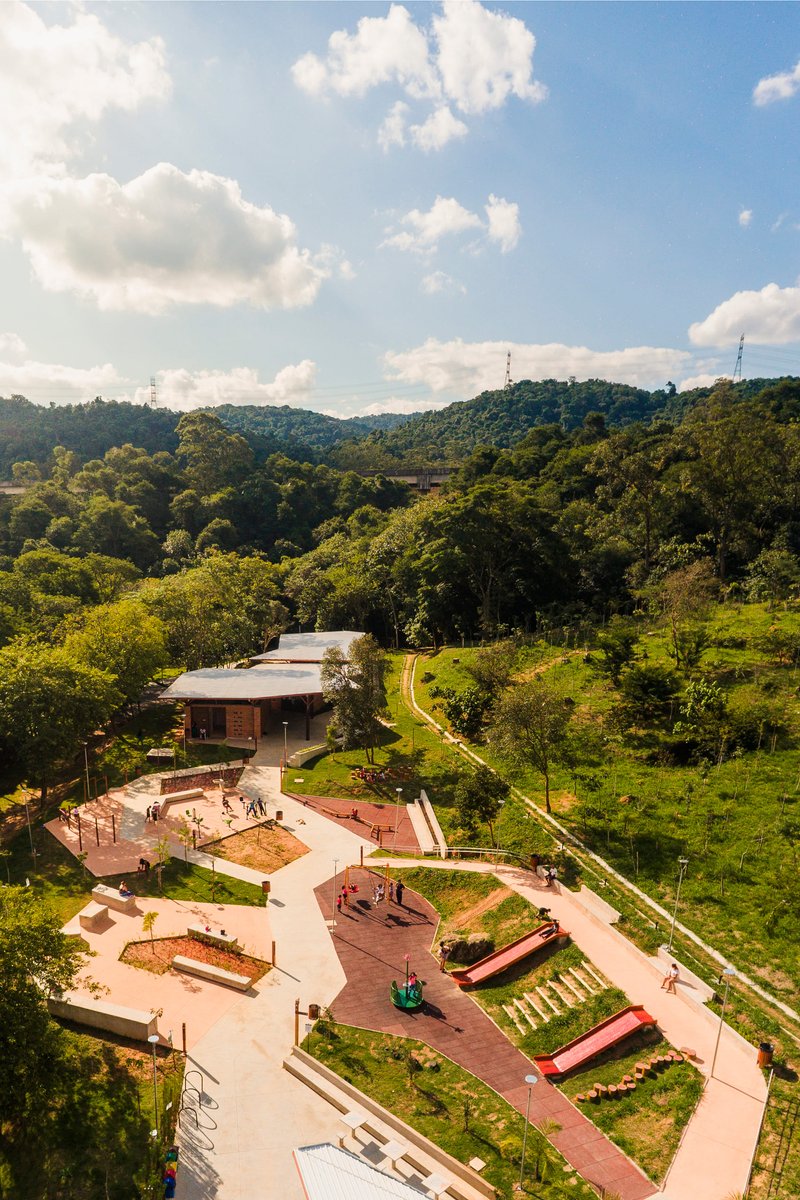
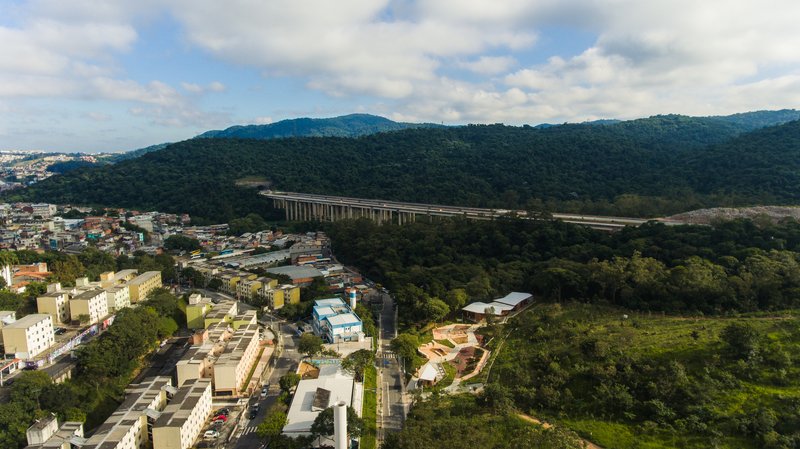
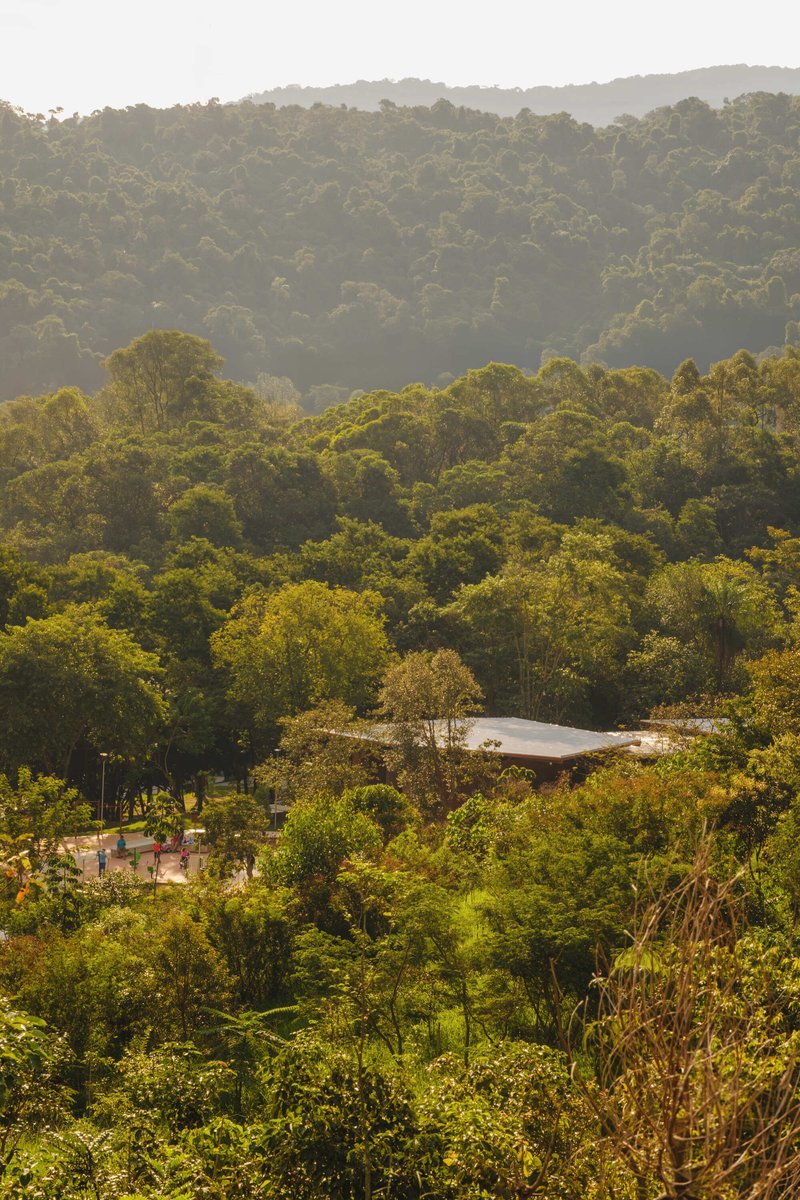
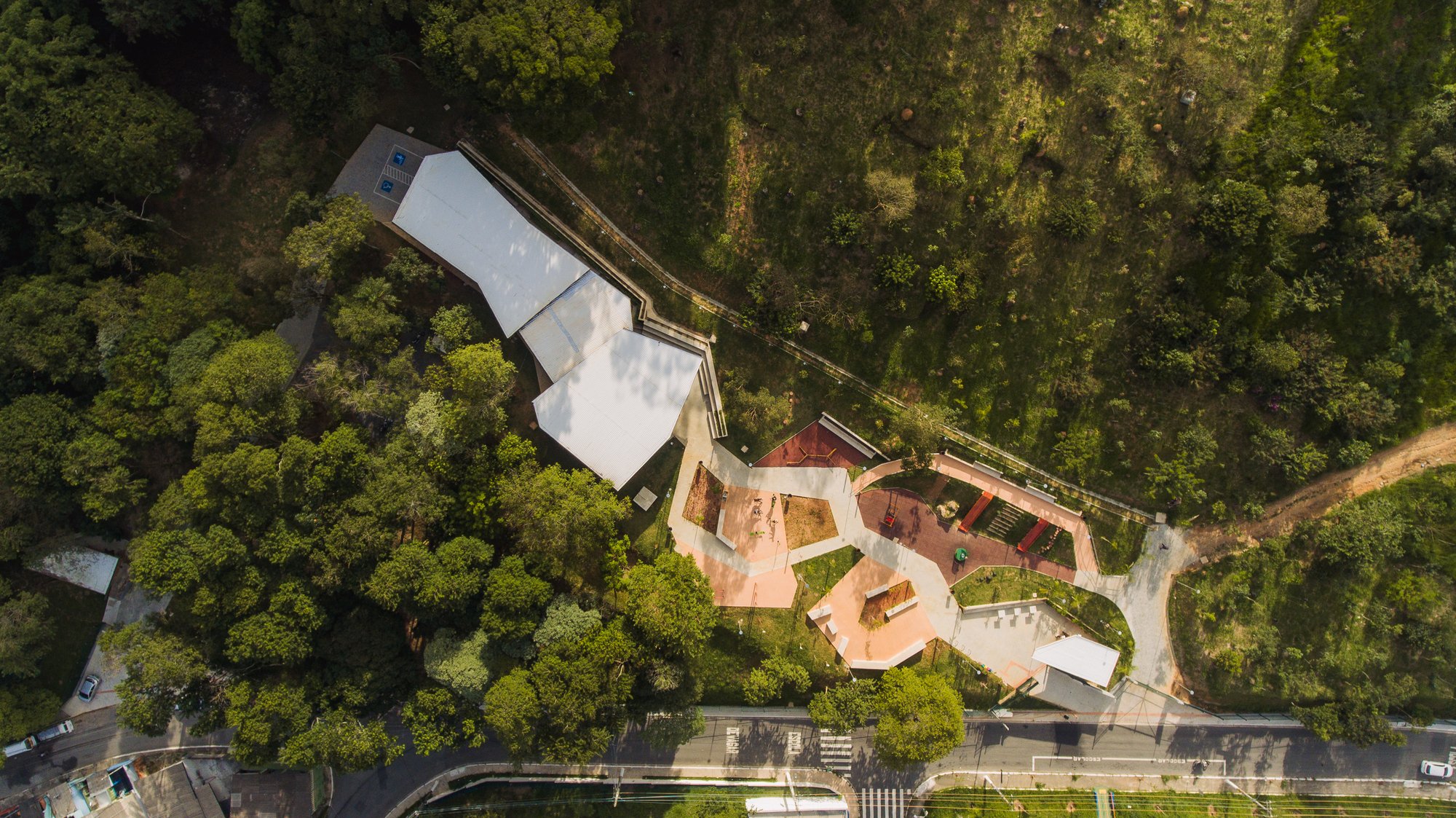
From the air, the park's logic becomes immediately legible. The site occupies a narrow strip of green wedged between dense informal residential neighborhoods and the forested slopes of a larger valley system. An elevated highway viaduct looms in the distance, a reminder that this part of São Paulo has historically received infrastructure designed to pass through rather than to serve. The park inverts that relationship. Its low-slung pavilions sit below the surrounding rooflines, deferring to the canopy rather than competing with it.
The decision to nestle buildings into the valley floor rather than perch them on higher ground is a quiet act of spatial generosity. It means the park is discovered rather than announced, visible primarily to the people who live within walking distance. The distant views show a flat roof emerging from trees in late afternoon light, almost camouflaged. For a neighborhood with few public amenities, this modesty reads as respect rather than understatement.
Brick as Landscape Material
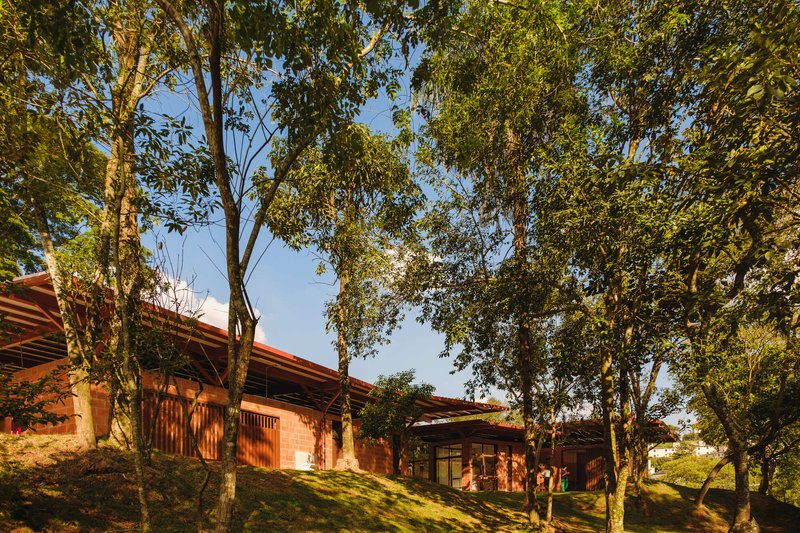
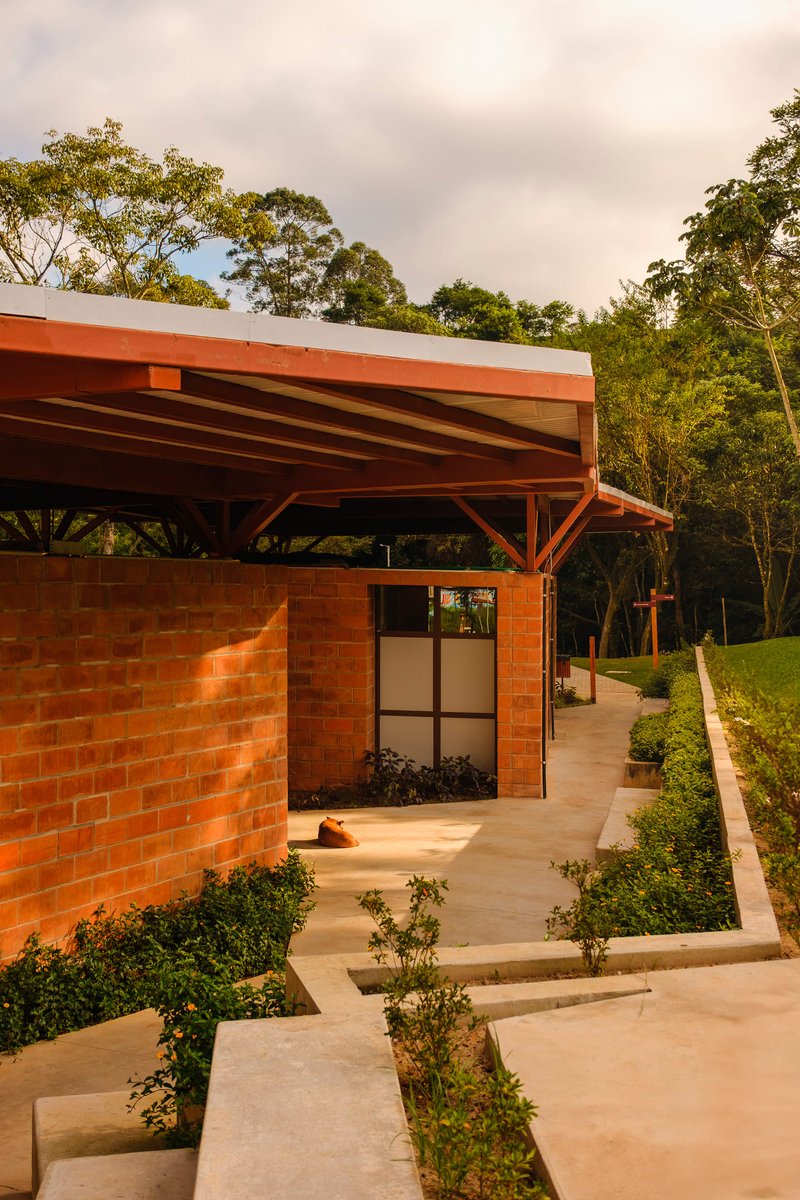
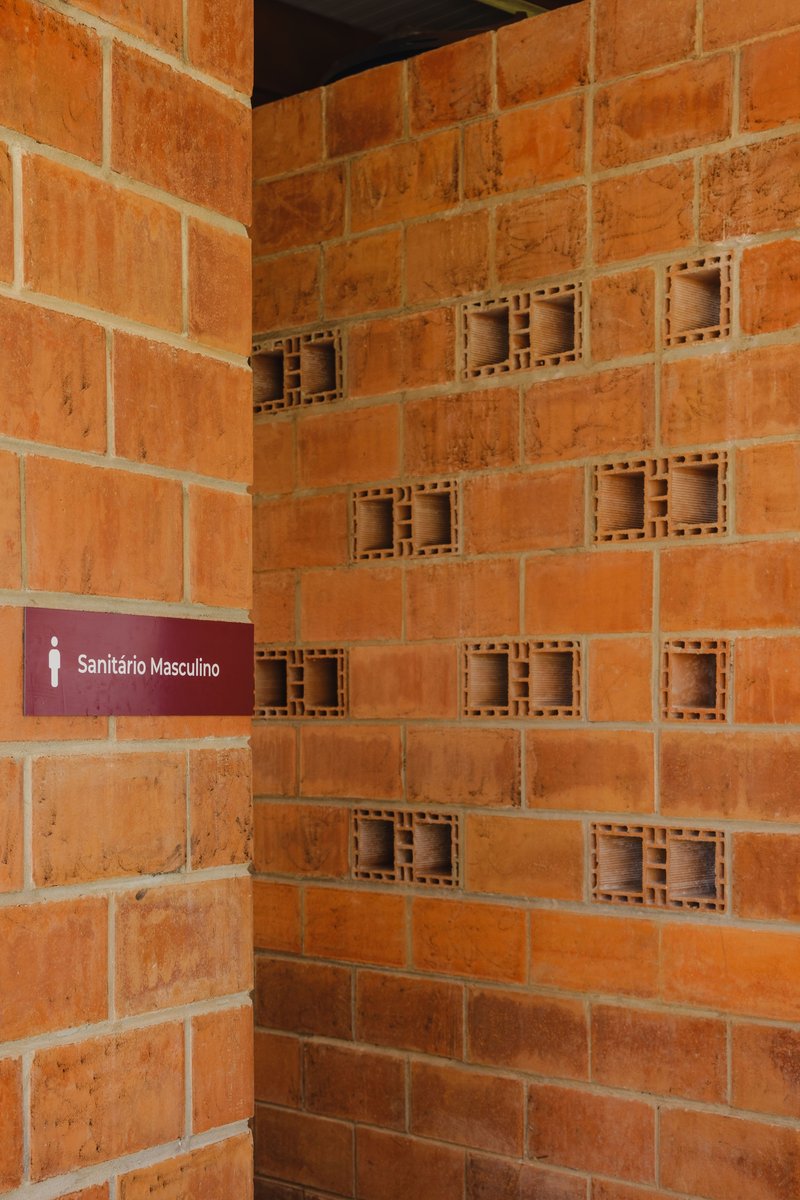
Red brick does a lot of work here, and Natureza Urbana uses it in ways that go beyond cladding. The terraced volumes with their low-pitched roofs read as topographic interventions, their masonry mass anchoring the buildings to the hillside. Hollow terracotta block units at corners and wall edges provide ventilation and visual texture, while also nodding to the vernacular construction techniques visible in the surrounding neighborhoods. Wayfinding signage is integrated directly into the brickwork, reinforcing the idea that these walls are infrastructure, not decoration.
The material palette is deliberately limited: red brick, exposed timber, concrete, and glass. That restraint lets each material do its job without competing for attention. The brick walls feel heavy and rooted, the timber structure feels light and protective, and the glass apertures frame specific views into the canopy. Narrow vertical windows punched through masonry walls filter dappled light into interior spaces, creating an atmosphere that owes more to the forest outside than to any artificial lighting strategy.
Timber Canopy and Structure
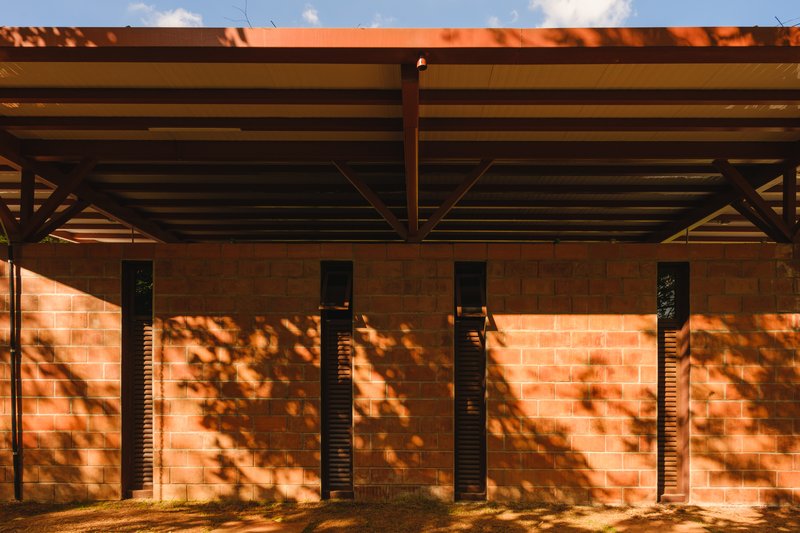
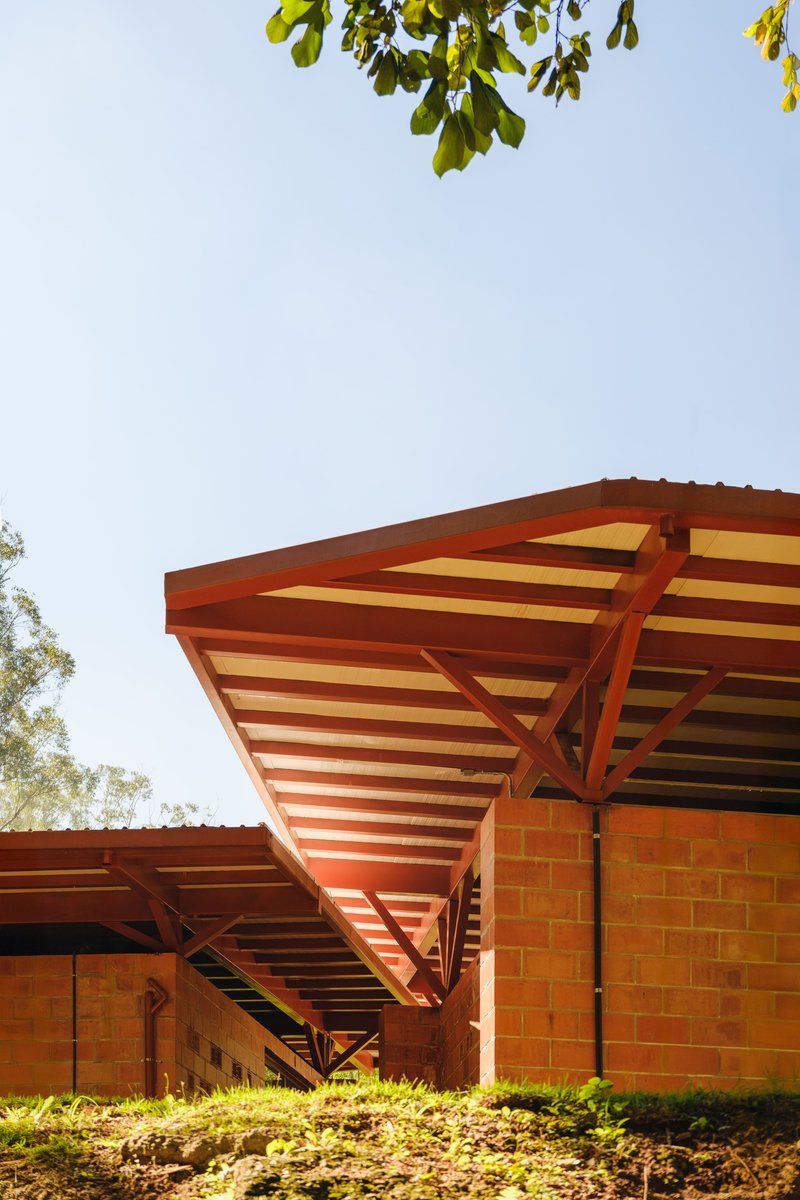
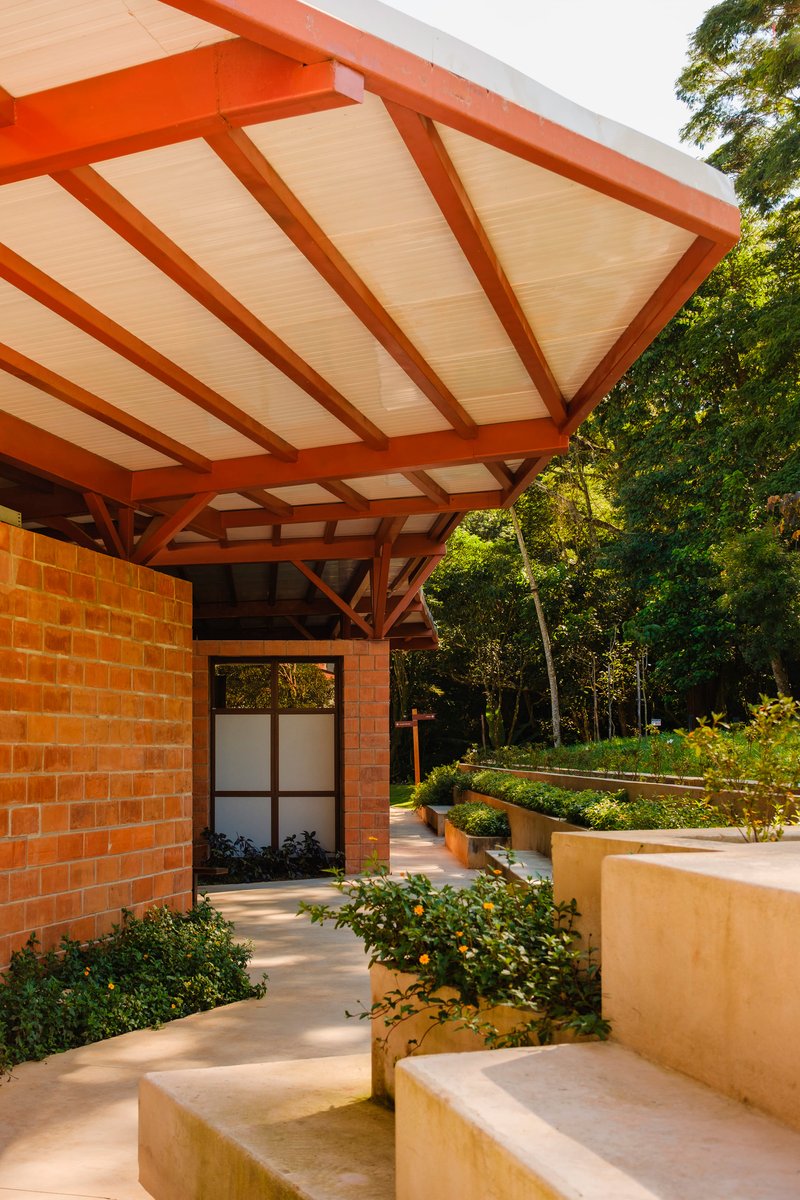
The timber roof system is the project's most expressive structural gesture. Diagonal bracing supports cantilevered canopies that extend well beyond the brick walls, creating deep covered zones that blur the line between inside and outside. The exposed rafters and slatted ceiling panels give the underside of the roof a warmth and grain that counterbalances the weight of the masonry below. You read the structure immediately: forces travel visibly through angled members to the ground, nothing is hidden.
This legibility matters in a public building intended to serve a community that may have limited experience with formal architecture. The timber pergola over the masonry walls communicates shelter in the most elemental way possible: a roof held up by beams, open to the air on multiple sides. Dappled tree shadows wash across the structure throughout the day, making the building a kind of sundial that registers the passage of time through changing patterns of light.
Covered Circulation as Public Space
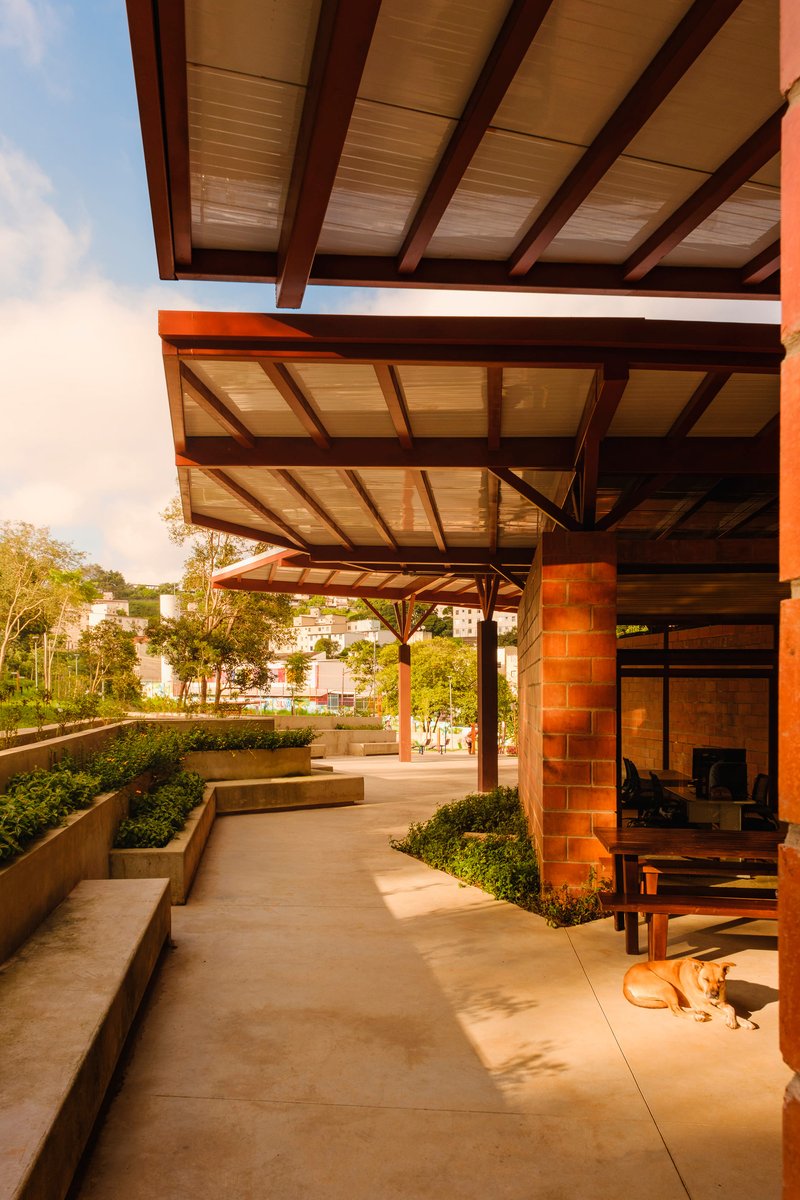
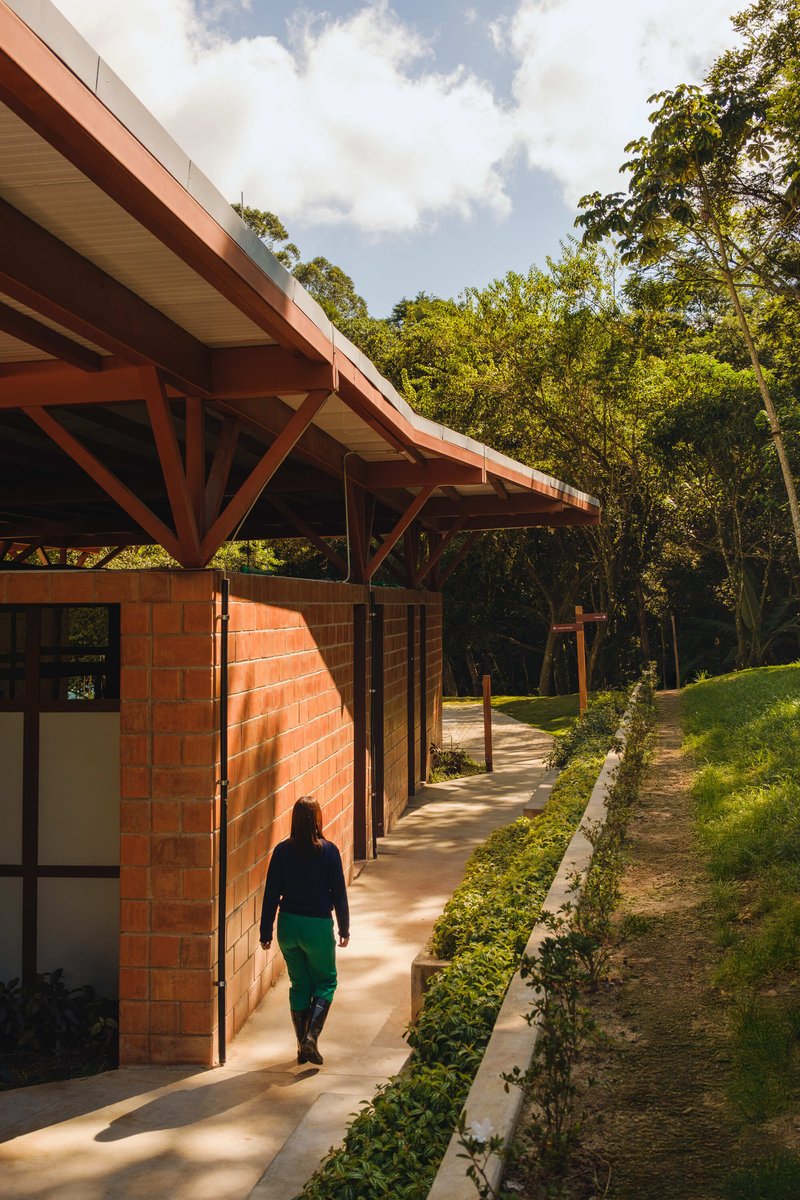
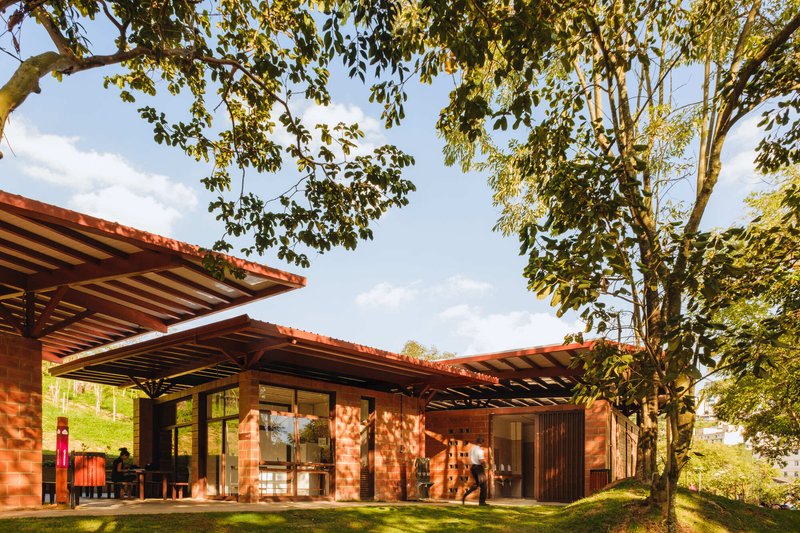
The covered walkways are perhaps the project's most important spatial move. In a city where rain can arrive suddenly and intensely, protected circulation is not a luxury but a necessity. The walkways here are generous in width, lined with planted beds on one side and brick walls on the other, their timber beam ceilings creating a rhythmic overhead cadence. A person walking through in afternoon light occupies a space that feels like a cloister: sheltered, directional, and calm.
These corridors connect the park's various programmatic elements, from community rooms to play areas, without forcing users through enclosed spaces. The covered terrace with its exposed timber roof structure and brick walls functions as an outdoor room, useful for gatherings, classes, or simply sitting in shade. The architecture provides structure for public life without prescribing it.
Play and Terrain
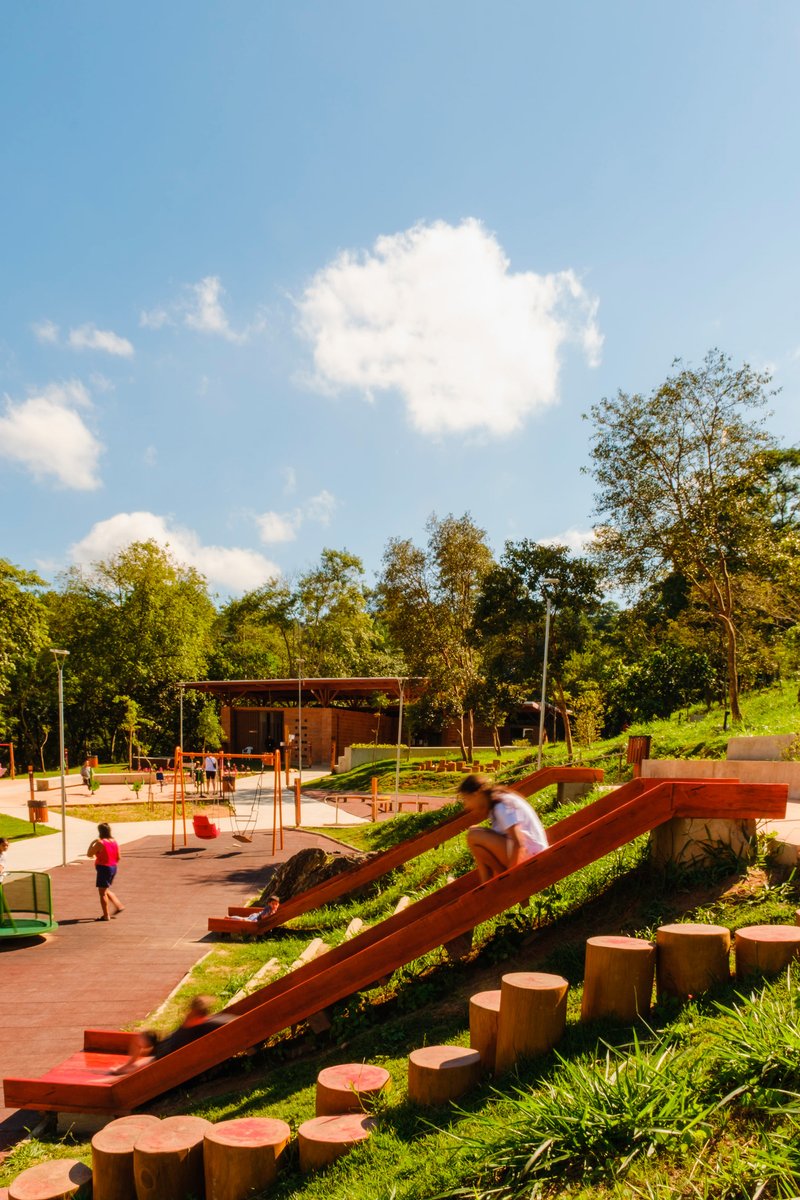
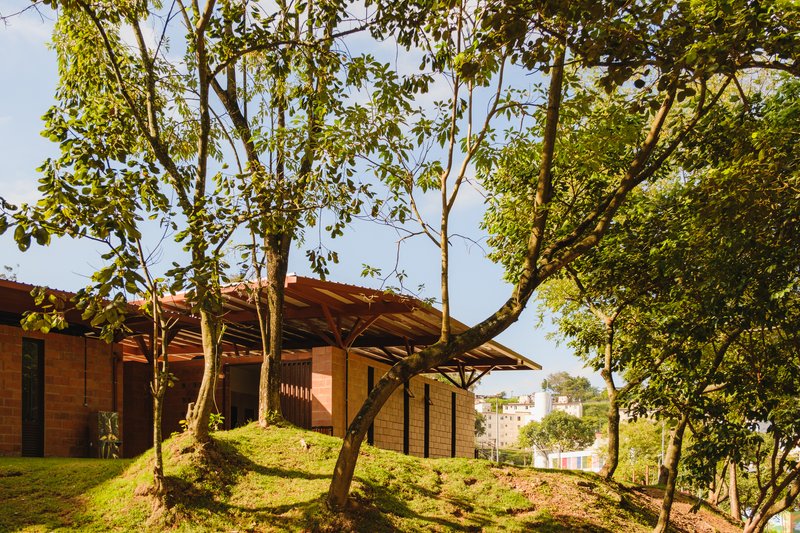
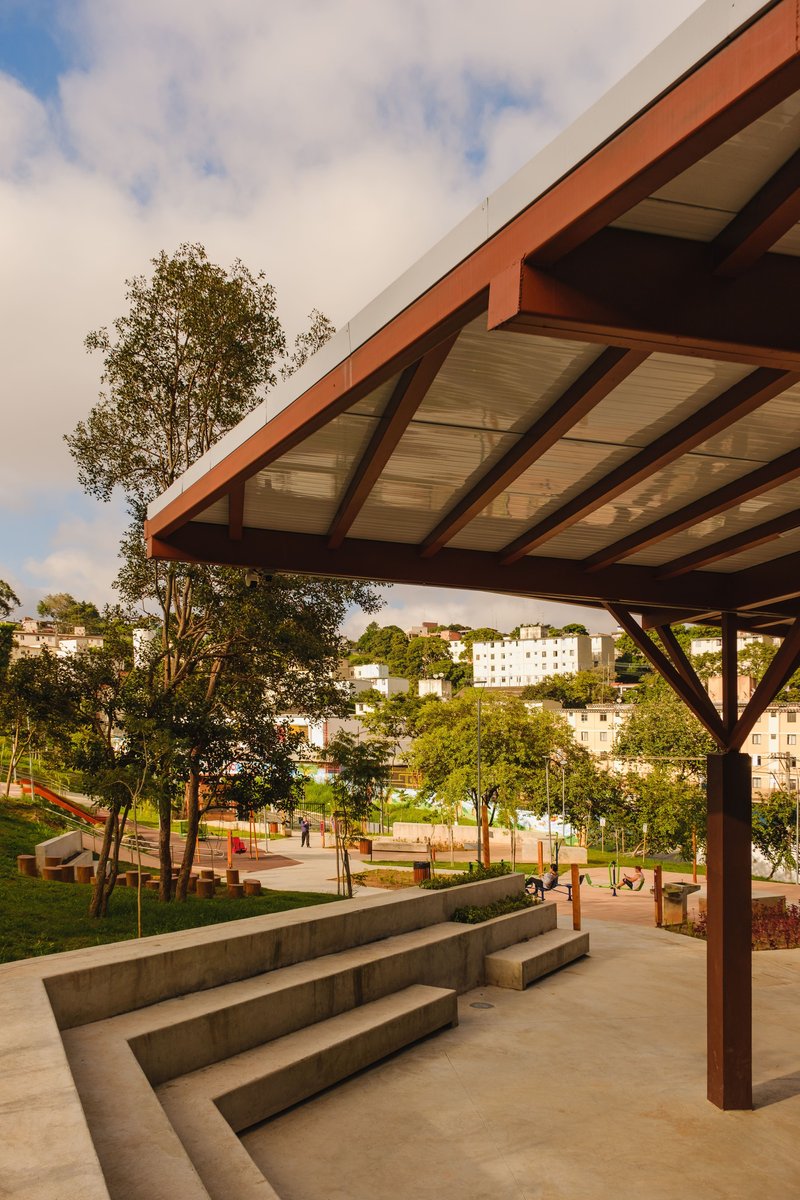
The playground design takes advantage of the site's natural slope in ways that a flat park never could. Terraced play surfaces with angled timber ramps and cylindrical log seating transform the topographic challenge into the primary play experience. Children move up and down the hill, not across a level surface, and the play equipment is integrated into the landscape rather than dropped onto it. A sloped grass lawn with planted trees rises toward the timber pergola roof, creating a green amphitheater that connects the recreational and architectural zones.
The cantilevered roof canopy above concrete steps provides a transition space between the covered community building and the open playground. This is a smart detail: it lets parents watch children from shelter while the kids themselves are out in sun and air. The architecture mediates between comfort and exposure, control and freedom.
After Dark
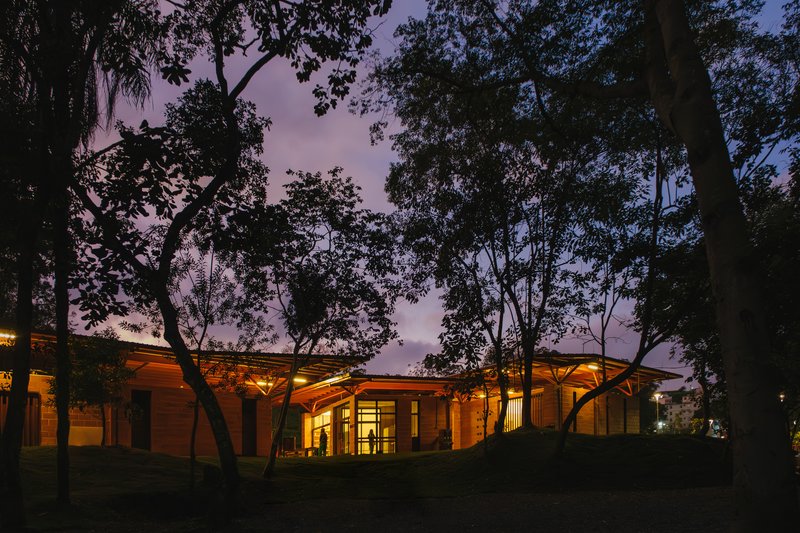
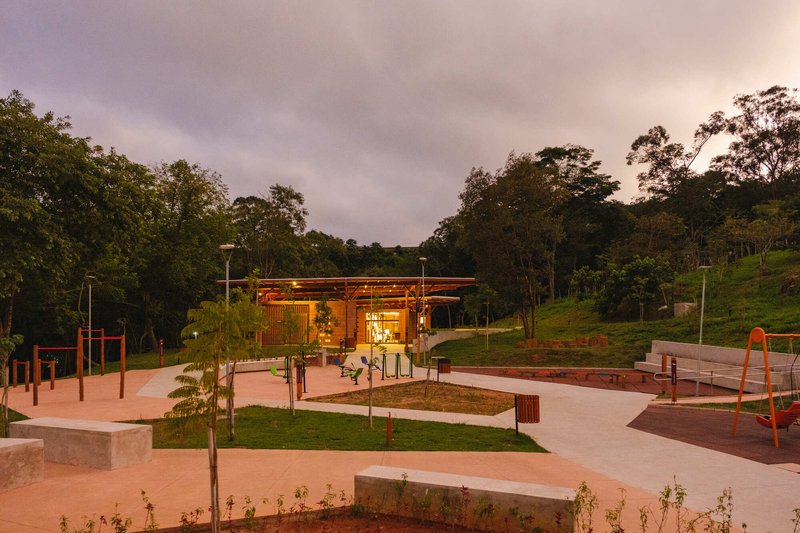
The dusk photographs reveal a park designed for extended hours of use. The glazed entrance beneath wide eaves glows warmly against tree silhouettes, announcing the building's presence without shouting. The community building's timber roof becomes a hovering plane of light overlooking a plaza with young plantings and playground equipment. Thoughtful lighting extends the park's usability into evening hours, which is critical in a neighborhood where safe, illuminated public space is scarce.
The lighting strategy appears restrained: warm tones, downward directed, concentrated at thresholds and gathering points. The park does not become a beacon visible from the highway viaduct. Instead, it serves the people immediately around it, creating a pocket of safety and warmth in the valley.
Stepped Rooflines and the Hillside
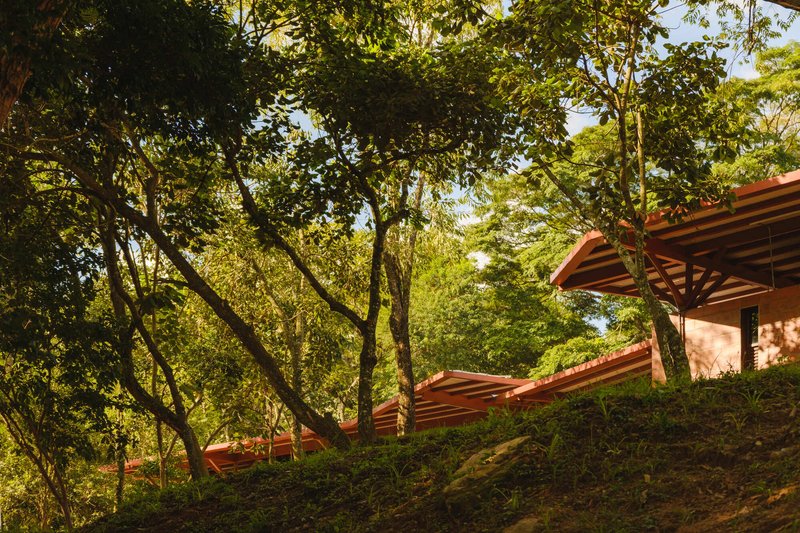
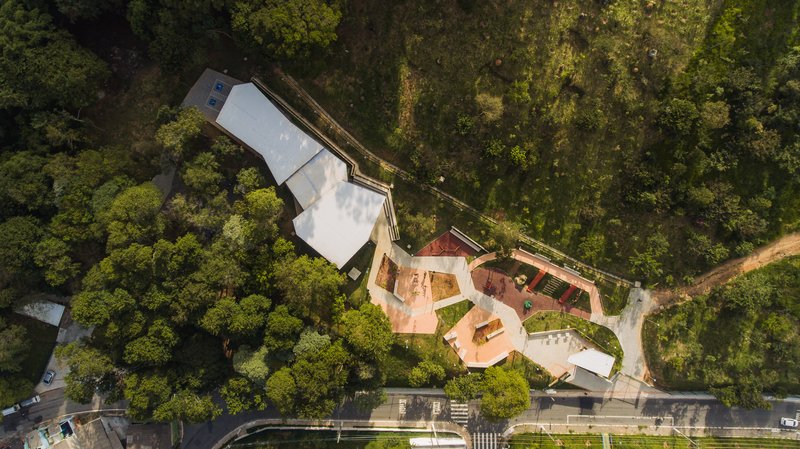
Seen from above, the angular roof and interconnected playground surfaces form an abstract composition surrounded by dense tree canopy. The stepped rooflines with exposed timber rafters descend through the canopy in a way that makes the buildings feel like a constructed version of the hillside itself. This is not architecture that sits on the land; it is architecture that follows the land's own logic, stepping down with the grade, opening where the trees part, and closing where the slope steepens.
Plans and Drawings
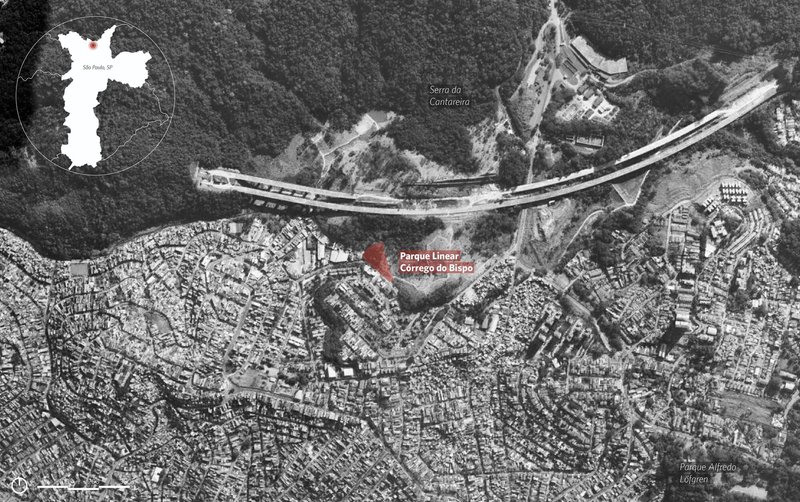
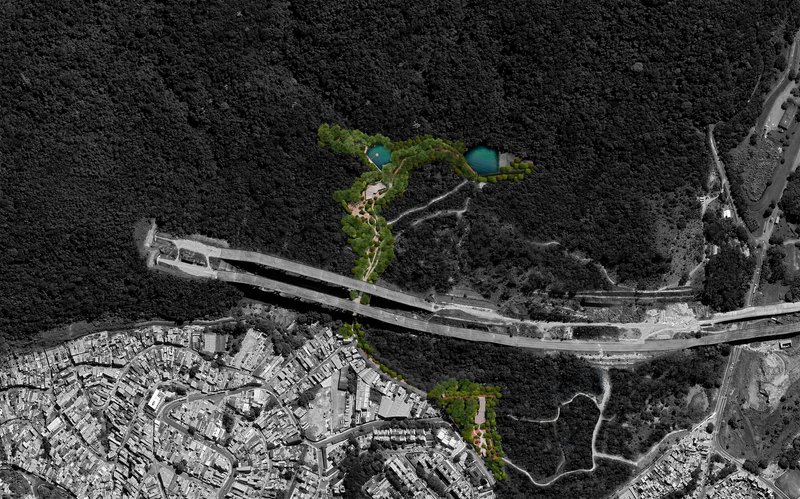
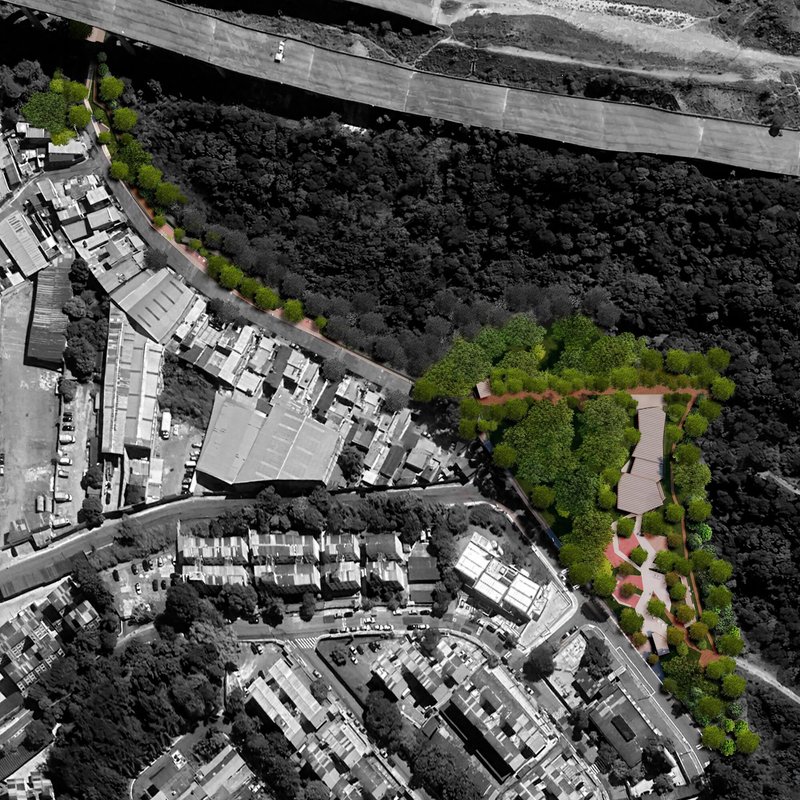
The aerial site plans make the urban strategy explicit. The park corridor, highlighted in red, cuts through dense urban fabric and forest, connecting zones that were previously divided by the stream valley. Colorized zones in the plan indicate distinct programmatic areas: play, gathering, circulation, and ecological restoration. The plans show how the park operates at a neighborhood scale, not just a site scale, linking residential development on both sides of the valley to a shared linear spine.
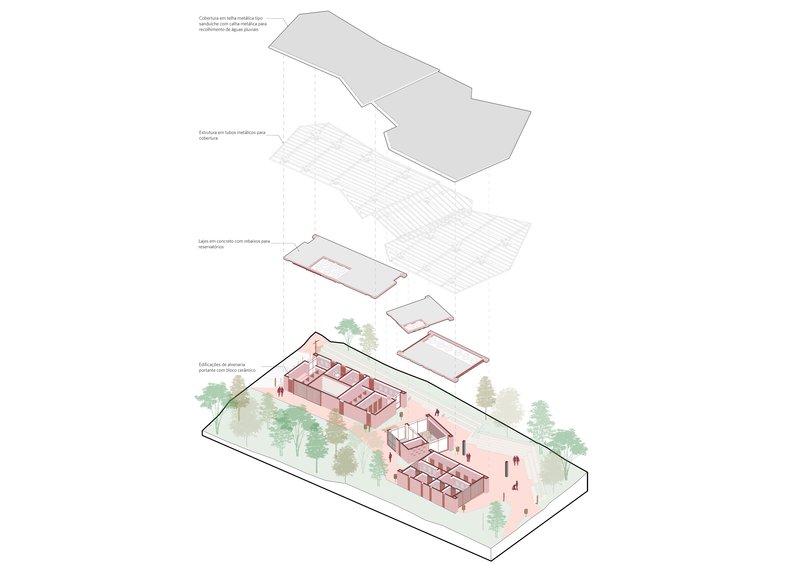
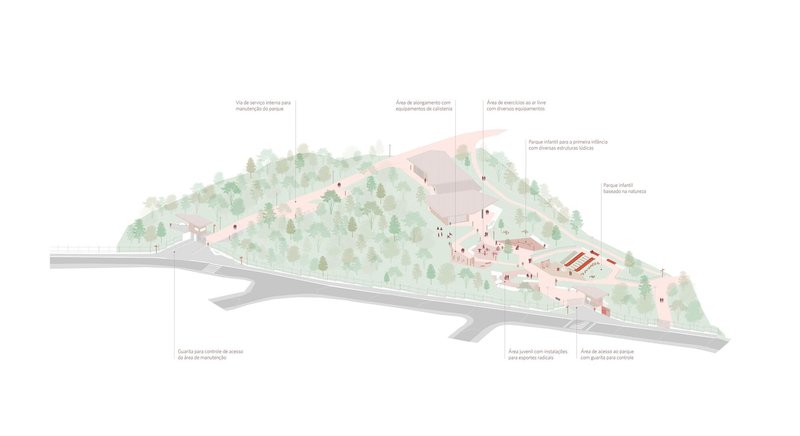
The exploded axonometric drawing reveals the project's constructive logic: roof, timber structure, floor plates, and red brick volumes are separated to show how each system contributes to the whole. The section drawing through the sloping site is particularly telling, depicting red brick structures nestled among watercolor trees and pathways in a way that emphasizes the project's ambition to dissolve the boundary between built and planted. The gentle rendering style of the section, with its soft tree canopies and earth tones, suggests that the architects see the buildings as participants in an ecosystem rather than objects imposed upon one.
Why This Project Matters
São Paulo has no shortage of grand urban parks, but it has a chronic deficit of well-designed public space in its peripheral neighborhoods. The Córrego do Bispo Linear Park addresses that deficit with intelligence and care, transforming a neglected stream corridor into a civic asset that provides recreation, community gathering space, and ecological infrastructure simultaneously. Natureza Urbana demonstrates that working with difficult topography and limited budgets is not a constraint to be overcome but a design opportunity to be embraced.
The project also offers a compelling model for how linear parks can function as urban connective tissue. Rather than creating an isolated green oasis, the park stitches together neighborhoods that were previously separated by terrain and neglect. Its brick and timber vocabulary is robust enough to age well, its spatial organization is legible enough to feel safe, and its ecological approach is serious enough to contribute to watershed health. In a city racing to address both social inequality and environmental vulnerability, this small park in Cachoeirinha proposes that the two challenges might share a single solution.
Córrego do Bispo Linear Park by Natureza Urbana, Cachoeirinha district, São Paulo, Brazil. 5,769 m². Completed 2025. Photography by Victor Lucena.
About the Studio
Share Your Own Work on uni.xyz
If projects like this are the kind of work you want to make, uni.xyz is a place to publish your own, find collaborators, and enter design competitions.




Popular Articles
Popular articles from the community

Community Library in Girona: A Replicable Model for Inclusive Library Architecture
A modular community library in Girona transforms learning, culture, and climate-responsive design into a shared civic network for all users.
Shinkō Komyuniti: Public Space Architecture Reimagining Sport, Culture and Community in Tokyo
Shinkō Komyuniti transforms sports spectatorship into public space architecture that reconnects play, culture, community and Tokyo life now.
POP ART: Adaptive Reuse Architecture as a Cultural Intervention in Sydney
POP ART reimagines an unused Sydney warehouse through adaptive reuse architecture, creating a bold cultural landmark above the city streets.

Vagaries of Life: Sustainable Urban Architecture for a Self-Sufficient Community in Singapore
Vagaries of Life reimagines Singapore housing as a tropical urban sanctuary for farming, resource cycles and collective community living now
Similar Reads
You might also enjoy these articles
Private Villa in Ubud by BAMM ARCHITECTS: Contemporary Design Amidst Bali’s Jungle
Private Villa in Ubud blends contemporary design with tropical landscape, featuring open-air pavilion, stone and wood materials, suspended master bedroom, and jungle pool views.
School Group Samuel Paty in Béziers: A Contemporary Educational Campus by Ateliers O-S Architectes and NAS Architecture
Samuel Paty School in Béziers features concrete massing, porous courtyards, metal structures, and landscaped playgrounds, creating a child-scaled, light-filled learning environment.
Four Public Pavilions in Beijing by Aurélien Chen and CSCEC
Four park pavilions in Beijing combine public services with floating roofs, acting as subtle urban signals integrated into landscape contextually.
LÁ-SÁCH House by Atelier tho.A
Compact tropical tube house-library with polycarbonate louvers, flexible interiors, concrete core, crafted materials, and community-focused alley setback.





Comments (0)
Please login or sign up to add comments
No comments yet. Be the first to comment!