
C+S Architects Build a Noah's Ark Nursery School in an Italian Heritage Park
A nearly zero-energy school for 125 children draws on Alzano Lombardo's concrete heritage and Enzo Mari's animal iconography.


For over three decades, C+S Architects have treated schools as civic infrastructure: buildings that belong to communities, not just to children. Their latest project, the Noah's Ark Nursery School in Alzano Lombardo near Bergamo, takes that conviction and plants it inside a heritage-protected park, replacing an earthquake-vulnerable 1950s school with a 3,380-square-meter structure that accommodates 125 children and, outside school hours, the entire neighborhood. Working with Studio Capitanio for local coordination, the firm spent five years bringing the project to completion on a €5.5 million budget.
What makes this project genuinely interesting is not the Noah's Ark metaphor alone, though that narrative is woven into every surface, from animal reliefs carved into the ramp wall to hippopotamus-shaped stroller storage. It is the way the building resolves a set of seemingly incompatible demands: deep respect for a protected landscape and centuries-old trees, nearly zero energy consumption, total transparency between classrooms and communal hall, and a roof profile that nods to the town's industrial past as a center for concrete production. The result is a school that feels simultaneously ancient and utterly contemporary, rooted in the Val Seriana landscape yet charged with the ambition of a civic manifesto.
A Pigmented Concrete Ramp and the Language of the Valley
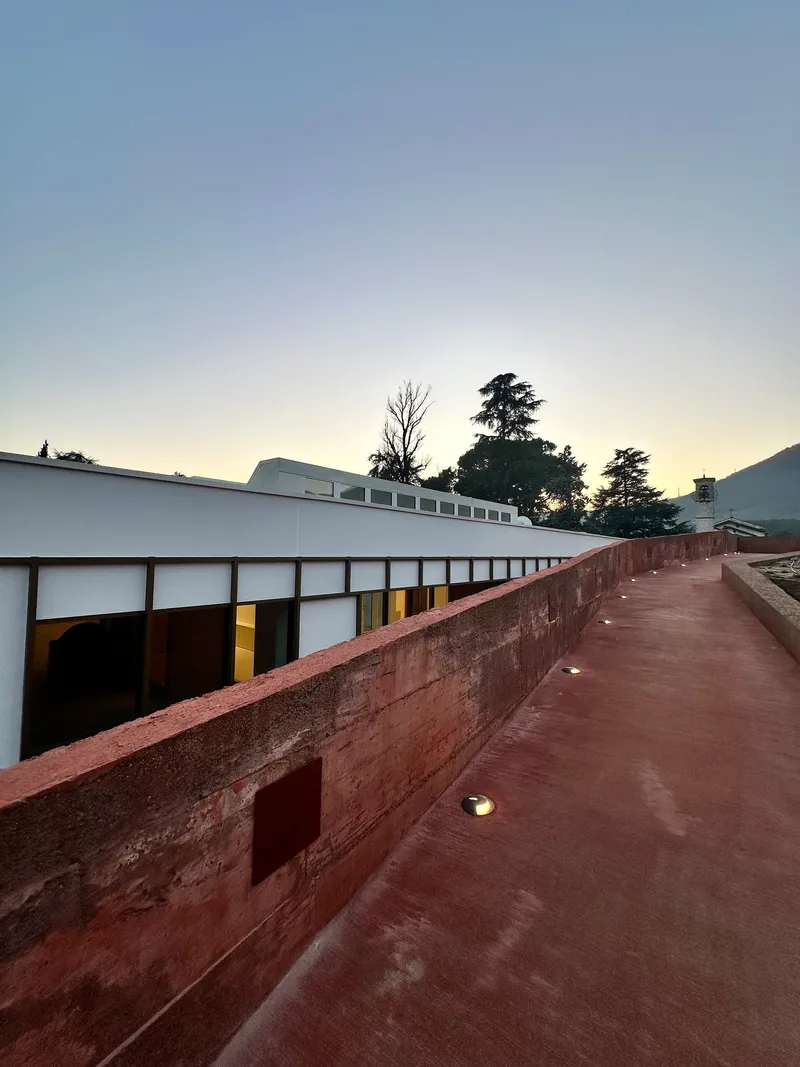
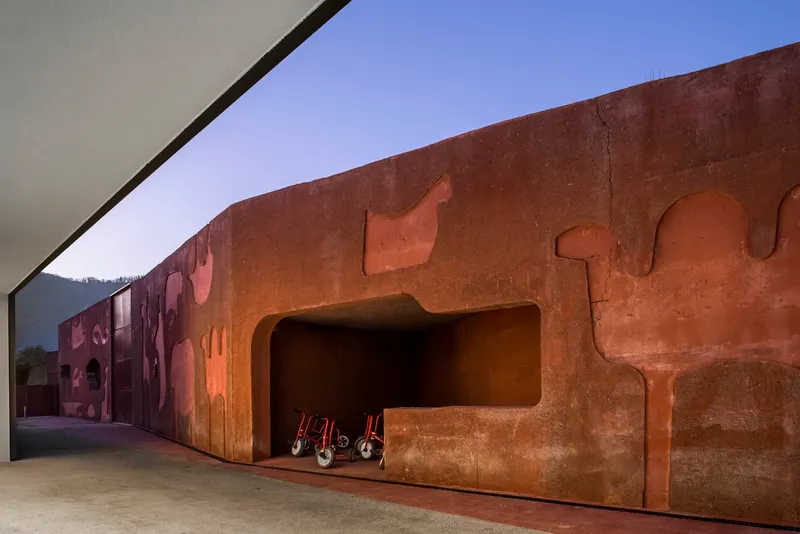
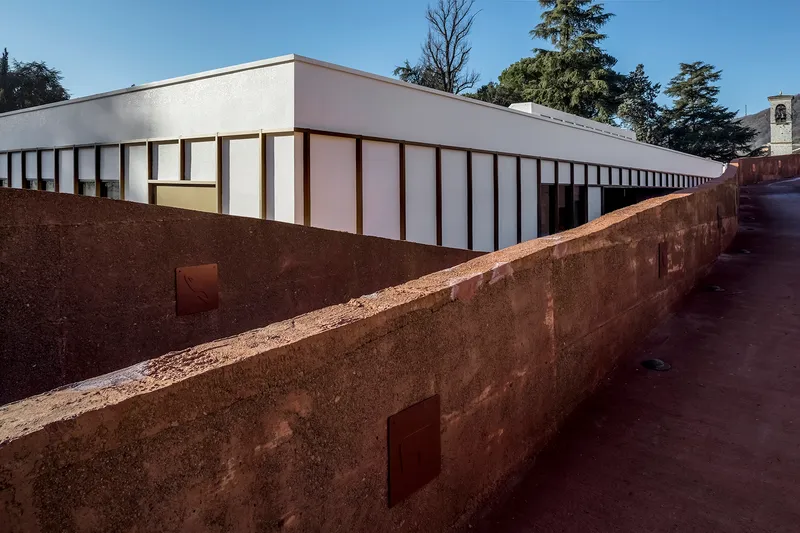
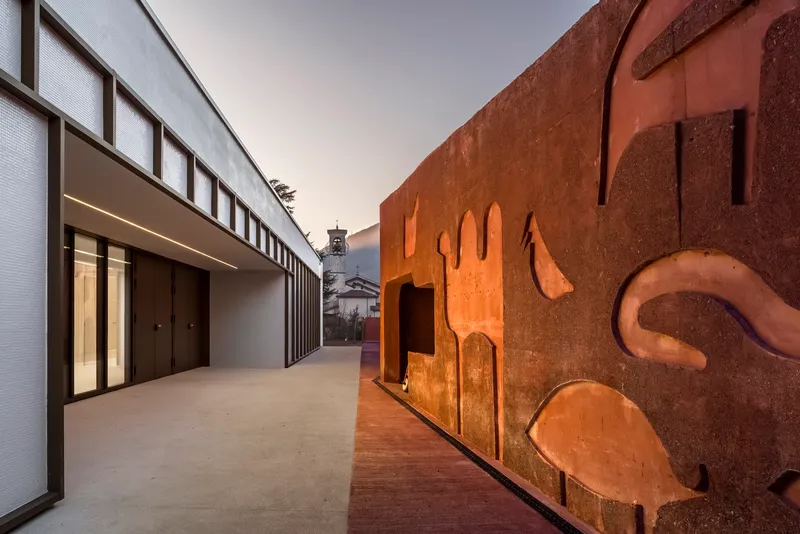
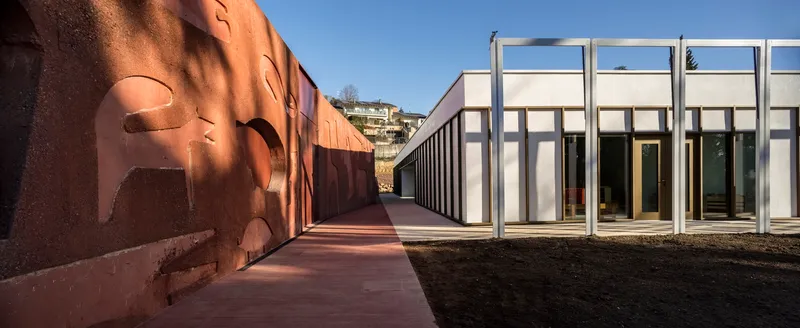
The approach to the school is mediated by a long ramp bordered by a red-pigmented reinforced concrete retaining wall whose exposed aggregates were chosen to echo the local geology. Stone retaining walls are, as C+S Architects describe it, the DNA of the Val Seriana landscape, and the project absorbs that topographic rule into its own structure. Sculpted animal relief cutouts punctuate the wall's surface, transforming what could have been mere civil engineering into a storytelling device. A recessed niche holds wheelchairs and strollers, merging accessibility with the ark's zoological narrative.
The color and texture of this wall establish a grounding contrast with the white volumes above. It reads as something geological, something that was always there, while the school itself seems to have alighted on top of it. That dual register, heavy base and lightweight superstructure, is the project's fundamental spatial move.
White Mosaic, Bronze Frames, and an Industrial Roofline
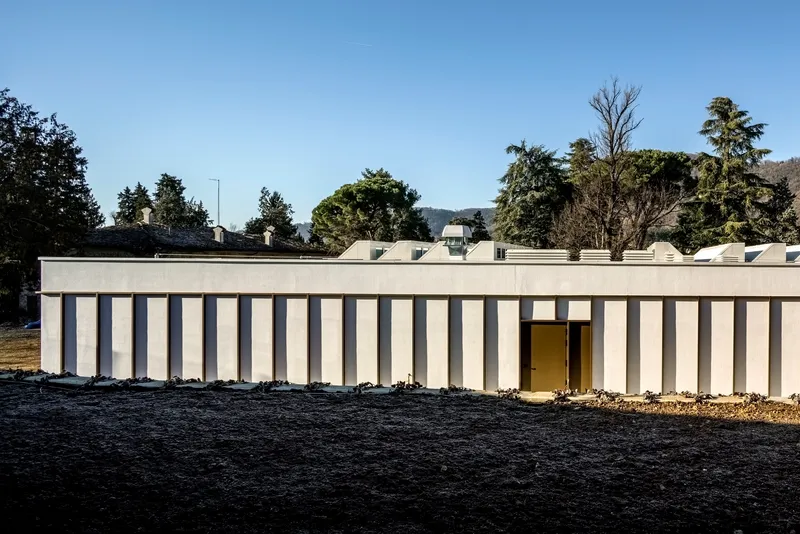
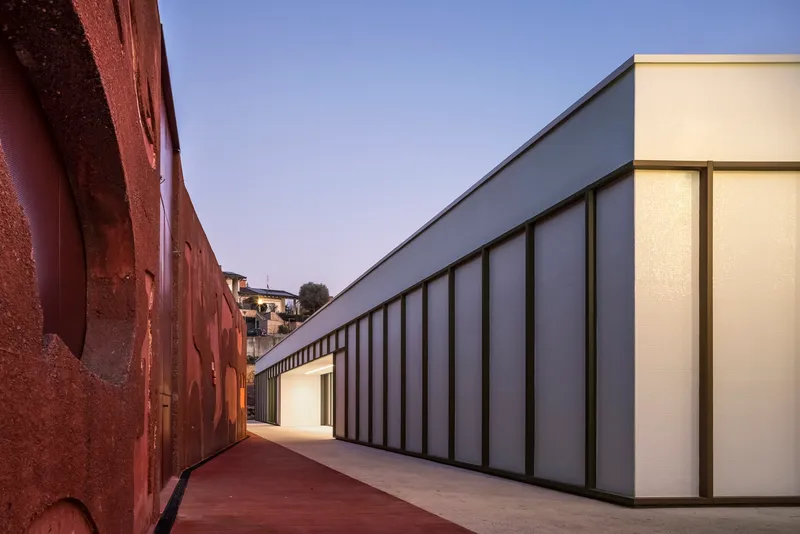
Alzano Lombardo was historically famous for white concrete, still known locally as "Alzano White." C+S Architects seized that identity and clad the school in white glass mosaic tiles, a material that requires virtually no maintenance and carries echoes of Italy's postwar design masters, from Gio Ponti to Luigi Moretti. The striped facade, alternating between cream panels and darker vertical elements, breaks down the building's considerable length and creates a rhythm that plays against the sawtooth roof silhouette visible from the park.
That sawtooth profile is itself a reference to the town's industrial sheds. But here the shed roof is not simply borrowed as an aesthetic gesture; the angled planes channel natural light deep into the central hall through a series of skylights, turning an industrial typology into an environmental strategy. Bronze-framed windows reinforce the warmth of the material palette, anchoring the white surfaces with a tonal richness that avoids sterility.
The Portico as Civic Threshold
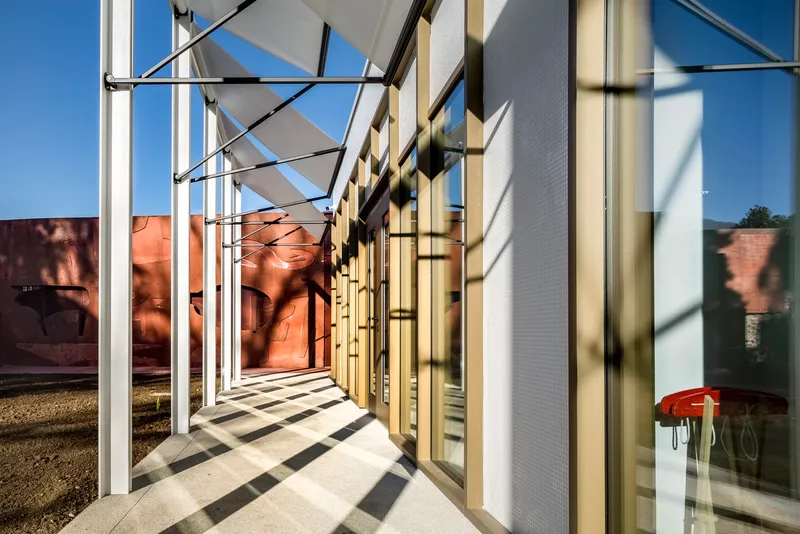
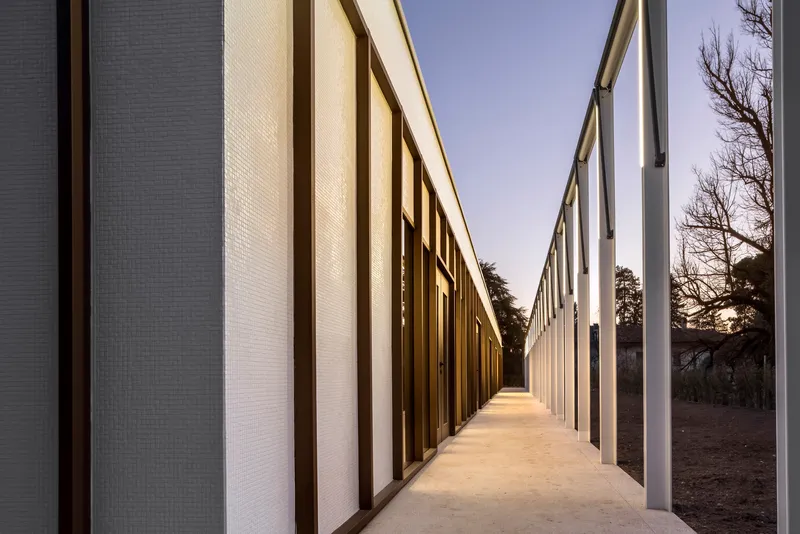
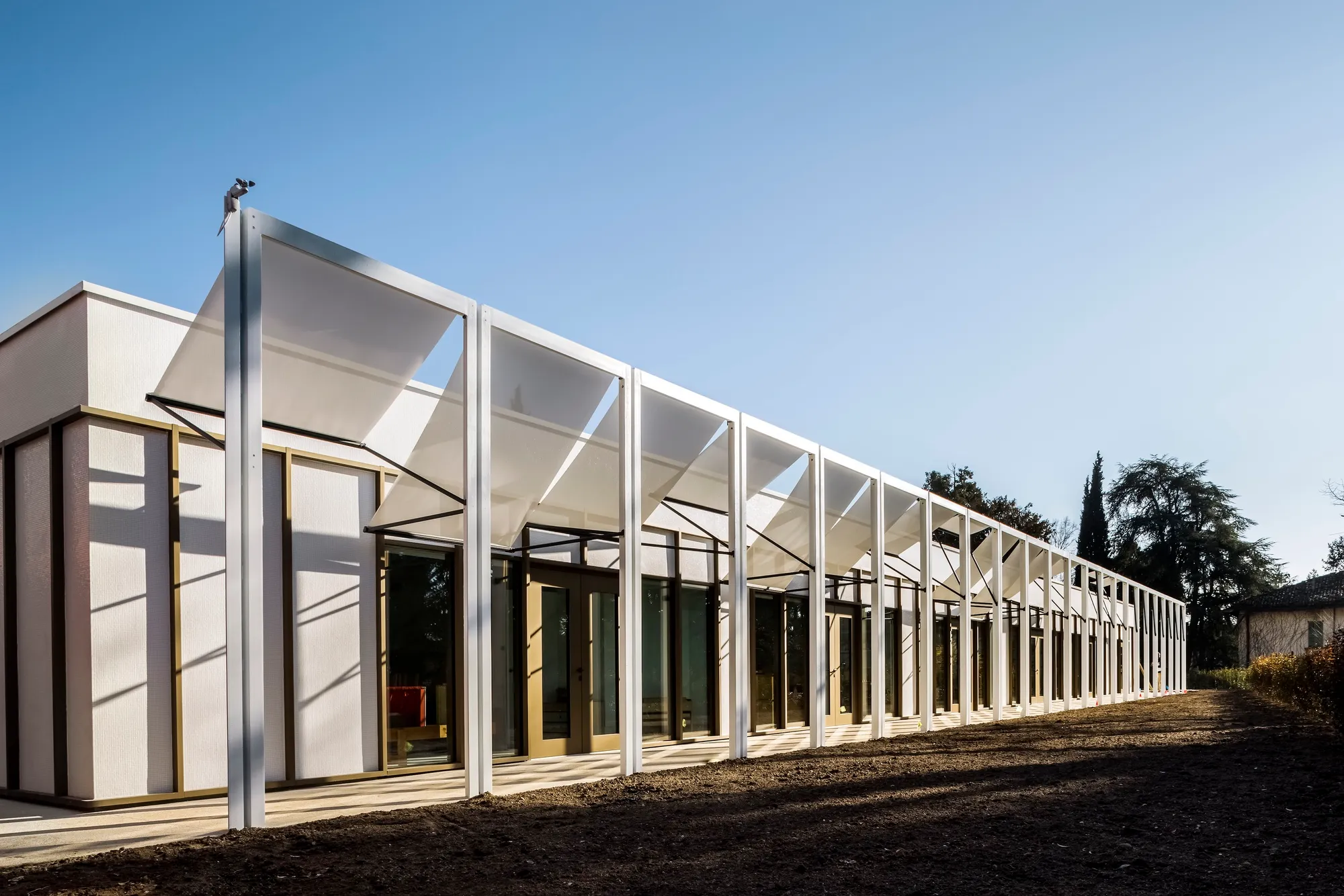
Running the length of the west facade, a colonnade of slender metal pillars supports an external portico that C+S Architects describe as a tribute to Giuseppe Terragni's Sant'Elia nursery school in Como. Each classroom opens directly onto this covered walkway, which overlooks Villa Paglia's centuries-old trees and historic pergola. There are no interior corridors. Children move from classroom to hall to garden through a sequence of thresholds that never feel sealed off.
The portico does double duty. During school hours it is a circulation spine and an extension of the classroom floor. Outside school hours, when the central hall becomes a community event space, the portico becomes an urban passageway connecting park and neighborhood. Shadows from the metal columns stripe the polished floor throughout the day, marking time in the manner of a sundial.
A Central Hall That Replaces the Corridor
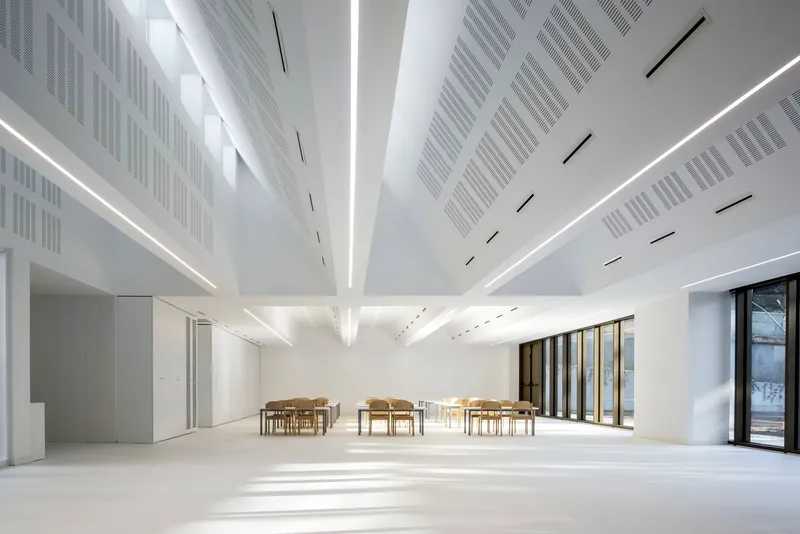
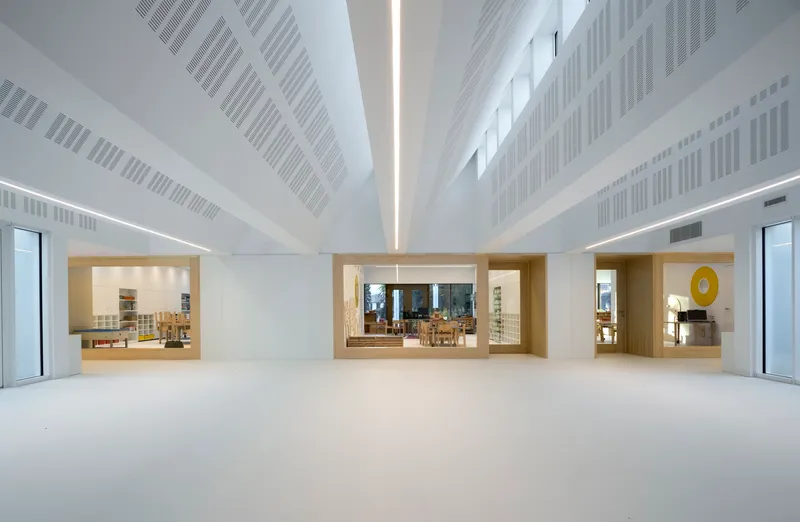
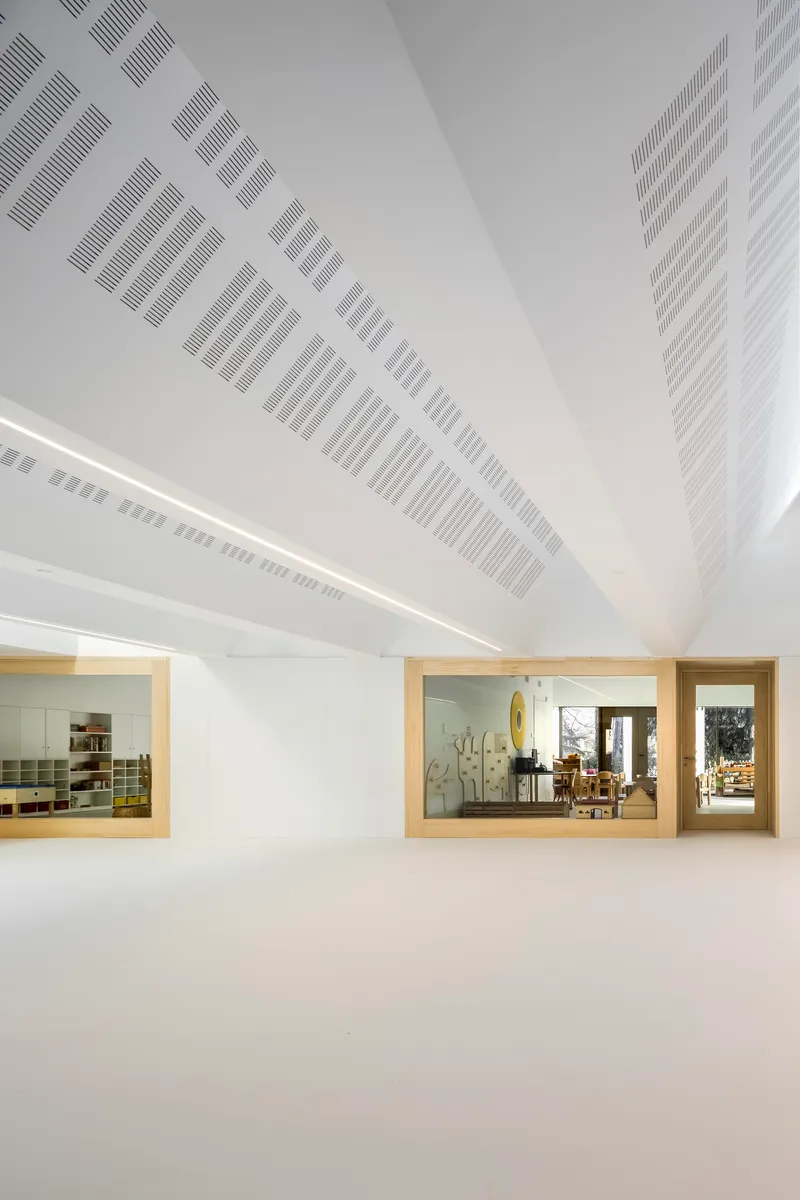
The heart of the building is the salone, a giant inner hall flooded with natural light from two glazed courtyards grafted into its volume. Angled ceiling beams and perforated acoustic panels create a layered overhead landscape that modulates sound and light simultaneously. Timber-framed openings between the hall and adjacent classrooms maintain constant visual connection; walls become frames, not barriers.
C+S Architects' insistence on eliminating corridors is more than a spatial preference. It is an educational philosophy made physical. When every room is visible from the central hall, socialization is not something that happens during recess; it is the ambient condition of the building. Classrooms can transform into art studios, digital labs, or performance spaces. The hall, in turn, can host town meetings, exhibitions, or celebrations. The school is a factory of knowledge in the morning and a piazza in the evening.
Interiors Designed at a Child's Scale
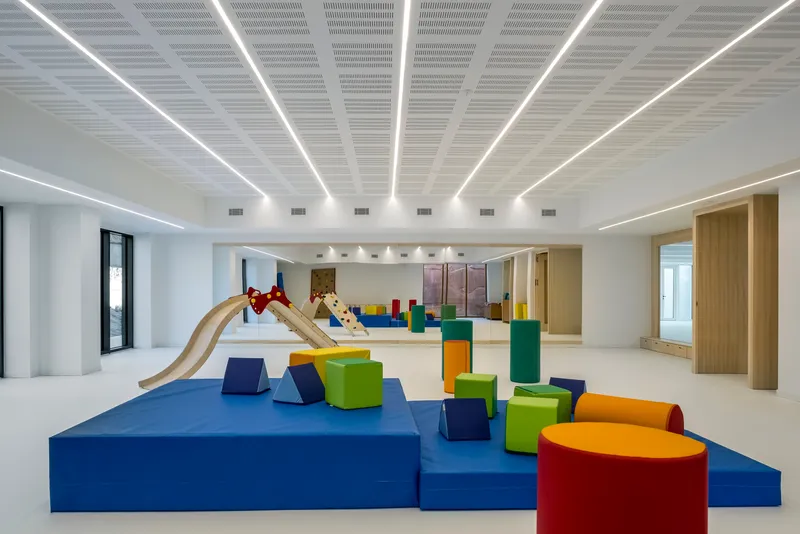
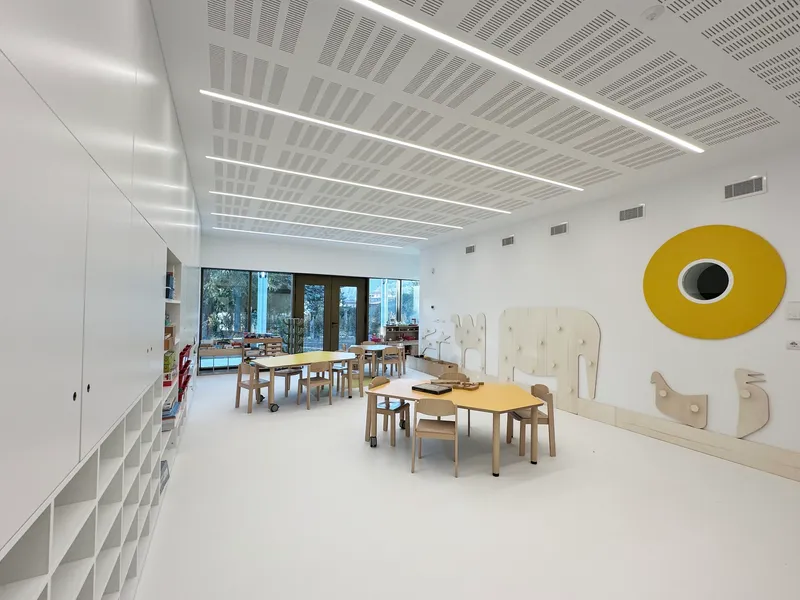
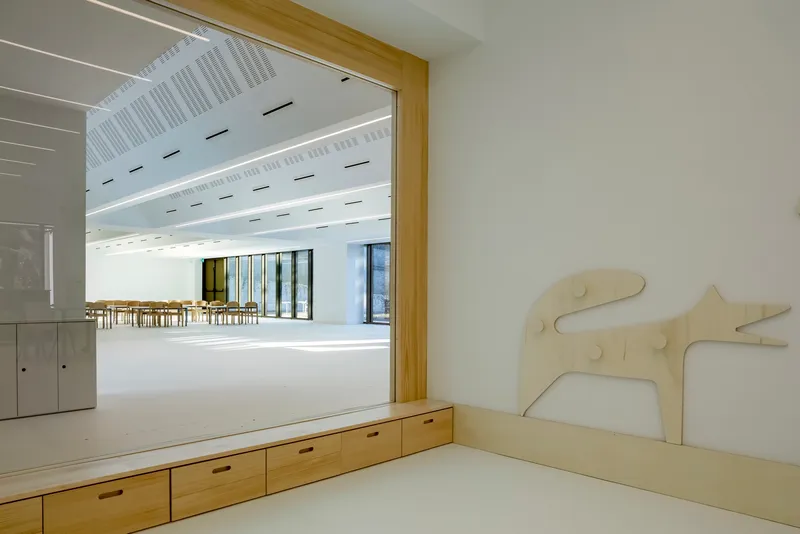
Inside the classrooms, plywood dominates: tables, chairs, built-in benches with storage drawers, large-scale teaching games. The material is warm, repairable, and legible to small hands. Each classroom floor is engraved with an animal in a different color, a direct nod to Enzo Mari's iconic animal puzzle from the 1950s. The corresponding bathroom is tiled in the matching hue, so a child navigating the building can orient by color and creature rather than by signage they cannot yet read.
The play area beneath a ceiling of radial light strips feels generous without being cavernous. Colorful foam blocks and a plywood slide create zones of activity, but the white linoleum floor and perforated ceiling panels keep the acoustic environment controlled. Fixed wardrobes running the full length of each section keep clutter contained, freeing floor area for the daily reconfiguration that nursery pedagogy demands.
Color as Wayfinding
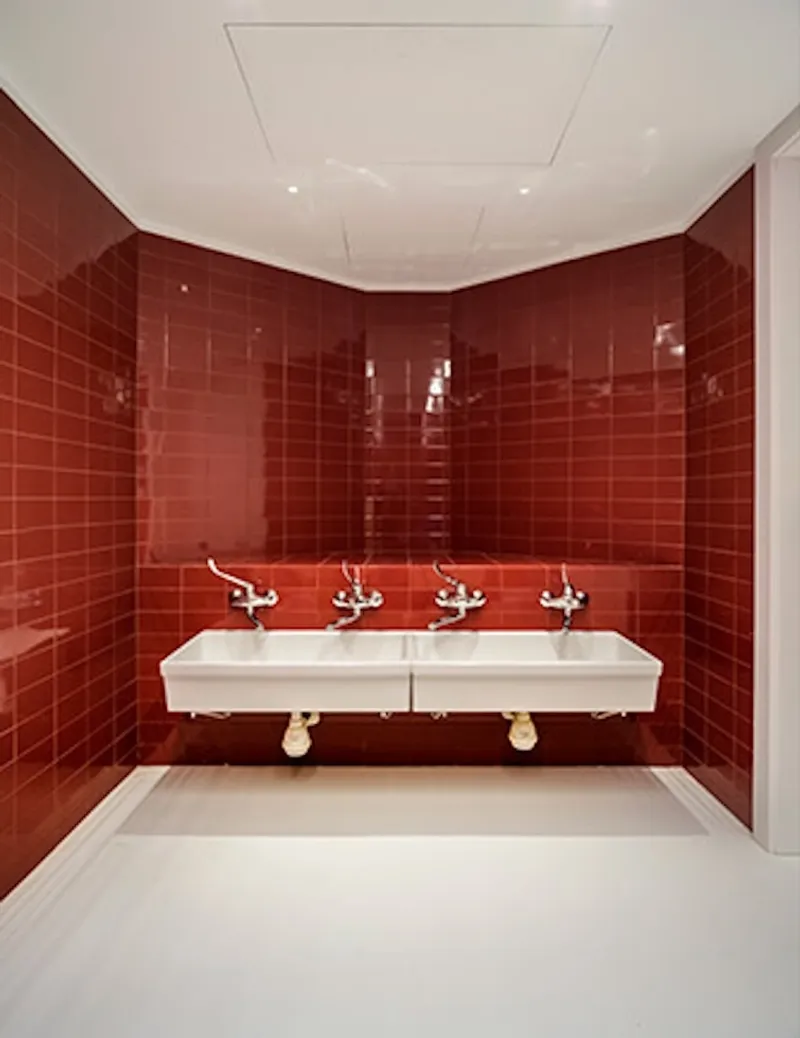
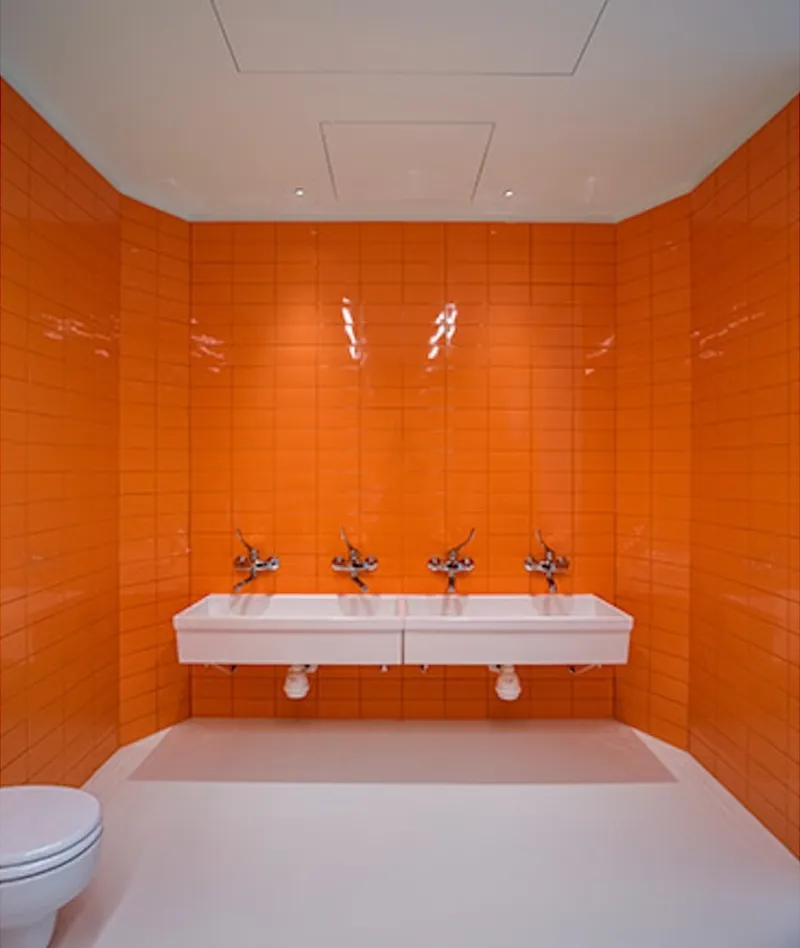
The bathrooms are the most joyful rooms in the building. Glossy ceramic tiles in saturated red, orange, and presumably other animal-coded hues wrap the walls, turning utilitarian spaces into moments of delight. Twin wall-mounted sinks at child height, chrome faucets, and nothing extraneous: the rooms are proof that durability and playfulness are not mutually exclusive.
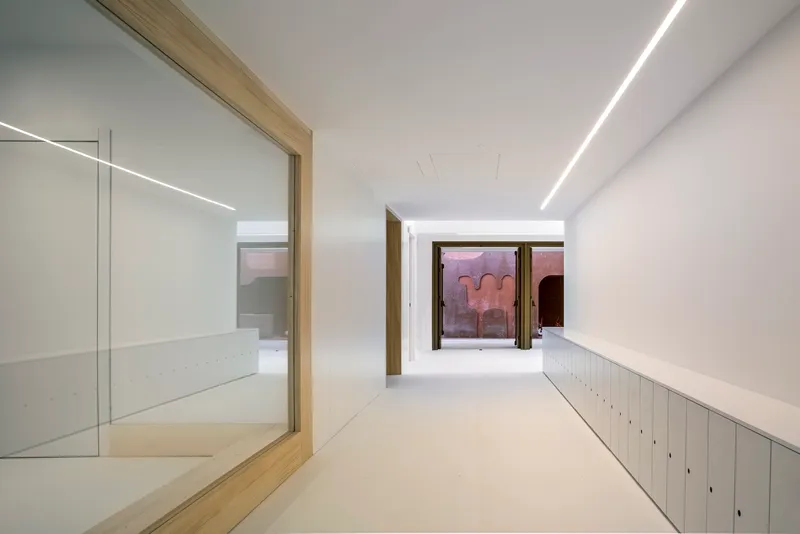
The white corridor connecting classrooms is lined with metal lockers and punctuated by timber door frames that maintain the plywood language of the teaching spaces. Natural light enters from glazed courtyard openings at the end of each corridor, pulling children forward through the plan. The building's wayfinding system is embedded in its architecture, not applied to it.
Courtyards, Light, and Nearly Zero Energy
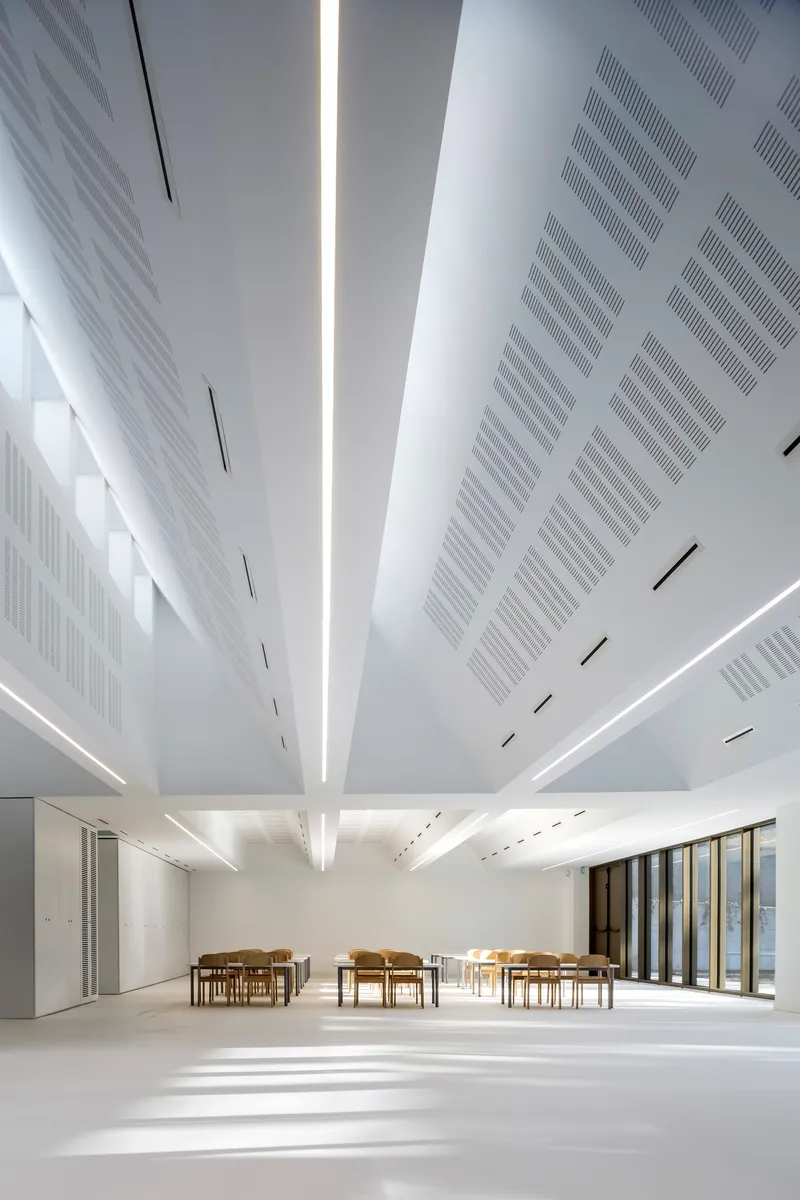
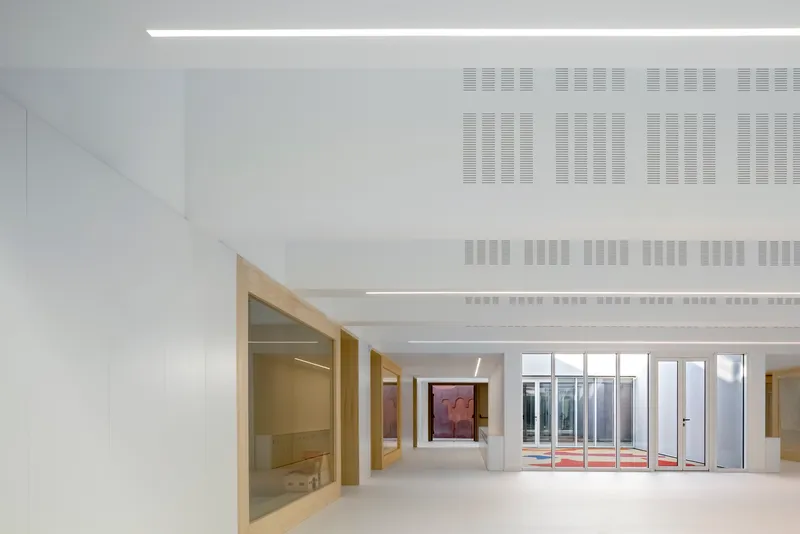
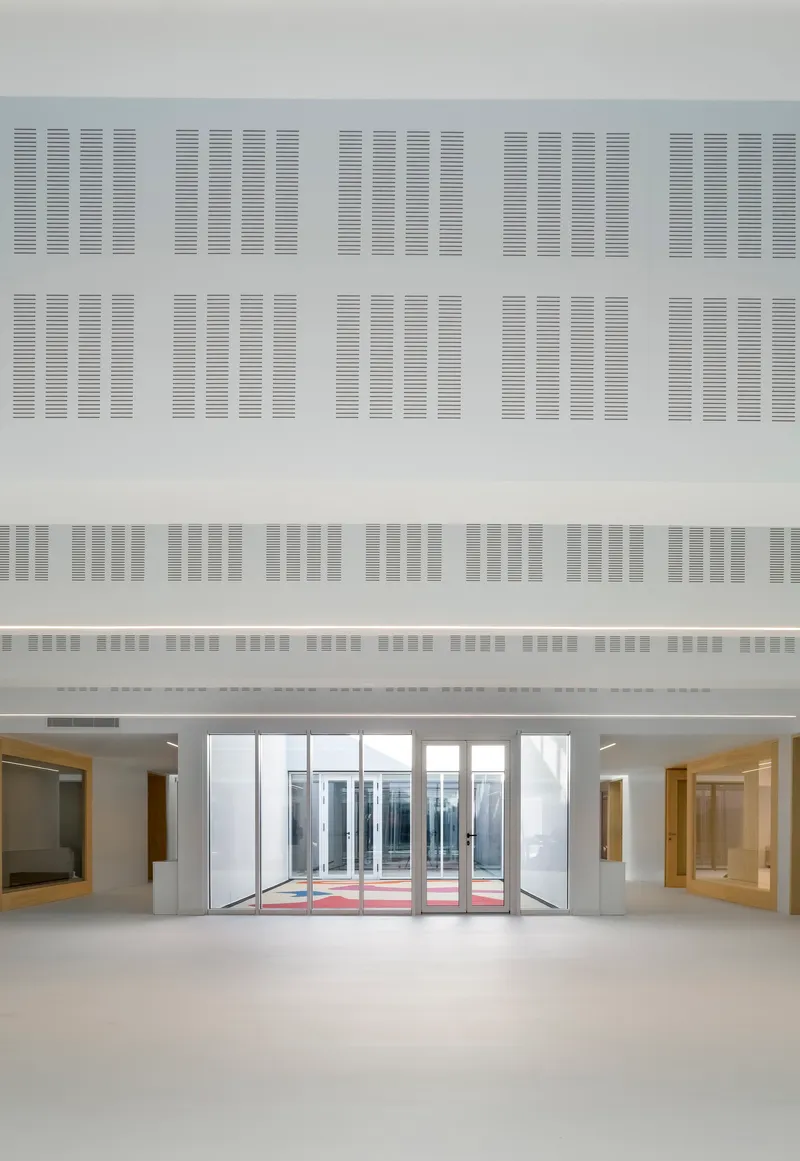
Two glazed interior courtyards bring daylight into the deepest parts of the plan, eliminating the need for artificial illumination during most of the school day. The ceiling over the central hall features a radial arrangement of perforated panels surrounding a central skylight, distributing light evenly across the white resin floor below. Curtains housed within the facade assembly provide adjustable shading without exterior appendages that might compromise the clean elevations.
The school is classified as a Nearly Zero Energy Building, relying on alternative energy sources and passive strategies to minimize environmental impact. The site within Villa Paglia's grounds was selected specifically for its superior solar exposure compared to the original school location. Deep roof sheds, stack ventilation through vertical shafts, and planted roof openings all contribute to a building that breathes without mechanical excess.
Plans and Drawings
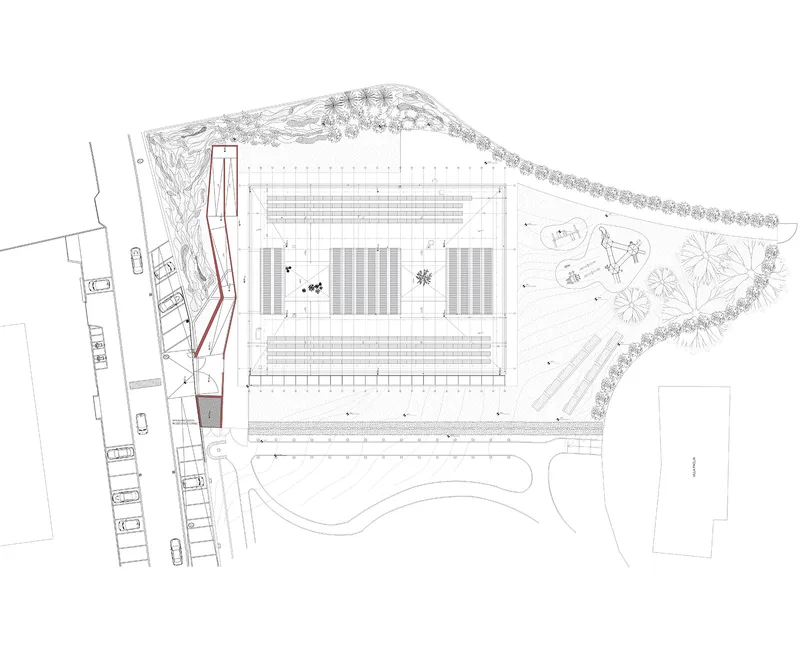
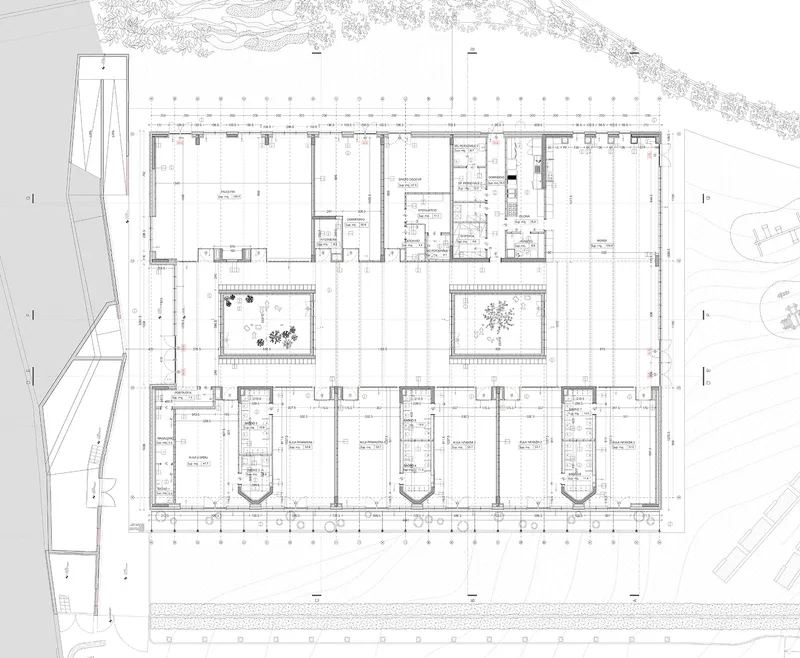
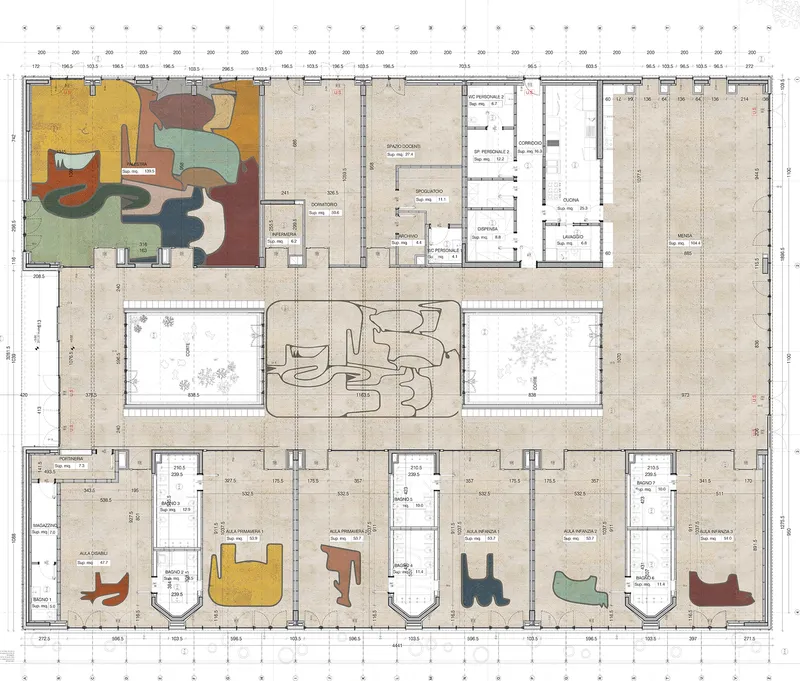
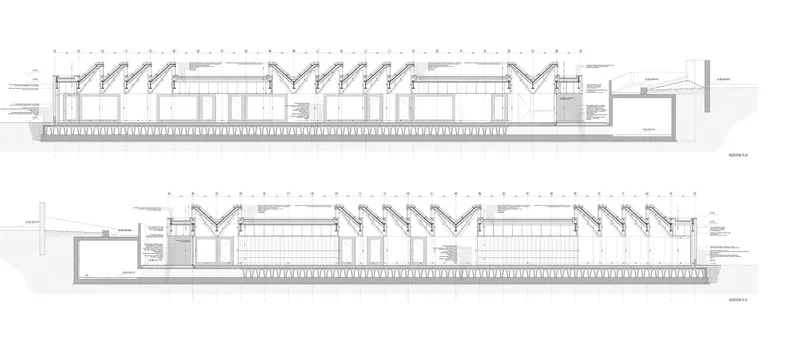
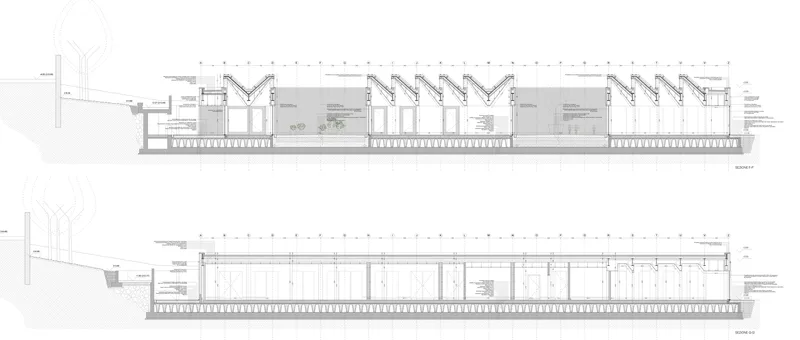
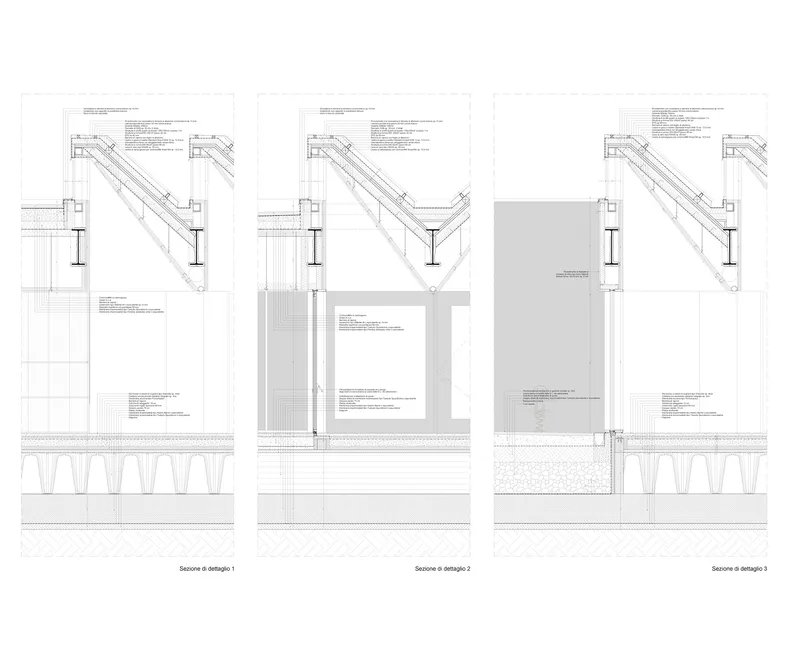
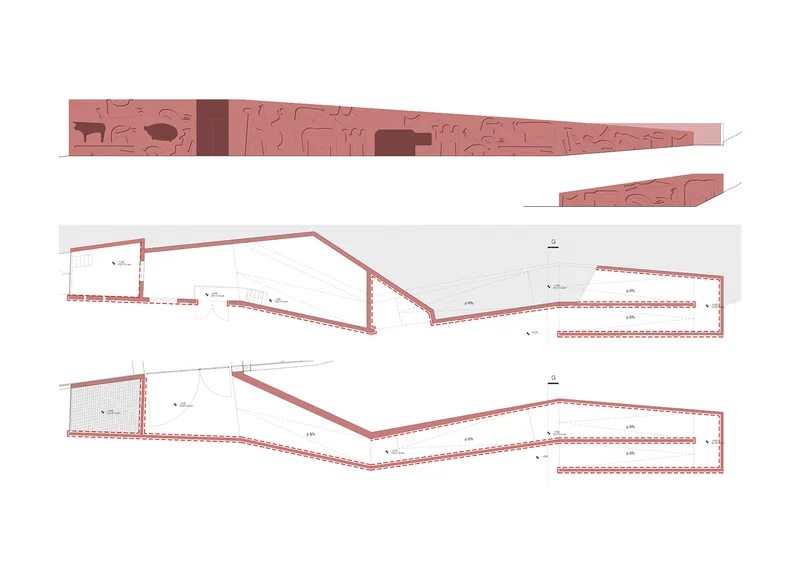
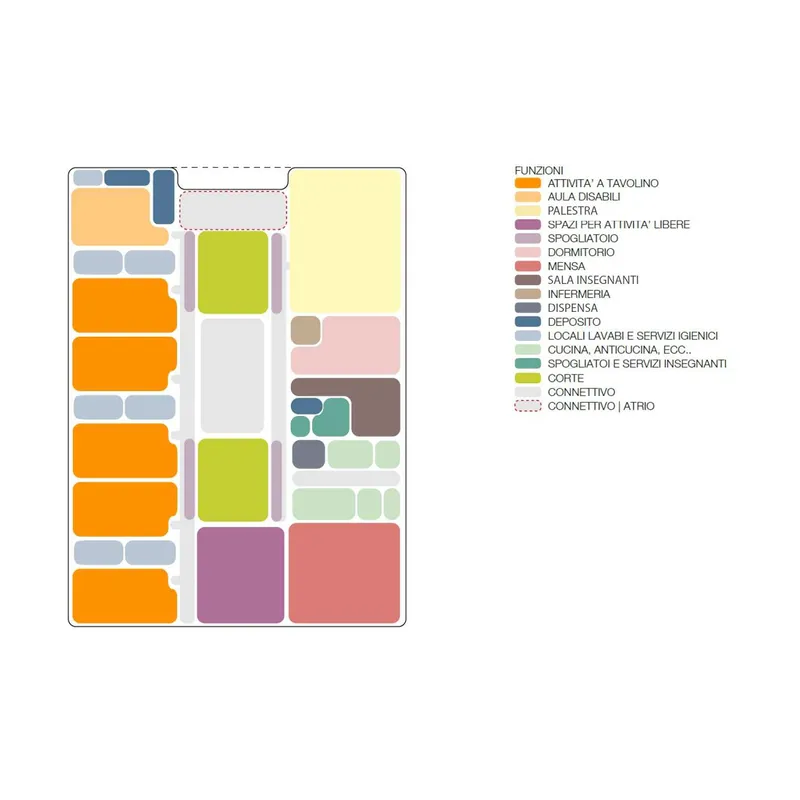
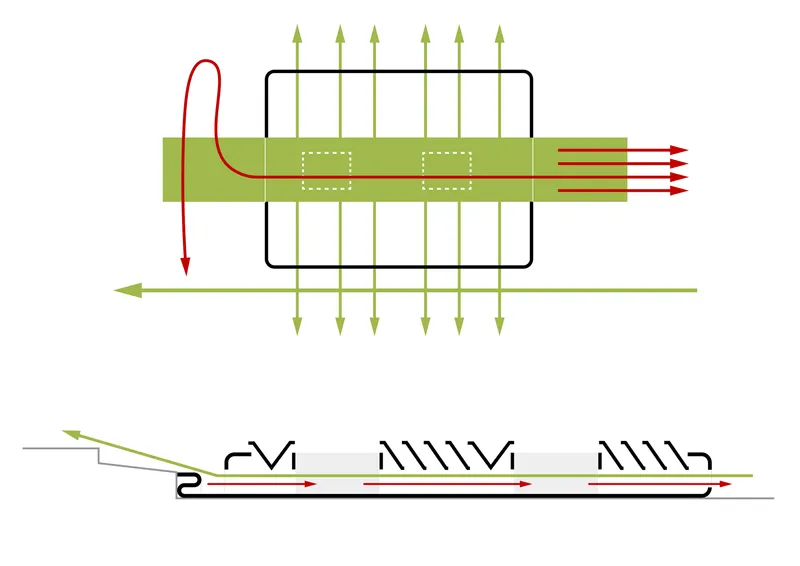
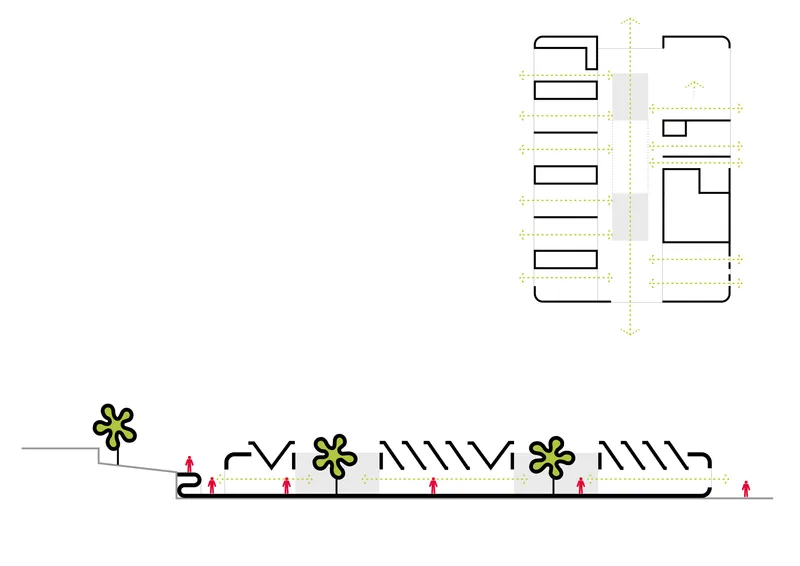
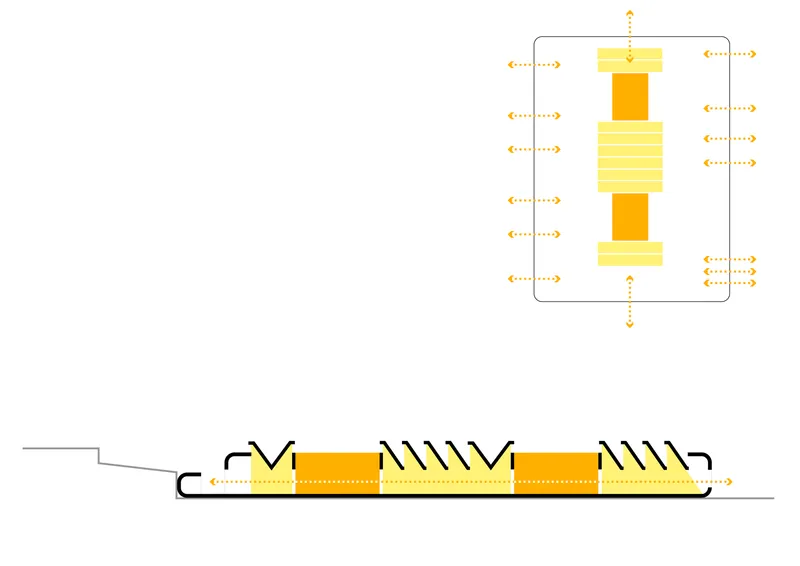
The floor plans reveal the building's organizational clarity: six classrooms arrayed along the west side, facing the park, with the central hall and its two courtyards occupying the spine. The color-coded programmatic diagram shows how organic, animal-shaped furniture groupings populate the otherwise orthogonal plan, creating pockets of informal activity within each section. The sections are where the sawtooth roof logic becomes legible, with angled skylights calibrated to admit northern light while the deeper bays channel ventilation through planted openings.
The ventilation and thermal diagrams are worth close attention. Stack ventilation through dedicated vertical shafts, insulated with yellow layers, draws warm air upward and out. Planted roof openings introduce evaporative cooling and biodiversity simultaneously. The detail sections of the three roof assembly conditions show how each skylight junction is resolved with a precision that belies the building's cheerful, almost naive exterior expression. The elevation drawings in terracotta tones confirm the patterned surface treatment of the ramp wall, revealing its full length as a continuous narrative surface.
Why This Project Matters
The Noah's Ark Nursery School matters because it refuses to treat a children's building as a lesser commission. C+S Architects have poured into this project the same material intelligence, contextual sensitivity, and spatial ambition that other firms reserve for museums or concert halls. The result is a building that teaches before a single lesson begins: its colors teach orientation, its transparency teaches sociability, its concrete ramp teaches geology, its roof teaches the town's industrial memory. Every surface carries information, and none of it is didactic.
More broadly, the project demonstrates that nearly zero-energy performance, heritage compliance, seismic resilience, and genuine architectural beauty can coexist at a public-school budget. In a country where school buildings are too often afterthoughts, C+S Architects have delivered a civic building that dignifies childhood, honors its context, and opens its doors to the community every evening. That is what an ark looks like when the flood is not water but indifference.
Noah's Ark Nursery School by C+S Architects with Studio Capitanio. Alzano Lombardo, Italy. 3,380 m². Completed 2025. Photography by Alessandra Bello.
About the Studio
Share Your Own Work on uni.xyz
If projects like this are the kind of work you want to make, uni.xyz is a place to publish your own, find collaborators, and enter design competitions.



Popular Articles
Popular articles from the community


The Earth Pod: 3D Printed Homes for Resilient Refugee Communities
The Earth Pod reimagines refugee housing through 3D printed homes made from clay, combining resilience, self-sufficiency, and rapid shelter.

The Musturak Paradise: Senior Living Architecture for a Connected Future in Temara, Morocco
The Musturak Paradise reimagines senior living architecture in Temara via private homes, social spaces, culture, community, and shared care.

The Ocean Hive: Sustainable Architecture for a Self-Sufficient Civilization at Sea
The Ocean Hive imagines sustainable architecture at sea, where modular habitats, algae, wave power and ocean waste sustain a growing colony.

Riyadh For All: Intergenerational Urban Design for Active Aging in Rabat
Riyadh For All reimagines urban design in Rabat with intergenerational co-living, adaptive courtyards, and Moroccan cultural exchange today.


Similar Reads
You might also enjoy these articles

Bao Huynh Watercolor Atelier: A Serene Art Retreat in Hội An
Bao Huynh Watercolor Atelier in Hội An blends multifunctional art spaces, sustainable design, local materials, and family-friendly living in a serene environment.

Atelier Macri Concept Store Interior Design by CASE-REAL
Atelier Macri store features a "ko" counter, walnut wood details, cork displays, blending retail, gallery, and seamless customer experiences.

Manuel Vargas Izquierdo Stadium and High-Performance Sports Center: Architectural Excellence in Jalpa de Méndez
The Manuel Vargas Izquierdo Stadium blends sustainable design, inclusive sports facilities, and cultural-inspired architecture, revitalizing Jalpa de Méndez’s public spaces.

KAKR Buluh Awar Hall: Revitalizing Community and Ecology Through Bamboo Architecture
Community built bamboo hall revitalizes Buluh Awar village, empowering youth, restoring ecology, celebrating vernacular craftsmanship through sustainable architecture and culture.





Comments (0)
Please login or sign up to add comments
No comments yet. Be the first to comment!