

Cuatro Cero Cuatro Arquitectura Lines Up Five Identical Beach Houses on Peru's Northern Coast
In Zorritos, five friends split a narrow beachfront lot into a modular housing complex tuned to equatorial sun and Pacific breezes.


Five friends buy a strip of sand between the Panamericana Norte and the Pacific Ocean. The parcel is 8 meters wide and 100 meters deep, repeated five times. The question is straightforward: how do you give each family a private vacation house on a site that reads more like a runway than a neighborhood? Cuatro Cero Cuatro Arquitectura, led by Israel Ascarruz and Diego Hernández, answered by embracing the constraint. Five identical elongated volumes sit side by side in Zorritos, Peru, each one a full expression of the lot's proportions, each one facing the sea with its translucent west wall while turning opaque flanks to its neighbors.
What makes Casamar genuinely interesting is the tension between repetition and individuality. The complex reads as a single composition from the outside, its white cubic masses stacking and stepping in near-identical rhythms. But inside each unit, the architecture uses slab inclinations, zenith light, and cross-ventilation corridors to create a sequence of spaces that feel generous despite the narrow plan. The daytime program on the ground floor bleeds into the beach; the nighttime program on the upper floor retreats into private, skylit bedrooms. It is a project about seriality made atmospheric.
White Walls, Strategic Opacity

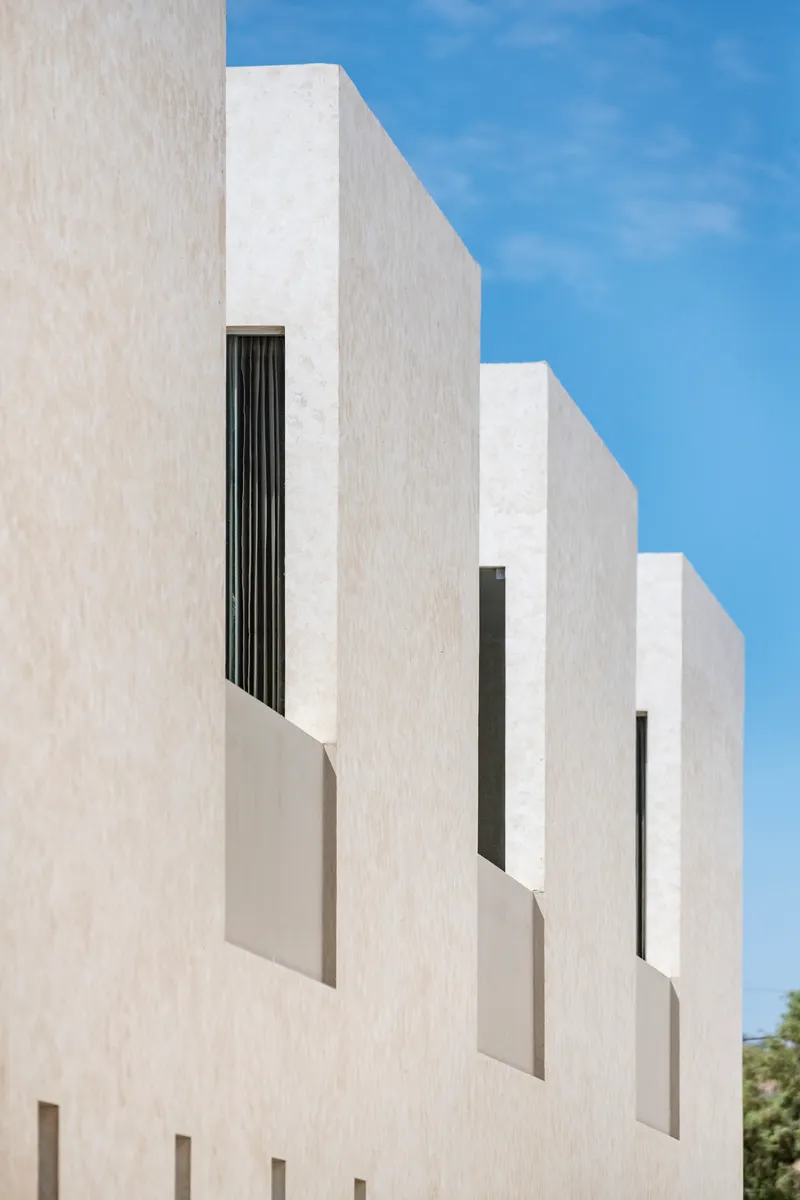

The north, south, and east facades are nearly blind. Deep recessed openings and vertical slot windows punctuate otherwise continuous white stucco planes, giving each unit complete seclusion from its neighbor. This is a practical decision as much as an aesthetic one: five different families might rent these houses at the same time, and privacy between units is non-negotiable. The result is a kind of fortified domesticity, where the solidity of the walls amplifies the drama of the few openings that do exist.
Seen from the sandy courtyard between units, the facades become an exercise in geometric shadow play. Young palms throw thin lines across broad surfaces, and the vertical slots act less like windows than like incisions, admitting narrow blades of light deep into the plan. The stepped massing of the upper floor adds another layer of relief, breaking what could be a monotonous wall into a composition of overlapping volumes against the equatorial sky.
Living Between Sand and Structure

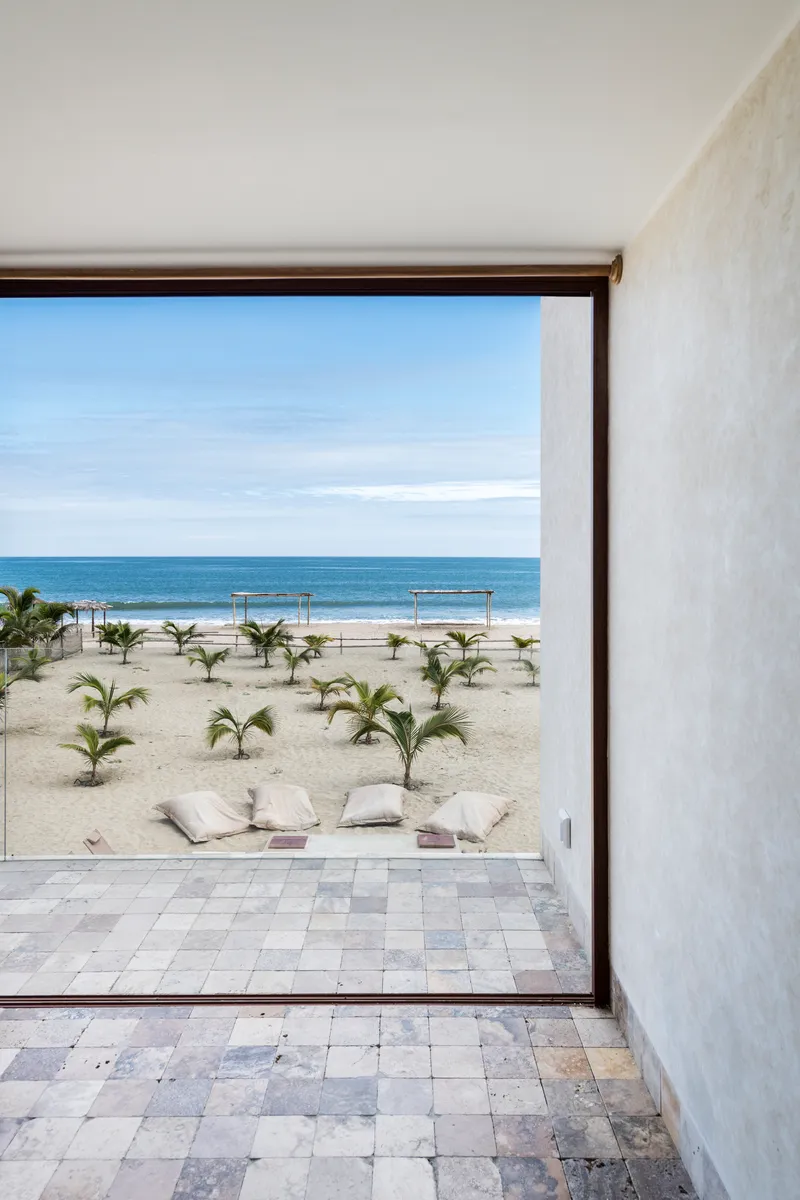

The west facade tells a completely different story. Here the architecture dissolves. Floor-to-ceiling openings frame the beach, palms, and the Pacific beyond, collapsing the boundary between terrace and shoreline. The ground floor social zone, an integrated living room, dining room, and kitchen, is designed to function as an extension of the sand itself. Stone pavers and rectangular pools establish a threshold that is more gradient than boundary.
Narrow passages between units channel views toward the water, creating compressed moments that release into panoramic ones. It is a cinematic trick: you move through a tight gap between opaque walls, catch a sliver of ocean through a breeze-block screen, and then arrive at the full-width opening where cushions meet sand and the horizon takes over. The offset positioning of units widens the visual angle from each balcony, ensuring no single house blocks its neighbor's view.
Entry and Vertical Circulation


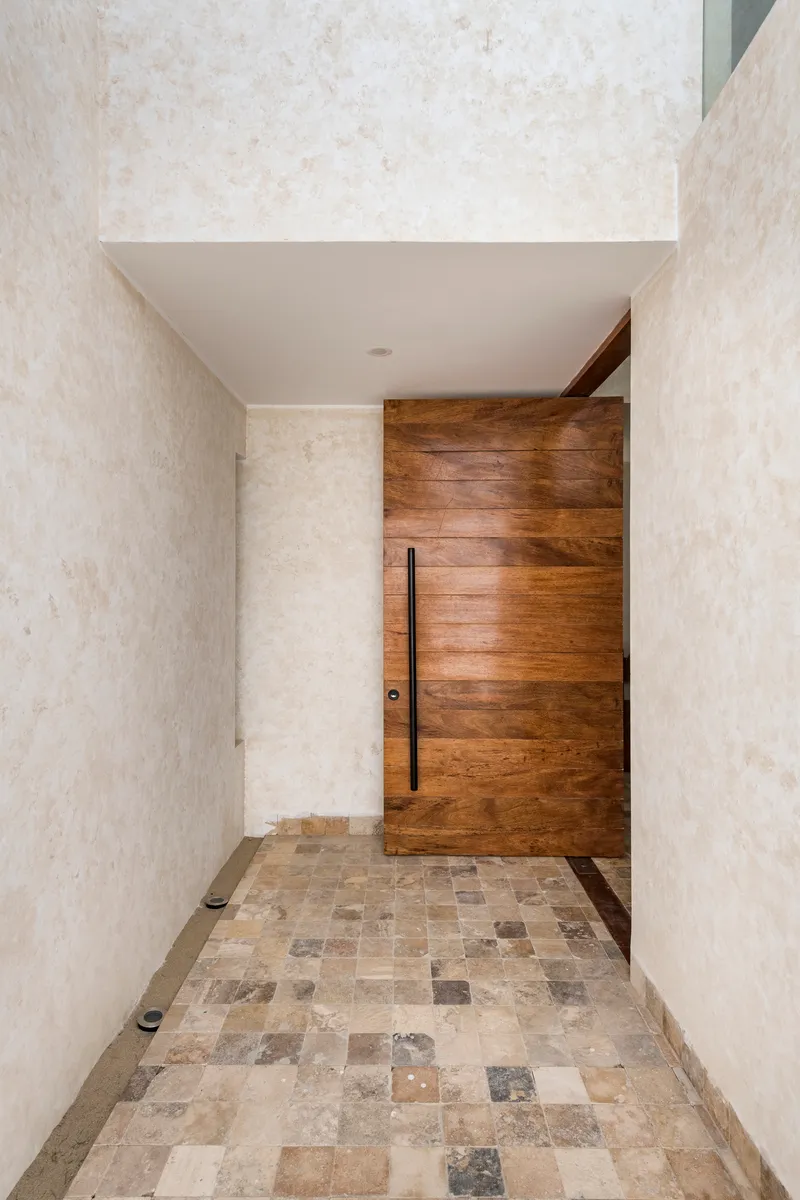
The entry hall is the hinge of each unit. A cantilevered staircase with timber treads and black steel railings rises through a double-height void, pulling skylight down into the center of the plan. This is the convergence space between the public ground floor and the private upper level, and the architects treat it with the care it deserves: a large timber pivot door, multicolored stone tile flooring, and a vertical shaft of natural light that orients you immediately upon entering.
The staircase itself is lean and open-tread, keeping the visual weight low so the void reads as continuous. It is a smart move in a narrow plan where any sense of compression would undermine the spatial ambition. By carving this vertical slot through the center of the house, Cuatro Cero Cuatro creates a natural stack effect that also serves the building's passive cooling strategy.
The Private Upper Floor
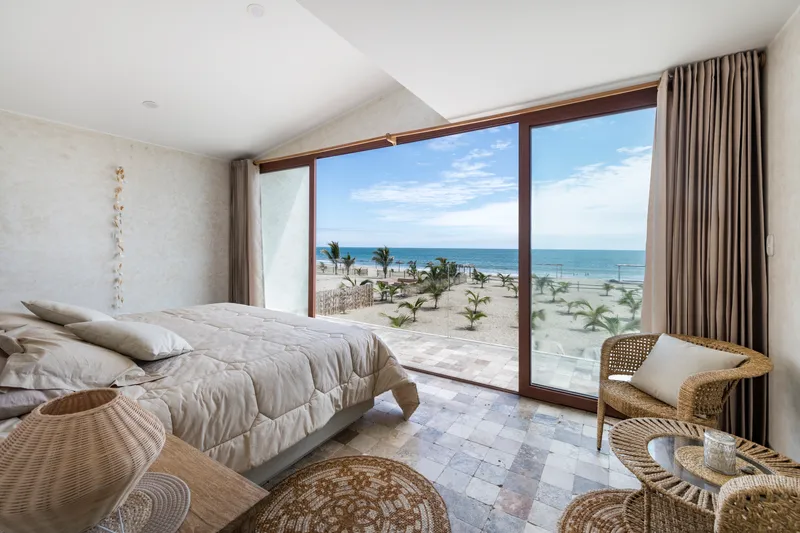

Upstairs, the architecture shifts register. Variable ceiling heights and inclined slabs introduce zenith lighting to every bedroom, washing walls with indirect light from above. The master bedroom gets full floor-to-ceiling glazing toward the ocean, framing young palms and sand in a composition that feels almost too composed, like a photograph of itself. Secondary bedrooms are more contained, with built-in bunk beds and ensuite bathrooms that use open timber-framed doors to borrow light from adjacent spaces.
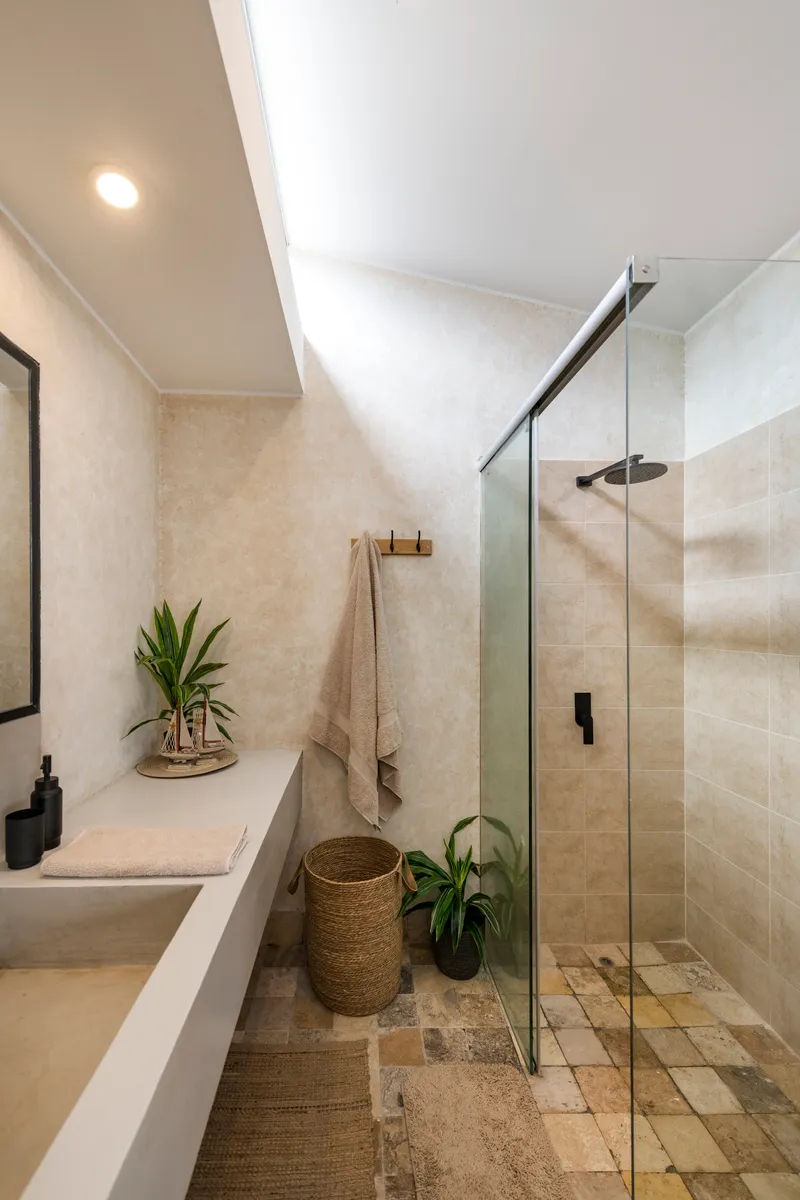
The bathroom detailing is worth noting: cast concrete vanities, walk-in glass shower enclosures, and skylights that pull daylight into rooms that have no exterior wall exposure. In an equatorial climate where the sun is relentless, the decision to light bathrooms from above rather than from the side keeps the private zones cool while still feeling open. It is a thermodynamic move dressed as an aesthetic one.
Breeze Blocks and Filtered Light
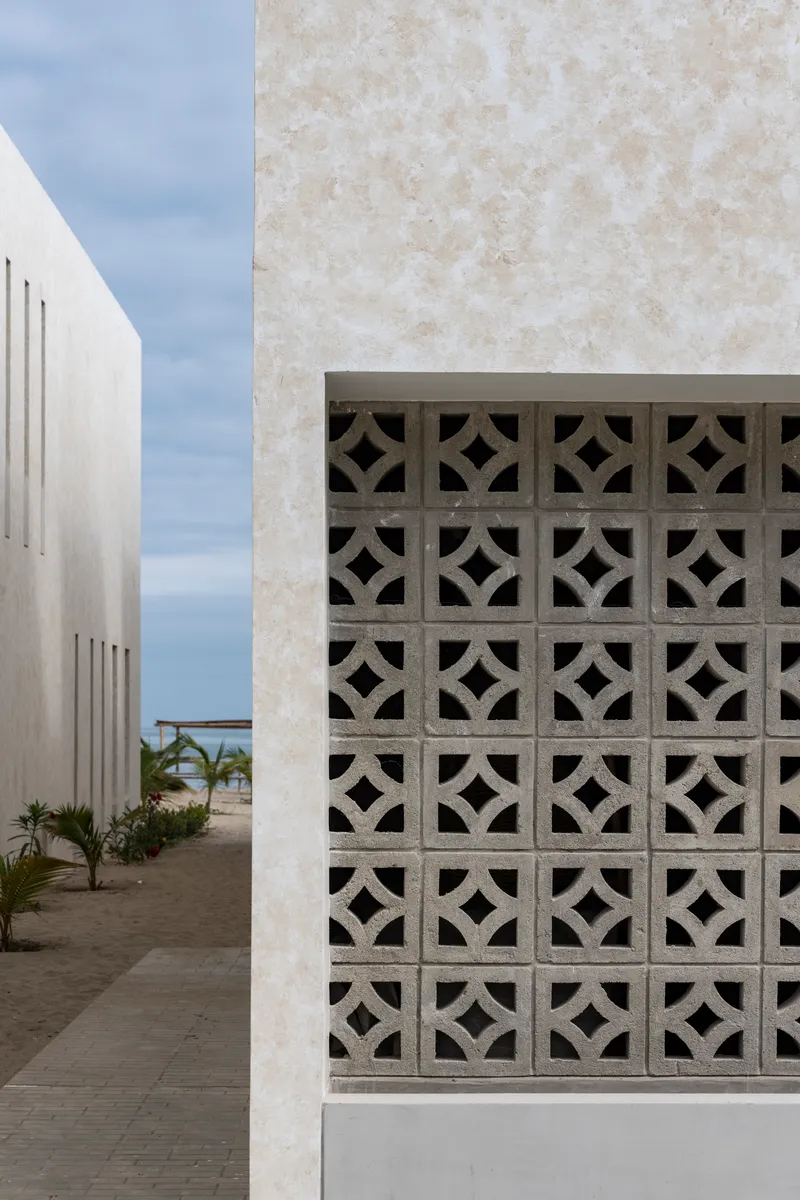

Geometric breeze-block screens appear at key moments in the facade, mediating between the opacity of the side walls and the transparency of the beachfront. These elements do double duty: they filter harsh equatorial light into patterned shade and allow air to pass through the envelope, feeding the cross-ventilation system that is central to the project's passive cooling strategy. Cool air drawn from the wide southwest void moves through the interior and exits through high northeast openings, creating a continuous flow that reduces reliance on mechanical systems.
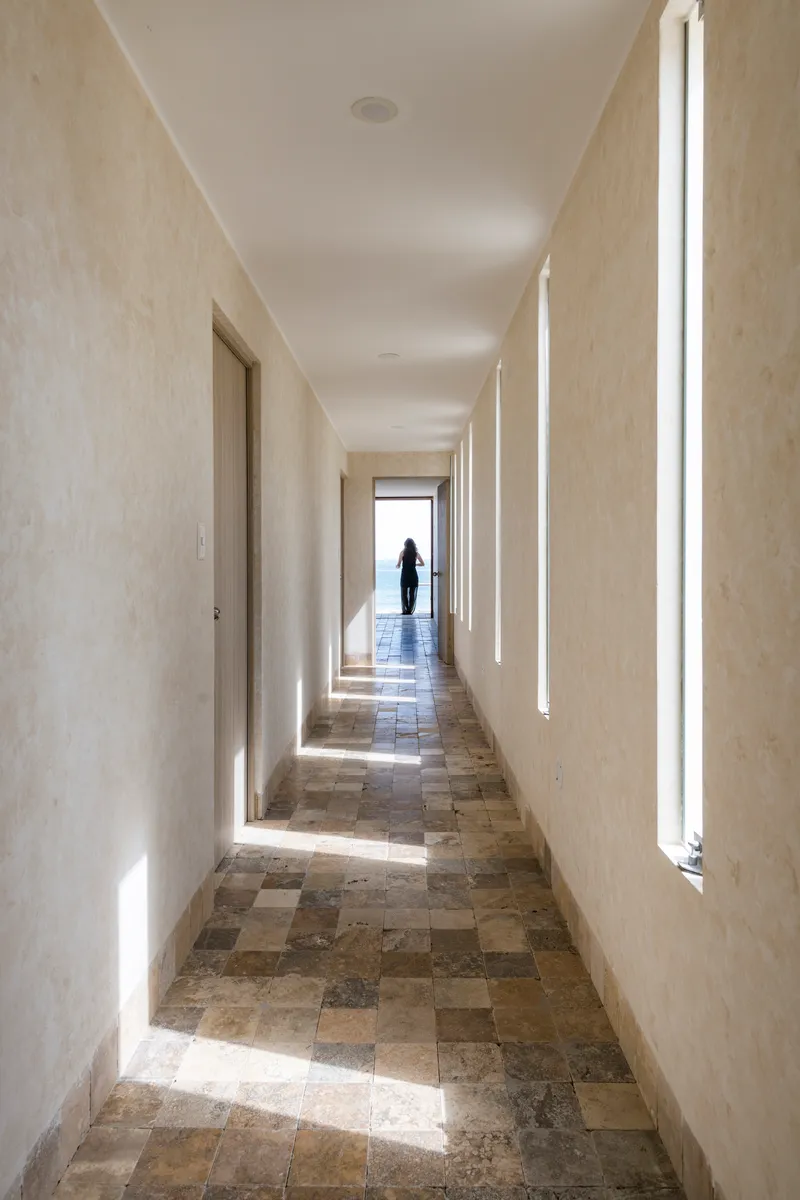
Narrow corridors with stone tile floors and vertical light slots reinforce this sense of controlled airflow. You feel the breeze as you move through the house, and the interplay of light and shadow along these passages makes the circulation itself a spatial event rather than a leftover between rooms.
Outdoor Rooms and the Pool Terrace

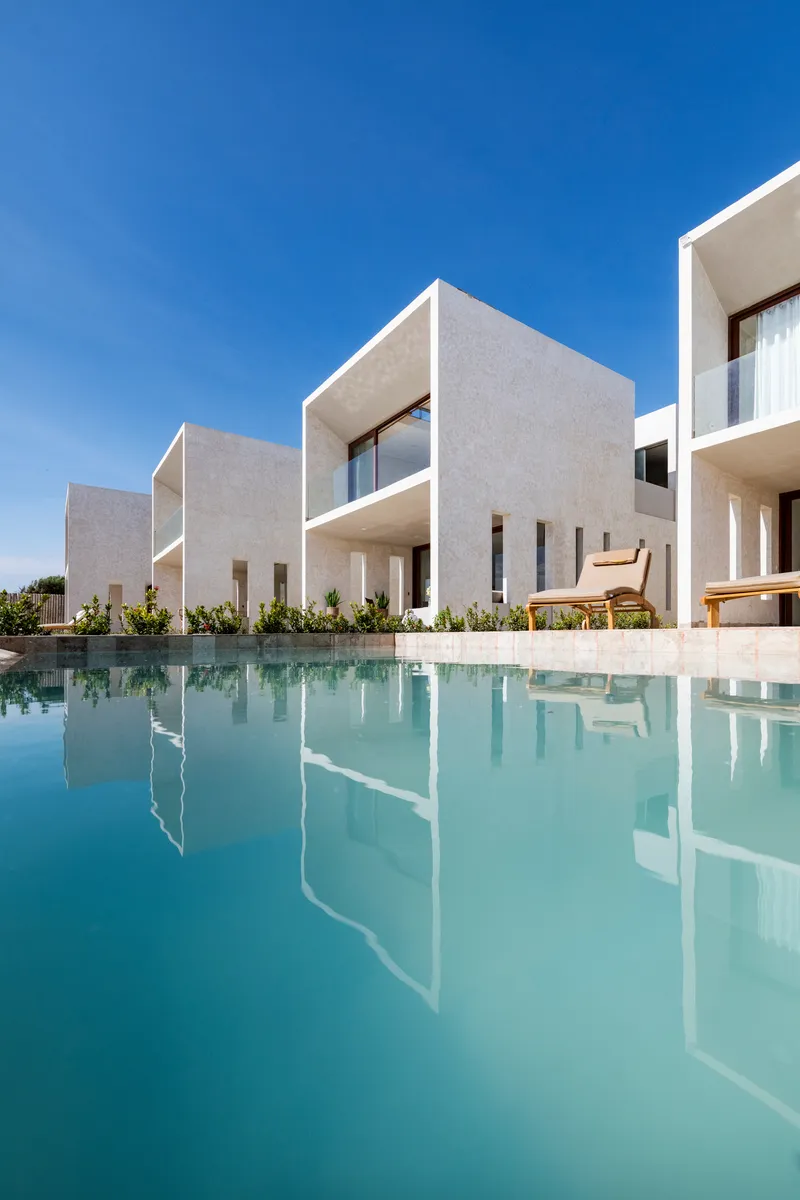

The covered outdoor terrace with built-in concrete seating and timber-framed sliding doors is perhaps the most lived-in space in the project. It sits at the intersection of interior and exterior, shaded by the mass of the upper floor, open to the pool and the beach beyond. The rectangular pool, positioned tight against the white volumes, acts as a reflecting surface that doubles the massing in still water. It is a deliberate compositional device, and on a clear day the effect is striking.
The roof edges and soffits, visible in close-up, reveal a crisp minimalism that relies on precise formwork and consistent plaster finishing. There is no ornament here beyond the geometry itself. The architecture trusts its proportions and its relationship to the sky, and it is right to do so.
Plans and Drawings
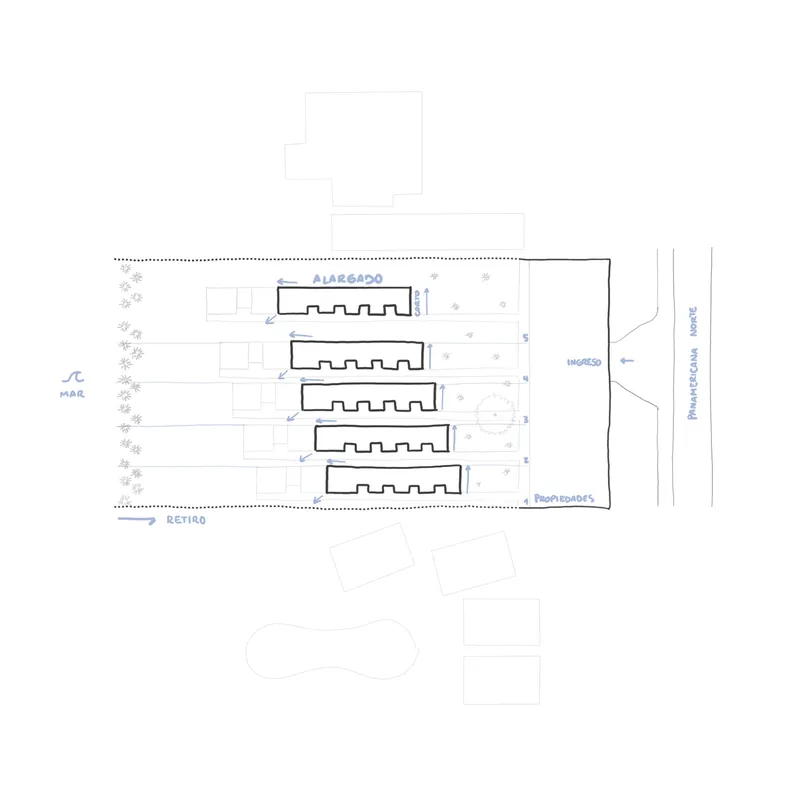
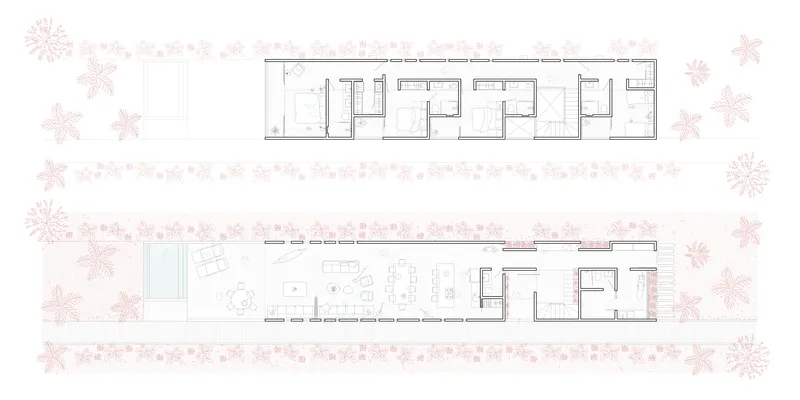
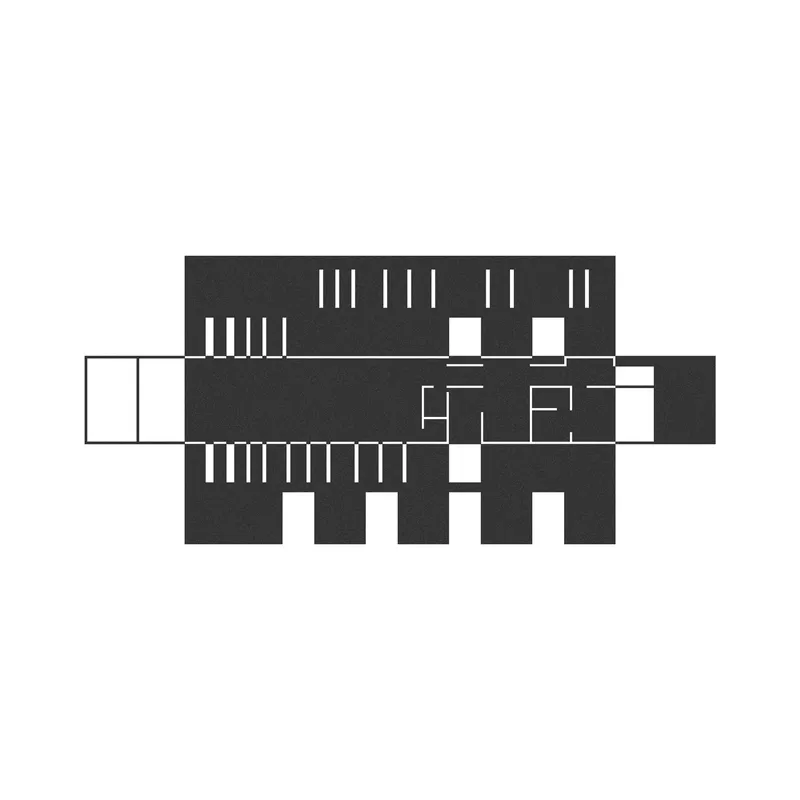
The site plan reveals the full logic of the complex: five parallel linear structures aligned between a promenade and the waterfront, each one a near-perfect extrusion of the 8-by-100-meter sub-lot. The floor plans show how the architects divided each unit into a central circulation spine flanked by room modules, with the daytime program concentrated at the beach end and the entry vestibule acting as a buffer from the highway side.

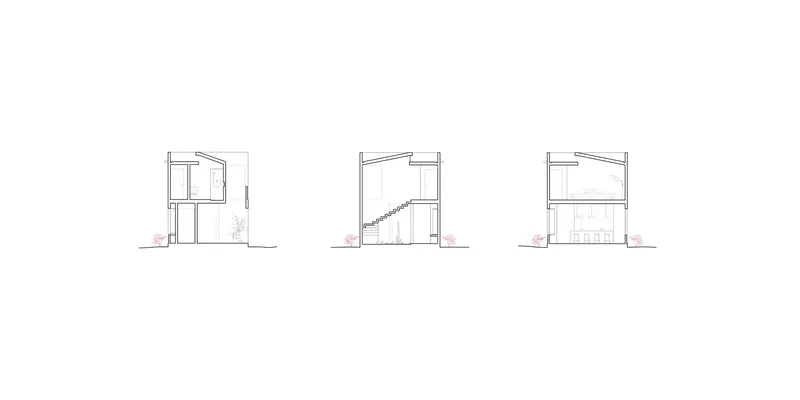
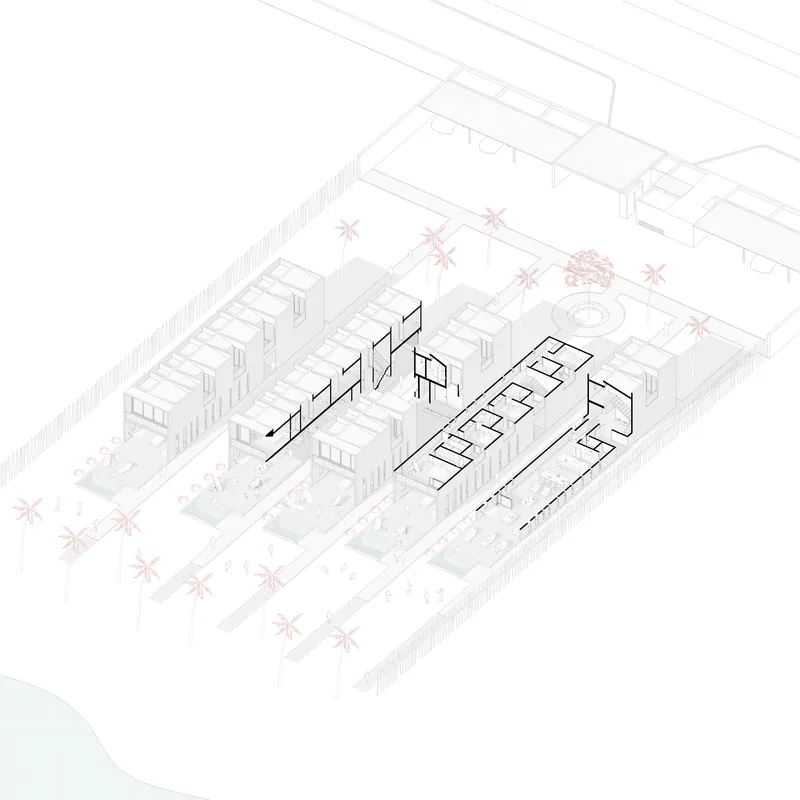
The section drawings are where the passive environmental strategy becomes legible. Clerestory windows at the upper level, variable slab heights, and the offset massing all work together to channel light and air through the section. The axonometric drawing of the full complex shows how the courtyard landscape of palms and sand ties the five units into a coherent ensemble, while the annotated ventilation diagrams make explicit what the architecture achieves implicitly: a thermodynamic envelope shaped by its equatorial context.


The airflow sketches are particularly revealing. They trace the path of cool maritime air from the southwest through the building section, showing how inclined ceilings and high openings create a stack effect that draws hot air up and out. These are not decorative diagrams; they are the intellectual backbone of the project, evidence that the formal moves visible in photographs are grounded in measurable environmental performance.
Why This Project Matters
Casamar matters because it takes the most generic brief imaginable, a beach vacation rental, and elevates it through disciplined repetition and environmental intelligence. The temptation with beachfront housing is always to make each unit special, to differentiate through form or material or orientation. Cuatro Cero Cuatro does the opposite. They commit to one module, one material palette, one spatial sequence, and then let the configuration of identical pieces generate the complexity. The result is a complex that feels monastic and hedonistic at the same time: austere white walls and controlled light on one hand, infinity pools and ocean panoramas on the other.
The deeper lesson is about the narrow lot. In coastal Peru, beachfront land is typically subdivided into exactly these kinds of improbable proportions, long, thin, and hemmed in on both sides. Rather than fighting the geometry, this project treats it as a generative constraint, using the elongated plan to separate public from private, day from night, opaque from transparent. It is a convincing argument that seriality and specificity are not opposites, and that the most powerful architectural moves are often the ones you repeat.
Casamar Housing Complex by Cuatro Cero Cuatro Arquitectura (Israel Ascarruz, Diego Hernández). Zorritos, Peru. 53,949 sq ft total; 3,466 sq ft per unit. Completed 2022. Photography by Renzo Rebagliati.
About the Studio
Share Your Own Work on uni.xyz
If projects like this are the kind of work you want to make, uni.xyz is a place to publish your own, find collaborators, and enter design competitions.


Popular Articles
Popular articles from the community


Extended Shell: Retrofitting Kolkata's Balconies as Living Urban Thresholds
A modular retrofit system recovers the social and environmental intelligence of Kolkata's historic verandas for contemporary Park Street residents.

Singing Woman: An Opera House That Performs Before the Curtain Rises
Ovidiu Cristian Pavel's conceptual opera house translates Estonia's choral identity into a sculpted waterfront landmark facing the Baltic Sea.

Cloaked Colonization: A Mobile Underwater Habitat That Moves Like a Fish
Micah Abaya's shortlisted EHC Pacific entry reimagines ocean settlement as a dispersed network of self-sustaining architectural organisms.
Faces of the Soviet Avant-Garde: Turning Moscow's Street Names into an Open-Air Museum
A network of sculptural installations across a Moscow residential district transforms forgotten architect names into spatial encounters with cultural memor

Similar Reads
You might also enjoy these articles

Pixel Gardens: One Repeated Module Stacked Into a Terraced Social Housing Tower for Famagusta
Salem Bader's shortlisted housing tower builds a vertical neighbourhood from one repeated module, offsetting units to carve terraces, light and air.

Bao Huynh Watercolor Atelier: A Serene Art Retreat in Hội An
Bao Huynh Watercolor Atelier in Hội An blends multifunctional art spaces, sustainable design, local materials, and family-friendly living in a serene environment.

Atelier Macri Concept Store Interior Design by CASE-REAL
Atelier Macri store features a "ko" counter, walnut wood details, cork displays, blending retail, gallery, and seamless customer experiences.

Manuel Vargas Izquierdo Stadium and High-Performance Sports Center: Architectural Excellence in Jalpa de Méndez
The Manuel Vargas Izquierdo Stadium blends sustainable design, inclusive sports facilities, and cultural-inspired architecture, revitalizing Jalpa de Méndez’s public spaces.

Comments (0)
Please login or sign up to add comments
No comments yet. Be the first to comment!