
Paulo Bruna Rebuilds São Paulo's Fire-Ravaged Concert Hall with 450 Sculptural Acoustic Pieces
Sixteen years after a devastating fire, Teatro Cultura Artística reopens on Rua Nestor Pestana with world-class acoustics and a preserved Di Cavalcanti mur


On August 8, 2008, fire tore through one of Latin America's most important concert halls and left behind a gutted shell, a charred stage, and a question: how do you rebuild a building that was never just a building? The original Teatro Cultura Artística, designed by Rino Levi with Roberto Cerqueira César and F. Pestalozzi, opened in 1950 with concerts conducted by Villa-Lobos and Camargo Guarnieri. It was heritage-listed at three levels of government. Its curved facade carried a monumental Emiliano Di Cavalcanti mural in glass tesserae. Bringing it back required more than reconstruction; it demanded a coherent argument about what preservation means when sound, not just stone, is the thing being preserved.
Pedro e Paulo Bruna Arquitetos Associados spent sixteen years making that argument. The result, completed in 2024, is a 7,600 square meter theater that treats acoustics as the primary design driver rather than an afterthought layered onto a finished form. Working with acoustician José Augusto Nepomuceno and artist Sandra Cinto, the firm produced a 770-seat Grande Sala whose walls are lined with 450 individually cast plaster diffusion pieces, each dimensioned for spacing, height, width, and rhythm. The project also adds a 150-seat second hall, eleven rehearsal rooms, and a transparent street-level program of bookstore, café, and educational spaces. It is, in every sense, a building rebuilt from the sound outward.
The Mural That Survived
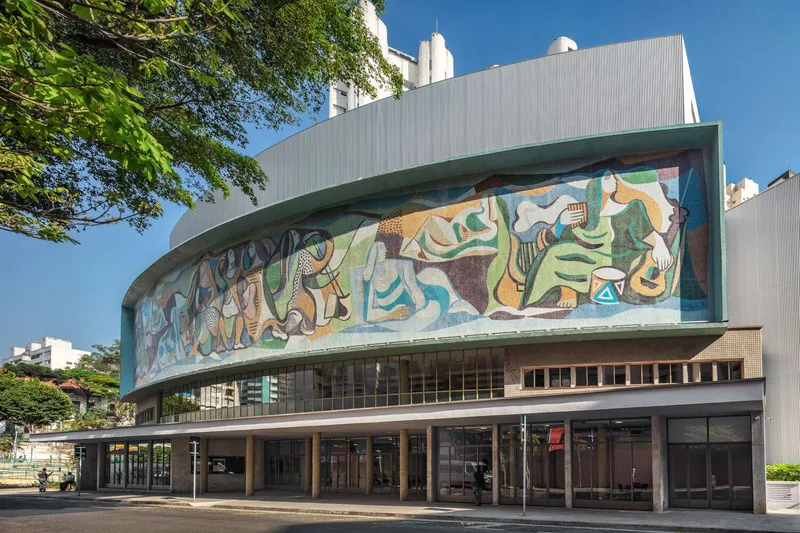
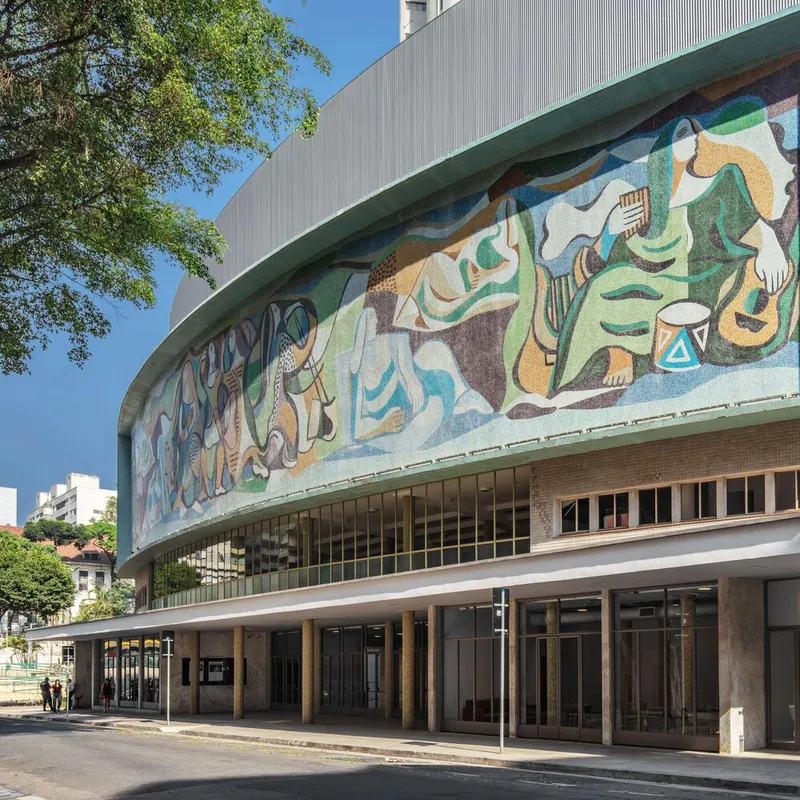
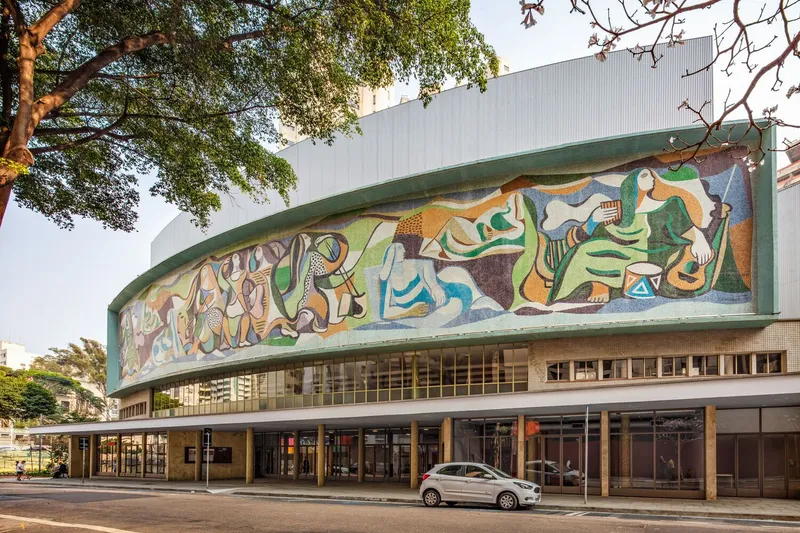
The Di Cavalcanti mural is the reason anyone who has walked past this building remembers it. Executed in Vidrotil glass tiles, the frieze wraps the curved facade with female figures and musical instruments in saturated color. The fire spared the foyers and the mural, which meant that the reconstruction had to start from a non-negotiable constraint: this surface could not be touched, scaffolded carelessly, or subordinated to a new architectural language. Paulo Bruna's team treated the mural as the fixed datum around which everything else was renegotiated.
The decision to preserve the mosaic facade while excavating and rebuilding behind it was technically harrowing. Complex shoring systems kept the heritage-protected facade standing while demolition, retention, and new foundation work proceeded inches away. The result reads as seamless, as if the mural had always fronted this particular interior. That illusion is the hardest thing to achieve in heritage work, and the team pulls it off without making the new building feel deferential or timid.
A Facade Open to the City
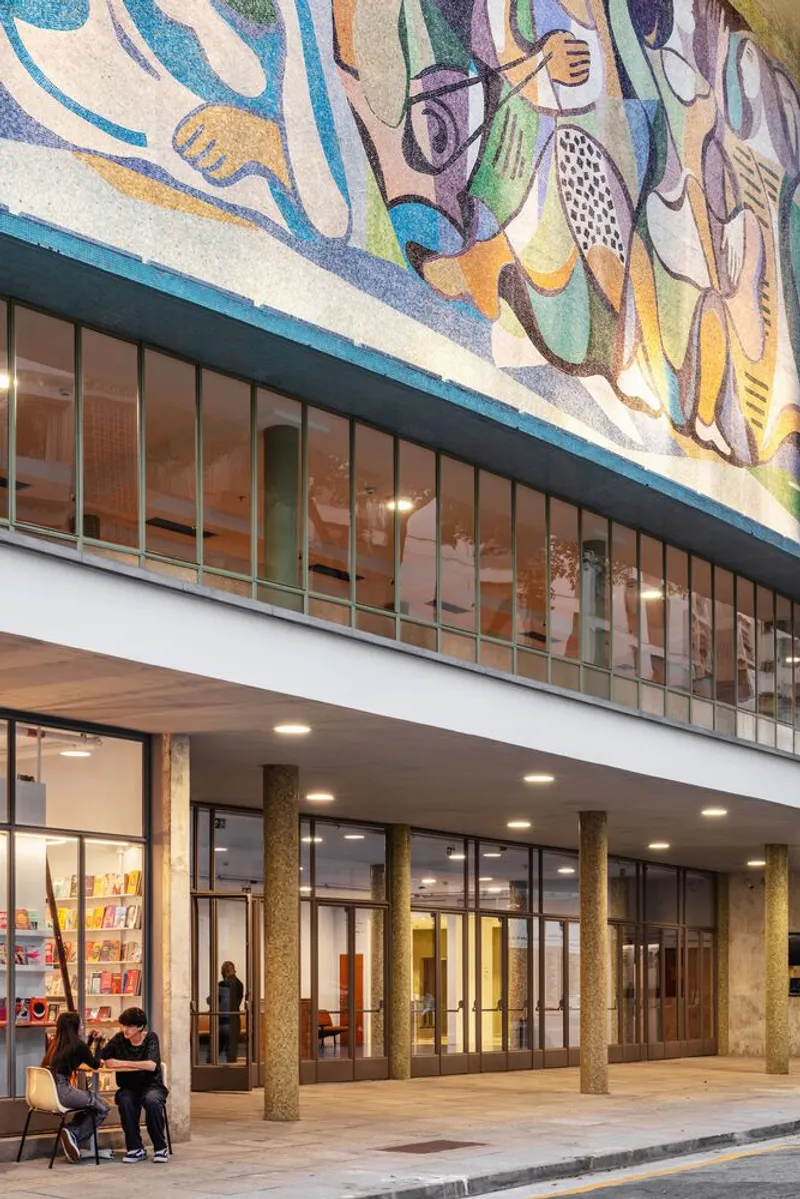
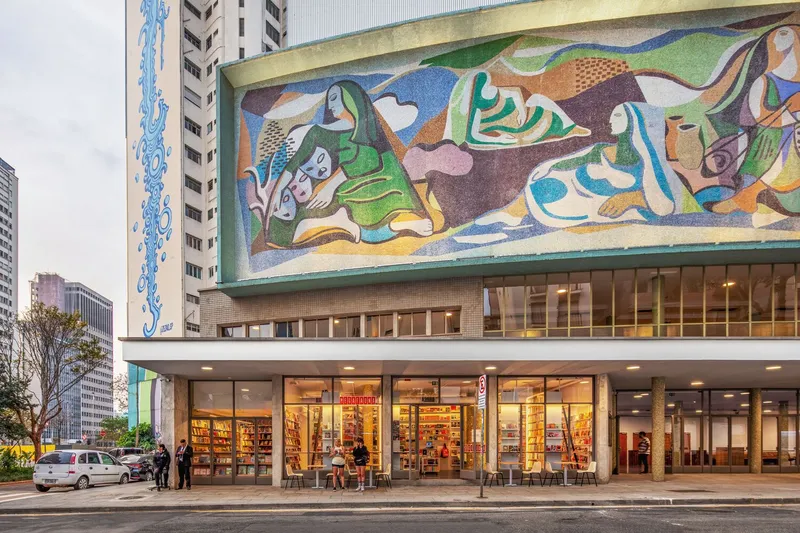
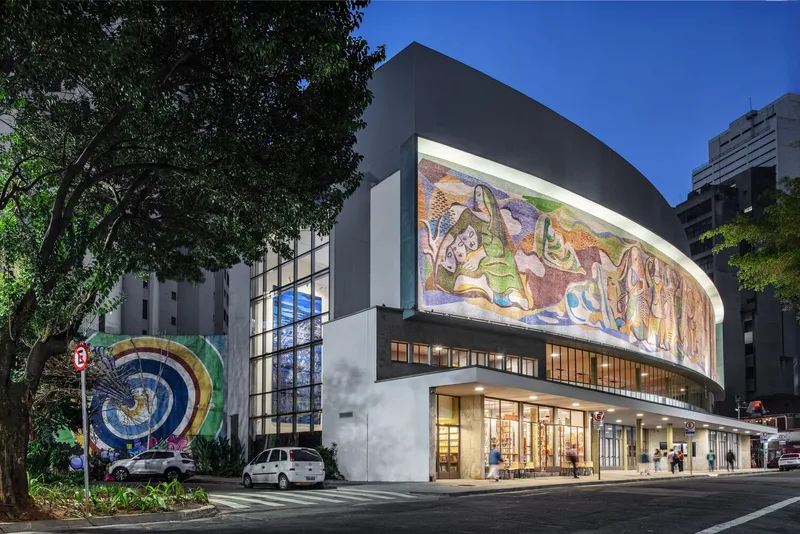
Below the mosaic band, the ground level opens through a colonnade of slender columns and full-height glazing. The intent is legible at a glance: the theater is not a sealed box that wakes up at curtain time. Pedestrians can see in. The bookstore and café activate the street frontage during the day, and the transparency at dusk, when interior lighting spills through the glass beneath the illuminated mural, gives the building a civic presence that the original solid-walled design never attempted.
This is a smart update to the modernist typology Rino Levi pioneered here. Mid-century concert halls were typically introverted, their lobbies sealed behind opaque walls for acoustic reasons. Paulo Bruna keeps the acoustic isolation where it belongs, at the auditorium envelope, and lets the public program breathe. The neighboring buildings on Rua Nestor Pestana, including the First Independent Presbyterian Church and residential blocks from the 1950s, gain a more animated streetscape as a result.
Foyers and Public Interiors
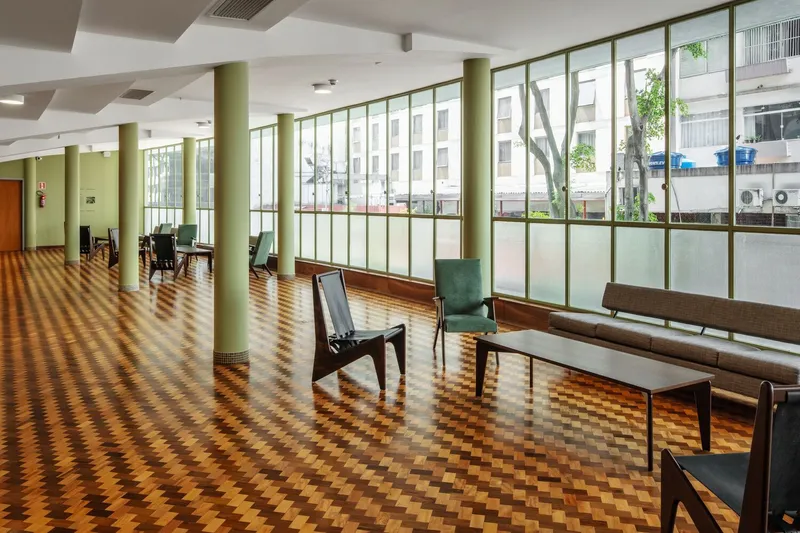
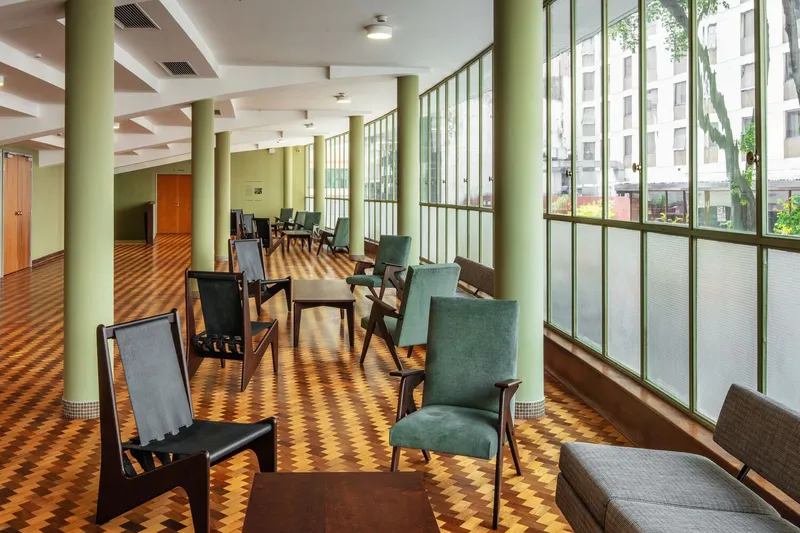
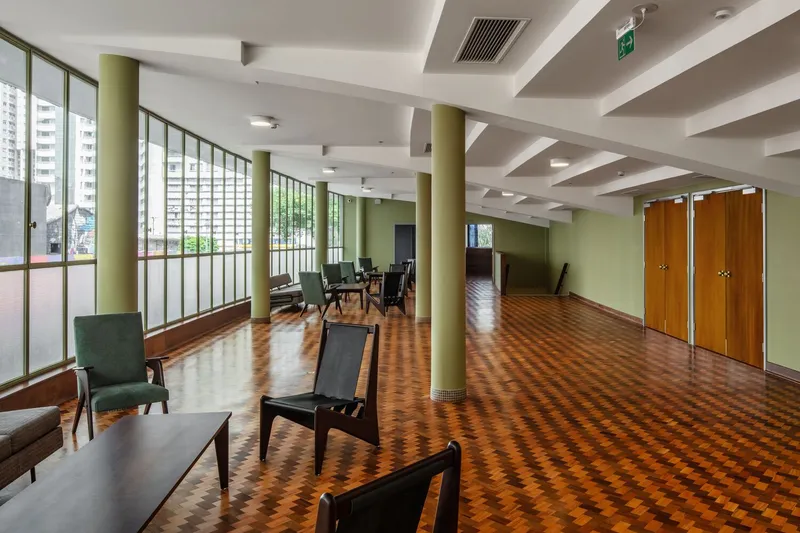
The foyer spaces are where the project's material palette becomes most legible. Olive-green cylindrical columns, some clad in golden mosaic, punctuate rooms floored in zigzag parquet and checkered tile, materials chosen to echo the original interiors without reproducing them literally. Vidrotil tiles and parquet were used in the 1950 building, and their reappearance here reads as continuity rather than pastiche. Coffered ceiling beams overhead organize the structural rhythm while concealing the mechanical infrastructure required for modern climate and acoustic control.
The lounge on the upper level, with its gridded window wall and parquet floor, is one of the calmest spaces in the building. It functions as a buffer between the street and the auditorium, a threshold where the audience's attention can shift from urban noise to the anticipation of performance. The proportions are generous without being monumental, and the glazing frames views of surrounding rooftops and tree canopy that quietly remind you this building sits in the middle of a dense city.
The Bookstore and Café
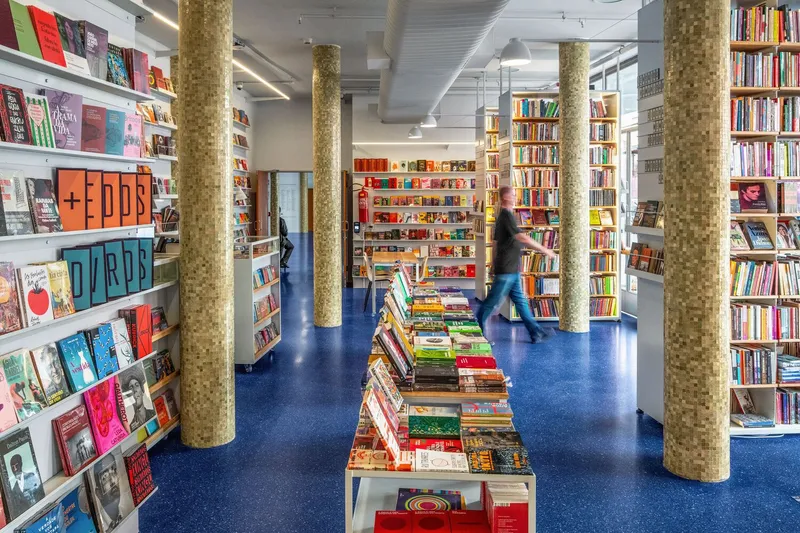
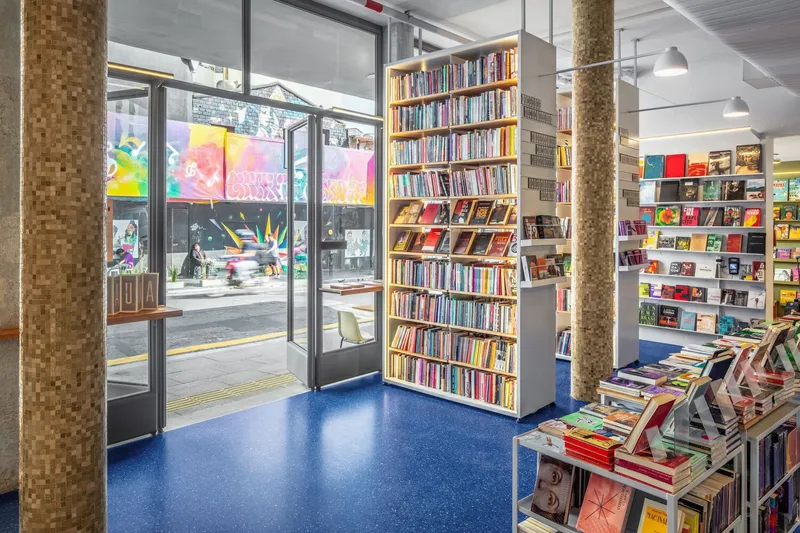
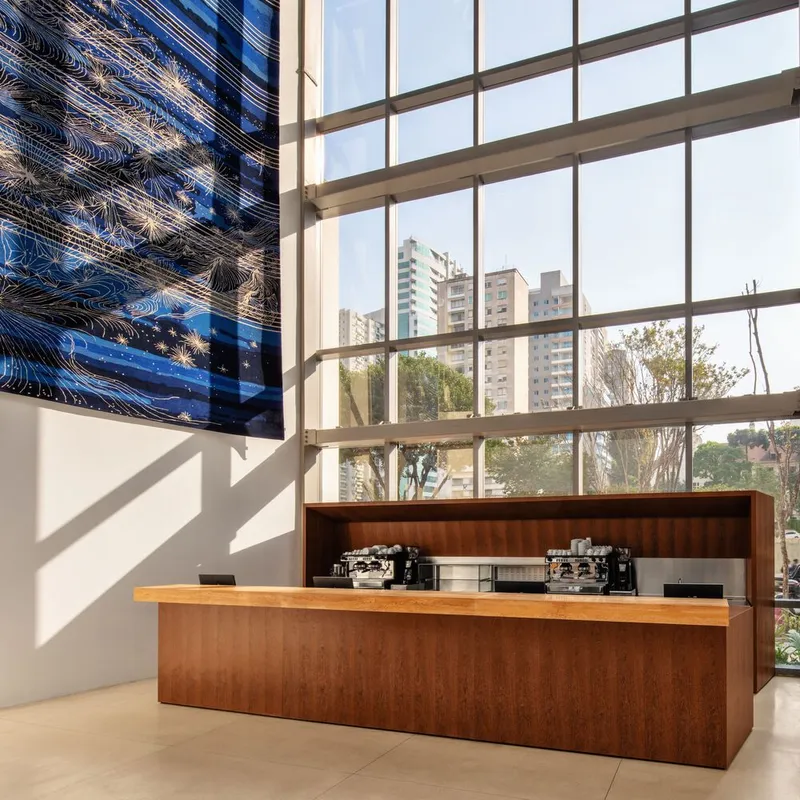
On the ground floor, the bookstore occupies a double-height space with cork-clad columns and blue terrazzo flooring. Cork is a deliberate acoustic choice even here: it absorbs high-frequency reflections that would otherwise bounce off the glass storefront, keeping the browsing environment comfortable. The café, set beneath a tall window wall with a reflective metal artwork catching afternoon light, extends the institution's public face from cultural programming into daily ritual. You can buy a coffee and a book without a ticket.
These are not afterthought amenities. They represent the Sociedade de Cultura Artística's stated commitment to accessibility and artistic dissemination. By placing revenue-generating, foot-traffic-friendly programs at the street edge, Paulo Bruna gives the institution a viable economic model for maintaining a building that, at its core, exists to host unprofitable art forms.
450 Sculptural Pieces and the Sound They Shape
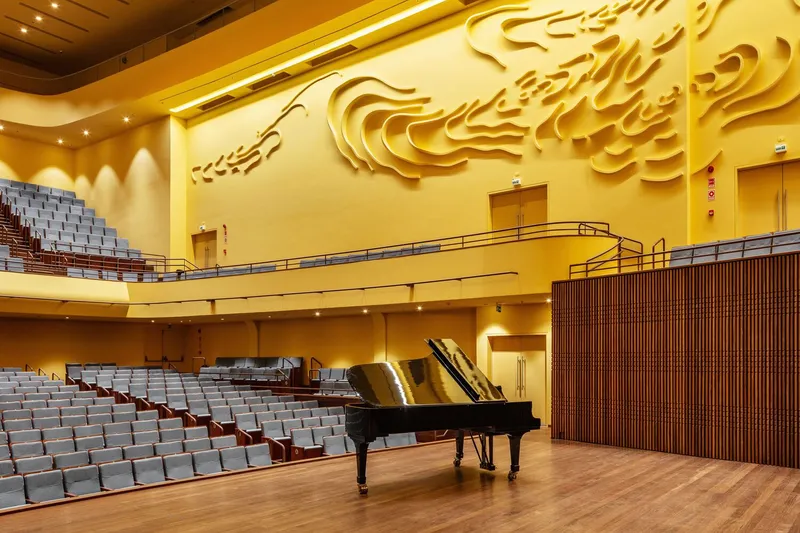
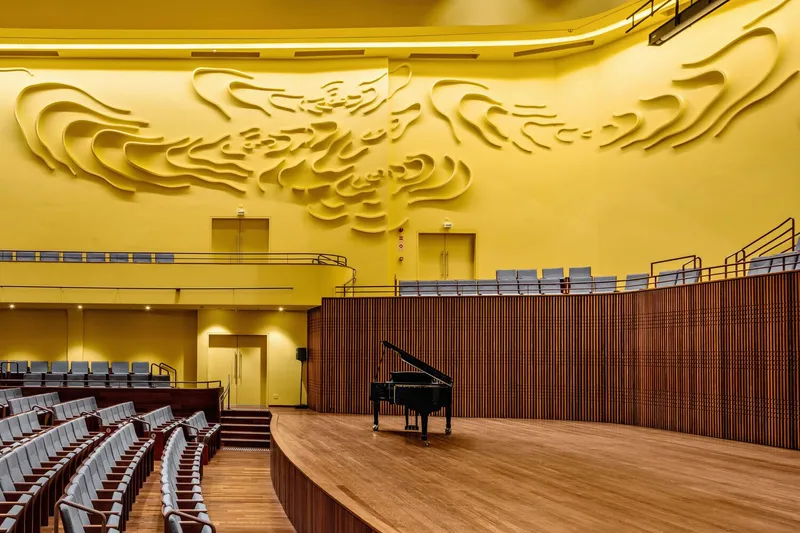
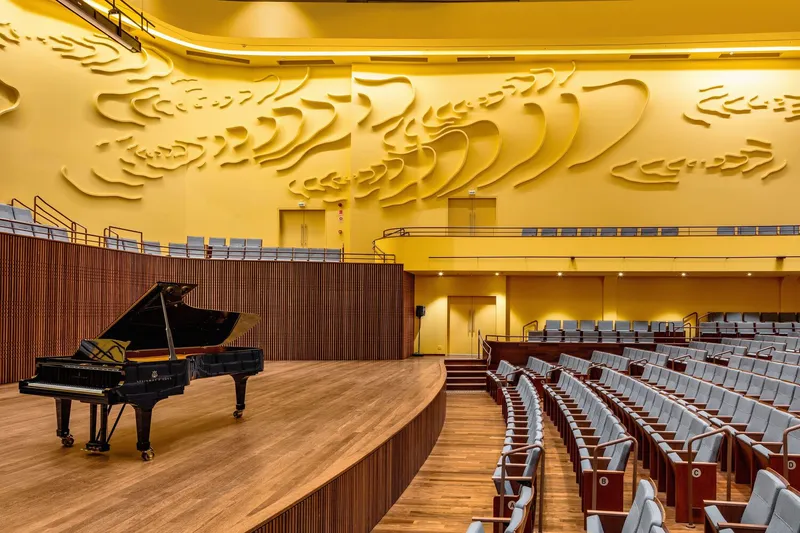
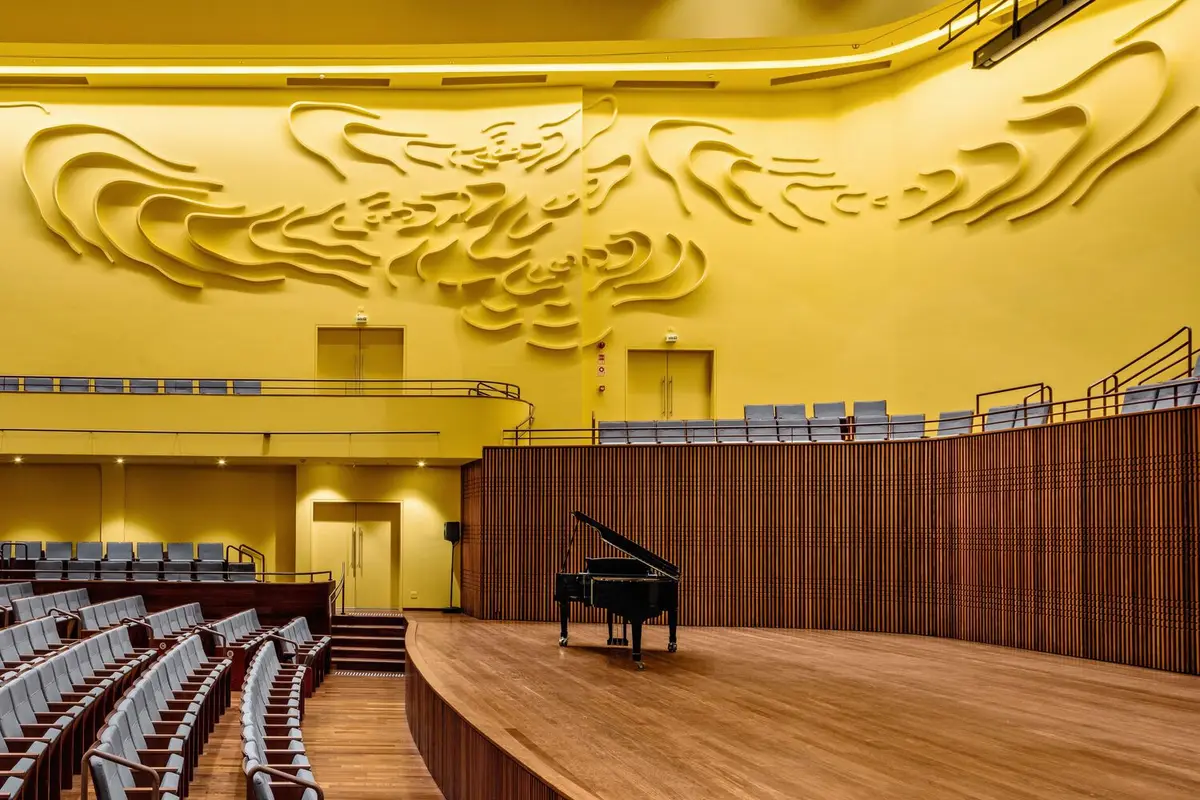
The Grande Sala is the building's reason for being, and its walls tell you exactly what was prioritized. Sandra Cinto's 450 plaster diffusion pieces cover the rear and side walls in a topography of fluid, organic forms cast in gesso. Each piece was dimensioned not as sculpture but as acoustic infrastructure: the spacing, height, width, and rhythm of the relief were defined by Nepomuceno's team to scatter sound evenly across the 770-seat room. The golden-yellow tone of the plaster gives the hall a warmth that photographs well, but the real performance is invisible, measured in reverberation time and frequency response.
The collaboration between Cinto and the acousticians is the detail that elevates this project above standard concert hall design. Rather than imposing a predetermined studio aesthetic and then asking the acoustician to make it work, the team allowed acoustic requirements to generate the wall's formal language. Cinto had freedom to interpret the topography artistically, but the underlying geometry was non-negotiable. The result is a surface that functions simultaneously as art, as diffusion, and as the room's defining spatial character.
The Hall in Performance
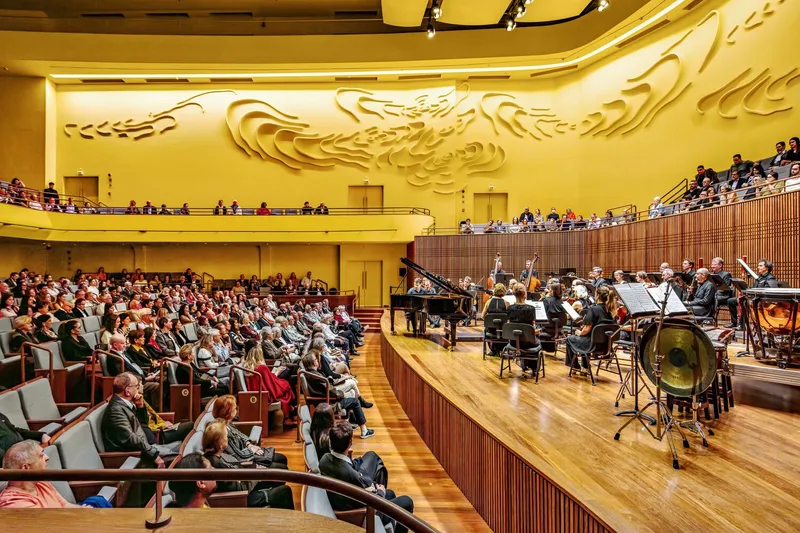
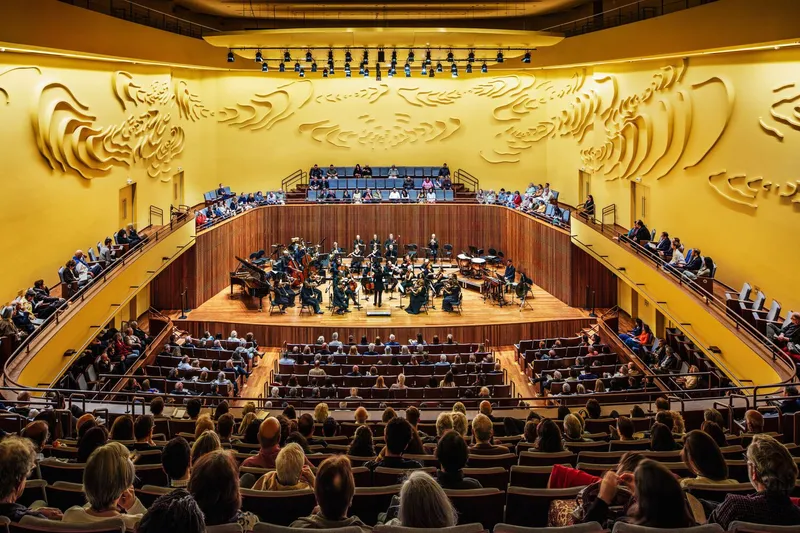
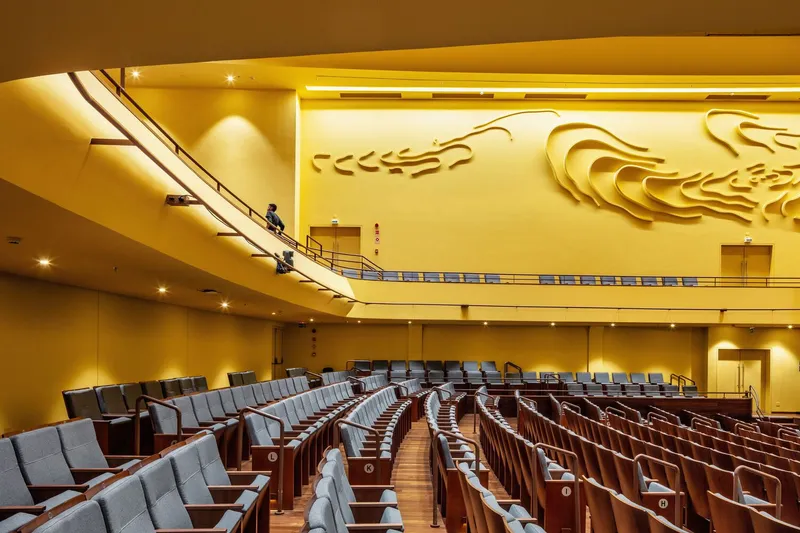
With an orchestra on the timber stage and an audience filling both the stalls and the curved balcony, the Grande Sala reveals the proportional logic that Paulo Bruna and the acoustic consultants spent years refining. The 14-meter ceiling height provides the air volume needed for long reverberation without muddiness. Vertical wood slat panels along the balcony fronts add high-frequency absorption precisely where early reflections from the stage would otherwise pile up. The curved balcony rail keeps sightlines clear and wraps the audience around the performers, reducing the psychological distance between listener and musician.
Two design paths were explored during the project's development: an asymmetric format with a hybrid acoustic concept and a rectangular shoebox hall. The final design borrows from both, using the rectangular hall's predictable acoustic behavior while introducing enough curvature in the balcony and wall geometry to avoid the flutter echoes that plague pure boxes. It is a pragmatic synthesis, not a doctrinaire choice, and the acoustic performance justifies it.
Balcony, Stage, and Material Detail
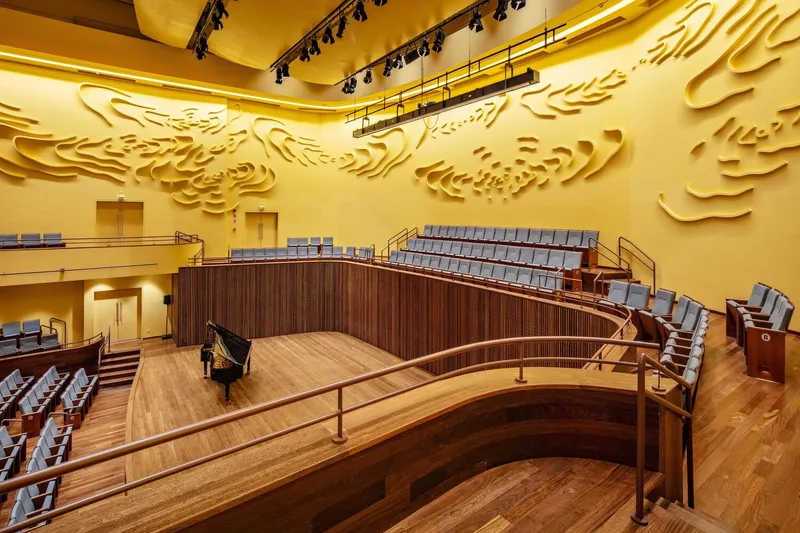
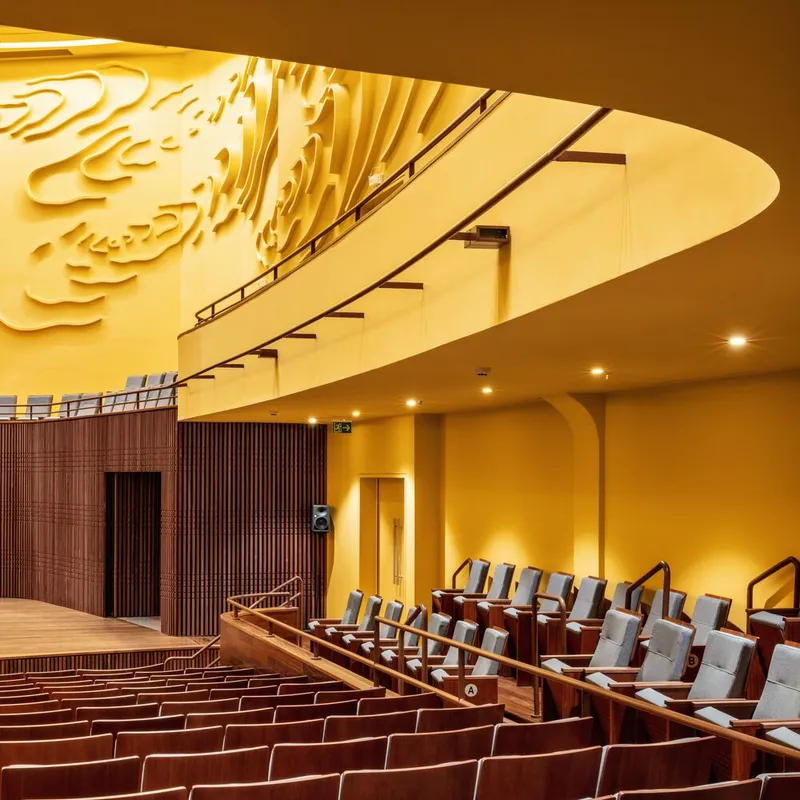
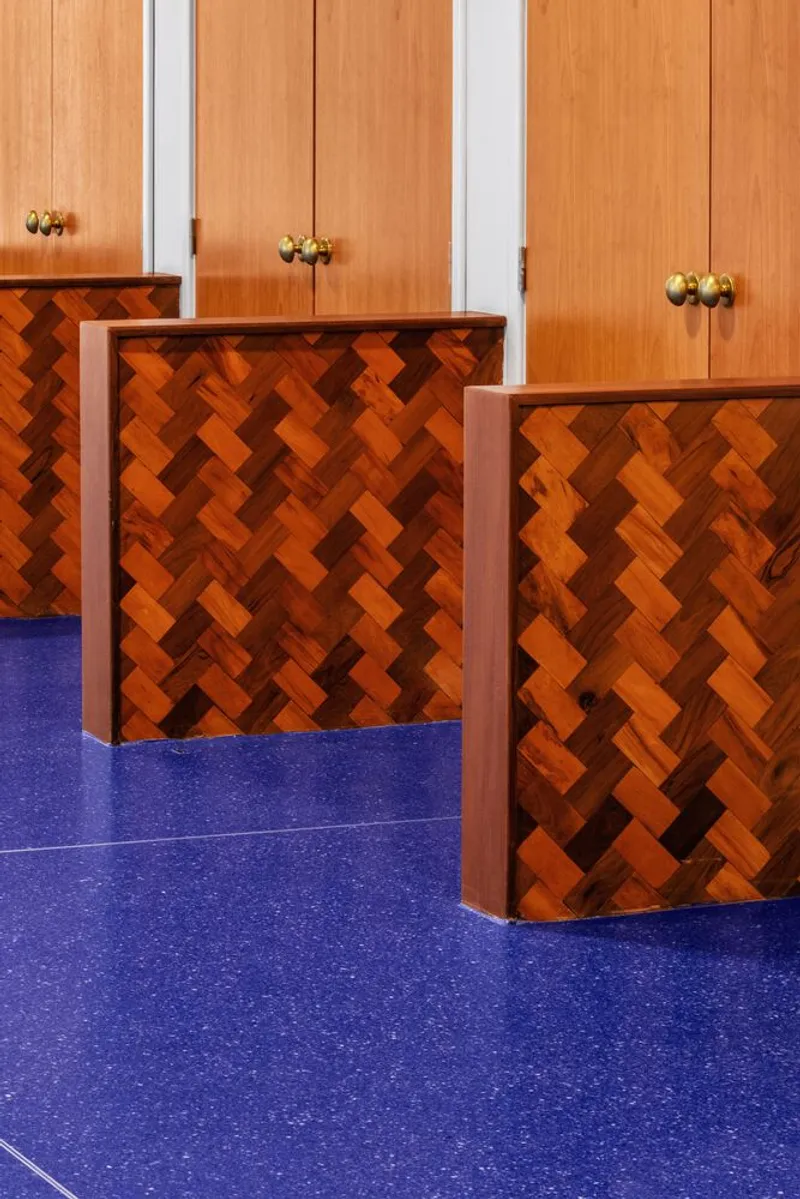
At closer range, the detailing holds up. The curved timber stage apron meets the front row without a visual barrier, reinforcing the intimacy that a 770-seat room can achieve when sightlines are managed carefully. Herringbone wood veneer covers the reception desks, their brass hardware a quiet signal that this is a building where finish quality was not value-engineered away. The vertical wood paneling behind the reception area continues the material vocabulary of the auditorium, tying front-of-house to back-of-house without a jarring transition.
The new four-story wing behind the stage houses the operational infrastructure that makes a touring-capable venue function: a covered loading dock, instrument storage, eight dressing rooms, a green room, offices, and an institutional archive. Updated stage lift systems and integrated audiovisual technologies meet international touring standards. None of this is visible to the audience, which is exactly the point. A concert hall's back-of-house quality determines whether world-class ensembles will book it, and Paulo Bruna clearly designed for that audience too.
Dusk and the Urban Stage
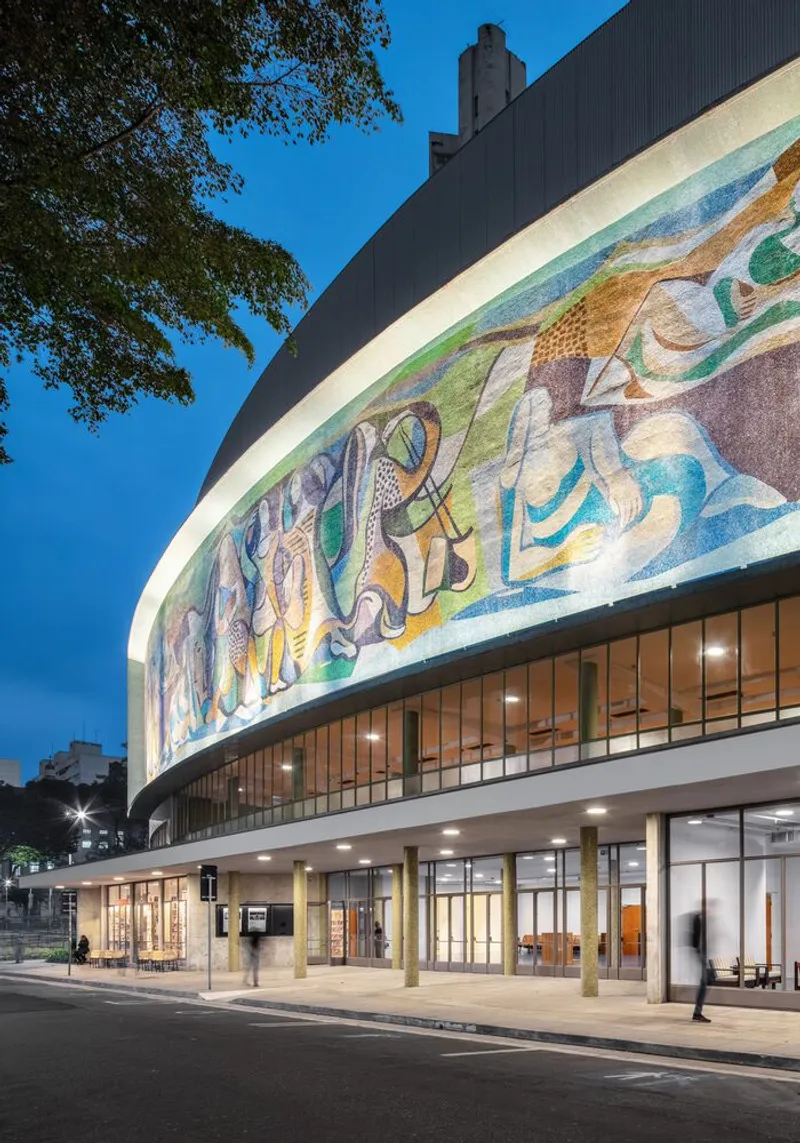
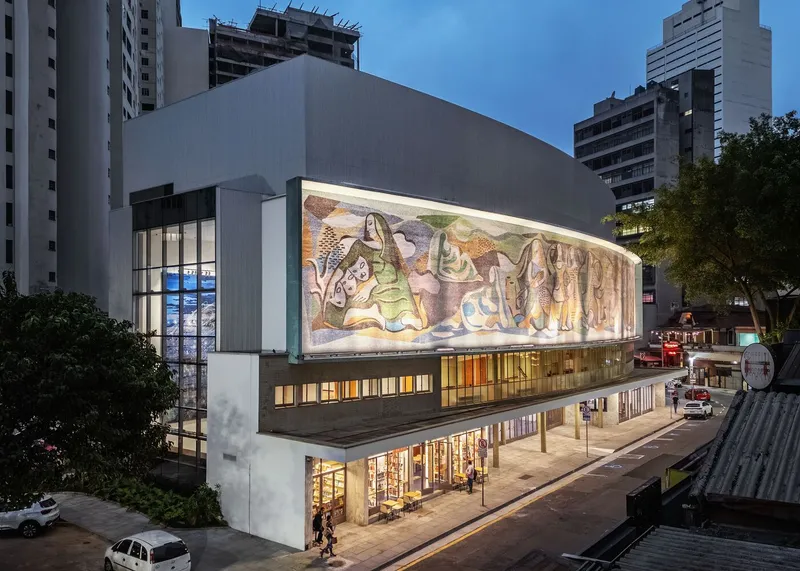
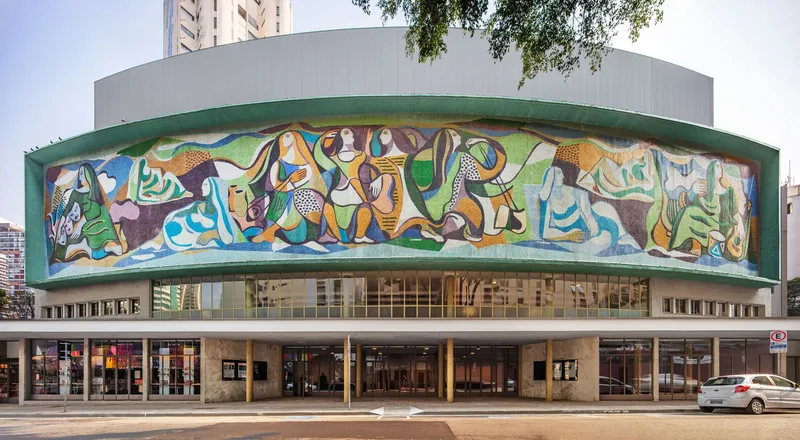
At twilight the building performs its best trick. The mosaic frieze catches the last daylight while the glazed colonnade below glows from within, and the entire facade becomes a lit billboard for culture in a city where commercial signage dominates the skyline. The elevated view from surrounding high-rises shows the building's modest footprint relative to its neighbors, a reminder that São Paulo's cultural infrastructure has always had to fight for space. The illuminated mural holds its own against towers twenty times its height.
Plans and Drawings
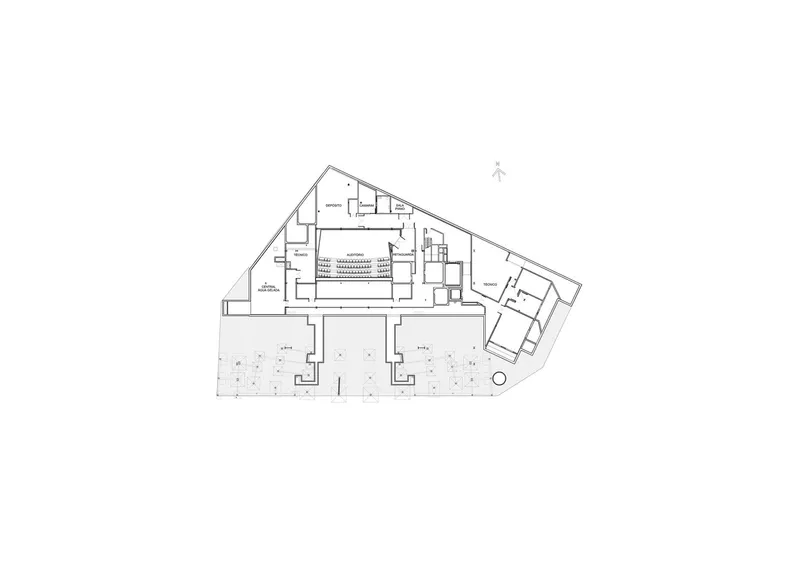
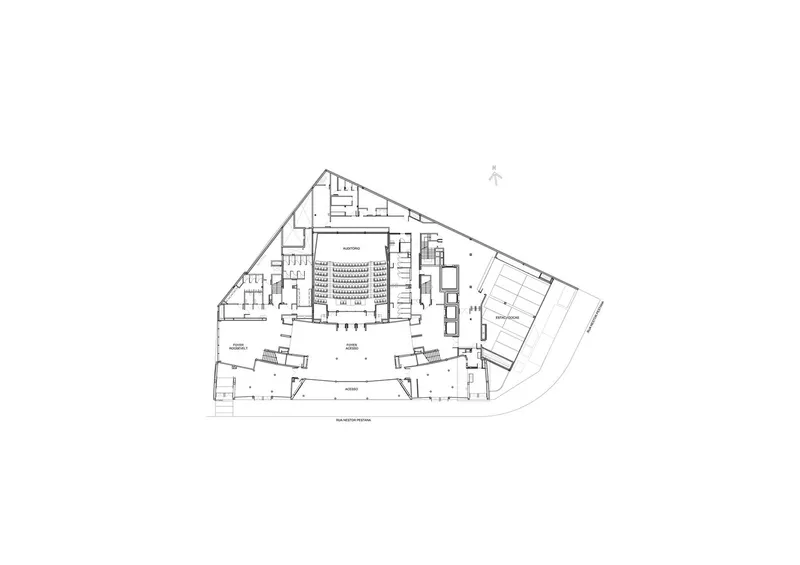
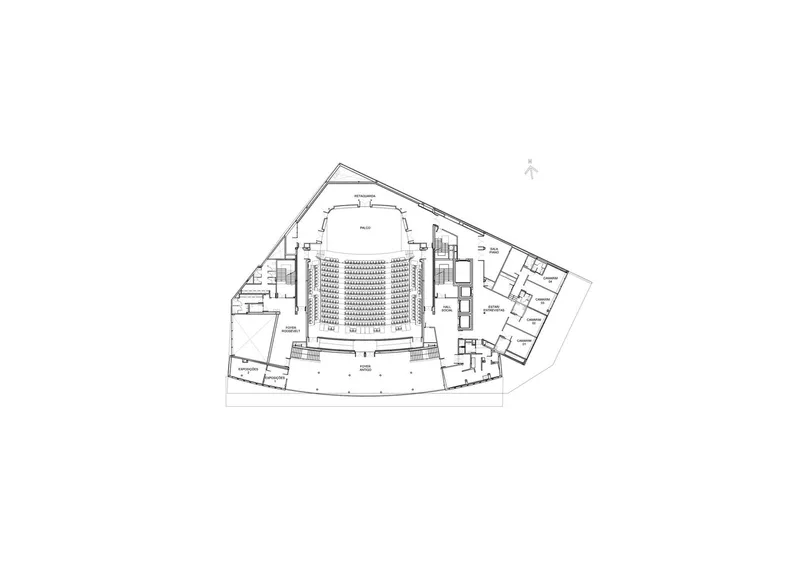
The floor plans reveal the triangular footprint that the site imposes and the ingenuity required to fit a proper concert hall into it. The ground floor plan shows diagonal circulation paths converging on the central auditorium, with paired courtyards flanking the hall to provide natural light and ventilation to the perimeter support spaces. The upper level plan makes the curved seating bowl legible, surrounded by a ring of rehearsal rooms, multipurpose spaces, and service corridors. The geometry is tight. Every square meter of the 7,600 square meter total is accounted for, and the plans make clear how little slack existed in fitting this program onto this lot.
Why This Project Matters
Sixteen years is a long time to rebuild a theater. In that span, São Paulo's cultural landscape shifted, funding structures changed, and the temptation to settle for a cheaper, faster solution must have been enormous. What Paulo Bruna's team delivered instead is a building where every major decision, from the plaster diffusion pieces to the transparent street facade to the cork columns in the bookstore, traces back to a coherent argument about how sound and public life should coexist. The acoustic strategy is not applied decoration; it is the architecture itself.
The project also demonstrates that heritage preservation and acoustic innovation are not in tension. By keeping the Di Cavalcanti mural and the original facade intact while completely rethinking the interior volumes, the team proves that a listed building can be rebuilt to exceed contemporary performance standards without erasing the history that made it worth listing in the first place. For a city with as much threatened modernist heritage as São Paulo, that precedent may be the building's most lasting contribution.
Teatro Cultura Artística by Pedro e Paulo Bruna Arquitetos Associados. Rua Nestor Pestana, Consolação, São Paulo, Brazil. 7,600 m². Completed 2024. Photography by Nelson Kon and Alberto Ricci.
About the Studio
Share Your Own Work on uni.xyz
If projects like this are the kind of work you want to make, uni.xyz is a place to publish your own, find collaborators, and enter design competitions.


Popular Articles
Popular articles from the community


The Ocean Hive: Sustainable Architecture for a Self-Sufficient Civilization at Sea
The Ocean Hive imagines sustainable architecture at sea, where modular habitats, algae, wave power and ocean waste sustain a growing colony.

ALGAL REALM: A Bio-Integrated Lunar Habitat Design for Life Beyond Earth
ALGAL REALM reimagines lunar habitat design with algae-powered life support, 3D-printed regolith, and vertical living for a lunar future.

Co-Life: Senior Housing Design That Reconnects Older Adults With the City
Co-Life reimagines senior housing design through healing gardens, shared streets, workshops, and a sustainable community across generations.

The Musturak Paradise: Senior Living Architecture for a Connected Future in Temara, Morocco
The Musturak Paradise reimagines senior living architecture in Temara via private homes, social spaces, culture, community, and shared care.

Similar Reads
You might also enjoy these articles

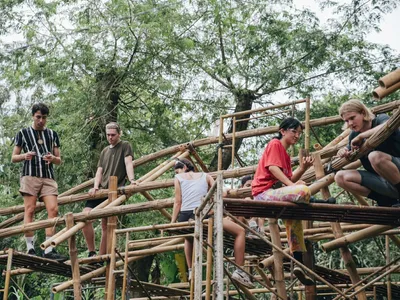
Bamboo Housing Challenge 2026: Design Affordable, Sustainable Homes Using Bamboo
An international design competition by Bamboo U and IBUKU inviting architects and designers to reimagine affordable housing using bamboo — with the winning design built full-scale in Bali.

Computational Design & Education: Beegraphy Design Awards Introduces 7th Category (Featuring Jiyun's Innovative Approach)
Dive into Beegraphy’s 7th Design Awards category, where computational design meets education to create immersive, interactive learning tools, inspired by Jiyun’s work.
From Parametric Lighting to Urban Furniture: Join the 2nd Workshop in Beegraphy’s Computational Design Series
Dive into Cutting-Edge Design Techniques and Practical Applications with Industry Experts

Last Call: Unleash Your Architectural Genius in SHAK's Kindergarten Design Competition
Urgent call for architects to join SHAK's kindergarten design competition before the looming deadline
Explore Architecture Competitions
Discover active competitions in this discipline

Challenge to reimagine the Iron Throne

Photograph architecture without architects

Illustrate the lost glory of Angkor Wat - Render Challenge

Design challenge to reuse E-waste
Comments (0)
Please login or sign up to add comments
No comments yet. Be the first to comment!