
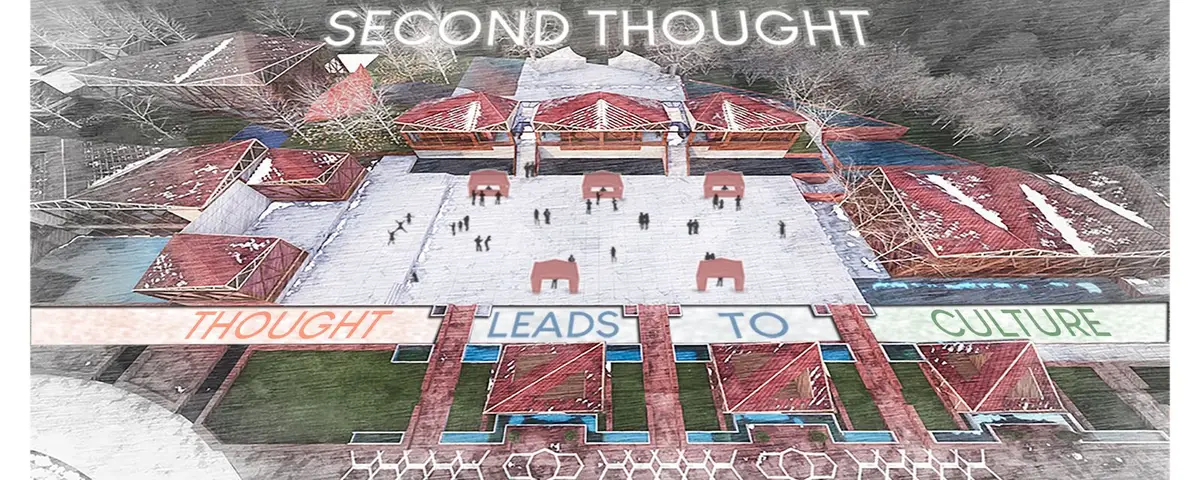
Second Thought: A Multi-Arts Center Rooted in Srinagar's Vernacular Memory
Shortlisted at Bharat Bhavan 2020, this cultural complex uses Kashmiri craft traditions and river-based urbanism to build civic dialogue.


What happens when architecture stops performing as a monument and starts functioning as a civic mirror? In Srinagar, a city shaped by the Jhelum River, centuries of craft tradition, and decades of political turbulence, the answer is not abstraction but grounding. Second Thought proposes a multi-arts cultural center that draws on Dhajji Dewari timber construction, hypocaust heating systems, and the spatial logic of Kashmiri houseboats to create a place where culture is not displayed but practiced, questioned, and evolved.
Shortlisted at Bharat Bhavan 2020, the project was designed by Yadu Vams, Arshad Sayed, Omar Ansari, and Harsh Gupta. Their entry reframes the Bharat Bhavan brief not as a singular building typology but as a living civic framework, a sequence of anchor points organized around history, culture, and social reform. Sited in Srinagar, Jammu and Kashmir, the design insists on local materials like timber, stone, bamboo, and wool, refusing to import an external architectural language into a landscape already rich with its own.
A Cyclical Theory of Culture, Drawn in Watercolor and Snow
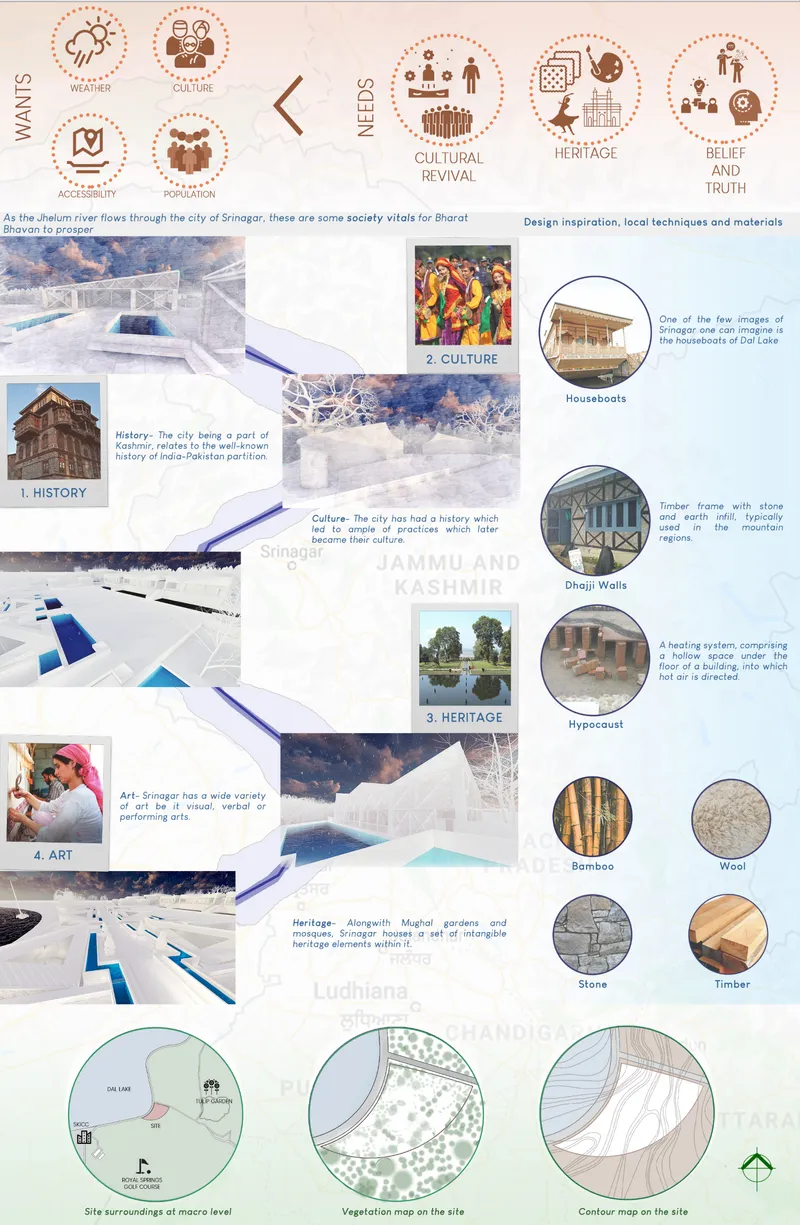
The opening presentation board lays out the project's intellectual spine: culture is not a product but a cycle. It originates from individual thought, gains shape through collective practice, gets transmitted as tradition, and evolves across time. The watercolor renderings of a terraced complex set against snow convey the climatic reality of the site while establishing an architectural tone that is deliberate but soft, layered but legible. Conceptual diagrams trace the idea of a continuously moving wheel, symbolizing a unified national vision that carries 29 distinct narratives, one for each Indian state, reinforcing unity without uniformity.
The designers position Bharat Bhavan as a response to specific societal realities: unemployment, environmental degradation, social distrust, the erosion of intangible heritage. Rather than monumental gestures, the architecture operates at the scale of everyday interaction, creating what the team calls an "inclusive, democratic, and non-iconic public space." The ambition is clear: architecture as an enabler of shared values, not a symbol of authority.
Pavilions, Courtyards, and the Jhelum as Organizing Force
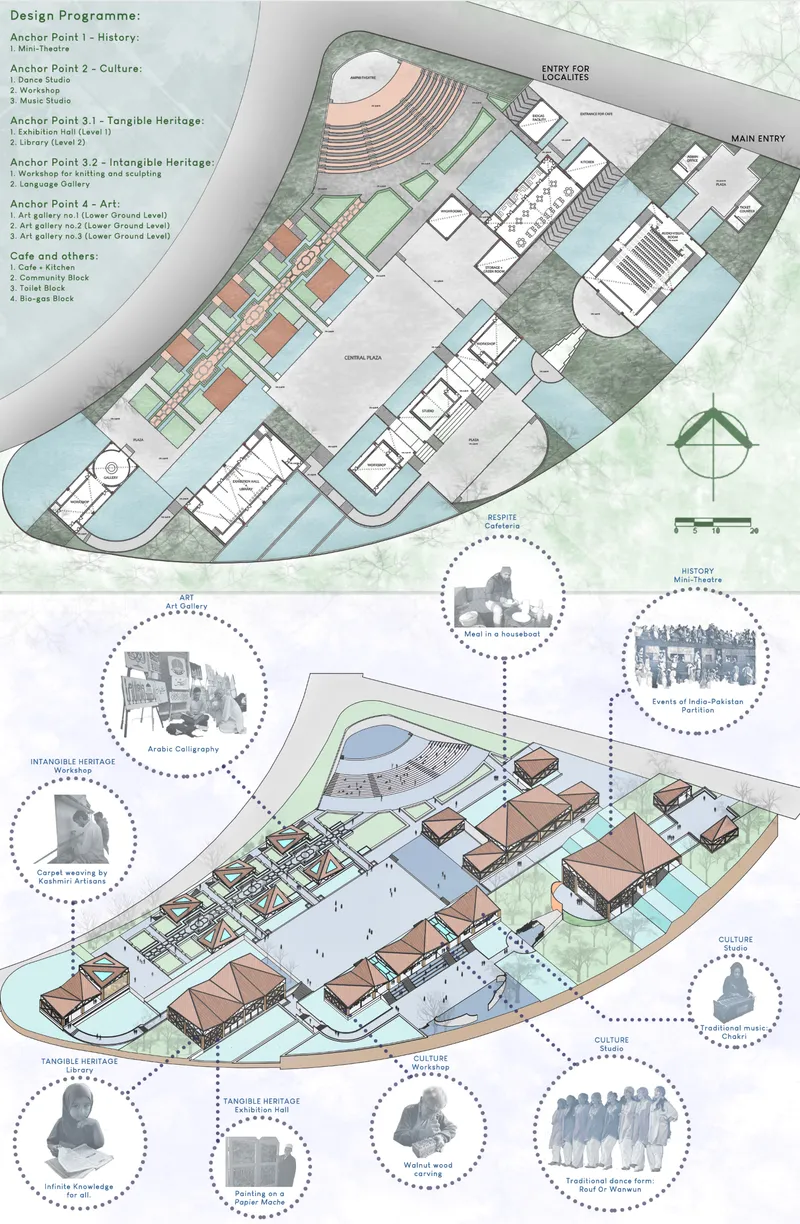
The site plan reveals a masterplan organized as a sequence of interconnected pavilions and courtyards, threaded with water features that reference Srinagar's river-based urbanism. The layout is not axial in the imperial sense; it meanders, creating pockets of intimacy within a larger public framework. Each pavilion corresponds to an anchor point in the program: history, culture, social reform. The axonometric drawing makes visible the spatial relationships between these anchor points, showing how a visitor's journey through the complex is a narrative experience rather than a processional one.
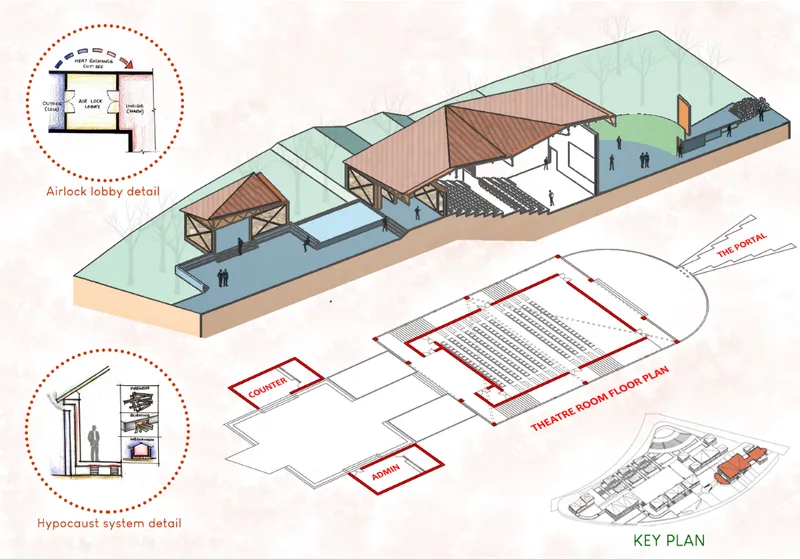
The cutaway axonometric digs into the interior organization, exposing timber roof structures and the circulation logic that links a mini-theatre and documentary space (Anchor Point 1, dedicated to Kashmir's layered and often misrepresented history) with workshops, studios, and a central quadrangle celebrating traditional dance forms like Rouf and Wanwun. A symbolic "portal" marks the spatial transition into the history zone, reflecting the emotional and political turbulence experienced post-partition. The theater zone, highlighted in the floor plan, is not a standalone auditorium but an embedded element within the cultural precinct, insisting that performance and daily life are inseparable.
Dhajji Dewari Logic: Structure as Cultural Continuity
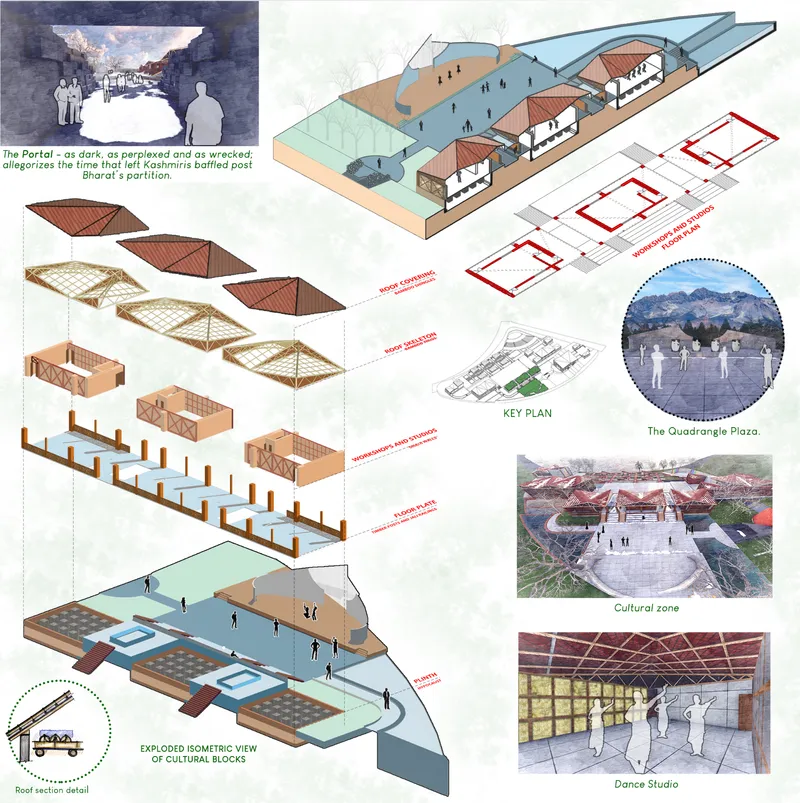
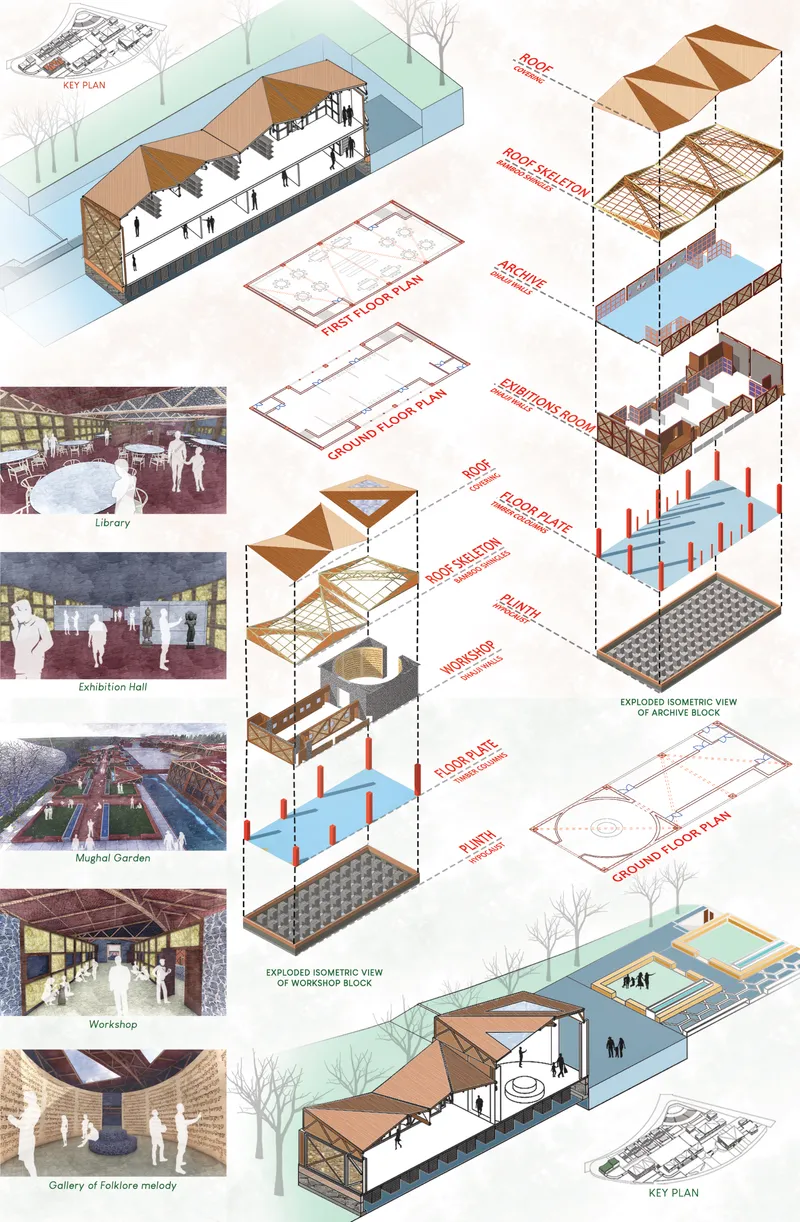
The exploded isometric drawings are where Second Thought's material commitments become most legible. Roof trusses, floor plates, and foundations are peeled apart layer by layer, accompanied by detail vignettes that document the construction logic. The designers reference Dhajji Dewari, the traditional Kashmiri timber-and-masonry wall system known for its seismic resilience, as a structural and cultural precedent. This is not decoration or pastiche; it is a genuine engagement with vernacular building intelligence, adapted to the program of a contemporary arts center.
The sequential assembly views of two building blocks further clarify how structure, spatial enclosure, and interior atmosphere are conceived as a single design problem. Interior renderings nestled alongside floor plans show timber-roofed rooms that feel warm, human-scaled, and specific to their climate. The use of stone, bamboo, and wool as primary materials keeps the palette honest to Srinagar's craft economy. Hypocaust heating, an ancient underfloor system, appears as a passive strategy suited to Kashmir's harsh winters. There is nothing nostalgic about these choices; they are practical, tested, and place-specific.
The Circular Amphitheater: Gathering as Architectural Act
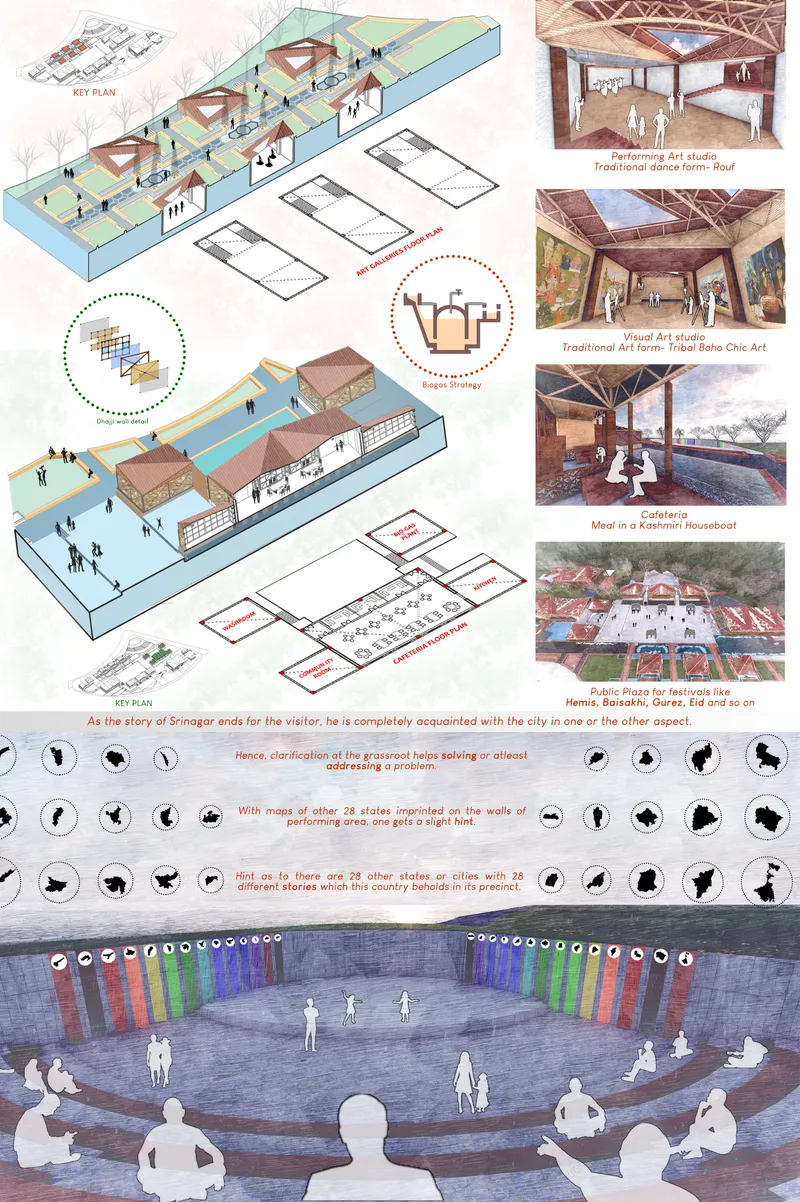
The final composite board pulls the project together with axonometric views, floor plans, and interior vignettes, but the image that anchors it all is a rendering of a circular amphitheater populated with silhouetted figures. This is the spatial embodiment of the project's thesis: culture is a collective act, and architecture's role is to make gathering possible, comfortable, and meaningful. The amphitheater is not a grand civic gesture but a contained, almost intimate forum, scaled to dialogue rather than spectacle.
The silhouettes matter. They suggest occupation without prescribing identity, a deliberate move in a project that argues for inclusivity and democratic access. The design positions this gathering space as the point where the three anchor narratives, history, culture, and social reform, converge. It is here that the "grassroot-level clarification" and "trust-based belief systems" the designers identify as missing from Indian civic life might begin to take root, not through slogans, but through the spatial conditions for encounter.
Why This Project Matters
Second Thought succeeds because it refuses the two easiest paths available to a competition entry about Indian cultural architecture: the iconic gesture and the sentimental revival. Instead, it builds a rigorous argument that links material choices (Dhajji Dewari, hypocaust heating, local timber) to programmatic ambitions (dialogue, reform, cultural transmission) and anchors both in a real place with real complexity. Srinagar is not treated as a backdrop but as a co-author of the design.
For a student team, the range of thinking here is remarkable. Yadu Vams, Arshad Sayed, Omar Ansari, and Harsh Gupta demonstrate that cultural centers do not need to look monumental to be consequential. They need to be porous, grounded, and honest about the society they serve. In a country navigating rapid change while holding immense inherited knowledge, that is the kind of architectural intelligence worth cultivating.
View the Full Project
About the Designers
Designers: Yadu Vams, Arshad Sayed, Omar Ansari, Harsh Gupta
Enter a Design Competition on uni.xyz
uni.xyz runs architecture and design competitions year-round that reward proposals with spatial conviction and real site intelligence.
Project credits: Second Thought by Yadu Vams, Arshad Sayed, Omar Ansari, Harsh Gupta Bharat Bhavan 2020 (uni.xyz).


Popular Articles
Popular articles from the community


The Musturak Paradise: Senior Living Architecture for a Connected Future in Temara, Morocco
The Musturak Paradise reimagines senior living architecture in Temara via private homes, social spaces, culture, community, and shared care.

Play: Fragments of Their World
Familiar architecture becomes modular playground design, creating safe spaces where displaced children can learn, connect, imagine and play.

Hill & Cross Opera: Sculptural Opera House Architecture Shaped by Tallinn’s Landscape and Identity
Hill & Cross Opera reimagines opera house architecture in Tallinn through its sculptural hill, civic plaza, glass wave and a luminous cross.

ALGAL REALM: A Bio-Integrated Lunar Habitat Design for Life Beyond Earth
ALGAL REALM reimagines lunar habitat design with algae-powered life support, 3D-printed regolith, and vertical living for a lunar future.

Similar Reads
You might also enjoy these articles
ALGAL REALM: A Bio-Integrated Lunar Habitat Design for Life Beyond Earth
ALGAL REALM reimagines lunar habitat design with algae-powered life support, 3D-printed regolith, and vertical living for a lunar future.

Cinema Futurismo: Futuristic Architecture Reimagining the Future of Cinema
Cinema Futurismo merges futuristic architecture, holographic projection, intimate seating, and landscape into a new social cinema.

Little Red Riding Hood: Architectural Design as a Journey Through Fear, Light, and Storytelling
Little Red Riding Hood reimagines the fairy tale through architectural design shaped by fear, light, scale, memory, uncertainty, and choice.
Playducation: Modular Architecture That Turns Play Into a Space for Learning
Playducation transforms modular architecture into a flexible world of play, learning, and healing for children in refugee settlements.

Explore Architectural Heritage Competitions
Discover active competitions in this discipline

Challenge to reimagine the Iron Throne

Photograph architecture without architects

Illustrate the lost glory of Angkor Wat - Render Challenge

Design challenge to reuse E-waste
Comments (0)
Please login or sign up to add comments
No comments yet. Be the first to comment!