
Cycle: A Klein Bottle Geometry Turned Into a Self-Sustaining Desert Habitat
Subterranean living units inspired by topological geometry create closed-loop water, thermal, and social systems for extreme desert settlement.


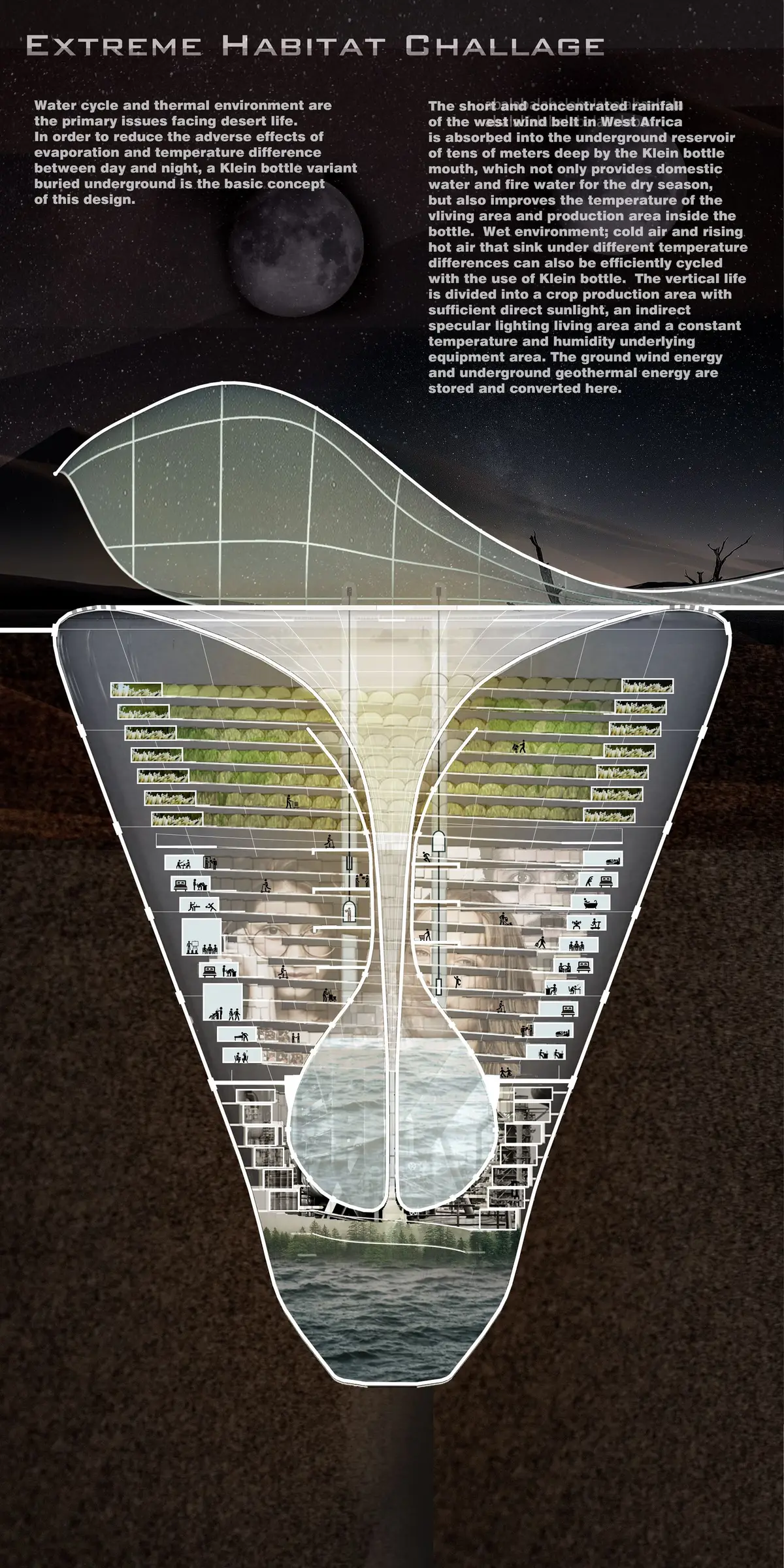
What if the key to surviving one of Earth's harshest environments was hiding inside a mathematical paradox? Cycle takes the Klein bottle, a non-orientable surface with no distinct inside or outside, and translates its continuous looping geometry into an underground desert habitat. The result is a self-sustaining settlement prototype where water, air, heat, and human activity circulate through a single unbroken system. Rather than fighting the desert's extremes, the project folds itself into the ground, using the earth as insulation and the sky as a thermal engine.
Designed by 洋 何 and published on uni.xyz, Cycle responds to two fundamental crises of arid landscapes: extreme day-to-night temperature swings and severe water scarcity. The proposal positions its primary living systems underground, reserving above-ground volumes for light collection, thermal regulation, and agricultural production. Each Klein bottle unit supports up to 350 residents as an autonomous socio-economic cell, but the real resilience emerges when multiple units form a coalition, sharing resources, labor, and disaster response across a networked desert settlement.
Three Ovals on Sand: A Settlement That Reads as Topology
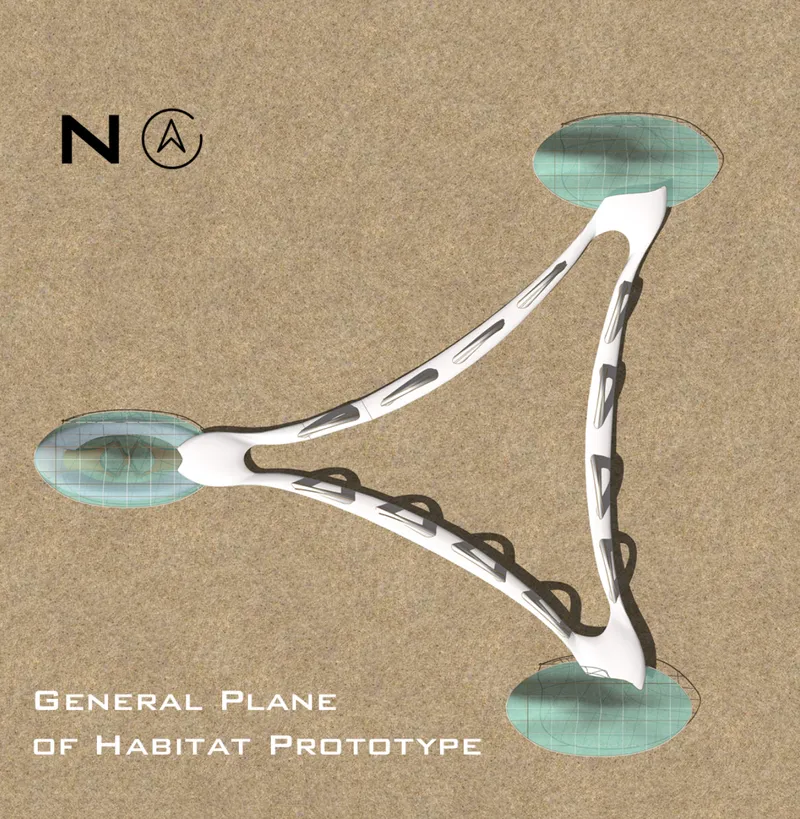
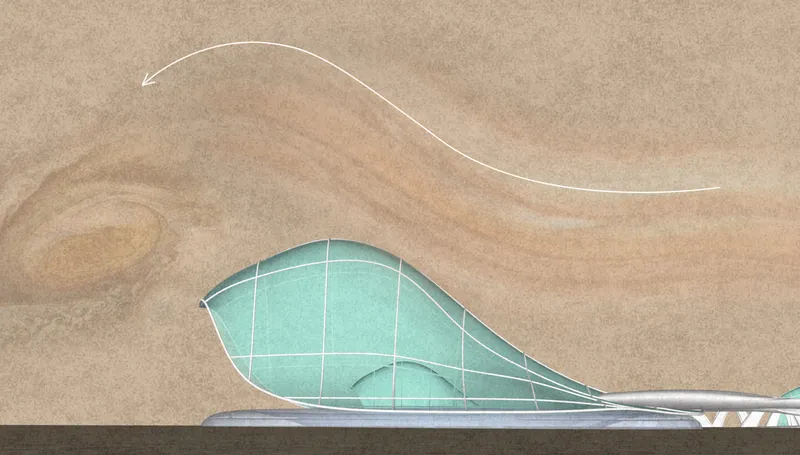
The plan drawing reveals three oval structures linked by white circulation paths laid across sandy terrain, establishing the project's core organizational logic: autonomous units connected into a cooperative network. Each oval represents one Klein bottle habitat, self-sufficient yet dependent on its neighbors for long-term economic and ecological viability. The connecting pathways are not mere corridors; they are the infrastructure of inter-unit exchange, carrying materials, people, and emergency evacuations between cells.
The section drawing cuts through one unit to expose its teardrop-shaped glass enclosure, supported by curved metal ribs that rise from the desert floor. Above ground, this shell acts as a thermal buffer and light diffuser. Below ground, inverted conical volumes plunge into the earth, hosting water reservoirs, temperature regulation systems, and the spiraling residential zones that define daily life. The geometry is simultaneously sculptural and performative: the continuous surface of the Klein bottle eliminates dead-end spaces, forcing air, water, and movement into a perpetual loop.
Vertical Zoning: Agriculture Above, Water Below
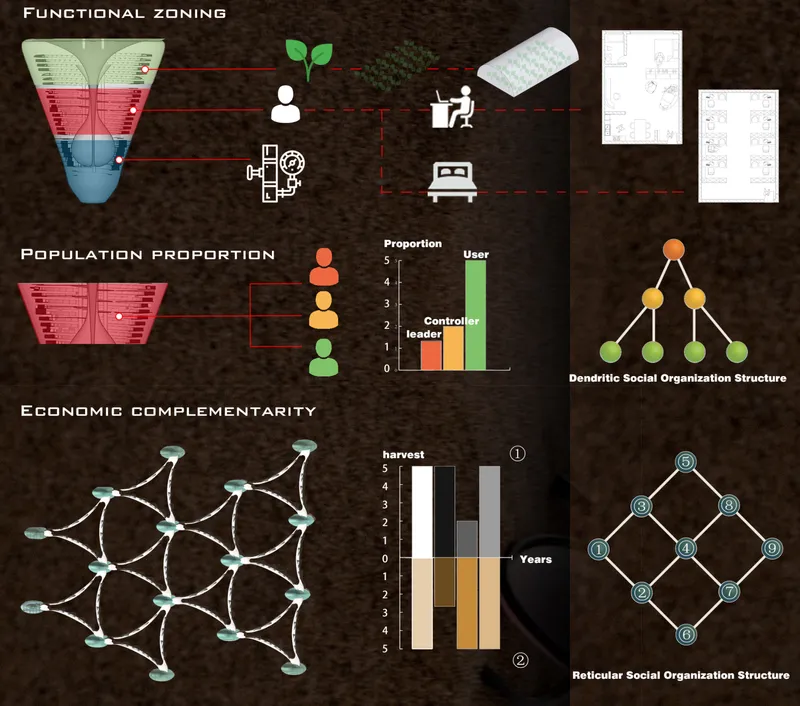
The functional zoning diagram lays out the project's vertical logic with precision. Upper zones accommodate agriculture, vegetation, and food production, benefiting from proximity to natural light. Middle zones house workspaces, research pods, and social areas. Lower zones contain mechanical systems, water reservoirs, and emergency infrastructure. This stratification is not arbitrary: it follows thermal physics. The hottest points receive natural ventilation effects, while the cooler depths become optimal for water collection and long-term storage, minimizing the evaporation that devastates conventional desert water systems.
The same diagram maps the settlement's population structure and economic relationships. Residents are categorized by role: users, controllers, and leaders, with proportions calibrated to maintain operational balance. Two organizational models operate in parallel. A dendritic, branching hierarchy manages daily operations, while a reticular, networked grid handles economic exchange and disaster management. Each unit produces agriculture, materials, and specialized outputs that complement neighboring units, generating a multi-year cycle of harvesting and inter-unit trade that forms a resilient micro-economy.
Arched Pathways and Green Domes: Infrastructure as Architecture
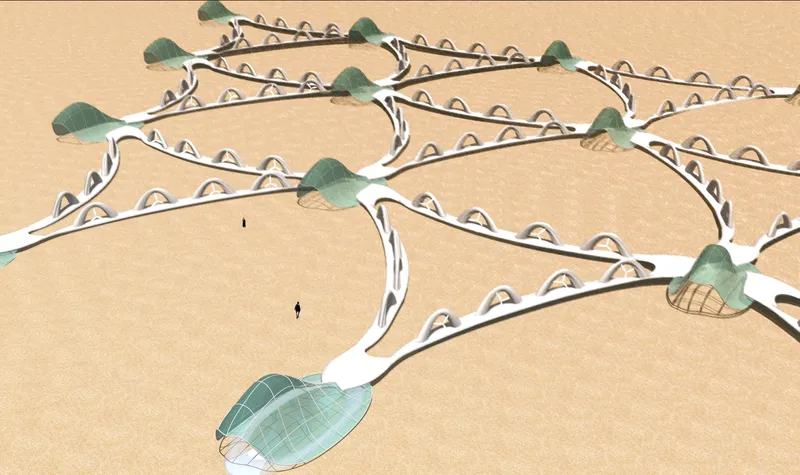
The axonometric drawing pulls apart the settlement's connective tissue. Interconnected white pathways with repeated arched openings link the habitat units, while green domed structures punctuate the network, likely marking agricultural or communal nodes. The arches are more than formal gestures; they provide structural efficiency for spans crossing open desert, and their rhythm creates a legible spatial sequence for residents navigating between units. The drawing makes clear that Cycle is not a single building but a settlement system, one whose identity emerges from the relationships between its parts rather than from any singular form.
Living in Horizontal Light Bands
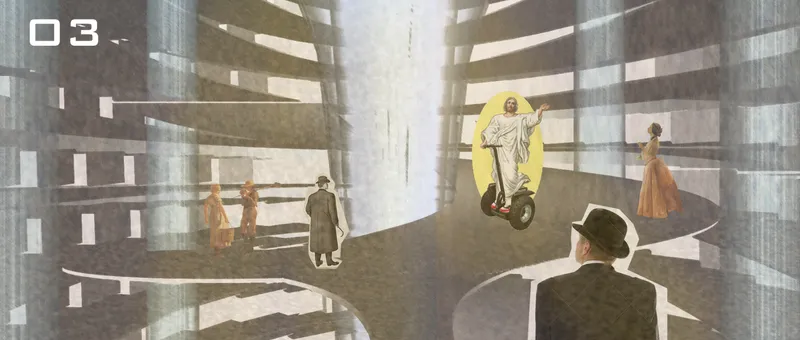
The section perspective reveals what daily life might feel like inside Cycle's subterranean volumes. Figures occupy a layered interior space striped with horizontal bands of light, filtered down from the central lighting shaft that penetrates the full depth of the structure. The spiral vertical distribution of residential units creates an uninterrupted spatial experience, where moving through the habitat feels continuous rather than compartmentalized. A central transportation lane threads through the spiral, enabling rapid movement of materials, people, and emergency evacuations. The atmosphere is calm and controlled, a stark contrast to the brutal desert surface just meters above.
Closing the Loop: Ventilation, Thermal Cycles, and Water Recovery
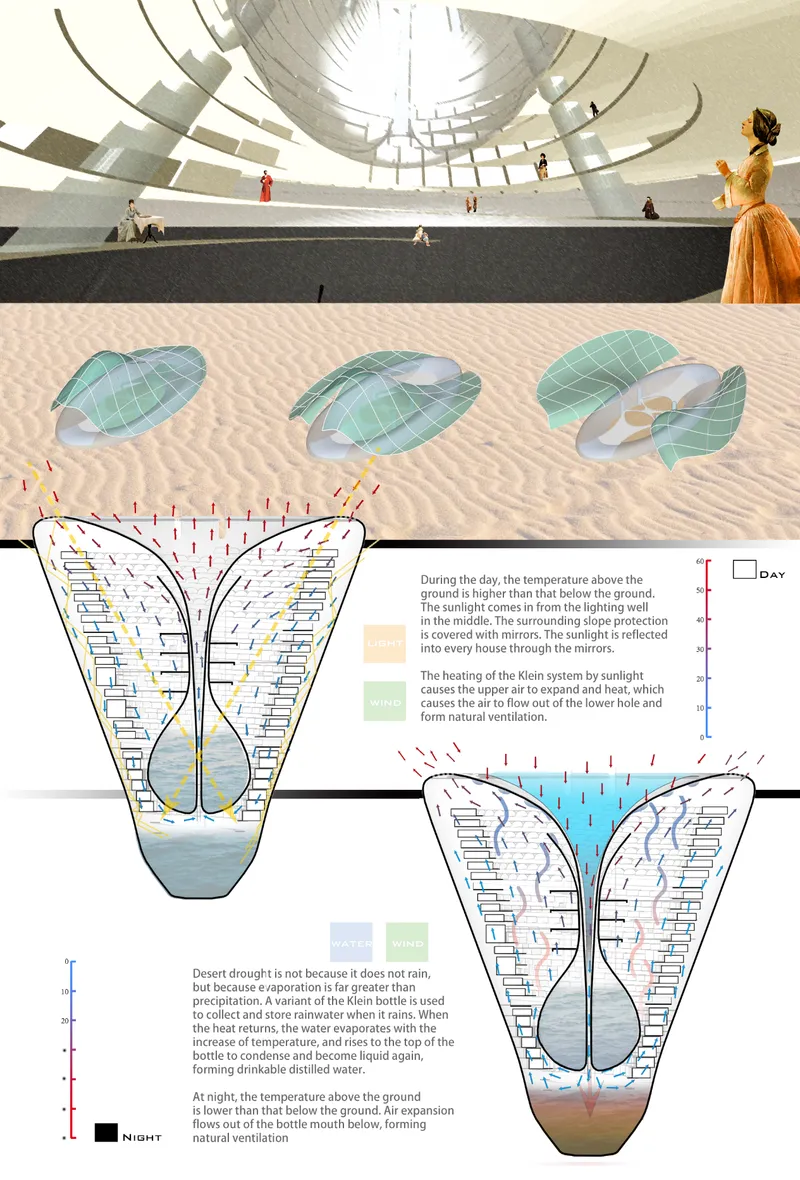
The composite board synthesizes the project's environmental engineering into a single reading. Section diagrams trace ventilation pathways and thermal systems through the habitat, showing how the Klein bottle geometry drives air circulation without mechanical input. Hot air rises through the above-ground shell, drawing cooler subterranean air upward in a continuous convective loop. Water systems exploit the same geometry: condensation collected at the cooler depths feeds reservoirs that double as firefighting infrastructure and long-term storage. The adjacent interior rendering shows these systems as lived space, not abstract engineering, with light, air, and humidity all perceptible to the people inside.
The emergency evacuation strategy is embedded into this same circulatory logic. Rotary ramps provide continuous vertical escape routes. Fire elevators move residents from the lowest zones to the surface during crises. Refuge storeys accommodate thousands of individuals with structural reinforcement and fire-safe materiality. Water tanks serve a dual purpose as both everyday reservoirs and emergency firefighting infrastructure. Nothing in the system exists for only one reason.
Why This Project Matters
Cycle's strength is its refusal to treat desert habitation as a problem of shelter alone. The project operates simultaneously as architecture, infrastructure, ecology, and social contract. By translating the Klein bottle's continuous surface into a spatial and environmental strategy, 洋 何 produces a habitat where water recovery, thermal regulation, food production, and community governance are not separate systems bolted together but expressions of a single geometric logic. That integration is rare in speculative desert architecture, which too often defaults to dome renderings with vague sustainability claims.
The proposal also pushes back against the common assumption that extreme environment design must be isolationist. Each 350-person Klein bottle unit is explicitly designed to be insufficient on its own. Resilience emerges only through coalition: shared harvests, networked disaster response, complementary economic production. In a moment when climate adaptation discourse often gravitates toward individual bunkers and off-grid fantasies, Cycle insists that survival in the desert, as everywhere else, is a collective project.
View the Full Project
About the Designers
Designer: 洋 何
Enter a Design Competition on uni.xyz
uni.xyz runs architecture and design competitions year-round that reward proposals with spatial conviction and real site intelligence.
Project credits: Cycle by 洋 何.


Popular Articles
Popular articles from the community


FCC Arquitectura Expands a Portuguese Granite House with a Board-Marked Concrete Wing
In Portugal, JV House pairs a cleaned-up whitewashed and granite dwelling with a timber-shuttered concrete extension, courtyards and a garden pool.

David Ortega Stacks a Two-Story Mexico City Penthouse Around a Steel Stair and a Pergola-Shaded Roof Terrace
In Colonia Roma, a 300 m² penthouse uses oak joinery, a planted steel stair and a slatted roof pergola to make a new-build apartment feel like a house.

Manzana Morphosis: Stretching Barcelona's Grid into a Living Landscape for 2050
A radical reworking of the Eixample manzana turns density into a tool for generous public space, vertical ecology, and environmental performance.

Singing Woman: An Opera House That Performs Before the Curtain Rises
Ovidiu Cristian Pavel's conceptual opera house translates Estonia's choral identity into a sculpted waterfront landmark facing the Baltic Sea.

Similar Reads
You might also enjoy these articles

Aquadapt: An Underwater Habitat That Rewrites Its Rooms by the Hour
Curved modules ring the seabed while one shell shifts from breakfast room to cinema, farm and football pitch as residents' needs change.

Play: Fragments of Their World: Remembered Architecture Rebuilt as a Modular Playground for Refugee Camps
Tom Gardner abstracts domes, arches and towers from the homelands of displaced families into a kit of child-scaled play parts for camp settlements.
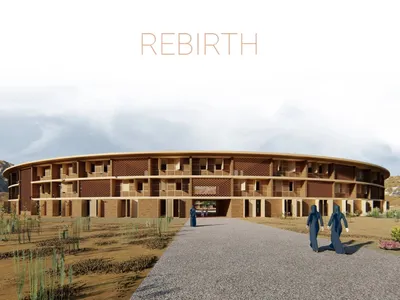
REBIRTH: A Circular Settlement Where Afghan Widows and Their Children Rebuild Life Together
A shortlisted Resile entry turns the circle into a protective ring of timber and brick, gathering homes, classrooms and gardens around a shared landscape.
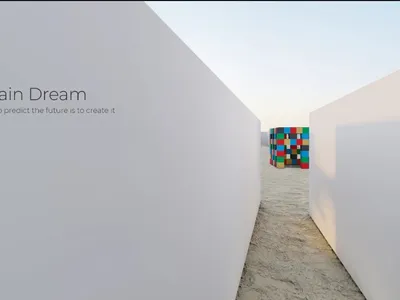
The Main Dream: A Recycled Plastic Kit That Lets Refugee Children Build Their Own Playground
Thirty-centimetre interlocking cubes that connect on three axes turn play into construction, letting children author the spaces they occupy.

Explore Desert Architecture Competitions
Discover active competitions in this discipline

Challenge to reimagine the Iron Throne

Photograph architecture without architects

Illustrate the lost glory of Angkor Wat - Render Challenge

Design challenge to reuse E-waste
Comments (0)
Please login or sign up to add comments
No comments yet. Be the first to comment!