

Dan Brunn Architecture Lines a SoHo Storefront with 2,000 Pounds of Broken Baccarat Crystal
RtA's third retail outpost occupies a landmarked Mercer Street building, trading polished luxury for raw, kintsugi-inspired glamour.


Retail design tends to swing between two poles: the antiseptic white box and the maximalist spectacle. Dan Brunn Architecture finds a charged middle ground in RtA's SoHo flagship, a 2,152-square-foot space on Mercer Street where nearly a ton of shattered Baccarat crystal becomes the organizing centerpiece. The store is the third chapter in a series that began in Los Angeles and continued to Las Vegas, but where those earlier locations established a tonal vocabulary, this New York iteration sharpens it into something more confrontational, more local.
What makes the project worth studying is not the provocation of smashing fine crystal, but the discipline with which that gesture is deployed. A single 40-foot-long illuminated table runs down a 90-foot central axis, splitting the 14-foot-tall volume into two zones for distinct collections. The space progresses from daylight at the street facade to a deep red threshold at its far end, controlled by a ten-band epoxy gradient painted directly onto the original wood floors. Every decision reinforces that axis: the blackened steel I-beams overhead, the mirrored chrome vitrines, and the arched neon-lined fitting rooms at the terminus. It is a store designed to be walked, not browsed.
The Axis and the Crystal Spine


The central installation dominates the plan. Forty feet of broken Baccarat crystal, lit from within by deeply set LEDs, runs like a geological formation down the heart of the store. It glows. It catches movement. It does the work that a conventional display island would do, anchoring the room and directing circulation, but it does so by being genuinely strange. Brunn has described the inspiration as bins of discarded crystal at a factory, and there is something satisfyingly anti-luxury about repurposing a prestige material in its damaged state.
The axis pulls daylight from the Mercer Street facade deep into the volume. The gradient floor, shifting from white near the windows to black at the rear, amplifies this effect, making the front of the store feel open and the back feel intimate. Display boxes increase in size and brightness as they progress away from the entrance, compensating for diminishing natural light. It is a simple trick executed with real care.
SoHo's Street Face


The store sits at the ground floor of a landmarked building, and the facade reads as deferential: white-framed storefront windows below a stone wall with a black fire escape. There is no attempt to compete with the building's historical presence. The hexagonal mosaic tile entry, spelling out the brand name against penny tile, is a nod to the neighborhood's 19th-century commercial vernacular. It signals that this is a store that knows where it is.
SoHo retail has become synonymous with a certain kind of bland polish. Brunn's approach here leans into the grit that made the neighborhood interesting in the first place. The existing brick walls are retained and celebrated, not concealed. The blackened steel overhead reads more like a loft conversion than a boutique fit-out. The design contextualizes an edgy fashion label within a streetscape that still carries the memory of its industrial past.
Steel Frame and Hanging System


Blackened steel I-beams span the ceiling and do double duty: they are both structural expression and retail infrastructure. A custom hanging system suspends clothing racks directly from these beams, freeing the floor of conventional fixture furniture and keeping the axis legible. The racks are minimal, almost industrial, and they let the garments read as the primary visual material in the room.
The side walls are organized into flexible "rooms" defined by product placement rather than partitions. Repeated arches puncture these walls, outlined in neon, creating rhythm without enclosure. The 14-foot ceiling height gives the clothing room to breathe, and the sparse furnishing keeps sightlines clear from front to back. It is a strategy borrowed from gallery design: control the periphery, let the center command attention.
The Crystal Surface Up Close




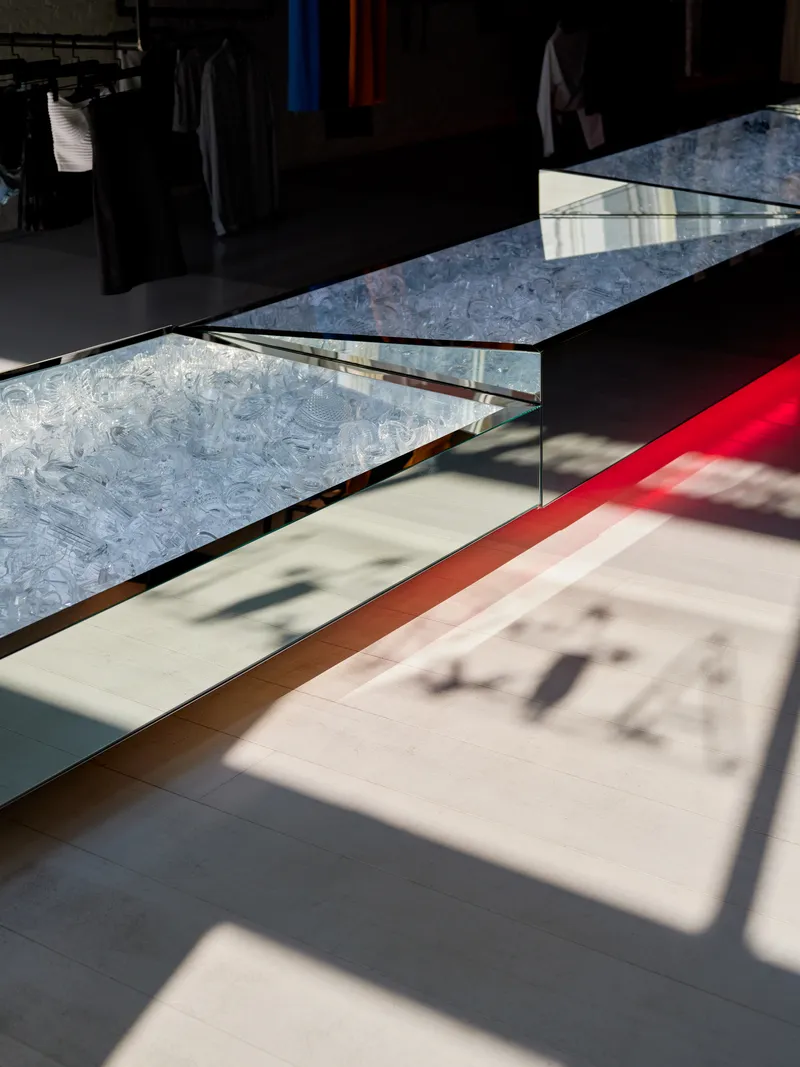
At macro scale the crystal installation reads as a luminous bar. Up close it becomes something else entirely: cast glass panels with swirling relief patterns, fish and shell forms caught in translucent blue material, bronze edging catching afternoon sun. The material has the quality of a geological specimen or an archaeological artifact. It resists the sleekness that characterizes most high-end retail surfaces.
The Japanese concept of kintsugi, embracing beauty in imperfection, runs through the project as a philosophical thread. It shows up most literally in the fitting rooms, where valleys in the existing brick are sporadically filled with gold leaf paint. But it is present everywhere: in the broken crystal, in the raw steel, in the decision to leave the original wood floors visible beneath their gradient paint. The store treats damage and age as assets, not liabilities.
The Red Room


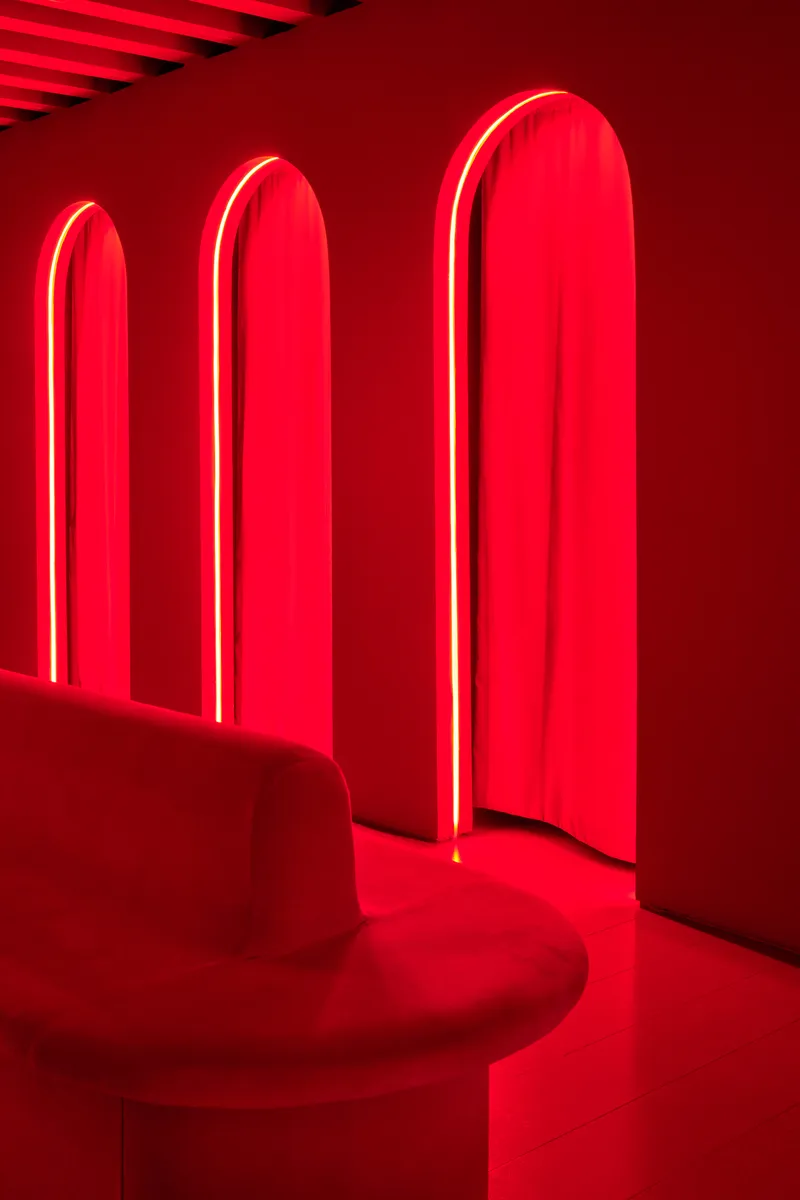
At the far end of the 90-foot axis, the space shifts register completely. Red velvet lines the arched fitting rooms. Red neon outlines every opening. A tufted bench sits beneath arched niches. If the front of the store belongs to SoHo's industrial memory, the back belongs to something closer to a nightclub or a theater dressing room. The transition is abrupt and intentional.
Brunn designed the project partly in response to the pandemic's call for more intimate retail environments. The Red Room delivers on that idea. It is genuinely enclosed, genuinely private, a space where a customer trying on clothes can feel separated from the public floor. The existing brick walls are left exposed, and gold leaf fills their irregularities, creating small glints of light against the saturated red. A projection wall at the axis terminus displays collections, turning the fitting area into a destination rather than an afterthought.
Illuminated Vitrines and Display Logic
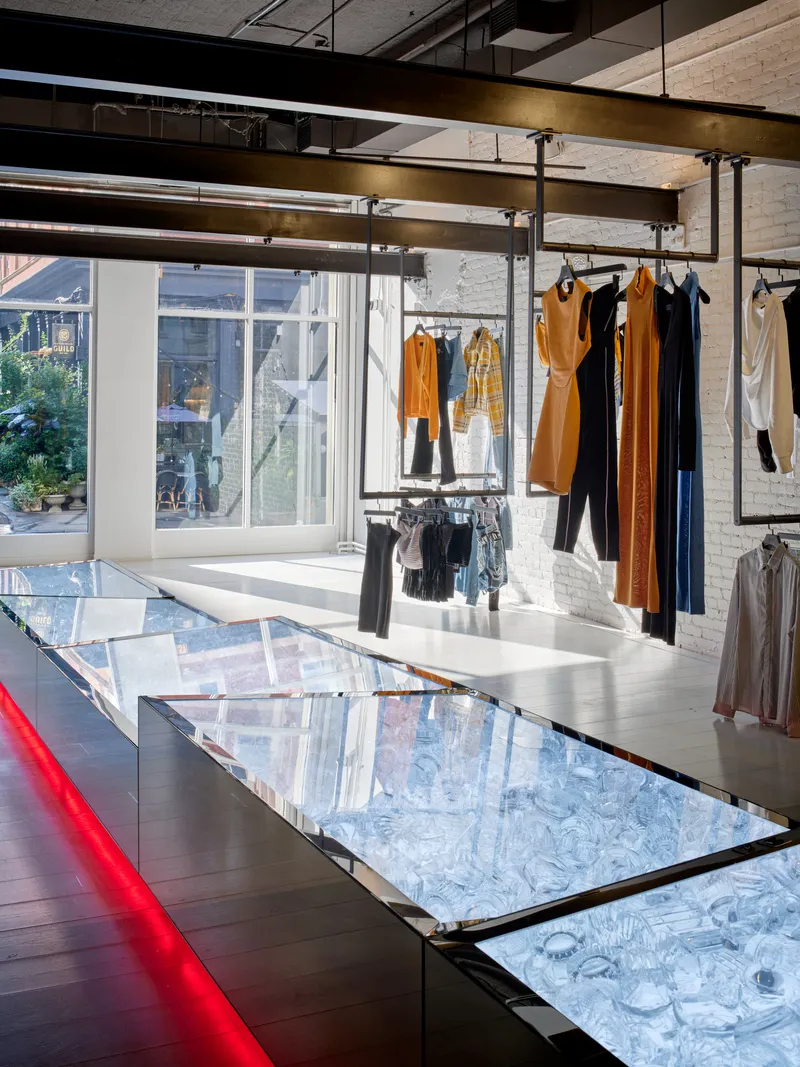
The mirrored chrome vitrines and Corian surfaces throughout the store are calibrated to a single idea: light increases as you move deeper. Near the facade, natural light does most of the work. By mid-space, the crystal table's internal LEDs take over. At the rear, neon and red uplighting dominate. The effect is cinematic. The customer's eye adjusts incrementally, and the shift in atmosphere registers as a spatial event rather than a change in decor.
This gradient strategy, applied to both the floor and the lighting, gives a modest 2,152-square-foot shop the experiential depth of a much larger space. It is the kind of move that works precisely because it is systematic. A single rule, applied consistently, produces variety without chaos.
Why This Project Matters
The RtA SoHo Store matters because it takes a clear position on what retail space should feel like after the pandemic: more focused, more sensory, more directional. The 90-foot axis is not just a plan move; it is an argument that physical stores need to offer an experience that cannot be replicated online. Walking through a gradient of light and color, past a glowing spine of broken crystal, into a velvet-lined chamber is something a screen cannot deliver.
It also demonstrates that working within a landmarked building in a heritage-loaded neighborhood does not require neutrality. Dan Brunn Architecture treated the constraints of the existing structure, its brick walls, its wood floors, its 14-foot ceilings, as the starting material for something bold. The kintsugi philosophy is more than a narrative device. It describes the actual method: find what is broken, fill it with gold, and make the imperfection legible. In a neighborhood that has spent decades smoothing over its rough edges, this store pushes back.
RtA Soho Store by Dan Brunn Architecture. Located on Mercer Street, SoHo, New York, United States. 2,152 square feet (200 square metres). Completed in 2022. Photography by Brandon Shigeta.
About the Studio
Share Your Own Work on uni.xyz
If projects like this are the kind of work you want to make, uni.xyz is a place to publish your own, find collaborators, and enter design competitions.


Popular Articles
Popular articles from the community


Singing Woman: An Opera House That Performs Before the Curtain Rises
Ovidiu Cristian Pavel's conceptual opera house translates Estonia's choral identity into a sculpted waterfront landmark facing the Baltic Sea.


David Ortega Stacks a Two-Story Mexico City Penthouse Around a Steel Stair and a Pergola-Shaded Roof Terrace
In Colonia Roma, a 300 m² penthouse uses oak joinery, a planted steel stair and a slatted roof pergola to make a new-build apartment feel like a house.

The Amber Palace Opera: A Geological Fiction Surfaces on Tallinn's Baltic Waterfront
Pierre Brillard reimagines a Baltic legend as a public landscape, opera house, and waterfront promenade rooted in Tallinn's coastal identity.

graciastudio Turns a Viewless Tijuana Lot Inward Around a Courtyard of Concrete, Timber and Trees
In Tijuana, Jorge Gracia's GA2 House stacks a timber-clad private floor over exposed concrete and replaces a missing view with a planted interior patio.

Similar Reads
You might also enjoy these articles

LAVA Architecten Gives Vocational Education a Sawtooth-Roofed Face on a Mechelen School Campus
In Mechelen, Belgium, a 2,053 m² STEM school on a 6×6 m grid turns workshops and classrooms into rooms that can be rearranged as teaching changes.

KEMA Studio Turns a Derelict Marvila Attic into a 60 m² Lighthouse Apartment Above Lisbon
In Lisbon's Marvila district, a rebuilt roof, four skylights and two plywood volumes turn an unlivable attic into a bright home facing the Tagus.

Pixel Gardens: One Repeated Module Stacked Into a Terraced Social Housing Tower for Famagusta
Salem Bader's shortlisted housing tower builds a vertical neighbourhood from one repeated module, offsetting units to carve terraces, light and air.

Bao Huynh Watercolor Atelier: A Serene Art Retreat in Hội An
Bao Huynh Watercolor Atelier in Hội An blends multifunctional art spaces, sustainable design, local materials, and family-friendly living in a serene environment.

Explore Commercial Buildings Competitions
Discover active competitions in this discipline

Challenge to design luxury tourism on rails

VR headsets Storefront design competition

Designing a staircase for a client
Comments (0)
Please login or sign up to add comments
No comments yet. Be the first to comment!