

DAR SALAM
Redevelopment of Mina Region

The proposal envisions the future of Mina region in alignment with the 2030 vision of the Saudi Arabia government to develop the Haj experience. Mina region accommodates Millions of pilgrims yearly during the Haj days in the largest gathering of tents globally. Although the Haj experience is increasingly enhancing year by year, however, the numbers of pilgrims increases as well. The increasing numbers posts a spectrum of challenges that call for rethinking the Mina region.
The design reacts to the challenges in a multi-dimensional response on the urban scale, architecture scale, as well as construction system. The design concept adopts 4 fundamentals:
- Authenticity: the design embraces a genuine symbolic geometry, that is the Octagonal Star, in forming the conceptual framework of the design. The octagonal star represents an evident source to the place, identity and culture.
- Response: the design responses to the contextual conditions of the site in a set of innovative and sustainable solutions in reaction to the climatic conditions of the site. This is reflected in the utilization of underground level, courtyard principles and construction materials.
- Reflection: the design attempts to reflect the cultural and spiritual values of the region on the urban configuration, urban space, internal spaces and design outline.
- Dynamic: although the design attempts to present a practical and replicable module, nevertheless, the configuration is dynamic, interactive and viable.
The design proposes a modular complex that manages crowd on different points within the site, and also, creates a hygiene and comfortable configuration than enhances the Haj experience. The site is divided into 2 main zones, Men Zone and Women Zone, each with a particular access and circulation. The site accommodates a total of 34 residential units, 16 Toilet Units on two levels, and defined by the multi-functional Units on the edges.
The residential unit provides a spot of 2.5 sq.m per person and accommodates 42 persons in a unit. The unit design is configured in response to the climatic conditions of the site, where living spaces are places on the ground level, and sleeping spaces are placed within the underground level as a natural response to the conditions of the site and a sustainable approach in design. The underground spaces are linked with a central courtyard and covered by a landmark umbrella. The sleeping spaces are designed to provide hygiene, private and isolated spaces with 2 persons per a sleeping module. The living spaces are more interactive and provides functional and spiritual facilities. A two floor toilet unit serves for each cluster of residential units. The design considers disabled users and provides suitable alternations in all units.
Apart of the underground approach in design, the units are designed to achieve a Zero Carbon operation through a total dependence on solar energy. Units are occupied with proper solar systems placed on the roof of each unit. Similarly, the design adopts durable materials such as compressed sand panels for building walls, and recycled finishing.
Prefabrication is the building system of all units. The design adopts elemental prefabrication approach, where building elements are manufactured off-site and assembled element by element on-site. The structural system is Steel Structure and Steel Frames for roof construction.
The poster presentation demonstrates a step by step concept development, the urban morphology of the design, and a technical presentation of the proposed units.


Popular Articles
Popular articles from the community


Manzana Morphosis: Stretching Barcelona's Grid into a Living Landscape for 2050
A radical reworking of the Eixample manzana turns density into a tool for generous public space, vertical ecology, and environmental performance.
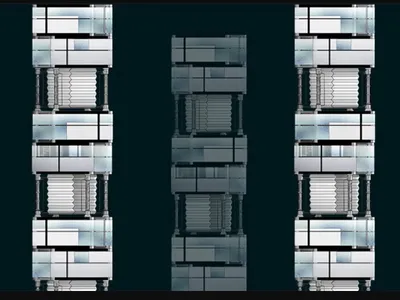
Tsunami Convergenics: Turning Catastrophic Ocean Forces into Underwater Housing Infrastructure
A speculative underwater settlement off the coast of Onagawa, Japan, treats tsunamis and typhoons as energy sources rather than threats.

Singing Woman: An Opera House That Performs Before the Curtain Rises
Ovidiu Cristian Pavel's conceptual opera house translates Estonia's choral identity into a sculpted waterfront landmark facing the Baltic Sea.
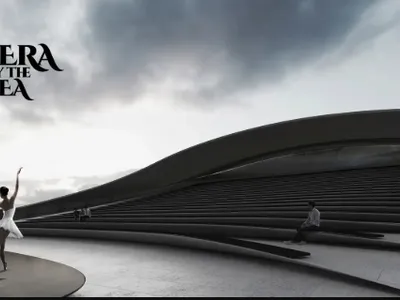
Opera by the Sea Estonia: Three Shells Dissolving Architecture into Tallinn's Coastline
A winning opera house proposal replaces monumental form with interconnected shells that blur the boundary between building, park and Baltic Sea.

Similar Reads
You might also enjoy these articles

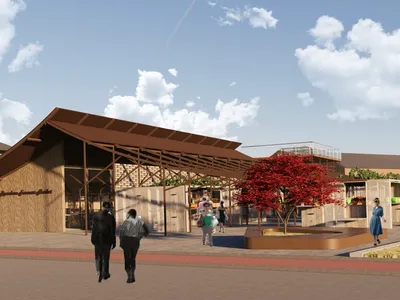
The Rhythm of Seasons
A Farmers' Market Connecting Nature and the City

More Than a Building-Designing a Living System
More Than a Building-Designing a Living System
Base Beyond
DESERT COMPOUND ARID: TOURISM OF ABSENCE AND ABUNDANCE


Comments (0)
Please login or sign up to add comments
No comments yet. Be the first to comment!