
Zhaohui Rong Studio Plants a Brick and Timber Library at 4,000 Meters in Tibetan Sichuan
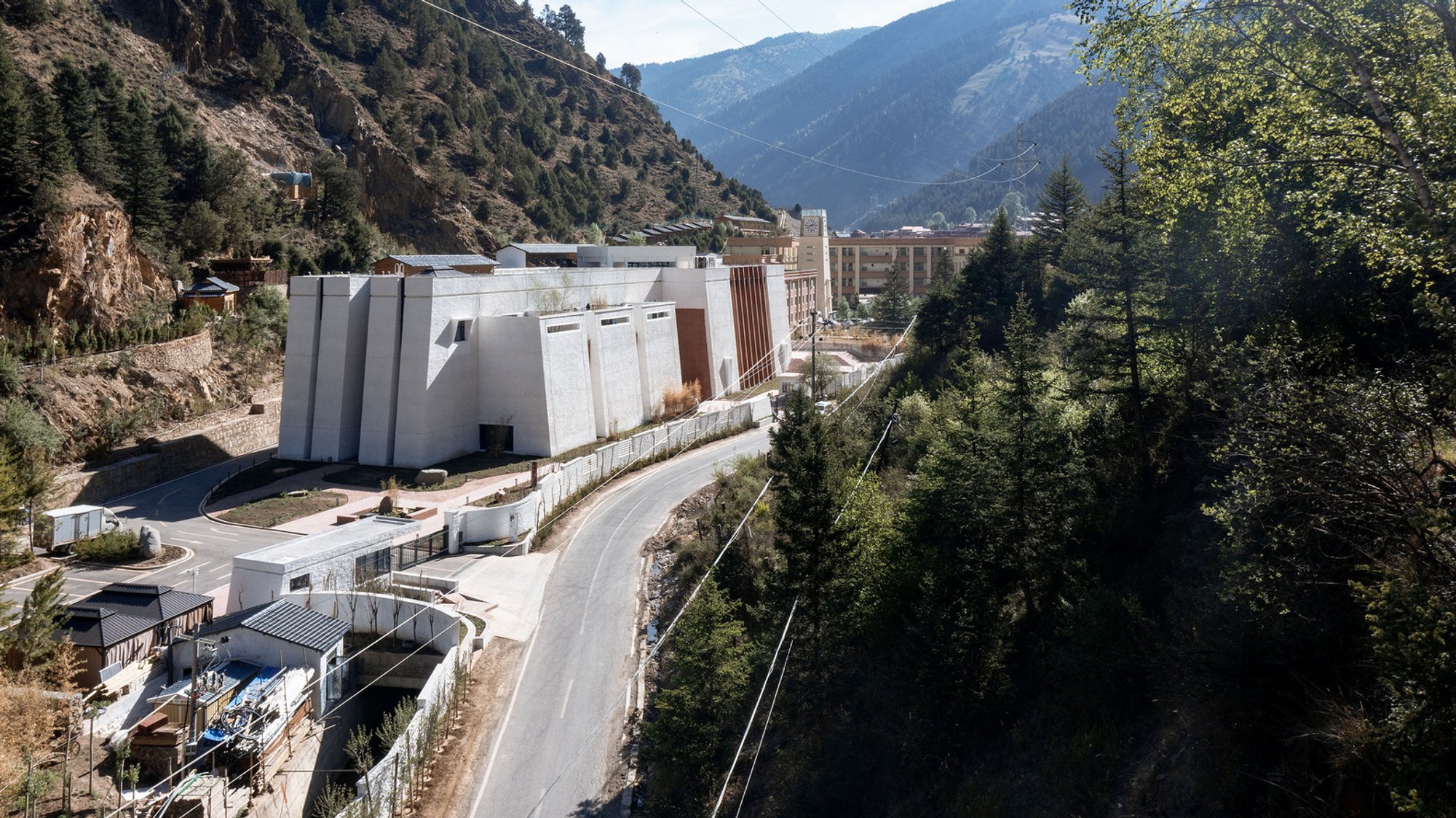
The Deba Library pairs a reading hall with a Tibetan culture museum on a narrow alluvial plateau in Garzê Prefecture, western China.

Building a 6,000 square meter cultural institution at 4,000 meters above sea level, on a sliver of alluvial land accessible only by a single four-meter-wide road, is an act of conviction before it is an act of design. The Deba Library, completed in 2022 by Zhaohui Rong Studio for the Deba Reading Enthusiasts Association in Luhuo County, Garzê Tibetan Autonomous Prefecture, is precisely that kind of project. It houses both a library and a Tibetan costume and culture museum, and its owner reportedly lived on site for more than three years to see it through.
What makes the building worth studying is not the remote location alone but the discipline it forced. The architecture resolves a demanding brief with very few gestures: brick arches, concrete structure, timber-lined interiors, and a centripetal plan that pulls readers inward. There are no gratuitous formal moves. Every decision, from the plastering technique on the exterior walls to the concealed window frames, serves either a structural, climatic, or spiritual purpose. The result is a building that feels both inevitable and deeply intentional.
A White Fortress in the Valley
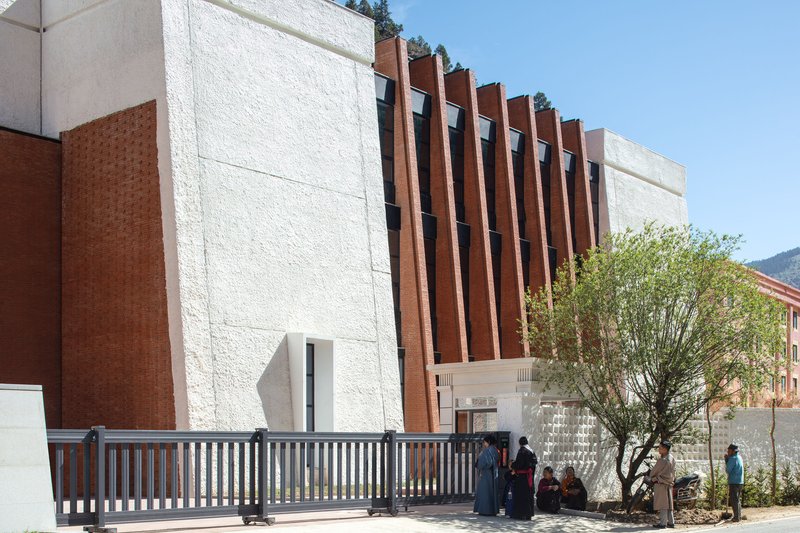
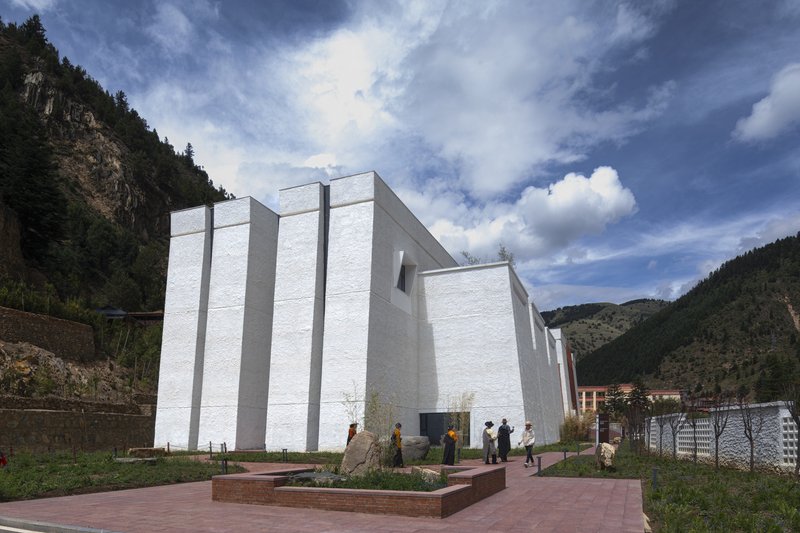
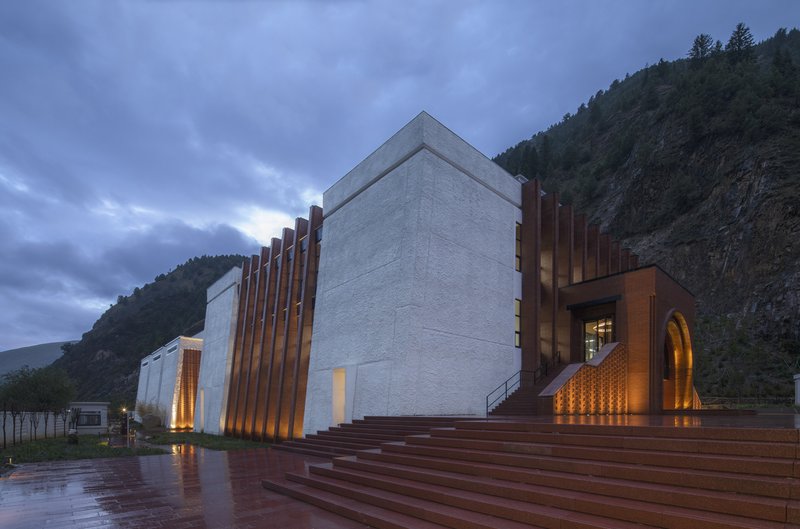
From the road, the Deba Library reads as a cluster of white masonry volumes punctuated by vertical concrete buttresses and terracotta-colored fins. The palette is restrained to the point of severity: white walls, grey concrete, warm terracotta. The effect is closer to a fortified compound than a civic building, and that reading is not accidental. Tibetan architecture has always prioritized resilience over ornament, and the coarse plastering on the exterior deliberately echoes techniques used on structures as prominent as the Potala Palace.
At twilight, the terracotta fins glow with interior light, transforming the building's stance from defensive to inviting. A stepped plaza at the entrance offers a transitional space between the narrow valley road and the building's interior world. Planted courtyards break up the massing, introducing pockets of greenery against the white walls and letting visitors pause beneath open sky before entering the reading rooms or museum galleries.
Settling into the Mountainside
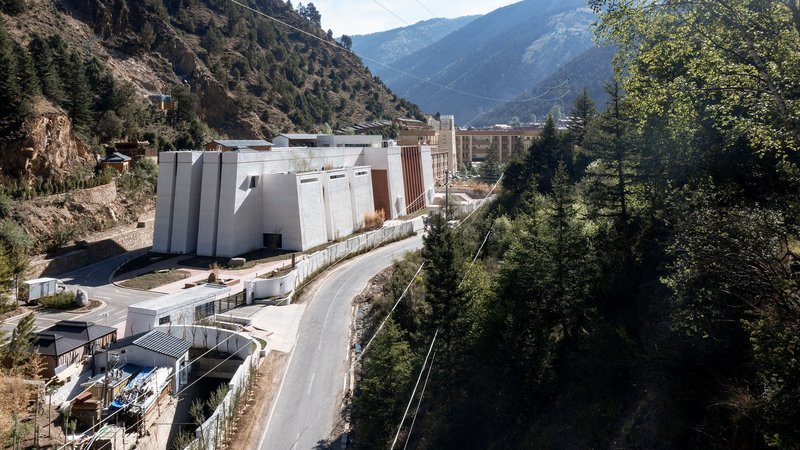
Seen from above, the building's relationship to its site becomes clearer. The white volumes are tucked into a forested mountain valley, their angular geometry contrasting with the organic slopes on either side. The massing stays low and spread out rather than stacking vertically, a sensible strategy at this altitude where wind loads and seismic considerations both argue against height.
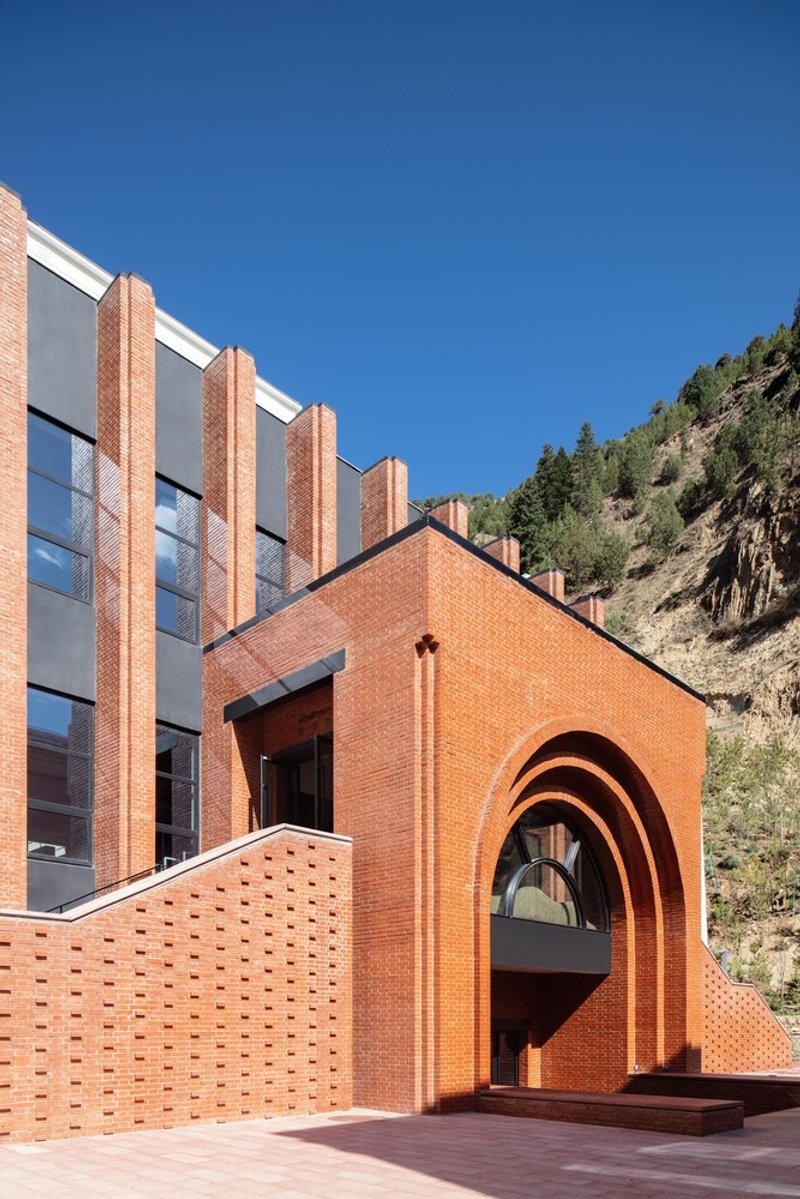
The brick entrance pavilion, with its stacked arches set against a steep hillside scattered with scrub vegetation, is one of the building's most powerful moments. The arches are constructed using traditional brick techniques, and their layered depth creates a sense of passage, of crossing from the exposed landscape into something sheltered and deliberate. The choice to place the arches at both entrances frames arrival as a threshold experience, a shift in atmosphere that the rest of the architecture sustains.
Centripetal Interiors and the Weight of Light
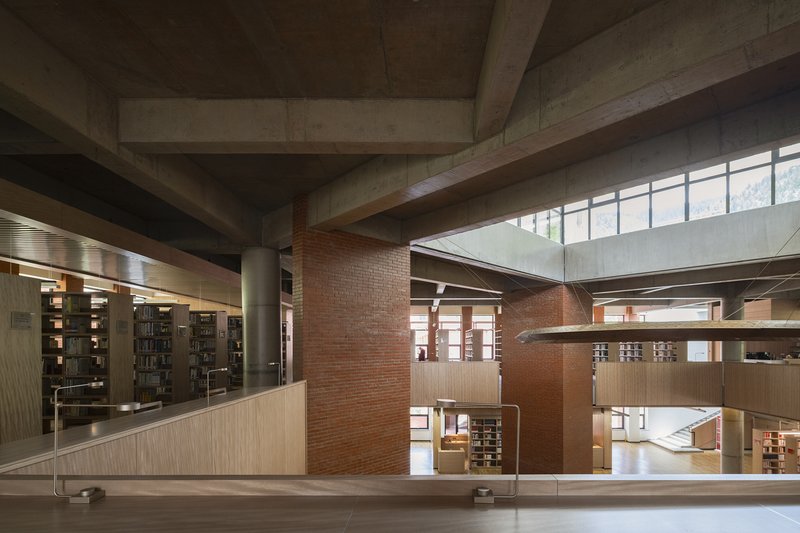
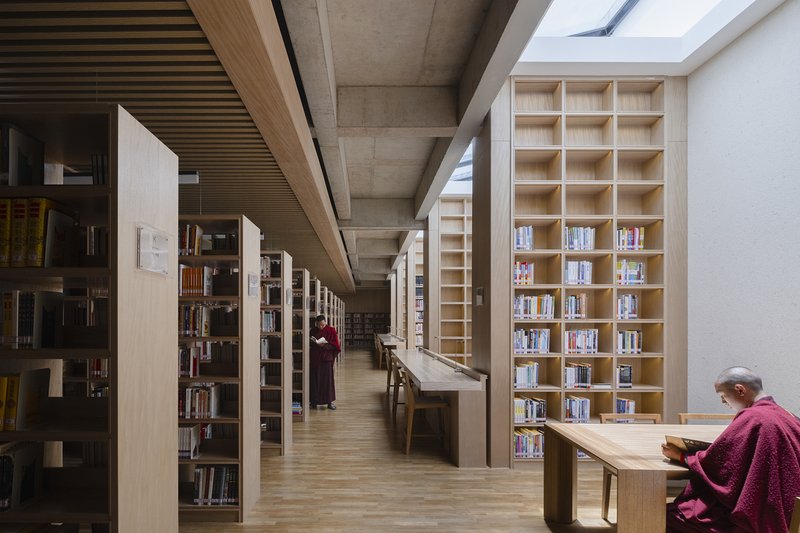
The library's interior plan is centripetal: it draws visitors inward toward a central space crowned by a 45-degree rotated skylight. The spatial sequence moves from the entrance arches through a shared hall and then into progressively more intimate reading zones. Exposed concrete beams span overhead, their rawness offset by the warmth of timber-clad shelving that lines the walls and a slatted timber ceiling that filters the harsh high-altitude light into something softer.
The reading room itself is quiet in the best sense. Two readers sit at timber desks beneath clerestory glazing, the concrete structure plainly visible above. There is no attempt to hide the building's bones. Brick volumes emerge through the interior as spatial dividers and vertical anchors, creating a layered section where books, light, and structure coexist at multiple levels. The windows on the southeastern corner adopt an abstracted Tibetan window profile, but Rong's team has concealed the frames and joints so that the openings appear carved directly from the wall mass.
In Tibetan culture, sunlight carries spiritual significance beyond its practical value. The library leverages this by choreographing how and where daylight enters: from the rotated central skylight, through clerestory bands above the shelving walls, and via the deep-set corner windows. The light is never uniform. It shifts across the brick and timber surfaces throughout the day, marking time in a building designed for the slow, deliberate act of reading.
Material Honesty at Altitude
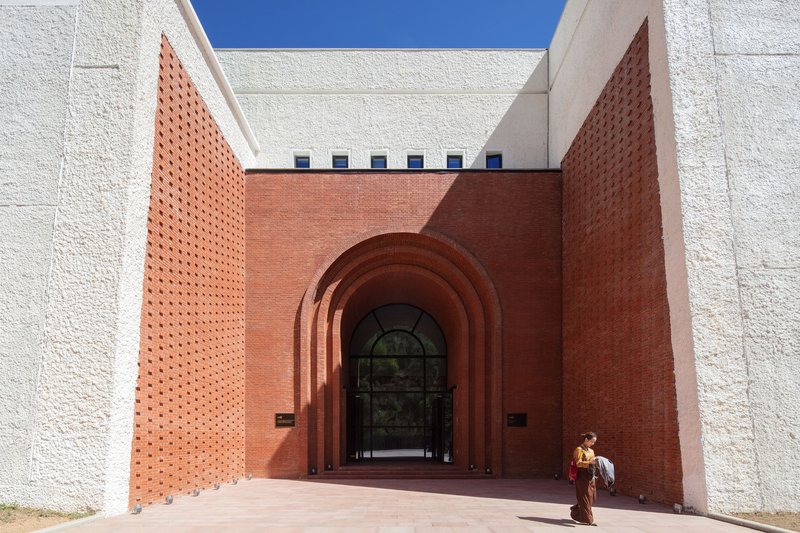
The material strategy, wood, concrete, and brick, is deliberately limited. At 4,000 meters, supply chains are constrained and construction seasons are short. Working with a reduced palette allowed the builders to develop genuine craft within each material rather than spreading skill thinly across many. The brick arches at the entrances are the clearest expression of this: they required precise laying and careful structural understanding, and they reward close inspection.
Rong's studio describes the brick as chosen to "express awe toward the environment," and while that phrasing risks preciousness, the built evidence backs it up. The walls are thick, the joints are tight, and the surfaces carry the irregularity of hand labor without drifting into self-conscious rusticity. There is no unnecessary decoration anywhere. The building earns its presence through proportion, repetition, and material weight rather than applied detail.
Why This Project Matters
The Deba Library matters because it demonstrates what happens when an architecture of constraint meets genuine cultural purpose. The building does not perform remoteness or exoticism for an outside audience. It was commissioned by a local reading association, built over years of sustained effort on site, and designed to serve a specific community's desire for both a library and a museum of Tibetan costume and heritage. That combination of client commitment and architectural rigor is rarer than any formal innovation.
Zhaohui Rong Studio's achievement here is one of calibration. The building is assertive enough to hold its own against a landscape of overwhelming scale, yet restrained enough to let its interiors be quiet places of concentration and reflection. The centripetal plan, the brick arches, the concealed joinery, the controlled light: each decision reinforces the same idea, that a building at the edge of habitable altitude can still be a place of deep intellectual and spiritual warmth. In an era of gesture architecture, the Deba Library makes its case through patience.
Deba Library by Zhaohui Rong Studio. Garzê Tibetan Autonomous Prefecture, Sichuan, China. 6,000 m². Completed 2022. Photography by Zhi Xia and Arch-Exist.
About the Studio
Share Your Own Work on uni.xyz
If projects like this are the kind of work you want to make, uni.xyz is a place to publish your own, find collaborators, and enter design competitions.



Popular Articles
Popular articles from the community

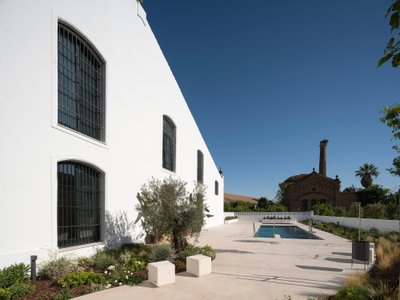
De la Riva Sherry Homes By Juan Vega Arquitectos
De la Riva Sherry Homes transform a historic winery into unique residences, blending industrial heritage, modern comfort, and community-focused courtyard living.

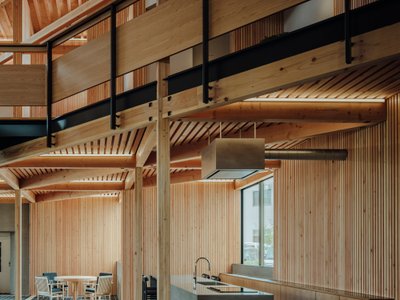
ure LLC Builds a Timber-Framed Suburban Office That Doubles as a Community Living Room in Hiroshima
KItoNOKO wraps sawtooth roofs and corrugated metal around an exposed timber frame to give a commercial district a new civic anchor.
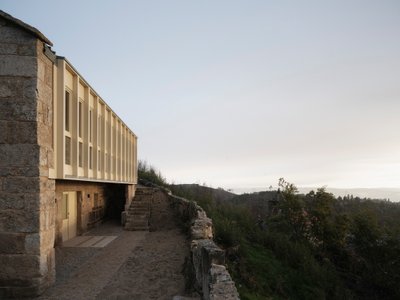
Three Architects Stitch a Social Center into a Crumbling Galician Hamlet
In Muimenta, Spain, timber and plywood volumes graft onto granite ruins to anchor a rural revitalization effort.

CTA | Creative Architects Designs Triangular Floating Shelters for Vietnam's Flood-Ravaged Communities
A timber-louvered triangular shelter rises on concrete pontoons to keep Vietnamese families safe and together when floodwaters come.


Similar Reads
You might also enjoy these articles

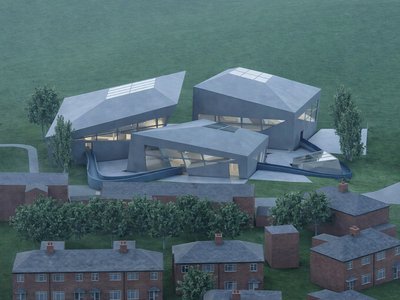
Filtering Space: A Gradual Spatial Experience
From urban intensity to spatial calm.


The Ken Roberts Memorial Delineation Competition (Krob)
As the most senior architectural drawing competition currently in operation anywhere in the world, it draws hundreds of entries each year, awarding the very best submissions in a series of medium-based categories.

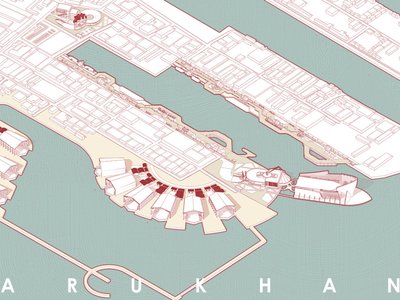
Waterfront Redevelopment and Urban Revitalization in Mumbai: Forging a New Dawn for Darukhana
A transformative waterfront redevelopment project reimagining Darukhana’s shipbreaking heritage into an inclusive urban future.

OUT-OF-MAP: A Call for Postcards on Feminist Narratives of Public Space
Rhizoma Design and Research Lab invites artists, designers, architects, researchers, and students to reflect on how feminist perspectives can reshape public space. Selected works will be exhibited in Barcelona, October 2026. Submissions open until 15 April 2026.

Explore Architecture Competitions
Discover active competitions in this discipline




The International Standard for Design Portfolios


The Global Benchmark for Architecture Dissertation Awards


The Global Benchmark for Graduation Excellence


Challenge to reimagine the Iron Throne
Comments (0)
Please login or sign up to add comments
No comments yet. Be the first to comment!