

Delmulle Delmulle Builds a Courtyard House in Ghent That Leans on Vermeer and Van Hee
Pluim House nestles between party walls in Ghent, threading courtyards and timber screens through a 319 m² domestic sequence.


Building next to a house by Marie-José Van Hee is not a neutral act. Van Hee's architecture in Ghent has become a kind of benchmark for how a dwelling can be simultaneously introverted and civic, and any addition to its immediate context carries the weight of that precedent. Delmulle Delmulle Architecten, led by Seger Delmulle, Frank Delmulle, and Jana De Meutter, chose not to mimic or defer but to compose a parallel conversation. Pluim House, completed in 2022, takes a deep and narrow lot in Ghent and organizes it around two courtyard gardens, threading daylight and planted volume through the entire section of the building.
The architects cite Vermeer's Het Straatje as an image that informed the adjacent Van Hee house, and that painterly attentiveness to the grain of a street, to the way private life registers on a public face, carries over here. What makes the project genuinely interesting is not just the courtyard typology, which is common enough in Belgian urbanism, but the range of atmospheric devices deployed within it: translucent shoji screens, slatted timber soffits, perforated metal gates, and a glass elevator shaft that reads more like a vitrine than a circulation core. The house moves from opacity at the street to transparency at the garden, and the plan drawings reveal a spatial intelligence that the photographs alone cannot fully communicate.
A Street Face of Quiet Composure

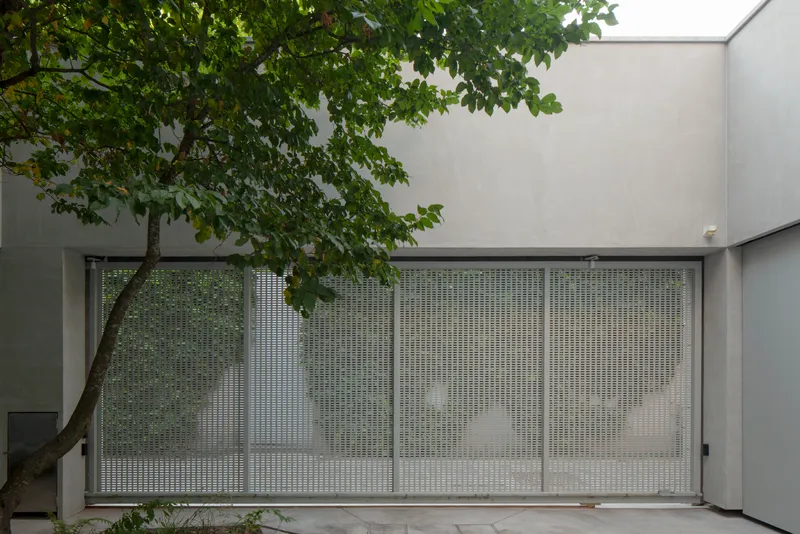
From the street, Pluim House presents a stack of white rendered volumes flanked by the ivy and brick of its neighbors. The facade is deliberately restrained: no heroic gesture, no transparency. A grey tile wall anchors the base, and the massing steps back at the upper levels to reduce its apparent bulk. The perforated metal gate at ground level, framed by rendered concrete walls, gives a controlled glimpse of the planted interior while maintaining a clear boundary between public and domestic life.
This reticence is a strategic choice. In a city where the row house tradition privileges the street wall, Delmulle Delmulle holds the line while keeping their best material for the interior. The street elevation earns its keep through proportion and material discipline rather than spectacle.
Courtyards as Organizing Principle
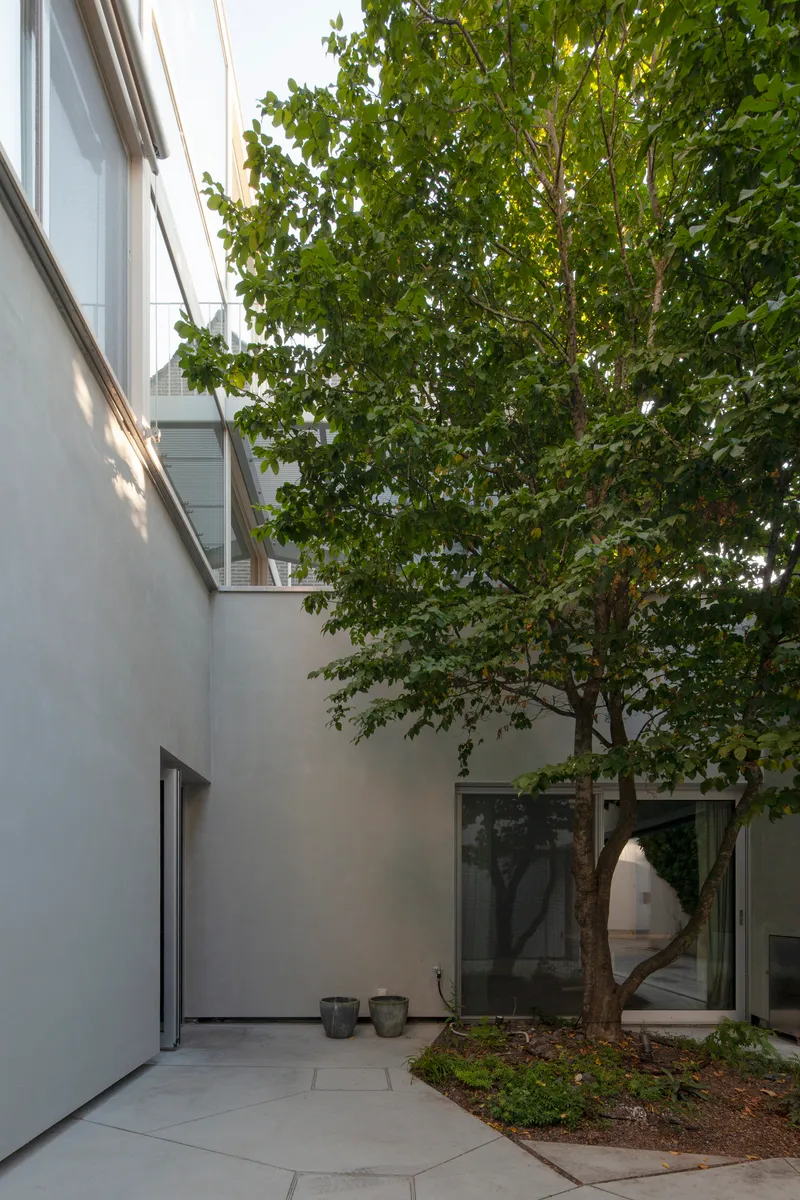


Two courtyard gardens anchor the plan and give the house its spatial logic. The first, visible through large glazed openings, centers on a mature tree whose canopy reaches above the roofline. The second is tighter and more enclosed, planted with tree ferns and suspended vines beneath a timber soffit. Together they turn what could have been a dark and airless party-wall house into a sequence of bright, ventilated rooms that always face something green.
The courtyards also regulate privacy. Because the house is surrounded by neighboring buildings, looking outward means looking at brick gables and tile roofs. By turning the major glazing inward, the architects create a domestic world that feels expansive without requiring views. The gridded translucent facade above the rendered walls in the first courtyard filters light into a luminous haze, so that even overcast Belgian weather reads as generous illumination.
Timber Screens and the Art of Filtering Light
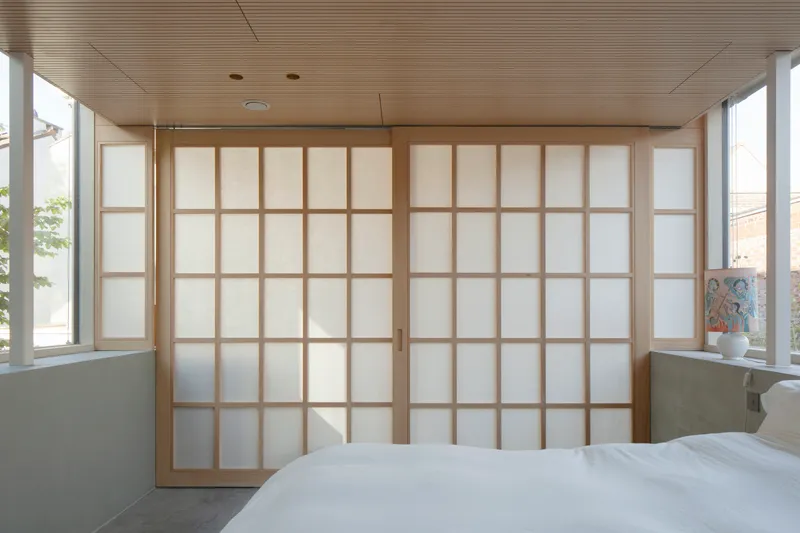


The shoji-like sliding screens are the most distinctive interior element. Constructed with timber grid frames and translucent panels, they subdivide the bedroom level into zones that can be opened or closed depending on the time of day and the desired degree of exposure. When closed, they cast a warm, diffused glow; when open, they frame views through the full depth of the house.
These screens work in concert with the slatted timber ceiling that runs through the upper levels. The ceiling absorbs sound (the material list includes SonaSpray, a spray-applied acoustic treatment) while its rhythm of slats creates a directional quality, drawing the eye along the length of the room. The combination of translucent panels and timber slats gives the private spaces a layered quality that avoids the clinical feel of minimalist interiors.
Living Between Inside and Out

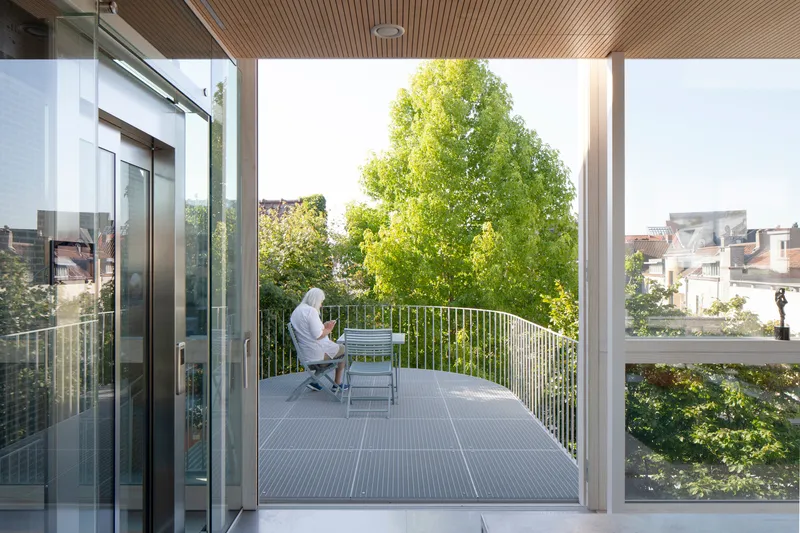
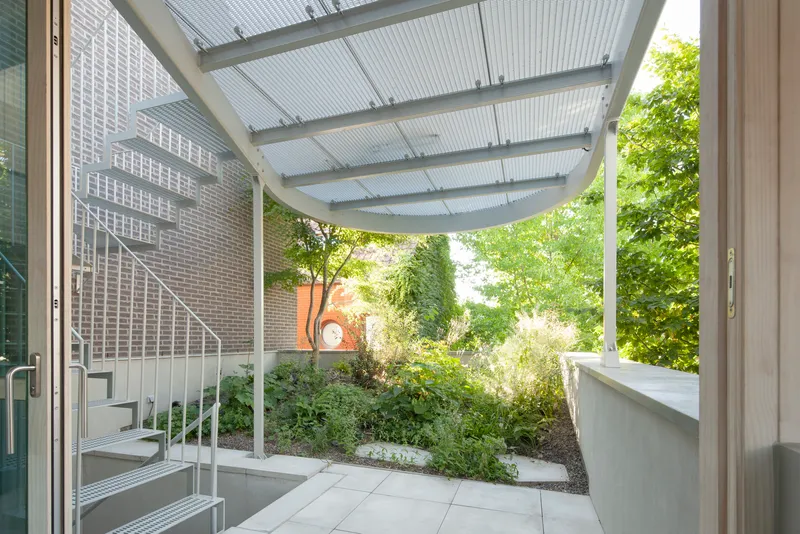
The dining room is the social heart of the house, and its full-height glazing dissolves the wall between interior and courtyard. Red pendant lights punctuate the slatted timber ceiling, introducing color into a palette otherwise dominated by white, concrete, and pale wood. The adjacent covered terrace, where a figure sits reading beneath a tree, extends the living space outward in a way that is genuinely usable rather than aspirational. A corrugated translucent canopy shelters the connection, letting light through while keeping rain at bay.
The material palette here deserves a closer look. Maple parquet flooring runs from the interior onto the threshold, blurring the line between in and out. The Accoya wood used for exterior elements is dimensionally stable enough to weather Belgian winters without warping, a practical decision that supports the seamless transition the architects are after.
Vertical Circulation as Spatial Event

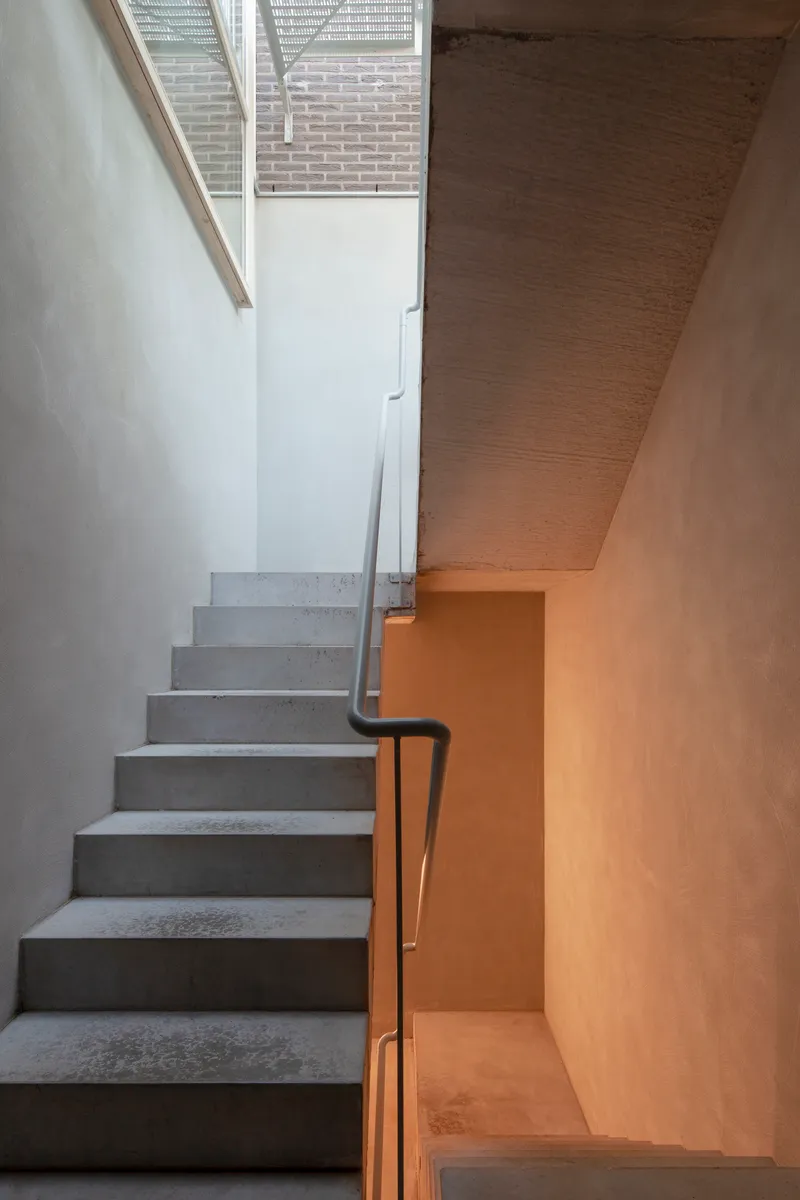

Stairs and an elevator in a 319 m² house might seem like an extravagance, but here they serve different roles. The white perforated metal stair, ascending alongside a pale brick wall under a slatted pergola, is sculptural and open. It belongs to the courtyard world, connecting levels while remaining visually part of the outdoor sequence. The concrete stair with its black metal handrail is more introverted, rising to a glazed opening that frames a brick wall beyond, treating the neighbor's gable as a found composition.
The glass elevator shaft in the kitchen zone is perhaps the most surprising move. It opens onto a balcony overlooking the surrounding brick facades, turning a practical accessibility feature into a viewing device. The transparency of the shaft means it reads as a void rather than a solid, preserving sightlines through the house.
Upper Levels and the Roofscape


At the upper levels, the house opens outward for the first time. A timber-framed glazed volume with a white railing looks across neighboring rooftops, and at sunset the view becomes almost painterly. A curved terrace with a metal balustrade catches afternoon light above the tree canopy. These moments reward the climb and reverse the logic of the lower floors: here, the city is the garden.
The section drawings reveal that these upper levels are not simply stacked above the ground floor but are offset in a split-level arrangement. The shifts in floor height create spatial variety within a compact footprint and allow the architects to calibrate ceiling heights room by room. The bedroom level sits lower, more enclosed; the living spaces reach higher, borrowing volume from the courtyards.
Concealed Surfaces and Material Restraint
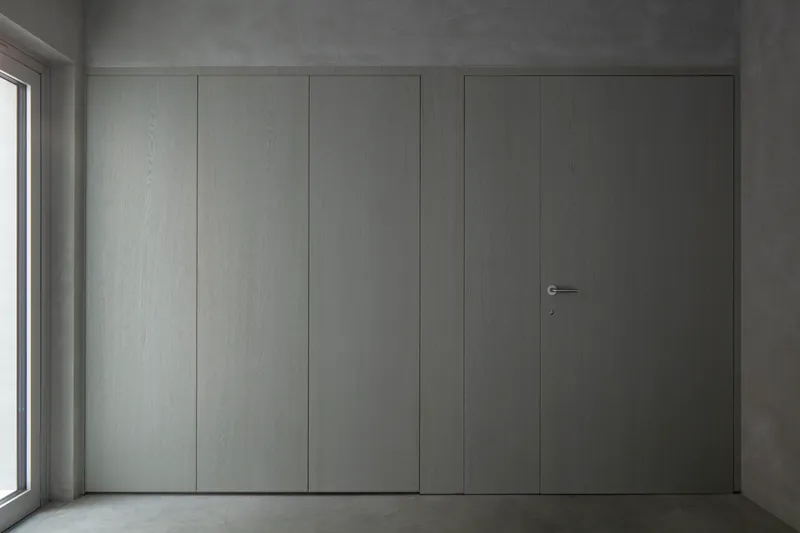

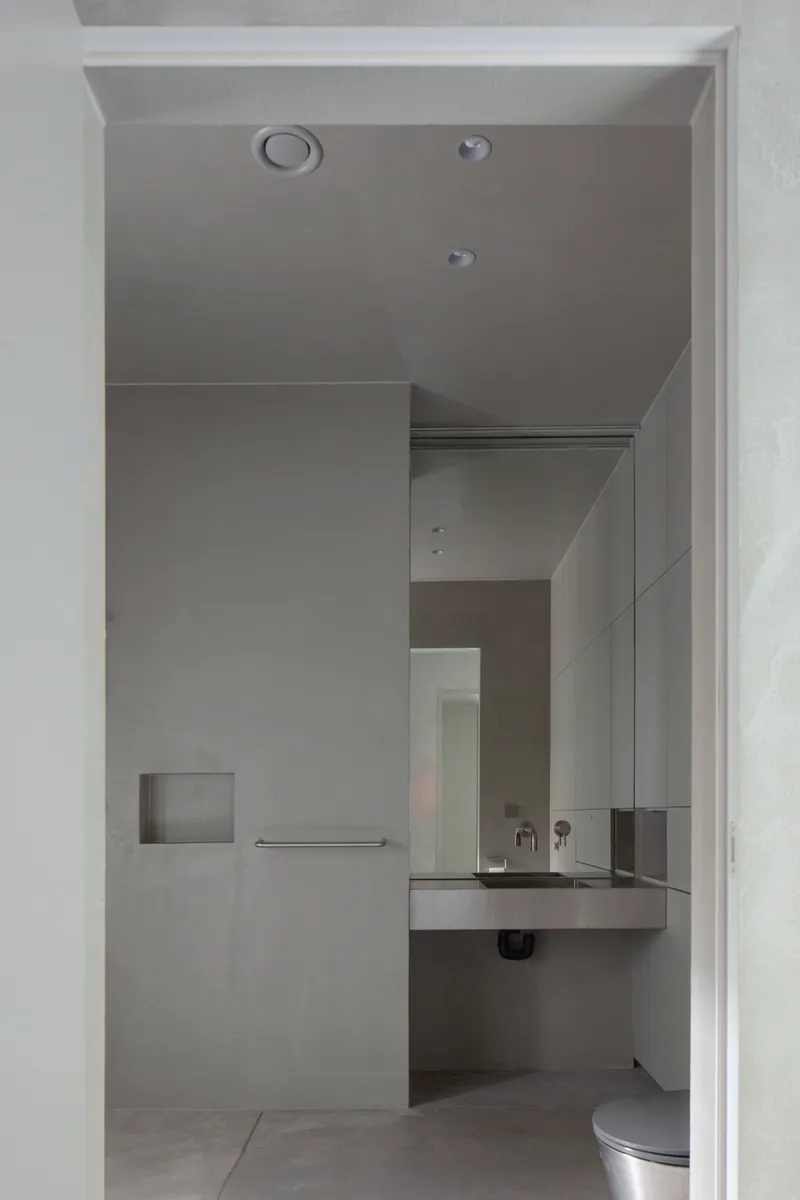
Throughout the house, walls are treated as continuous surfaces with concealed joints. Doors disappear into flush paneling; hardware is minimal or absent. The bathroom, visible through a white doorway, distills this approach to its purest form: a floating concrete sink, a recessed niche, and nothing else. The materials here, Antisone veneer maple and Ayous Chinese Paper among them, are chosen for their tactile warmth rather than their visual drama.
This degree of surface discipline could easily feel sterile, but the constant presence of the courtyards prevents that. Every room that risks austerity is saved by a window that frames a tree fern or a vine. The house never lets you forget that it is organized around living things.
Plans and Drawings
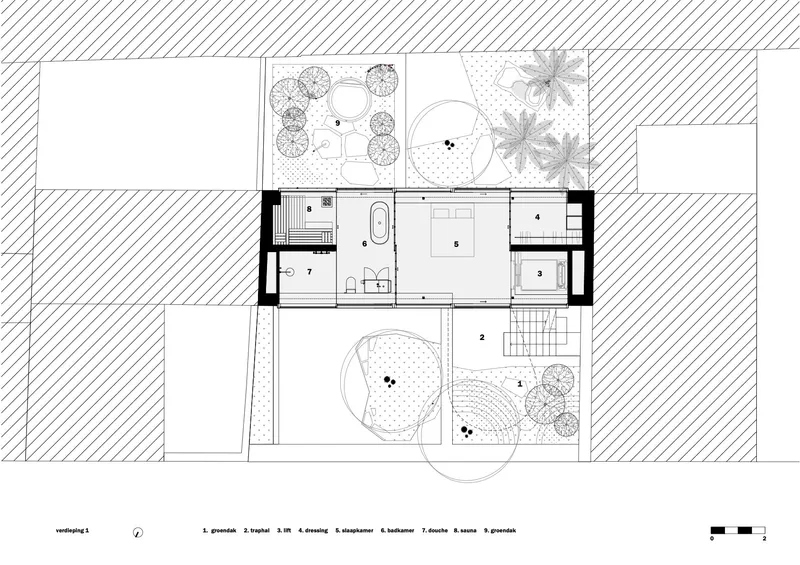
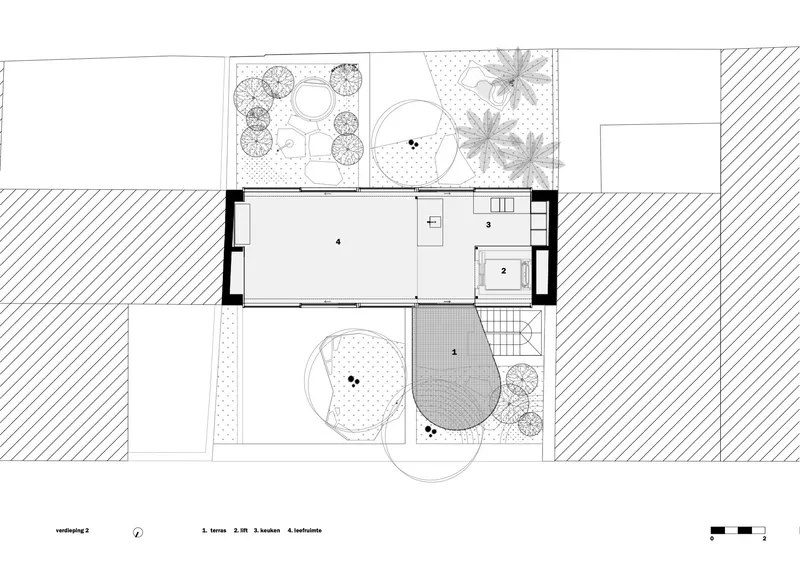
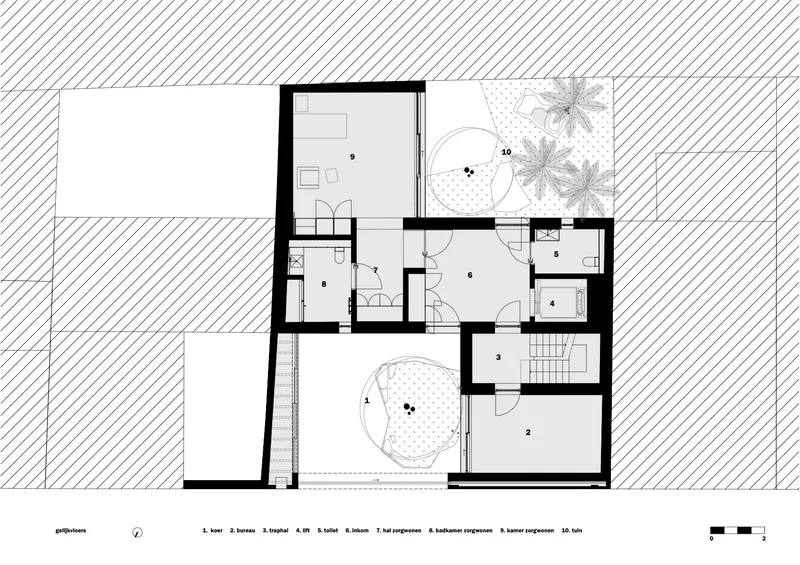

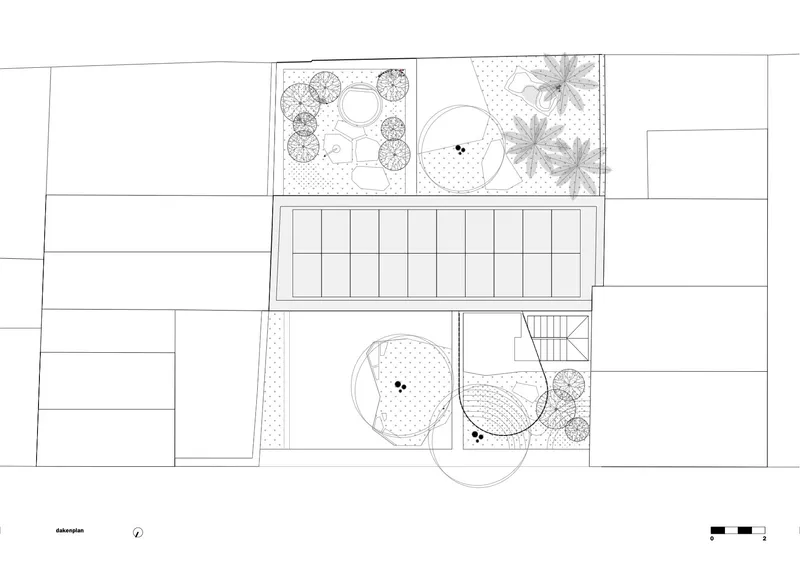


The floor plans make the spatial strategy legible in a way the photographs cannot. The two courtyards, marked by circular paving patterns and tree planters, sit on either side of the main living volume. The house is essentially a long, narrow bar that widens and contracts as it negotiates the presence of these voids. At the upper level, the plan becomes L-shaped, with rooms arranged along a single corridor that terminates at the rooftop terrace.
The sections are equally revealing. The split-level arrangement becomes clear: a partially buried volume with a glazed facade opens onto one courtyard, while the main living floors step up toward the street. The hatched earth in one section drawing confirms that the lower level is cut into the ground, a move that keeps the house low relative to its neighbors and avoids overshadowing the Van Hee house next door. The elevation drawing shows how the glazed panels and textured brick volumes alternate across the facade, giving each face of the house a distinct character depending on its orientation.
Why This Project Matters
Pluim House is a lesson in how to build densely without sacrificing spatial generosity. In a city where party-wall construction is the default, Delmulle Delmulle demonstrate that courtyards, split levels, and translucent screens can produce a domestic environment that feels expansive on a modest footprint. The project does not rely on a single grand gesture but on the accumulation of many considered decisions: the placement of a tree, the angle of a screen, the depth of a reveal.
It also engages intelligently with its immediate context. Building next to a Van Hee house demands a certain seriousness of intent, and the architects meet that challenge by matching her rigor with their own vocabulary. The Vermeer reference is not cosmetic; it speaks to a shared interest in how ordinary domestic life achieves dignity through spatial composition. Pluim House does not shout. It builds a world behind a quiet street wall and rewards anyone patient enough to step inside.
Pluim House by Delmulle Delmulle Architecten (Seger Delmulle, Frank Delmulle, Jana De Meutter). Ghent, Belgium. 319 m². Completed 2022. Photography by Johnny Umans.
About the Studio
Share Your Own Work on uni.xyz
If projects like this are the kind of work you want to make, uni.xyz is a place to publish your own, find collaborators, and enter design competitions.


Popular Articles
Popular articles from the community


Cube Design Draws an Ecological Corridor Between Two Shenzhen Hills with the Nankai Building
Beside Shenzhen's container docks, the Nankai Building pairs stacked balconies with a climbing green screen to connect two hillsides across its height.


Manzana Morphosis: Stretching Barcelona's Grid into a Living Landscape for 2050
A radical reworking of the Eixample manzana turns density into a tool for generous public space, vertical ecology, and environmental performance.

The Amber Palace Opera: A Geological Fiction Surfaces on Tallinn's Baltic Waterfront
Pierre Brillard reimagines a Baltic legend as a public landscape, opera house, and waterfront promenade rooted in Tallinn's coastal identity.

FCC Arquitectura Expands a Portuguese Granite House with a Board-Marked Concrete Wing
In Portugal, JV House pairs a cleaned-up whitewashed and granite dwelling with a timber-shuttered concrete extension, courtyards and a garden pool.

Similar Reads
You might also enjoy these articles

LAVA Architecten Gives Vocational Education a Sawtooth-Roofed Face on a Mechelen School Campus
In Mechelen, Belgium, a 2,053 m² STEM school on a 6×6 m grid turns workshops and classrooms into rooms that can be rearranged as teaching changes.

KEMA Studio Turns a Derelict Marvila Attic into a 60 m² Lighthouse Apartment Above Lisbon
In Lisbon's Marvila district, a rebuilt roof, four skylights and two plywood volumes turn an unlivable attic into a bright home facing the Tagus.

Pixel Gardens: One Repeated Module Stacked Into a Terraced Social Housing Tower for Famagusta
Salem Bader's shortlisted housing tower builds a vertical neighbourhood from one repeated module, offsetting units to carve terraces, light and air.

Bao Huynh Watercolor Atelier: A Serene Art Retreat in Hội An
Bao Huynh Watercolor Atelier in Hội An blends multifunctional art spaces, sustainable design, local materials, and family-friendly living in a serene environment.

Explore Geurst & Schulze Architecten Competitions
Discover active competitions in this discipline

Comments (0)
Please login or sign up to add comments
No comments yet. Be the first to comment!