
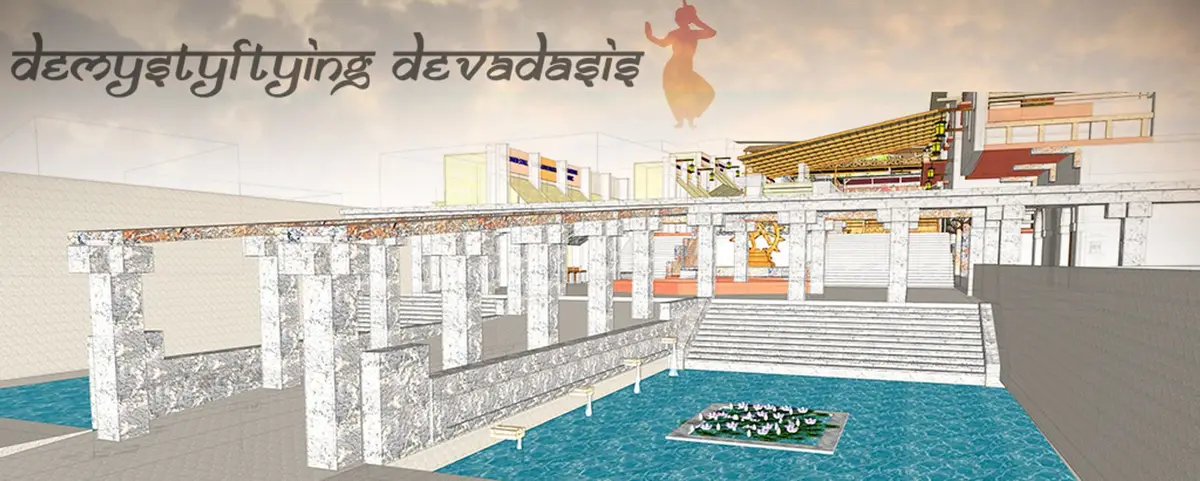
Demystifying Devadasis: Architecture That Restores Cultural Identity in Saundatti
A rehabilitation center in Karnataka reinterprets the Natya Mandapa to weave dance, craft, and economic agency into the fabric of a temple town.


What happens when architecture refuses to treat rehabilitation as containment? In Saundatti, a small temple town in Karnataka's Belgaum district, a thesis project proposes a cultural center that does not wall off its occupants from the city but instead dissolves into it. The Devadasi system, historically rooted in sacred dance and temple ritual, has been flattened by centuries of socio-political upheaval into a stigmatized identity. This project takes a different position: rather than designing a welfare institution, it builds a spatial argument that the Devadasis are bearers of intangible cultural heritage, and that their rehabilitation must happen through the very culture that was taken from them.
Designed by Yamuna Sakthivel as an undergraduate thesis in 2016, this was a shortlisted entry in UnIATA '18. The project is sited along the primary spine of Saundatti's settlement, maintaining a deliberate visual and spatial relationship with the town's temple. It unfolds not as a single object-building but as an urban sequence, a series of mandapas and courts that blur the line between street, institution, and public realm.
Mandapas Fragmented Along a Temple Axis
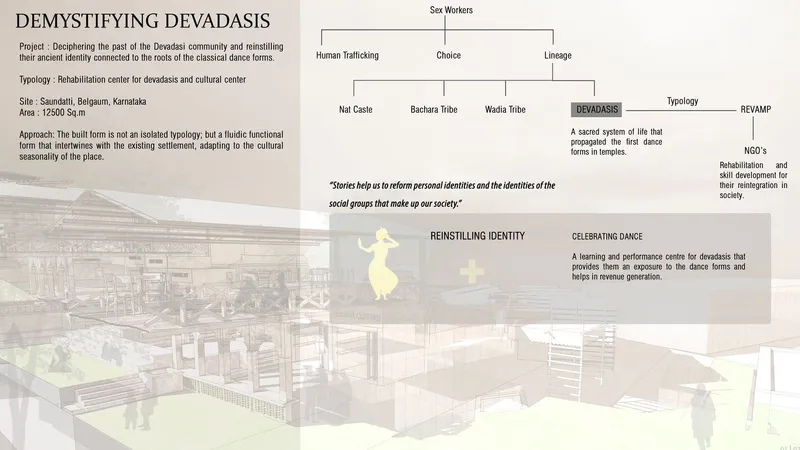
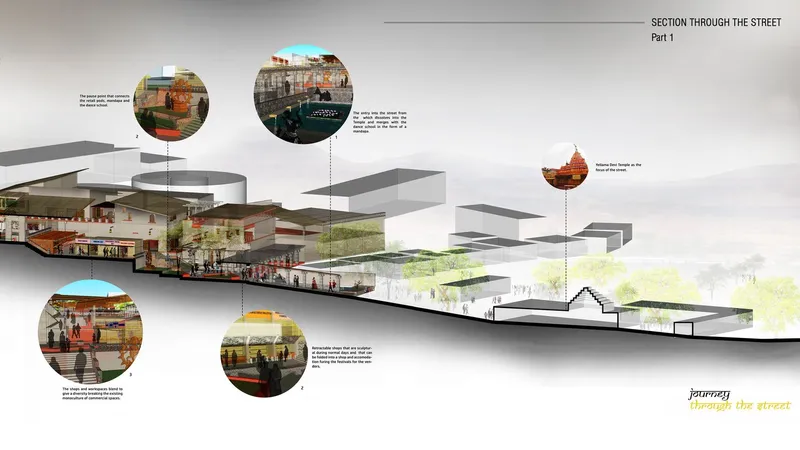
The architectural concept draws directly from the Natya Mandapa, the traditional performance space found within temple complexes where Devadasis once danced. Sakthivel abstracts this typology into a series of concentric and fragmented mandapas distributed along the street, each defining a different degree of enclosure, privacy, and performance intensity. The axonometric diagram reveals this logic clearly: intimate rehearsal zones sit alongside open performance courts, while the conceptual framework annotations trace how dance, craft, and community interaction are woven into a single spatial sequence rather than separated into discrete institutional blocks.
The section drawing through the street shows how stepped building volumes negotiate the site's slope, with circular detail callouts highlighting transitions between interior and exterior. A subtle but powerful move is the tilting of axes throughout the plan, symbolically representing the historical deviation of Devadasis from their original cultural path. Architecture here acts as a corrective, a realignment that is spatial before it is social.
The Street as Cultural Infrastructure
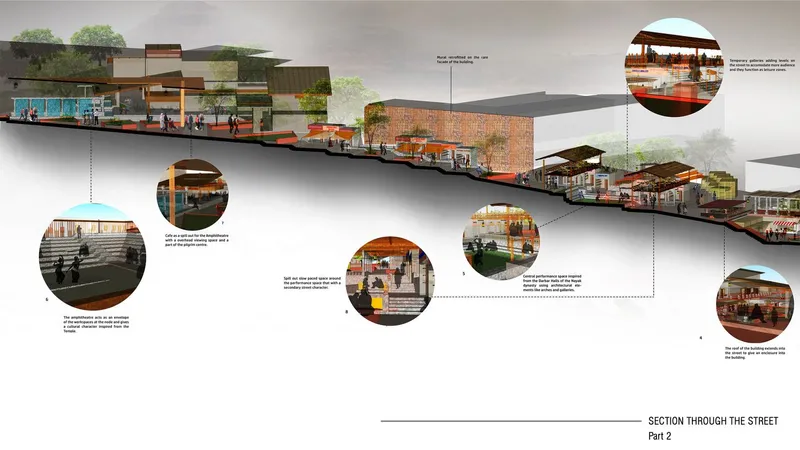

Saundatti is a town shaped by seasonal pilgrimage. During festivals, the street transforms: temporary settlements appear, informal commerce lines the edges, and ritual movement overtakes vehicular logic. Sakthivel treats this existing condition not as a problem to be managed but as a design resource. The section drawing through the sloped street shows brick buildings and canopy structures that frame public space without closing it off. Circular insets reveal the interiors of these volumes, where workshops and gathering spaces maintain visual connectivity with the street. The architecture is porous by design, allowing dance and craft to spill outward.
The rendered courtyard view reinforces this strategy. A central planted area is flanked by timber screens that modulate privacy without erecting walls. Silhouetted figures occupy the space casually, not as visitors to an institution but as participants in a shared urban life. Temporary pop-up structures during festivals are intended to expand the performance landscape further, treating the entire street as an adaptable cultural framework rather than a static monument.
Rehabilitation Through Mixed Program, Not Isolation
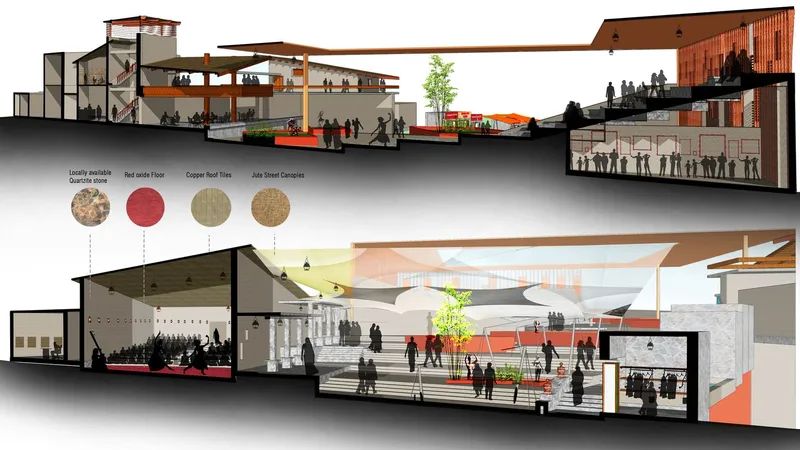
The programmatic strategy is where the project's social ambition becomes concrete. Dance learning and performance spaces coexist with skill development workshops for tailoring, metalwork, and crafts. Retail units supporting micro-economies line the street edge, and community gathering courts double as semi-public galleries. NGO offices and training rooms for reintegration are embedded within the complex rather than separated from it. The section drawings here show gathered figures occupying these diverse programmatic spaces, with material palette swatches indicating a commitment to local construction: brick, timber, and exposed structural elements that ground the architecture in the region's building culture.
The critical insight is that continuous activity throughout the day and year prevents the center from becoming a ghetto. Visual connectivity between programs reinforces transparency and shared ownership. When a woman in a tailoring workshop can see a rehearsal happening in the adjacent court, and a passerby on the street can witness both, the architecture actively dismantles the stigma that isolation would only reinforce.
Sacred Geometry Reclaimed as Public Space
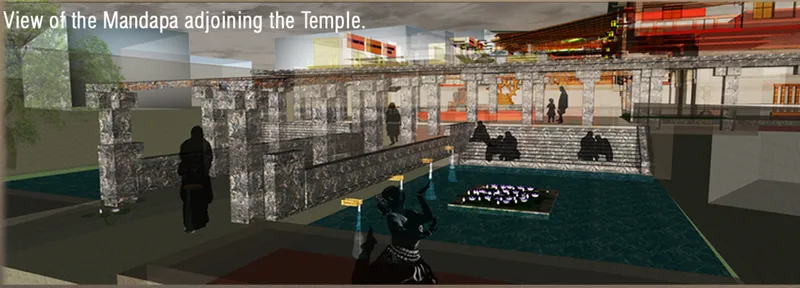
The final rendered view is perhaps the project's most evocative image. A columned platform sits adjacent to the temple, figures gathering in shadow beside a reflecting pool. The composition recalls the spatial quality of the original Natya Mandapa: a place defined by columns, shade, and the presence of gathered bodies rather than by enclosing walls. The reflecting pool introduces a stillness that contrasts with the surrounding activity, creating a threshold between the secular rehabilitation program and the sacred geography of the temple.
By positioning this platform in direct dialogue with the temple, Sakthivel makes an architectural argument that is also a political one. The Devadasis' relationship to sacred space was not an aberration to be corrected; it was a cultural practice to be understood and, through architecture, reclaimed on new terms.
Why This Project Matters
Rehabilitation architecture too often defaults to institutional typologies that isolate their occupants from the very communities they need to reenter. Sakthivel's project rejects this default with precision and conviction. By deriving its spatial logic from the Natya Mandapa, aligning its axes with the temple, and distributing its program along an existing urban spine, the project treats culture not as decoration applied to a building but as the structural principle that organizes space, economy, and social life.
What makes this thesis exceptional is its refusal to separate the architectural problem from the social one. The question is not "how do we house a rehabilitation program" but "how does space itself become rehabilitative." In a discipline that frequently struggles to connect built form to lived injustice, this project demonstrates that the connection can be direct, specific, and architecturally rigorous. The mandapas of Saundatti are not metaphors. They are rooms where dignity is rebuilt through practice, visibility, and the simple act of occupying public space.
View the Full Project
About the Designers
Designer: Yamuna Sakthivel
Enter a Design Competition on uni.xyz
uni.xyz runs architecture and design competitions year-round that reward proposals with spatial conviction and real site intelligence.
Project credits: Demystifying Devadasis by Yamuna Sakthivel UnIATA ’18. (uni.xyz).


Popular Articles
Popular articles from the community


Aquadapt: An Underwater Habitat That Rewrites Its Rooms by the Hour
Curved modules ring the seabed while one shell shifts from breakfast room to cinema, farm and football pitch as residents' needs change.


Cube Design Draws an Ecological Corridor Between Two Shenzhen Hills with the Nankai Building
Beside Shenzhen's container docks, the Nankai Building pairs stacked balconies with a climbing green screen to connect two hillsides across its height.

Opera on the Sea: Driftwood Logic Shapes a Timber Opera House on Estonia's Coast
Trevor Orgill's opera house translates the entangled drift of floating timber into a civic building where wood, water, and music converge.

David Ortega Stacks a Two-Story Mexico City Penthouse Around a Steel Stair and a Pergola-Shaded Roof Terrace
In Colonia Roma, a 300 m² penthouse uses oak joinery, a planted steel stair and a slatted roof pergola to make a new-build apartment feel like a house.

Similar Reads
You might also enjoy these articles
Yenisei Monitoring Center: A Sun-and-Moon Sphere Anchors a Research Campus on Siberia's Great River
In Krasnoyarsk, shifting square blocks, a glazed central sphere and descending window rhythms turn river science into a public spectacle on the Yenisei.
Andretta Artist's Village: A Node-Based Masterplan That Lets the Hills Write the Plan
A cultural landscape strategy for Palampur's artist colony threads studios, residences and stages along a porous spine shaped by the Dhauladhar terrain.
Street Children Rehabilitation Center: A Brick Campus That Eases Children From Street to Safety
A low-rise courtyard campus where learning streets, uthans and shaded verandahs stage a gradual passage from street into protective, family-scale life.

The NEON Culture: A Field of Pavilions Built for the 24-Hour City
Smaran Alva spreads galleries, stages, clubs and markets across a varied site, treating light, sound and ramped movement as the real building materials.


Comments (0)
Please login or sign up to add comments
No comments yet. Be the first to comment!