

Design of modular accommodation units
Compact homes
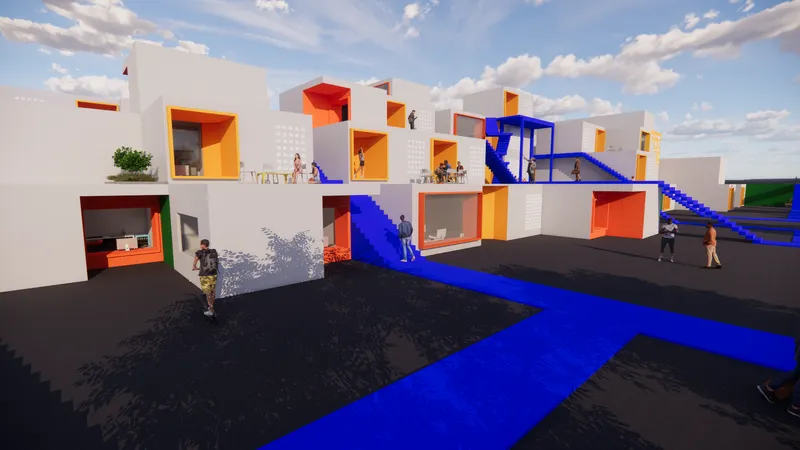
After many sketches for this project, what I came to conclusion was to move the whole project into the ground for about 3.20 meters. Therefore, I formed the units stratified in front of the direction of sunlight.
New Zealand is a country where the weather is mostly raining, but you can often see the sun in the sky as well.
In order to enjoy the maximum possible sunlight throughout the day, I designed the units to have as many wide windows as possible.
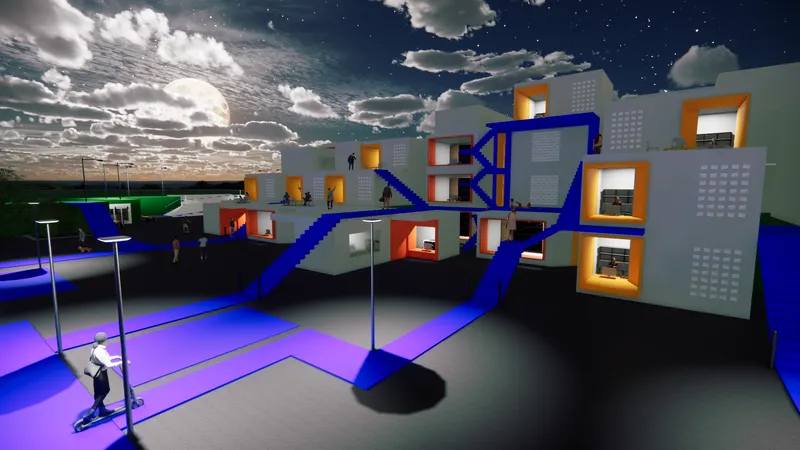
Bearing in mind that these units are aimed to be inhabited mostly by workers such as freelancers, software engineers, etc., I made these housing units a place where you can see your neighbors or colleagues as they work; and because these people are most likely night owls, these units provide them with a comfortable and competitive workplace/house, giving the site a terrific view as well.
You can see some shops built into the body of the site plan. There are coffee shops, restaurants, a supermarket, a green grocery, and even a liquor store. These local shops give students a chance to find a job close to their home. This provides the opportunity for the freelancing students to have a second occupation near their first workplace (aka their homes), if need be.
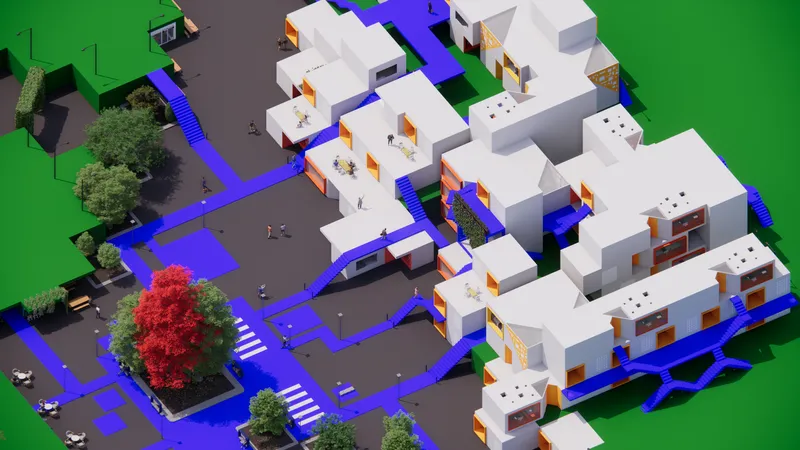
The blue sections of the project might look curious at first, but they are in fact the horizontal and vertical access paths that penetrate the project and circle through it.
You can enjoy a game of colors in this project. In addition to bold some parts of the project using the colors, I aimed to make an eye-catching home place, contrary to typical housing complexes that merely have a cold, dry soul.
I also designed the terraces to act as common areas for the dwellers of neighboring units, a place to sit down together and interact.
The material incorporated into these units is High-Pressure Laminate (HPL) in white and orange colors. This material shows good resistance against pressure, rust, etc., and one good benefit of choosing it is the thin width of the laminates.
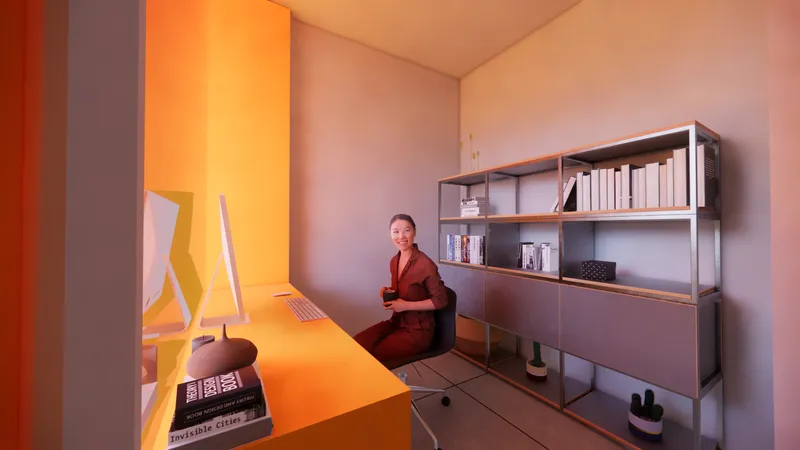
In the interior design of the units, the facade of the building continues into the unit (the orange section) to be a part of where the desk and the study is placed.
In the bedroom section, the bed is design in a way that in case more space is needed, it can be folded into the wall and finally look like a wall cupboard.
Perhaps considering the main focus of the interior (i.e. being the workplace), the main, biggest window of the units is the window across the desk, attracting the center of attention to this space, especially during the night.
80 housing units are designed in this project, 54 of which are single units with 2 different designs. The other 26 units are double, 5 of which are exclusively designed as duplex. These units are designed in a modular way, allowing the project to be further expanded in the future.
Around the units, the general green space is seen. I have tried not to plant many trees around the units, since the project might be further expanded in the future and planting many trees will eventually result in (sadly) cutting them . So I did not add trees in the expanding part of the complex. Instead, in the -3.20m level of the design area and also in the entrance of the site, a reasonable green space was designed.

Popular Articles
Popular articles from the community


The Amber Palace Opera: A Geological Fiction Surfaces on Tallinn's Baltic Waterfront
Pierre Brillard reimagines a Baltic legend as a public landscape, opera house, and waterfront promenade rooted in Tallinn's coastal identity.
Faces of the Soviet Avant-Garde: Turning Moscow's Street Names into an Open-Air Museum
A network of sculptural installations across a Moscow residential district transforms forgotten architect names into spatial encounters with cultural memor

Cloaked Colonization: A Mobile Underwater Habitat That Moves Like a Fish
Micah Abaya's shortlisted EHC Pacific entry reimagines ocean settlement as a dispersed network of self-sustaining architectural organisms.

Temporary Home for Dogs: A Reversed Zoo Rethinks Animal Shelter Architecture
In Bucharest, a sinuous corridor and freed landscape flip the logic of containment, designing a shelter that works to make itself unnecessary.

Similar Reads
You might also enjoy these articles
Sustainable Architecture Design: Embracing Nature and Modernity at Villa Solsidan
The article explores Villa Solsidan by AndrénFogelström, showcasing its sustainable architecture design and integration with the natural surroundings in Saltsjöbaden, Sweden.

Maya Harvest: A Cacao Resort Village Rooted in Mayan Tradition and Local Craft
Situated within a Tabasco cacao plantation, this shortlisted resort proposal merges vernacular materials with hands-on cultural immersion.
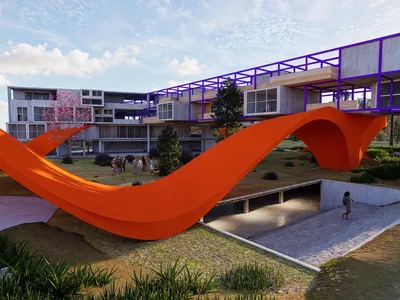
Harmonia: A River-Shaped Community That Grows Over Decades in Boa Vista
Curved pathways and modular grid structures along the Branco River create a phased settlement designed to evolve from 2030 to 2050.
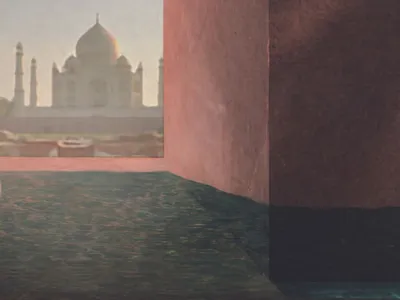
The Architecture of Bathing: A Mughal Hammam Reimagined Across the Yamuna
Charlotte May's honorable mention entry for The Black Taj reinterprets Agra's bathing rituals through red sandstone, water, and framed views of the Taj Mah

Comments (0)
Please login or sign up to add comments
No comments yet. Be the first to comment!