
Designing frameworks and forms of Education
Changing the perception of schools and conceive a new model of school with a vehicle of the built environment.


Today’s mode of education
Our children are sent to school with the best intention, believing that formal education is what kids need to become productive, happy adults. Meticulously enough, parents gauge different schools based on their rankings, curriculum, faculty, their infrastructures overall.
Which eventually boils down to perceptions like best schools = costly fees. But what if the model itself might be unfit for today?
There might be many similar questions raised by time as society moves ahead. Doubts which question the very existence of schools. But their contribution to today’s world cannot be disregarded without evaluating what’s going wrong here. Logically, schools were the best models of education in a time when the dissipation of knowledge was at its least. Initiatives like setting up institutions were then taken to set standards of education to ensure learning reaches many.
Standards, which will still hold relevance when we migrate to a new place. Standards, which enable the model of school, could scale from a cult to a more universal entity spreading knowledge.
But what if these benchmarks are threatening a school’s relevance today?
Idea of Schools
The idea of schools, where a certain ‘individual’ with a certain ‘curriculum’ - teaching to a set number of ‘students’; as a model has derived itself from a long journey.
There is various evidence found in several empires where ‘schools’ were developed as a setup to imbibe purpose-driven knowledge. The function of this tool was predominantly to transfer religious or linguistic knowledge in times where civilizations were under constant threat of existence. The authoritative approach to teaching with almost no opportunity to evaluate what is being taught is an outcome of this age.
As times have evolved, schools have become an essential agenda of governments. They have a more secular approach to teaching today than in the past. Schools might have adopted digital technologies like online homework submission, E-exams or Webinars - but the fundamental frameworks are more a result of history and less of scientific evidence/findings.
But even if the frameworks are derived from the past, what exactly is making them un-useful today?
Issue
There are various reasons why traditional school models are battling for relevance today. A few of them are laid down below:
The top-down, teach-and-test method, in which learning is motivated by a system of rewards and punishments rather than by curiosity or by any real desire to know, is the first place to begin the inquiry. What follows this inquiry, is the curriculum, questioning its usefulness to the vast amount of children who cannot question the authority/board. Lastly is the competitive environment that the children have to be moulded into, is this eroding creativity/critical thinking?
Almost any grownup individual usually can raise similar doubts. However, when one of the key objectives of schooling which are usually stated as building careers - when they are not being met, there’s certainly a huge problem. This is usually caused by the rapidly outdating conventional learning provided against the evolving work and technology.
Is this evidence enough that there should be a call for newer models of learning?
Friction
While there are so many fundamental issues stated, what a school can offer as a function is highly irreplaceable. Parents may impart knowledge to their children, but what they can’t give is a learning environment and the company of more children. A place where a child experientially learns more than any teaching.
And hence, there are a lot of opinions but no real alternatives. There are a lot of experiments happening globally which sparks new hope of how we look at learning, but there’s no clear direction of what a model school should be. A few directions speak of giving entrepreneurial qualities right at the beginning, or to making them aware of world views, or even teaching children technical work-life right away and it goes on.
As these are mostly experiments, the results may or may not go in favour - but as most educational endeavours are being led by businesses, in the end, what matters is a success.
The success of children, Success of classroom, Success of Enterprise. But; is success a definite objective? On whose success are we investing here?
Balance?
With the growing world population, the K-12 education market has become a lucrative business opportunity - where all it matters is to churn out a faster number of students - and make them ‘succeed’. The fundamental drive of this innovation is led by a market force - it's difficult to find out what is the right way. Can you spot what is missing here?
Brief
The problem with schools is not only the frameworks, but the outdated built forms they spring from as well. Hence, the actual issue is not just about the way of teaching but the perception of school as a function. As an advocate of a better environment, designers can not only argue what may be the right direction to move but show how the model of a better school of today could be.
The design challenge was to conceive a new model of school with a vehicle of the built environment to portray it.
The challenge did not dwell into drafting an education curriculum as academicians are much better individuals to do this. Our role in this problem was to discover how valuable learning models can be imparted with newer forms of the built environment.
How existing schools can be made more friendly to these essential life skills through smaller retrofits?
How to prepare our children with dependable thought processes that work in tandem with our changing societies?
How existing perceptions of pedagogy can be shaken up so schools are compelled to evolve?
As most cities are mitigating problems with density how can schools be stacked but still not lose their means of imparting a holistic education?
Objectives
The following were the given objectives for the design challenge:
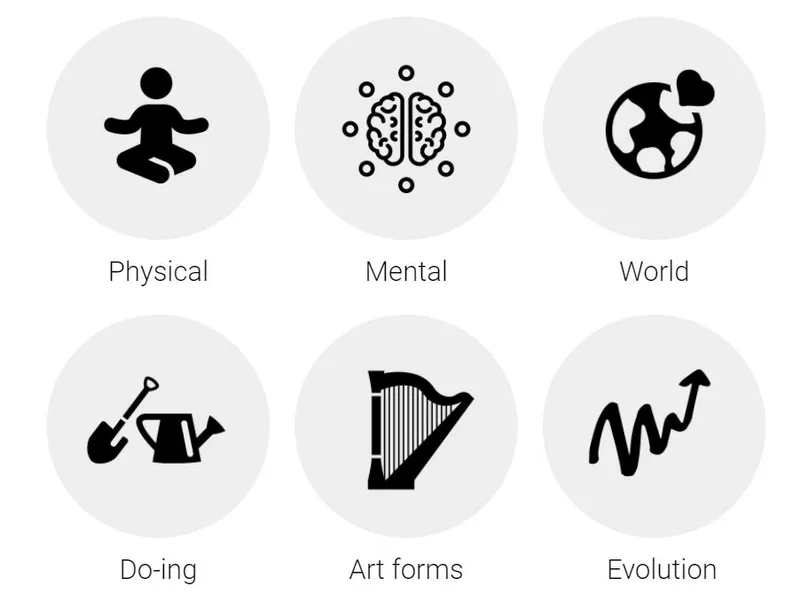
Physical: How the body can be trained for wellness using various activities. How children can be taught what’s good to eat, etc.?
Mental: How traditional learning can be translated into more fun/experiential ways of developing reasoning?
World: How can children discover their connection to the planet, nature, culture and the world around them?
Creativity: How can a child explore learning by doing things and exploring how things work by doing?
Art forms: How can a child explore various forms of art forms. Eg. Dance, Music, Painting, etc.
Evolution: How these forms of teaching will constantly evolve with time considering the larger period.
User
The recommended age band we proposed was 5yrs - 12yrs. The participants flexibly chose an age band of their choice based on the concept - but the quantities shall be met.
Here are the best of competition projects:
Winning project: SITUATIONS SCHOOL
By: Mariana Rios, Lety Lozano
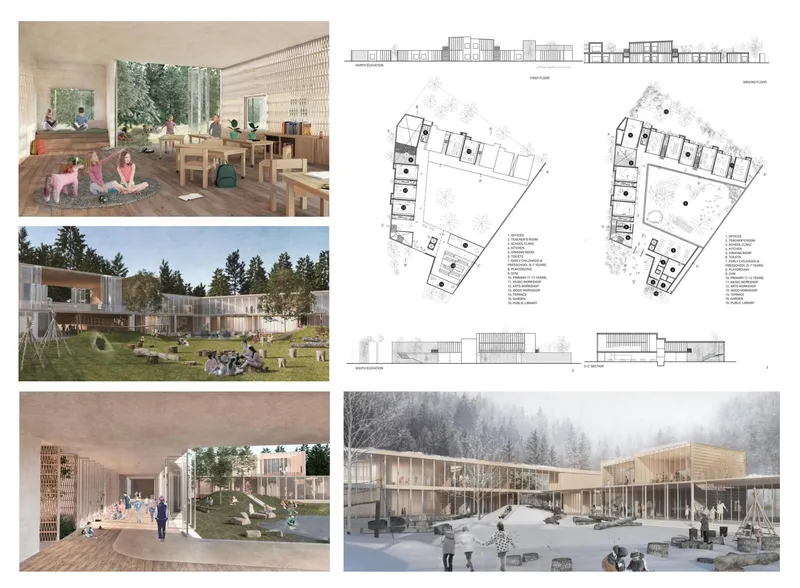
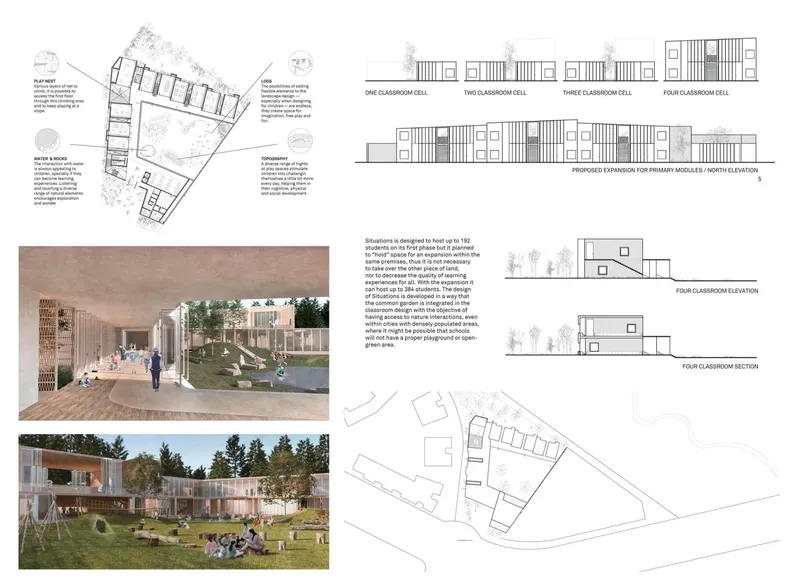
Description: We believe learning should not be restricted to a specific space, it needs to be a nonstop process, a mindset to transform all human-made environments into learning opportunities. Therefore a school should be a place where children learn how to learn through their natural behaviours? play and exploration? and at their own pace.
Various Models of Learning in the design strategy: The design concept began by deconstructing the classroom as the first cell where the learning process happens, the space can be adapted for an instructive learning situation where everyone can choose from sitting or lying down on the floor, whatever feels more comfortable to pay attention to a teacher. The extension of the classroom was designed to be of advantage for the learning by doing situations where children can create something individually or together. Every classroom is designed to have access to a small garden, where children can interact with nature and learn by observing and exploring. Every four classrooms share a common garden to encourage self-initiated projects between classrooms, favouring interaction between peers of different ages, and developing a sense of pride and belonging. On the far end of every classroom, there is a small bay window where children can sit and do some learning by themselves or go with some peers and enjoy the exterior views.
-----------------
Honorable Mention: JUST SCHOOL
By: Жук Иван and Пoлина Вязoвская
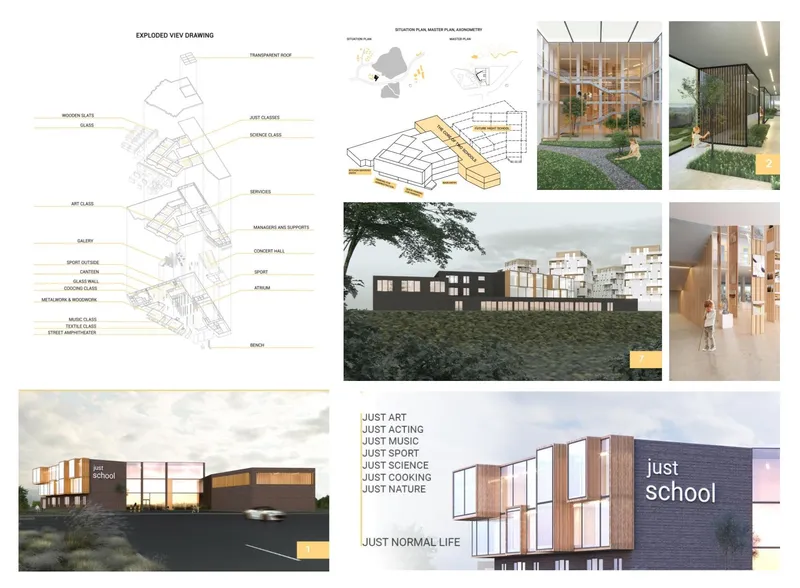
Description: The project of our school involves an education system without a system, but with a huge number of opportunities for self-development. Students must create a comfortable atmosphere for themselves. There are classes of metalwork & woodwork, music, art, cooking, science, textiles, a sports hall with a stadium, and a concert hall with an easy-to-use backstage.
-----------------
Honorable Mention: PLAY = LEARN BETTER
By: 东旭 朱, 翔 S.H, 咩 川
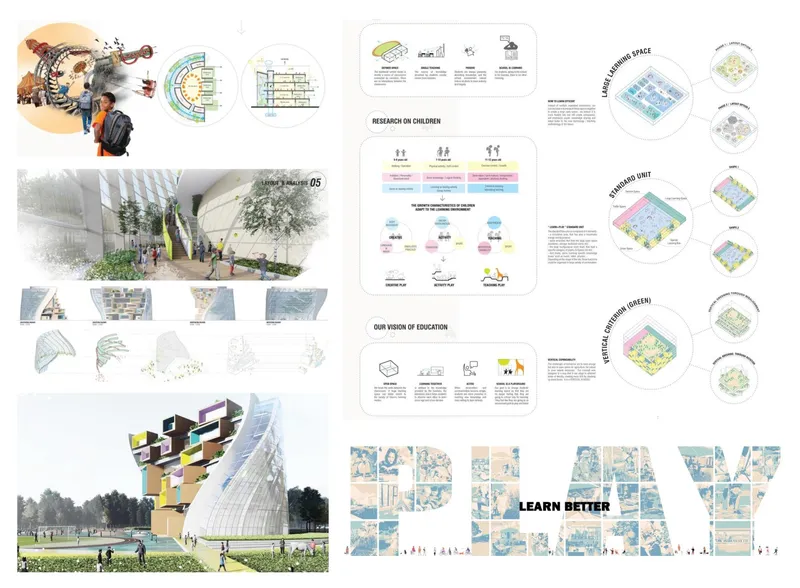
Description: Our research on learning methods, regardless of the age category of the pupils, conclude that PLAYing can promote children's learning process. PLAY is the key to learning and adapting to tomorrow's environment. Our Architectural concept proposes to focus on the activity of playing by creating a "large multipurpose space" to meet the PLAY needs'.
-----------------
Honourable Mention: COMMON LEARNING HOUSE
By: Christine
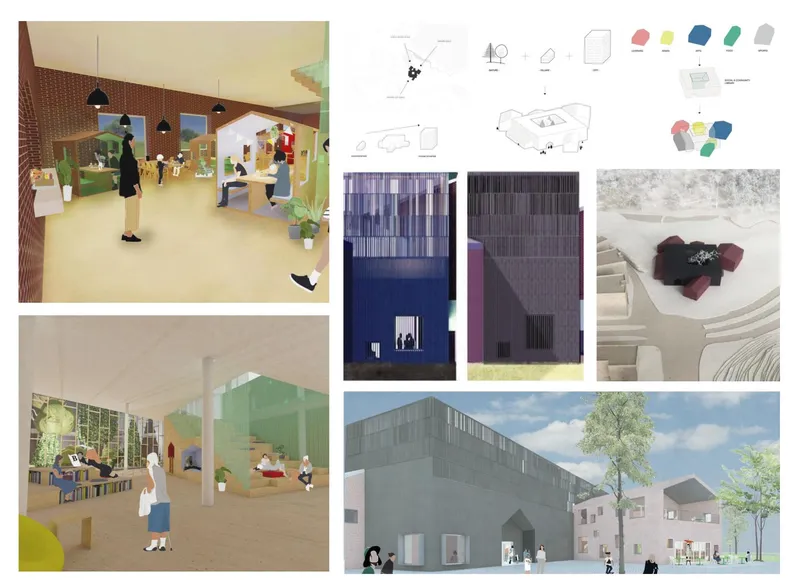
Description: The Common Learning House is not only a place for pupils, but it's also an open education and learning ground for everyone. 5 houses with different themes come together in one big hall and library like a marketplace for knowledge. It’s designed to give a special atmosphere to develop not only the education and cognitive but also the social development altogether.
-----------------
Honourable Mention: THE SCHOOL OF ONE
By: Kate Samuels, Lucas Carbia, Lena Pfeiffer and Charlie Yu
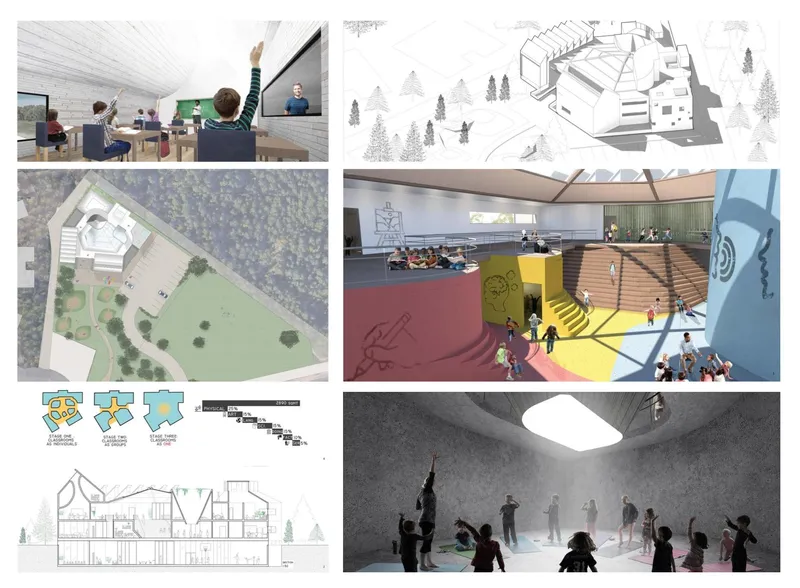
Description: The School of ONE proposes an academic environment based on inter-generational learning. Rooms are divided with expanding and contracting walls, allowing overflow into the atrium spaces. This flexibility encourages the individual classes to become ONE, by overlapping art with science, music with literature, physical education with math, and so on.
-----------------
People’s Choice: A SPACE FOR COMMUNITY
By: Paola Pulella
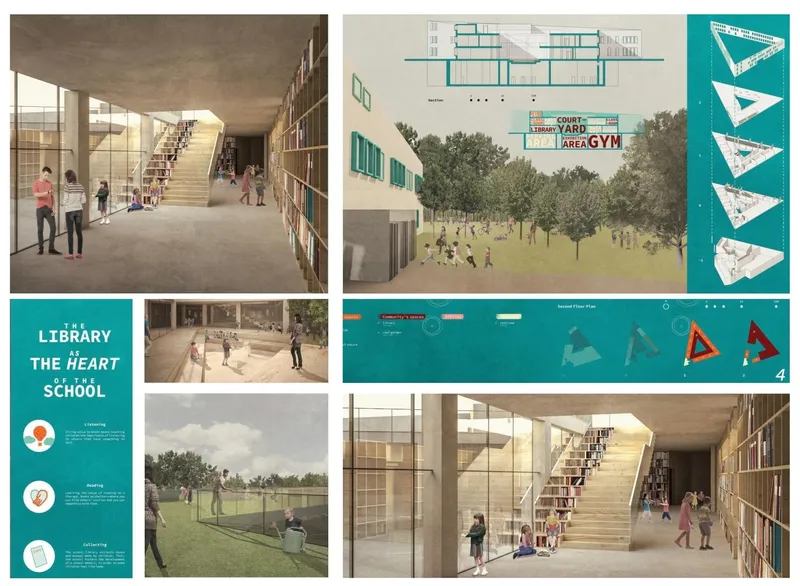
Description: The school is a space for the community, where children are welcome to experience life at a reduced scale. It is a beating heart for the community activities, where elders can teach children how to grow a plant or read them a book. The design aims to make people transmit know-how and children breathe knowledge in every space of the school.
------------
People’s Choice: THE SENSE OF COHERENCE
By: AKVK& Partners
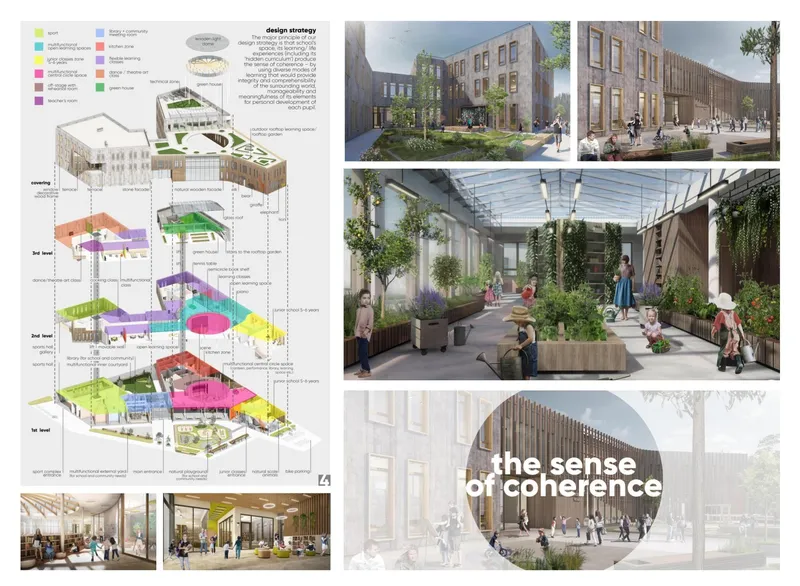
Description: The major principle of our design strategy is that school's building and space (including its 'hidden curriculum') produce the sense of coherence - by using diverse modes of learning that would provide integrity and comprehensibility of the surrounding world, manageability and meaningfulness of its elements for personal development of each pupil.
Conclusion
There were various forms of learning a child deserves and should learn, but this varies from place to place. In this challenge, we rooted this on a very fundamental level of universal learning.
The jury for the competition consisted of esteemed designers, professionals and academicians from around the world. The Lead Jurors for the competitions were as follows:
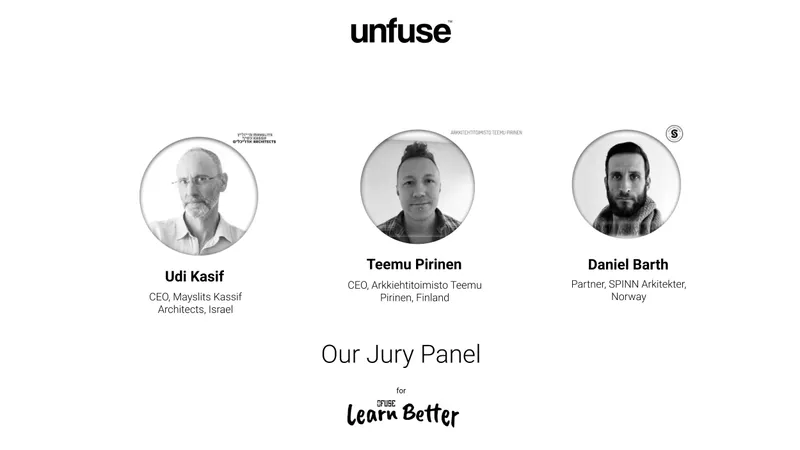
Udi Kassif, Co-Founder, Mayslits Kassif Architects, Israel |Teemu Pirinen, CEO, Arkkitehtitoimisto Teemu Pirinen, Finland | Daniel Barth, Architect, SPINN Arkitekter, Norway
Discover the full results here: https://uni.xyz/competitions/learn-better/entries
Discover the design brief here: https://uni.xyz/competitions/learn-better/info/about
Follow us on social media: Facebook | Instagram | LinkedIn | Twitter | Youtube
Discover other design competitions to participate here: https://uni.xyz/competitions




Popular Articles
Popular articles from the community


Play: Fragments of Their World
Familiar architecture becomes modular playground design, creating safe spaces where displaced children can learn, connect, imagine and play.

Hill & Cross Opera: Sculptural Opera House Architecture Shaped by Tallinn’s Landscape and Identity
Hill & Cross Opera reimagines opera house architecture in Tallinn through its sculptural hill, civic plaza, glass wave and a luminous cross.

Riyadh For All: Intergenerational Urban Design for Active Aging in Rabat
Riyadh For All reimagines urban design in Rabat with intergenerational co-living, adaptive courtyards, and Moroccan cultural exchange today.

Lunar Spiral: Space Architecture Shaped by the Mathematics of the Universe
Lunar Spiral reimagines space architecture through Fibonacci geometry, lunar regolith, levitating habitats, and self-sustaining Moon living.
Similar Reads
You might also enjoy these articles
Lunar Spiral: Space Architecture Shaped by the Mathematics of the Universe
Lunar Spiral reimagines space architecture through Fibonacci geometry, lunar regolith, levitating habitats, and self-sustaining Moon living.
The Main Dream: Modular Architecture for Play, Learning, and Community
A modular playground turns recycled plastic into adaptable spaces where refugee children can play, build, learn, and reconnect.
Play: Fragments of Their World
Familiar architecture becomes modular playground design, creating safe spaces where displaced children can learn, connect, imagine and play.

Wadi Rum Observatory: Desert Architecture Designed for the Night Sky
Wadi Rum Observatory turns desert architecture into a quiet instrument for astronomy, hiding research spaces under Jordan's starlit terrain.

Comments (0)
Please login or sign up to add comments
No comments yet. Be the first to comment!