
Designing a universal form of education
Changing the perception of schools and conceiving a new model of school through architecture competition "Learn Better"

H2: Issue (edit full sentences)
There are various reasons why traditional school models are battling for relevance today. A few of them are laid down below:
The top-down, teach-and-test method, in which learning is motivated by a system of rewards and punishments rather than by curiosity or by any real desire to know, is the first place to begin the inquiry. What follows this inquiry, is the curriculum, questioning its usefulness to the vast amount of children who cannot question the authority/board. Lastly is the competitive environment that the children have to be moulded into, is this eroding creativity/critical thinking?
Almost any grownup individual usually can raise similar doubts. However, when one of the key objectives of schooling which are usually stated as building careers - when they are not being met, there’s certainly a huge problem. This is usually caused by the rapidly outdated conventional learning provided against the evolving work and technology.
H4: Is this evidence enough that there should be a call for newer models of learning?
H2: Brief (edit full sentences)
The problem with schools is not only the frameworks, but the outdated built forms they spring from as well. Hence, the actual issue is not just about the way of teaching but the perception of school as a function. As an advocate of a better environment, designers can not only argue what may be the right direction to move but show how the model of a better school of today could be.
H4: On the basis of the discussed outline, the design challenge was to conceive a new model of school with a vehicle of the built environment to portray it.
The challenge did not dwell into drafting an education curriculum as academicians are much better individuals to do this. Participants' role in this problem was to discover how valuable learning models can be imparted with newer forms of the built environment. Building on these questions they had to design a relevant school.
- How can existing schools be made more friendly to these essential life skills through smaller retrofits?
• How to prepare our children with dependable thought processes that work in tandem with our changing societies?
• How do existing perceptions of pedagogy be shaken up so schools are compelled to evolve?
• As most cities are mitigating problems with density, how can schools be stacked but still not lose their means of imparting a holistic education?
H2: Here are the best of competition projects:
Winning project: SITUATIONS SCH
H4: By: Mariana Rios, Lety Lozano
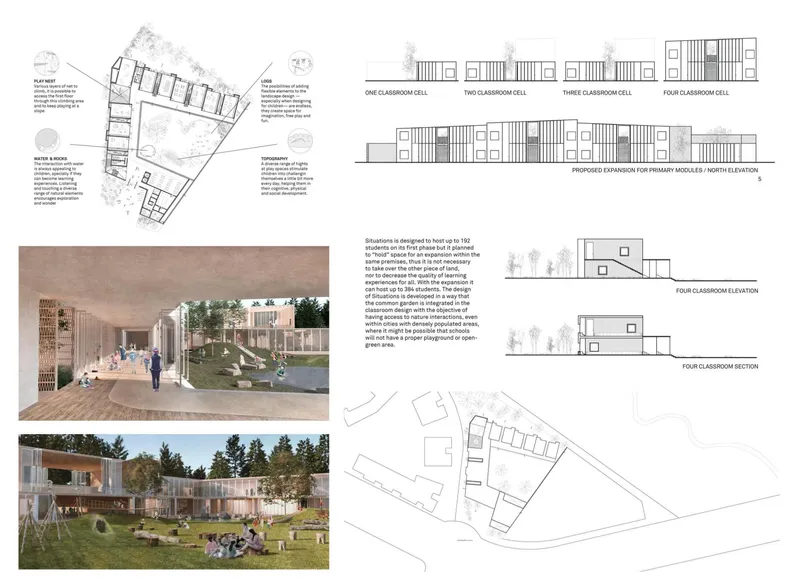
Description: We believe learning should not be restricted to a specific space, it needs to be a nonstop process, a mindset to transform all human-made environments into learning opportunities. Therefore a school should be a place where children learn how to learn through their natural behaviours? play and exploration? and at their own pace.


Popular Articles
Popular articles from the community


Co-life: Sustainable Architecture for Age-Friendly Community Living
Co-life reimagines sustainable architecture for seniors through courtyards, rammed earth, shared gardens, and spaces designed for belonging.

Conexión: Biophilic Design Reimagines High-Rise Living in Hong Kong
Conexión reimagines high-rise living in Hong Kong through biophilic design, green facades, shared spaces, daylight, water and nature within.

Little Red Riding Hood: Architectural Design as a Journey Through Fear, Light, and Storytelling
Little Red Riding Hood reimagines the fairy tale through architectural design shaped by fear, light, scale, memory, uncertainty, and choice.

Hill & Cross Opera: Sculptural Opera House Architecture Shaped by Tallinn’s Landscape and Identity
Hill & Cross Opera reimagines opera house architecture in Tallinn through its sculptural hill, civic plaza, glass wave and a luminous cross.

Similar Reads
You might also enjoy these articles

Bao Huynh Watercolor Atelier: A Serene Art Retreat in Hội An
Bao Huynh Watercolor Atelier in Hội An blends multifunctional art spaces, sustainable design, local materials, and family-friendly living in a serene environment.

Atelier Macri Concept Store Interior Design by CASE-REAL
Atelier Macri store features a "ko" counter, walnut wood details, cork displays, blending retail, gallery, and seamless customer experiences.

Manuel Vargas Izquierdo Stadium and High-Performance Sports Center: Architectural Excellence in Jalpa de Méndez
The Manuel Vargas Izquierdo Stadium blends sustainable design, inclusive sports facilities, and cultural-inspired architecture, revitalizing Jalpa de Méndez’s public spaces.

KAKR Buluh Awar Hall: Revitalizing Community and Ecology Through Bamboo Architecture
Community built bamboo hall revitalizes Buluh Awar village, empowering youth, restoring ecology, celebrating vernacular craftsmanship through sustainable architecture and culture.


Comments (0)
Please login or sign up to add comments
No comments yet. Be the first to comment!