

Dominique Coulon & associés Build a School in Saclay That Uses Color as a Compass
On the Saclay plateau outside Paris, a 7,400 square meter school complex turns diagonal geometry and bold color into wayfinding for children.


The Moulon quarter on the Saclay plateau south of Paris is emerging from a masterplan by XDGA and landscape designer Michel Desvignes, and its residential fabric is deliberately muted: pale grey, white, orthogonal. Into that calm grid, Dominique Coulon & associés have dropped a 7,400 square meter school complex that refuses to blend in. The Moulon Group of Schools houses an infant school with eight classrooms, a primary school with twelve, a recreation center, a gymnasium, a restaurant, and a constellation of shared rooms, all wrapped in a pixelated brick envelope that grades from white to near-black and punctuated by volumes of saturated orange and blue.
What makes the project genuinely interesting is its insistence that a public building for children should be legible through its senses, not its signage. Diagonal geometry in plan and section replaces the right angle as the organizing logic. Vivid color differentiates each zone so a five-year-old can orient by hue. And the section stacks programs vertically, putting nursery classrooms and their playground at grade while the elementary school rises to the upper floors and claims the roof itself as a courtyard. It is a civic building that earns its presence by working harder than anything around it.
A Brick Envelope That Refuses Neutrality
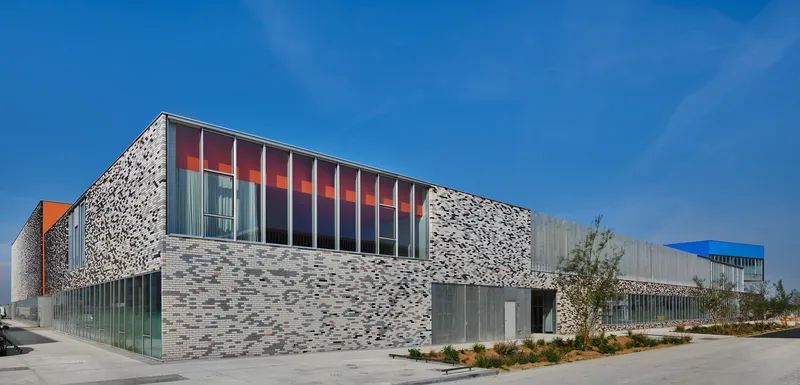
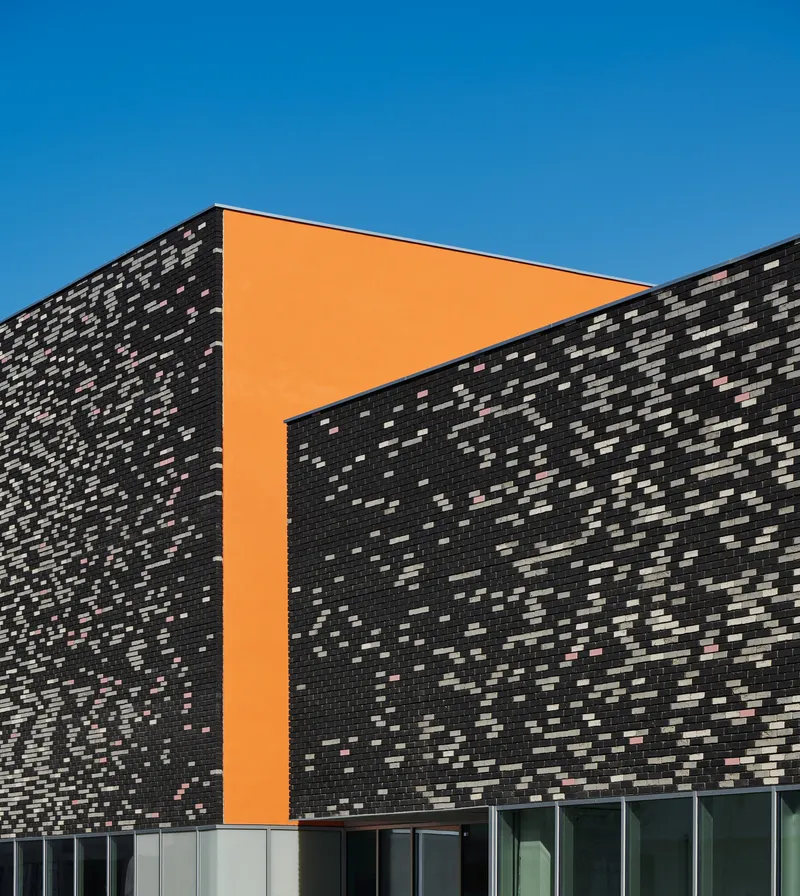
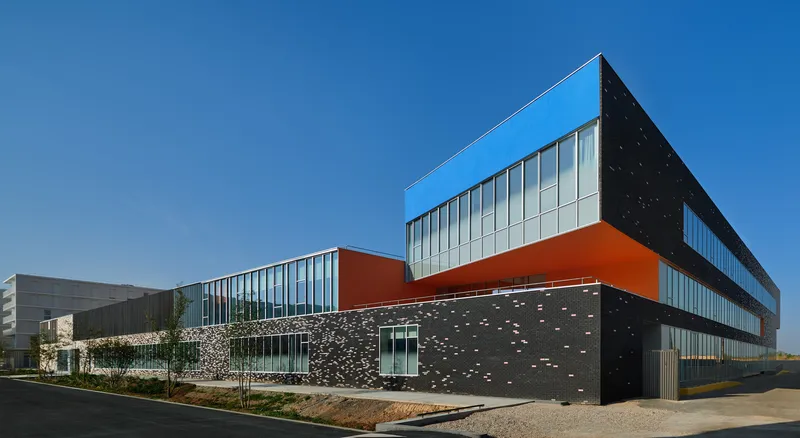
The neighborhood's buildings are almost uniformly pale, so the school's brick facades register as a deliberate provocation. A pixelated gradation from white through grey to near-black gives the long elevations a textile quality, dense and varied, that reads differently depending on distance and light. At the corners, panels of bright orange break through the masonry like exposed organs, signaling entrances and programmatic shifts.
The glazed ground floor recedes beneath the heavier upper mass, keeping the street edge transparent and inviting while the brick screens above provide thermal and visual protection. It is a sophisticated play on weight: the school looks anchored from afar but permeable up close.
Horizontal Presence on the Plateau
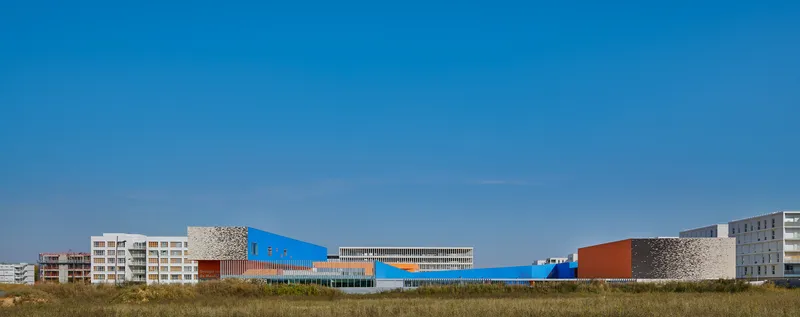
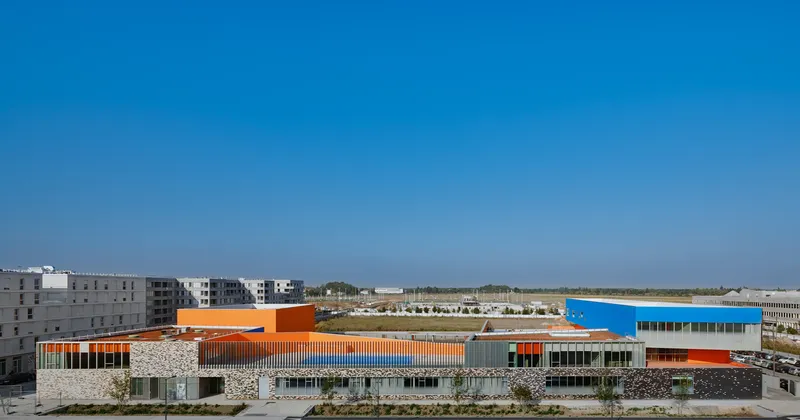
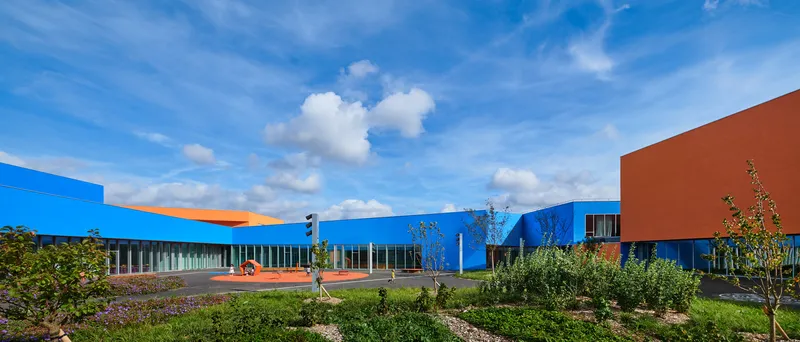
Seen from the open terrain that still surrounds much of the Saclay development, the school reads as a long, low bar of color set against dry grass and sky. The blue and orange volumes act as landmarks in a landscape that has not yet matured, giving the quarter an anchor before its streets are fully populated. Coulon's decision to stretch the building horizontally rather than stack it into a compact tower means the school occupies the ground with authority, defining edges for future public space.
The western side of the complex is kept porous, opening toward pedestrian routes, while the other three edges form a protective envelope around the internal courtyards and playgrounds. Children are sheltered without being sealed off.
Stacking the Playground
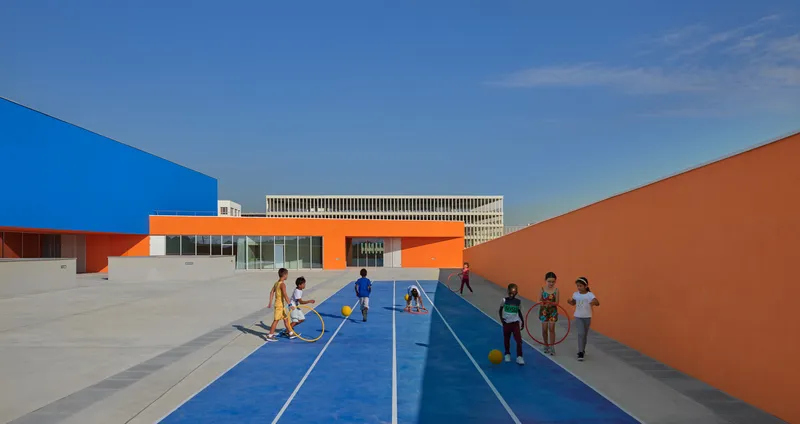
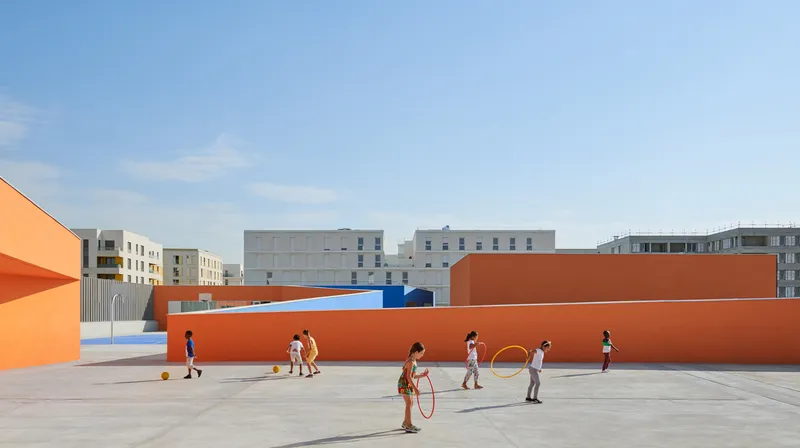
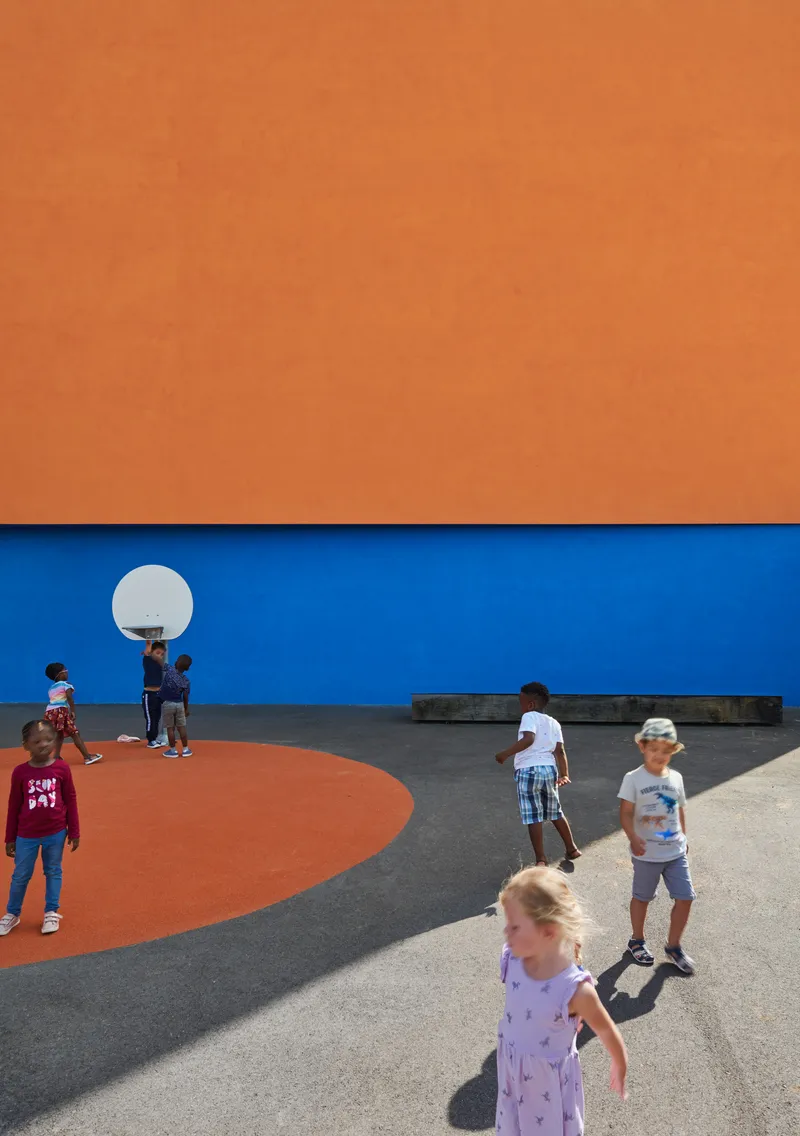
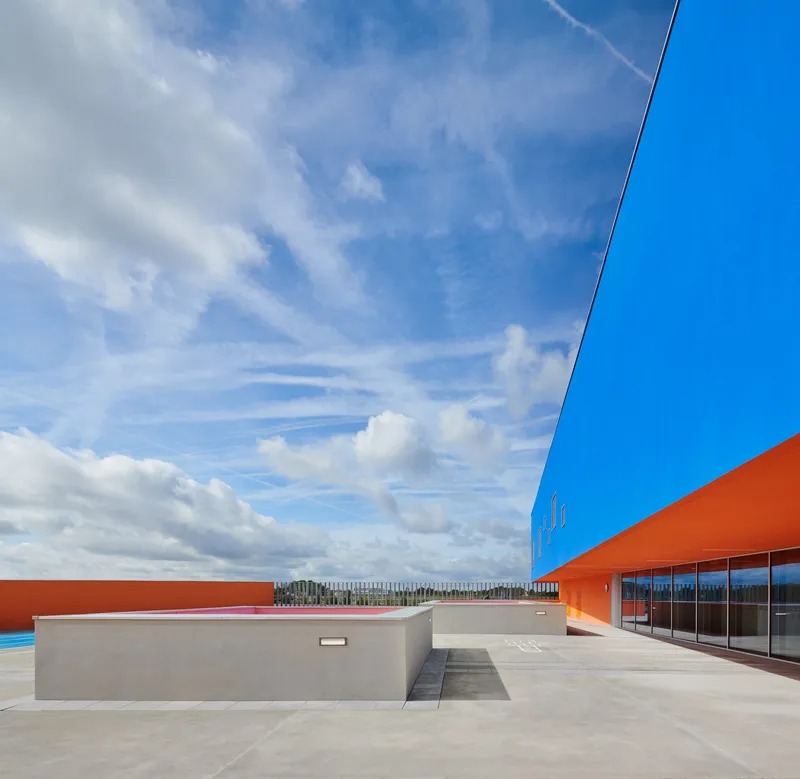
The most inventive sectional move is placing the elementary school's playground on the roof. A bright blue running track surface and tall orange walls create an open-air room that sits above the neighborhood, giving children sunlight and air without consuming any of the limited ground plane. Below, the nursery school keeps its playground at grade, separated from the older children both vertically and experientially.
The rooftop court doubles as a basketball area, its painted walls turning sport into spatial orientation. For children too young to read a floor plan, the shift from blue underfoot to orange at the edges is immediate and intuitive. Color is not decoration here; it is infrastructure.
Courtyards, Thresholds, and the Ground Floor
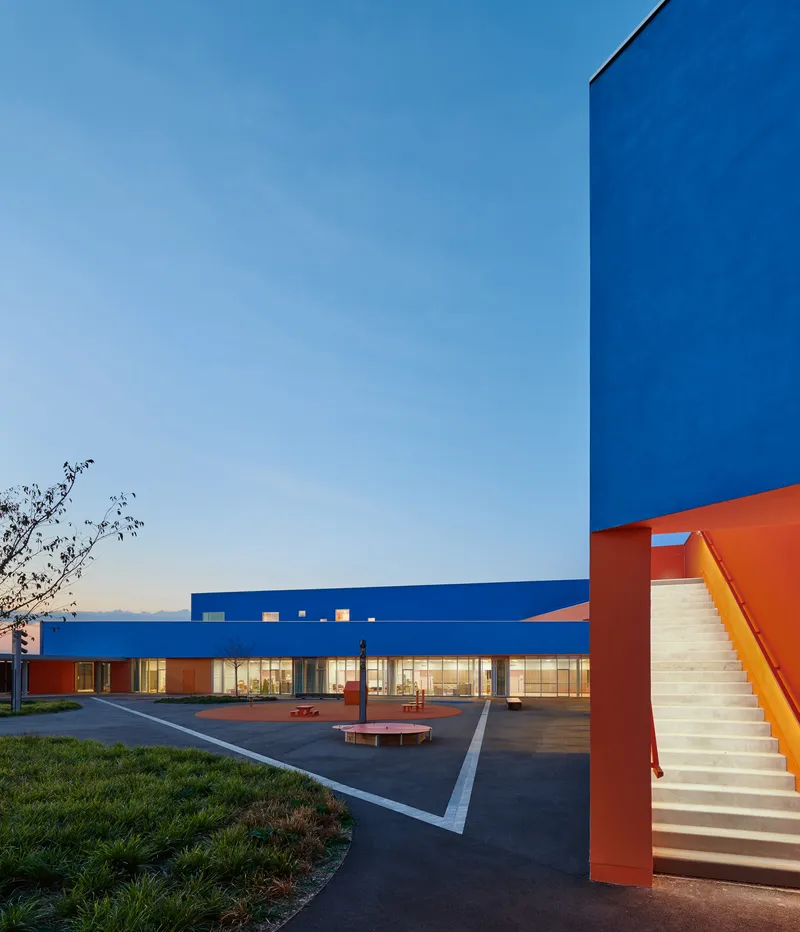
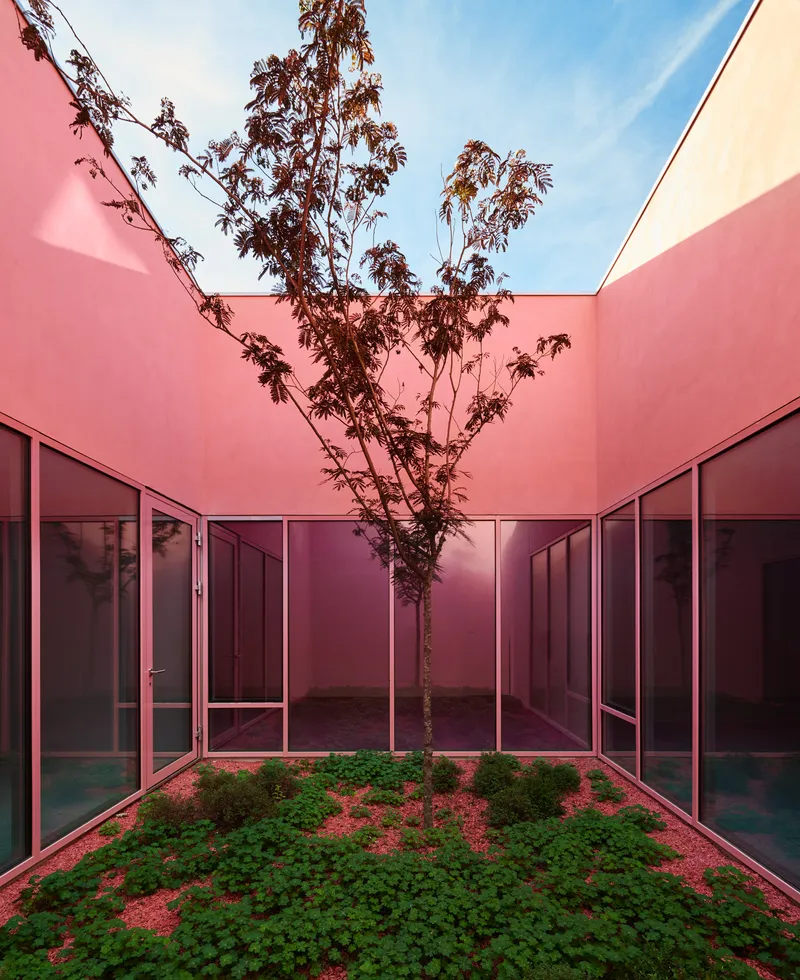
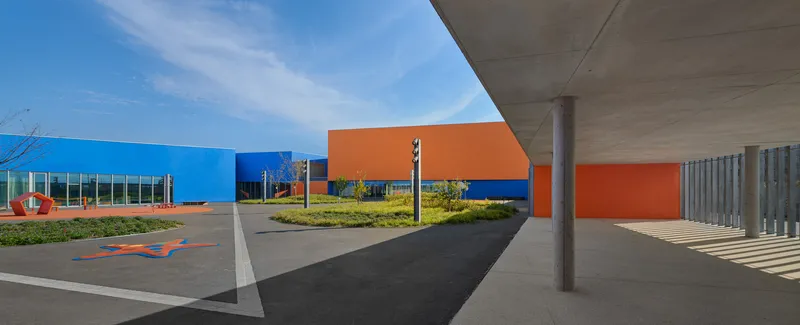
At ground level, courtyards carved into the building mass create distinct outdoor rooms. An orange staircase anchors one courtyard where benches face a glazed corridor that glows at dusk. Another is painted pink and centered on a single tree, a quiet counterpoint to the energetic rooftop. These are not leftover voids; they are calibrated social spaces that give each entrance, nursery, primary, and recreation center, its own threshold and character.
The covered entry drive beneath a cantilevered concrete canopy offers a practical drop-off zone while planted beds soften the transition from street to school. Every entrance sits along Moulon's pedestrian route, reinforcing the building's role as a piece of urban connective tissue rather than a freestanding object.
Interior Color as Wayfinding
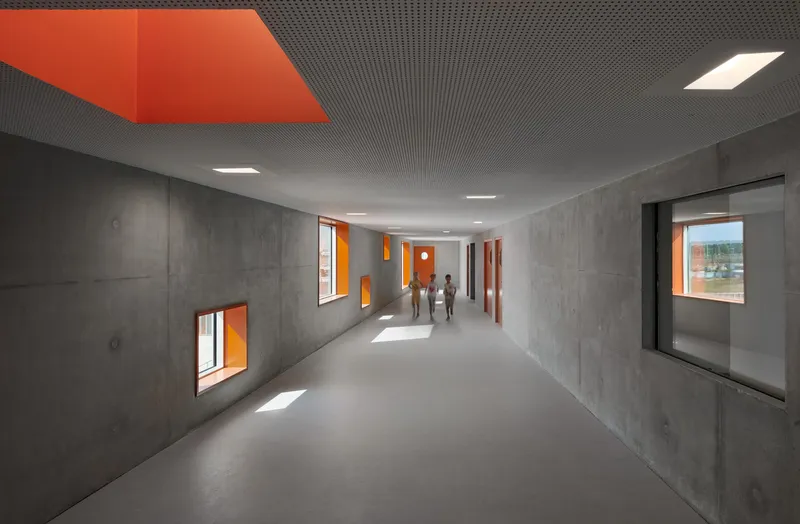
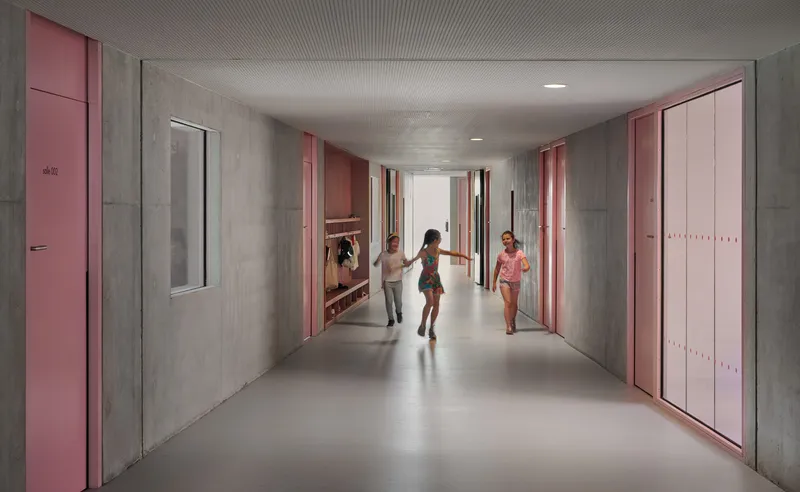
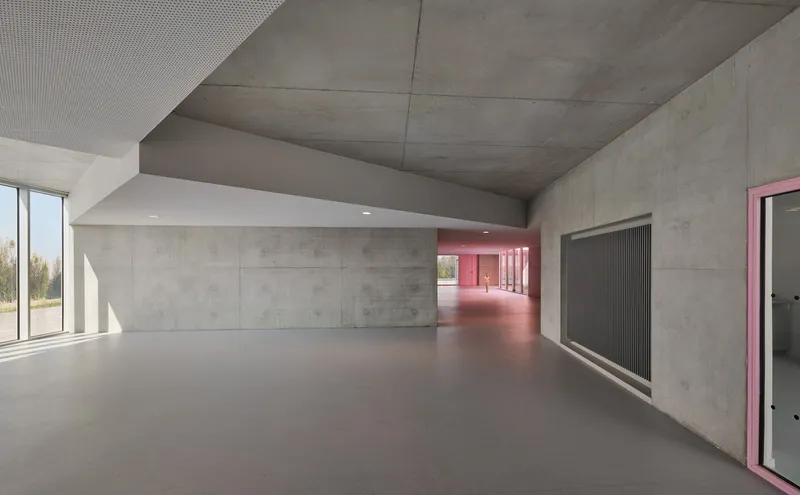
Step inside and the concrete structure is left exposed: ribbed ceilings, fair-faced walls, raw stairwells. Against that neutral grey, the color interventions hit hard. Corridors shift from concrete to pink-lit passages, orange window reveals throw warm shafts across hallways, and doorframes pop against monochrome surfaces. The palette is not random; each programmatic zone gets its own hue, so a child moving through the building understands intuitively where one world ends and another begins.
Coulon has long used color as a spatial tool rather than a surface finish, and here the strategy is tested at scale. With children running through these corridors daily, the architecture functions as a legible map drawn in sharp orange and deep blue.
Concrete, Light, and Daily Life
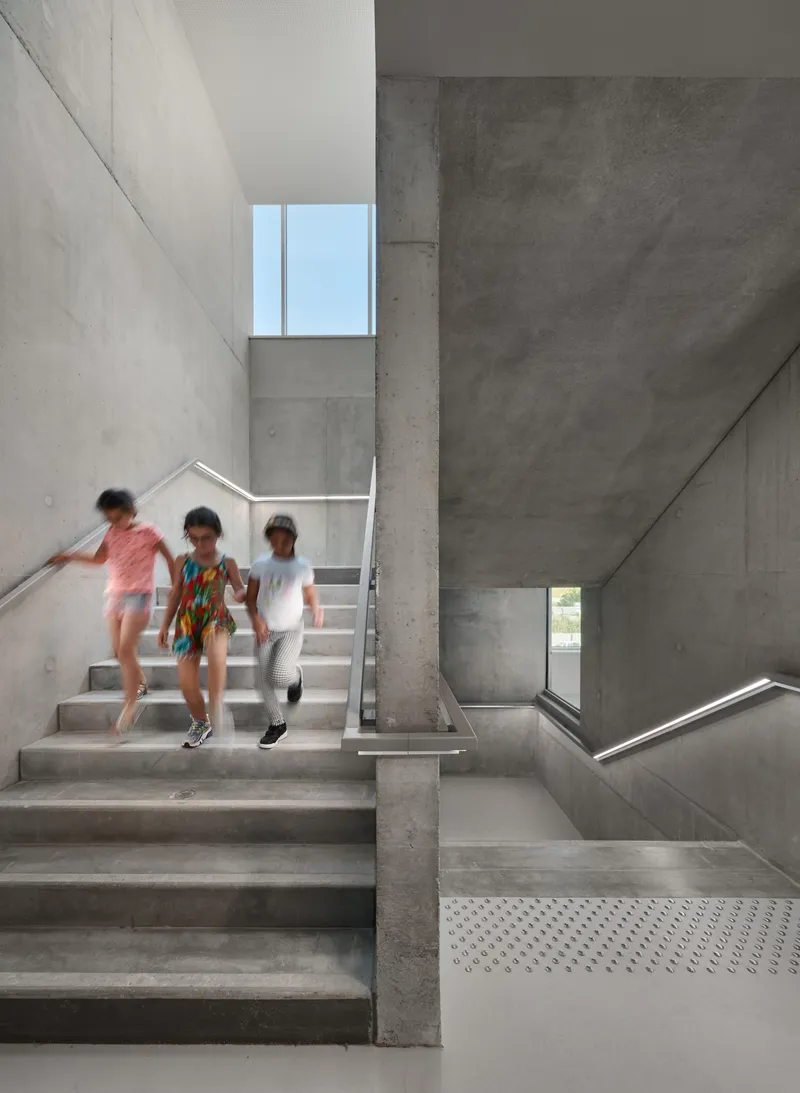
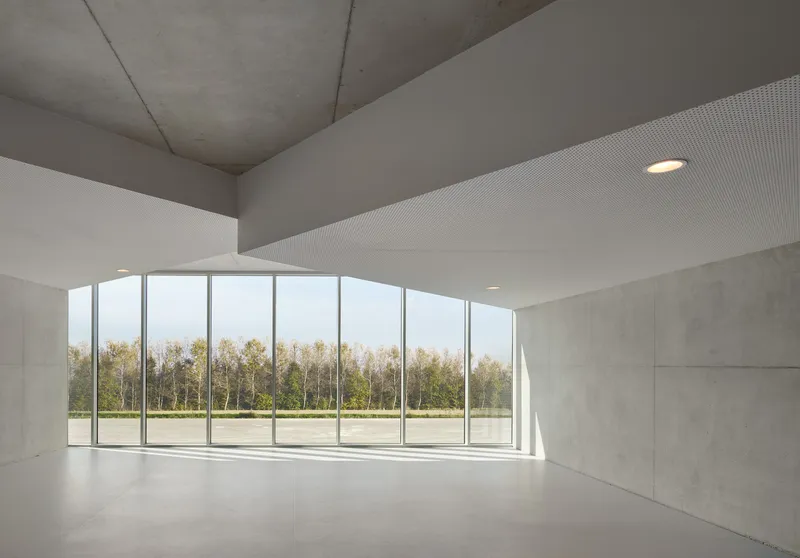
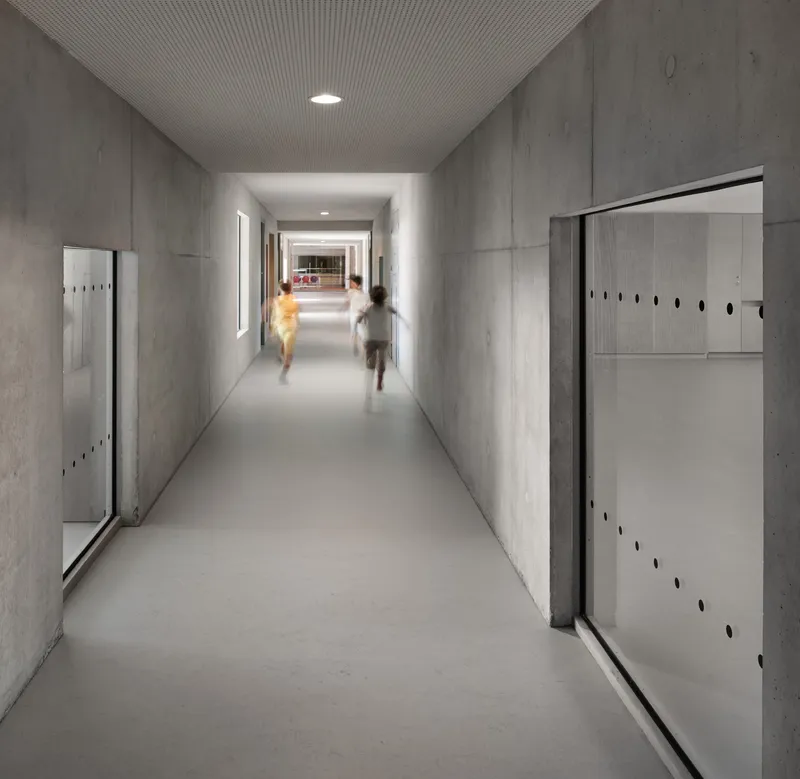
The stairwells and corridors are unadorned concrete, lit by skylights and sidelight that change character throughout the day. In the stairwell, a skylight washes the walls with even light as children descend; along the locker-lined hallways, the raw ceiling and polished floor reflect figures in motion. There is a monastic quietness to these circulation spaces that makes the color bursts at their ends feel even more charged.
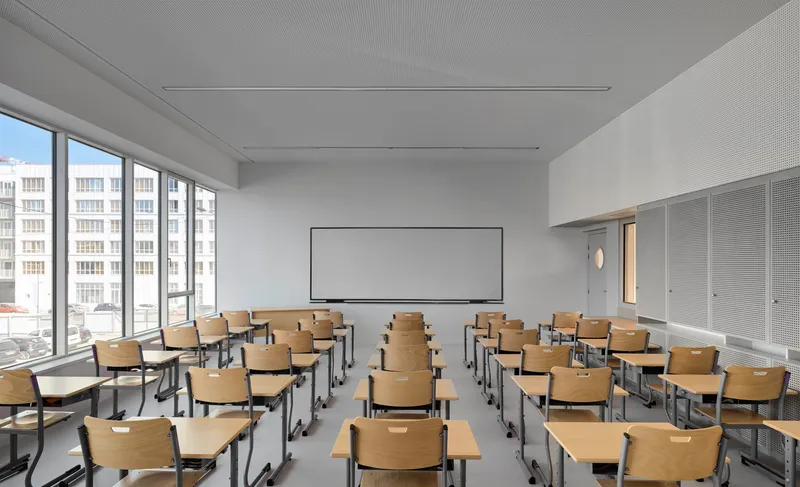
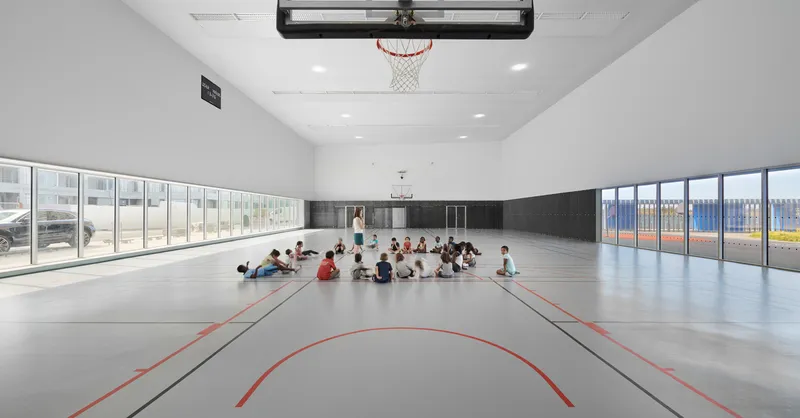
Classrooms are deliberately restrained: wooden desks, a whiteboard, concrete walls, and generous glazing facing trees. The gymnasium follows the same logic, a clear-span volume with court markings and a basketball hoop, no fuss. Coulon reserves spectacle for shared circulation and outdoor spaces, keeping the rooms where focused work happens calm and uncluttered. The rooftop terrace, visible from upper corridors through blue and orange facade panels, ties the whole sequence together as a reminder that play is always just a staircase away.
Exterior Assembly and Roofscape
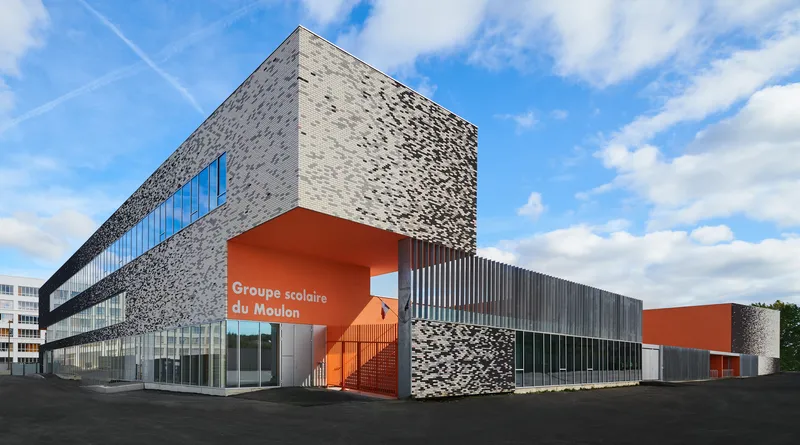
The corner view reveals how the perforated grey panels, the orange cantilevered entry volume, and the glazed ground floor work as a single composition. The perforation pattern on the concrete screens filters light while breaking down the building's scale, a texture strategy that pairs with the brick gradation on adjacent facades to give every elevation a distinct grain.
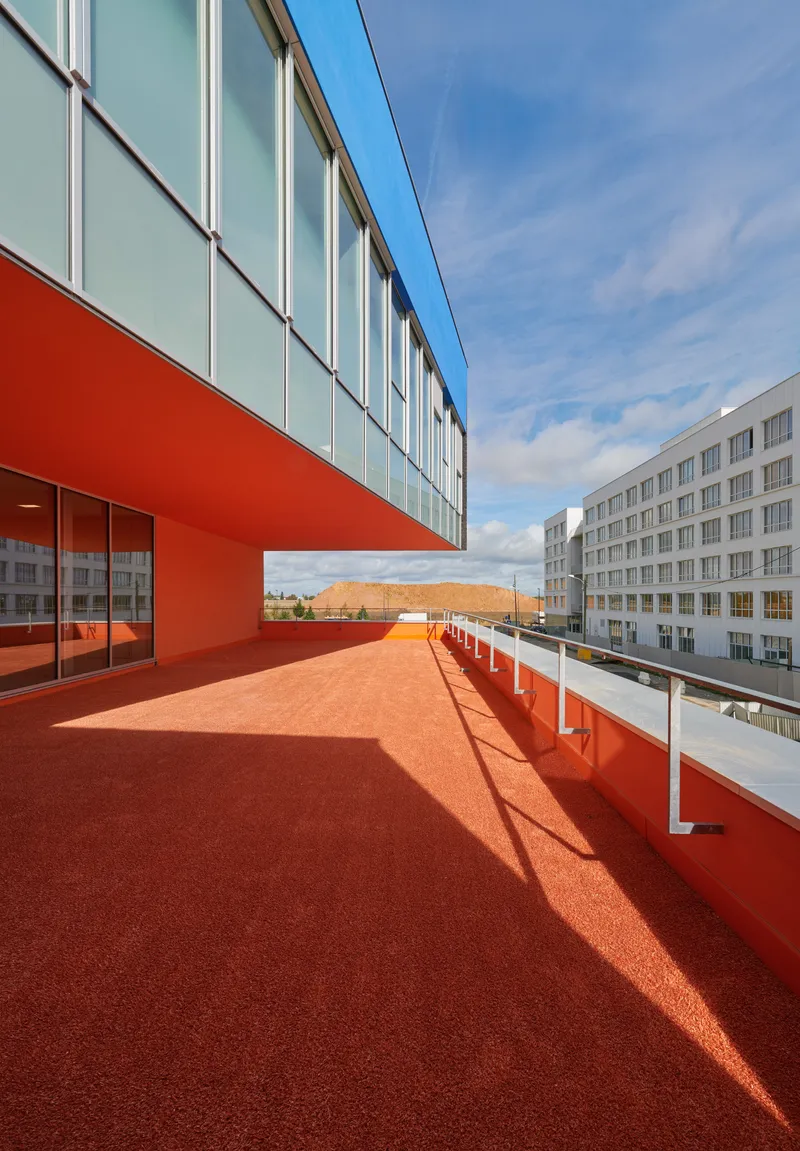
On the rooftop terraces, the orange rubberized surface extends along glazed corridors, blurring the line between indoor circulation and outdoor play. White railings give views over the adjacent neighborhood buildings, making children participants in the urban landscape rather than inmates of a sealed compound.
Plans and Drawings
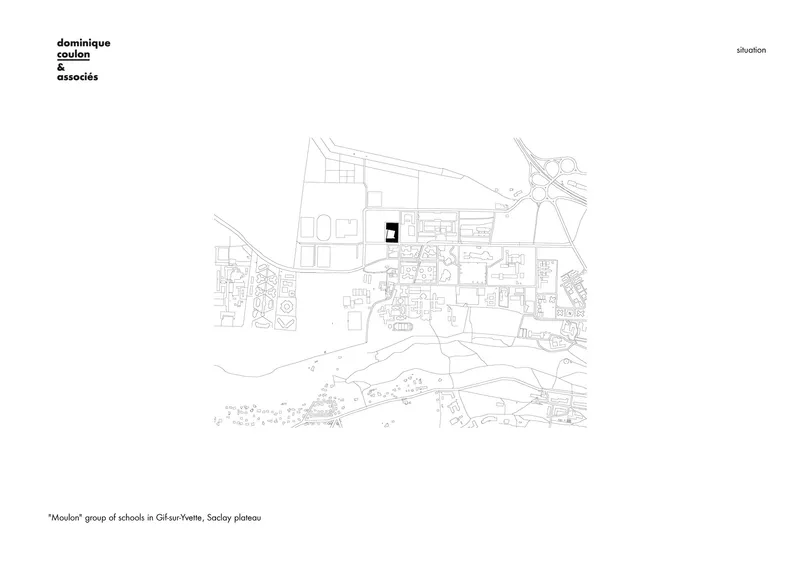
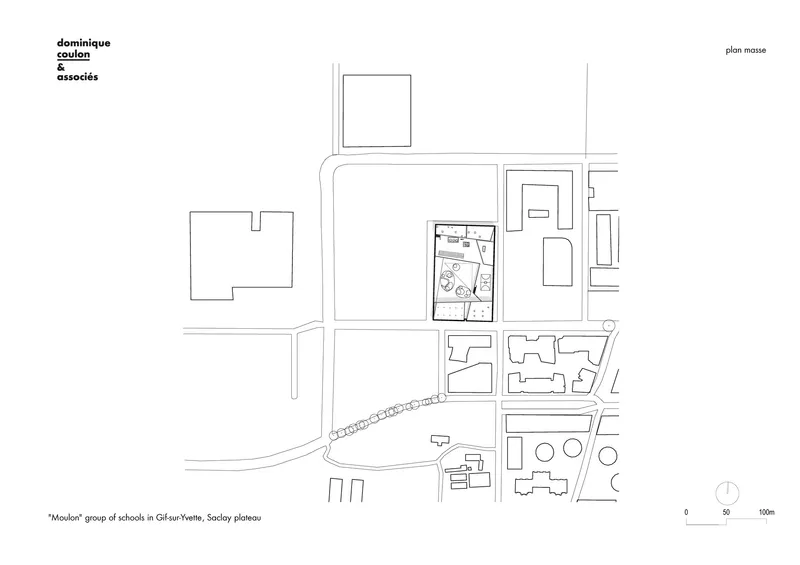
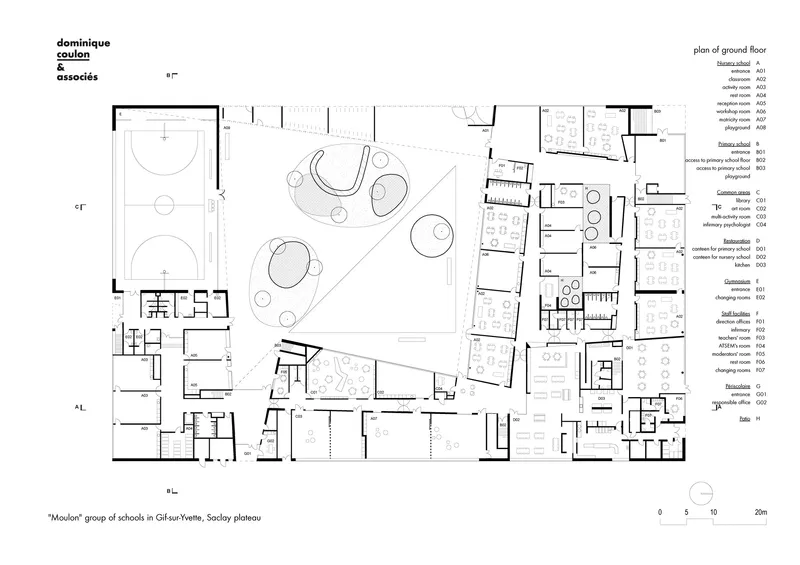
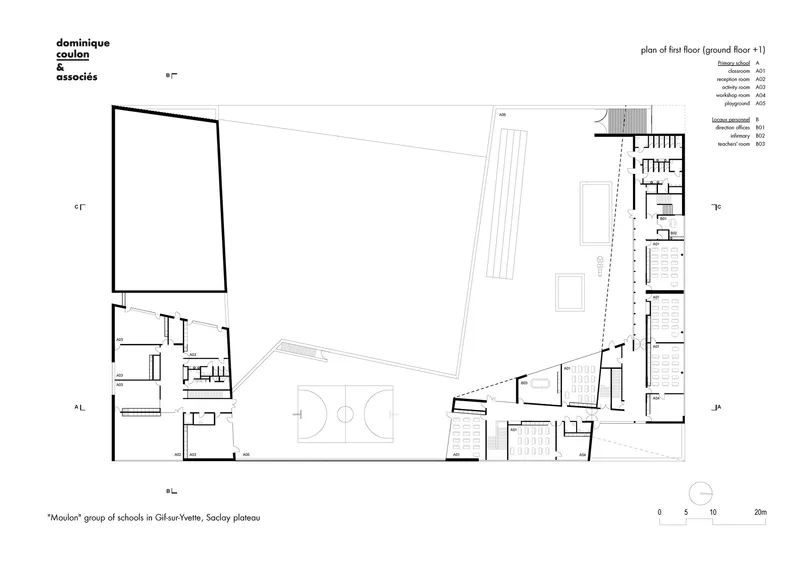
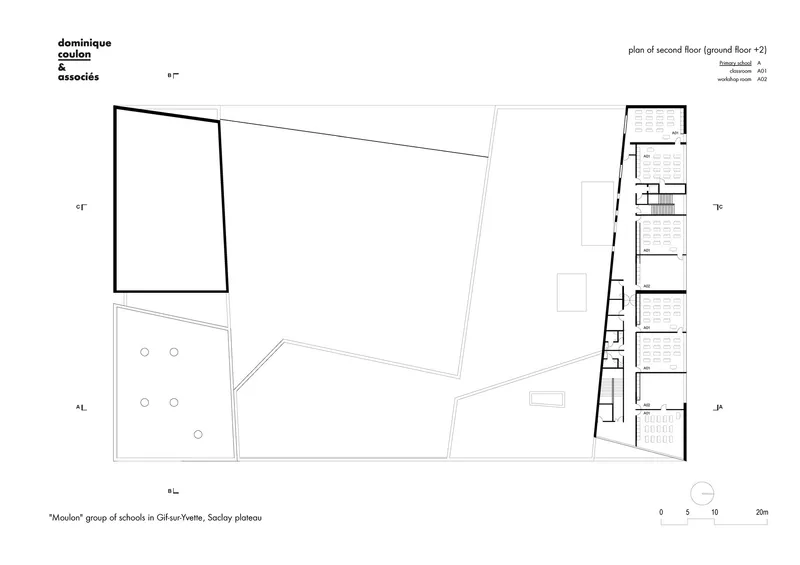
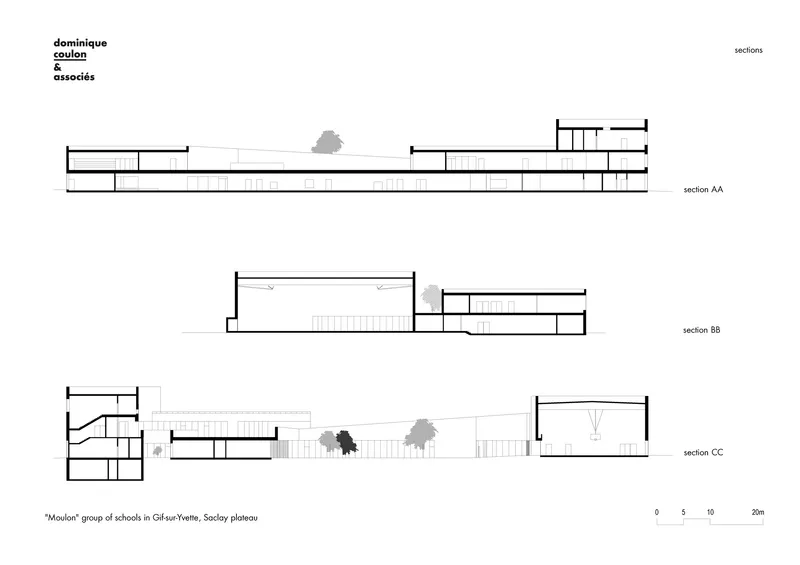
The site plans confirm the school's role as a defining block within the Moulon quarter's curved road network. At ground level, classroom blocks wrap around a central playground with curved edges that push against the rectilinear grain, a direct expression of Coulon's diagonal play. The first floor introduces the sports court flanked by classrooms, while the second floor reduces the footprint to a single wing, stepping the mass back and opening the rooftop to daylight. Sections show how the horizontal massing conceals significant sectional variation: double-height courtyards, mezzanine corridors, and the elevated playground all coexist within what reads from the street as a modest three-story bar.
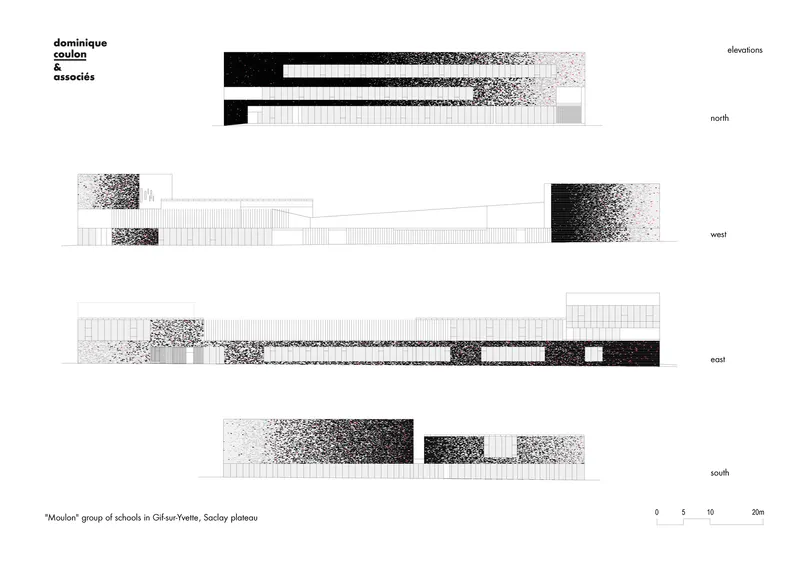
The elevation drawings are especially revealing. The four facades demonstrate the alternating rhythm of black and white textured panels, proving that the pixelated effect visible in photographs is a systematic tonal map, not an arbitrary pattern. Every shift in brick shade corresponds to a change in the program behind it.
Why This Project Matters
School design is too often reduced to a checklist of classroom counts and fire exits. The Moulon Group of Schools reminds us that architecture for children can carry genuine civic ambition. By stacking programs vertically, Coulon frees the ground plane for urban life and gives a rooftop back to play. By saturating shared spaces with color while keeping classrooms neutral, the building teaches spatial literacy before its students can read. And by placing a deliberately assertive public facility within a muted residential quarter, the project argues that schools should be the most visible buildings in a neighborhood, not the most forgettable.
Financed under the Région Île-de-France's 100 innovative and ecological neighborhoods initiative and built for a budget of roughly €14 million, this is not a showcase pavilion. It is real infrastructure serving a real community on the edge of Paris, and it operates at a level of spatial intelligence that many projects with far larger budgets fail to reach. That gap between ambition and means is where the best public architecture lives.
Moulon Group of Schools by Dominique Coulon & associés, Saclay, France. 7,400 m². Completed 2022. Photography by Eugeni Pons.
About the Studio
Share Your Own Work on uni.xyz
If projects like this are the kind of work you want to make, uni.xyz is a place to publish your own, find collaborators, and enter design competitions.


Popular Articles
Popular articles from the community


Singing Woman: An Opera House That Performs Before the Curtain Rises
Ovidiu Cristian Pavel's conceptual opera house translates Estonia's choral identity into a sculpted waterfront landmark facing the Baltic Sea.

Cloaked Colonization: A Mobile Underwater Habitat That Moves Like a Fish
Micah Abaya's shortlisted EHC Pacific entry reimagines ocean settlement as a dispersed network of self-sustaining architectural organisms.

Tsunami Convergenics: Turning Catastrophic Ocean Forces into Underwater Housing Infrastructure
A speculative underwater settlement off the coast of Onagawa, Japan, treats tsunamis and typhoons as energy sources rather than threats.

Faces of the Soviet Avant-Garde: Turning Moscow's Street Names into an Open-Air Museum
A network of sculptural installations across a Moscow residential district transforms forgotten architect names into spatial encounters with cultural memor

Similar Reads
You might also enjoy these articles

Pixel Gardens: One Repeated Module Stacked Into a Terraced Social Housing Tower for Famagusta
Salem Bader's shortlisted housing tower builds a vertical neighbourhood from one repeated module, offsetting units to carve terraces, light and air.

Bao Huynh Watercolor Atelier: A Serene Art Retreat in Hội An
Bao Huynh Watercolor Atelier in Hội An blends multifunctional art spaces, sustainable design, local materials, and family-friendly living in a serene environment.

Atelier Macri Concept Store Interior Design by CASE-REAL
Atelier Macri store features a "ko" counter, walnut wood details, cork displays, blending retail, gallery, and seamless customer experiences.

Manuel Vargas Izquierdo Stadium and High-Performance Sports Center: Architectural Excellence in Jalpa de Méndez
The Manuel Vargas Izquierdo Stadium blends sustainable design, inclusive sports facilities, and cultural-inspired architecture, revitalizing Jalpa de Méndez’s public spaces.

Explore Pont-Aven School Competitions
Discover active competitions in this discipline

Challenge to design a barrier free sports center

Challenge to design an outdoor ice-rink and park

Challenge to design public laboratory
Comments (0)
Please login or sign up to add comments
No comments yet. Be the first to comment!