

Dominique Coulon Stacks a School in Joyful Chaos on a Villejuif Reservoir Site
A compact, deconstructed group of schools near Paris turns a tight interstitial plot into layered green playgrounds and panoramic classrooms.


School buildings on cramped urban sites tend to retreat into bland efficiency: stack the classrooms, squeeze the playground, call it done. Dominique Coulon & associés refused that logic at the Simone Veil Group of Schools in Villejuif, a southern suburb of Paris. Built on a former reservoir site ringed by large trees and shielded from street noise, the 8,913 square meter complex packs six nursery classrooms, eleven primary classrooms, a canteen, after-school care, a double-height library, staff housing, and parking into a composition that reads less like an institution and more like a landscape of interlocking fragments.
What makes the project genuinely interesting is its refusal of repetition. Scorched timber, raw bark-clad wood strips, glazed curtain walls, concrete columns, and multiple shades of green paint collide across the facades in what the architects describe as a collage. The building's compact, deconstructed massing lets you read each programmatic layer from the street, yet the whole never dissolves into incoherence. It holds together precisely because each fragment responds to a specific condition: ground-floor nursery rooms opening onto a tree-shaded playground, upper-level elementary classrooms cantilevered out to capture a panoramic view toward Paris, a covered terrace beneath that overhang painted a saturated green on the soffit. The result is a public school that asserts its civic identity without a trace of institutional severity.
A Collage of Materials on a Constrained Site
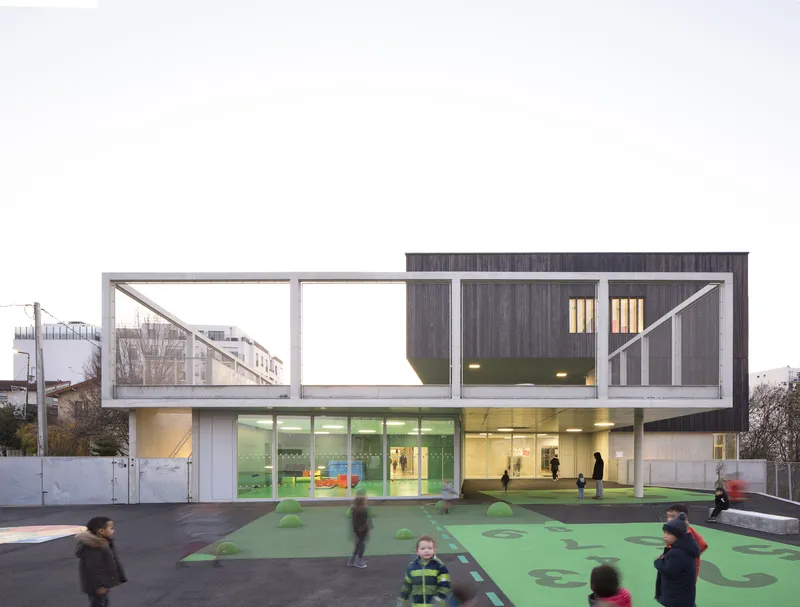
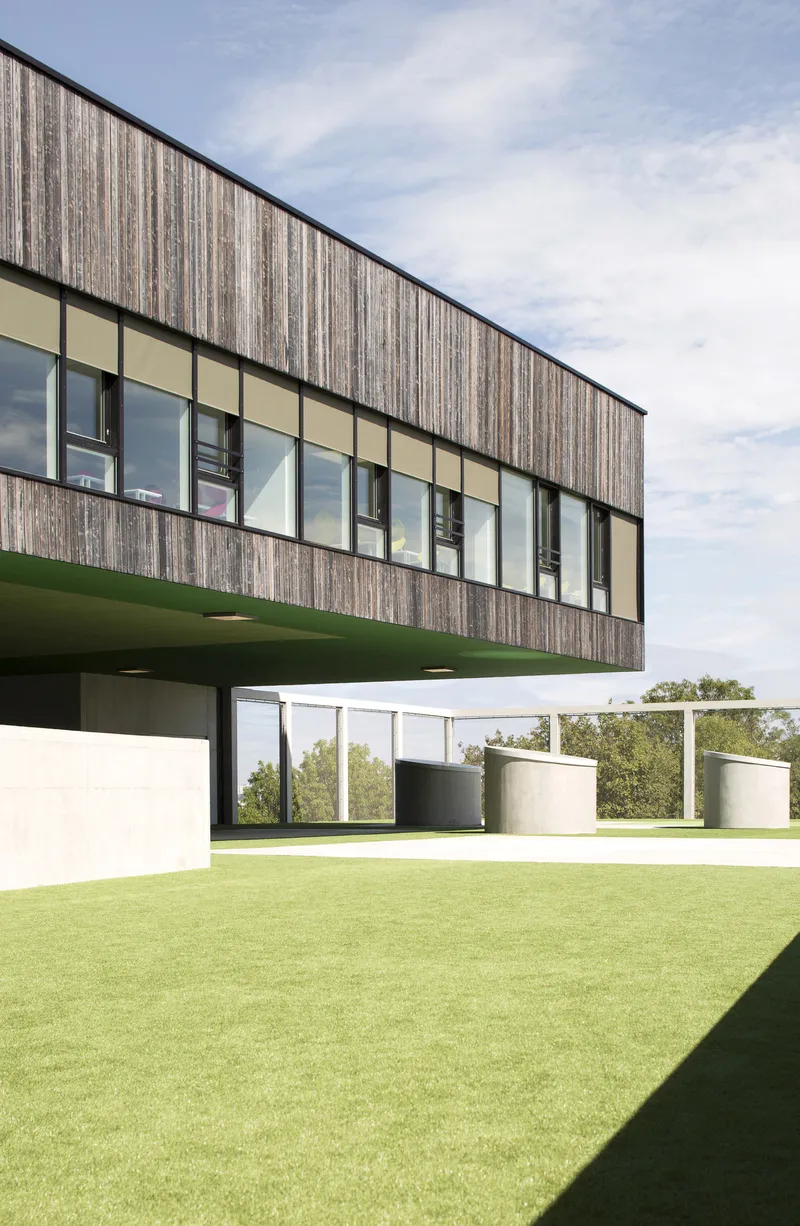
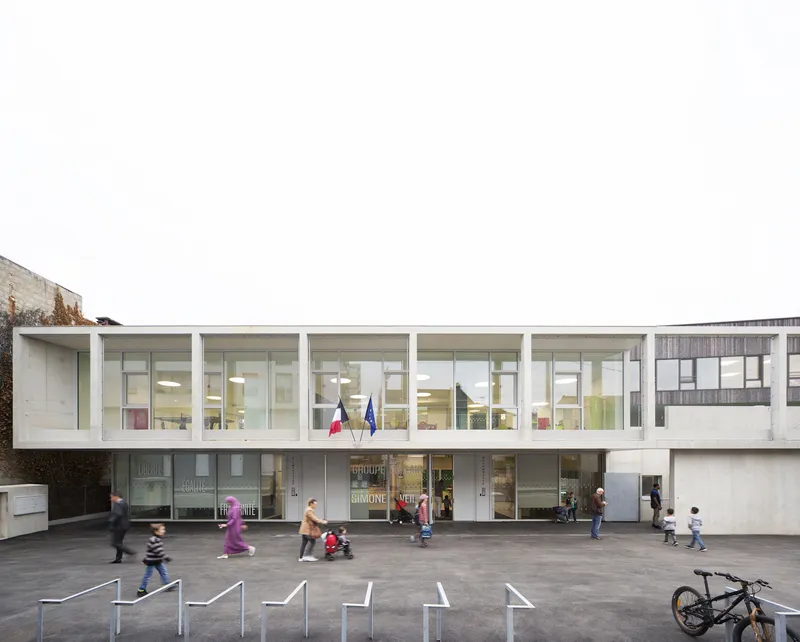
The site is small, interstitial, and organized across a series of platforms. Dominique Coulon's response was to compress the footprint and let the building grow vertically and outward in cantilevers, freeing ground-level space for play. From the street, the school's identity is immediately legible: a dark, scorched-timber volume for the elementary school floats above a lighter, glazed base housing the nursery. The vertical timber cladding is deliberately rough, with bark left intact on some strips, giving the facade a tactile quality that feels closer to landscape than architecture.
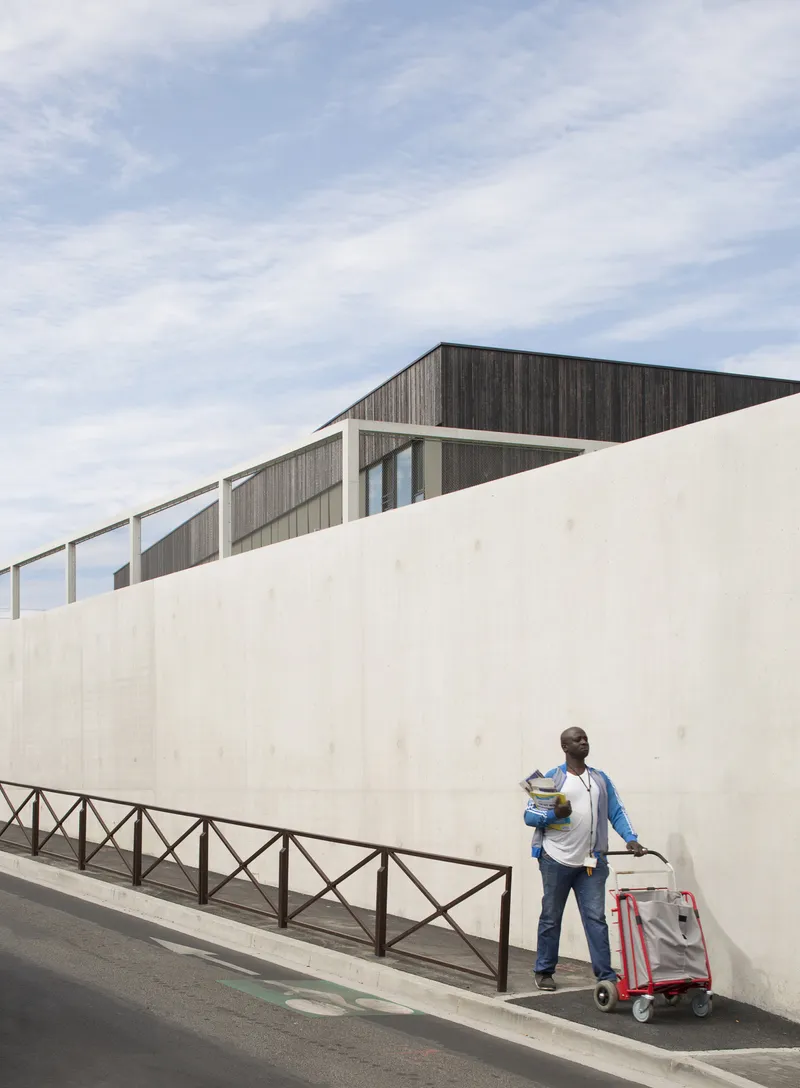
At street level, concrete walls and columns anchor the composition. A delivery worker passing along the base reads against the raw concrete and dark wood above, a reminder that this is a working neighborhood building, not a pavilion in a park. The material shifts are abrupt and intentional. There is no smooth transition from one surface to the next, and that directness is what gives the school its character.
Green Canopies and Covered Playgrounds
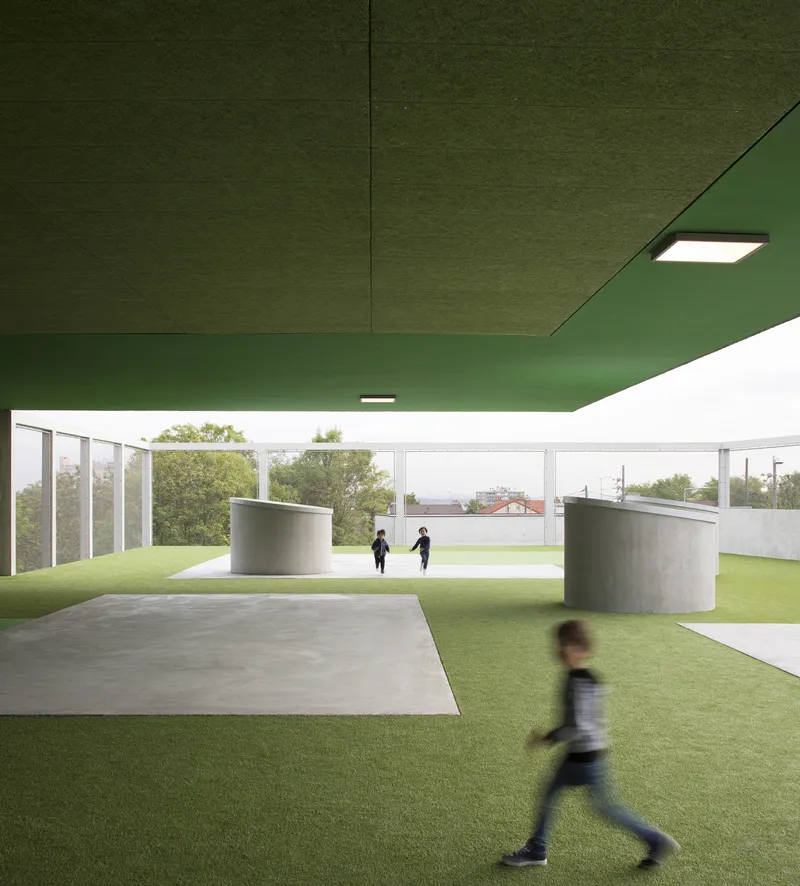
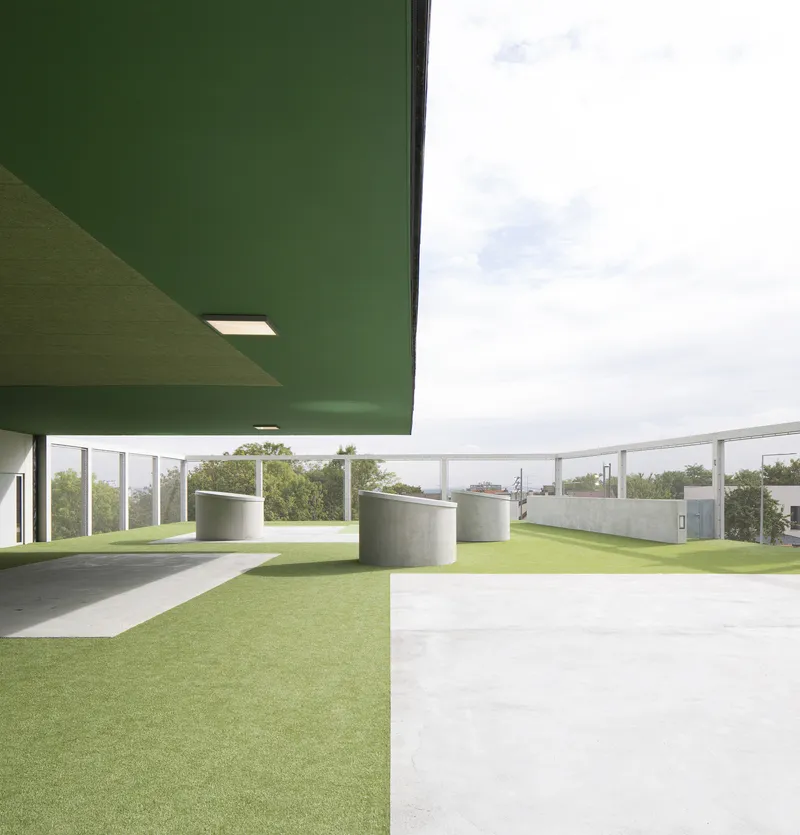
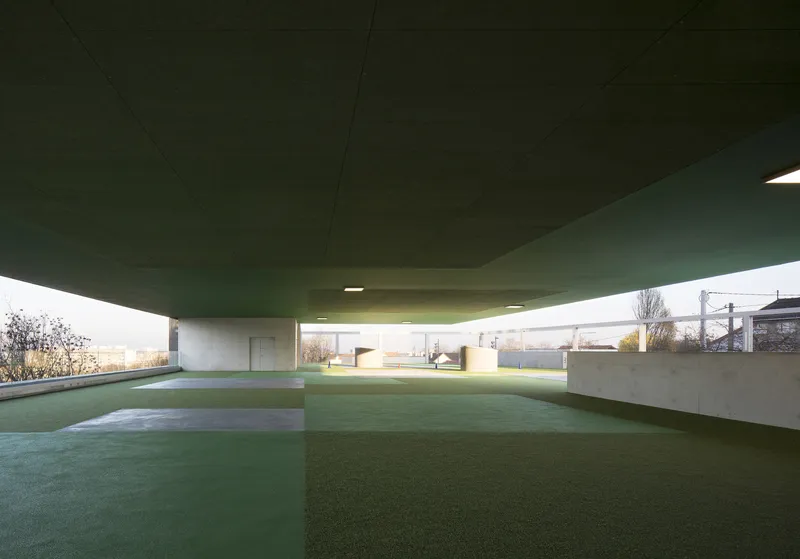
The most generous gesture in the project is the large overhang that creates a covered playground on synthetic turf. Its soffit is painted a deep green that saturates the space with color even on overcast days, turning a utilitarian shelter into something atmospheric. Cylindrical concrete elements punctuate the ground plane, acting as both structural supports and informal play objects. Children running beneath this canopy experience a space that is simultaneously interior and exterior, protected from rain but open to air and views.
The color choice is not decorative whimsy. Multiple shades of green run through the entire project, inside and out, keyed to the mature trees that surround the reservoir site. The building echoes its landscape rather than contrasting with it, and the green soffits, floors, and storage walls reinforce that continuity at every turn.
Courtyards and Elevated Play
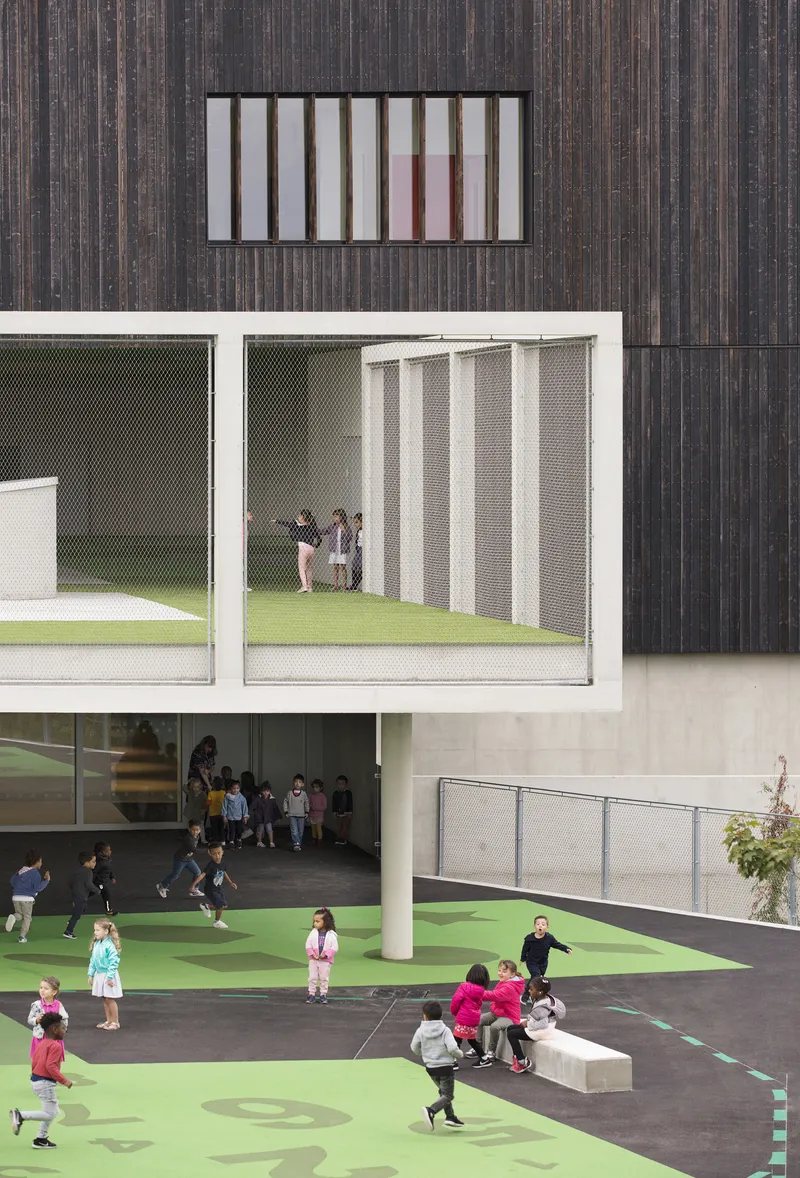
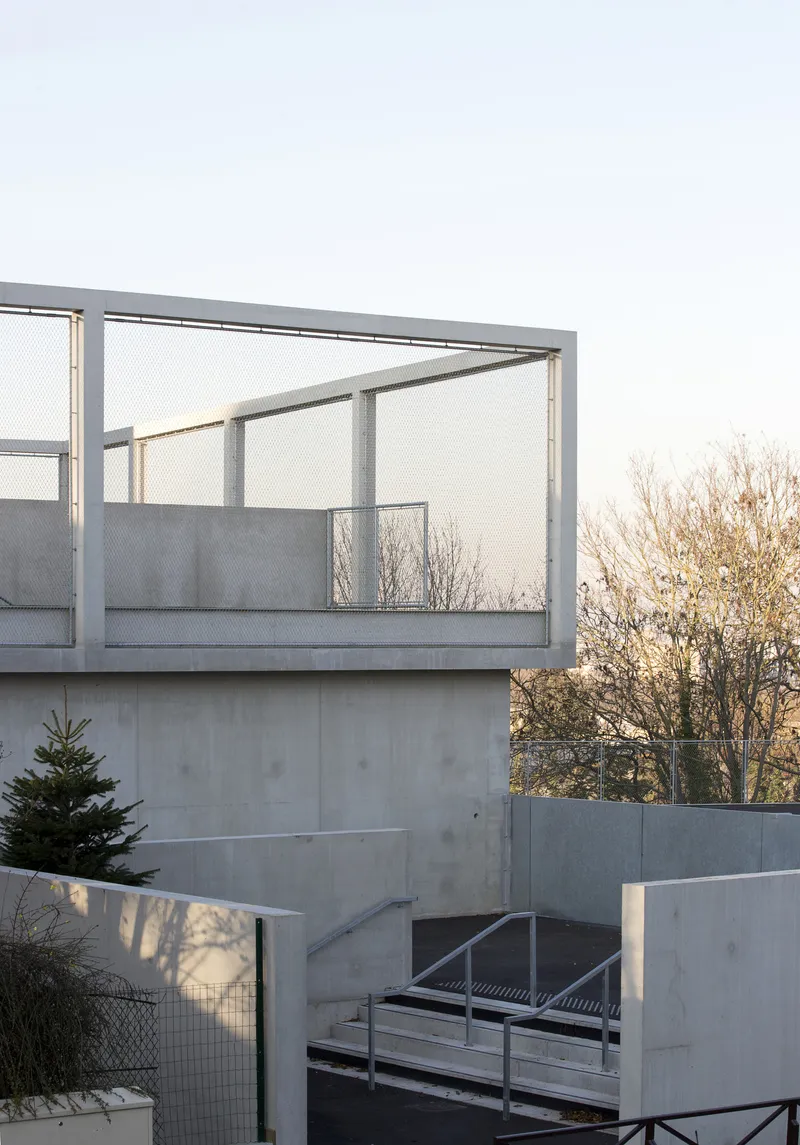
On a tight site, the architects carved out multiple outdoor spaces at different levels. The ground-floor courtyard, surfaced in green artificial turf, serves the nursery. From there, stairs lead directly to a first-floor playground conceived as a large empty platform beneath the cantilevered elementary volume. Mesh-screened balustrades and metal railings keep the edges safe without blocking light or views, and the layered section means that every age group gets its own outdoor territory without competing for the same square meters.
Three distinct access routes feed into the building from a shared forecourt, allowing nursery parents, elementary students, and after-school care to arrive and depart without bottlenecks. The circulation is generous and daylit, treating corridors as inhabitable spaces rather than leftover voids.
Classrooms Built for Light
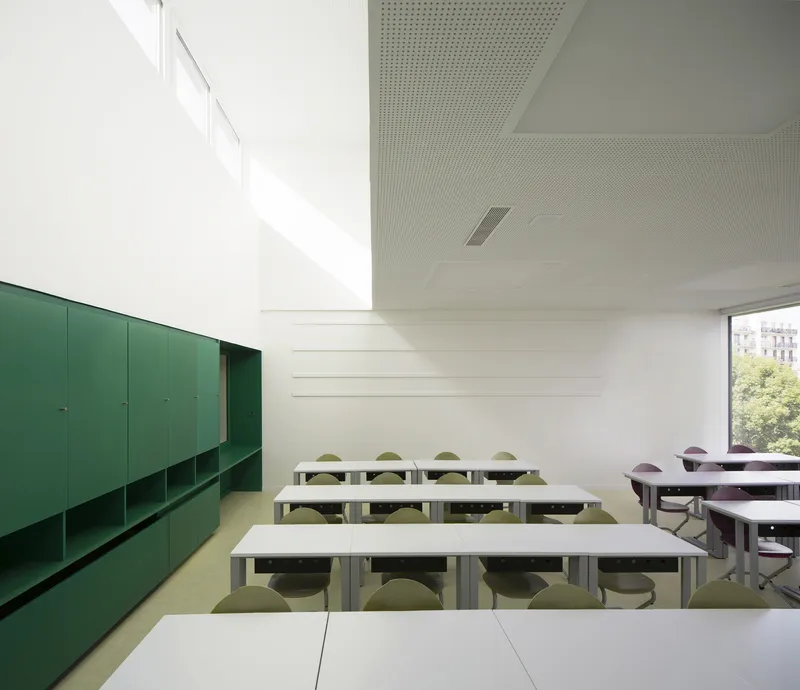
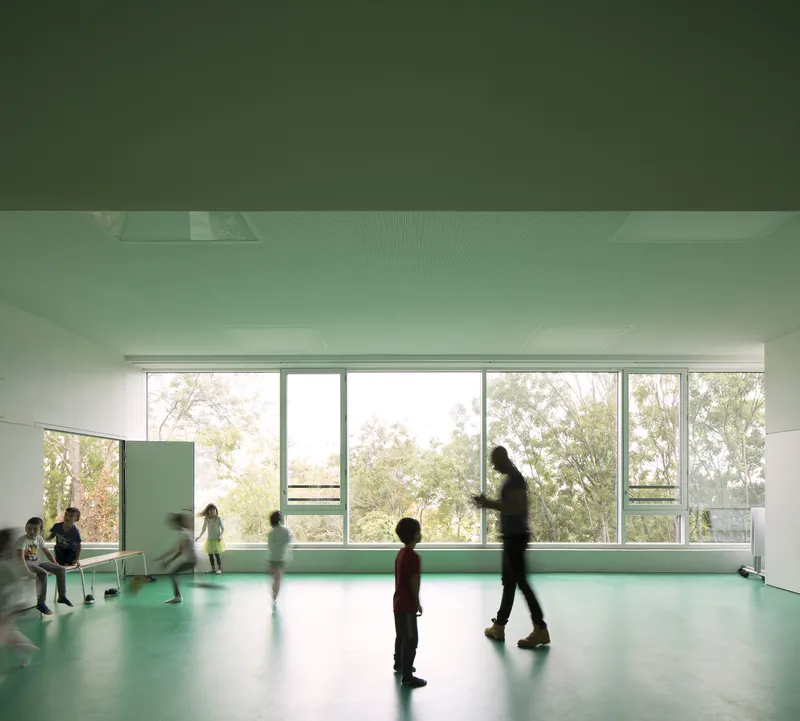
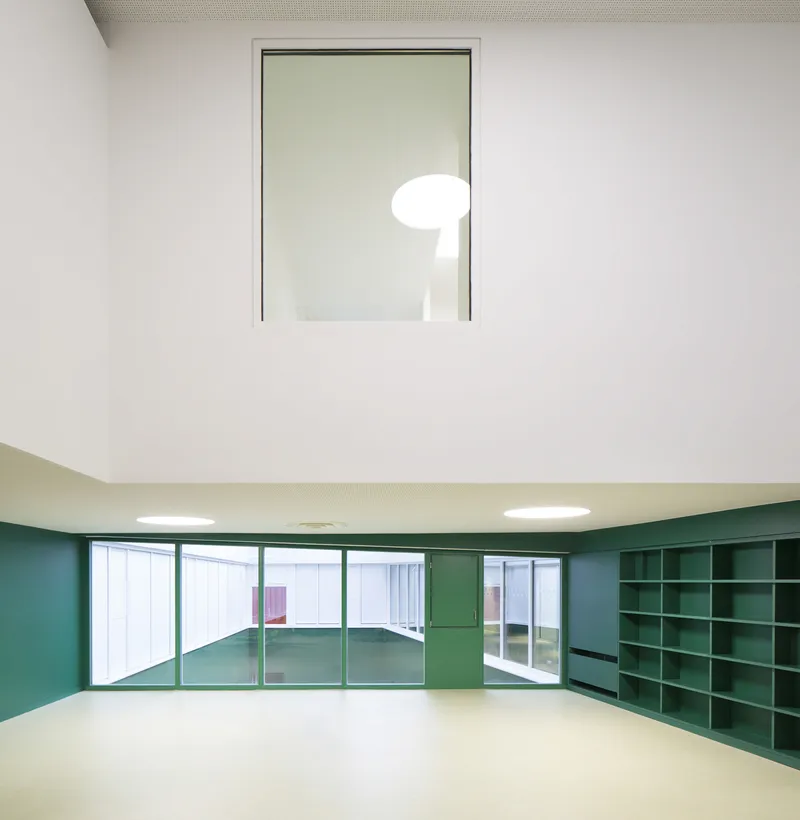
Inside, the classrooms are calm without being sterile. Green built-in storage walls provide visual continuity with the exterior palette, while perforated acoustic ceilings and clerestory windows manage sound and light. The nursery classrooms look out onto the large existing trees, framing nature as a constant presence. The elementary classrooms on upper levels are well endowed with ribbon windows that flood the rooms with even, diffused daylight.
One of the most striking interior moments is a curved classroom wall fitted with green shelving, where a single high window frames what appears to be an illuminated sphere. It is an almost surreal detail, a reminder that Coulon's architecture is always searching for the unexpected image within a functional program. The architects designed every classroom to avoid repetition: no two rooms feel identical, even when their dimensions are similar.
Corridors as Inhabitable Space
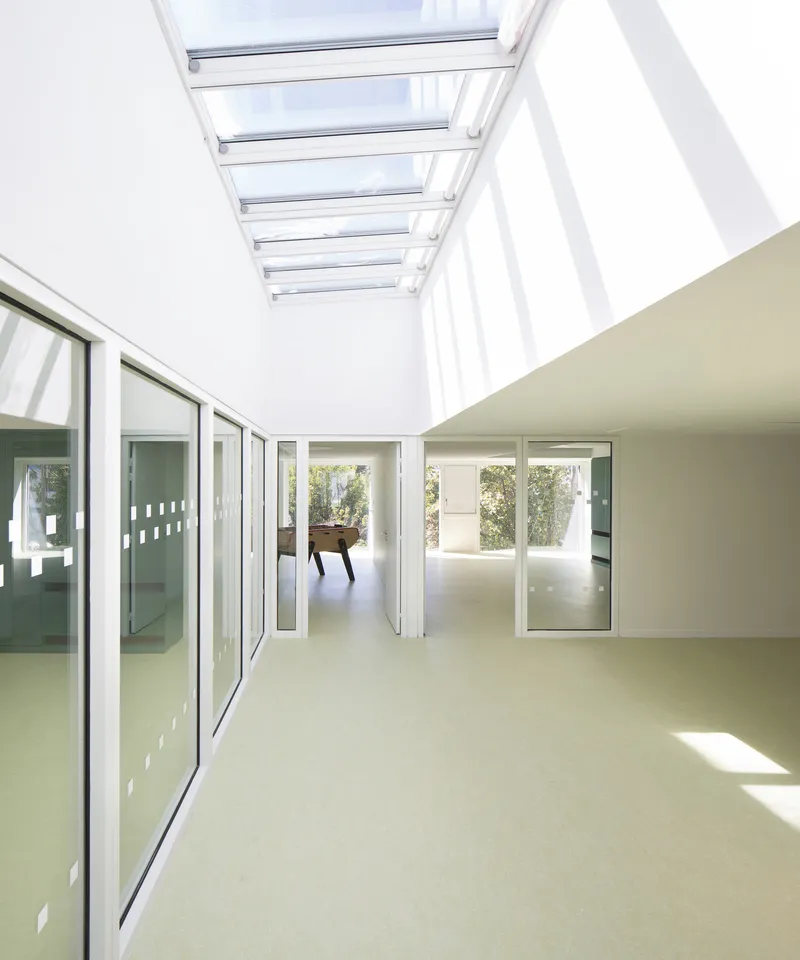
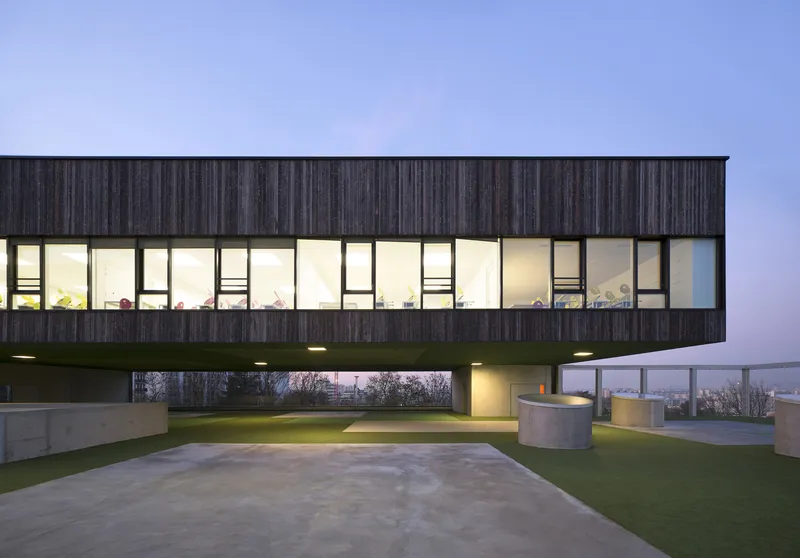
Coulon has long argued that circulation in a school should not be residual. Here, the corridors are skylit and glazed, connecting interior spaces with overhead louvers that filter sunlight into shifting patterns on the floor. At dusk, the illuminated corridor visible through the upper glazing gives the building a lantern quality from the street, signaling activity and warmth. These generous traffic routes double as informal gathering and display spaces, absorbing the overflow energy of hundreds of children without feeling crowded.
Rooftop and the Paris Panorama
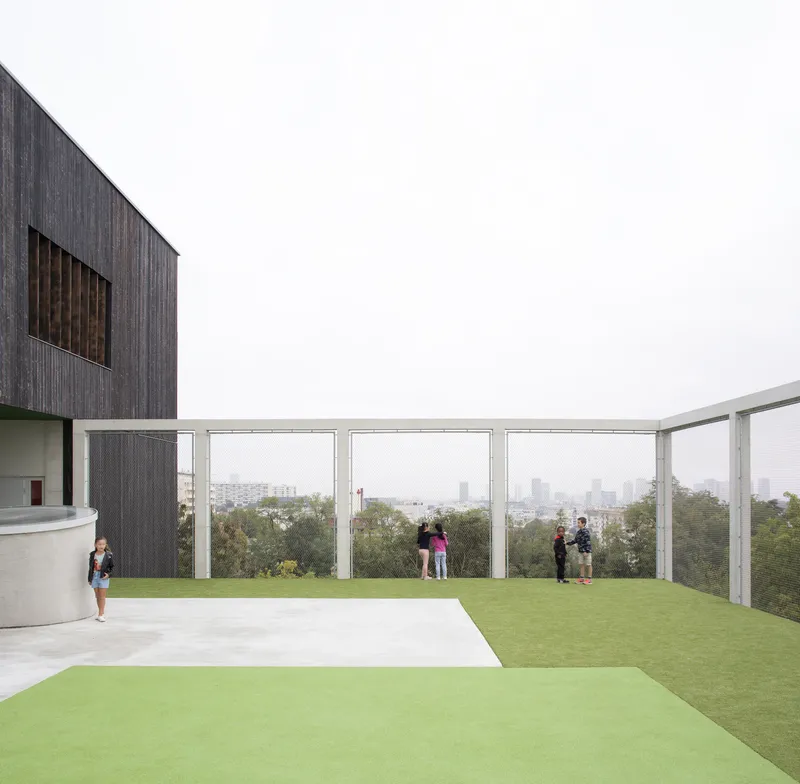
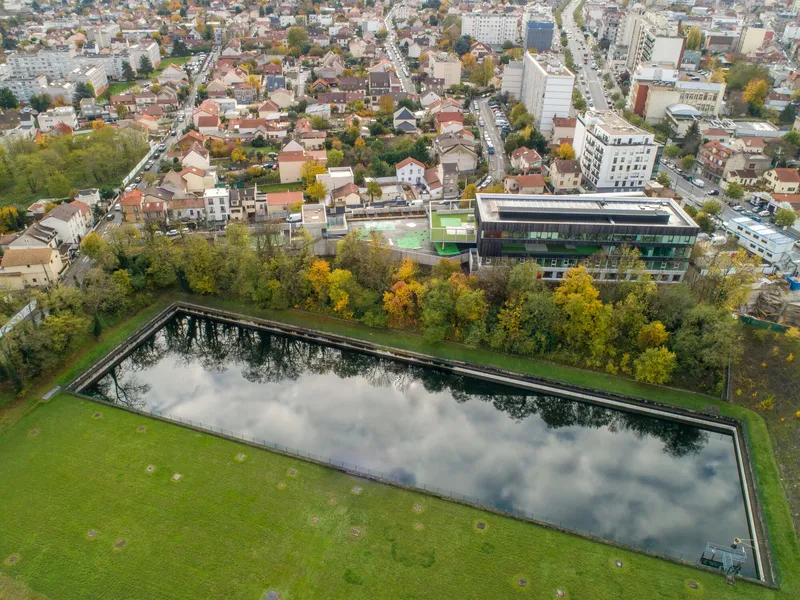
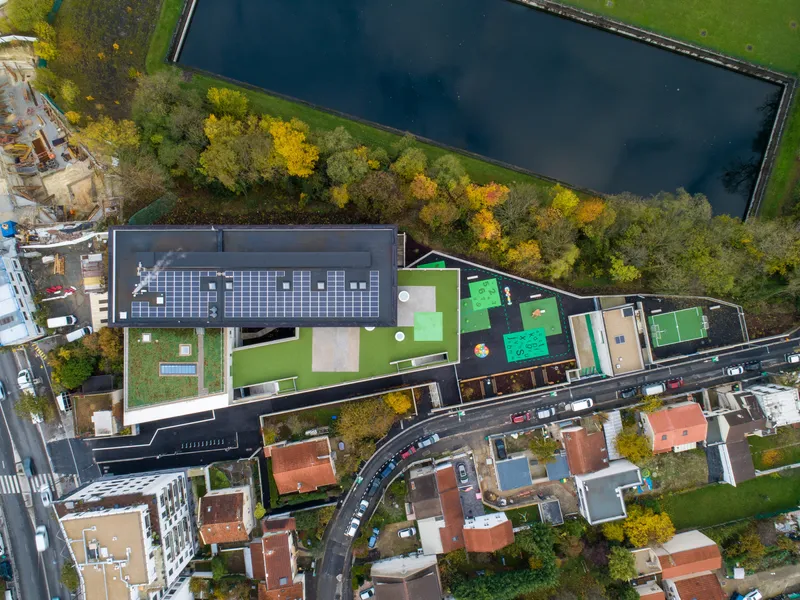
The rooftop terrace offers a panoramic view toward central Paris, an unexpected reward for a school that sits on the metropolitan fringe. White metal railings frame the hazy cityscape without obstruction, giving teachers and visitors alike a sense of the school's position within the larger urban geography. Below, a rectangular reflecting pool surrounded by lawn and autumn trees marks the old reservoir footprint, preserving the site's memory as open water within a dense residential district.
The roof itself is a working surface: photovoltaic panels generate on-site electricity, and green courtyard terraces step down to connect with the upper classrooms. The aerial view reveals the building's angular, almost triangular footprint, a shape driven by the irregular plot boundaries rather than any compositional gesture. Practicality generates form, and the result is more convincing for it.
Plans and Drawings
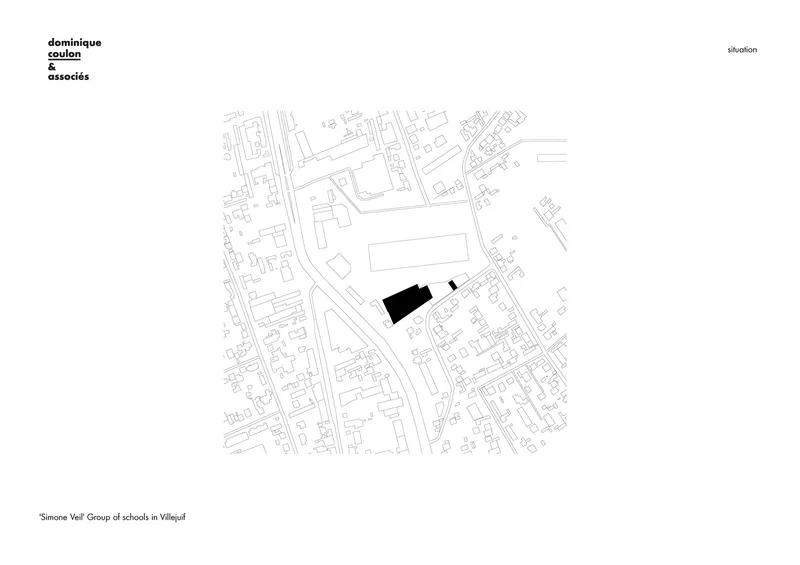
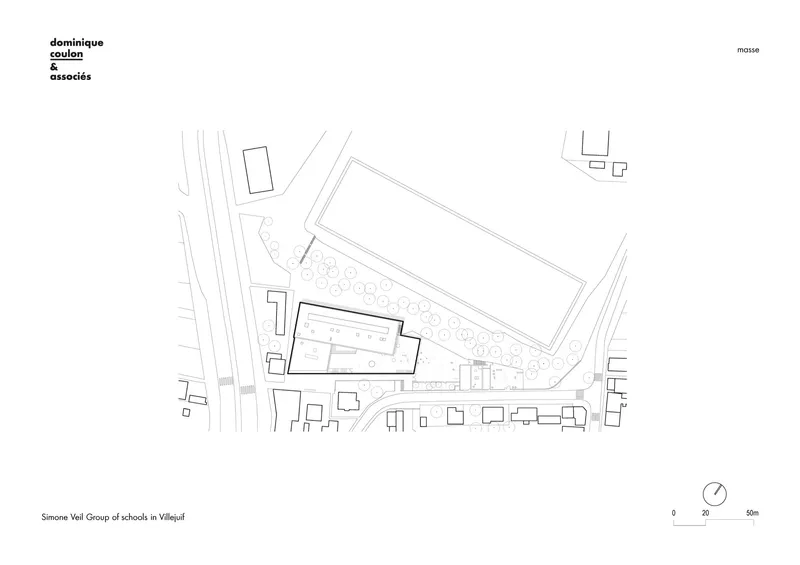
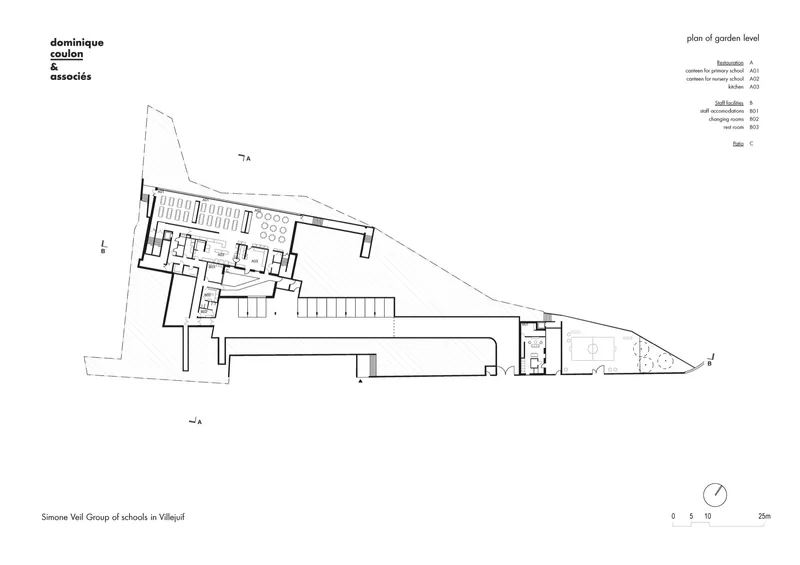
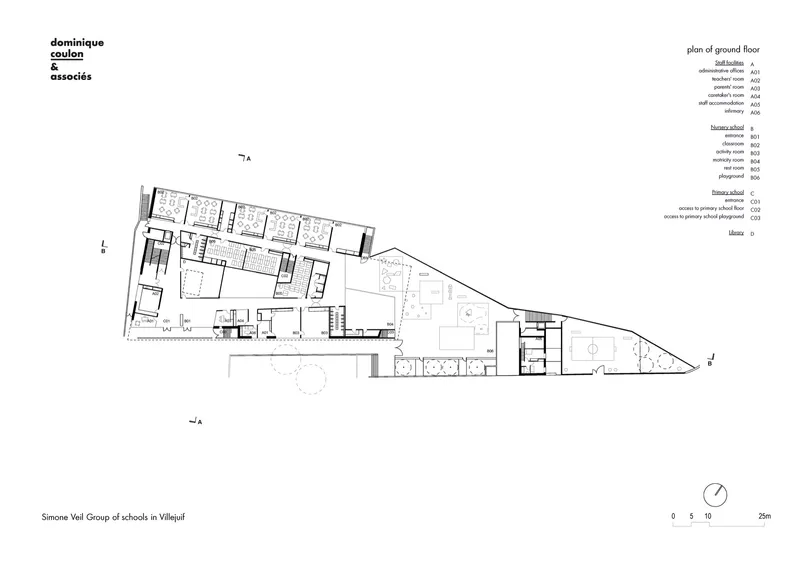
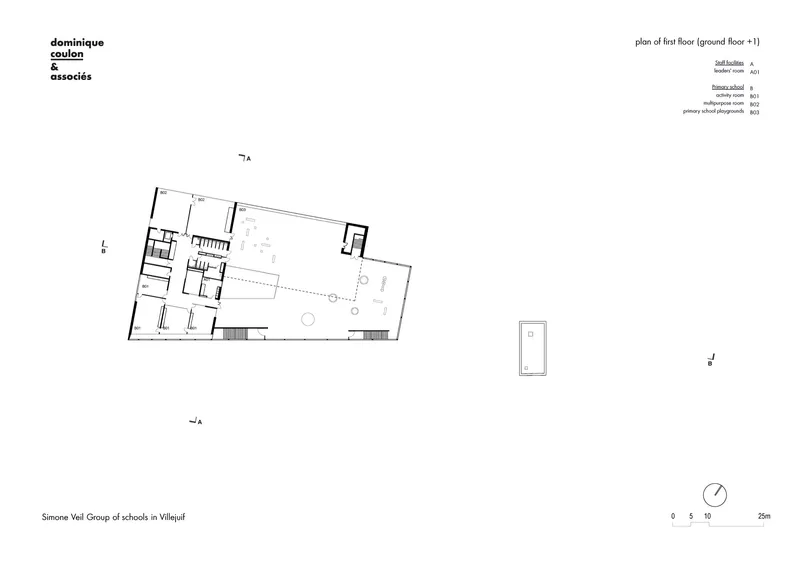
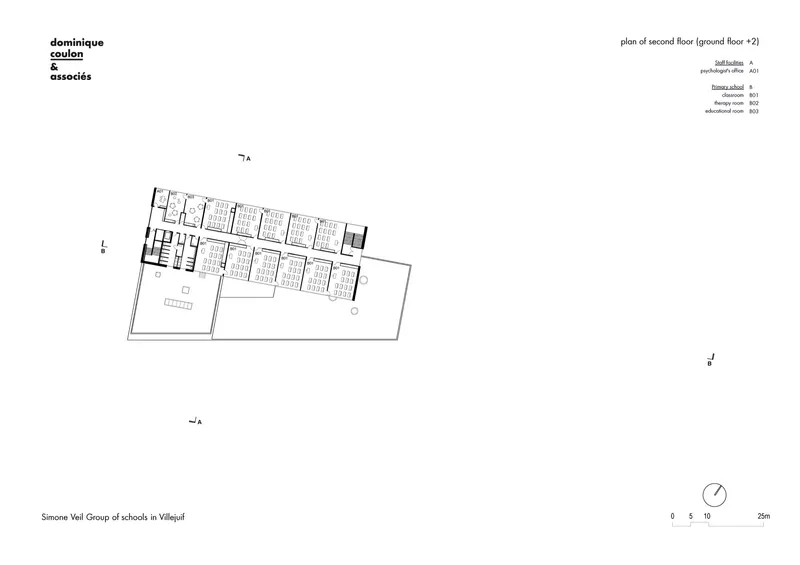
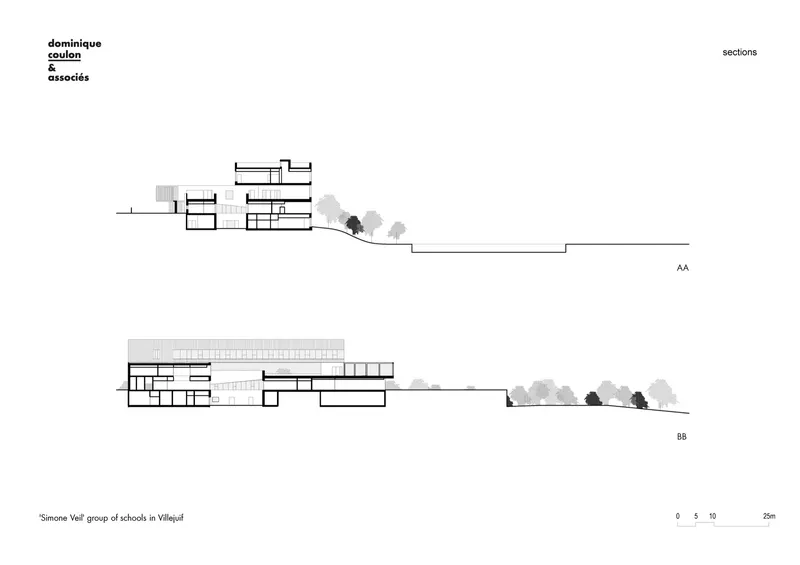
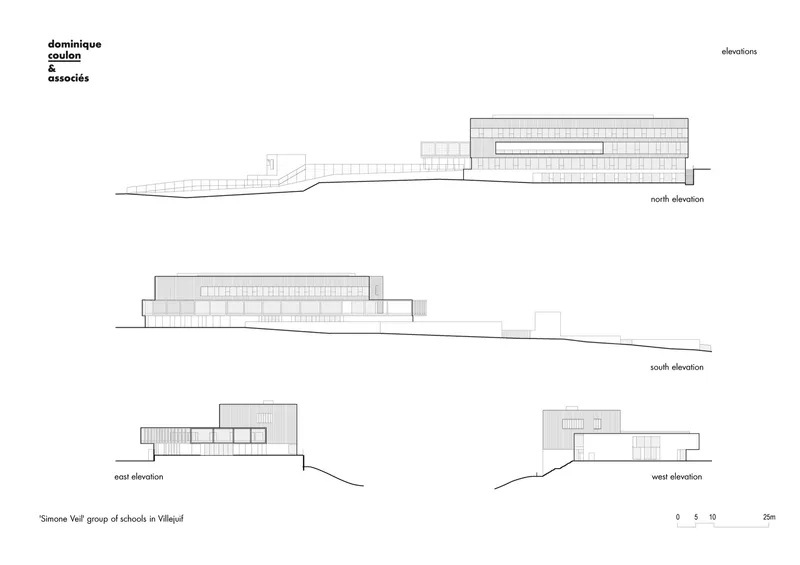
The site plans confirm the tightness of the plot: a single angular building footprint wedged into a network of surrounding streets. The garden-level plan shows nursery classrooms along one edge opening onto a large courtyard with landscape, while the ground and first floors organize classrooms and circulation within the irregular triangular geometry. By the second floor, the plan narrows to a single row of classrooms and the double-height library, with a terrace that becomes the panoramic overlook. The sections reveal how the building negotiates sloping terrain, with the cantilevered volumes stepping out over the lower levels to maximize both covered outdoor space and distant views.
Why This Project Matters
The Simone Veil Group of Schools demonstrates that a public school on a constrained suburban site does not need to compromise on spatial generosity or architectural ambition. By stacking programs vertically, cantilevering upper volumes to free ground-level play space, and treating every surface as an opportunity for material expression, Dominique Coulon has produced a building that gives children far more than the minimum. The covered green playground alone is worth the price of admission: a space that is neither strictly indoors nor outdoors, colored by architecture rather than decoration, and genuinely exciting to be inside.
More broadly, the project challenges the growing tendency toward smooth, neutral school design. Coulon's collage approach, with its abrupt material transitions, its refusal of repetition, its willingness to let fragments collide, produces a building that children will actually remember. Not because it is flashy, but because every room, every corridor, every view is specific. That specificity is rare in institutional architecture, and it matters enormously in a building where young people spend the formative hours of their day.
Simone Veil Group of Schools, designed by Dominique Coulon & associés. Villejuif, France. 8,913 m². Completed 2021. Photography by Clément Guillaume.
About the Studio
Share Your Own Work on uni.xyz
If projects like this are the kind of work you want to make, uni.xyz is a place to publish your own, find collaborators, and enter design competitions.


Popular Articles
Popular articles from the community

Temporary Home for Dogs: A Reversed Zoo Rethinks Animal Shelter Architecture
In Bucharest, a sinuous corridor and freed landscape flip the logic of containment, designing a shelter that works to make itself unnecessary.

Extended Shell: Retrofitting Kolkata's Balconies as Living Urban Thresholds
A modular retrofit system recovers the social and environmental intelligence of Kolkata's historic verandas for contemporary Park Street residents.

Cloaked Colonization: A Mobile Underwater Habitat That Moves Like a Fish
Micah Abaya's shortlisted EHC Pacific entry reimagines ocean settlement as a dispersed network of self-sustaining architectural organisms.
Opera by the Sea Estonia: Three Shells Dissolving Architecture into Tallinn's Coastline
A winning opera house proposal replaces monumental form with interconnected shells that blur the boundary between building, park and Baltic Sea.

Similar Reads
You might also enjoy these articles

Bao Huynh Watercolor Atelier: A Serene Art Retreat in Hội An
Bao Huynh Watercolor Atelier in Hội An blends multifunctional art spaces, sustainable design, local materials, and family-friendly living in a serene environment.

Atelier Macri Concept Store Interior Design by CASE-REAL
Atelier Macri store features a "ko" counter, walnut wood details, cork displays, blending retail, gallery, and seamless customer experiences.

Manuel Vargas Izquierdo Stadium and High-Performance Sports Center: Architectural Excellence in Jalpa de Méndez
The Manuel Vargas Izquierdo Stadium blends sustainable design, inclusive sports facilities, and cultural-inspired architecture, revitalizing Jalpa de Méndez’s public spaces.

KAKR Buluh Awar Hall: Revitalizing Community and Ecology Through Bamboo Architecture
Community built bamboo hall revitalizes Buluh Awar village, empowering youth, restoring ecology, celebrating vernacular craftsmanship through sustainable architecture and culture.

Explore Pont-Aven School Competitions
Discover active competitions in this discipline

Challenge to reimagine the Iron Throne

Photograph architecture without architects

Illustrate the lost glory of Angkor Wat - Render Challenge

Design challenge to reuse E-waste
Comments (0)
Please login or sign up to add comments
No comments yet. Be the first to comment!