

dongqi Design Turns Three Buildings in Shanghai's Jing'an District into a Raw Metal Complex
A 600-square-meter renovation in downtown Shanghai fuses a factory, a three-story block, and a single-story structure through exposed steel and galvanized


Most renovation projects in Shanghai's historic core play the heritage card: restore, reveal, romanticize. dongqi Design, led by JIANG Nan, takes a different position entirely. Faced with three separate brick-concrete structures in Jing'an District, a dense and commercially pressured part of downtown Shanghai, the firm chose not to sentimentalize the existing fabric. Instead, it wrapped the trio in a language of stainless steel, hot-dip galvanized plates, and dark metal mesh, producing a 600-square-meter complex that reads as a single metallic organism despite housing retail, exhibition, food and beverage, and office programs across very different spatial volumes.
What makes the project worth studying is not its programmatic ambition but its obsessive material discipline. Every joint, every fastener, every surface transition has been treated as a design problem. The result is a building that uses metal the way fine furniture uses wood: with grain direction, edge profiles, and joinery legibility all in service of a larger proportional order. The original concrete and brick walls stay visible where they can earn their keep, but the new insertions, from staircase balustrades to display racks to ceiling surfaces, form a cohesive metallic interior world that feels precise without feeling cold.
A Quiet Street Presence
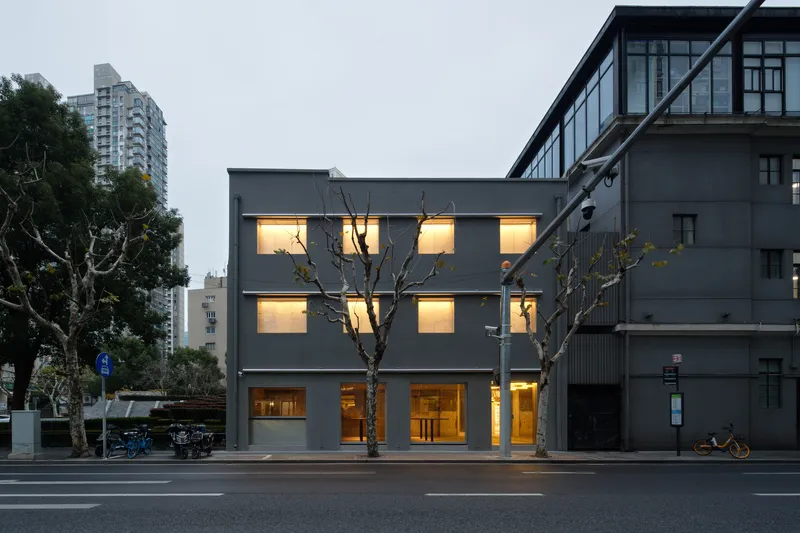
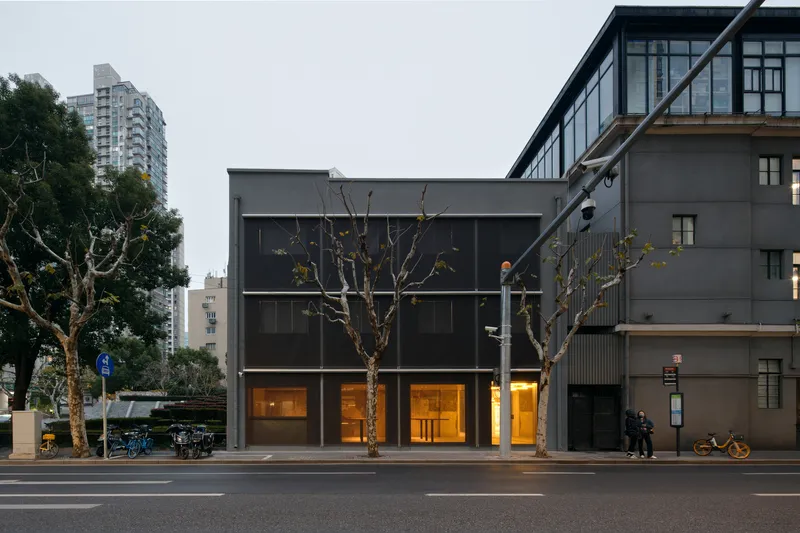
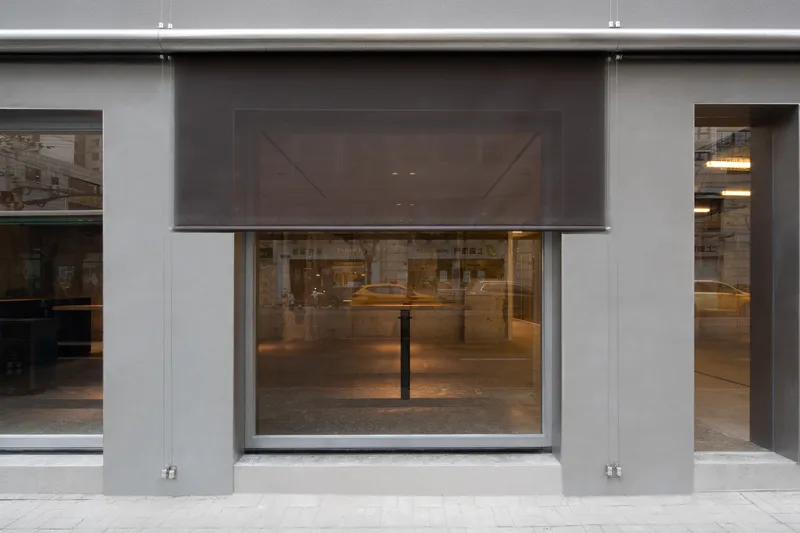
The facade strategy is deliberately restrained. Gray metal panels clad the three-story block in a taut skin, while a retractable dark mesh sunshade curtain adds a second layer that softens the street edge and manages solar gain. At dusk, warm interior light leaks through glazed storefronts and illuminated upper windows, turning the building into something closer to a lantern than a billboard. Pedestrians cluster near bare street trees, drawn in by the glow rather than any signage.
Horizontal stainless steel tubes run across the elevation, concealing tracks and electromechanical components while establishing a measured rhythm. The wider vertical joints on the metal plates reinforce this cadence. Beveled undersides and recessed flanges on the panels refine each profile, a level of care usually reserved for interior millwork, applied here to a public face.
The Factory Volume: Double-Height Retail Theater


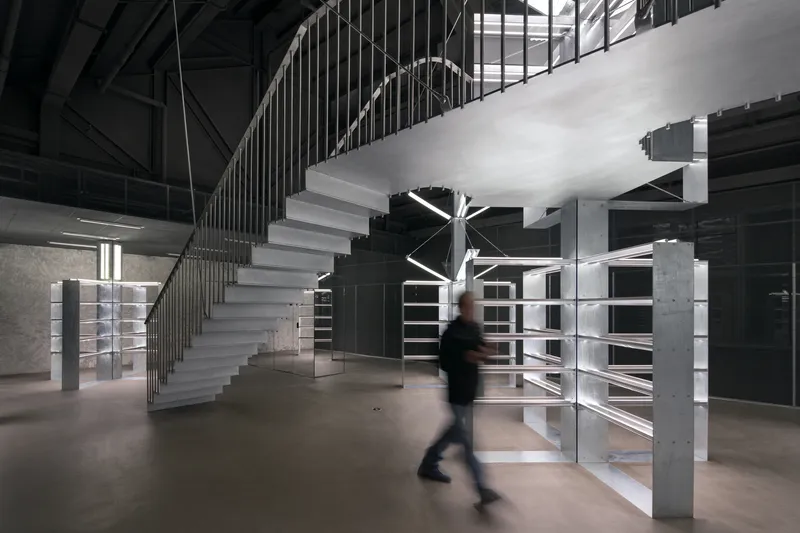
The former 8-meter-high factory building is the dramatic heart of the complex. dongqi Design inserts eleven cross-shaped display racks into this volume, freestanding glass and metal units that populate the floor like a grid of monuments. A suspended overpass structure threads through the upper portion of the space, connecting circulation across levels and giving visitors an aerial perspective on the merchandise below.
Exposed steel trusses and angular skylights overhead flood the space with controlled daylight, and at blue hour the double-height glazing transforms the room into a stage set visible from the street. Symmetrical staircases anchor the composition on both sides. The proportional relationship between the tall shelving units and the overhead structure gives the retail floor an almost ecclesiastical quality: vertical, ordered, deliberately ceremonial.
Staircase as Sculpture
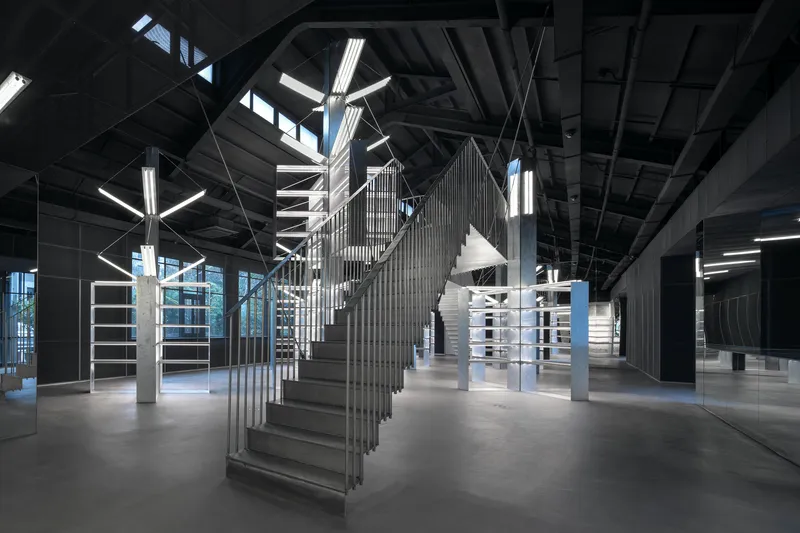
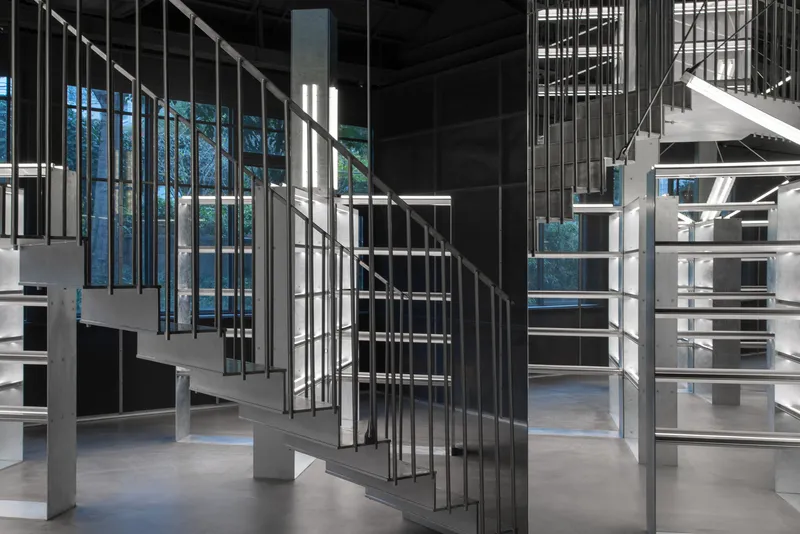

The staircases deserve their own category. Concrete treads cantilevered from curved forms meet vertical steel rod balustrades that rise uninterrupted through multiple levels. The rods are not decorative: they do structural work, tensioned and connected to the treads through precise steel plates with countersunk fasteners. The resulting silhouette is open, almost musical, a series of parallel lines ascending through black-paneled ceilings with daylight filtering from above.


Close inspection reveals the rigor. Cylindrical handrails cantilever from the stair edges. Rod tensioners connect to concrete treads through machined steel plates. Brushed metal surfaces meet raw concrete with visible but carefully placed screws. Nothing is hidden, but nothing is accidental either. The detailing vocabulary owes more to industrial engineering than to architectural convention, and it is all the better for it.
Ground Floor: Where the Street Comes In


Large hopper windows along the street elevation lift upward toward the ceiling, dissolving the boundary between interior and sidewalk. When open, the ground floor leisure space reads as an extension of the public realm. Tall elm wood tables, sized for standing use, replace conventional seating and reinforce the casual, drop-in atmosphere. The terrazzo floor ties the room together and offers a material counterpoint to the dominant metal palette.
A reception lobby in the adjacent volume presents a different mood. A black tiered counter sits against a textured concrete wall, flanked by orange stepped seating under linear ceiling lights. The color is unexpected and welcome: a controlled burst of warmth that prevents the metallic consistency from becoming monotonous.
Material Conversations: Metal, Mesh, and Moiré

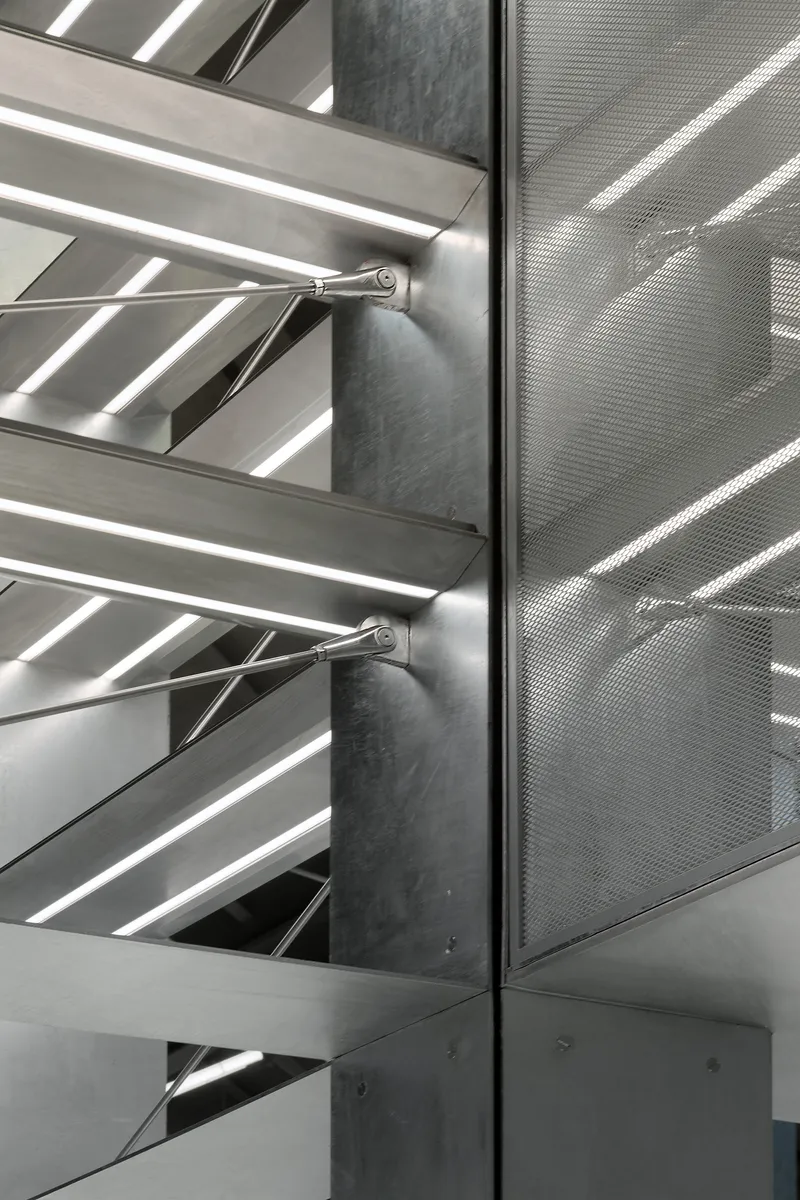
The project's most inventive detail may be the double-layer dark metal mesh partitions. Two sheets of perforated metal, slightly offset, produce a moiré effect that shifts as you move and as light conditions change. The result is a surface that is never static. It screens, reveals, and distorts in turn, adding visual depth to what could have been a flat dividing wall.
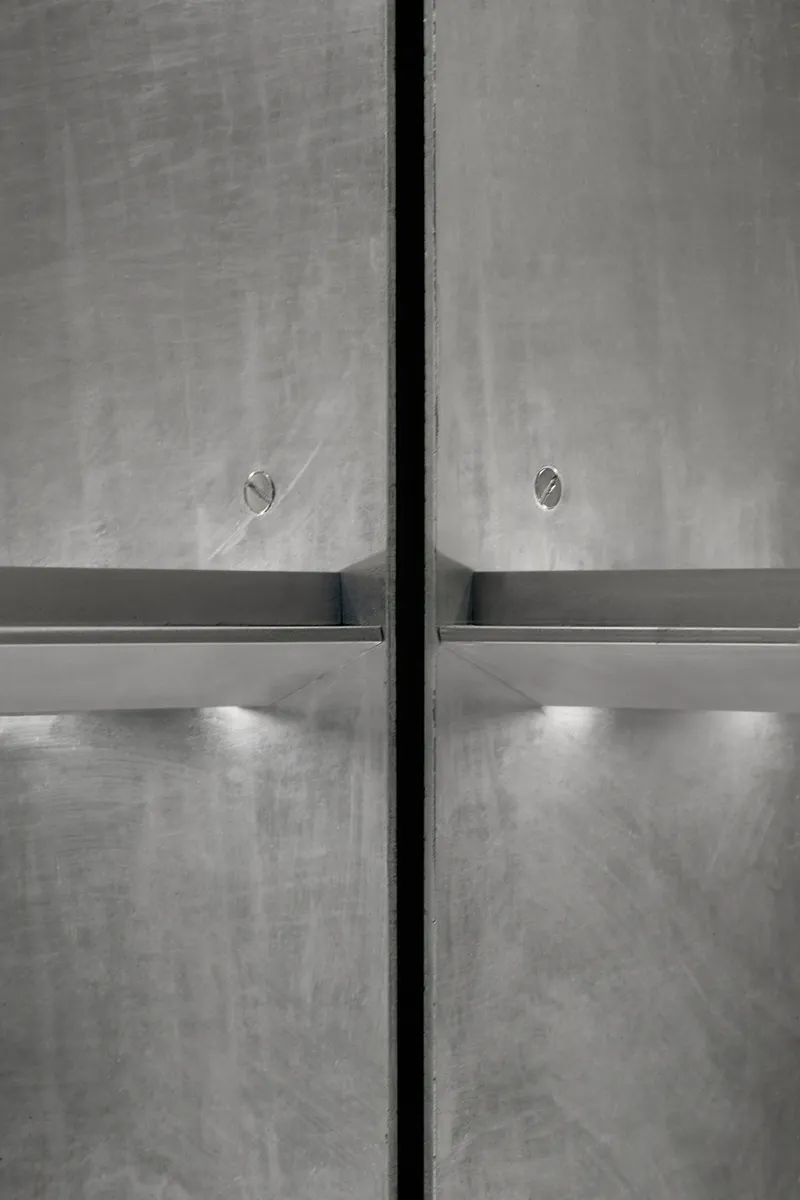
Elsewhere, junctions between perforated panels, raw concrete, and brushed steel are treated with a cabinetmaker's attention to tolerance. Horizontal metal ledges integrate lighting below. Galvanized plate doors use visible straight-head screws as ornament, while stainless steel inserts protect high-contact zones from wear. The building is designed to age, but on its own terms.
Upper Levels and Interstitial Spaces
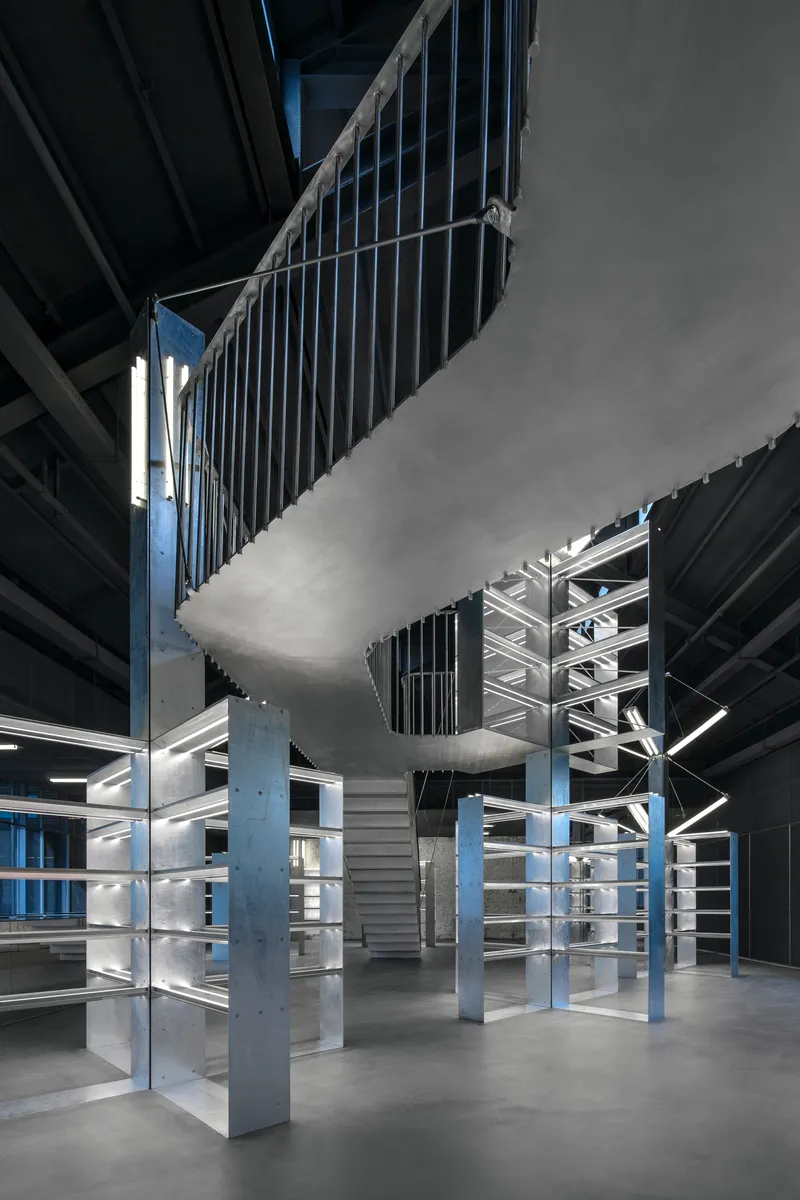


The upper walkway of the factory volume passes beneath exposed timber trusses and clerestory windows, a reminder that the original structure still carries the roof. Vertical metal slat screens and blue steel columns define the edges of the double-height retail space below, creating a layered visual field. On the office floors above the three-story building, the palette calms down: fluorescent tube lighting arranged in geometric clusters hangs from an industrial ceiling above library shelving, giving the workspace a studious, almost archival character.


The F&B spaces in the single-story building introduce softer textures. A curved green velvet banquette sits beneath recessed cove lighting against gradient-painted wall panels. A curved reception counter plays off a backlit wall of oxidized copper and verdigris patina panels, adding an organic, time-worn surface to a complex otherwise defined by precision-finished metals. The contrast is deliberate: the food and drink program gets its own material register.
Plans and Drawings

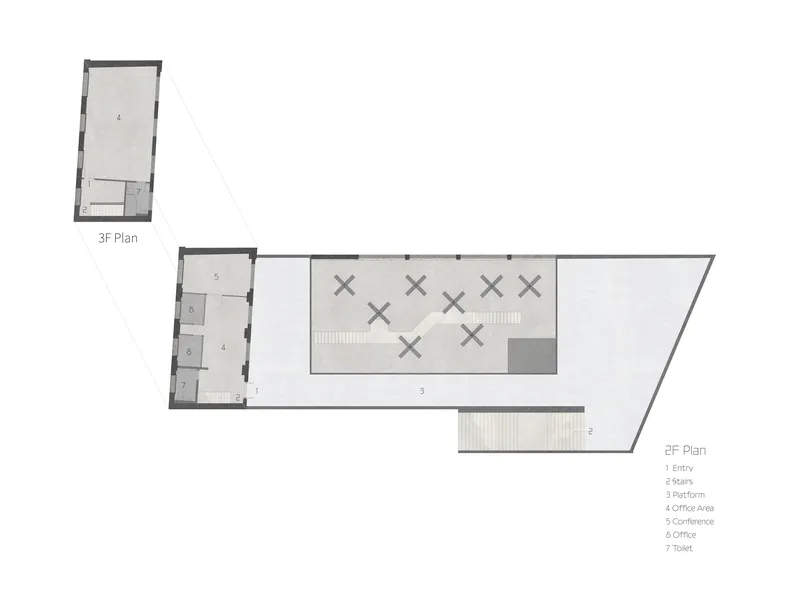
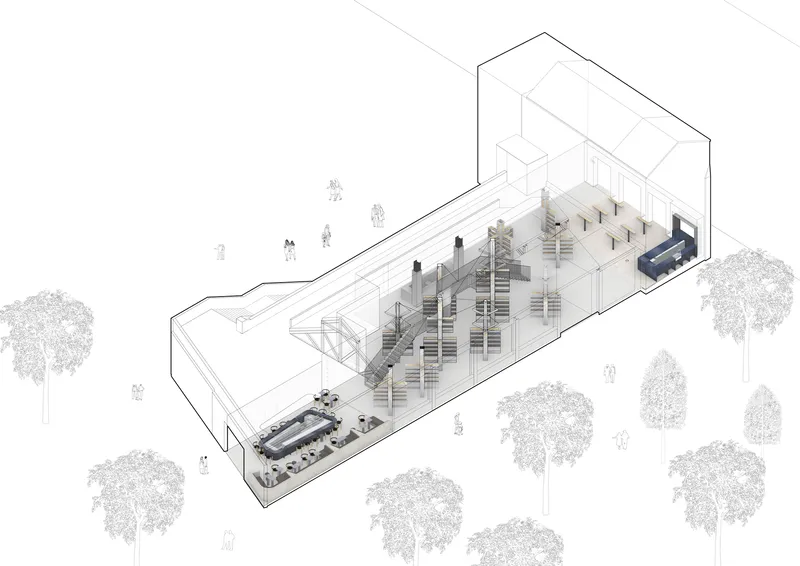
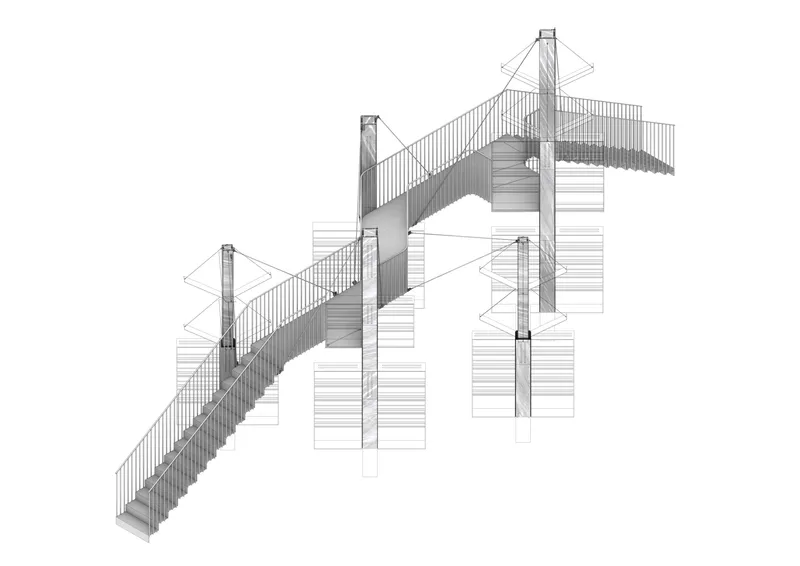
The ground floor plan reveals the angular footprint of the factory building, with the staircase cores and service areas tucked into the perimeter to free the central volume for display. Upper floor plans show the office areas organized as open loft spaces with a mezzanine overlooking the double-height below. The axonometric cutaway illustrates the relationship between the rows of cross-shaped shelving, the suspended walkway, and the surrounding streetscape, while the isometric staircase drawing exposes the zigzagging steel-and-concrete assembly in forensic detail.
Why This Project Matters
Shanghai's historic districts are full of renovation projects that oscillate between nostalgic preservation and aggressive erasure. dongqi Design finds a third path. By retaining existing wall textures and structural bones while overlaying a highly resolved metallic skin, the firm produces a hybrid that respects the past without performing it. The three buildings, different in scale and character, are unified not by a cosmetic wrapper but by a shared language of joinery, surface treatment, and proportional logic.
The deeper lesson here is about detailing as design argument. In an era when renovation often means white walls and Edison bulbs, dongqi Design's insistence on galvanized plates, moiré mesh, and visible straight-head screws amounts to a polemical position: that adaptive reuse can be forward-looking, materially rigorous, and still welcoming. At 600 square meters, the complex is modest in footprint, but its ambition per square meter is anything but.
Renovation Project in the Heart of Shanghai's Historic Area by dongqi Design, led by JIANG Nan. Located in Jing'an District, Shanghai, China. 600 m². Completed in 2025. Photography by Yasu Kojima.
About the Studio
Share Your Own Work on uni.xyz
If projects like this are the kind of work you want to make, uni.xyz is a place to publish your own, find collaborators, and enter design competitions.


Popular Articles
Popular articles from the community


Singing Woman: An Opera House That Performs Before the Curtain Rises
Ovidiu Cristian Pavel's conceptual opera house translates Estonia's choral identity into a sculpted waterfront landmark facing the Baltic Sea.


ETEH Reworks the Shared Spaces of São Domingos School in Brazil Around Timber, Color and Hanging Plants
At São Domingos School in Brazil, 436 m² of hall, refectory and library are recast with timber joinery, a yellow and blue code and trailing greenery.

The Amber Palace Opera: A Geological Fiction Surfaces on Tallinn's Baltic Waterfront
Pierre Brillard reimagines a Baltic legend as a public landscape, opera house, and waterfront promenade rooted in Tallinn's coastal identity.

Opera on the Sea: Driftwood Logic Shapes a Timber Opera House on Estonia's Coast
Trevor Orgill's opera house translates the entangled drift of floating timber into a civic building where wood, water, and music converge.

Similar Reads
You might also enjoy these articles

LAVA Architecten Gives Vocational Education a Sawtooth-Roofed Face on a Mechelen School Campus
In Mechelen, Belgium, a 2,053 m² STEM school on a 6×6 m grid turns workshops and classrooms into rooms that can be rearranged as teaching changes.

KEMA Studio Turns a Derelict Marvila Attic into a 60 m² Lighthouse Apartment Above Lisbon
In Lisbon's Marvila district, a rebuilt roof, four skylights and two plywood volumes turn an unlivable attic into a bright home facing the Tagus.

Pixel Gardens: One Repeated Module Stacked Into a Terraced Social Housing Tower for Famagusta
Salem Bader's shortlisted housing tower builds a vertical neighbourhood from one repeated module, offsetting units to carve terraces, light and air.

Bao Huynh Watercolor Atelier: A Serene Art Retreat in Hội An
Bao Huynh Watercolor Atelier in Hội An blends multifunctional art spaces, sustainable design, local materials, and family-friendly living in a serene environment.

Explore Shanghai Competitions
Discover active competitions in this discipline

Challenge to design luxury tourism on rails

VR headsets Storefront design competition

Bring back Drive In's

Designing a staircase for a client
Comments (0)
Please login or sign up to add comments
No comments yet. Be the first to comment!