
Dorte Mandrup Grounds a Wadden Sea World Heritage Center in the Tides of Lauwersoog
A timber-screened pavilion on the Dutch coast dissolves the threshold between exhibition space and the UNESCO tidal landscape it celebrates.


The Wadden Sea is one of the largest unbroken tidal flat systems on Earth, a landscape where land and water refuse to commit to either state. Building a visitor center for a place like that demands more than a box with informational panels. Dorte Mandrup seems to understand this instinctively: the Wadden Sea World Heritage Center in Lauwersoog, the Netherlands, is a building that behaves like the territory it interprets, low and horizontal, wrapped in a permeable timber screen that lets wind, light, and water define the experience as much as any curated exhibit.
What makes the project genuinely interesting is its refusal to compete with the landscape for attention. The center sits at the edge of a mudflat harbor, barely taller than the dike infrastructure around it, yet it orchestrates a full 360-degree encounter with the Wadden Sea through rooftop terraces, waterfront promenades, and interior spaces that frame views of tidal flats and open sky. It is the second of three Wadden Sea projects by the Danish studio, and it may be the most quietly persuasive argument for how architecture can amplify a place rather than narrate it.
A Timber Veil for a Tidal Edge
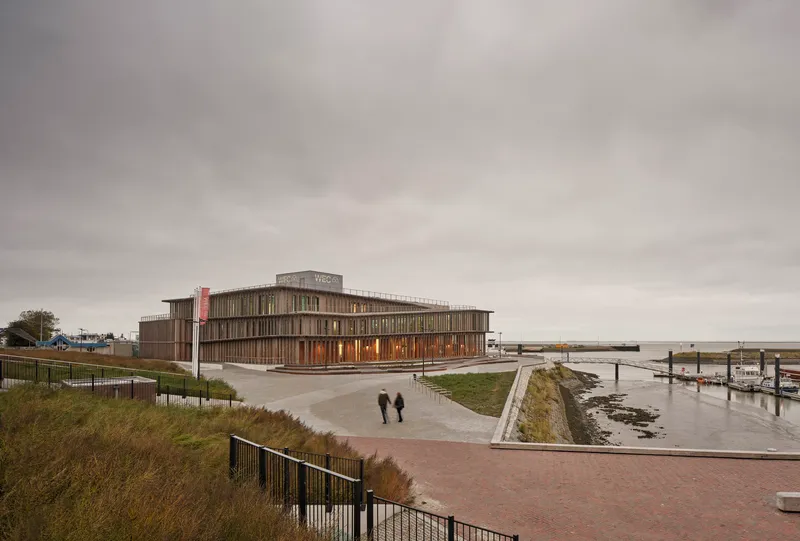
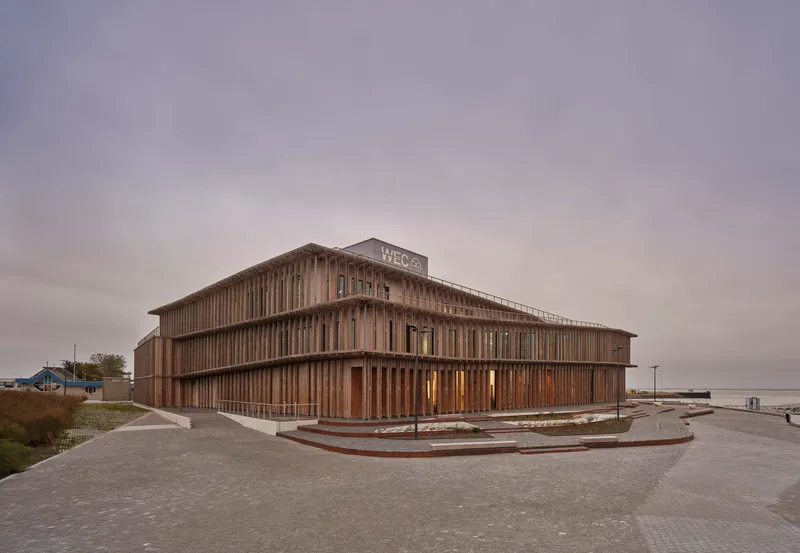
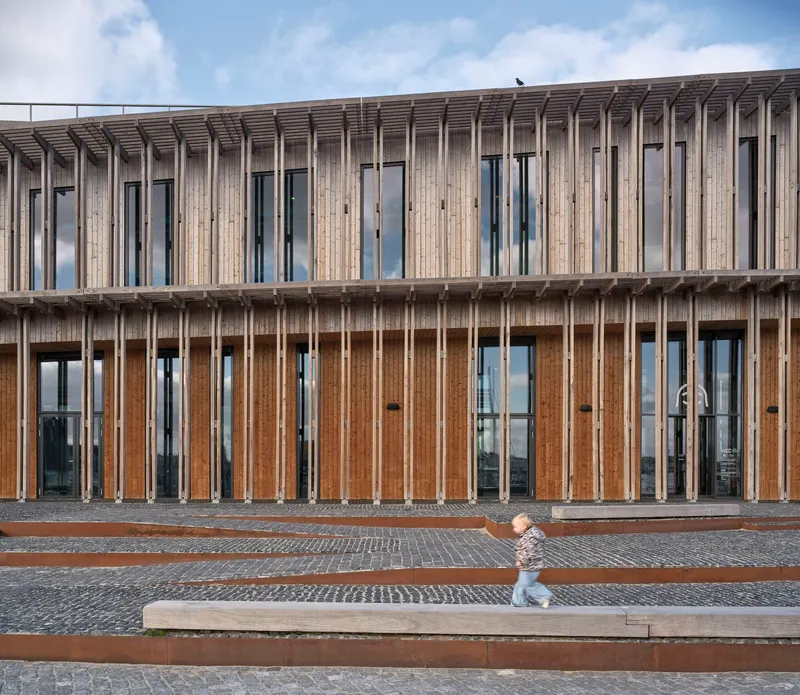
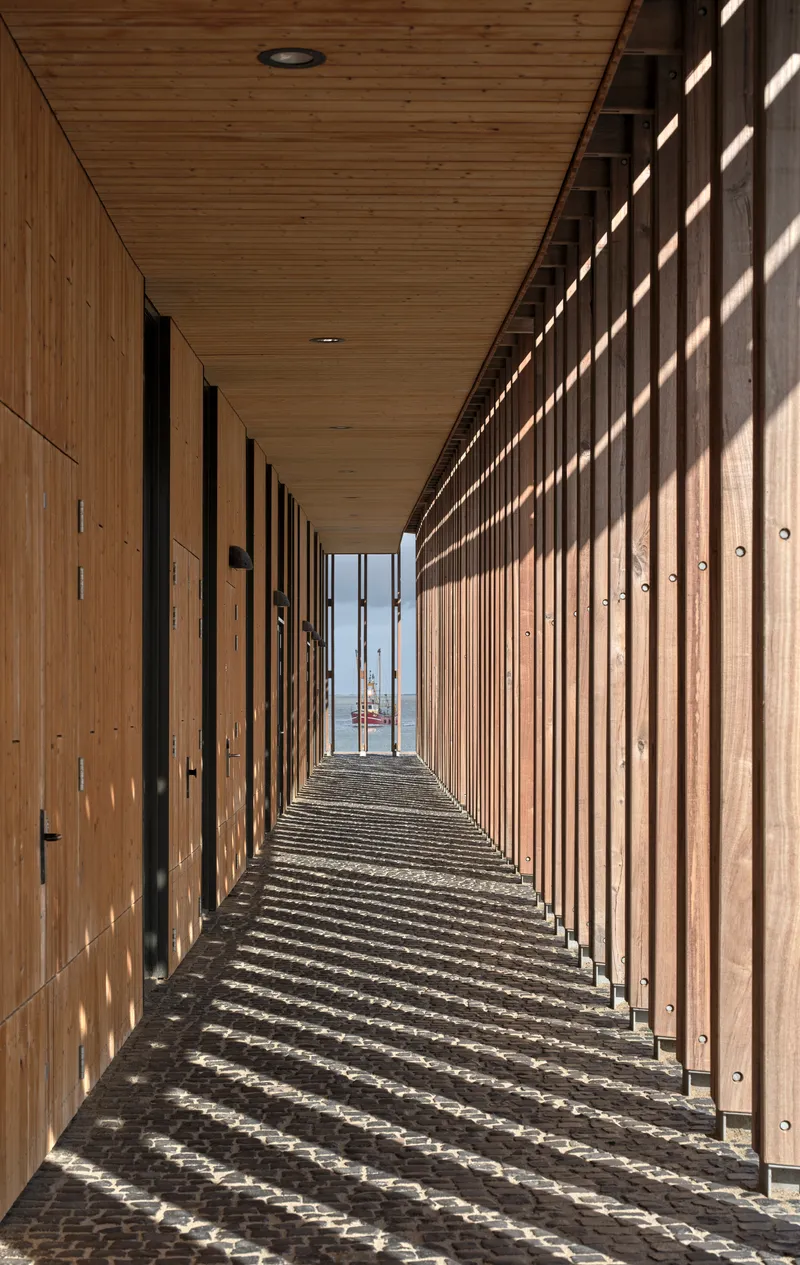
The building's defining material gesture is a continuous screen of vertical timber slats that wraps the entire perimeter. It reads differently at every angle and every hour: opaque from a distance, translucent up close, and almost incandescent when backlit at dusk. The slats operate as a brise-soleil, a privacy filter, and a formal unifier all at once. They soften the building's rectilinear mass into something that feels woven rather than constructed.
At the corners, the screen curves gently, eliminating hard edges and reinforcing the reading of the facade as a singular envelope rather than four distinct walls. Close up, you notice the craft: bolted connections, inset glazing panels, and a rhythm of open and closed slats that modulates the interior light with real precision. The timber will grey over time, which is exactly the point. In a few years the building will look as weathered as the harbor pilings beside it.
Harbor Presence
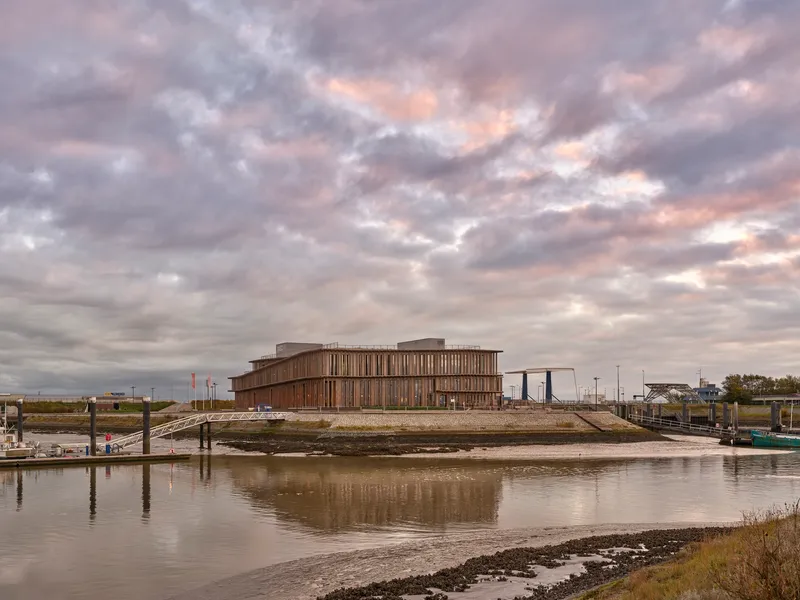
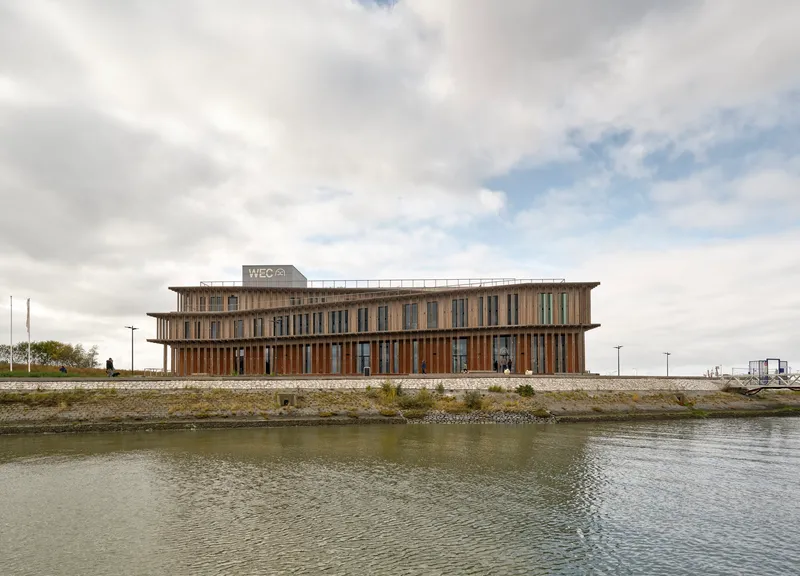
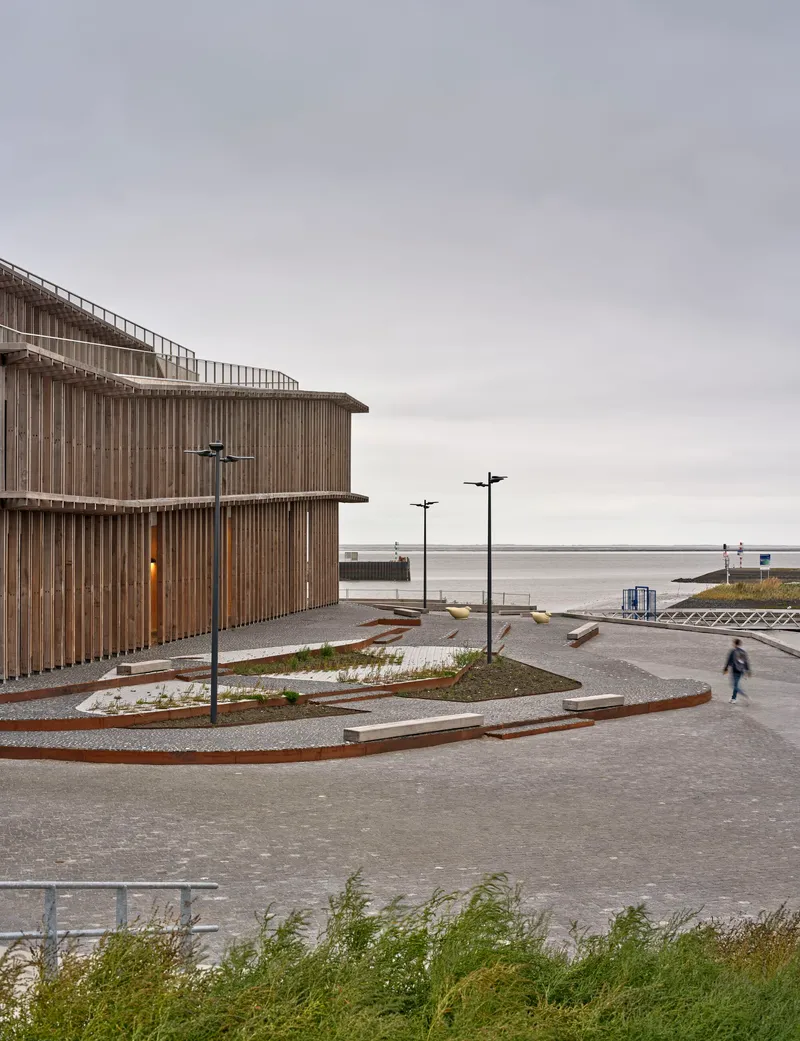
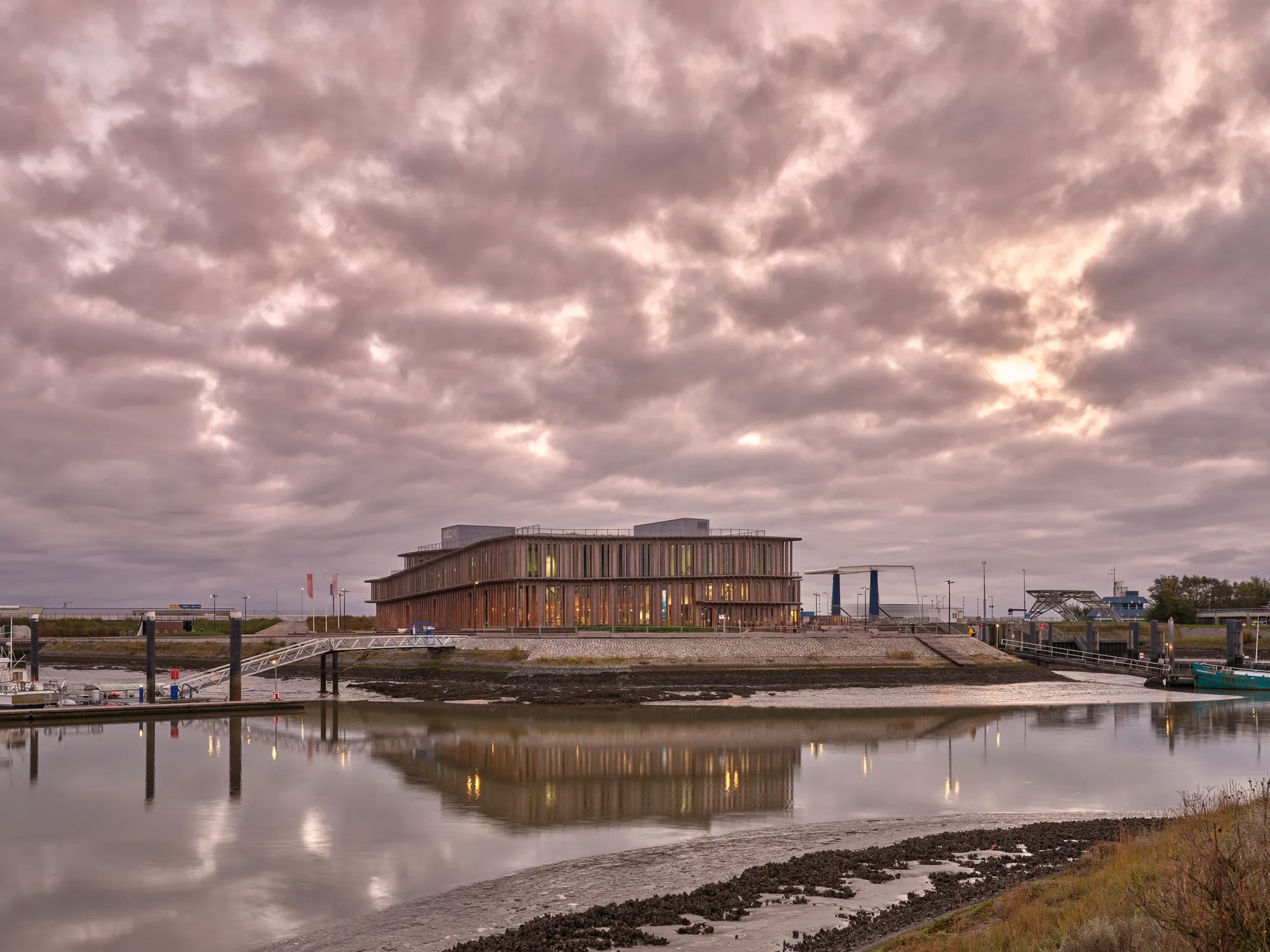
From across the water, the center reads as a long, low datum line, barely interrupting the horizon. It sits on a stone plinth that anchors it to the harbor edge, elevating the main volume just enough to clear tidal fluctuations without looking defensive. The decision to keep the building at two stories is critical. Any taller and it would have become a landmark competing with the sky; at this height, it belongs to the waterline.
The reflections in still water double the effect, turning the building into a symmetrical figure that seems to float on the surface of the mudflats. Dorte Mandrup has spoken about wanting her Wadden Sea buildings to feel inevitable in their settings. In Lauwersoog, that ambition registers clearly: the center does not look placed on the harbor so much as grown from it.
Interior Atmospheres: Concrete, Timber, Brass
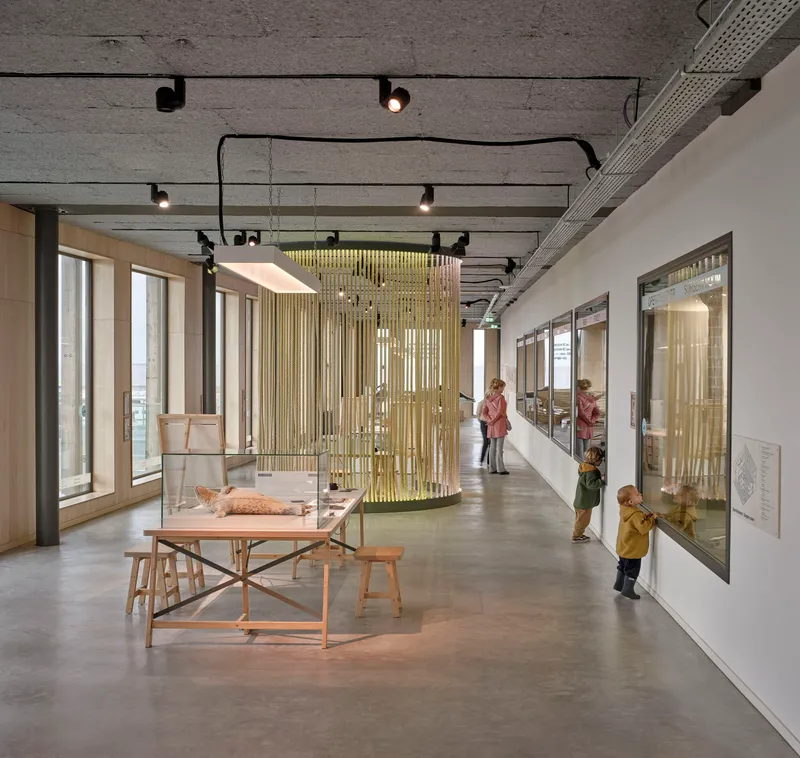
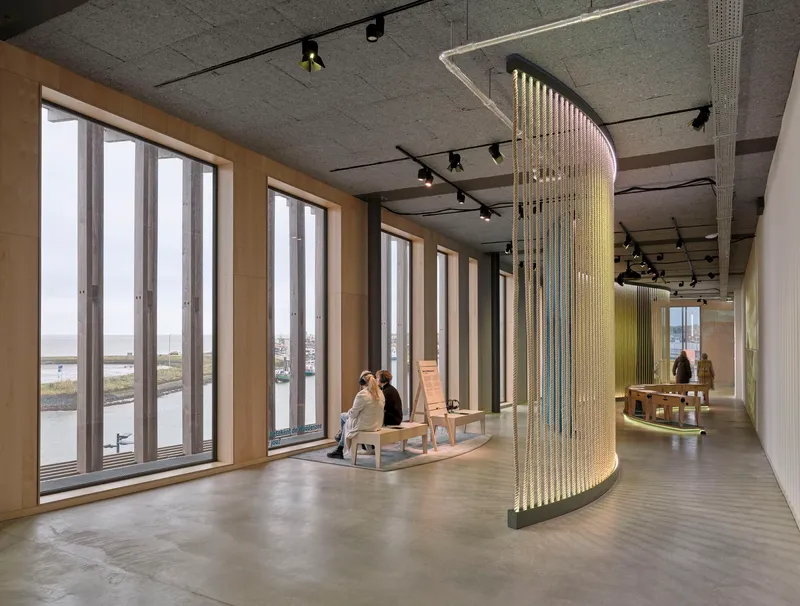
Inside, the palette shifts to exposed concrete soffits, polished concrete floors, and brass mesh installations that introduce a warm metallic shimmer into the gallery spaces. The concrete is honest, left with plank imprints on the ceiling that echo the timber cladding outside. Mechanical ducts run exposed, and steel columns stand unadorned. There is no plasterboard concealing the structure, which keeps the interiors feeling robust and slightly industrial, appropriate for a building on a working harbor.
The brass mesh screens and bead curtain partitions deserve particular attention. Suspended from the ceiling, they divide space without enclosing it, creating veils of transparency that mirror the timber screen outside at a finer grain. When lit from within at twilight, they glow against the mirrored ceiling, producing a shimmering, almost submarine atmosphere that references the aquatic world on display nearby. It is a material choice that does real spatial work, not just decorative work.
Learning Spaces and the Wide Staircase
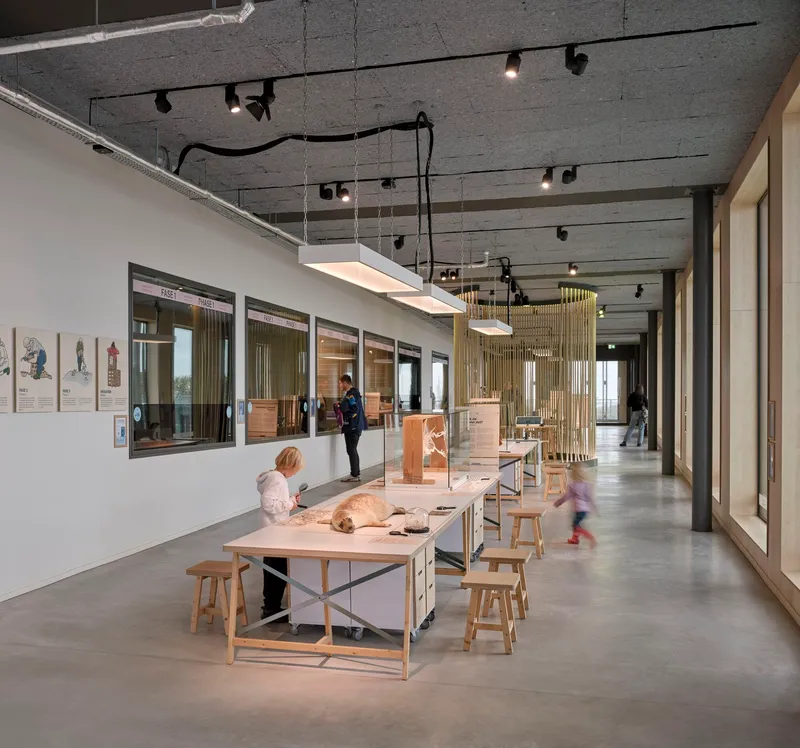
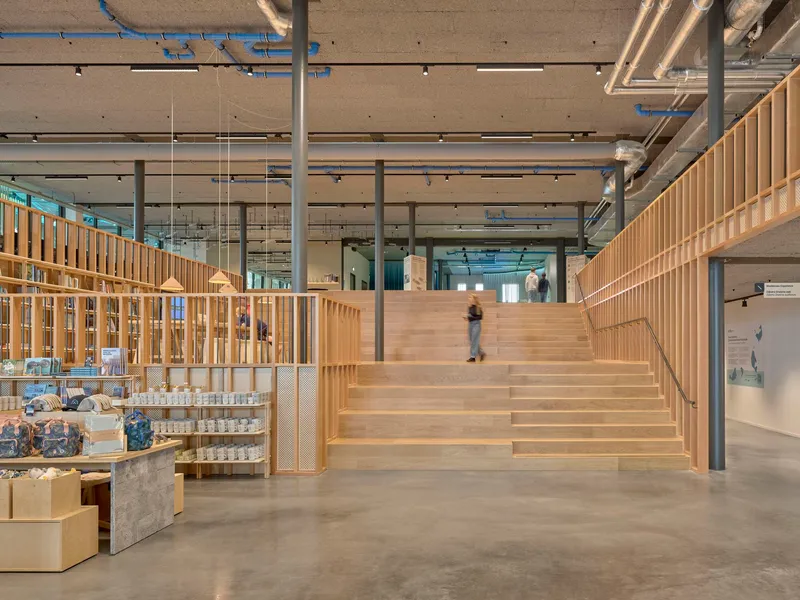
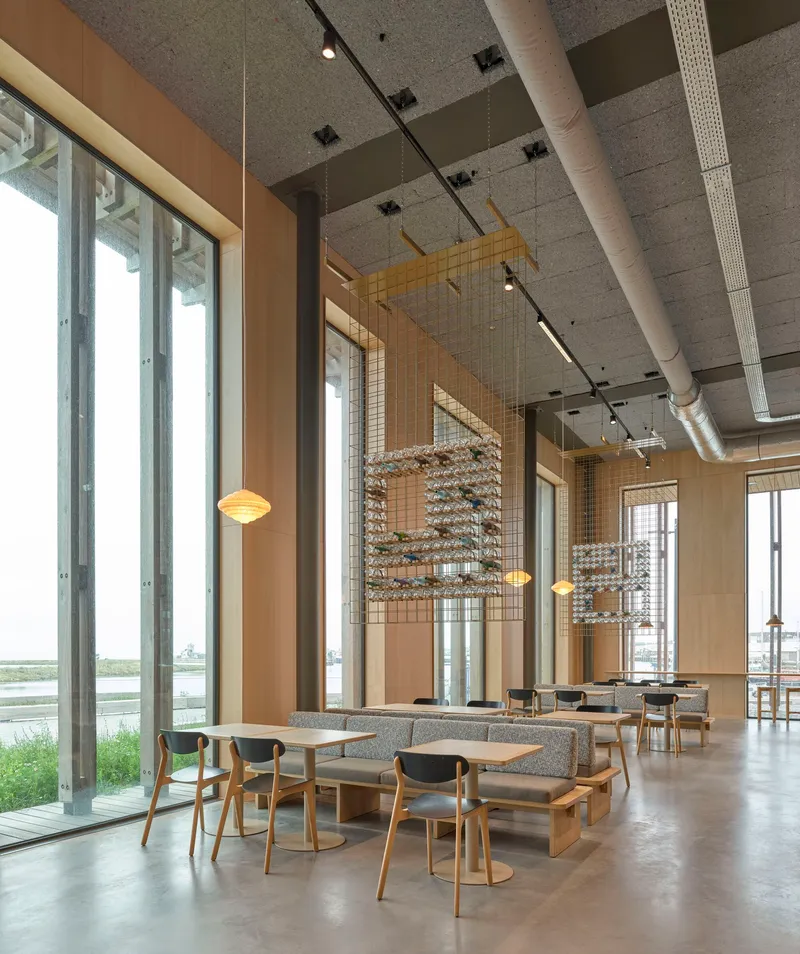
The center is designed as much for school groups and families as for casual tourists, and the circulation reflects that. A wide timber staircase, generous enough to sit on, acts as the primary vertical connector and doubles as an informal amphitheater. Integrated shelving recesses line one side, turning the stair into a browsable display wall. It is a move borrowed from library design, and it works well here: ascent becomes discovery.
Exhibition halls are furnished with sturdy work tables and wooden stools, scaled for children and robust enough to absorb the energy of a school visit. A double-height reading room with stepped timber seating and suspended wire mesh screens provides a quieter counterpoint. The variety of spatial characters, from bustling workshop to contemplative reading nook, gives the building resilience across different programs and seasons.
Living Exhibits: The Seal Pools
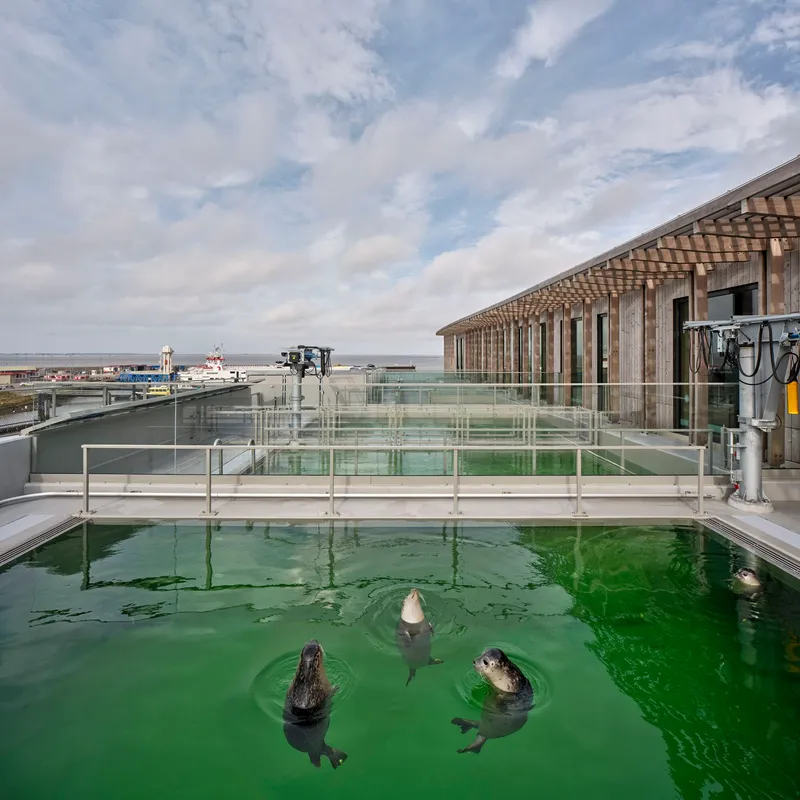
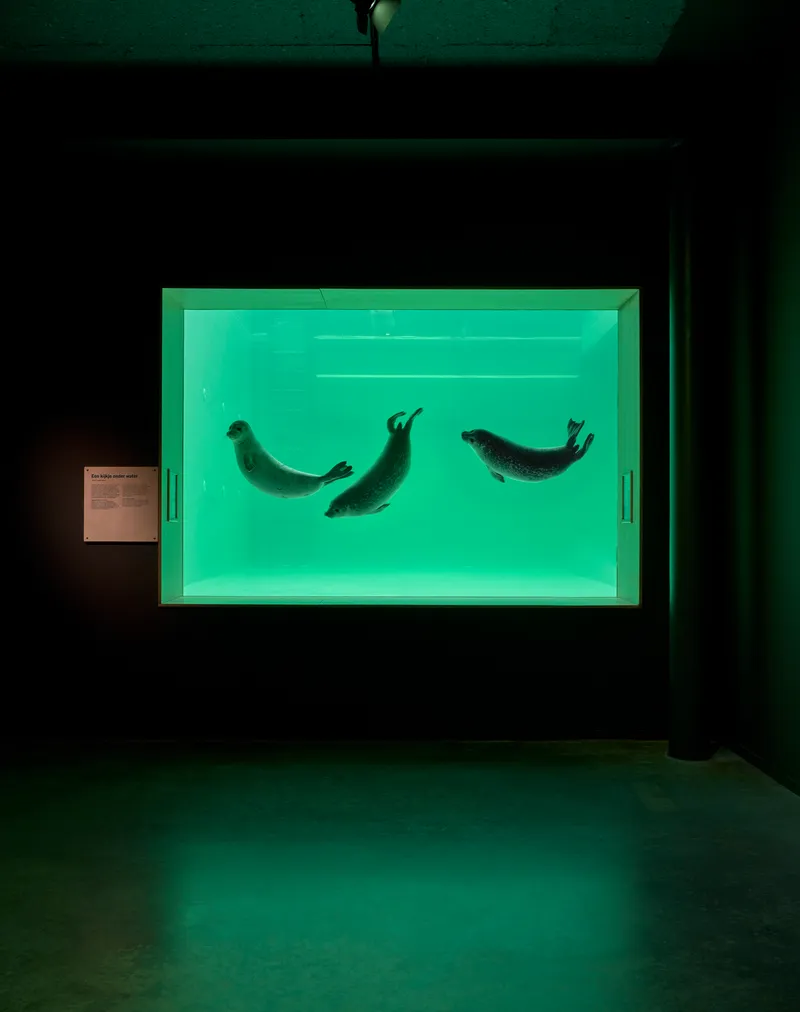
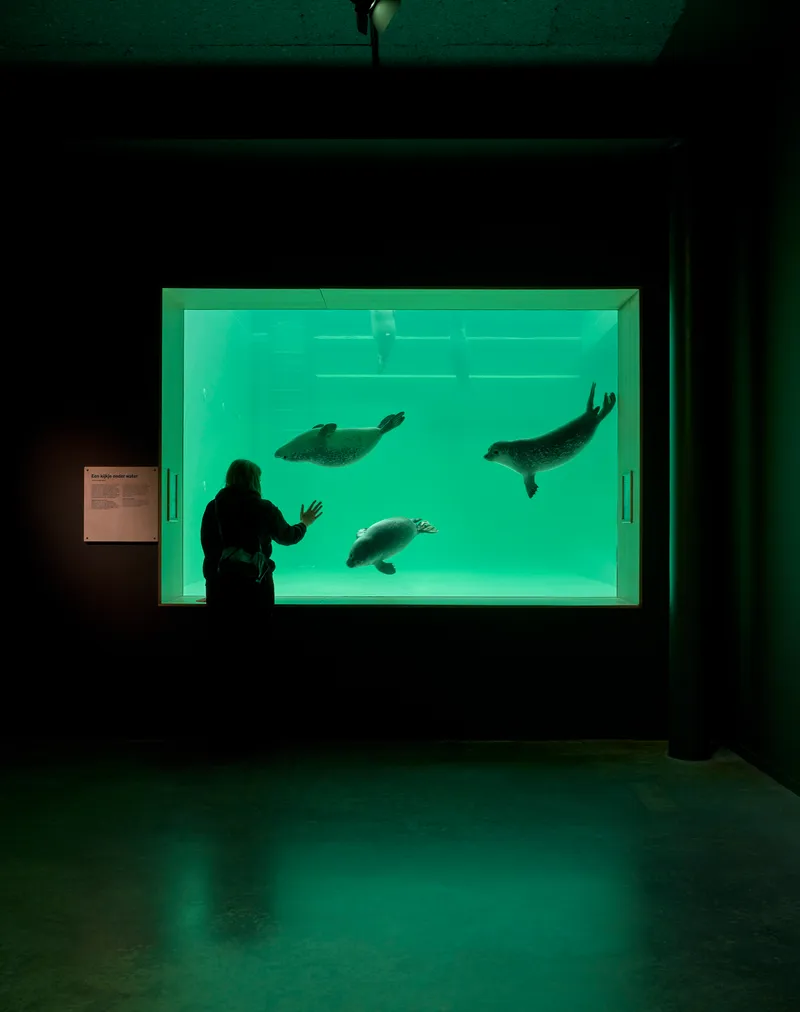
Perhaps the most unexpected element is the integration of seal rehabilitation pools directly into the building's program. An outdoor pool sits alongside the timber-clad facade, framed by glass and steel enclosures that let visitors observe the animals against the backdrop of the working harbor. Inside, a subterranean viewing gallery places you below water level, face to face with seals swimming overhead in a green-lit tank.
The silhouette of a visitor watching a seal glide past is one of the building's most arresting moments. It collapses the distance between human observer and marine inhabitant in a way that no panel or film can replicate. By housing living animals, the center stakes a claim that goes beyond interpretation: it participates directly in the ecological stewardship of the Wadden Sea.
Rooftop and Waterfront: The 360-Degree Landscape
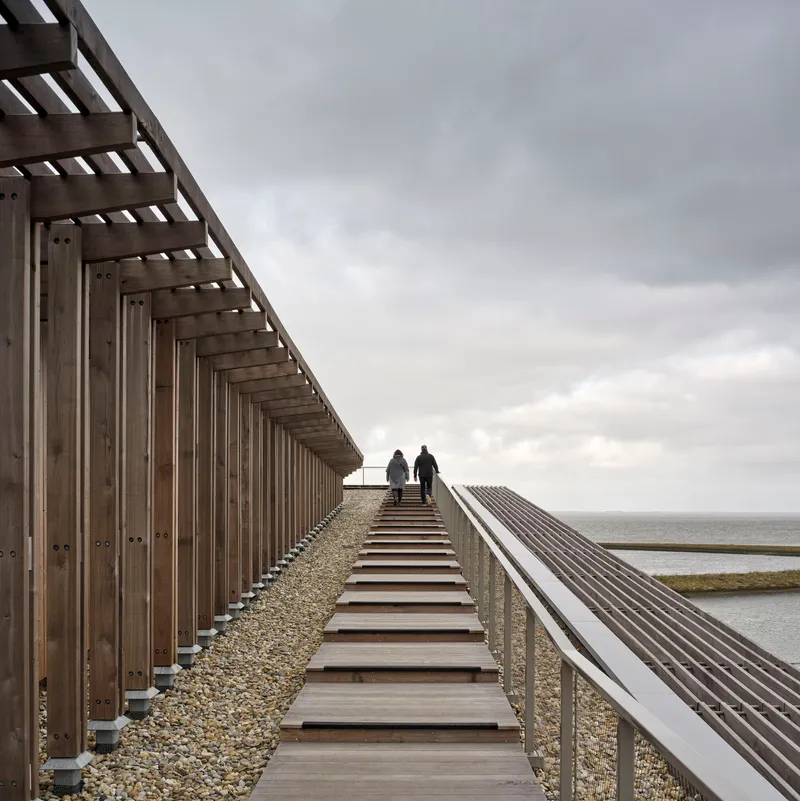
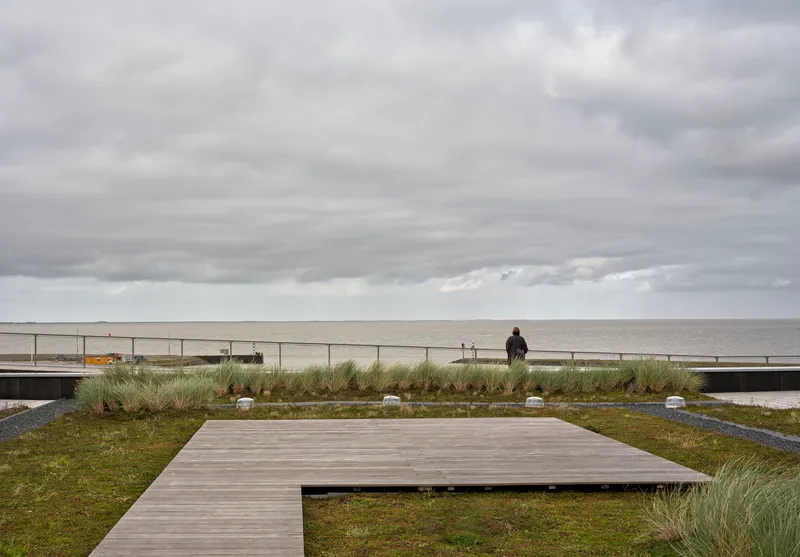
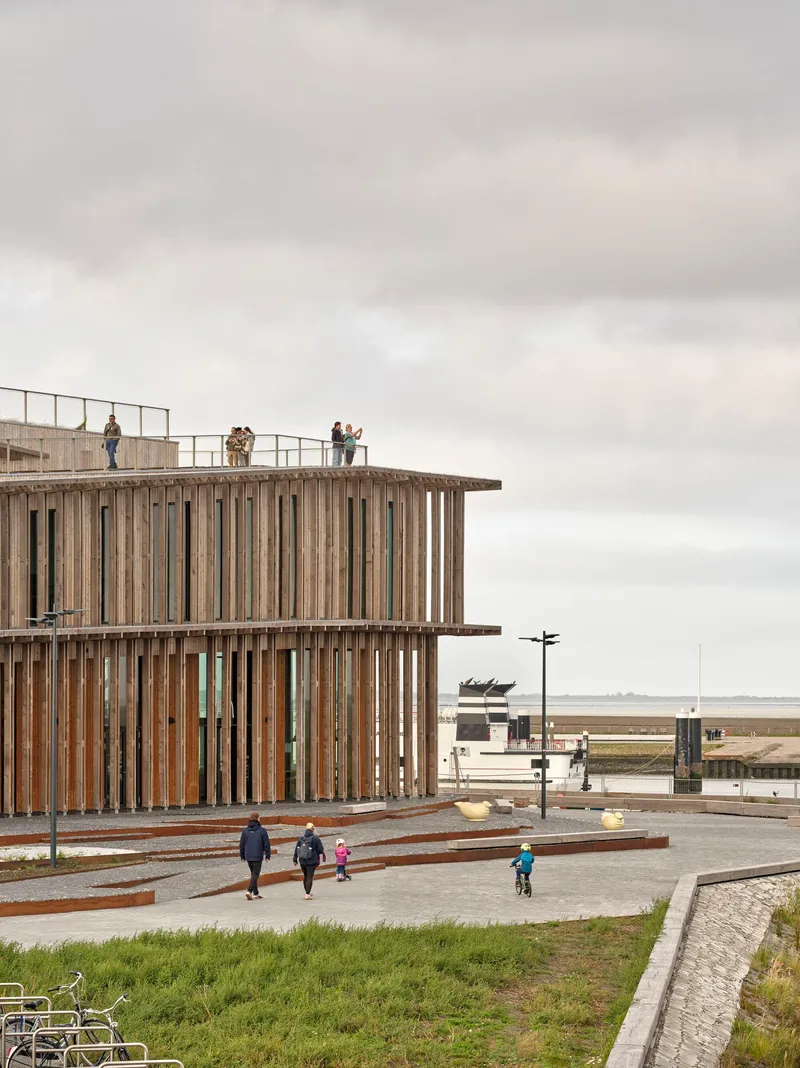
The roof is not an afterthought. Timber boardwalks lead to open terraces planted with coastal grasses, offering an unobstructed panorama of the Wadden Sea, the harbor, and the Dutch polder landscape beyond. A gravel ballast roof absorbs rainwater and reduces heat gain, but it also gives the roofscape a material kinship with the tidal flats below. Standing up there, the building disappears beneath you, and you are left alone with the horizon.
At ground level, the promenade loops the full perimeter, lined with bicycle racks and terraced paving that steps down to the water's edge. The building generates its own public space, drawing the town's waterfront life into contact with the center without requiring anyone to buy a ticket. This is generous urbanism for a small settlement, and it transforms the center from a destination into a piece of civic infrastructure.
Dusk and the Question of Presence
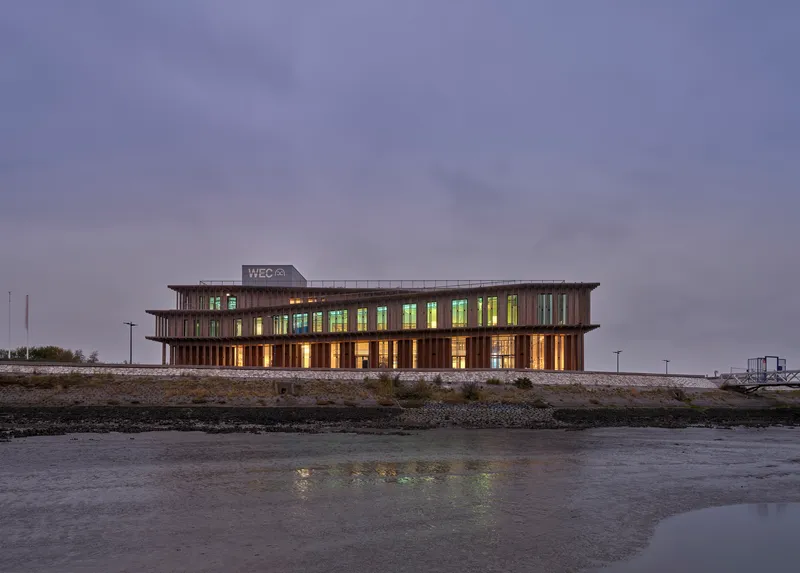
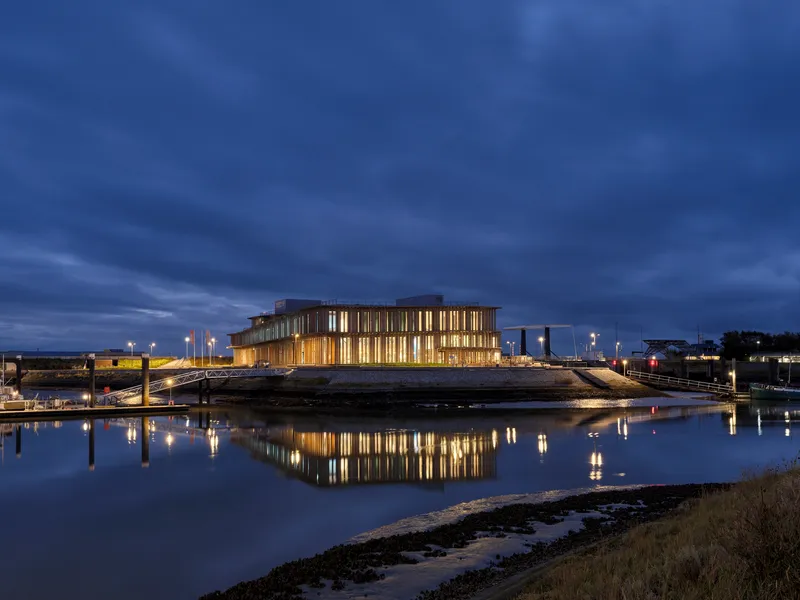
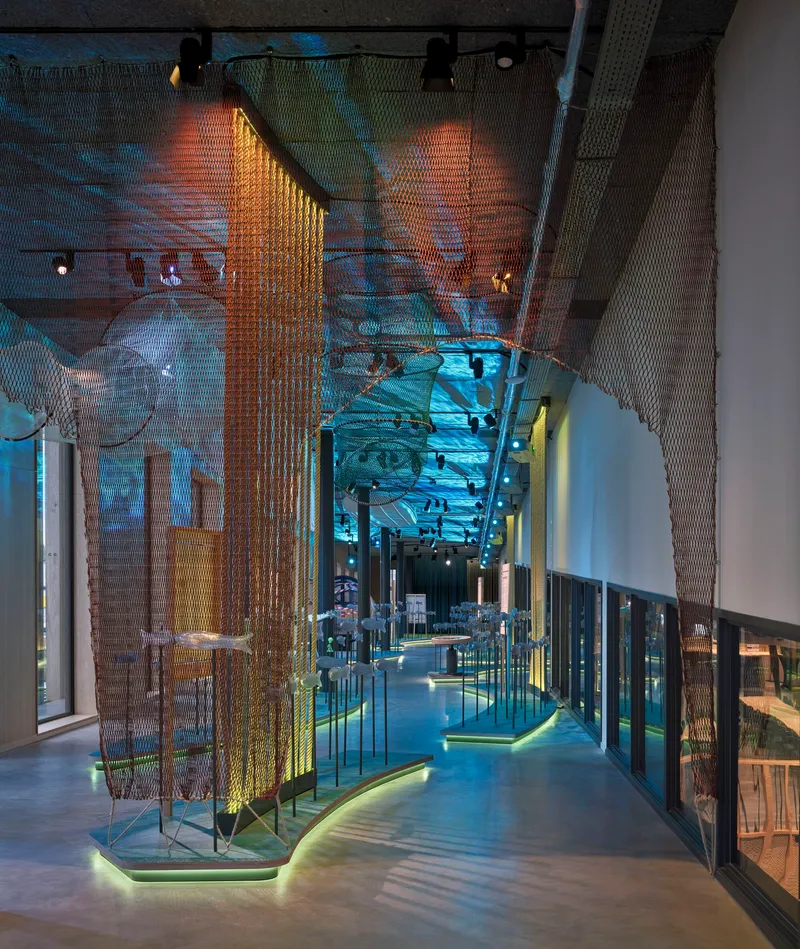
At dusk, the timber screen becomes a lantern. Interior light filters through the slats and across the water, and the building's daytime reticence gives way to a warm, glowing presence on the harbor edge. The mirrored ceiling inside amplifies the brass mesh installations into rippling corridors of reflected light. It is a different building after dark: more theatrical, more assertive, and frankly more beautiful in the way that harbors always are when the working day ends and the lights come on.
The photographs of the building reflected in calm evening water are striking, but they also reveal a design discipline that many waterfront projects lack. Dorte Mandrup has calibrated the building's luminosity so that it enhances rather than overwhelms its setting. It reads as a signal, not a spectacle.
Why This Project Matters
Heritage centers are notoriously difficult to get right. They tend to oscillate between two failures: the overwrought sculptural gesture that upstages the landscape it claims to honor, or the bland civic shed that nobody visits twice. The Wadden Sea World Heritage Center avoids both by treating the building itself as a threshold. Every surface, every circulation path, every material choice is calibrated to move you from the town into the tidal landscape and back again. The architecture does not explain the Wadden Sea; it puts you in it.
For Dorte Mandrup, the project extends a body of work that takes extreme landscapes seriously without resorting to extreme form. The Icefjord Centre in Greenland and the forthcoming Trilateral Wadden Sea Centre in Denmark share the same ethos: restrained profiles, honest materials, and spatial sequences that defer to the horizon. In Lauwersoog, that ethos meets a working harbor and a living ecosystem, and the result is a building that earns its place on the water's edge through quiet conviction rather than architectural bravado.
Wadden Sea World Heritage Center by Dorte Mandrup, Lauwersoog, The Netherlands.
About the Studio
Share Your Own Work on uni.xyz
If projects like this are the kind of work you want to make, uni.xyz is a place to publish your own, find collaborators, and enter design competitions.




Popular Articles
Popular articles from the community


Conexión: Biophilic Design Reimagines High-Rise Living in Hong Kong
Conexión reimagines high-rise living in Hong Kong through biophilic design, green facades, shared spaces, daylight, water and nature within.

The Earth Pod: 3D Printed Homes for Resilient Refugee Communities
The Earth Pod reimagines refugee housing through 3D printed homes made from clay, combining resilience, self-sufficiency, and rapid shelter.

Co-life: Sustainable Architecture for Age-Friendly Community Living
Co-life reimagines sustainable architecture for seniors through courtyards, rammed earth, shared gardens, and spaces designed for belonging.

The Musturak Paradise: Senior Living Architecture for a Connected Future in Temara, Morocco
The Musturak Paradise reimagines senior living architecture in Temara via private homes, social spaces, culture, community, and shared care.


Similar Reads
You might also enjoy these articles

Bao Huynh Watercolor Atelier: A Serene Art Retreat in Hội An
Bao Huynh Watercolor Atelier in Hội An blends multifunctional art spaces, sustainable design, local materials, and family-friendly living in a serene environment.

Atelier Macri Concept Store Interior Design by CASE-REAL
Atelier Macri store features a "ko" counter, walnut wood details, cork displays, blending retail, gallery, and seamless customer experiences.

Manuel Vargas Izquierdo Stadium and High-Performance Sports Center: Architectural Excellence in Jalpa de Méndez
The Manuel Vargas Izquierdo Stadium blends sustainable design, inclusive sports facilities, and cultural-inspired architecture, revitalizing Jalpa de Méndez’s public spaces.

KAKR Buluh Awar Hall: Revitalizing Community and Ecology Through Bamboo Architecture
Community built bamboo hall revitalizes Buluh Awar village, empowering youth, restoring ecology, celebrating vernacular craftsmanship through sustainable architecture and culture.

Comments (0)
Please login or sign up to add comments
No comments yet. Be the first to comment!