

Downie North Architects Grafts a Japanese Minka Roof onto a Sydney Federation Bungalow
In Mosman's conservative suburban fabric, an oversized zinc canopy shelters new multi-level living spaces behind an intact heritage frontage.


The hip roof is the most ubiquitous element in Sydney's suburban vocabulary. It caps almost every Federation bungalow from Mosman to Manly, a polite lid that signals good taste and nothing more. At the Mosman Minka House, Downie North Architects takes that familiar silhouette and stretches it into something far more purposeful: a sweeping zinc canopy that borrows its logic from the Japanese minka, a traditional farmhouse typology defined by a single oversized roof sheltering multiple levels of inhabitation beneath it.
What makes the project genuinely interesting is the discipline of the move. The front four rooms of the original Federation bungalow are left largely intact. All the ambition is concentrated at the rear, where an asymmetrical zinc roof slopes down toward the west, managing privacy from neighbours, western sun, and views in a single gesture. The result is a house that reads as conservative from the street but opens into a sequence of timber-lined, breeze-washed spaces that feel closer to coastal Japan than coastal Sydney.
Heritage Front, Minka Back
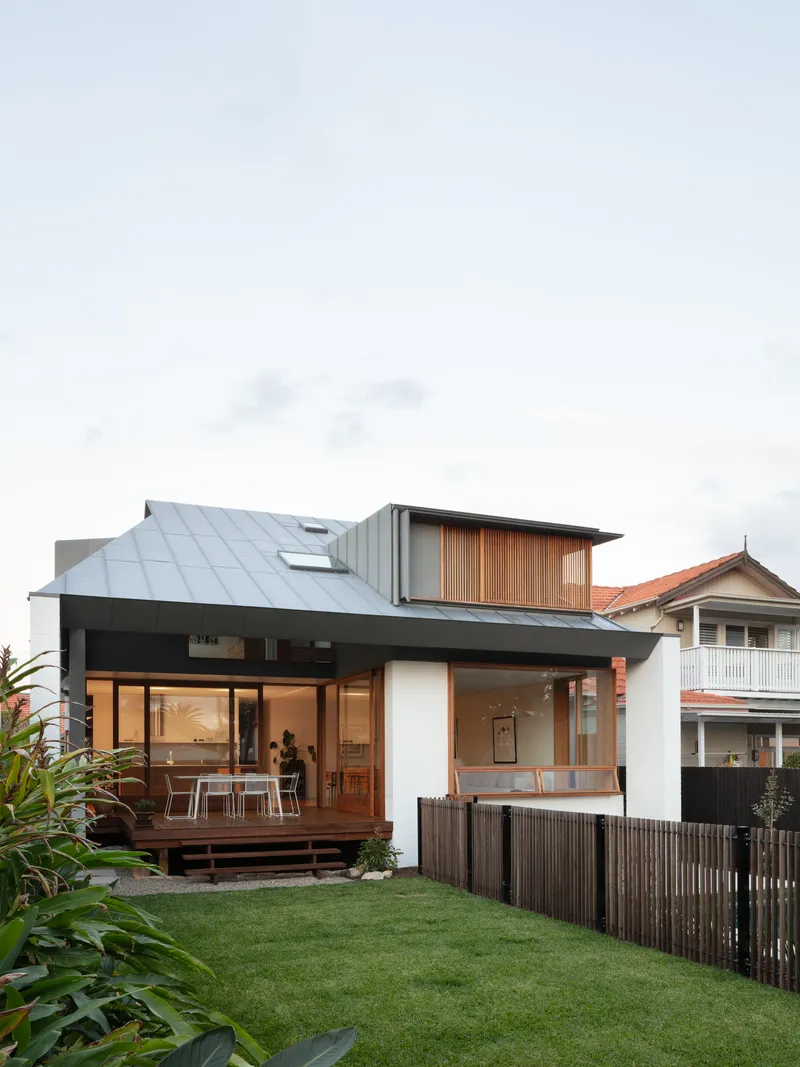
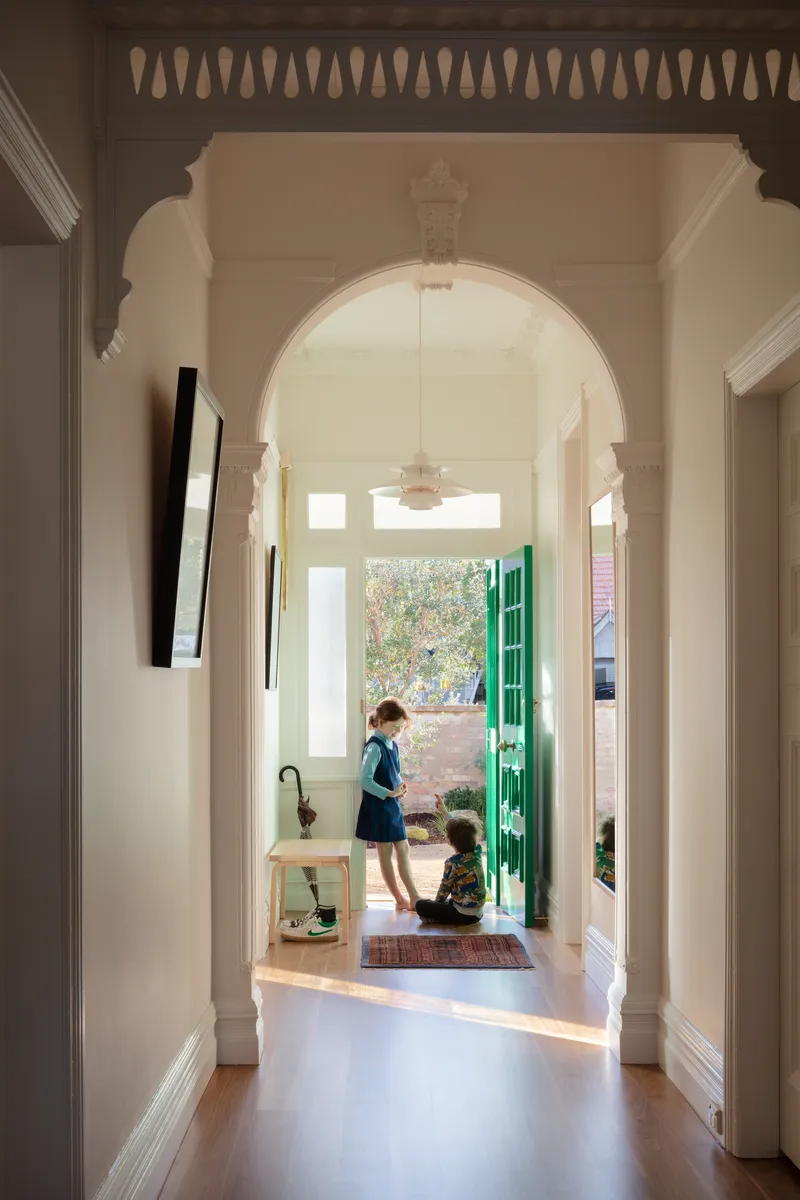
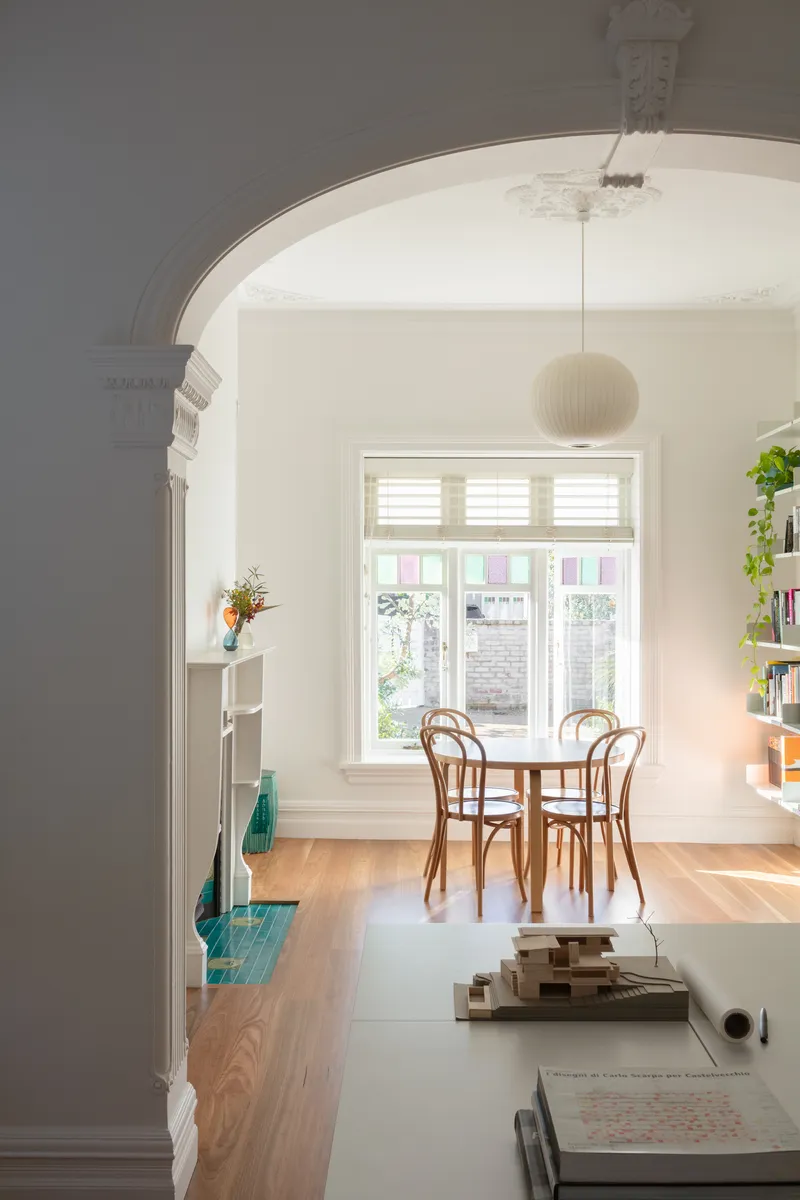
From the street the house barely announces its transformation. A sloped metal roof and timber upper volume sit behind the established garden, reading as an evolution of the original rather than an imposition. Walk through the arched doorway inside and you are still in Federation territory: decorative corbels, a pendant light, and a hallway leading to a bright green entry door that two kids might dash toward on any given afternoon.
The proportions of the addition deliberately echo those of the original bungalow, a calibration that keeps the streetscape intact. Downie North treats the front rooms as a threshold rather than a museum piece, making minor interventions that allow them to participate in the new plan without losing their character.
Living Under the Canopy
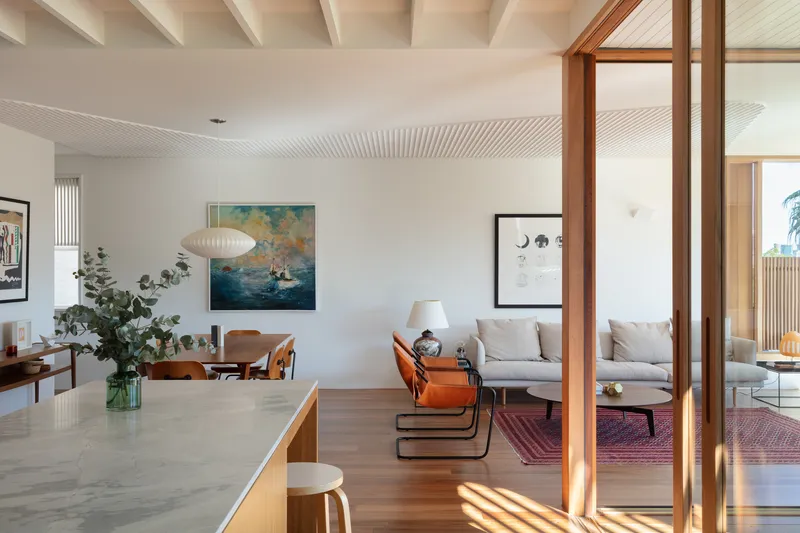
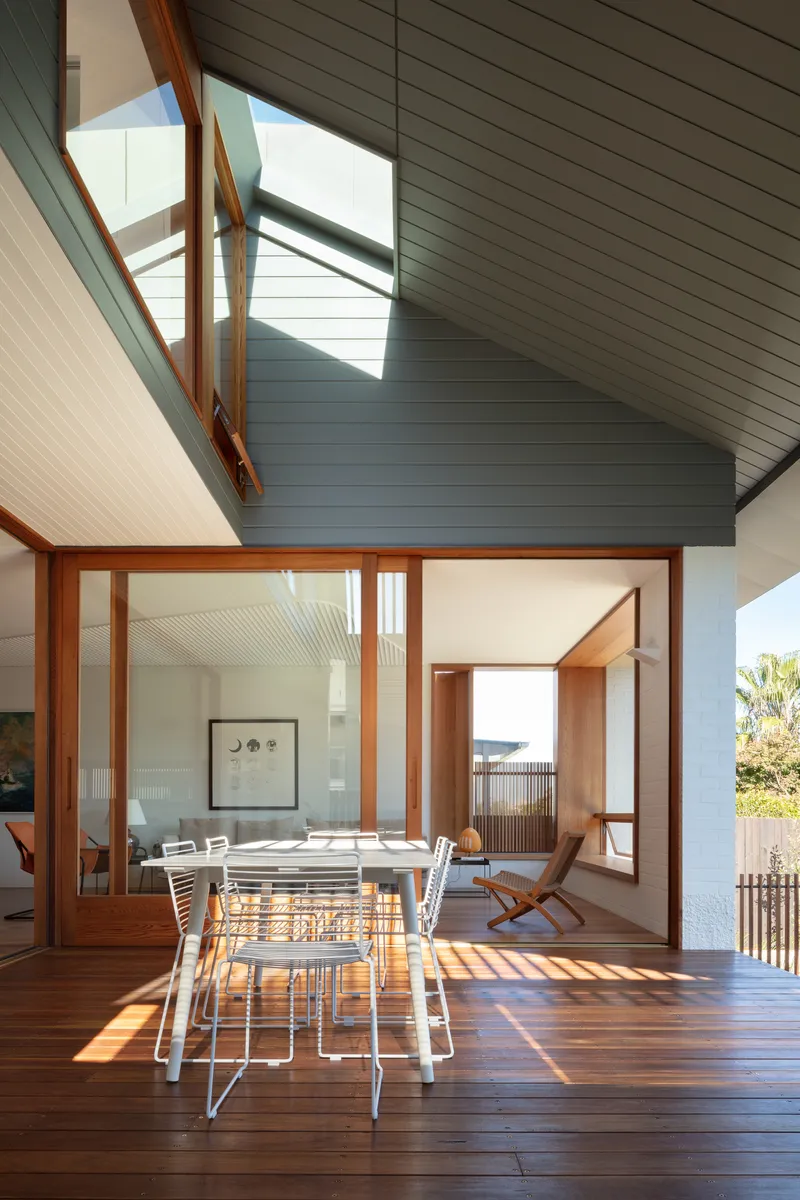
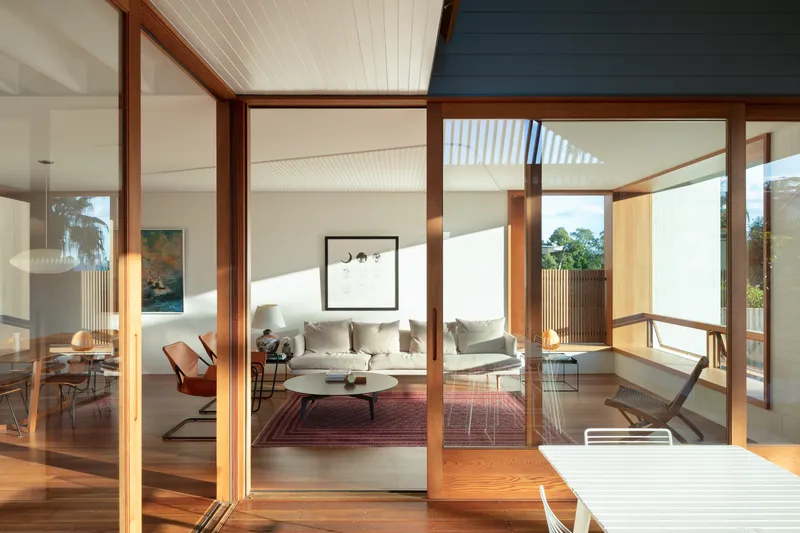
Step past the heritage rooms and the roof opens up. Exposed rafters rake overhead, and timber screen dividers slice the open plan into zones without boxing them in. The covered deck, framed by glazed walls and an angled ceiling, functions as both dining room and outdoor room, collapsing the boundary between the two in a way that reflects the family's stated desire to live outside as much as possible.
The minka concept is not decorative here. It is structural and spatial. A large roof form contains shared living on the ground floor and loft-like bedrooms above, with the vaulted ceiling creating a sense of volume that a conventional two-storey addition would never achieve. Afternoon light filters through timber-framed glazed doors onto the deck and into the living room, softened by the deep eave that doubles as a passive solar device.
Kitchen as Fulcrum
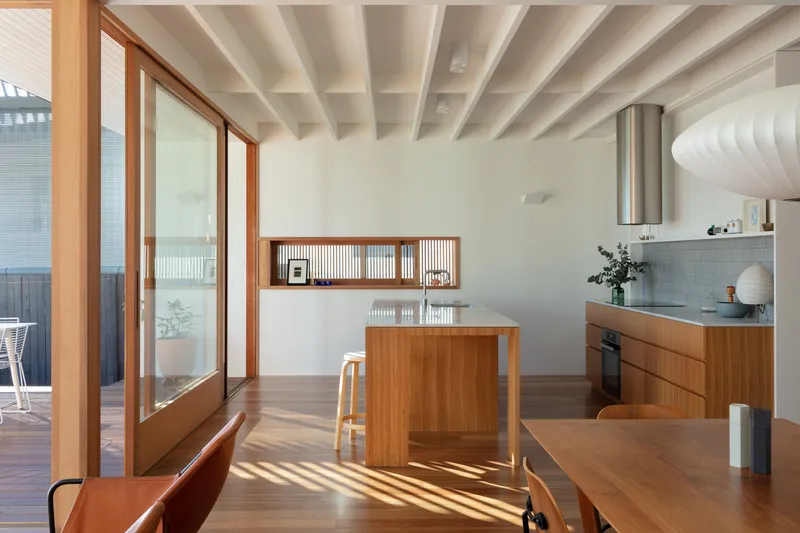
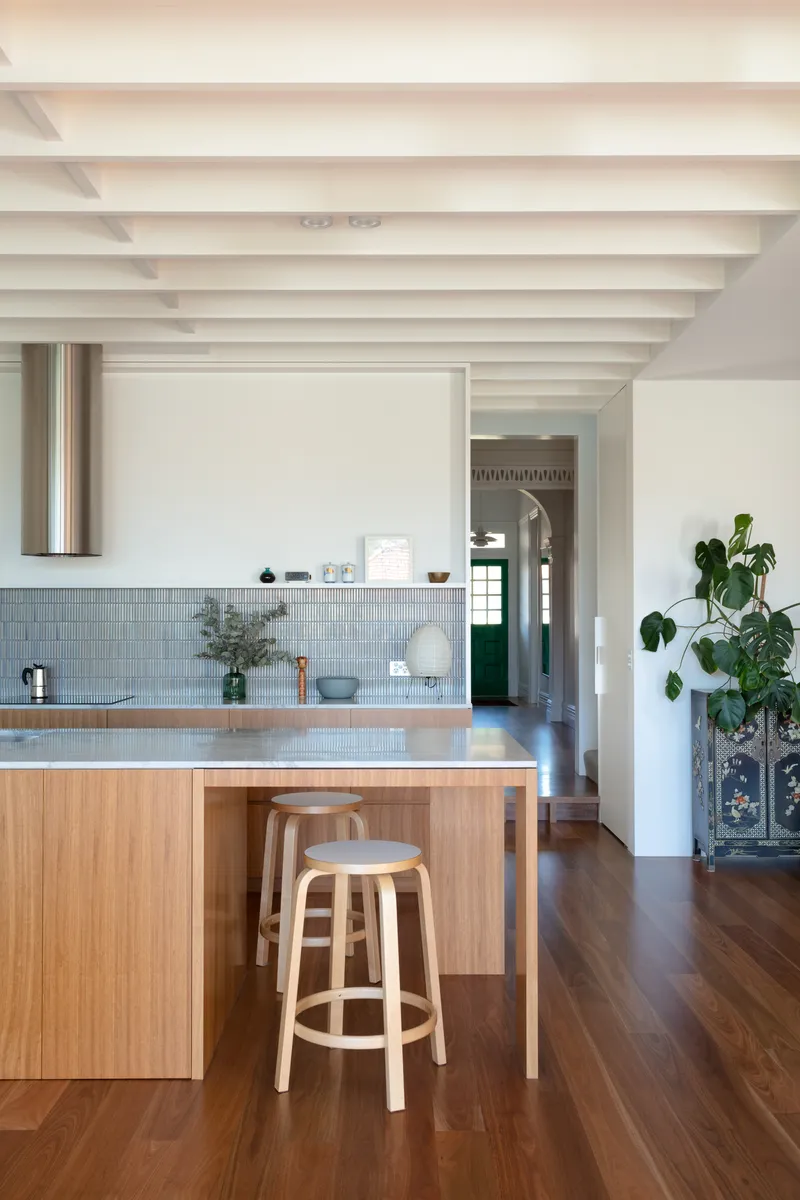
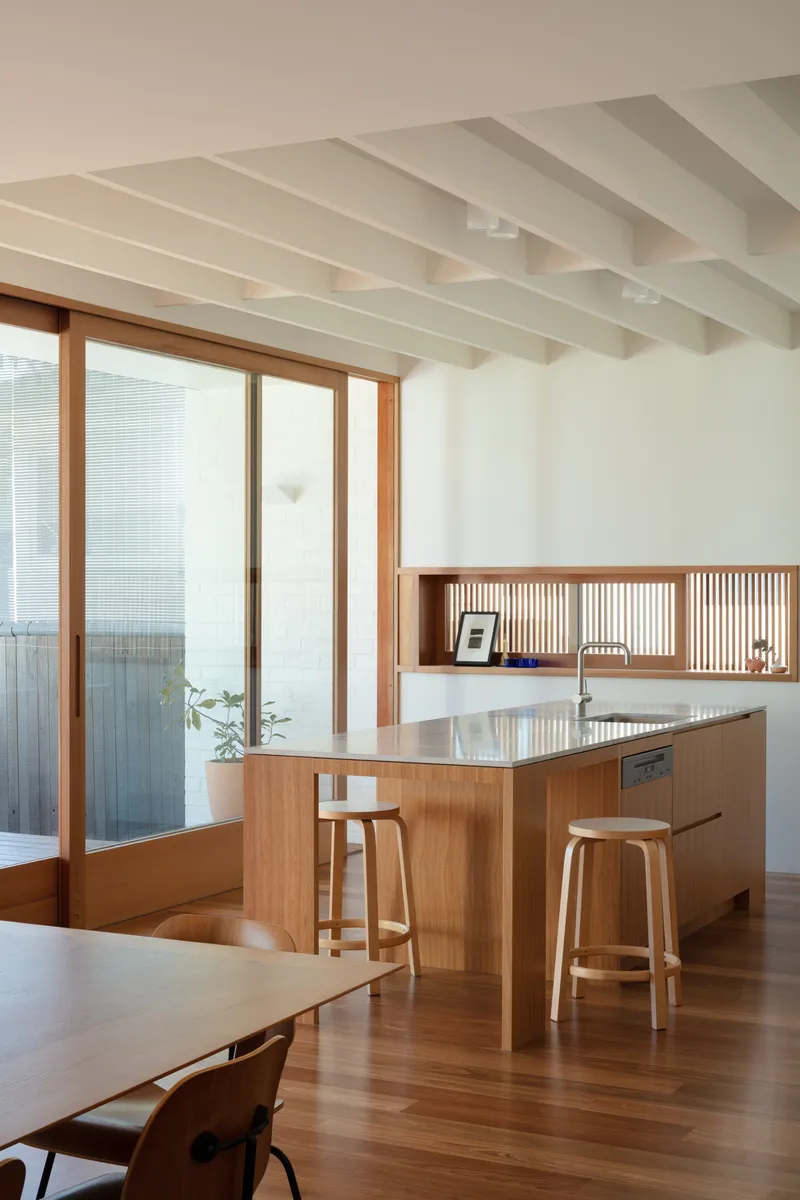
The kitchen occupies the geographic centre of the addition and functions as its social fulcrum. A pale timber island with grey tile countertop anchors the room, while painted beams overhead maintain a visual link to the heritage ceiling language of the front rooms. The palette is deliberately restrained: timber veneer cabinetry, slatted shelving niches, and a grey mosaic tile backsplash that provides texture without competing for attention.
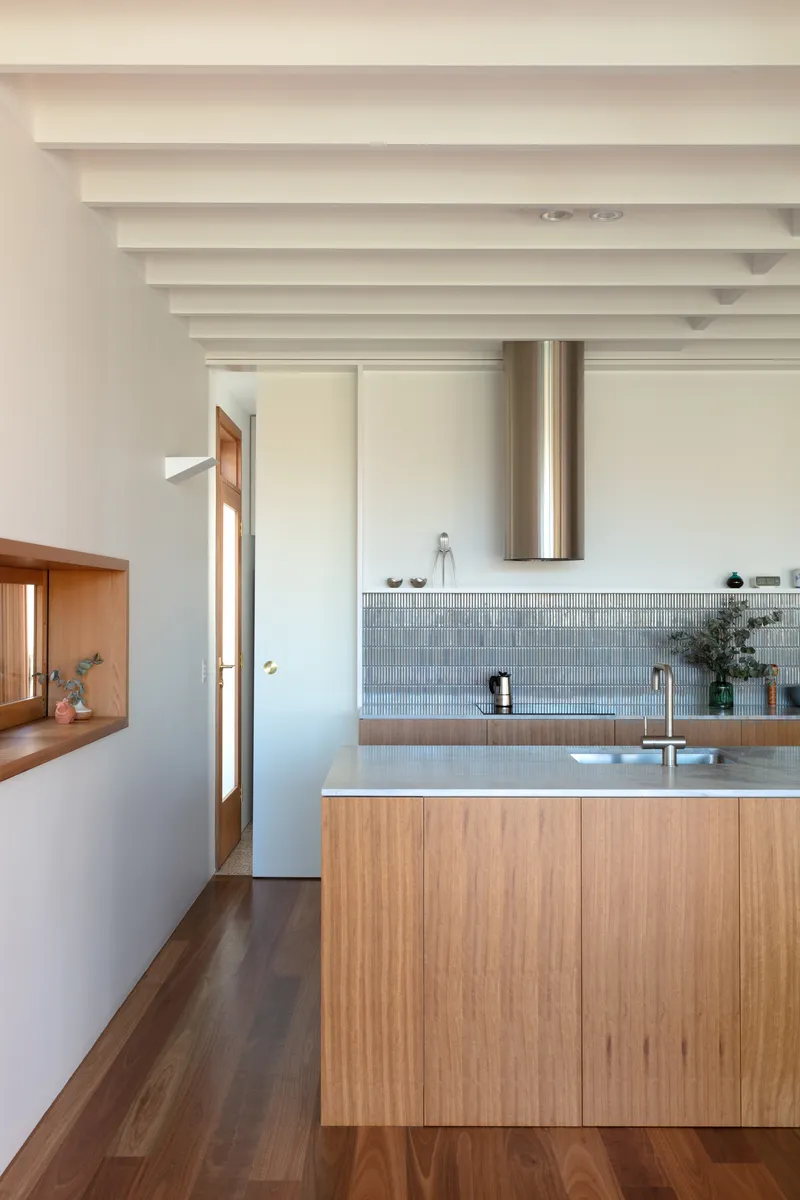
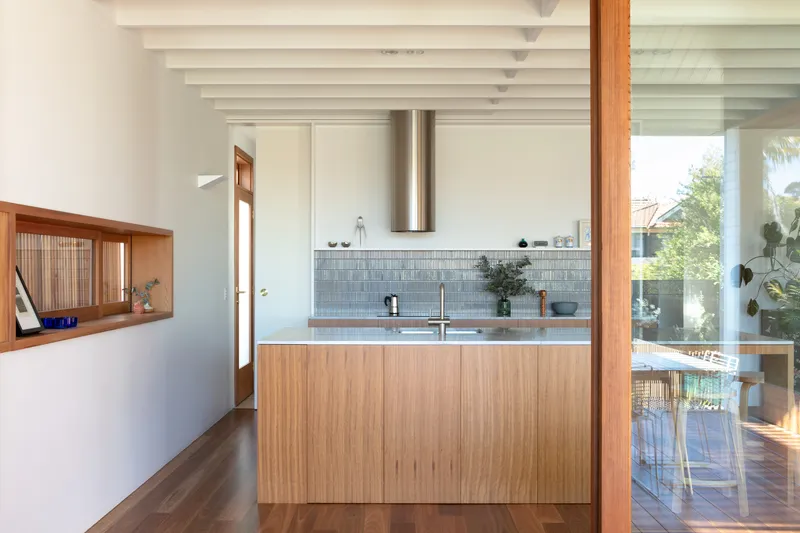
Look through the pass-through niche beside the island and you catch a framed view of an exterior timber column and the pool beyond. It is a small detail, but it encapsulates the project's core strategy: curating views while nurturing private spaces. The kitchen is simultaneously enclosed and connected, a room where you can cook with your back to the garden and still feel it.
Breezes, Screens, and the Western Slope
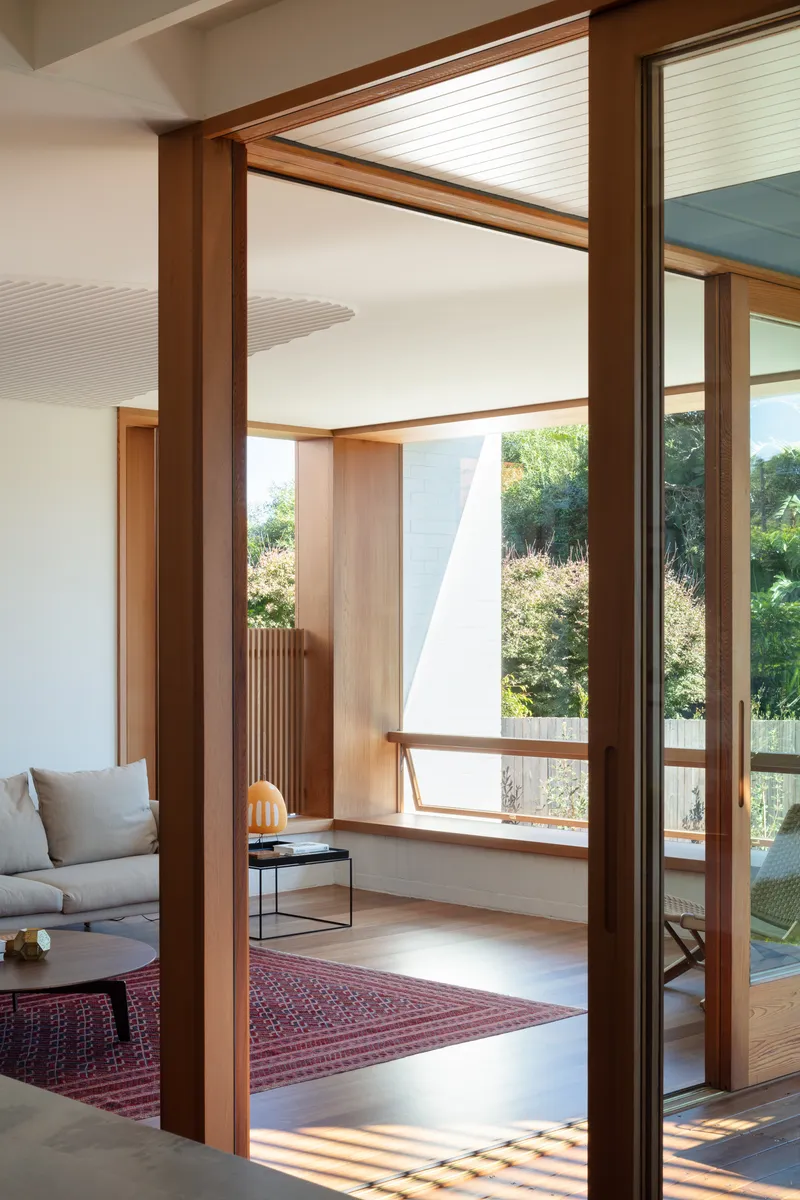
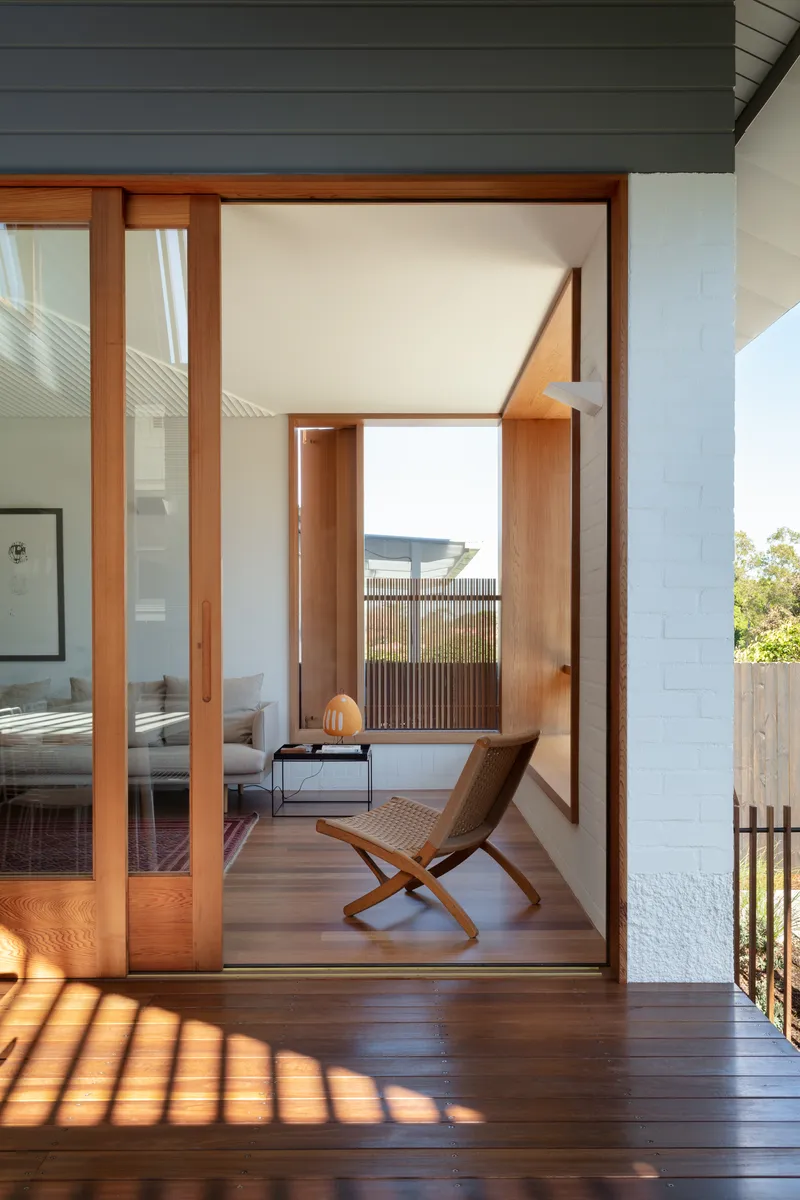
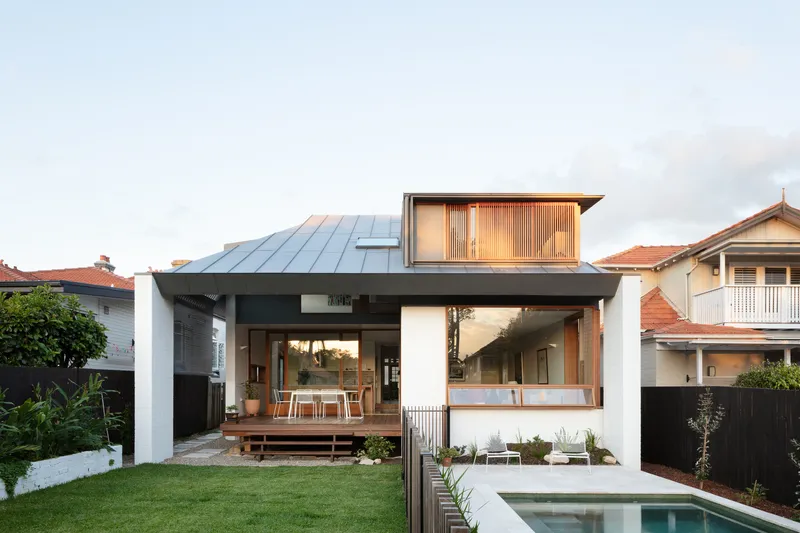
Mosman sits close enough to the harbour to catch reliable coastal breezes, and the design is calibrated to exploit them. Openings on both ground and first floors allow air from different directions to be captured and filtered through the house throughout the year. On hot days the cross-ventilation can be focused into a directed flow that cools the interior without mechanical assistance.
Timber screens do double duty, managing privacy from adjacent properties while providing shade from the western sun. The roof itself slopes to the west and rear, a single plane that mediates between opposing requirements for sunlight, air, views, and seclusion. The deep protective eave is not just aesthetic: it is sized to admit low winter sun for thermal gain while blocking the steep summer angle.
Upper Rooms and Light Wells

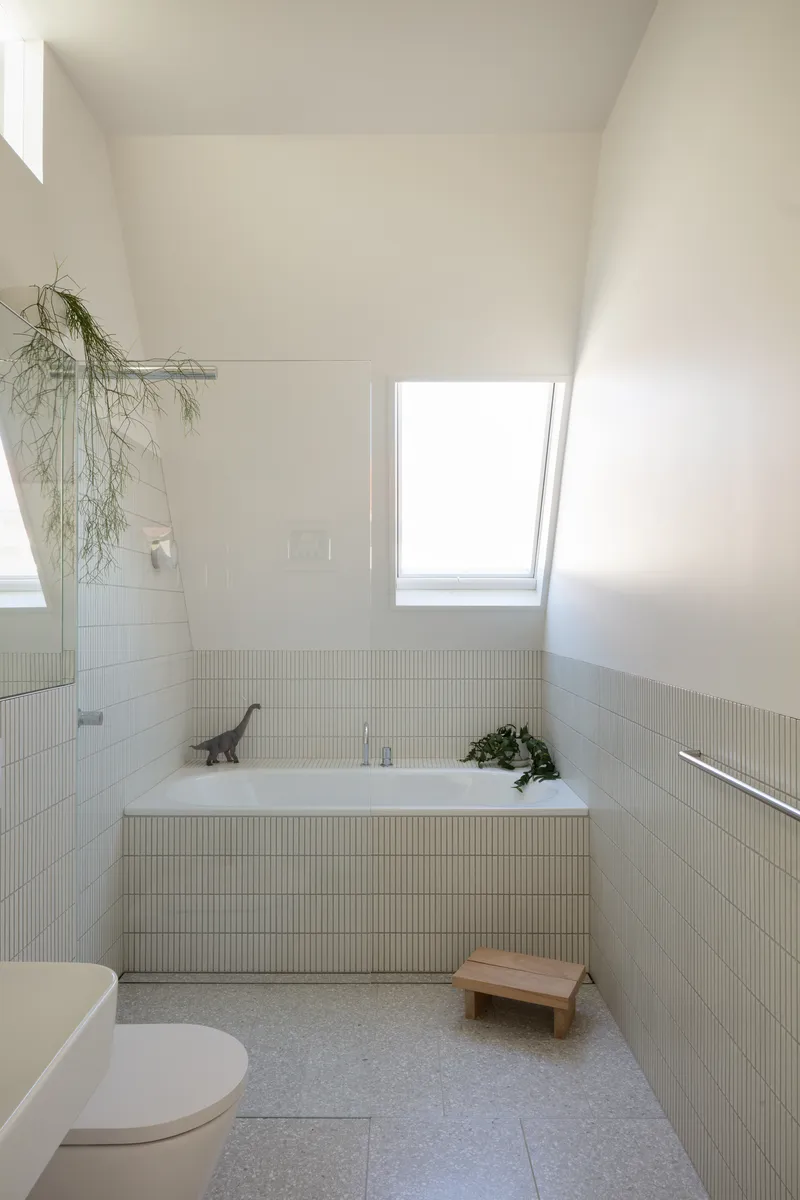
The upper level tucks bedrooms into the raking roof forms, and the stairwell connecting the two floors becomes a light well in its own right. A skylight casts diagonal shadows across angled white walls, turning the circulation space into something worth pausing in. The bathroom follows a similar logic: fluted tile wainscoting wraps a built-in bathtub beneath a skylight that washes the room in soft, even light.
These are modest rooms, not voluminous ones, and that is the point. The minka tradition is about nesting private spaces under a generous communal canopy. Bedrooms here feel sheltered and contained, a deliberate counterpoint to the expansive living areas below.
Plans and Drawings
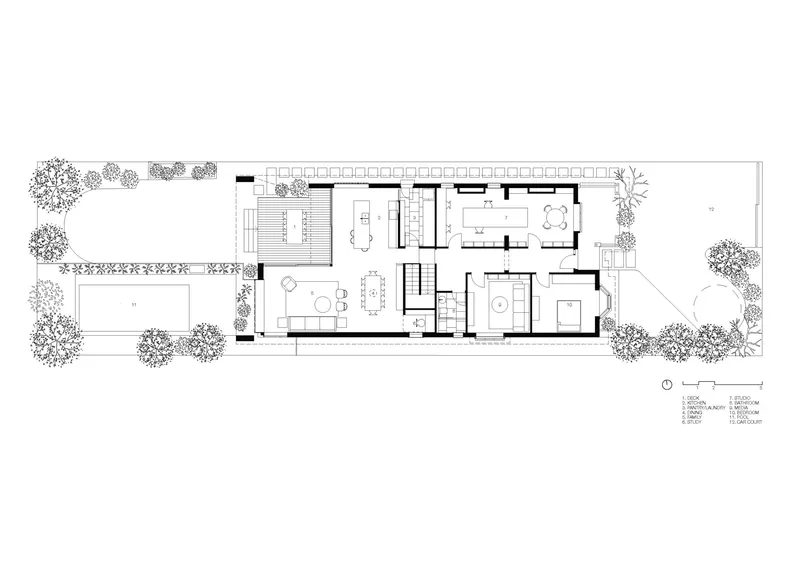
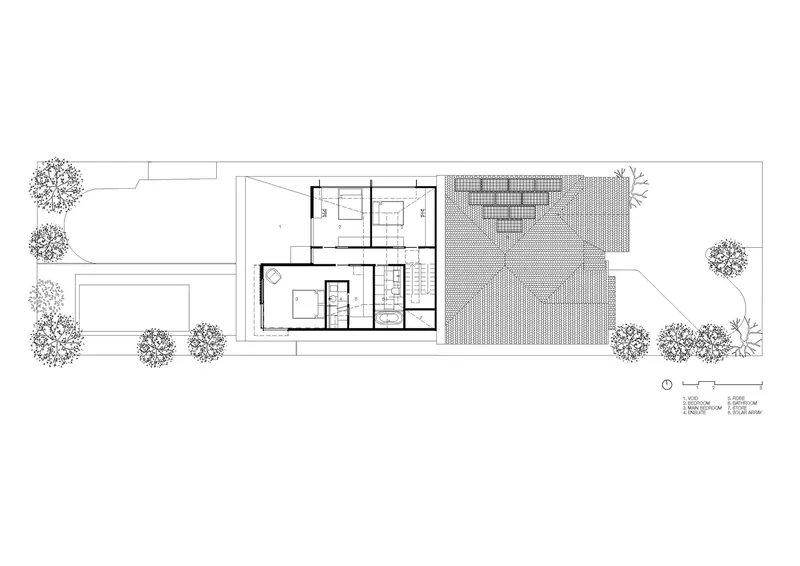
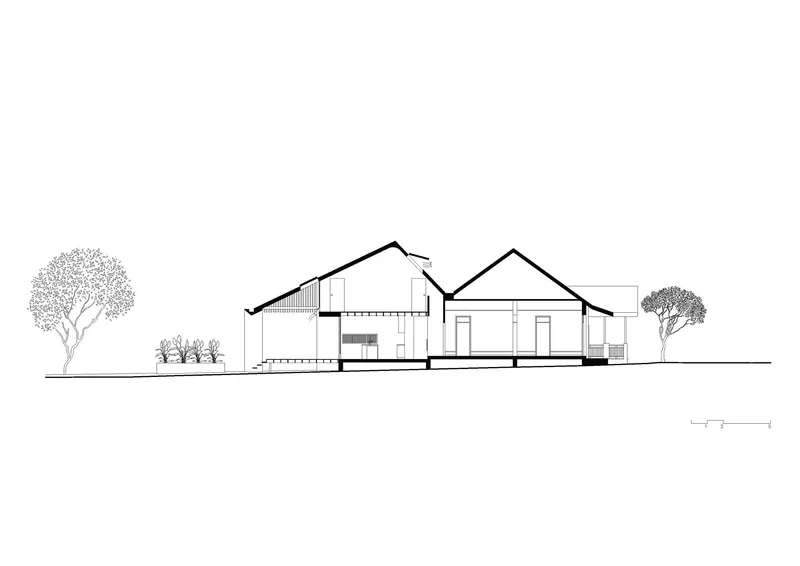
The ground floor plan reveals the narrow site and the offset quadrant arrangement that Downie North used to accommodate bathroom and laundry programs without distorting the primary living sequence. Rooms are arranged along the site's length, with the original Federation plan at the front giving way to the open kitchen, living, and dining zone at the rear. The upper floor plan shows how bedrooms occupy the area under the zinc canopy, with a rooftop terrace extending the habitable surface outward.
The elevation drawing is especially telling. Two gabled volumes sit side by side, flanked by trees, and you can read the proportional correspondence between old and new forms at a glance. The addition does not mimic the original; it reinterprets the hip roof at a different scale and in a different material, establishing a dialogue rather than a disguise.
Why This Project Matters
Heritage additions in Sydney's inner suburbs tend to fall into two camps: timid rear boxes that refuse to engage with the original, or glass-and-steel pavilions that treat the heritage front as a decorative mask. Mosman Minka sidesteps both traps by finding a cross-cultural typological reference that actually works. The minka roof is not a style choice; it is an organizational principle that solves real problems of scale, climate, and privacy on a constrained suburban lot.
The project also demonstrates that passive climate strategies and heritage sensitivity are not competing agendas. The deep eave, the slatted screens, the calibrated openings for cross-ventilation: none of these elements undermine the Federation character of the street. They simply operate on a different register, visible only once you step through the front door. That is the kind of sophistication that the best suburban alterations deliver, and it is why this modest house in Mosman deserves a closer look.
Mosman Minka House by Downie North Architects. Mosman, Australia. Over 200 m². Completed 2021. Photography by Clinton Weaver.
About the Studio
Share Your Own Work on uni.xyz
If projects like this are the kind of work you want to make, uni.xyz is a place to publish your own, find collaborators, and enter design competitions.


Popular Articles
Popular articles from the community


Jaramillo Van Sluys Arquitectura and Urbanismo Turn a Demolished Registry Lot in Quito into an Orchard Plaza
In Quito's Centro Histórico, a 2,800 m² plaza exposes the San Agustín convent wall and redraws its lost Augustinian orchard in volcanic stone.

David Macias Steps a Doorless Stone and Plaster House Down a Tropical Colombian Hillside
In the humid hills of Colombia, Threshold House replaces the front door with an open void and terraces its 850 m² down the slope instead of fighting it.

LT2A and OPEN Architectes Thread a Brick and Glass High School Through a Wooded Belgian Campus
In Braine-l'Alleud, a 3,000 m² wing for Collège Cardinal Mercier pairs pale brick with a glazed colonnade, deferring to a small chapel and a dense wood.

Juan García Correa, John González and Claudia Rueda Sink a Circular Amphitheater into a Manizales Engineering Building
On the La Nubia campus in Manizales, Colombia, the S1 Building folds labs and offices into a hillside of ramped lawns that double as a campus route.

Similar Reads
You might also enjoy these articles


LAVA Architecten Gives Vocational Education a Sawtooth-Roofed Face on a Mechelen School Campus
In Mechelen, Belgium, a 2,053 m² STEM school on a 6×6 m grid turns workshops and classrooms into rooms that can be rearranged as teaching changes.

KEMA Studio Turns a Derelict Marvila Attic into a 60 m² Lighthouse Apartment Above Lisbon
In Lisbon's Marvila district, a rebuilt roof, four skylights and two plywood volumes turn an unlivable attic into a bright home facing the Tagus.

Pixel Gardens: One Repeated Module Stacked Into a Terraced Social Housing Tower for Famagusta
Salem Bader's shortlisted housing tower builds a vertical neighbourhood from one repeated module, offsetting units to carve terraces, light and air.

Bao Huynh Watercolor Atelier: A Serene Art Retreat in Hội An
Bao Huynh Watercolor Atelier in Hội An blends multifunctional art spaces, sustainable design, local materials, and family-friendly living in a serene environment.

Explore Residential Building Competitions
Discover active competitions in this discipline

Challenge to design mud housing for contemporary communities

Challenge to reimagine the Iron Throne

Photograph architecture without architects

Illustrate the lost glory of Angkor Wat - Render Challenge
Comments (0)
Please login or sign up to add comments
No comments yet. Be the first to comment!