
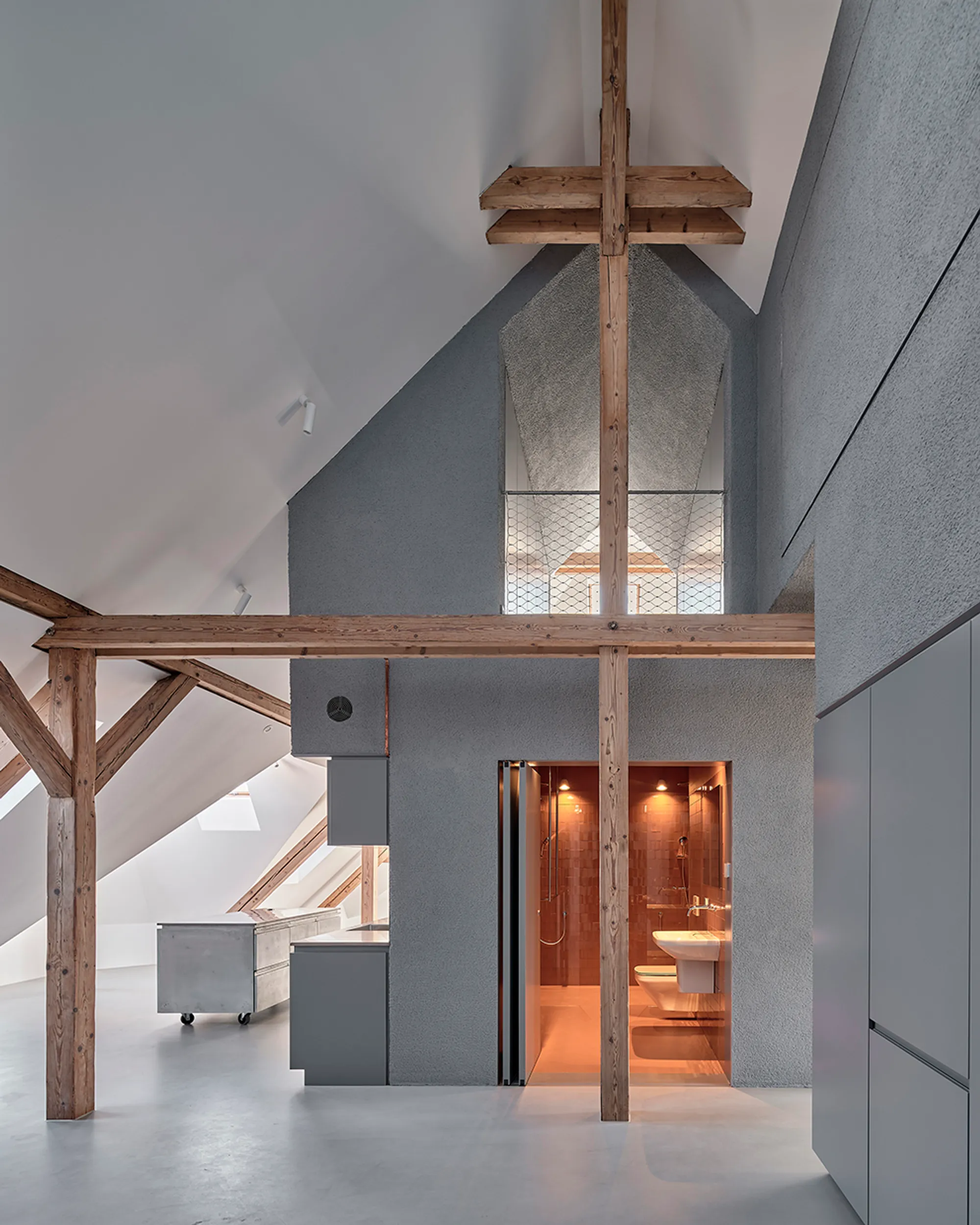
Dyrda Fikus Architekci Threads a New Home Through the Timber Skeleton of a Gliwice Tenement
A 108 square meter attic in a historic Polish tenement house becomes an open-plan apartment that defers entirely to its existing roof truss.


Most attic conversions begin by taming the roof structure, boxing it in or stripping it back to make room for something tidier. Dyrda Fikus Architekci took the opposite approach in this 108 square meter apartment inside a historic tenement house in central Gliwice. Here the existing wooden truss, with its posts, beams, struts, and braces, is treated not as an obstacle but as the primary architectural event. Every new element introduced into the space is calibrated to stay out of the timber's way.
The project was designed for a couple without children who chose to leave a single-family housing estate for the density and character of a city center building. What they got is not a conventional apartment with rooms and corridors but a continuous landscape of living organized around a freestanding grey volume that absorbs all the utilitarian demands: bathroom below, dressing room above, three existing chimneys folded into its mass, and technical installations hidden within its walls. The result is a space where you inhabit the structure itself, sleeping between columns, eating beneath braces, and looking up through the full depth of the roof.
The Truss as Architecture
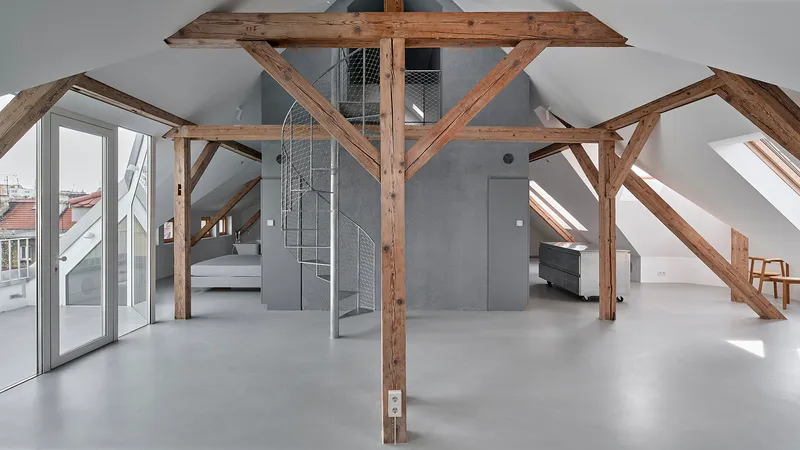
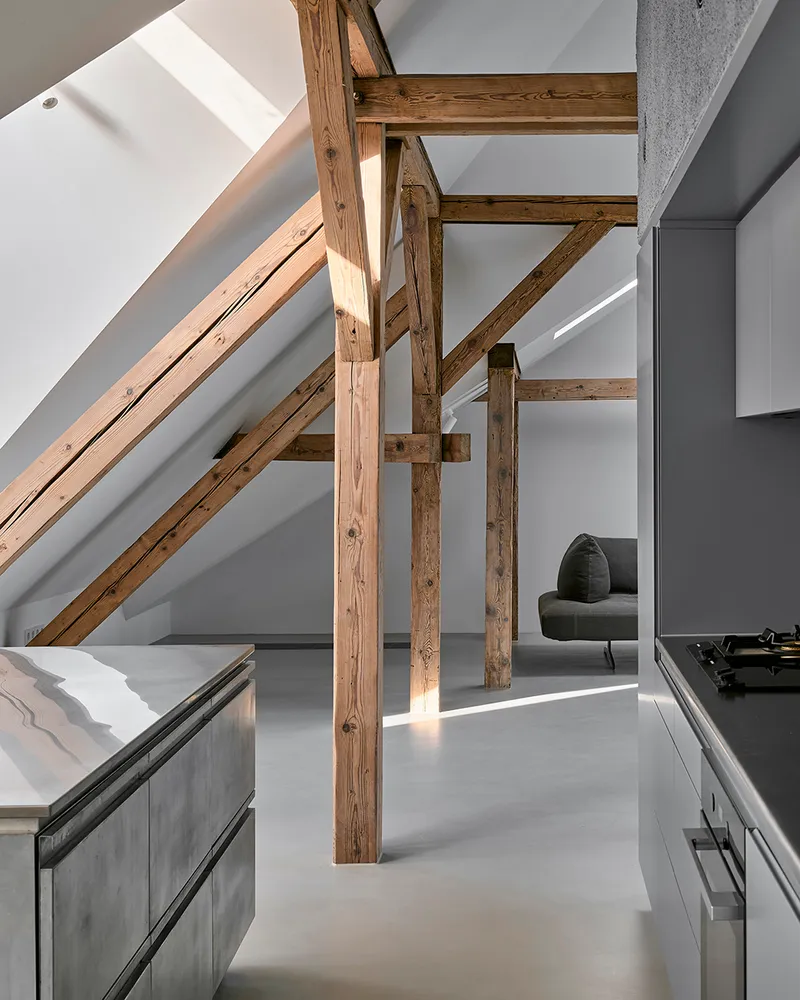

The post-and-beam wooden roof truss is the dominant spatial presence. Rather than concealing or competing with it, the architects made an explicit decision to distance every new insertion from the existing structural arrangement. Nothing touches unless it has to. The timber members read as a second architecture layered over the apartment, casting irregular shadows across the polished concrete floor and framing views through the double-height space.
Close inspection of the joinery reveals the honest patina of age. These are not decorative timbers; they are load-bearing members doing real structural work, their surfaces rough and darkened. The white plaster walls behind them act as a neutral foil, ensuring the wood remains the protagonist. It is a disciplined move: the architects clearly understood that adding visual noise would diminish the quality already present.
The Grey Monolith


The central strategy is a freestanding grey volume, almost monolithic in its simplicity, that consolidates every service function into a single compact block. On its lower level it contains the bathroom; above, a dressing room. Three existing chimneys, remnants of the tenement's original heating infrastructure, are absorbed into the mass rather than demolished or exposed. The effect is that everything the apartment needs to function, plumbing, storage, wardrobes, technical installations, is packed into one sculptural object.
The surface treatment is deliberately mute. Flush door panels and seamless cabinet faces dissolve the block's functional complexity into a single grey plane. Against the warm grain of the timber structure, it reads as a precise, contemporary insertion that knows its place. The kitchen extends from one face of this volume, its concrete countertop and light grey cabinetry maintaining the same restrained material language.
The Wire Mesh Stair and Vertical Circulation
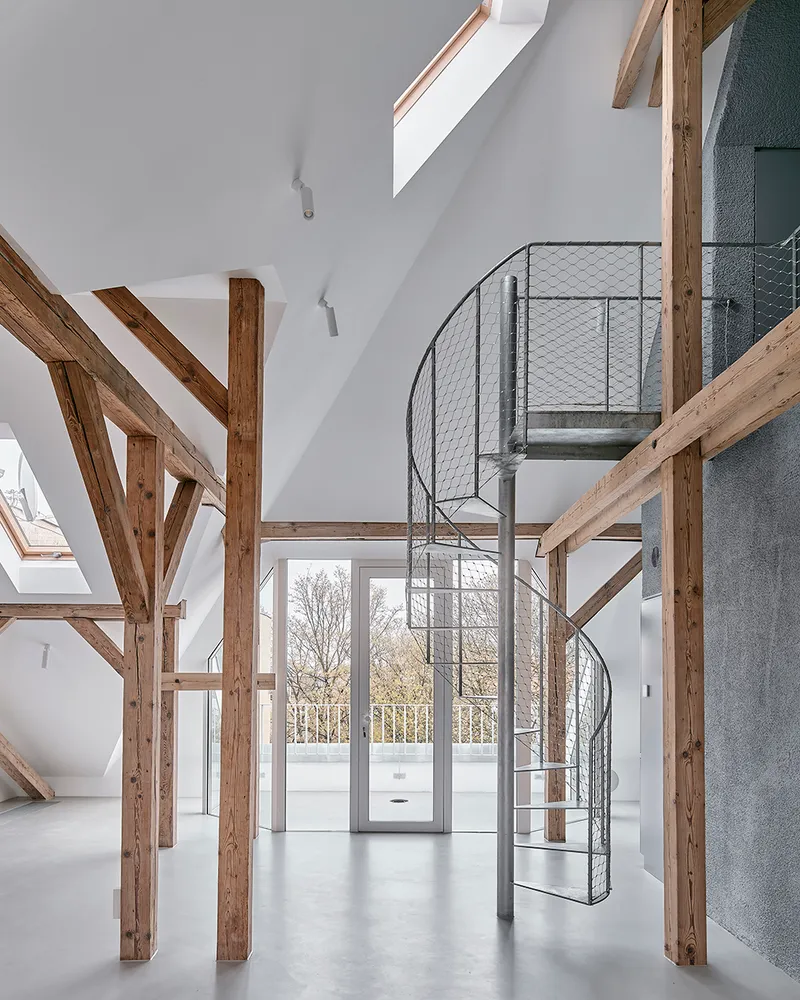


Connecting the two levels of the central block is a wire mesh spiral staircase that is perhaps the apartment's most visually striking element. Its transparency is the point. A solid stair in this location would have blocked sightlines through the truss and interrupted the spatial continuity that defines the project. Instead, the mesh allows light and air to pass through, and the spiral form introduces a rare curve into an otherwise orthogonal composition.
On the upper level, the wire mesh continues as a railing along the walkway, maintaining the visual permeability. Circular floor openings punctuate the mezzanine, pulling natural light down from skylights and reinforcing the sense that this is one interconnected volume rather than a stack of separate floors. It is an elegant solution to a practical problem: how do you move between levels without breaking the spatial generosity of a single open room?
Living Within the Frame


The open plan means that domestic activities are defined by position within the truss grid rather than by walls. The sleeping area sits between two timber columns beneath a sloped ceiling pierced by skylights. The dining table occupies a bay framed by a single post. The kitchen stretches along the grey volume beneath the full span of the exposed rafters. There is a directness to this arrangement that recalls loft living, but with more intention. Each zone feels considered rather than leftover.
Skylights are critical. In an attic with limited facade area, these roof openings are the primary source of daylight, and they wash the timber in changing light throughout the day. The polished concrete floor reflects it back up, amplifying the brightness and giving the space a luminous quality that belies its position tucked under the eaves of a 19th century building.
Moments of Warmth
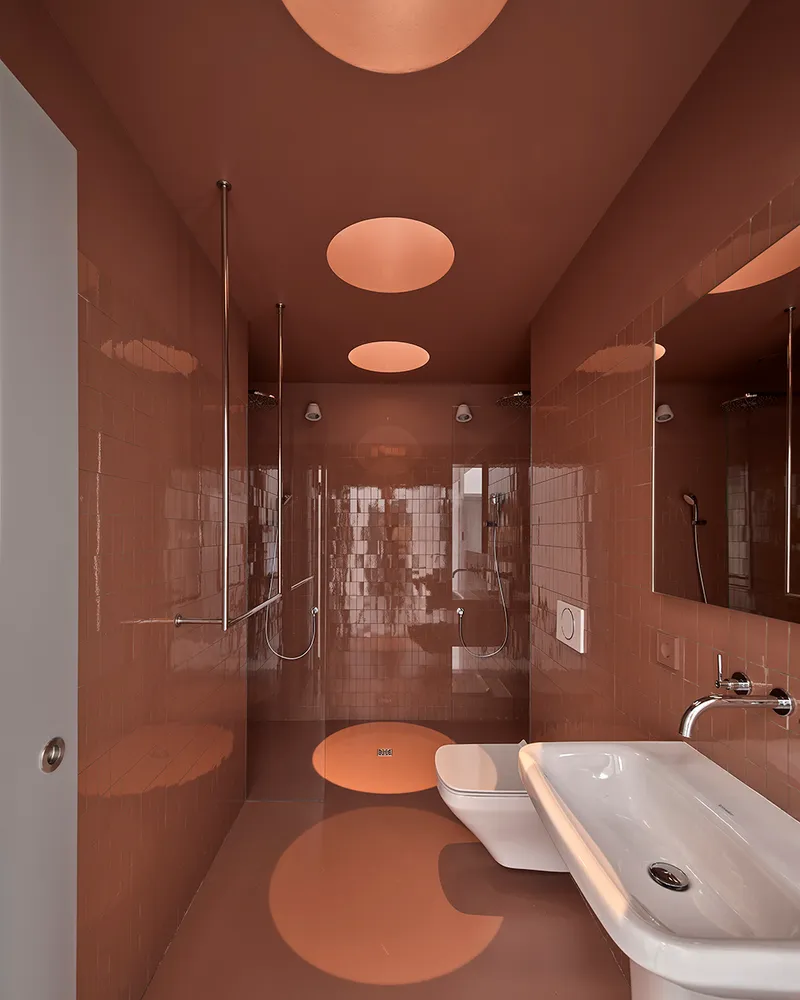
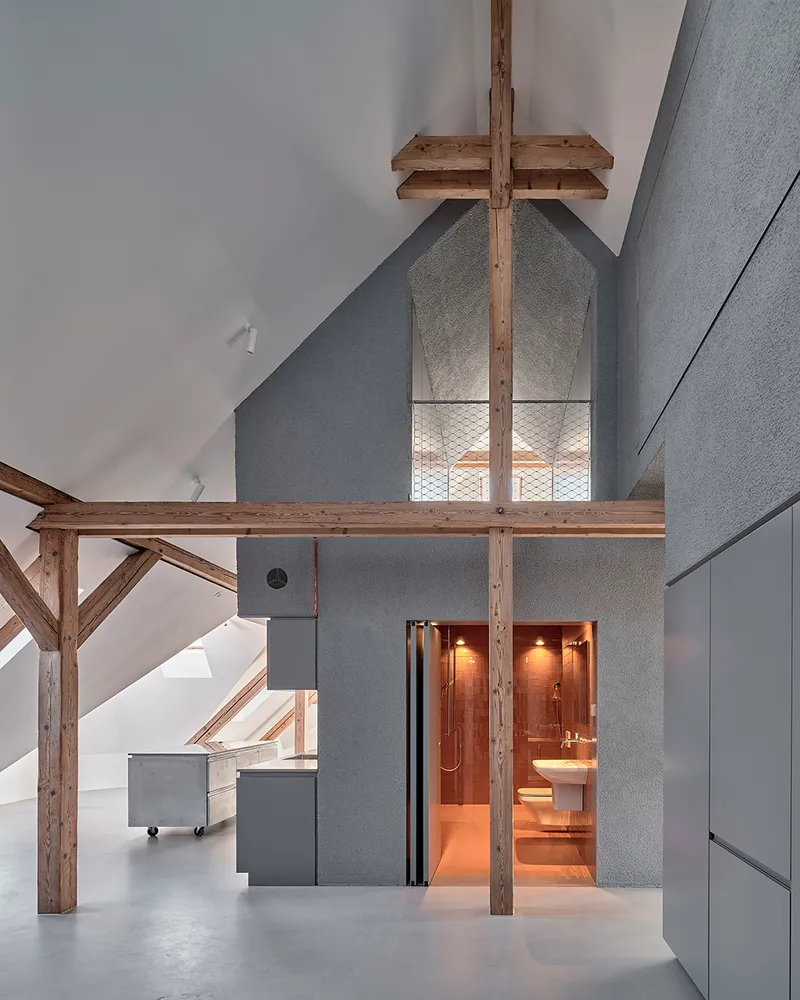

The bathroom, visible through a glass partition from the double-height space, introduces a completely different material register. Terracotta tiles and amber lighting create a warm, enclosed atmosphere that contrasts sharply with the airy neutrality of the main living areas. Circular ceiling lights echo the round openings found elsewhere in the project, maintaining a thread of formal consistency even as the mood shifts.
A corridor on the upper level features a circular skylight embedded in the polished floor, a detail that is both practical and theatrical. It pulls light into the level below while giving occupants the uncanny sensation of walking over a luminous void. These small, precise gestures are what elevate the project beyond a straightforward renovation. They suggest architects who are paying attention to experience, not just organization.
Plans and Drawings
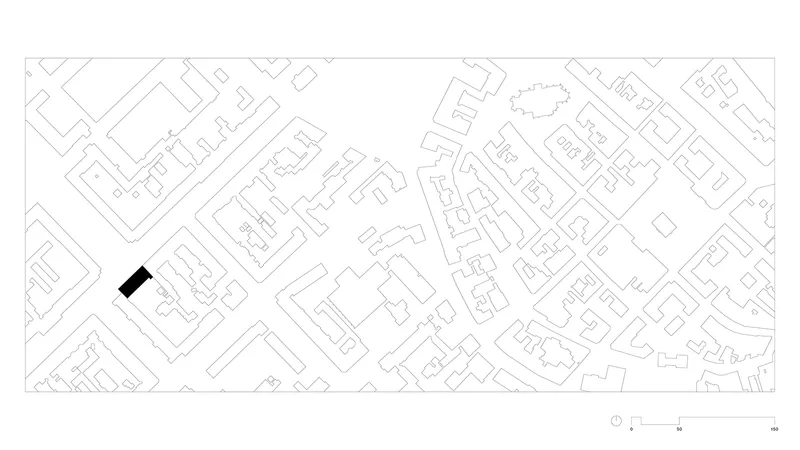
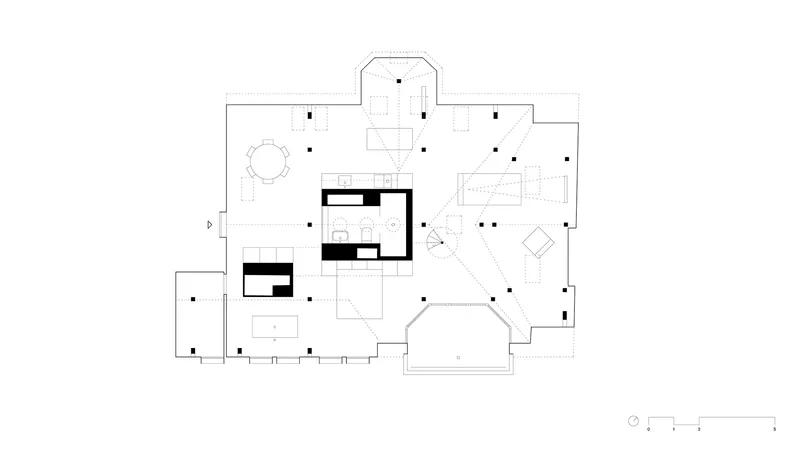

The site plan reveals the tenement's position within the tight urban fabric of central Gliwice, a single footprint in a dense block. The floor plans show the irregularity of the attic perimeter and the logic of the central service core. Columns are distributed throughout, confirming that the existing truss is a genuine grid rather than a decorative framework. The curved stair appears clearly on the upper level plan, alongside the compact rectangular volume that contains the dressing room. What the drawings make visible is just how little new wall area was introduced: the apartment is defined almost entirely by the roof above, the floor below, and the single freestanding block in between.
Why This Project Matters
The instinct in renovation work is often to assert the new, to prove that contemporary design can hold its own against whatever historical fabric surrounds it. Dyrda Fikus Architekci resisted that instinct. Their approach is closer to curation: identify what already has value, clear away everything that obscures it, and introduce only what is strictly necessary. The grey block, the mesh stair, the polished floor, and the skylights are all in service of the wooden truss, not in competition with it.
For architects working on similar adaptive reuse projects in historic European buildings, the lesson here is one of restraint paired with spatial ambition. The apartment feels generous despite its 108 square meters because the architects refused to subdivide. They trusted the structure to organize the space and trusted the occupants to live within that openness. That is a harder brief to execute than it sounds, and the result is a home that feels both ancient and completely contemporary.
Attic Reconstruction in Gliwice by Dyrda Fikus Architekci. Located in Gliwice, Poland. 108 m². Completed in 2022. Photography by Jakub Certowicz.
About the Studio
Share Your Own Work on uni.xyz
If projects like this are the kind of work you want to make, uni.xyz is a place to publish your own, find collaborators, and enter design competitions.



Popular Articles
Popular articles from the community


Hill & Cross Opera: Sculptural Opera House Architecture Shaped by Tallinn’s Landscape and Identity
Hill & Cross Opera reimagines opera house architecture in Tallinn through its sculptural hill, civic plaza, glass wave and a luminous cross.

The Ocean Hive: Sustainable Architecture for a Self-Sufficient Civilization at Sea
The Ocean Hive imagines sustainable architecture at sea, where modular habitats, algae, wave power and ocean waste sustain a growing colony.

Co-life: Sustainable Architecture for Age-Friendly Community Living
Co-life reimagines sustainable architecture for seniors through courtyards, rammed earth, shared gardens, and spaces designed for belonging.

Conexión: Biophilic Design Reimagines High-Rise Living in Hong Kong
Conexión reimagines high-rise living in Hong Kong through biophilic design, green facades, shared spaces, daylight, water and nature within.


Similar Reads
You might also enjoy these articles

Bao Huynh Watercolor Atelier: A Serene Art Retreat in Hội An
Bao Huynh Watercolor Atelier in Hội An blends multifunctional art spaces, sustainable design, local materials, and family-friendly living in a serene environment.

Atelier Macri Concept Store Interior Design by CASE-REAL
Atelier Macri store features a "ko" counter, walnut wood details, cork displays, blending retail, gallery, and seamless customer experiences.

Manuel Vargas Izquierdo Stadium and High-Performance Sports Center: Architectural Excellence in Jalpa de Méndez
The Manuel Vargas Izquierdo Stadium blends sustainable design, inclusive sports facilities, and cultural-inspired architecture, revitalizing Jalpa de Méndez’s public spaces.

KAKR Buluh Awar Hall: Revitalizing Community and Ecology Through Bamboo Architecture
Community built bamboo hall revitalizes Buluh Awar village, empowering youth, restoring ecology, celebrating vernacular craftsmanship through sustainable architecture and culture.

Explore Architecture Competitions
Discover active competitions in this discipline



Challenge to reimagine the Iron Throne


Photograph architecture without architects


Illustrate the lost glory of Angkor Wat - Render Challenge


Design challenge to reuse E-waste
Comments (0)
Please login or sign up to add comments
No comments yet. Be the first to comment!