

Thumbimpressions Builds an Educational Campus from Adobe and Bamboo in Bihar's Tea Gardens
The eArthshala Campus in Kishanganj, India, proves that vernacular materials can shape serious institutional architecture without concrete columns.


Somewhere between the tea gardens and pineapple farms of Kishanganj, Bihar, a campus has risen without a single concrete column. The eArthshala Campus, designed by Thumbimpressions for the NGO Project Potential, is a 970 square meter learning and social innovation center made almost entirely from stabilized adobe, sundried brick, bamboo, and thatch. Its two signature pitched roofs sit in the flat Terai lowlands near the Mechi river, colored ochre yellow and sandstone red against a relentlessly green landscape. Completed in 2024, the first phase includes a training hall and an office studio, with residential units planned for later.
What makes the project worth serious attention is not simply the material palette, which is interesting enough, but the structural ambition behind it. Bamboo trusses span the training hall to create a column-free interior large enough for community gatherings, workshops, and the kind of flexible programming that an evolving rural campus demands. The walls are load-bearing adobe, eliminating the need for reinforced concrete frames. Local women crafted the sundried bricks. Semi-skilled artisans were trained on site to build the bamboo roof structure. The architecture is inseparable from the labor that produced it, and that is exactly the point.
A Campus Set in the Fields
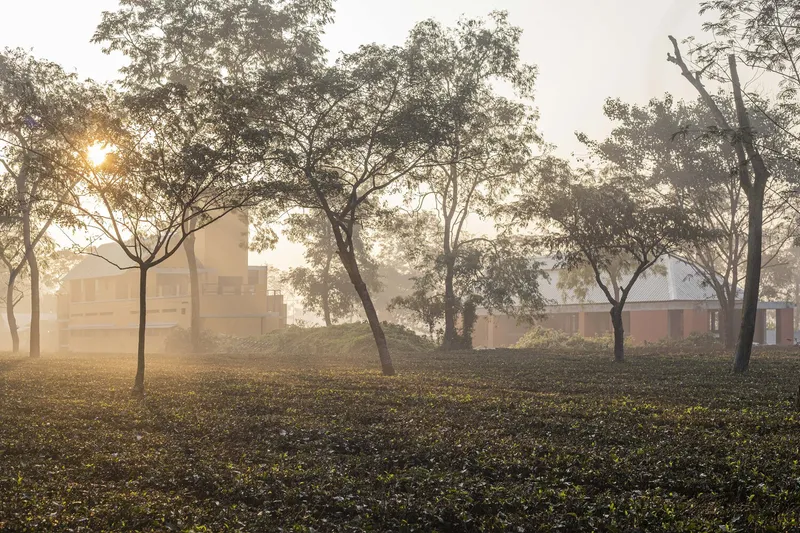
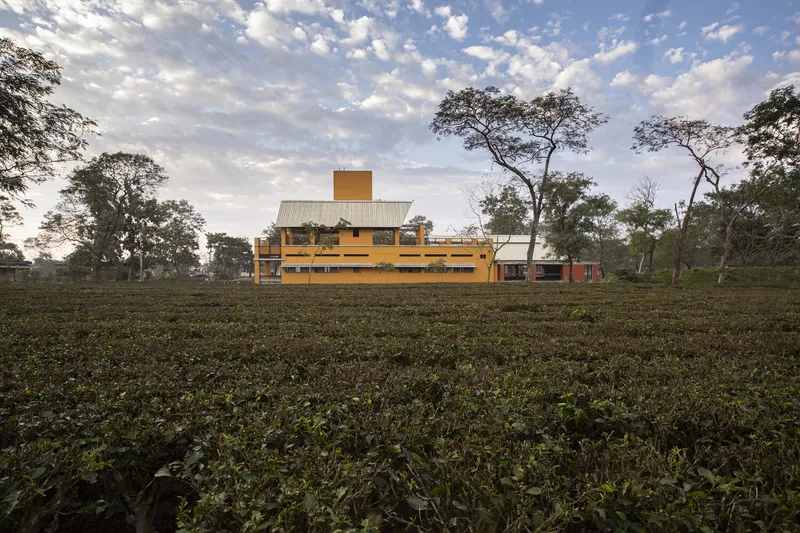
The campus occupies 15 acres of land that includes working tea gardens and pineapple farmland, and the architects made no attempt to separate the buildings from the agriculture. The pavilions are dispersed across the site, low and modest in profile, emerging from the planted rows like farm structures that happen to have been designed with care. In the early morning mist, the corrugated metal roofs catch low sunlight and the buildings read as a loose constellation rather than a walled compound.
The arrangement is deliberate. By spacing the buildings apart and allowing tea plantations to flow between them, Thumbimpressions created a campus where the outdoors is as much a teaching space as any enclosed room. Extended verandahs along each building provide semi-covered zones for informal gathering. The result is an institutional program that refuses to feel institutional.
Adobe Walls and the Weight of Color
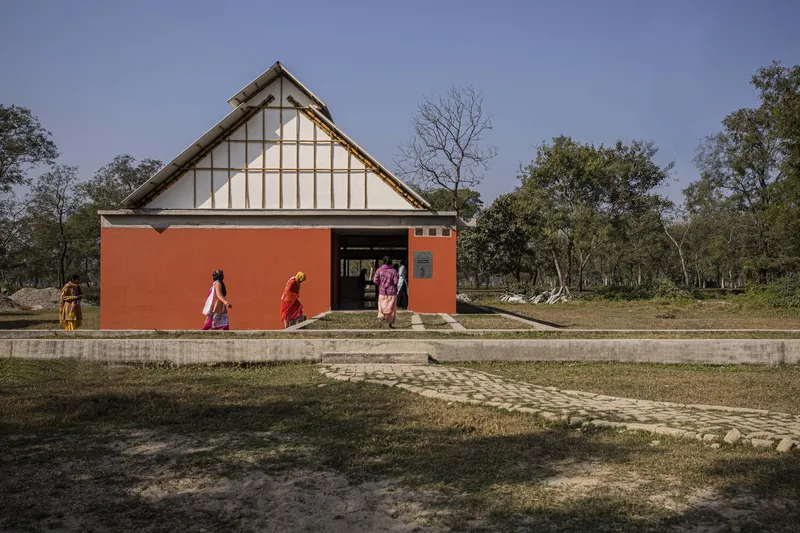
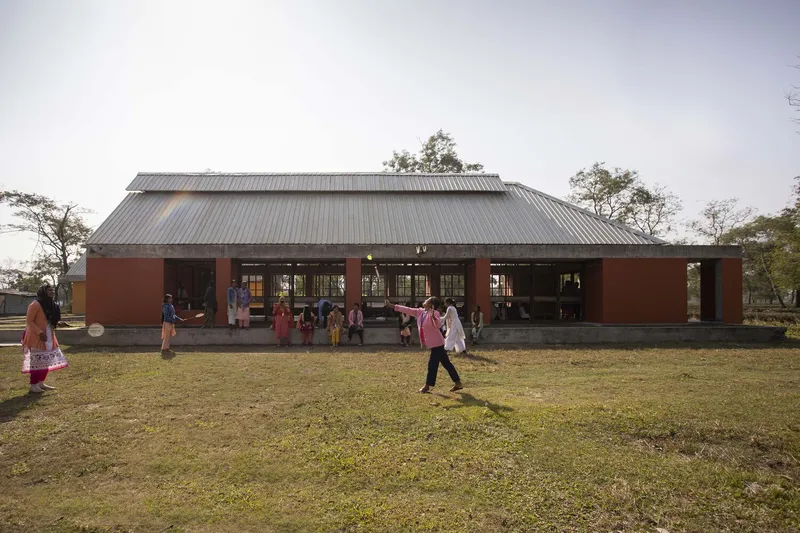
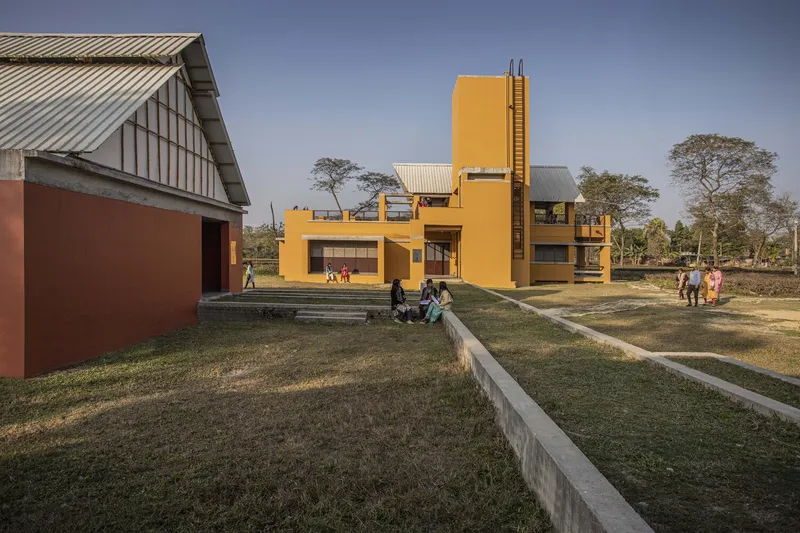
The most visually striking decision is the use of untreated, pigmented adobe walls in two colors: a deep sandstone red and a warm ochre yellow. These are not painted surfaces. The color is integral to the material itself, which means it will weather and shift over time rather than peel. Against the green of the tea fields, the red pavilion reads as something elemental, almost geological, while the yellow block has a softer, more institutional presence.
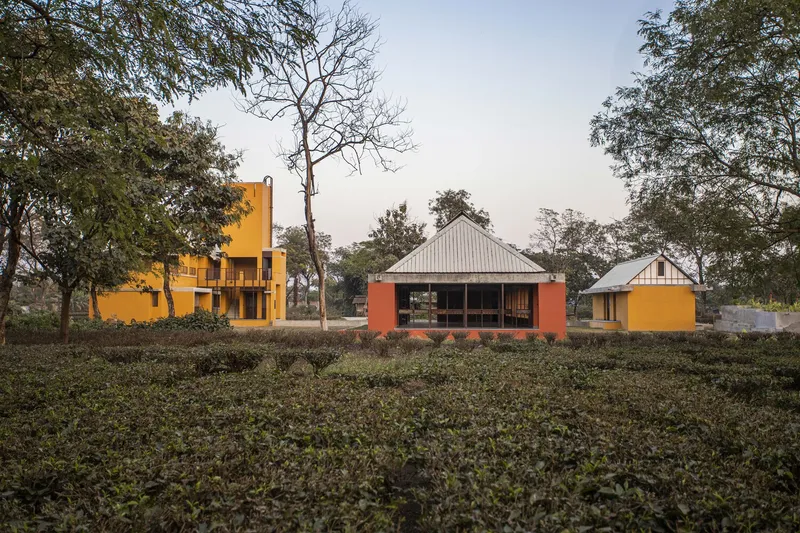
The red training hall in particular carries real presence. Its walls are thick enough to perform thermally in Bihar's punishing summers, and the deep reveals of its windows create shadow lines that change through the day. People move along its covered colonnade in colorful garments, and the building absorbs them. It does not compete. The yellow two-story block, visible beside the red pavilion, introduces a vertical element with a central tower and stepped grass terraces that soften the transition between building and ground.
Bamboo Structure as the Main Event
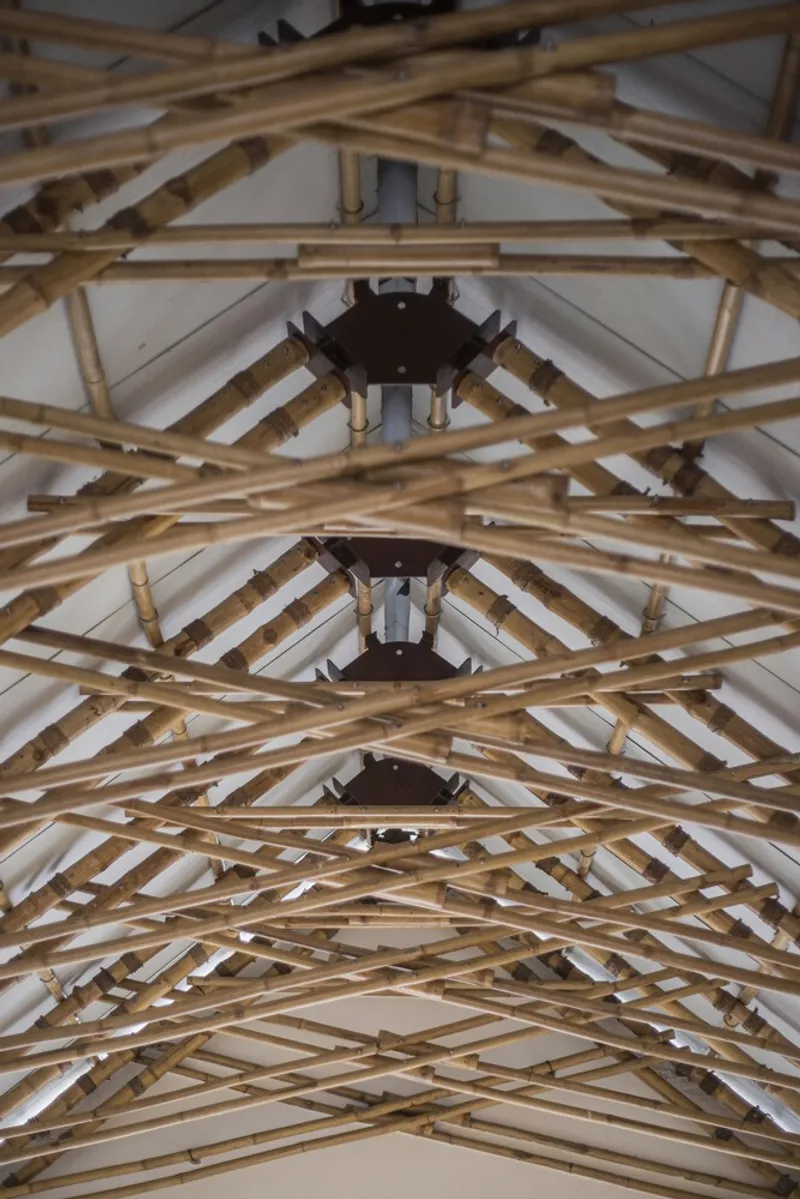
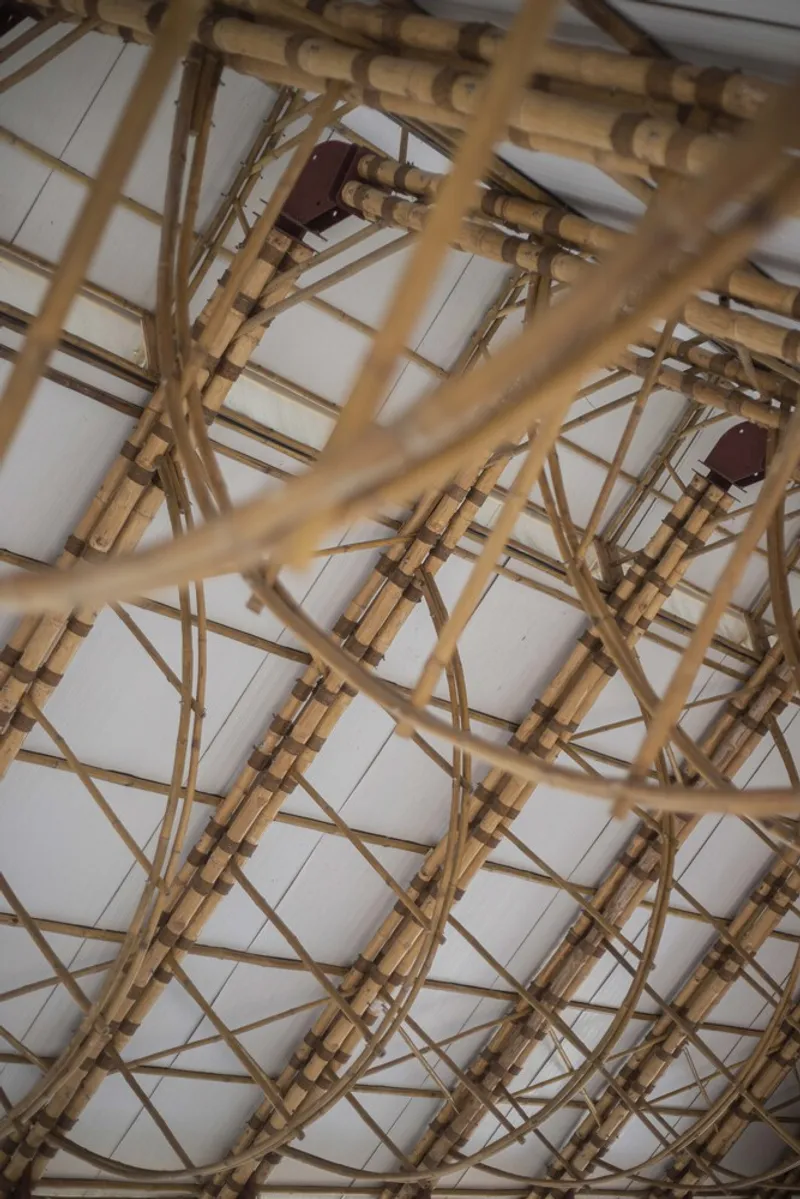
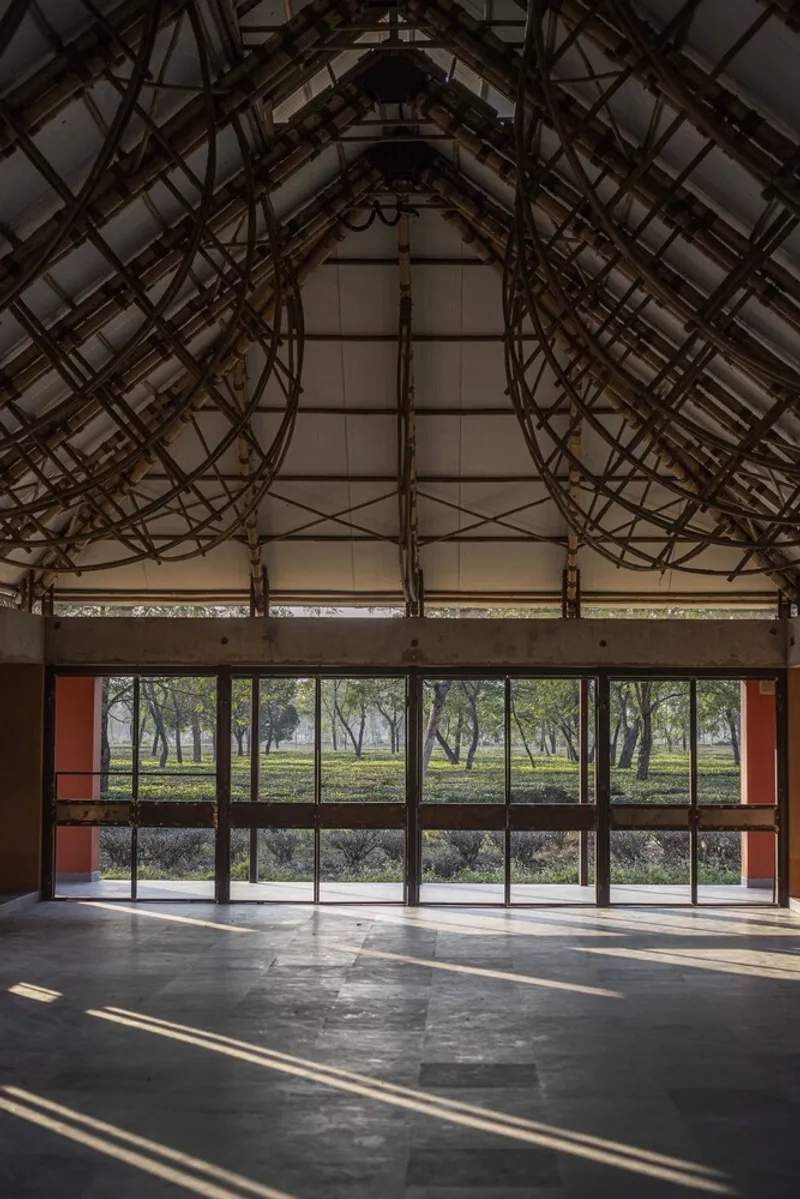
Look up inside the training hall and the roof structure becomes the dominant architectural experience. Bamboo trusses with repeating hexagonal nodes and metal junction plates form a rhythmic pattern overhead that is equal parts engineering and ornament. The joints are bundled and bolted, each connection visible and legible, nothing hidden behind cladding. It is an honest display of how the building holds itself up.
The high pitch of the roof serves a dual purpose. It allows hot air to rise and escape through vents near the ridge, driving natural ventilation without mechanical systems. And it gives the interior a sense of volume that is genuinely unexpected for a building of this budget and material class. Full-height glazing at the end walls floods the space with light and frames the surrounding trees, collapsing the boundary between the hall and the landscape.
The Interior Life of the Hall
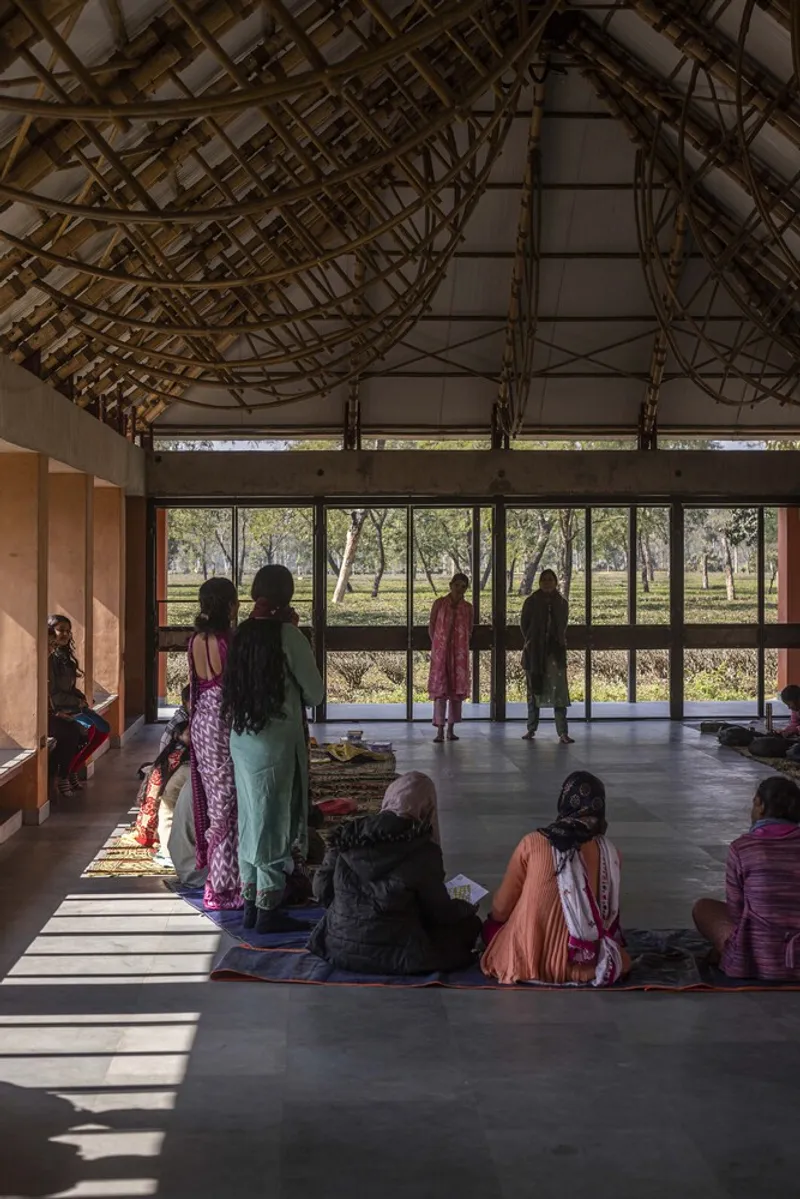
When the training hall is occupied, it transforms. Visitors sit cross-legged on the dark floor beneath the vaulted bamboo roof, facing the glazed wall and the landscape beyond it. The space functions as a meeting hall, a workshop, a classroom, and a gathering point. Its open plan and lack of columns mean it can be reconfigured for any of these uses without friction. The recessed windows along the side walls incorporate built-in seating and storage below, details that quietly increase the building's utility without adding cost.
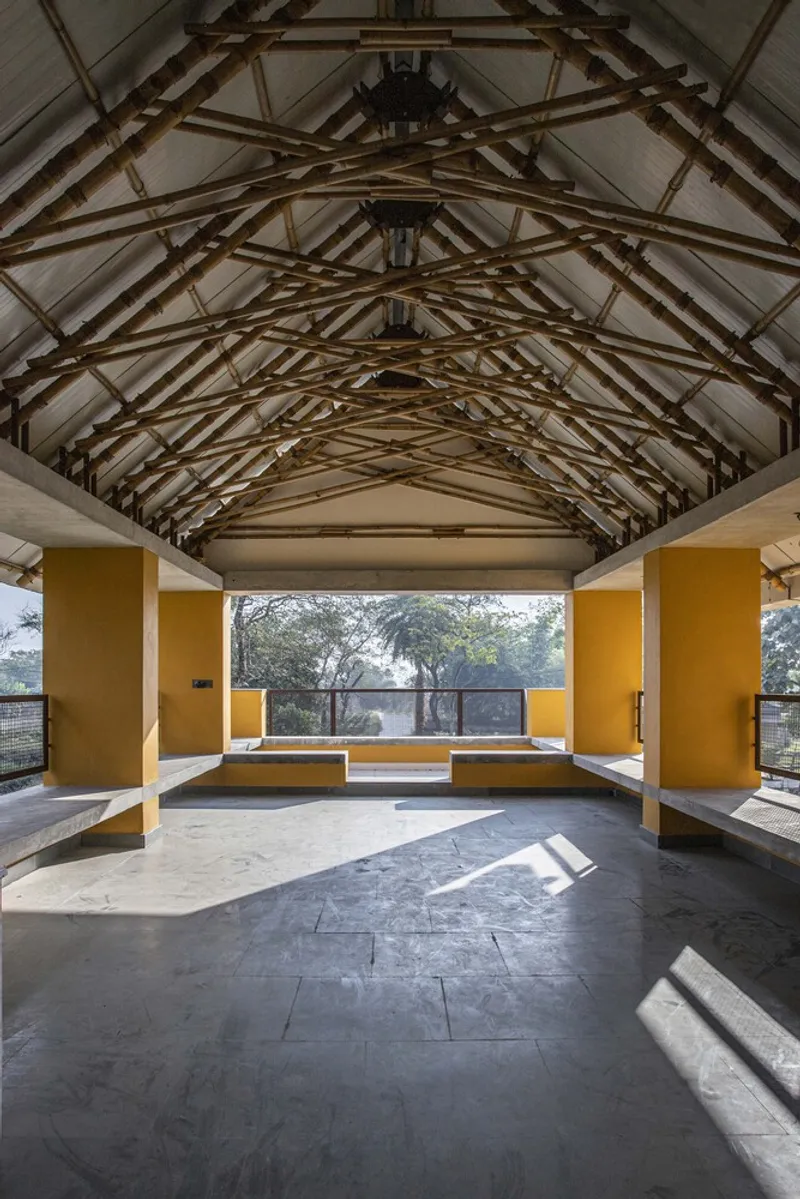
The open-air hall with exposed timber trusses and yellow columns overlooking the courtyard serves a different register. It is lighter, more porous, a threshold space between indoors and out. Morning light enters horizontally and warms the floor. Together, these two spaces establish a range of environmental conditions that users can move between throughout the day, a kind of passive comfort strategy achieved through spatial variety rather than mechanical control.
Bamboo Lattice and Translucent Color
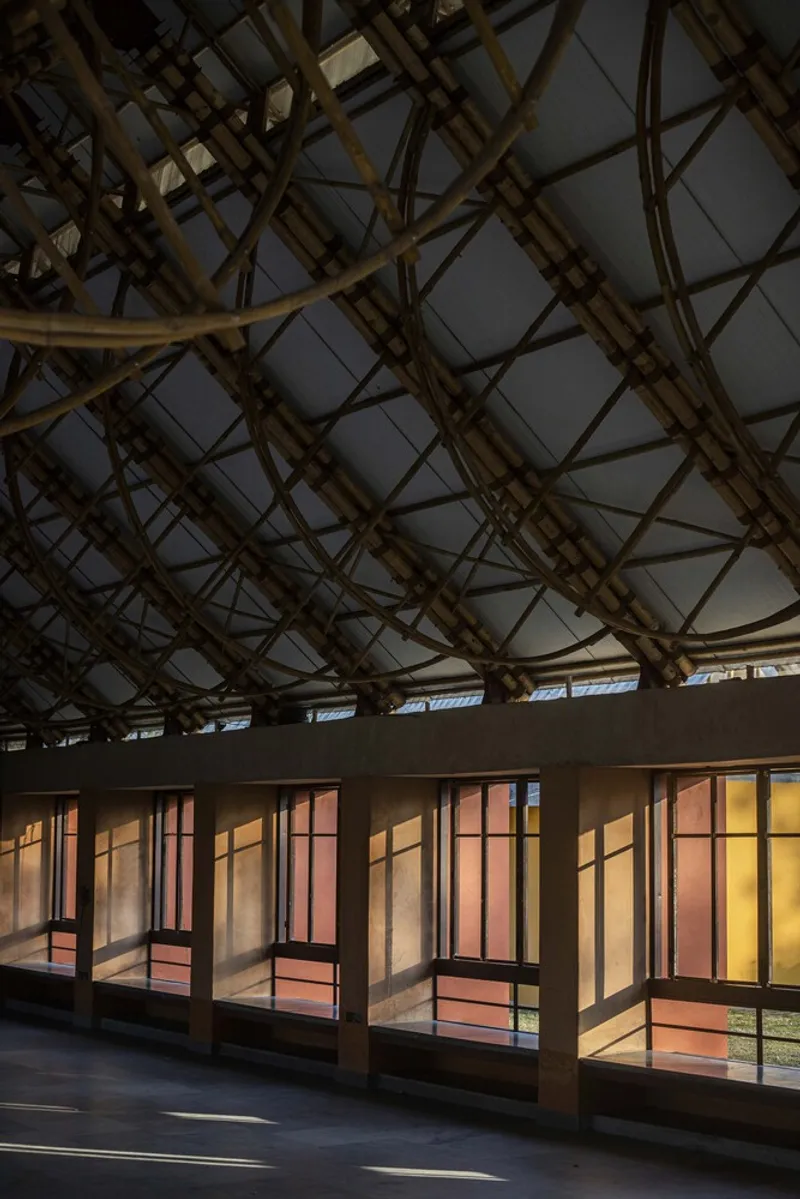
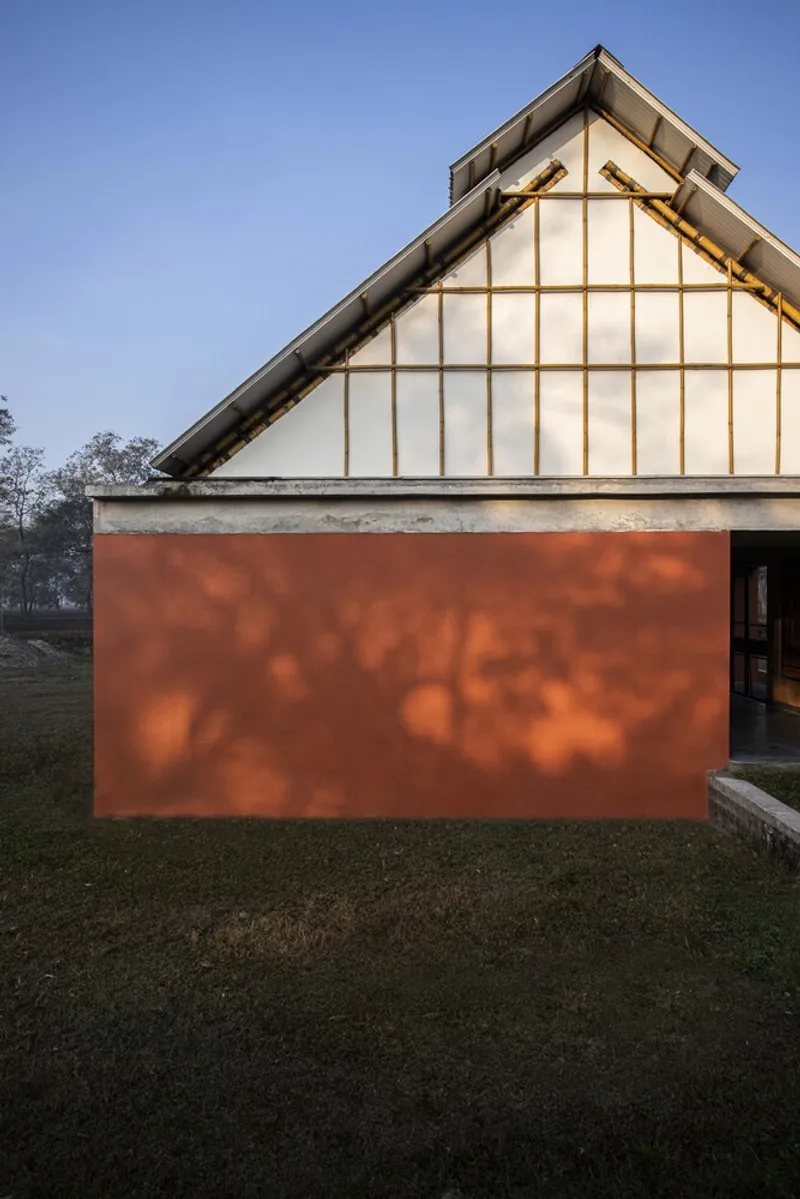
One of the most inventive moments in the campus is the bamboo lattice dome that arches over a corridor, paired with colorful translucent window panels that cast tinted light into the passage. It is a small gesture, almost decorative, but it signals something important about the architects' ambitions. They are not interested in austerity for its own sake. The vernacular material palette is a structural and economic choice, not a stylistic constraint. Where an opportunity for delight presents itself, they take it.
The timber-framed gable wall with translucent panels above a rust-colored volume operates similarly. At dusk, the panels glow from within, turning the building's end wall into a lantern. These are moments where craft becomes spectacle, and they give the campus a visual identity that goes beyond its material origins.
The Yellow Block and Stepped Terraces
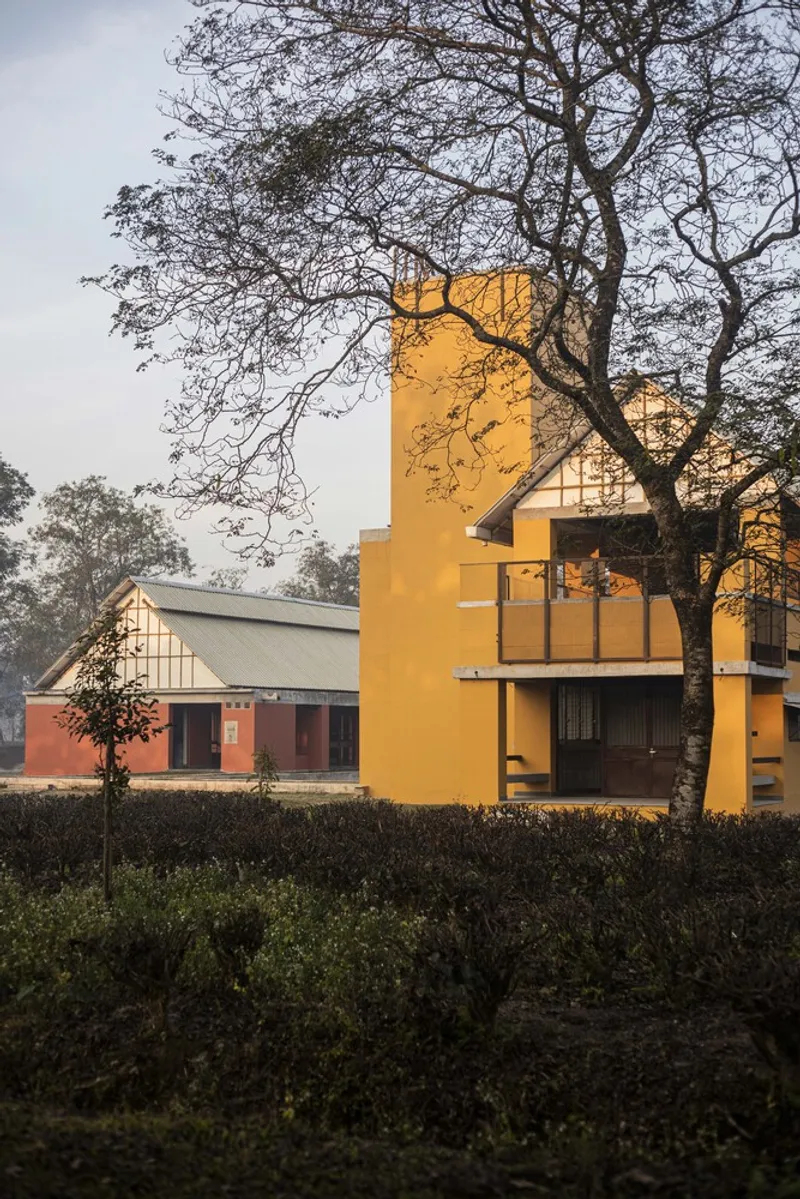
The yellow stucco building with its central tower anchors the second phase of the campus. Stepped grass terraces cascade down from the building, creating informal amphitheater seating where people gather in the afternoon light. The tower element is unusual for a campus of this scale: it provides a vertical marker in an otherwise horizontal landscape, a point of orientation that you can see from the tea fields.
At dusk, the yellow block and the red pavilion sit side by side in the fading light, their warm earth tones cooling gradually as the sky darkens. The bare tree branches that frame this view in one image suggest a dry season, a reminder that the campus must perform across Bihar's extreme seasonal swings. The thick adobe walls and high bamboo roofs are calibrated for exactly this kind of thermal range.
Plans and Drawings
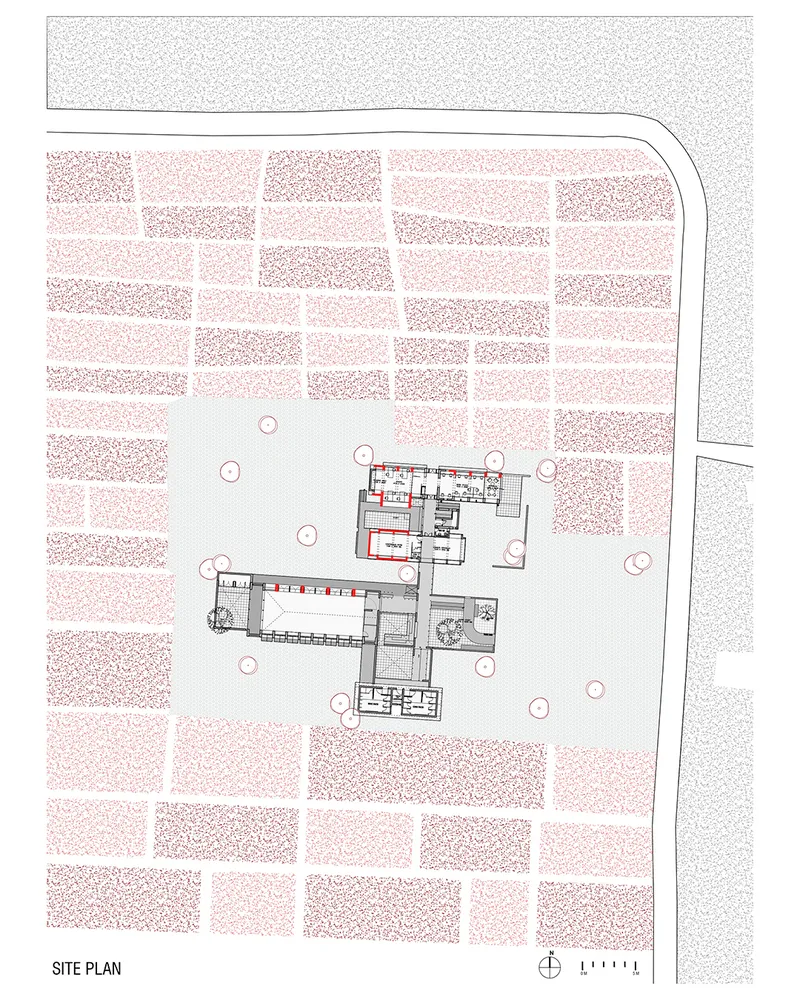
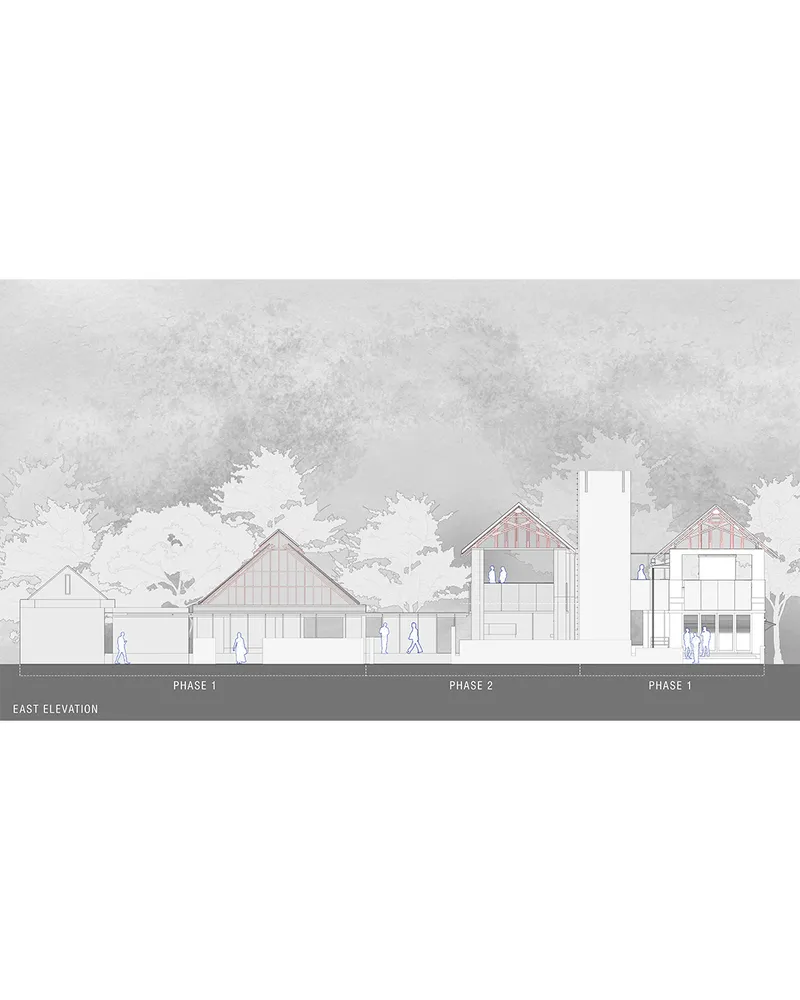
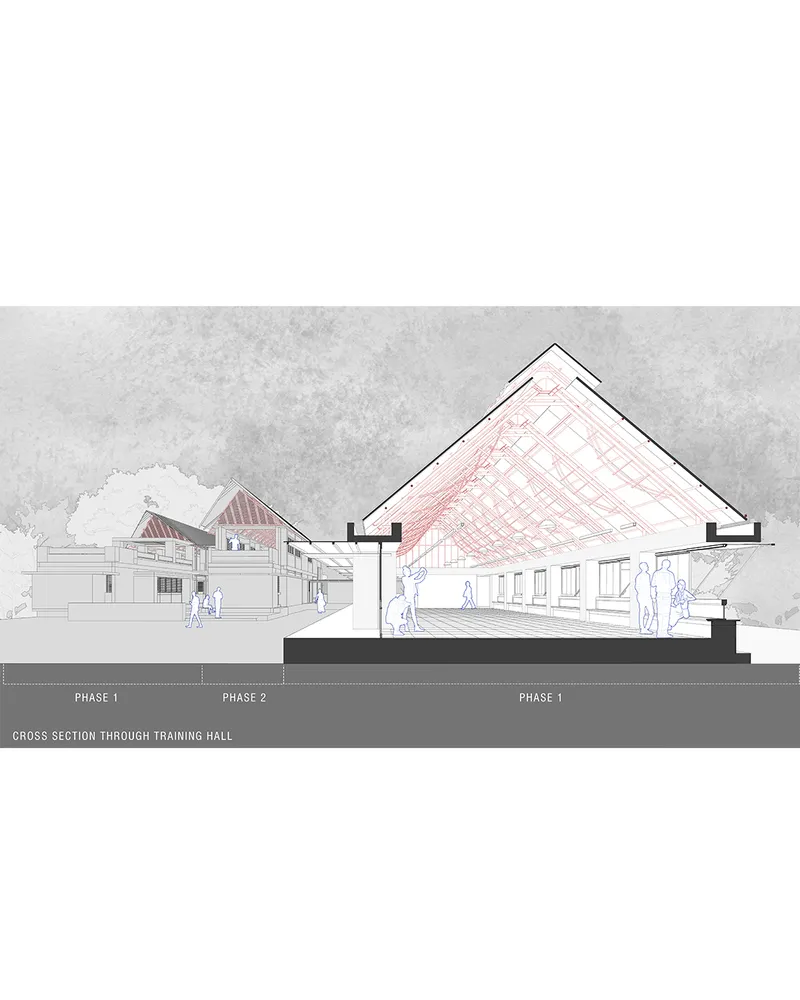

The site plan reveals the deliberate spacing strategy: buildings are oriented around a central courtyard but remain embedded within the agricultural grid, not set apart from it. The east elevation drawing shows how the gabled volumes and tower are phased across three stages, suggesting a campus that will grow incrementally. The cross and longitudinal sections through the training hall make the pitched roof structure legible in a way that the photographs alone cannot. You can see the exact proportions of the bamboo truss system, the relationship between wall height and roof pitch, and the way the section tapers to create both intimacy at the edges and grandeur at the center.
Why This Project Matters
The eArthshala Campus matters because it refuses the false choice between sustainability and ambition. It is a building made from mud and bamboo by local artisans, many of whom were trained on the job, and yet it achieves spatial qualities that most concrete-framed institutional buildings in India never approach. The column-free training hall, the bamboo lattice dome, the translucent gable walls: these are not concessions to a limited budget. They are design moves that exploit the properties of their materials to produce something genuinely inventive.
More broadly, the project demonstrates that vernacular construction techniques can scale beyond the single dwelling. Thumbimpressions has produced a campus, not a hut. It accommodates complex institutional programming across multiple buildings and phases, on a real site with real climatic challenges, using materials that store almost no embodied carbon. For anyone working on educational architecture in South Asia, or anywhere where the impulse toward reinforced concrete remains the default, the eArthshala Campus is a serious counter-argument built at full scale.
eArthshala Campus by Thumbimpressions, Kishanganj, Bihar, India. 970 sqm. Completed 2024. Photography by Nikhil Patel.
About the Studio
Share Your Own Work on uni.xyz
If projects like this are the kind of work you want to make, uni.xyz is a place to publish your own, find collaborators, and enter design competitions.


Popular Articles
Popular articles from the community


Juan García Correa, John González and Claudia Rueda Sink a Circular Amphitheater into a Manizales Engineering Building
On the La Nubia campus in Manizales, Colombia, the S1 Building folds labs and offices into a hillside of ramped lawns that double as a campus route.

David Ortega Stacks a Two-Story Mexico City Penthouse Around a Steel Stair and a Pergola-Shaded Roof Terrace
In Colonia Roma, a 300 m² penthouse uses oak joinery, a planted steel stair and a slatted roof pergola to make a new-build apartment feel like a house.

longwave studio Reorganizes a 112 m² Tainan Apartment Around the Daily Routines of a Family and Two Cats
In Tainan, Taiwan, birch plywood, rust-red furniture and a freestanding plaster wall link arrival, storage, work and family life in one apartment.

David Macias Steps a Doorless Stone and Plaster House Down a Tropical Colombian Hillside
In the humid hills of Colombia, Threshold House replaces the front door with an open void and terraces its 850 m² down the slope instead of fighting it.

Similar Reads
You might also enjoy these articles


Hodi-Mandai Geram
Project Function: Preservation and revitalization of the Intangible heritage and socio-spatial identity of the Hodi by Housing, Cultural Memory Center, Sacred Grove, landscape, local tourism economy


Olio Towers: A Mid-Rise for Performers That Fuses Housing, Rehearsal, and Stage
Located blocks from Houston's Theater District, this modular tower stacks living units around a central performance atrium.

Oasis: Modular Green Housing Carved into Dhaka's Urban Fabric
A shortlisted Plugin Housing entry reclaims unauthorized settlements in Dhaka with stepped concrete volumes, green roofs, and ventilation-driven design.

Black Hole: A Floating Megastructure for the Post-Physical Era
Emiliano Mazzarotto envisions a spherical, self-scaling arena where e-sports, digital hotels, and holographic stadiums replace traditional public space.

Explore Omdayal Architecture College Competitions
Discover active competitions in this discipline

Challenge to reimagine the Iron Throne

Photograph architecture without architects

Illustrate the lost glory of Angkor Wat - Render Challenge

Design challenge to reuse E-waste
Comments (0)
Please login or sign up to add comments
No comments yet. Be the first to comment!