

East West House Bloot Architecture – A Cross‑Cultural 1930s Corner House Transformation in The Hague
East West House in The Hague blends Chinese and Dutch sensibilities, transforming a 1930s corner home with sunken concrete garden.


The East West House Bloot Architecture is a 140 m² renovation and extension of an uninsulated 1930s brick corner house in The Hague, The Netherlands. Designed for a couple with roots in both China and the Netherlands who have lived extensively across Asia, the project reimagines domestic space as a cultural meeting ground. Material continuity, flexible program, and indoor‑outdoor connections drawn from Asian domestic traditions intersect with the structural clarity and functional legibility associated with Western building culture, producing a home that is at once warm, modern, and deeply personal.
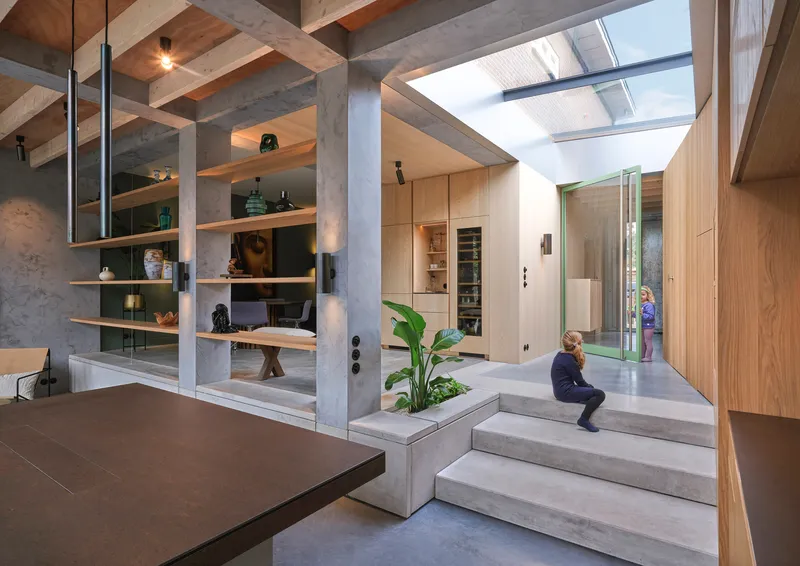
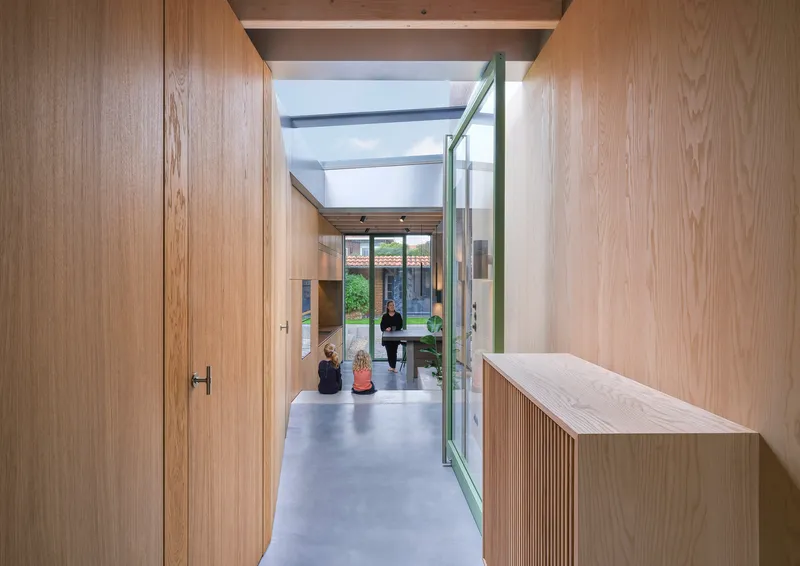
East Meets West: Cultural Drivers of the Design
The brief asked that the renovated house express both worlds. In classical terms, Western architecture privileges stone, defined rooms, and functionally coded layouts, while Asian precedents often celebrate wood, porous thresholds, and looser program boundaries that flow from interior to exterior. The design answers by dissecting the original corner house and recomposing it as an overlapping spatial field in which only essential elements remain fixed. Everything else—movement, gathering, sitting, looking, resting—slides fluidly across levels, surfaces, and materials that extend inside and out.
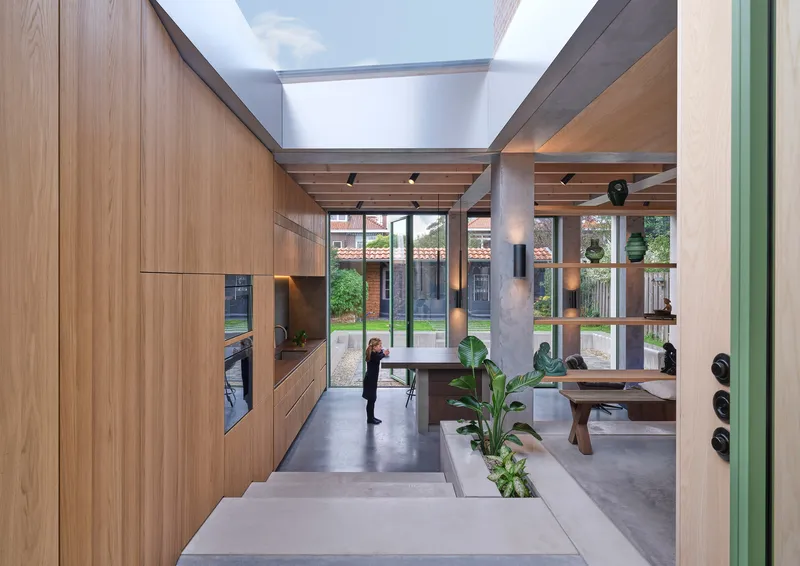
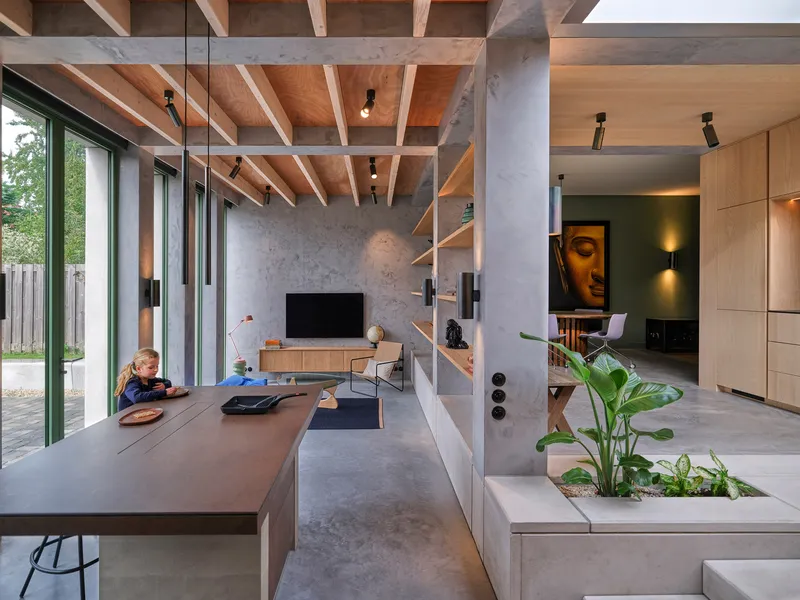
Reworking the 1930s Brick Corner House
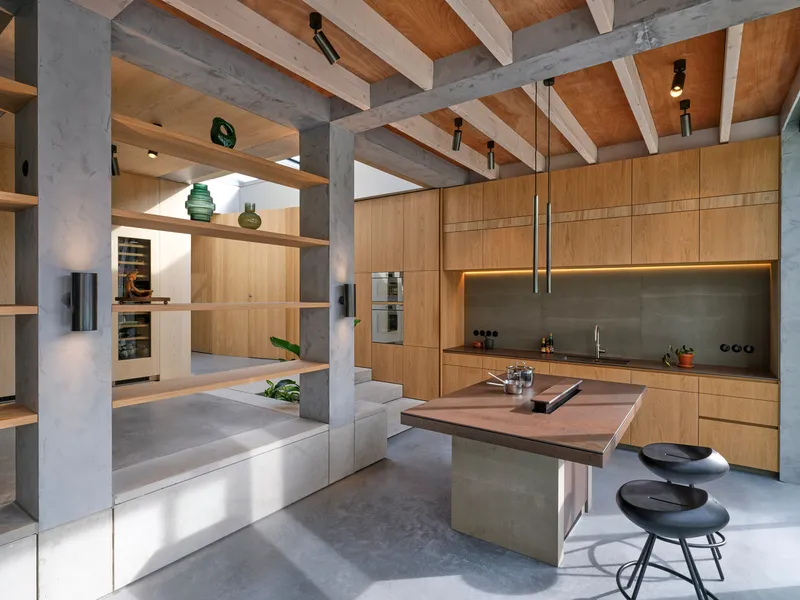
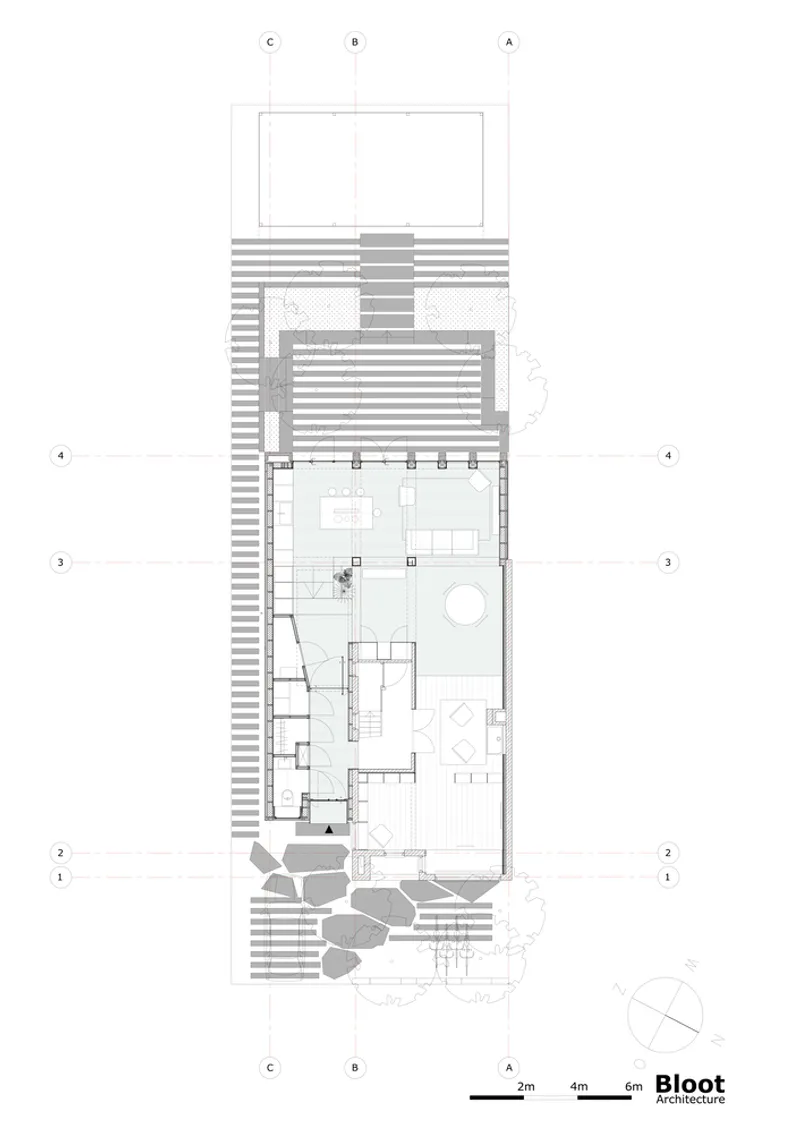
The existing masonry shell became the armature for a spatial plan that dissolves rigid room definitions. Walls are opened, ceiling heights vary, and volumes interlock. The kitchen, spread across three distributed components within the main living level, is the one program anchored in place; all other functions adapt to changing daily life. This looseness recalls Asian domesticity while retaining the technical performance upgrades and structural discipline needed in a Northern European climate.
Material Palette: Wood, Concrete, Steel in Dialogue
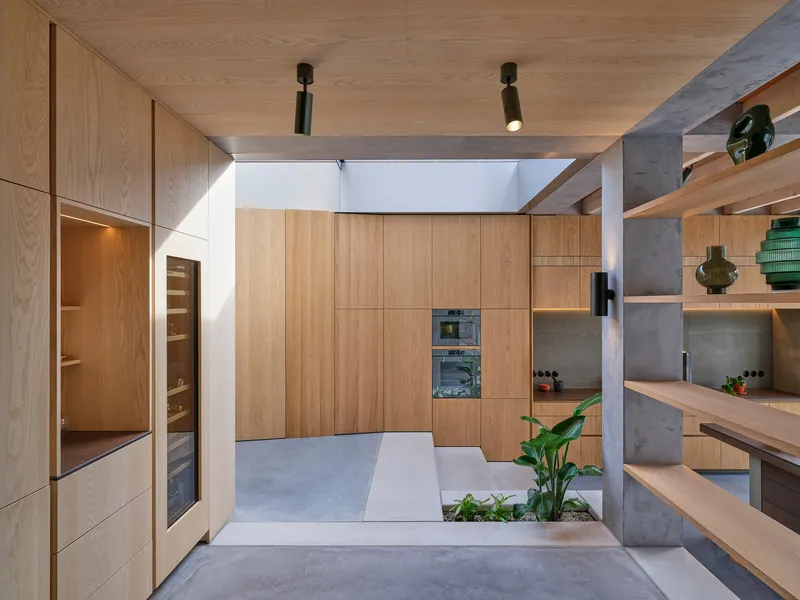
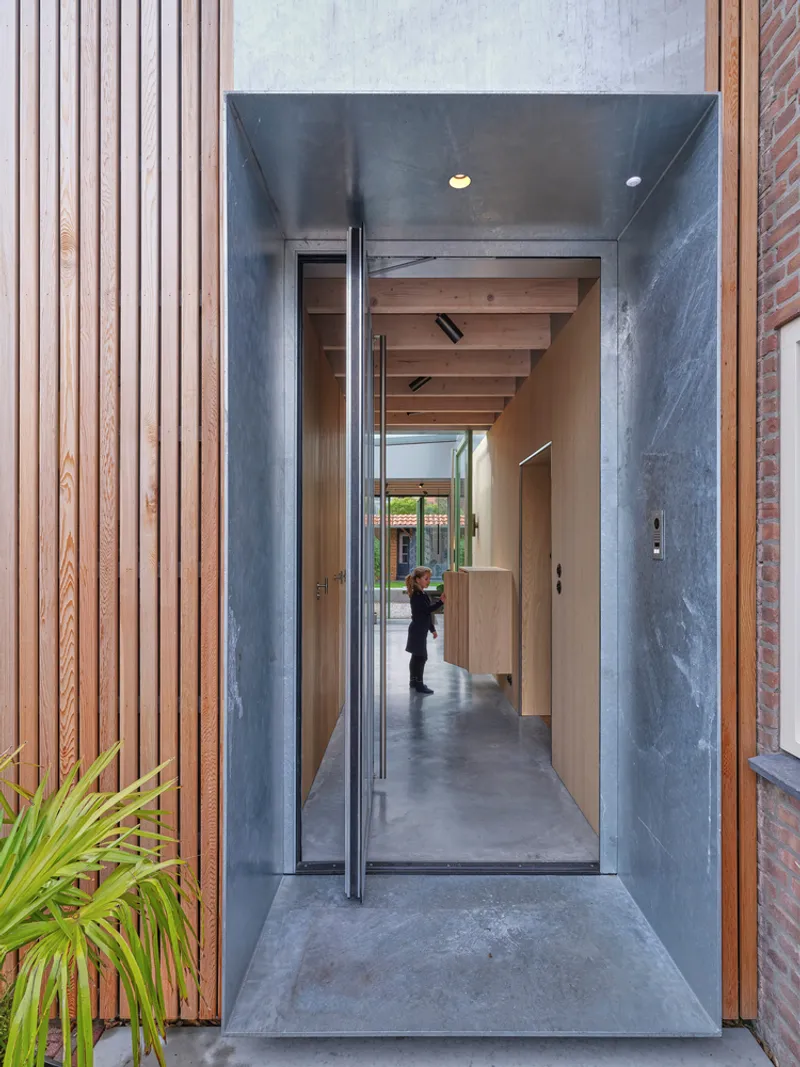
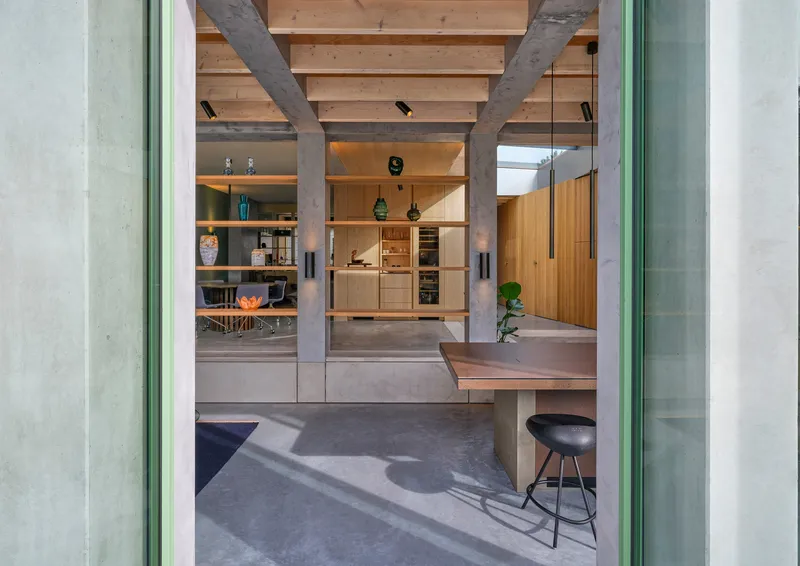
A rich mix of wood, concrete, and steel forms the tactile foundation of the East West House Bloot Architecture renovation. Rather than rely on a single finish, multiple species, textures, and surface treatments are layered to create depth and warmth. Prefab concrete defines structural moves and spills from interior grids into the garden terraces. Galvanized steel articulates entry, pivot doors, and exposed details with raw honesty. Wood surfaces soften circulation paths and hold built‑in program. The contrasting materials echo the cultural duality at the project’s core.
Extension, Plasticity, and Relationship to the Existing Facade
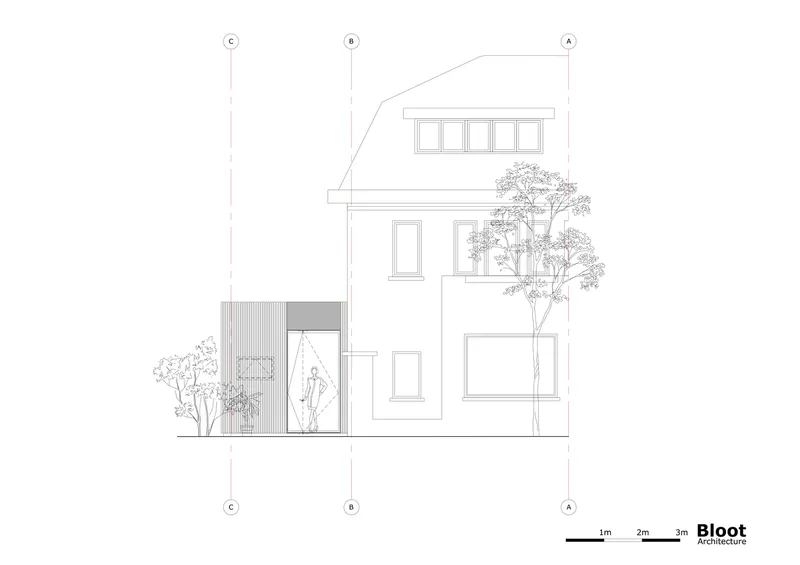
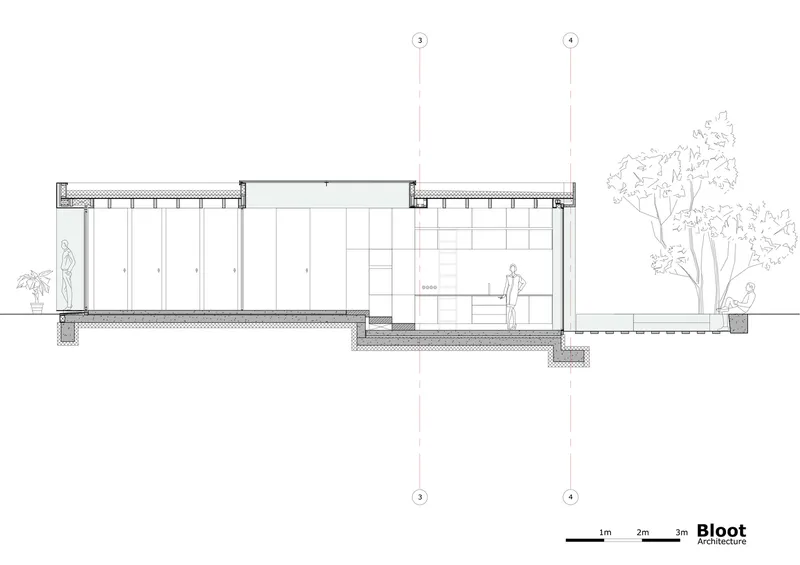
The new extension participates in the scale play and plastic articulation of the original 1930s house without attempting mimicry. Its materialization contrasts with the brick shell yet belongs to the same palette family, creating coherent continuity across old and new. At the rear, the extension turns monumental; the floor is deliberately lowered to gain interior height while setting up playful level changes and stair connections that energize daily movement.
Concrete Grid Inside and Out
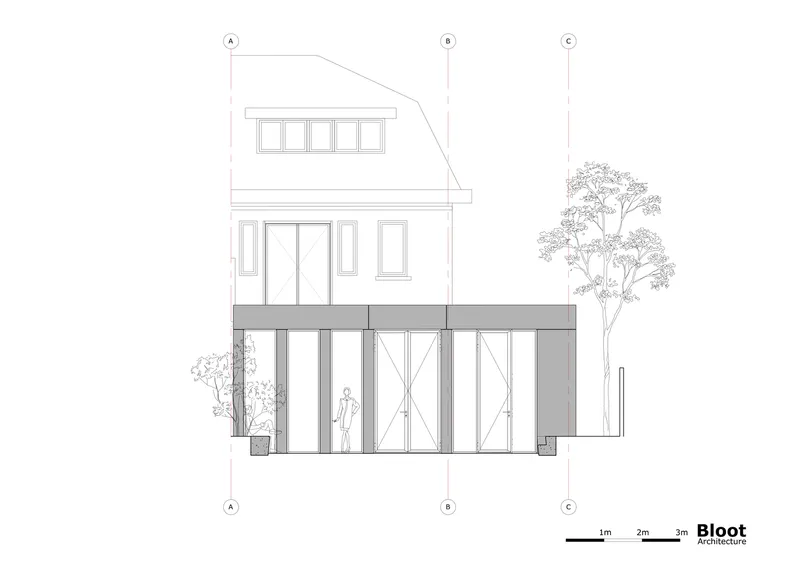
A defining gesture of the East West House Bloot Architecture addition is the prefab concrete facade that folds inward to become a spatial grid. This structural rhythm continues outward again into a sunken garden edged with concrete seating ledges. The result is a park‑like courtyard sequence where sitting, gathering, gardening, and informal play dissolve the traditional perimeter between house and landscape. Because the grid grows from the existing home’s structural cadence, renovation and expansion read as a single, integrated whole.
Galvanized Steel Niche Entrance and Pivot Threshold
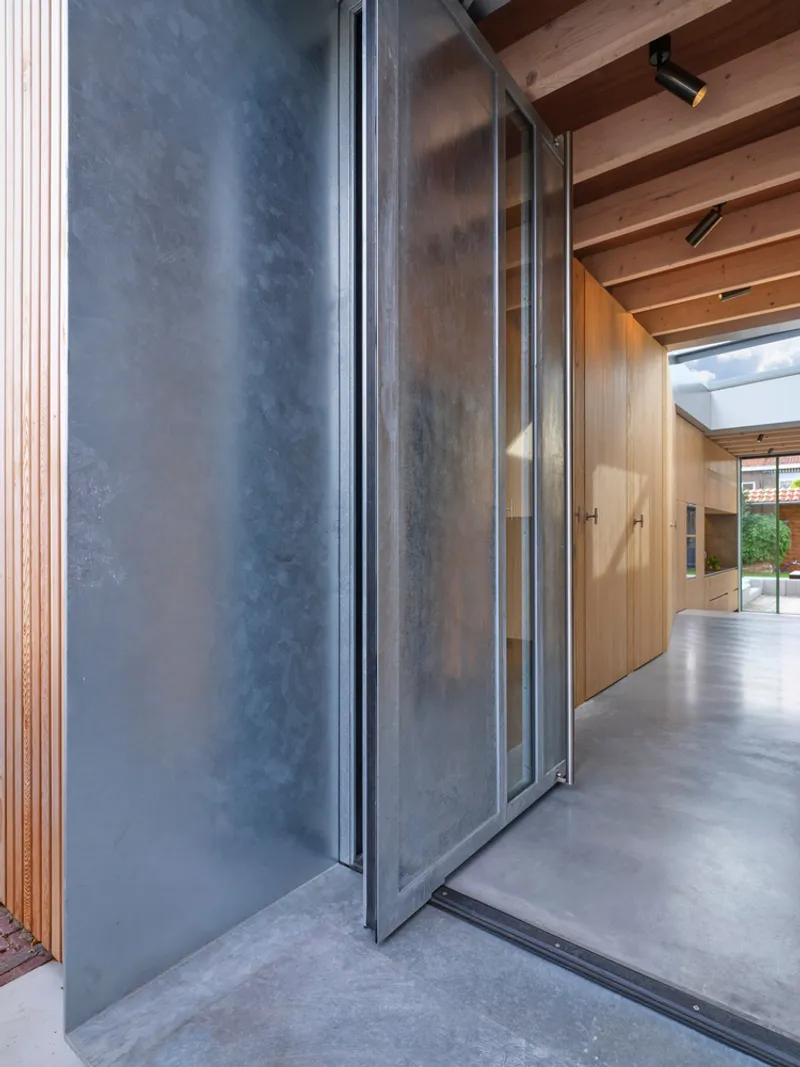
Arrival is marked by a galvanized steel niche that projects through the timber skin of the extension. A raw steel pivot door—dimensioned to match the full width and height of the interior hall—swings open to reveal a new, enlarged entry volume. This assertive threshold compresses and then releases, heightening the experiential transition from street to home while signaling the project’s material honesty.
The Program Wall: Services, Storage, and Continuity
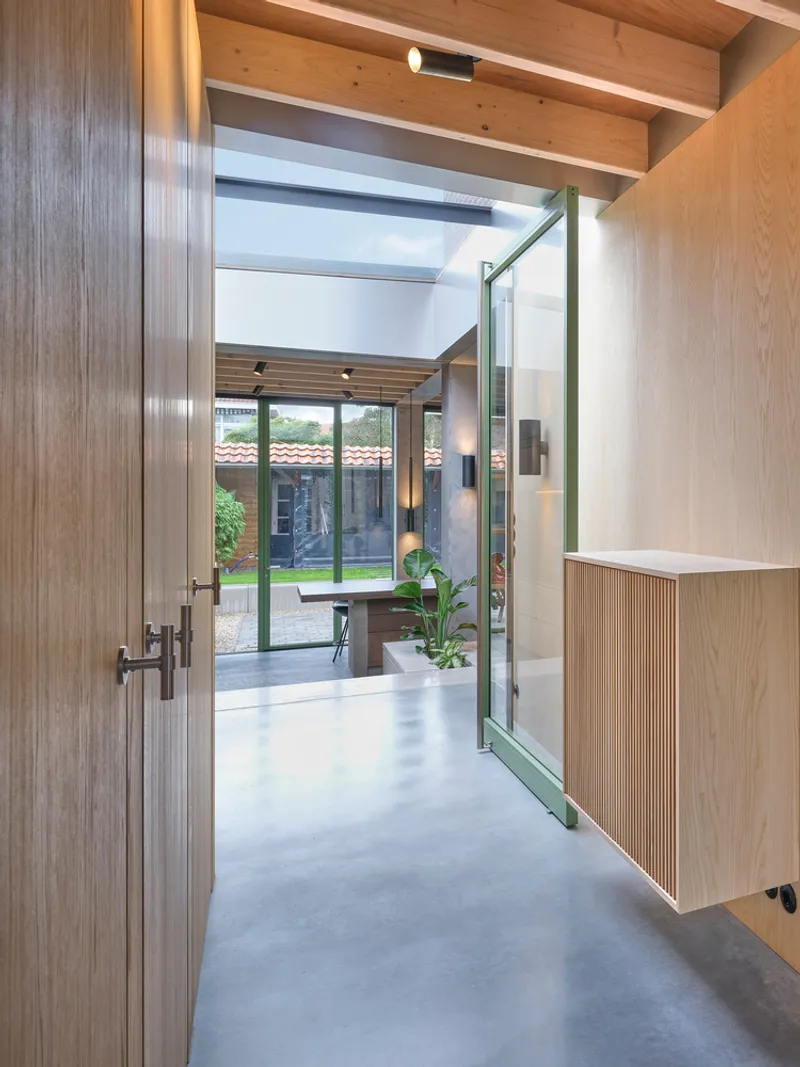
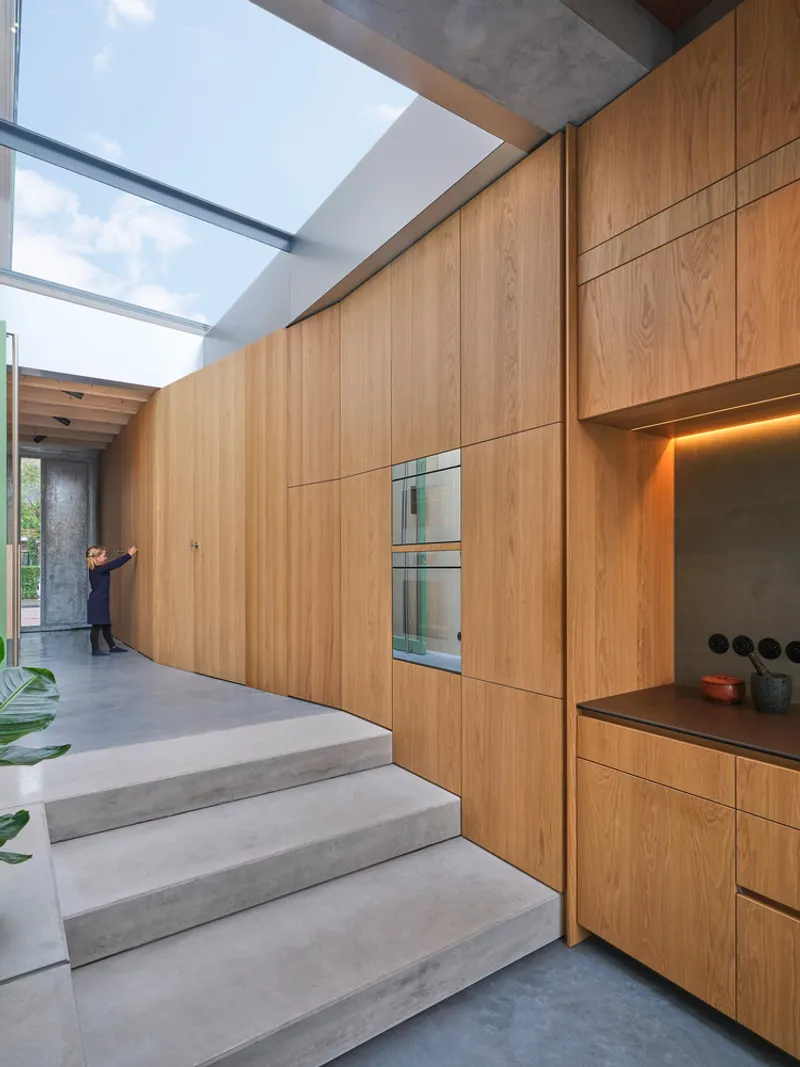
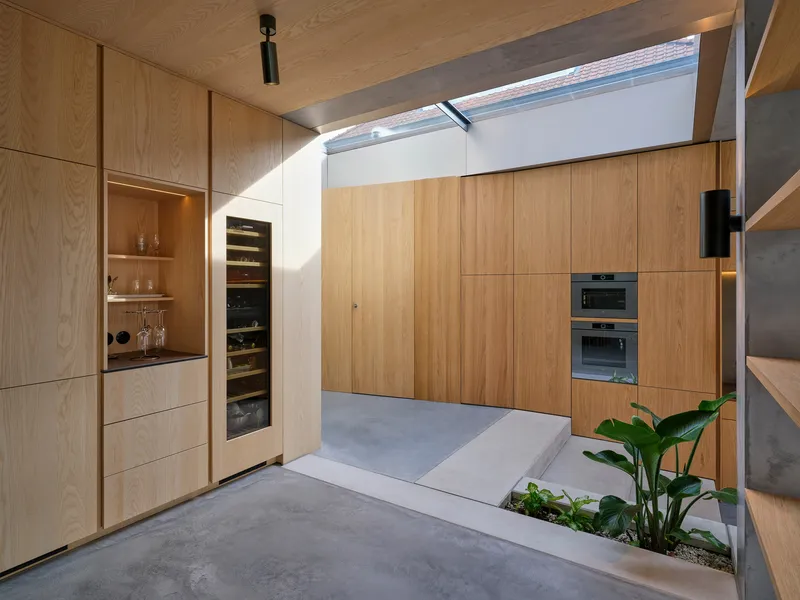
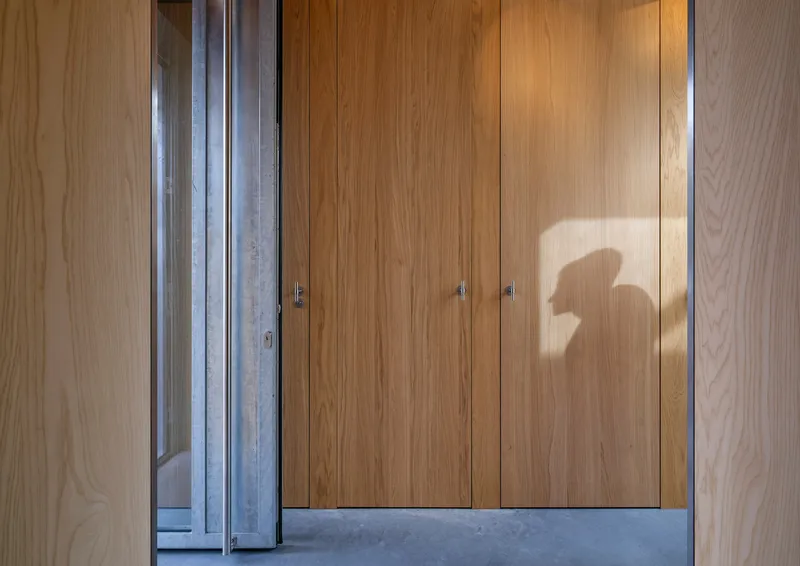
A continuous wooden wall extends from the entry toward the rear, quietly absorbing the functional backbone of the house. Within its thickness are concealed the toilet, wardrobe, mechanical systems, storage, and distributed kitchen elements. By consolidating services, the design frees surrounding space to remain flexible, open, and reconfigurable—one of the key strategies allowing east‑west cultural coexistence within a compact footprint.
The New Heart Beneath the Skylight
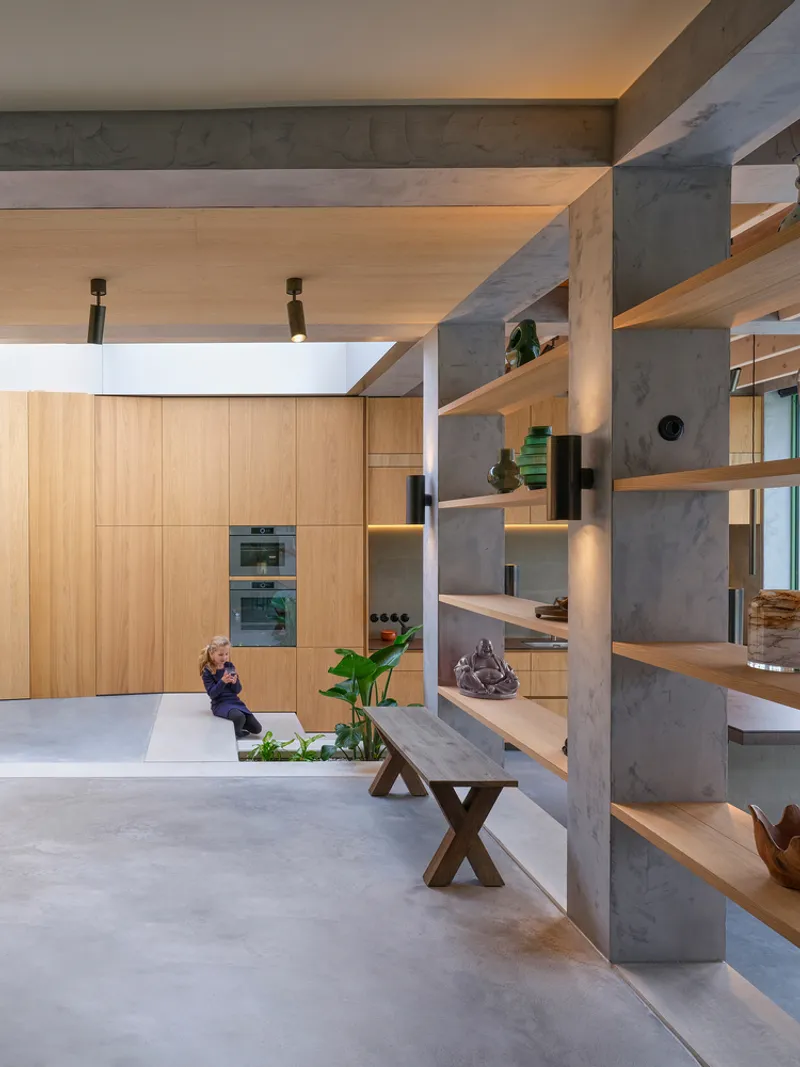
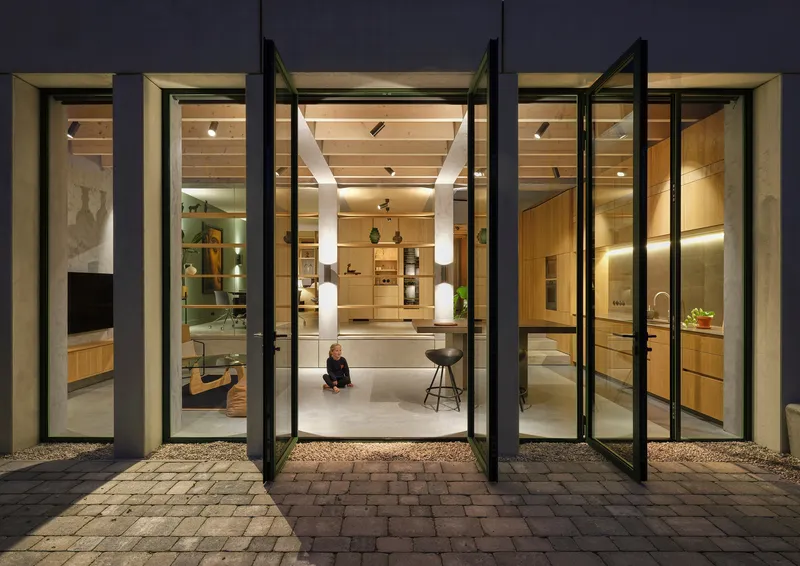
At the core of the extension lies a tall, light‑filled central volume under a generous skylight. Large prefab concrete steps cascade through the space, doubling as circulation and seating. Plantings and daylight transform this interior landscape into a calm communal heart without prescribed function. Its deliberate programmatic ambiguity invites everything from tea, conversation, and children’s play to reading in solitude, embodying the intuitive spatial use so common in Asian domestic traditions.
Sunken Garden and Level Play
Lowering the rear extension floor created a sectional swing that continues into a sunken exterior garden ringed by sitting edges in concrete. Interior concrete grid lines land outside as benches, planters, and steps, generating a continuous field for gathering that blurs in and out. Level shifts, stair landings, and material seams compose a lived topography scaled to family life.
Integration and Coherence
Although constructed in phases—renovation, extension, landscape—the project works as one integral environment because structure, materials, and circulation sequences lock together. The rhythm of the original house informs new grids; new materials return to meet old ones; inside gestures extend outdoors; the cultural narrative of east and west is embedded in every junction.
The East West House Bloot Architecture project turns a modest 1930s brick corner dwelling in The Hague into a cross‑cultural living landscape of wood, concrete, and steel. Flexible overlapping spaces, a service‑integrating program wall, a luminous central heart beneath a skylight, and a sunken concrete garden complete a home where Eastern spatial fluidity and Western tectonic rigor meet. It is modern, warm, sustainable in its reuse and upgrade, and deeply shaped by the life journeys of its owners.
All the photographs are works of Jeroen Musch


Popular Articles
Popular articles from the community


Juan García Correa, John González and Claudia Rueda Sink a Circular Amphitheater into a Manizales Engineering Building
On the La Nubia campus in Manizales, Colombia, the S1 Building folds labs and offices into a hillside of ramped lawns that double as a campus route.

Architekt Andreas Gruber Scatters 23 Dark Timber Chalets Across a South Tyrolean Forest Edge
In Molini di Tures, Amonti Chalets breaks a resort into a hamlet of gabled timber houses, with parking, storage and services pushed into the slope.

David Ortega Stacks a Two-Story Mexico City Penthouse Around a Steel Stair and a Pergola-Shaded Roof Terrace
In Colonia Roma, a 300 m² penthouse uses oak joinery, a planted steel stair and a slatted roof pergola to make a new-build apartment feel like a house.

LT2A and OPEN Architectes Thread a Brick and Glass High School Through a Wooded Belgian Campus
In Braine-l'Alleud, a 3,000 m² wing for Collège Cardinal Mercier pairs pale brick with a glazed colonnade, deferring to a small chapel and a dense wood.

Similar Reads
You might also enjoy these articles

Bamboo Housing Challenge 2026: Design Affordable, Sustainable Homes Using Bamboo
An international design competition by Bamboo U and IBUKU inviting architects and designers to reimagine affordable housing using bamboo — with the winning design built full-scale in Bali.
Computational Design & Education: Beegraphy Design Awards Introduces 7th Category (Featuring Jiyun's Innovative Approach)
Dive into Beegraphy’s 7th Design Awards category, where computational design meets education to create immersive, interactive learning tools, inspired by Jiyun’s work.
From Parametric Lighting to Urban Furniture: Join the 2nd Workshop in Beegraphy’s Computational Design Series
Dive into Cutting-Edge Design Techniques and Practical Applications with Industry Experts

Last Call: Unleash Your Architectural Genius in SHAK's Kindergarten Design Competition
Urgent call for architects to join SHAK's kindergarten design competition before the looming deadline

Explore Architecture Competitions
Discover active competitions in this discipline

Challenge to reimagine the Iron Throne

Photograph architecture without architects

Illustrate the lost glory of Angkor Wat - Render Challenge

Design challenge to reuse E-waste
Comments (0)
Please login or sign up to add comments
No comments yet. Be the first to comment!