
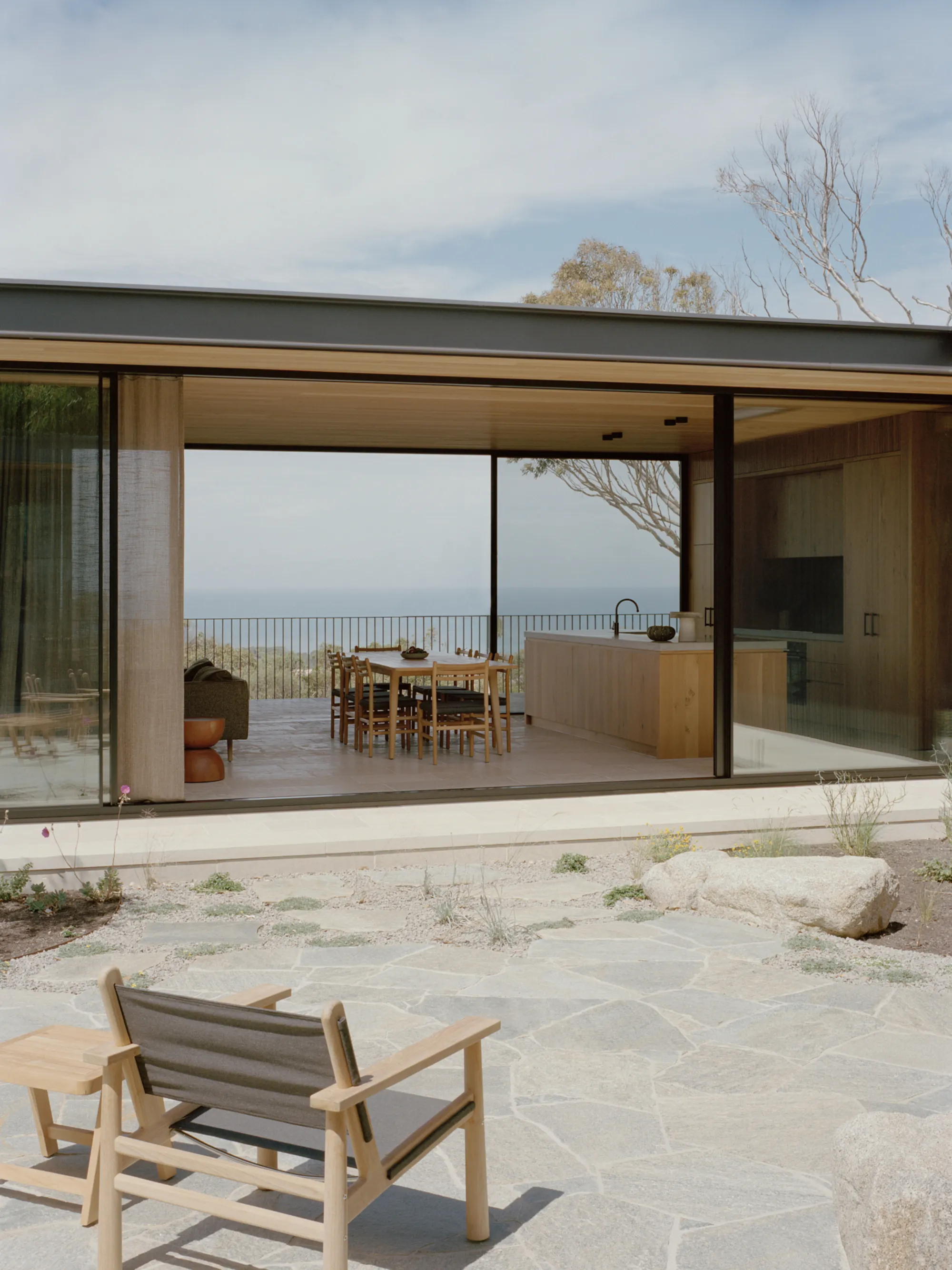
Eckersley Architects Channels the Spirit of 1960s Beach Shacks in a Coastal Victorian Home
Overlooking Anglesea's surf beach, a charred timber and sandstone house wraps around courtyards to invite wind, light, and three generations in.


The elevated fibro shack, once a fixture of every Australian coastal township, has all but disappeared. Its replacement is typically larger, sleeker, and entirely disconnected from the casualness that made those originals so livable. At Anglesea, a surf town southwest of Melbourne where the Great Ocean Road begins its sweep along the Southern Ocean, Eckersley Architects has tried to recover something of that earlier ethos without pretending the last sixty years of building science never happened. The result is a 337 square metre house on a 720 square metre site that manages to feel generous for a multigenerational family yet intimate when occupied by two.
What makes Anglesea House worth studying is less any single gesture than the disciplined logic of its plan. An H-shaped configuration creates two courtyards that do real thermodynamic and social work: one draws northern light into the core of the house, the other provides a sheltered outdoor room when the ocean wind makes the main deck inhospitable. The house replaces a dark 1970s two-storey structure that never connected to its back garden or its landscape. This one connects to both, and to a mid-century lineage it treats with genuine respect rather than nostalgic quotation.
A Front Facade That Earns Its Privacy
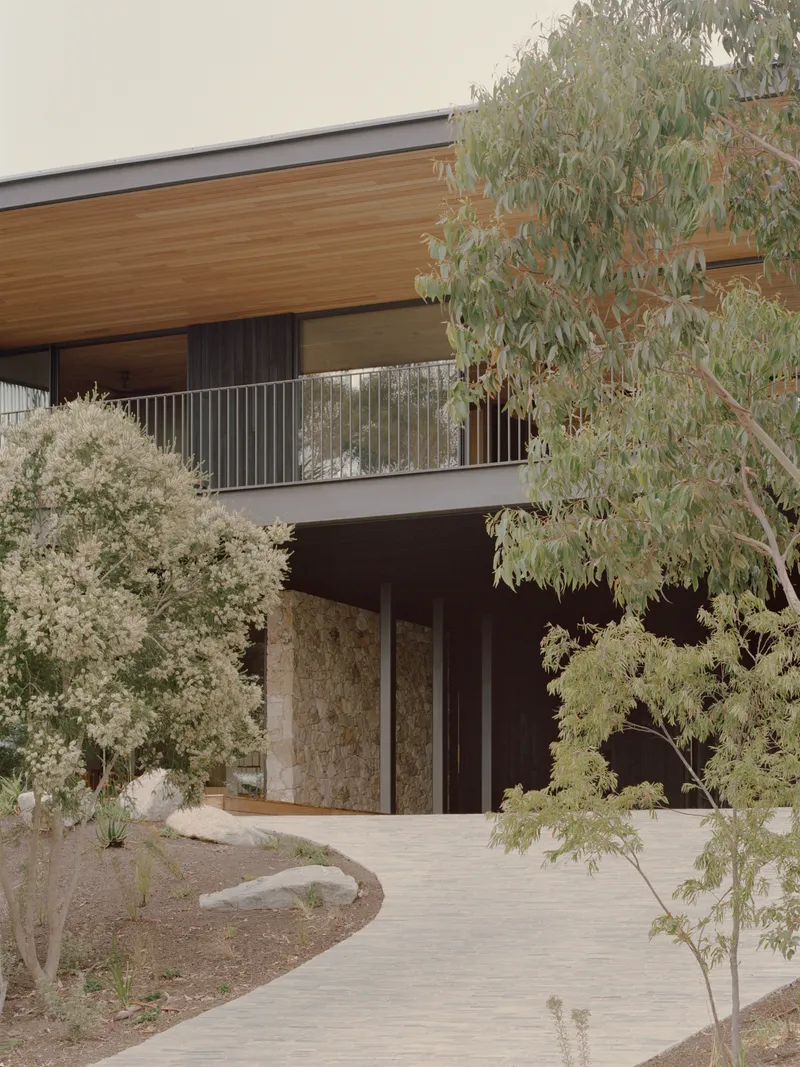
From the street, the house presents a deliberately restrained face. Stone-clad walls and a deep timber soffit anchor the entry, while maturing tea trees are planted to gradually obscure sightlines between the first-floor deck and the road. It is a slow reveal: you enter through native plantings along a curved pathway and only progressively understand the depth of the site. The carport and front facade reference the elevated fibro beach shacks still dotted around Anglesea, translating their proportions into charred timber cladding and Canyonfell Freeform stone.
The entry sequence matters because it sets up the courtyard experience. You arrive at street level, roughly three metres above the crest, and descend into the plan. By the time you reach the glazed living space at the rear, the horizon of the Southern Ocean is waiting for you through floor-to-ceiling glass, framed by distant hills. The progression from closed to open is handled with enough patience that the ocean view lands as a genuine event.
The Courtyard as Engine

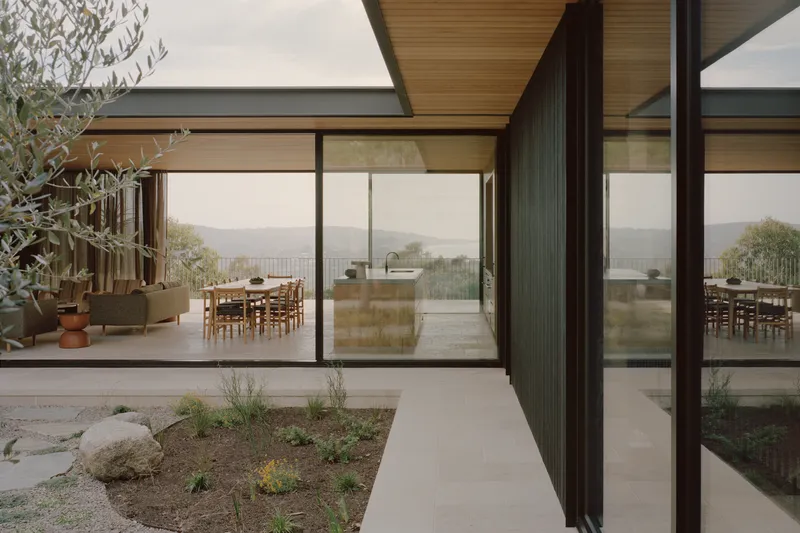
The central courtyard is the organizational heart of the H-plan and its best spatial idea. Three mature olive trees stand among boulders and flagstone crazy paving that deliberately channels a mid-century looseness. Charred timber cladding wraps the interior walls of the courtyard, making it read as an outdoor room rather than a leftover void. The crazy paving, executed in Luca gneiss stone, reinforces the mid-century feel without resorting to replica detailing.
More importantly, the courtyard works as a passive solar device. Oriented to capture northern light, it channels warmth and daylight into rooms that would otherwise be dim on a site squeezed between neighbours. When Anglesea's famously gusty conditions make the ocean-facing deck uncomfortable, the courtyard offers a still, sun-filled alternative. Sliding glass doors on opposite sides of the dining room allow you to look straight through the courtyard and out to the ocean horizon in a single sightline. That transparency keeps the 337 square metre plan from feeling compartmentalized.
Living at the Horizon

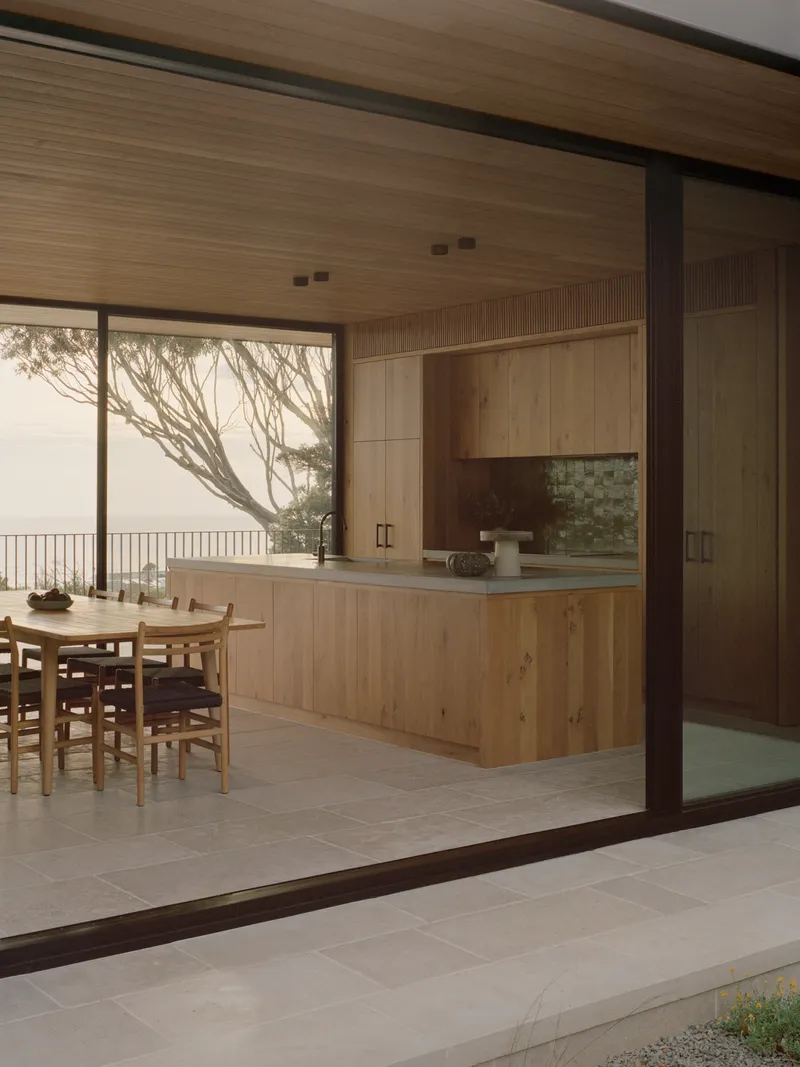
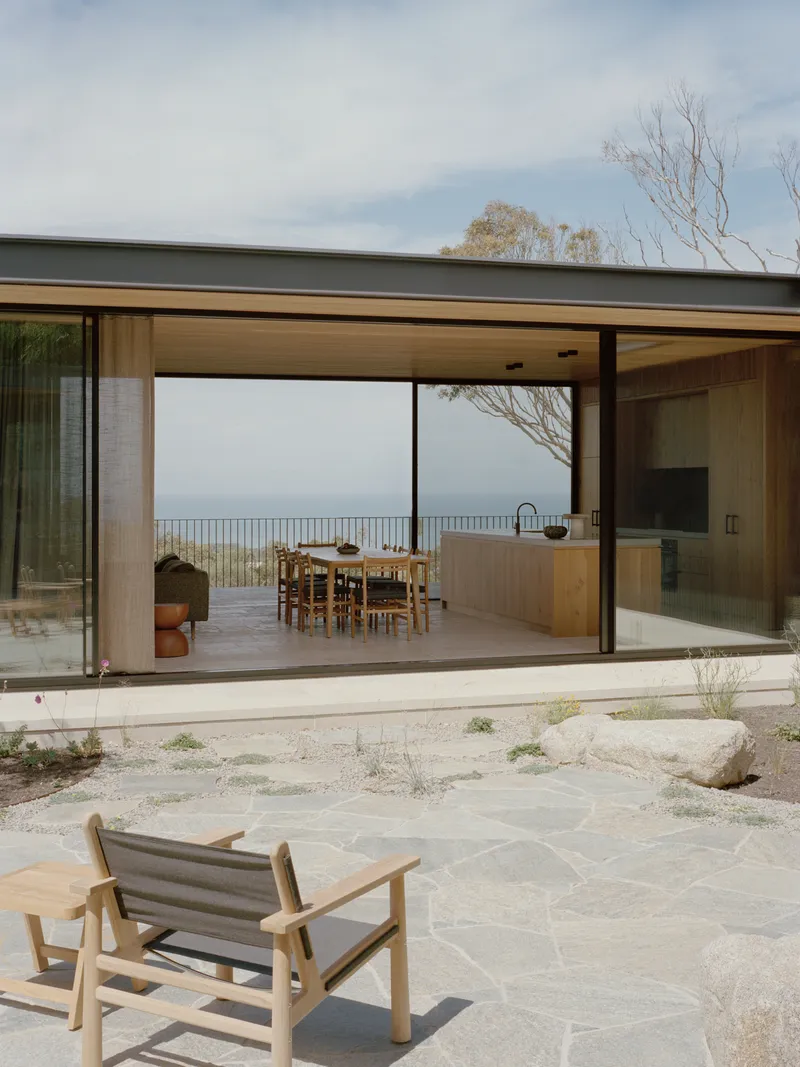
The first floor houses the open-plan kitchen, dining, and living space, and this is where the house fully commits to its coastal outlook. Full-height glazing opens onto a deck that cantilevers toward the surf beach, and the living space reads as a continuous plane of Beauford sandstone, spotted gum ceiling, and sky. The choice of sandstone for flooring is pragmatic as well as aesthetic: its thermal mass helps the house stay comfortable year-round, absorbing warmth in winter and staying cool underfoot in summer.
The kitchen island, cast in in-situ concrete, anchors the plan without interrupting the view. Solid French oak joinery and blackbutt timber ceilings warm the palette against the harder stone and glass. A bare tree framed through the glazing operates almost like a piece of land art, its branches tracing the wind patterns the house is designed to negotiate. The room is not trying to be dramatic; it simply puts you in contact with weather, water, and light in a way the previous house on this site never managed.
Bedroom Wing and the Outdoor Walkway


One of the most charming decisions in the plan is borrowed directly from rudimentary beach shack typology: the rear bedroom wing is accessed via a covered walkway that requires guests to step outside. It sounds minor, but it fundamentally changes the experience of moving through the house. You feel the air, hear the wind, register the time of day. It also cleanly separates the private sleeping quarters from the social core, giving the multigenerational family the buffer it needs.
Inside the bedrooms, limestone flooring extends to the courtyard terraces and walkway, maintaining material continuity. Timber wainscoting and integrated floating nightstands give the rooms a quiet, almost monastic quality. The ensuite, visible through a timber-framed doorway, uses a limestone vanity and a vertical mirror that reflects the bedroom beyond, amplifying the sense of depth in a compact space. These are not flashy rooms. They are considered ones, designed to reward repeated stays.
Material Logic and Bushfire Compliance


Strict bushfire requirements heavily influenced the exterior material palette, pushing the design toward charred timber cladding, stone, rendered walls, and exposed steel. Rather than treating compliance as a constraint to overcome, Eckersley Architects absorbed it into the design language. The charred timber reads as deliberate, even poetic, in a landscape where fire is a permanent presence. Internally, walls carry a subtle eucalypt green tint that links the house to the surrounding eucalyptus canopy without overstating the reference.
The upper-level hallway reveals the structural honesty at work: a stone feature wall and steel balustrade overlook the floor below, exposing the section of the house in a way that makes you conscious of the three-metre fall the site negotiates. High-performance double glazing, a hidden 14 kWh solar panel array with battery storage, and the complete removal of gas make the house fully electric. A water tank handles storage. These systems are integrated cleanly enough that they never announce themselves, which is exactly how sustainability should function in a domestic project.
Why This Project Matters
Anglesea House is a useful corrective to two tendencies in contemporary coastal architecture. The first is the impulse to maximize glass and minimize enclosure, producing houses that overheat in summer and feel exposed year-round. The H-plan here, with its courtyards and its tiered section, negotiates wind, sun, and privacy with enough sophistication to remain comfortable without mechanical intervention for much of the year. The second tendency is nostalgic pastiche: borrowing the forms of mid-century beach houses without understanding their spatial logic. Eckersley Architects borrows the logic instead, particularly the outdoor walkway, the courtyard as social hub, and the deliberate casualness of plan, and builds it in materials appropriate to current bushfire and energy codes.
What stays with you is the generosity of the plan toward multiple modes of occupation. A couple in their sixties can live in the first-floor wing and barely touch the ground-floor bunk room. When grandchildren arrive, that room becomes a rumpus room, the courtyard fills with activity, and the deck accommodates a larger table. The house scales up and down without feeling empty or cramped. That flexibility, more than any single material choice or framed view, is what connects it to the shack tradition it admires.
Anglesea House by Eckersley Architects. Anglesea, Victoria, Australia. 337 m², completed 2024. Photography by Tasha Tylee.
About the Studio
Share Your Own Work on uni.xyz
If projects like this are the kind of work you want to make, uni.xyz is a place to publish your own, find collaborators, and enter design competitions.




Popular Articles
Popular articles from the community


The Musturak Paradise: Senior Living Architecture for a Connected Future in Temara, Morocco
The Musturak Paradise reimagines senior living architecture in Temara via private homes, social spaces, culture, community, and shared care.

Lunar Spiral: Space Architecture Shaped by the Mathematics of the Universe
Lunar Spiral reimagines space architecture through Fibonacci geometry, lunar regolith, levitating habitats, and self-sustaining Moon living.

The Ocean Hive: Sustainable Architecture for a Self-Sufficient Civilization at Sea
The Ocean Hive imagines sustainable architecture at sea, where modular habitats, algae, wave power and ocean waste sustain a growing colony.

Play: Fragments of Their World
Familiar architecture becomes modular playground design, creating safe spaces where displaced children can learn, connect, imagine and play.


Similar Reads
You might also enjoy these articles

Bao Huynh Watercolor Atelier: A Serene Art Retreat in Hội An
Bao Huynh Watercolor Atelier in Hội An blends multifunctional art spaces, sustainable design, local materials, and family-friendly living in a serene environment.

Atelier Macri Concept Store Interior Design by CASE-REAL
Atelier Macri store features a "ko" counter, walnut wood details, cork displays, blending retail, gallery, and seamless customer experiences.

Manuel Vargas Izquierdo Stadium and High-Performance Sports Center: Architectural Excellence in Jalpa de Méndez
The Manuel Vargas Izquierdo Stadium blends sustainable design, inclusive sports facilities, and cultural-inspired architecture, revitalizing Jalpa de Méndez’s public spaces.

KAKR Buluh Awar Hall: Revitalizing Community and Ecology Through Bamboo Architecture
Community built bamboo hall revitalizes Buluh Awar village, empowering youth, restoring ecology, celebrating vernacular craftsmanship through sustainable architecture and culture.




Comments (0)
Please login or sign up to add comments
No comments yet. Be the first to comment!