
3andwich Design Buries a Sculpted Cave Space Beneath the Fujian Coastline
On a rocky headland in Xiapu, a 460-square-meter underground cultural venue disappears into the landscape it celebrates.

Architecture that hides is not architecture that retreats. On a rocky promontory along Donghai No.1 Road in Xiapu, Fujian Province, 3andwich Design / He Wei Studio has inserted 460 square meters of public cultural space almost entirely underground, capping it with a vegetated roof that doubles as a viewing platform above the East China Sea. The Blue Insight Cave Space takes its formal cues from the reefs and sea caves that line the cliffs below the site, translating geological erosion into sculpted concrete interiors where columns melt into ceilings and walls dissolve into niches. It is one component of Ningde's "Zero Carbon Island" initiative, and it makes a persuasive case that ecological ambition and spatial drama are not competing goals.
What makes the project genuinely interesting is the method. The team borrowed sculpture techniques rather than conventional formwork: metal mesh was positioned on the structural frame to rough out curving forms, then plastic concrete was hand-shaped and surface-treated to approximate weathered rock. The result is an interior that reads less like a building and more like a hollowed-out geologic formation, complete with irregular voids for bookshelves and buried lighting. Meanwhile, the roof above it hosts grass, boardwalks, and tilted concrete skylights shaped like marine organisms. Visitors walking the headland can spend several minutes before they realize they are standing on top of a building.
Disappearing into the Headland
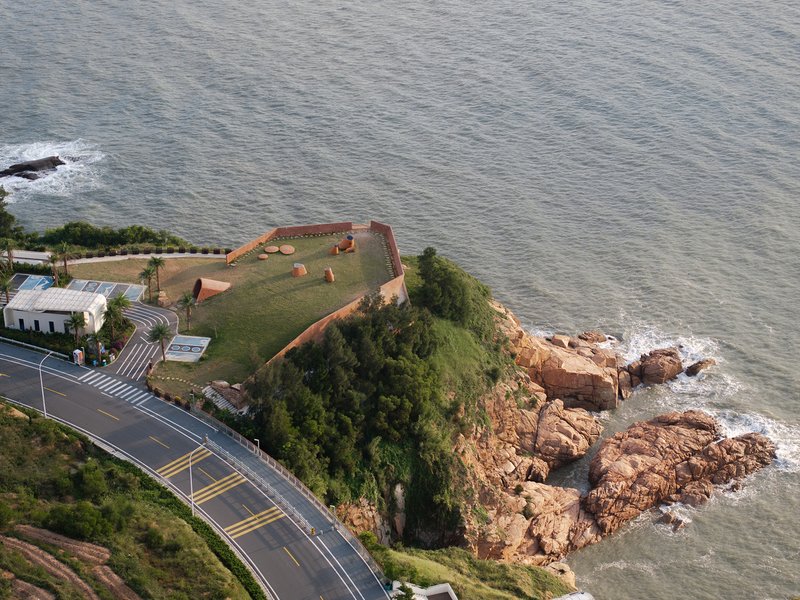
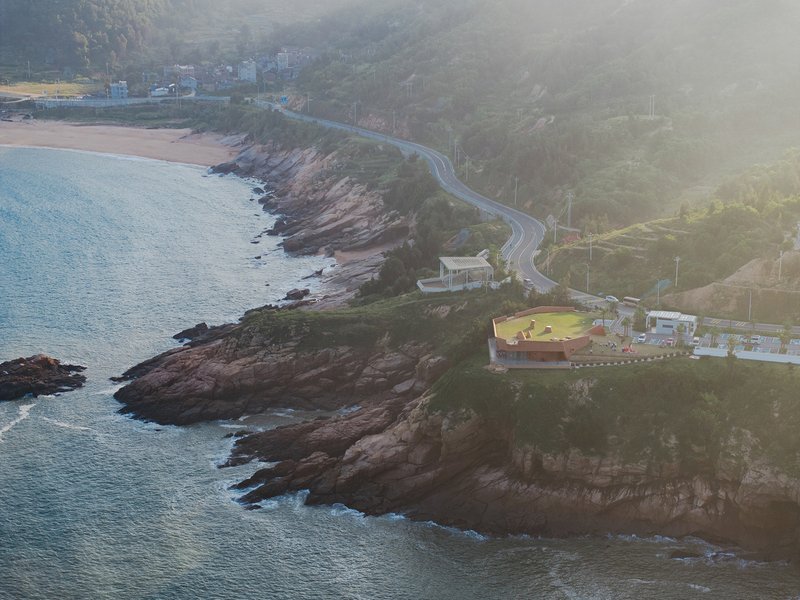
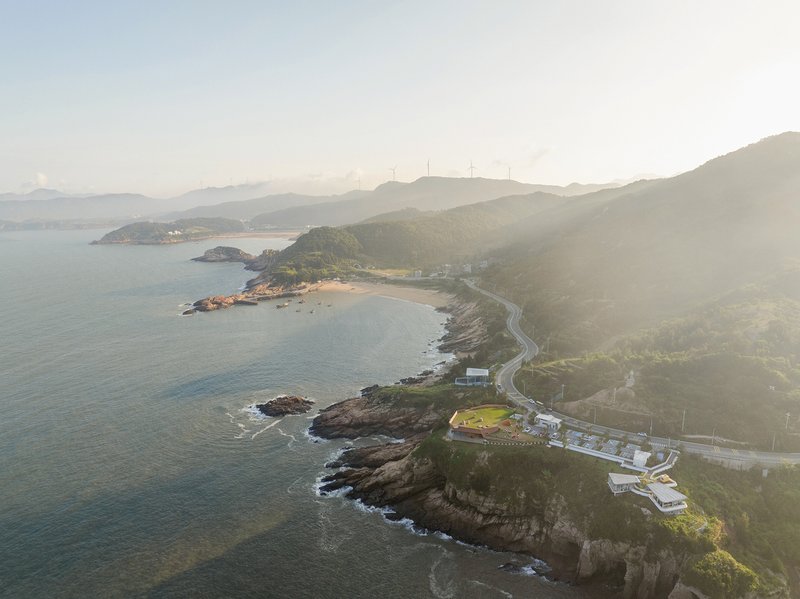
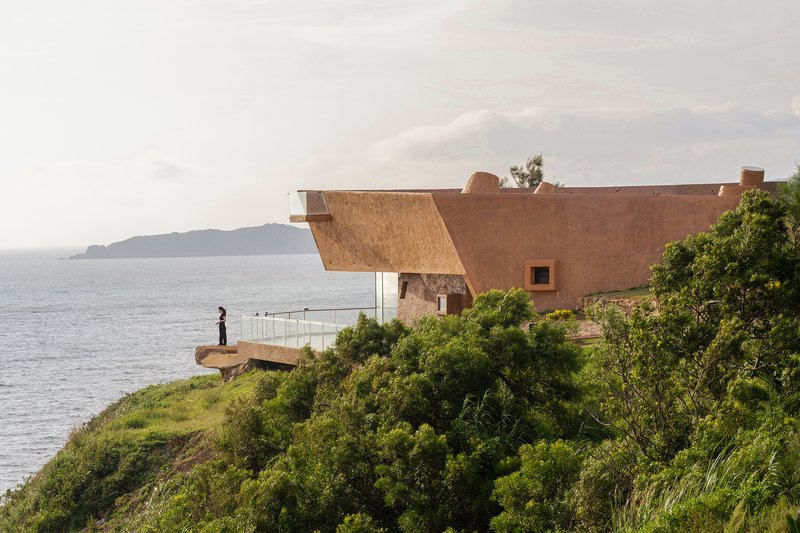
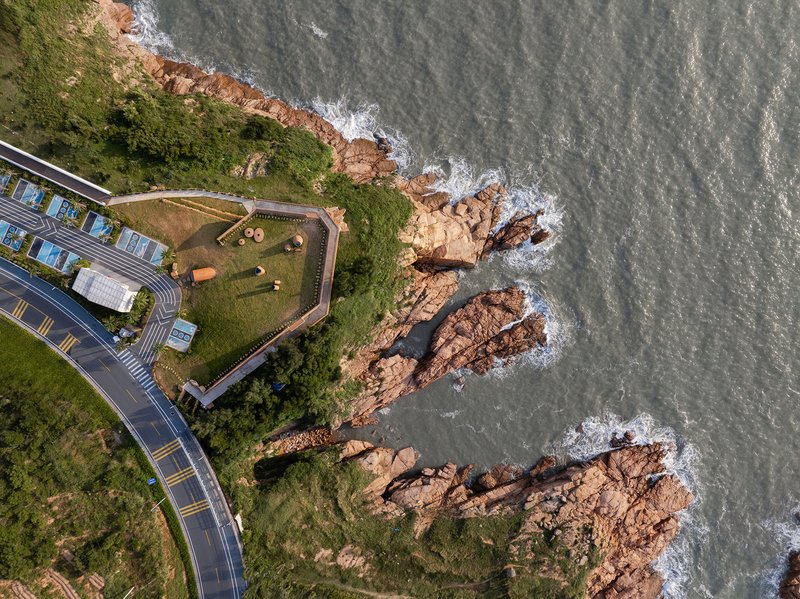
The site's power is immediately legible from the air: a narrow promontory of layered sedimentary rock jutting into the bay, Bijia Mountain Island directly ahead, and a winding coastal road connecting the headland to surrounding hills. The original program here was simply a parking lot and a viewing platform. 3andwich Design kept both functions but layered a building beneath them, using the slope of the terrain to bury the structure with the roof high on the east side, facing the water, and low on the west, merging with the parking lot road. The building's footprint, covered in soil and vegetation, achieves what the studio calls "zero lands used," a pointed claim that the architecture occupies no new ground.
From the drone perspectives, the integration is striking. Mist rolls over the headland and the building is nearly invisible, its green roof continuous with the surrounding hillside vegetation. Only the glass east facade, cantilevered slightly over the slope, announces that something is happening below grade.
The Roof as Public Ground
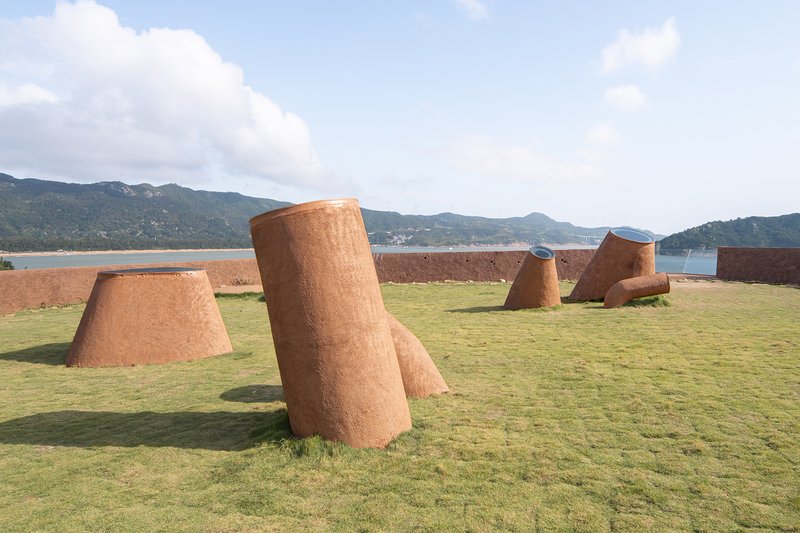
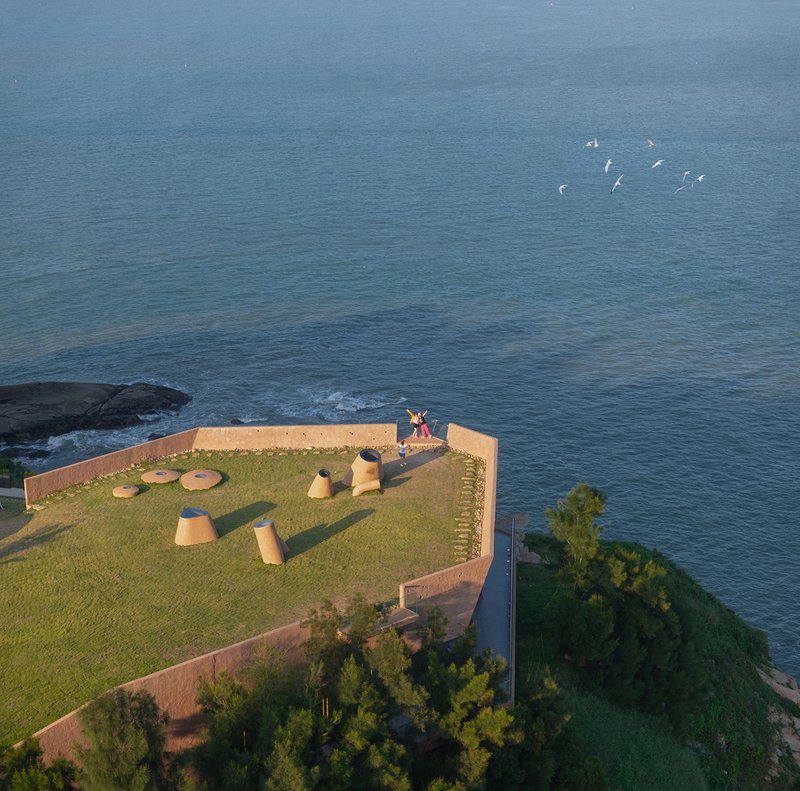
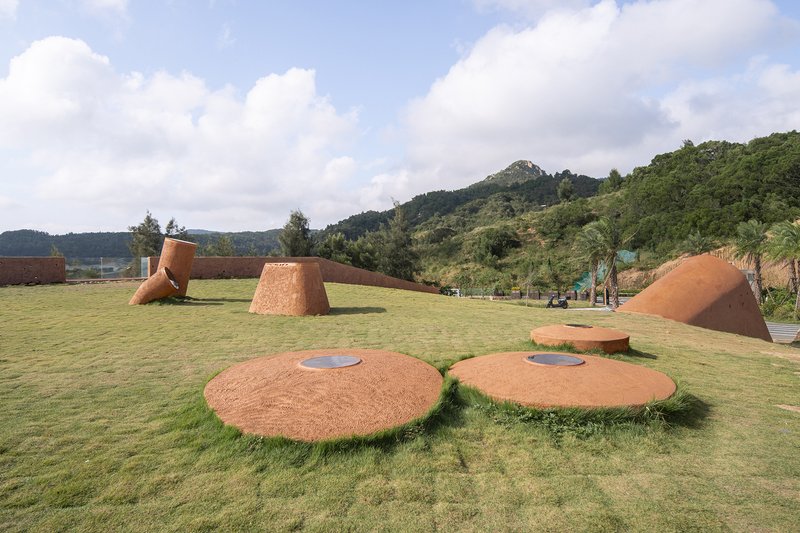
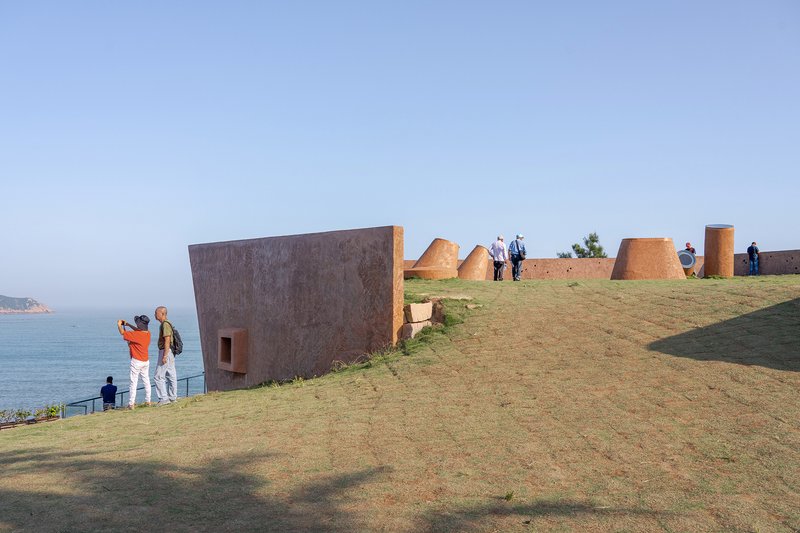
The vegetated roof is arguably the building's most public face. Cylindrical and conical skylights in brown pigmented concrete tilt out of the lawn at various angles, their forms inspired by anemones and barnacles. These are not decorative; they are the building's primary strategy for daylighting and ventilation, connecting the underground spaces to the sky through circular, triangular, and tubular openings. An outer ring boardwalk with leisure seating wraps the platform and connects to surrounding roads and parking, making the roof an extension of the coastal path network rather than a private amenity.
At the northeast and southeast corners, small cantilevered platforms with glass railings push out beyond the concrete retaining wall, offering vertiginous views down to the reef-lined shore. The effect is somewhere between a geological observatory and a sculpture park. Visitors sit among the skylights, unaware that warm light is filtering through the same openings into a gallery below their feet.
Entering the Cave
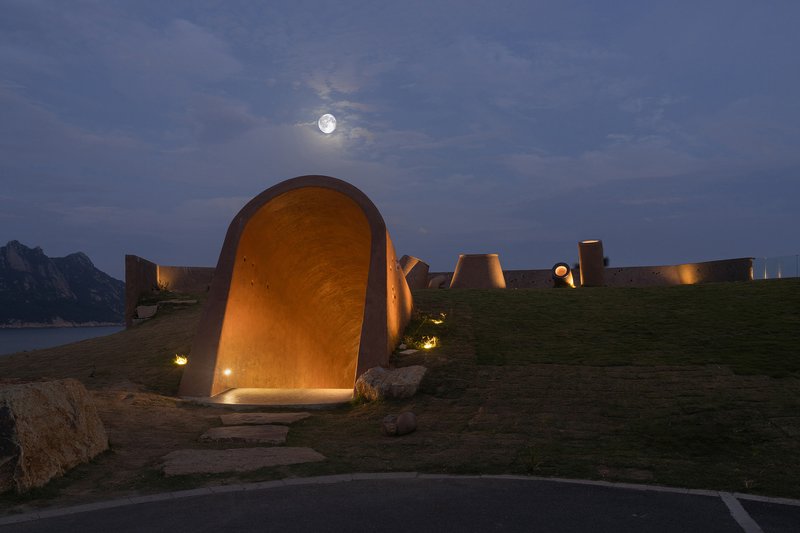
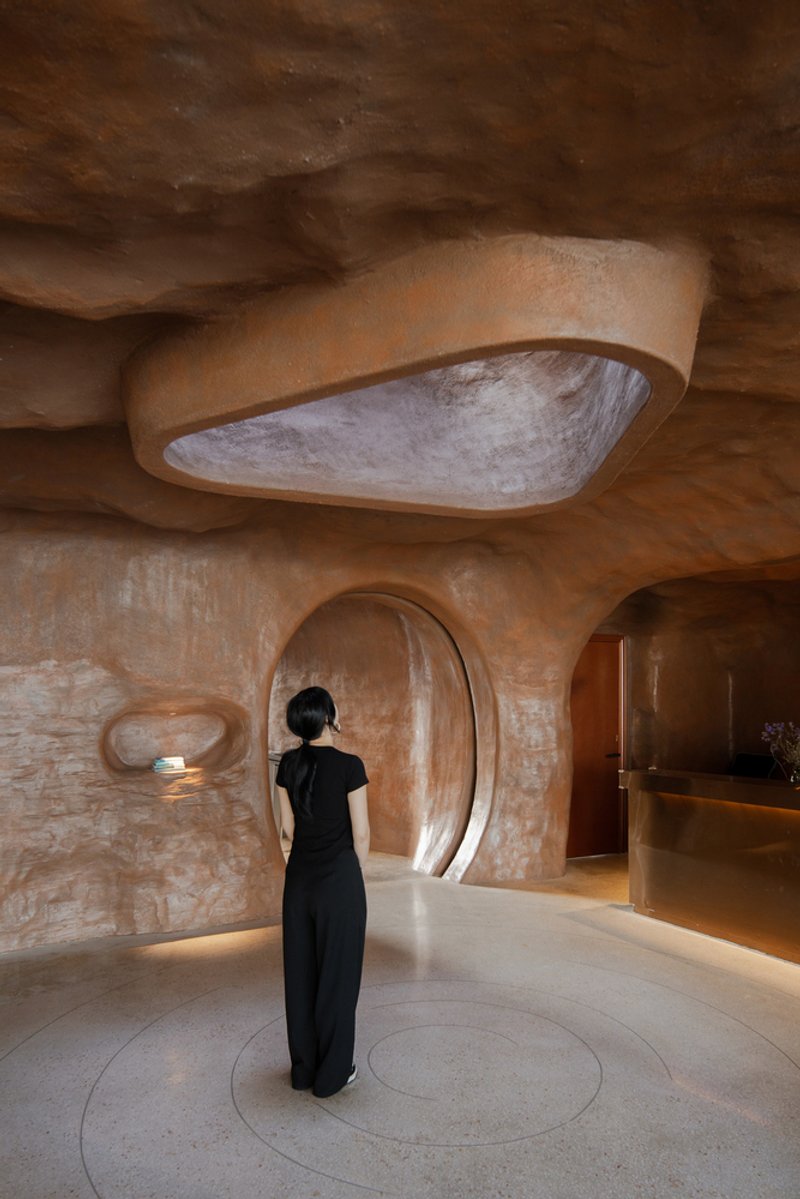
The main entrance sits on the roof's west side: a semi-circular vault that extends from the underground volume like the mouth of a sea cave. A descending staircase draws visitors down through an arched concrete portal into a lobby where the walls are pale, textured, and perforated with circular openings. The spatial sequence deliberately mimics the experience of entering a natural grotto, compressing and releasing the visitor's field of view before opening to the main hall and its panoramic glass wall.
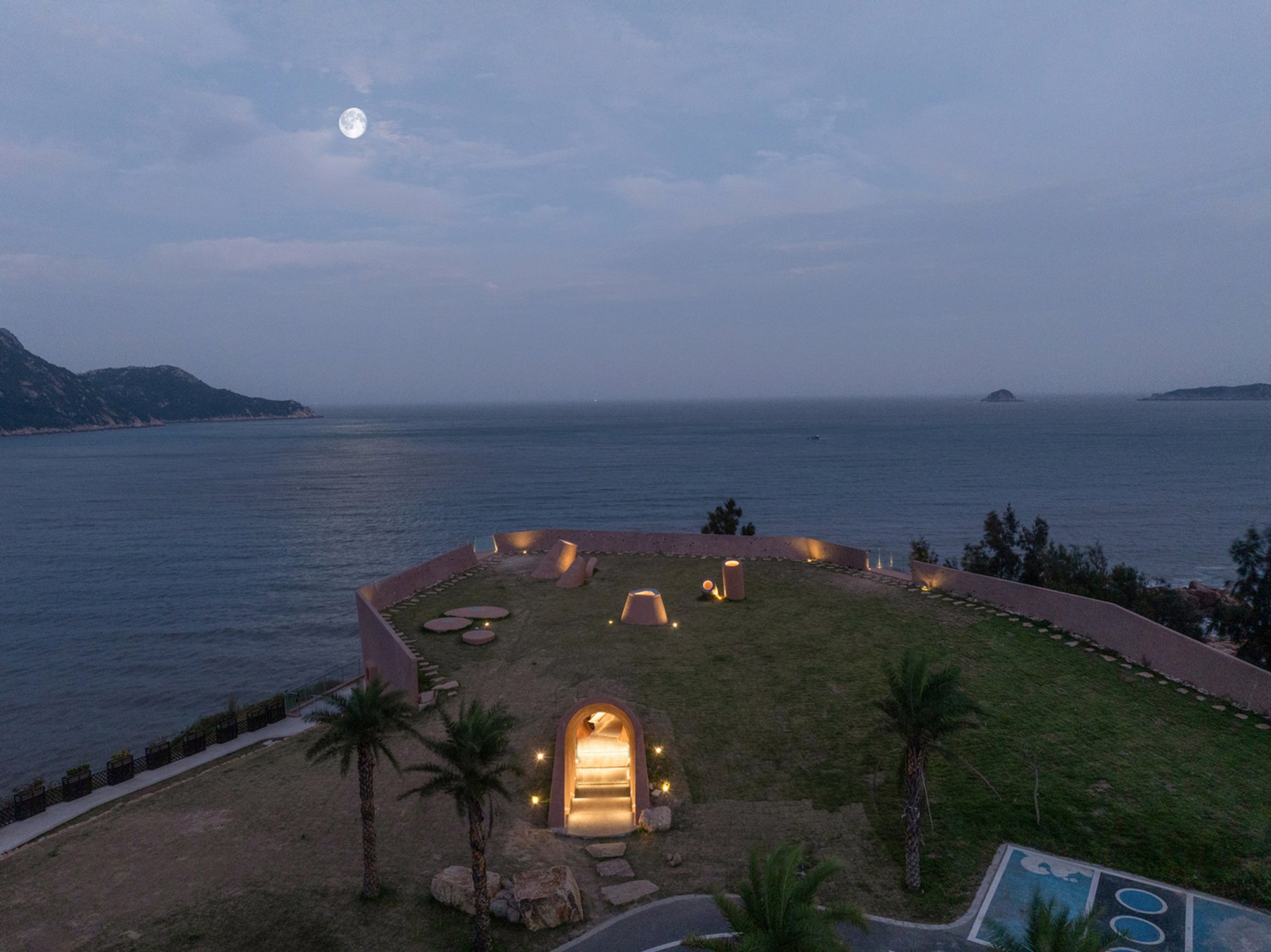
The entrance architecture does serious atmospheric work. At night, the vault glows from within, a warm halo against the darkening hillside. By day, it reads as a geological anomaly, a smooth concrete form emerging from the grass like an exposed rock formation. The ambiguity is intentional. The studio's three guiding principles for the project, precipitousness, concealment, and integration, are all legible in this single threshold moment.
Sculpted Concrete Interiors
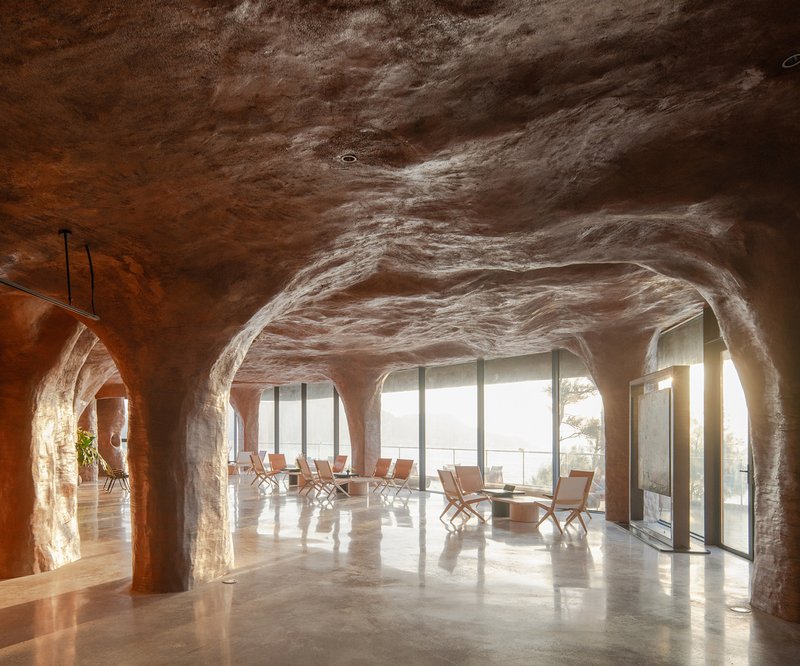
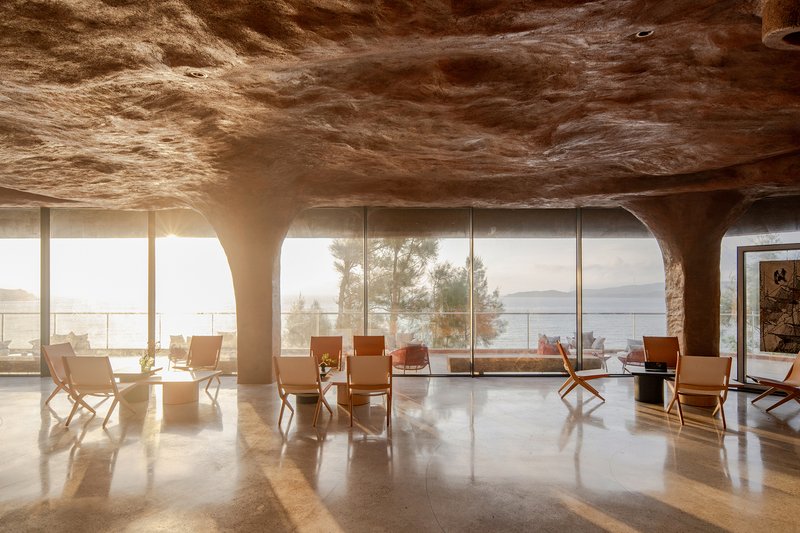
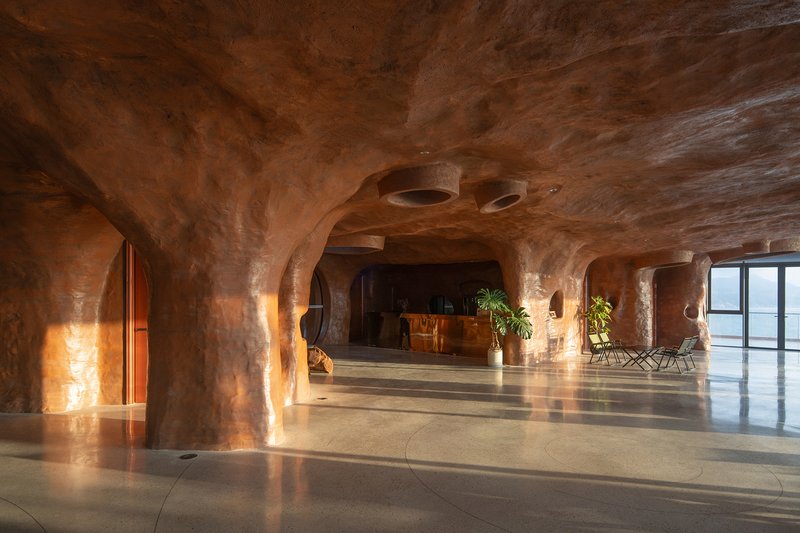
Inside, the building is organized into three zones: a lobby, a main space containing a salon and gallery, and a logistics area with storage, administration, and facilities. The main space faces east through floor-to-ceiling glass, framing the sea and Bijia Mountain Island. Columns rise from the polished concrete floor and transition into the roof through free curved surfaces, eliminating any hard joint between vertical and horizontal structure. The ceiling undulates overhead in vaults and bulges, with oval skylights punching through to admit shafts of natural light.
The construction technique here is the project's most distinctive contribution. Rather than casting the interior in conventional formwork, the team used metal mesh armatures shaped by hand, then applied plastic concrete over them, sculpting and roughening the surface to produce a texture that reads like weathered stone. The result is genuinely cave-like without being literal: arched openings frame views between rooms, irregular wall undulations create niches for books and recessed lighting, and the warm terracotta hue of the pigmented concrete shifts under different lighting conditions. Ambient light comes from buried lamps in the floor and walls; functional light sits on tables. Architectural lighting is deliberately restrained, both for atmosphere and to avoid disturbing nocturnal wildlife on the headland.
Glass, Light, and the Sea
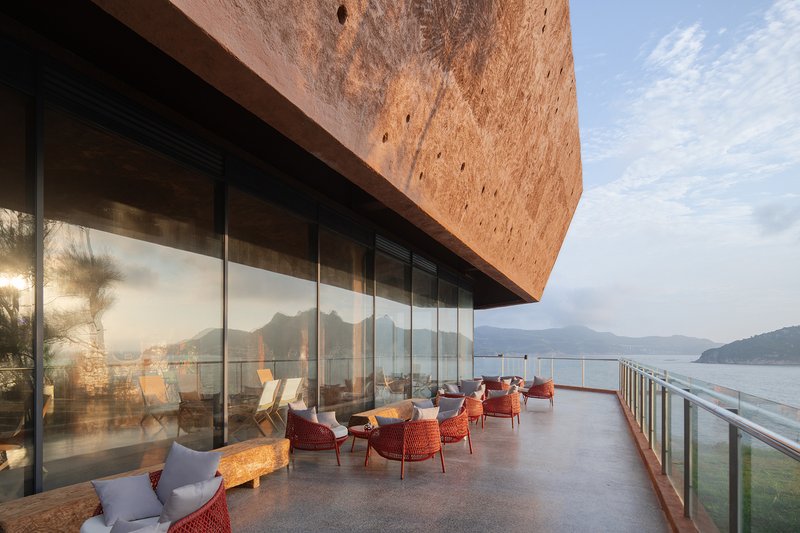
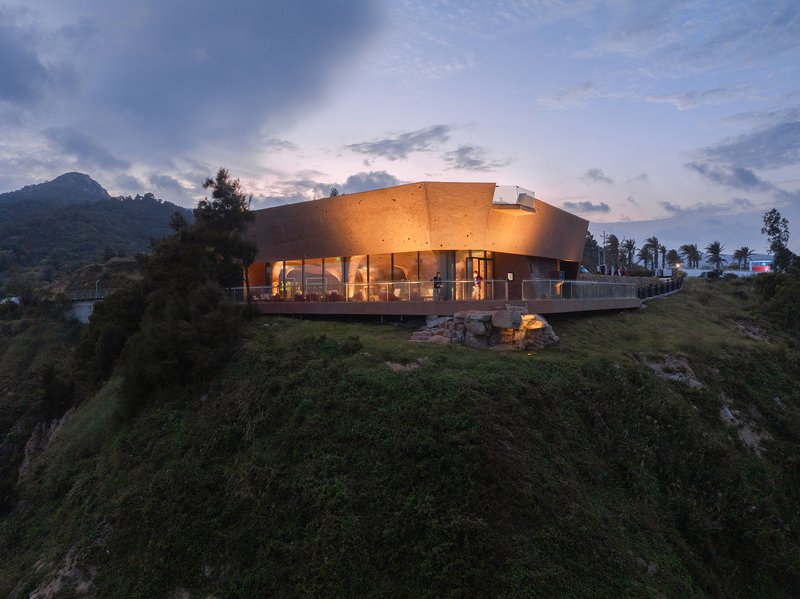
The east facade is the building's one extroverted gesture. A full-height glass wall wraps beneath the cantilevered concrete volume, opening the salon and gallery spaces to the water. A sheltered terrace with seating sits under the overhang, protected from rain and direct sun while maintaining an unobstructed view of the bay. At dusk, the glazed facade glows against the hillside, revealing the sculpted interior to anyone approaching by sea or from the coastal road below.
The contrast between the opaque, earth-covered mass and this single transparent plane gives the building a legible diagram: rock on five sides, glass on the sixth. It is a straightforward move, but it works because the glass wall does not merely frame a view. It collapses the distance between the underground interior and the horizon, making the cave space feel simultaneously enclosed and boundless.
Dusk and Darkness
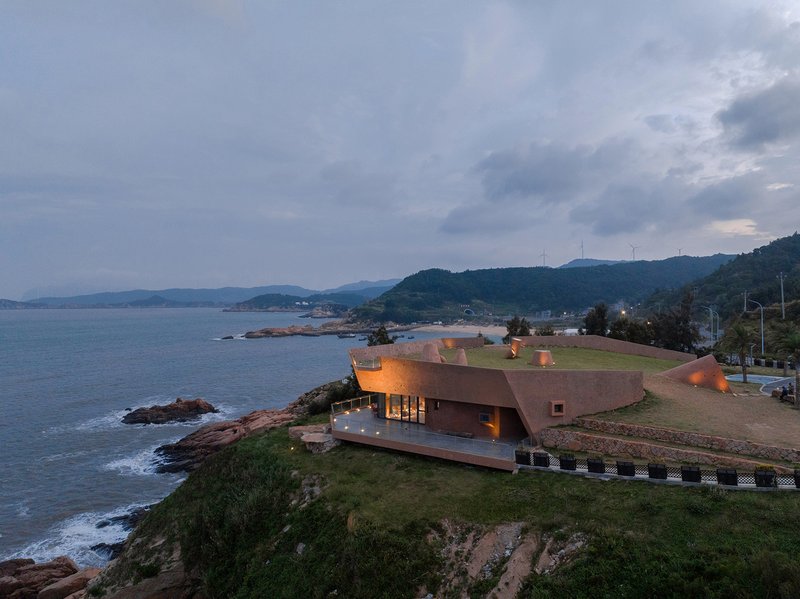
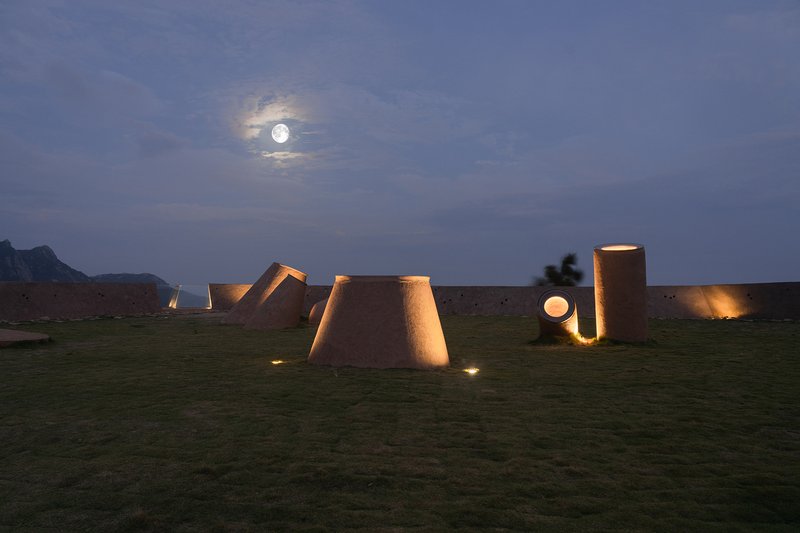
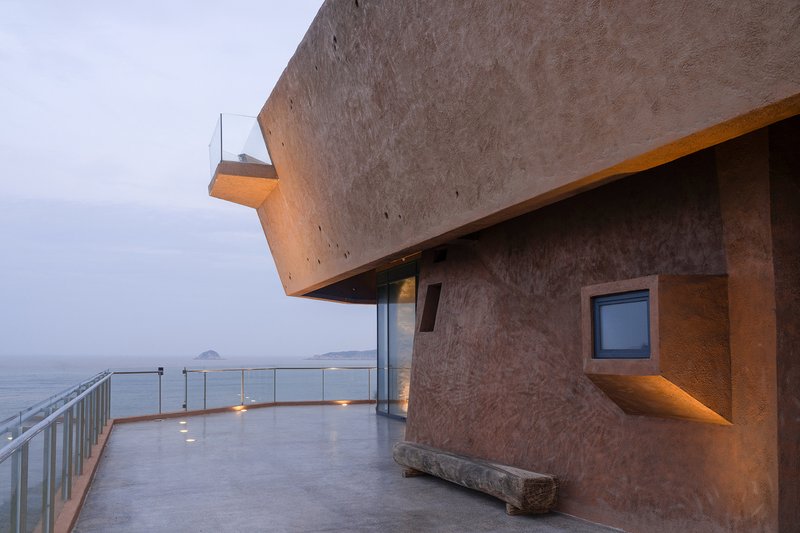
The building transforms after sunset. The skylights on the roof become glowing beacons, their conical forms uplift against the night sky. From the air, the illuminated vaulted openings read as a constellation scattered across the dark headland. The decision to keep exterior lighting minimal is both ecological and aesthetic: it protects the nocturnal environment while ensuring that the building's nighttime identity comes from within, light escaping through the same openings that admit daylight.
A carved concrete bench on the terrace faces the ocean under a single recessed window, a quiet detail that sums up the project's ethos. The architecture provides a seat and a frame; the landscape provides everything else.
Passive Performance Underground
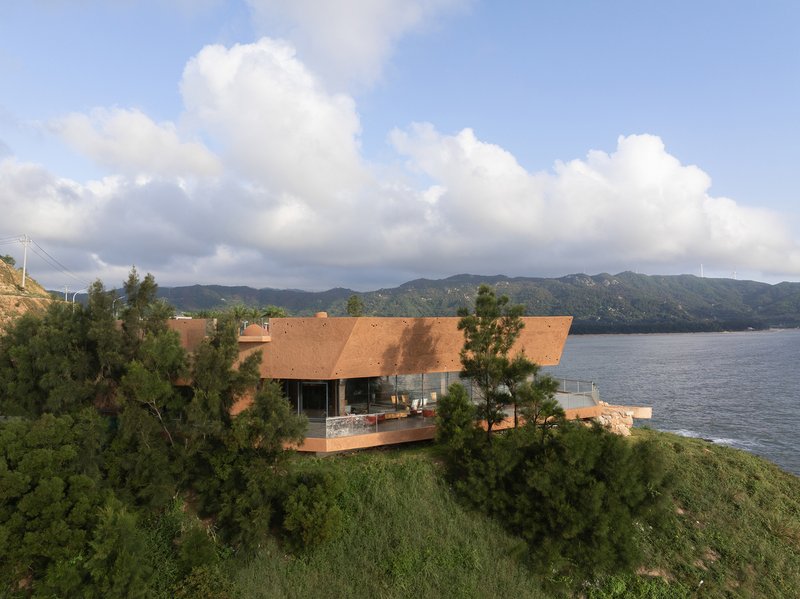
The underground strategy is not just formal; it is the building's primary climate move. With most of its mass buried, the structure benefits from the thermal stability of the surrounding earth, significantly reducing cooling loads during Fujian's humid summers. The light tubes distributed across lobby, main space, and logistics areas provide both natural illumination and stack-effect ventilation, reducing dependence on mechanical systems. Intelligent control systems supplement these passive strategies, but the fundamental energy equation is set by the section: a building that stays cool because it is, quite literally, inside a hill.
The soil covering also minimizes the building's visual and ecological footprint. Newly planted vegetation on the roof integrates with the existing hillside flora, and the boardwalk connections mean the building generates public landscape rather than consuming it. For a project positioned within a "Zero Carbon Island" initiative, these are not optional extras. They are the core proposition.
Plans and Drawings
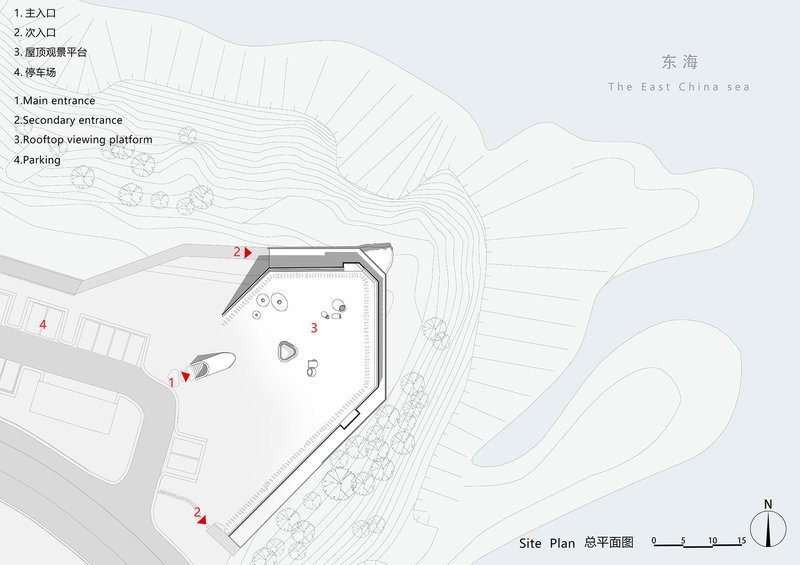
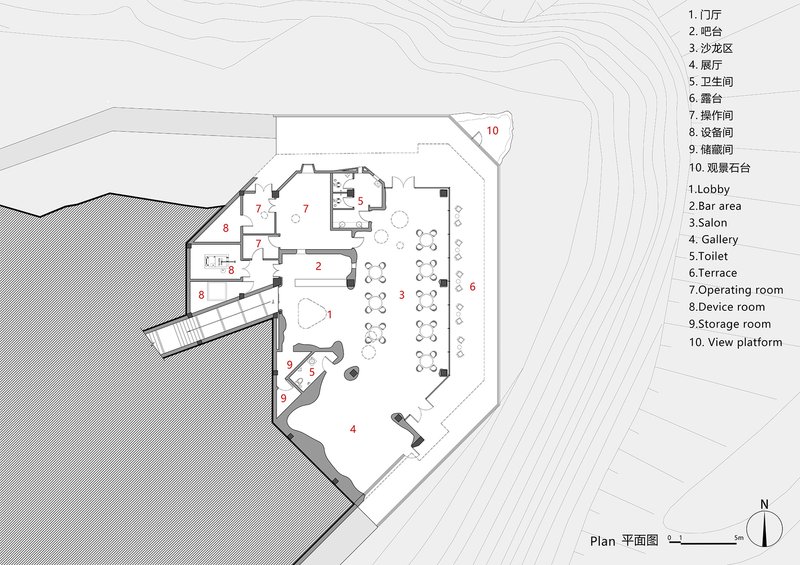
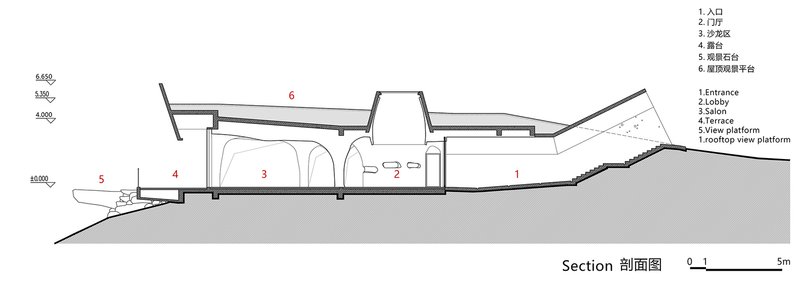
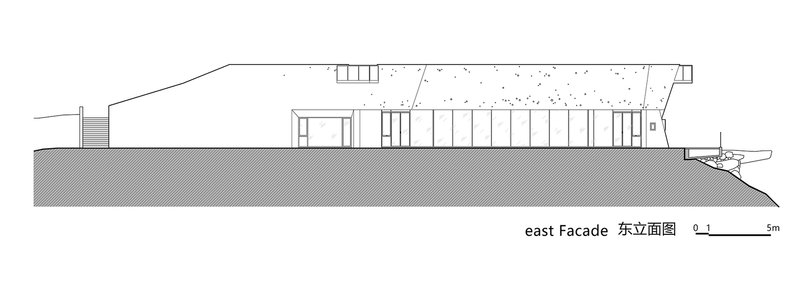
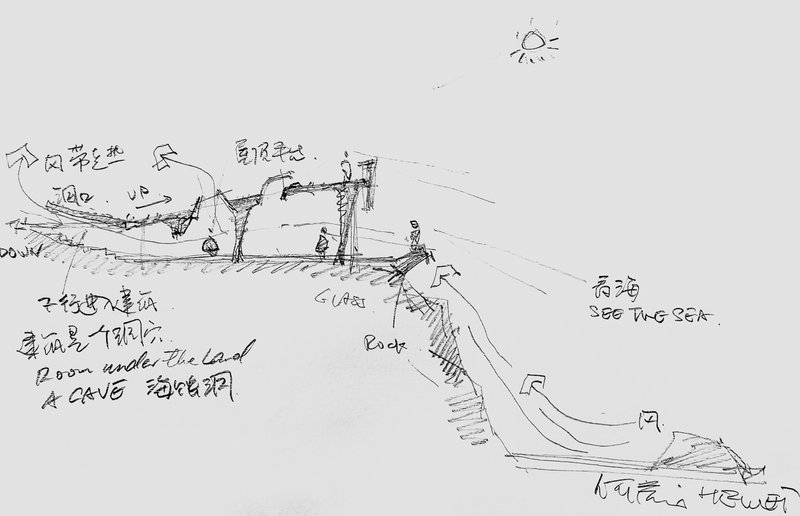
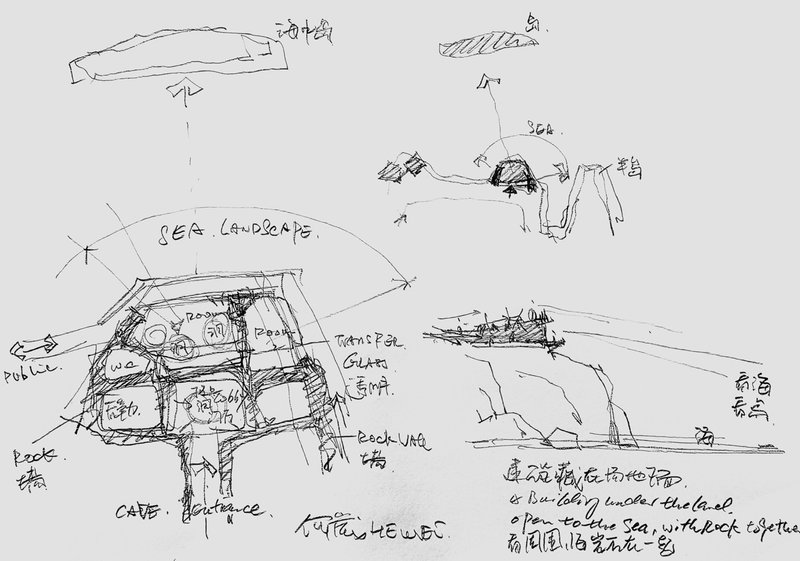
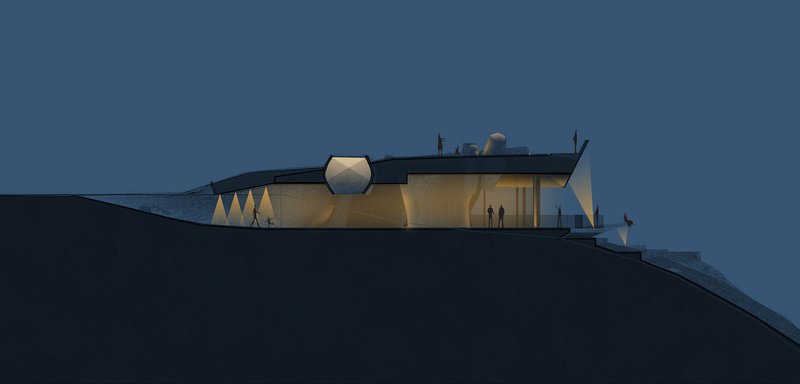
The site plan reveals how the building wraps around the contours of the headland, its irregular perimeter following the topography rather than imposing a grid. The floor plan shows the lobby at the western entrance transitioning to the gallery and salon spaces on the east, with logistics tucked to one side. In section, the relationship between the sloping terrain, the buried volume, and the raised viewing platform becomes clear: the roof rises toward the sea, lifting just enough to accommodate the glass facade while keeping the western entry at grade with the parking lot. The conceptual sketches are worth studying for their directness. He Wei's drawings depict the building as a void carved from a hillside, with figures descending into the earth and emerging at the ocean. The idea preceded the technology.
Why This Project Matters
Underground architecture has a long history of being either utilitarian or utopian, bunkers or fantasies. The Blue Insight Cave Space occupies a rarer position: it is underground architecture as public infrastructure, a cultural venue that generates landscape rather than consuming it. The sculpture-based construction technique, hand-shaped concrete over metal mesh, is labor-intensive but produces spatial qualities that no digital fabrication process currently matches. It is a reminder that craft-driven methods can serve ecological goals, not just aesthetic ones.
More broadly, the project demonstrates that sustainable design does not require visual austerity. The interiors are atmospheric, the rooftop is inviting, and the glass facade is dramatic precisely because the building's energy strategy is baked into its section and siting rather than bolted on as a system. For a small city in Fujian seeking to build cultural identity around ecological ambition, this is exactly the kind of architecture that earns the attention: specific to its site, rigorous in its logic, and generous in its public offering.
Blue Insight Cave Space by 3andwich Design / He Wei Studio. Xiapu, Ningde City, Fujian Province, China. 460 m². Completed 2024. Photography by DONG Image.
About the Studio
Share Your Own Work on uni.xyz
If projects like this are the kind of work you want to make, uni.xyz is a place to publish your own, find collaborators, and enter design competitions.


Popular Articles
Popular articles from the community

Inside a Timeless Mumbai Residence by Aether Studio
Aether Studio's 2,250 sq ft apartment in Malad, Mumbai uses marble, brass, boucle, and disciplined restraint to build a quiet retreat from the city.

The Flow: Coffee Shop Interior Design Where Time, People, and Process Intertwine
The Flow reimagines Viennese coffee culture through arched forms, warm interiors, music, reading, work, and social gathering.
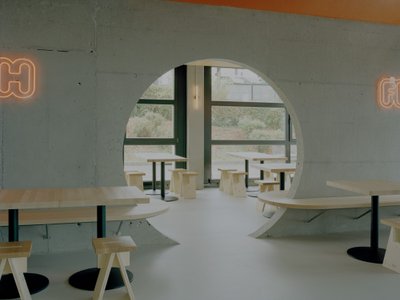
Noue Studio Organizes a Swiss Restaurant Around a Single Concrete Wall
In Granges-Paccot, Switzerland, a 216-square-meter renovation turns raw materials and a central spine into a legible dining experience.
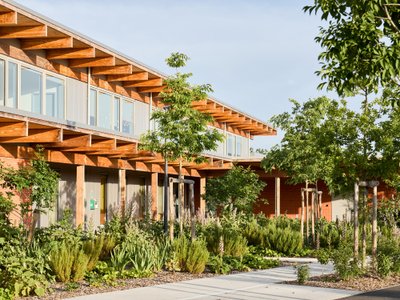
GGR Architectes Anchors a New Neighborhood in Frouzins with a Brick and Timber School Complex
A cruciform plan of terracotta brick and exposed wood frames four courtyards for 140 students outside Toulouse, France.

Similar Reads
You might also enjoy these articles

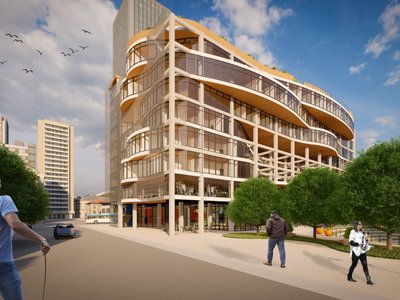
Olio Towers: A Mid-Rise for Performers That Fuses Housing, Rehearsal, and Stage
Located blocks from Houston's Theater District, this modular tower stacks living units around a central performance atrium.
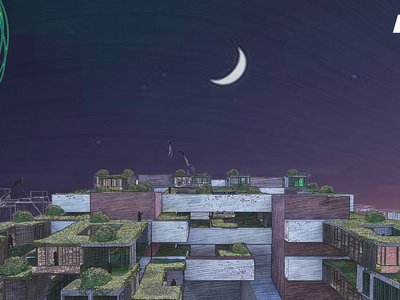
Oasis: Modular Green Housing Carved into Dhaka's Urban Fabric
A shortlisted Plugin Housing entry reclaims unauthorized settlements in Dhaka with stepped concrete volumes, green roofs, and ventilation-driven design.

Black Hole: A Floating Megastructure for the Post-Physical Era
Emiliano Mazzarotto envisions a spherical, self-scaling arena where e-sports, digital hotels, and holographic stadiums replace traditional public space.
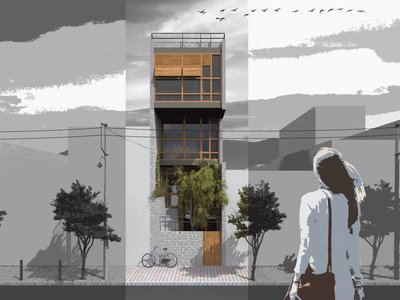
Compact & Sustainable Living in Piraeus: A Four-Level Family Home Built Around Light and Air
A narrow townhouse in one of Greece's densest port cities uses a central atrium and passive strategies to house three generations under one roof.


Explore Architecture Competitions
Discover active competitions in this discipline




The International Standard for Design Portfolios


The Global Benchmark for Architecture Dissertation Awards


The Global Benchmark for Graduation Excellence


Challenge to reimagine the Iron Throne
Comments (0)
Please login or sign up to add comments
No comments yet. Be the first to comment!