
Einspanner: Café Architecture Reimagining Vienna’s Coffee House Culture
Einspanner reimagines Vienna’s coffee house tradition through café architecture shaped for culture, community, reading, and urban exchanges.

Project Name: Einspanner
Designers: Seyma Cengiz, Kivanc Cagdas Cengiz
Recognition: Honorable Mention entry of Brewed 2020
Vienna’s coffee houses have never been just places to drink coffee. Since the 1700s, they have operated as public rooms for conversation, reading, debate, writing, chess, music, and social exchange. They became cultural interiors where intellectual life could unfold slowly, where people could sit for long hours, read newspapers, meet strangers, and build a sense of urban belonging.
Einspanner, a café architecture proposal by Seyma Cengiz and Kivanc Cagdas Cengiz, revisits this rich history through a contemporary architectural lens. Recognized as an Honorable Mention entry of Brewed 2020, the project aims to preserve the social character of the Viennese coffee house while adapting it to the needs of modern urban life.
Rather than treating the café as a purely commercial destination, Einspanner understands it as a civic interior. It becomes a link between people, place, and coffee. Through its triangular form, flexible program, layered public and private spaces, and carefully selected material palette, the project explores how café architecture can support cultural continuity, social resilience, and everyday urban rituals.
Café Architecture as a Public Living Room
The central idea of Einspanner is rooted in the role of the coffee house as a public forum. In the past, Viennese coffee houses supported a broad range of activities. People gathered to read the news, discuss politics, play chess, write, observe city life, and participate in cultural conversations. These spaces were democratic in spirit because they allowed people from different social backgrounds to occupy the same room for extended periods of time.
Einspanner translates this heritage into a modern café architecture proposal that blends open social spaces with more enclosed zones for reading, working, and reflection. The design does not force a single mode of use. Instead, it provides a spectrum of spatial experiences, from active outdoor seating and public platforms to quieter interior lounges and upper floor work areas.
This layered approach gives the project its social depth. The café becomes more than a hospitality space. It becomes an urban connector, a shared room for residents, visitors, artists, commuters, and readers.
Site Context: Connecting Arsenalstrasse, Belvedere 21, and Schweizer Garten
The project is located near Arsenalstrasse Street, close to the Central Train Station of Vienna, Belvedere 21 Museum, and Schweizer Garten. This context gives Einspanner an important urban role. It sits between transport, culture, residential development, and landscape.
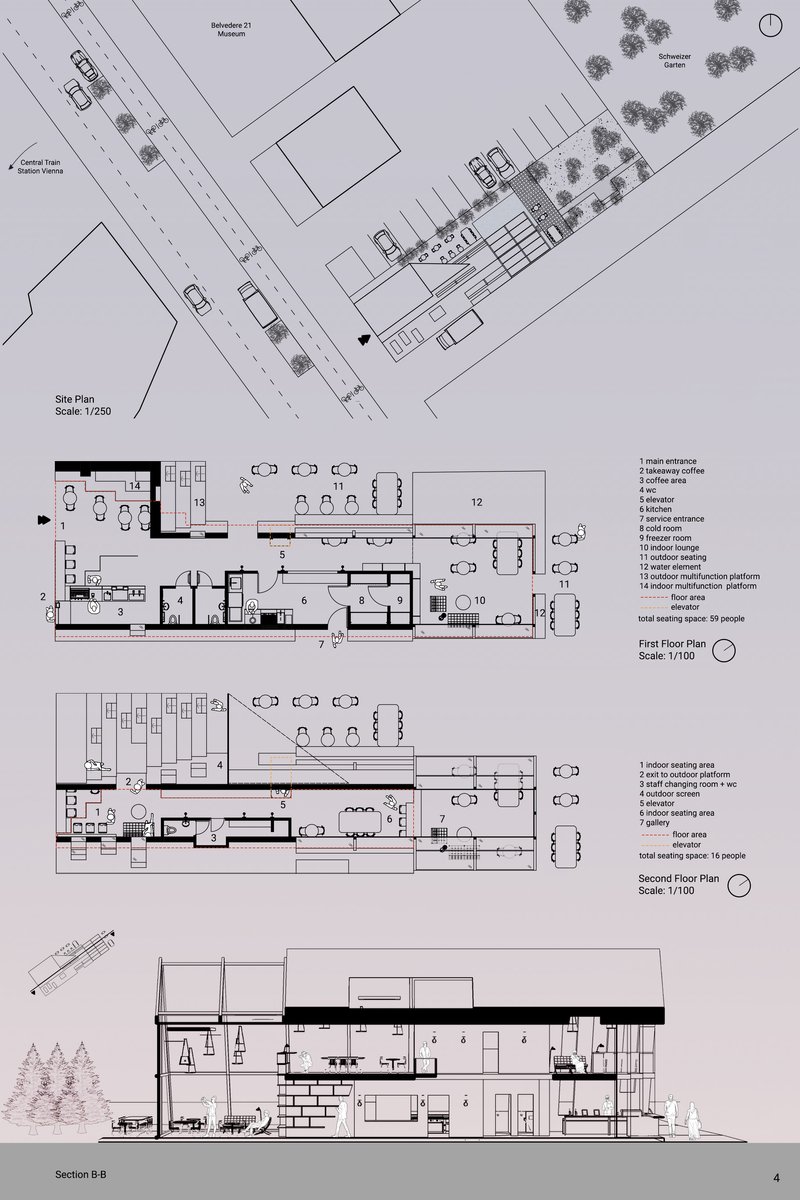
The main entrance is positioned to open the café toward the street and draw pedestrian flow into the building. Its location near the Central Train Station increases its accessibility for both local residents and temporary visitors. The proximity to Belvedere 21 strengthens its cultural identity, while the connection to Schweizer Garten supports the project’s relationship with greenery, calmness, and outdoor public life.
The design responds to these conditions by creating a café that is both visible and intimate. Toward Arsenalstrasse, the façade is more enclosed and controlled, creating a sense of urban edge. Toward the backyard and garden side, large glazed areas open the interior to greenery, daylight, and shaded outdoor experiences.
Design Vision: Linking People, Place, and Coffee
The vision of Einspanner is to provide a place that inspires and connects people through different day and night functions. It is conceived as a new public living room for Vienna, one that carries forward the spirit of traditional coffee houses while welcoming contemporary patterns of use.
The design objectives are clear:
Connecting people: The café encourages social encounters between residents, tourists, commuters, artists, and readers.
Creating varied space experiences: Open, semi-open, and enclosed areas allow different kinds of interaction, from group gathering to individual concentration.
Integrating tradition and modern values: The project references the ambiance of Viennese coffee houses while using contemporary materials, flexible layouts, and modern spatial programming.
Strengthening the relationship between people, place, and coffee: The triangular concept symbolizes this relationship and gives the building a recognizable architectural identity.
Through these objectives, Einspanner positions café architecture as a social infrastructure. It is not only about service, seating, or branding. It is about designing spaces where cultural memory and contemporary urban life can coexist.
Architectural Form: The Triangle as Symbol and Structure
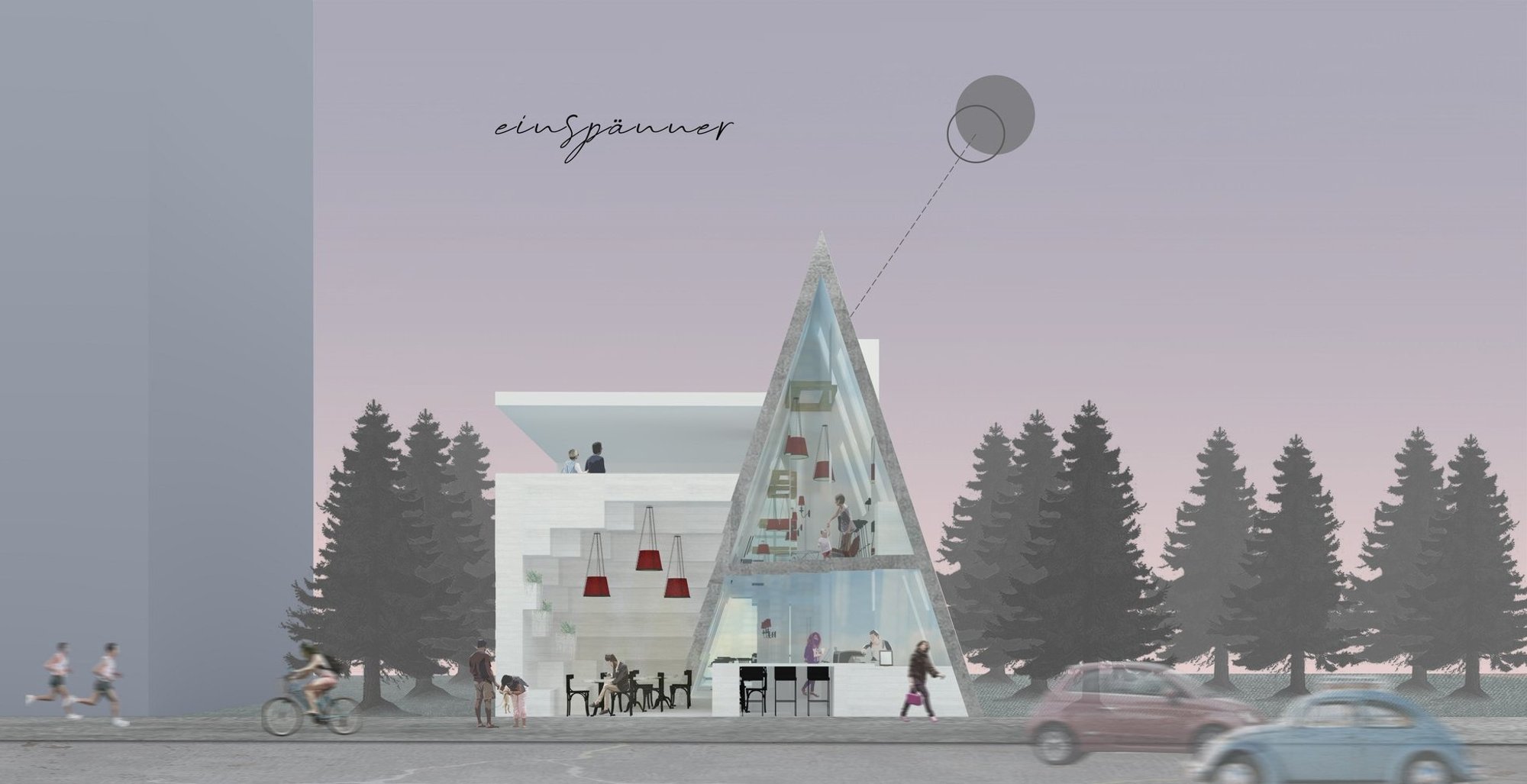
One of the most distinctive elements of Einspanner is its triangular form. The design refers to the Austrian Pine Tree, Pinus nigra, and uses this reference to connect the building with nature and the nearby garden context. The triangular profile also represents the conceptual relationship between people, place, and coffee.
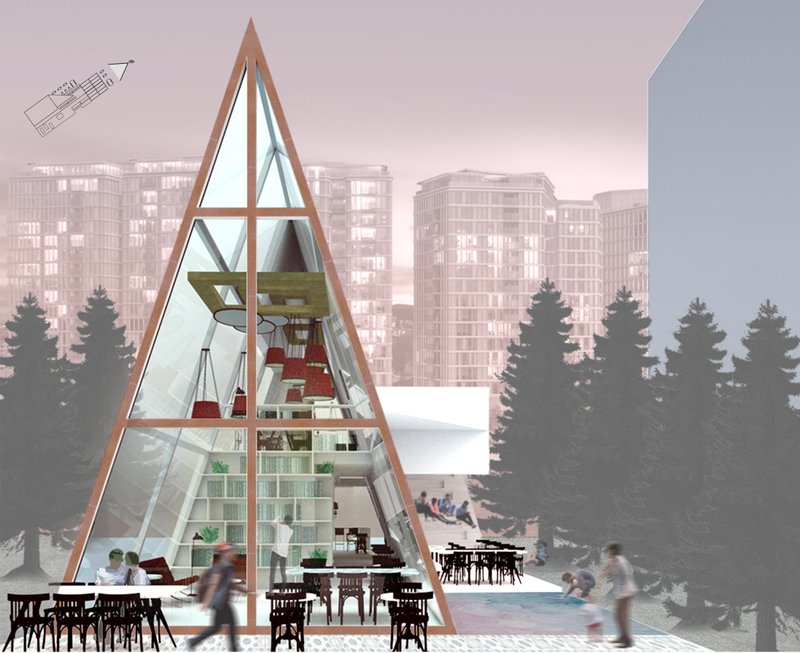
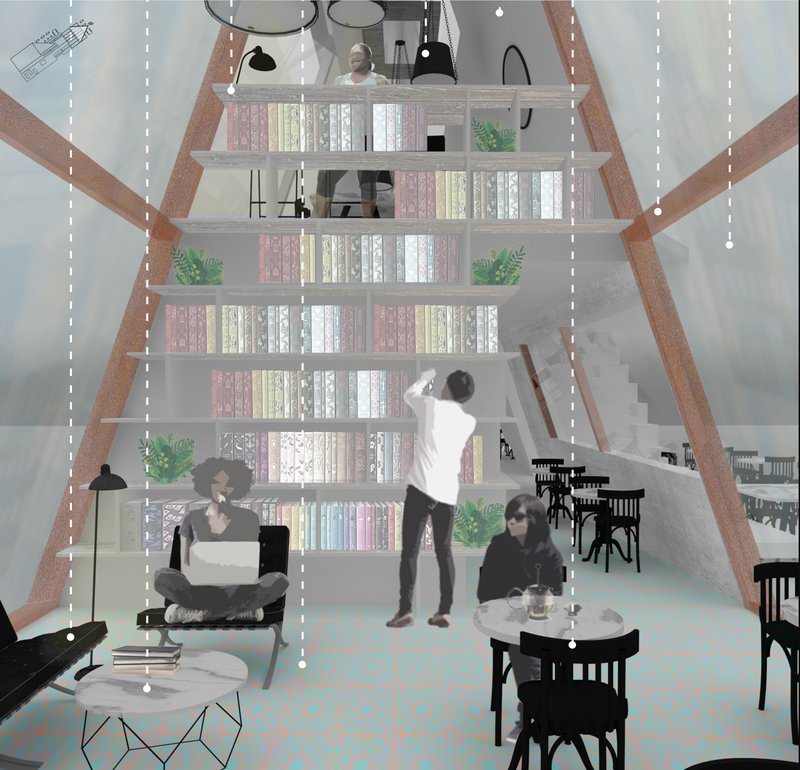
This geometric clarity gives the project a strong urban image. The triangular frame creates an immediate visual identity, making the café recognizable within its surrounding urban fabric. At the same time, the form produces a dramatic interior section, allowing double-height spaces, vertical visual connections, and layered seating experiences.
Inside the triangular volume, the café becomes both intimate and expansive. The structure creates a sense of enclosure while the glazing allows light and transparency. This contrast supports the project’s main idea: a café that mediates between public and private, tradition and modernity, city and garden.
Spatial Organization: Open and Closed Public Spaces
Einspanner is organized around a mixture of open and closed spaces. This is central to the project’s interpretation of café architecture. Traditional coffee houses were not simply open halls. They offered different zones for different forms of occupation, including conversation, observation, reading, and solitary thinking.
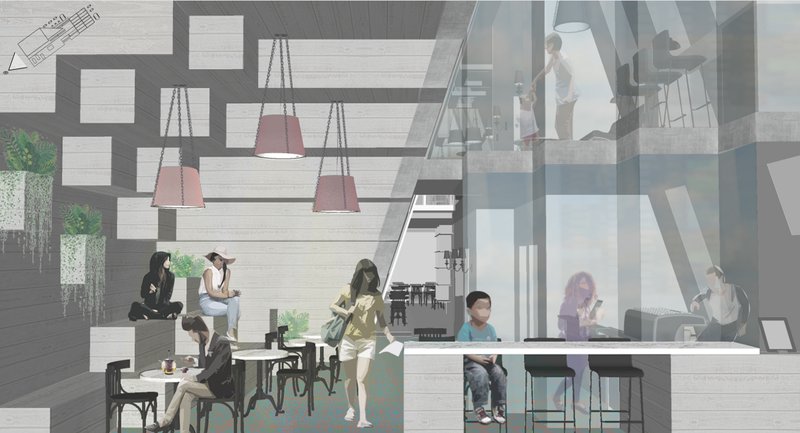
The ground floor supports active public functions. It includes the main entrance, takeaway coffee area, coffee area, service spaces, indoor lounge, outdoor seating, water element, and multifunctional platform. This level is designed for circulation, gathering, and interaction.
The first floor becomes more private and contemplative. It includes indoor seating, staff facilities, gallery space, and access to the outdoor platform. The upper level allows quieter use, supporting reading, working, and small group conversation.
This vertical distribution creates a gradual transition from public activity to private concentration. The café does not separate these modes completely. Instead, it connects them through stairs, visual openings, a bookcase element, and a circulation network that links the interior with the outdoor platform.
The Platform as a Social Stage
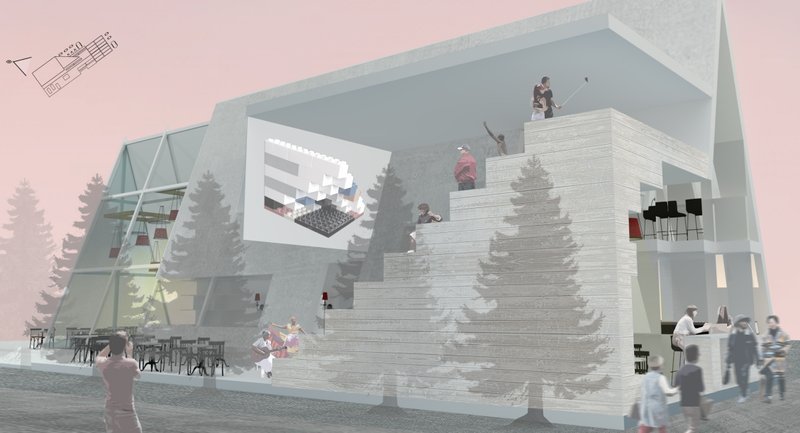
A key programmatic feature of Einspanner is the platform. It acts as a gathering space that can support different functions during the day and night. It can host informal meetings, outdoor seating, local art events, music performances, and cultural activities.
This platform reflects the historic character of coffee houses, where coffee drinking was often accompanied by discussion, entertainment, and intellectual exchange. In Einspanner, the platform becomes a contemporary version of that tradition. It gives the café the ability to extend beyond consumption and become a space of cultural production.
The platform also strengthens local identity. By supporting local artists and performances, the café becomes a bridge between visitors and the surrounding community. It introduces temporary cultural events into everyday urban life and gives residents a reason to return.
Interior Atmosphere: Reading, Working, and Social Interaction
The interior of Einspanner is designed to support multiple forms of occupation. The double-height lounge creates a generous central space, while the large bookcase connects the lower and upper levels. This bookcase is not only functional. It is symbolic. It recalls the intellectual atmosphere of traditional coffee houses, where newspapers, journals, books, and public conversation formed the cultural background of the space.
The café includes spaces for group interaction as well as individual work. Some visitors may come for coffee and conversation, while others may use the space for reading, writing, studying, or quiet observation. This flexibility is important because contemporary café architecture often needs to respond to hybrid lifestyles. Cafés today are social venues, remote workspaces, cultural settings, and informal public interiors.
Einspanner addresses this complexity by avoiding a single fixed identity. It allows people to define their own relationship with the space.
Material Palette: Traditional Ambiance with Contemporary Contrast
The material palette of Einspanner plays a major role in translating the project’s design story. The café uses materials associated with traditional Viennese coffee houses, including marble tabletops, wood chairs, red velvet fabrics, and warm lighting elements. These materials create a sense of familiarity, elegance, and historical continuity.
At the same time, the project introduces contemporary materials such as concrete, rusted metal, black wood, glass, and patterned tile. The tile flooring references modern Viennese architectural history and recalls the influence of Otto Wagner, who combined traditional architectural principles with Art Nouveau sensibilities in projects such as Majolikahaus.
This combination of old and new gives the interior a layered identity. Red velvet, marble, and wood provide warmth and cultural memory. Concrete, metal, glass, and black wood introduce a sharper contemporary character. Together, they support the project’s ambition to merge the traditional and the modern without allowing one to overpower the other.
Façade Strategy: Between Urban Edge and Garden Openness
The façade design responds directly to the site condition. On the Arsenalstrasse side, the façade is more enclosed. This creates a defined urban presence and helps pull pedestrian movement toward the café entrance. The entrance becomes a threshold between the street and the social interior.
As one moves toward the backyard, the building opens through larger glazed surfaces. This allows daylight to enter the space and creates a visual relationship with the green surroundings. The transition from enclosed street edge to open garden-facing façade supports the project’s conceptual balance between city and nature.
The glazing also creates changing light conditions during the day. Shadows, reflections, and transparency become part of the café experience. This makes the architecture responsive to time, weather, and atmosphere.
Indoor and Outdoor Continuity
Einspanner treats indoor and outdoor spaces as connected parts of one spatial system. Outdoor seating near the entrance and platform promotes social interaction and communication. The backyard offers a calmer atmosphere, supported by greenery, water, and a direct connection to Schweizer Garten.
The water element in the backyard introduces a symbolic and sensory layer. It represents purification of the soul and helps create a calm environment. Along with the wood pathway, it forms a gentle transition toward the garden, reinforcing the café’s role as a link between the urban street and the landscape.
The interior continues this strategy. Semi-indoor spaces near the entrance allow people to sit, read newspapers, talk, and observe city life while remaining connected to the street. The upper floor extends this network by linking private reading and working areas to the outdoor platform.
Reinterpreting the 19th-Century Viennese Coffee House
The project’s conceptual strength lies in its interpretation of the 19th-century Viennese coffee house. Historically, these spaces attracted writers, poets, thinkers, and citizens. They were places of leisure, but also places of intellectual production. Figures such as Peter Altenberg and Arthur Schnitzler were closely associated with this culture, while Stefan Zweig famously described the Viennese coffee house as a democratic club where one could sit for hours, write, play cards, receive mail, read newspapers, and consume a small cup of coffee.
Einspanner draws from this cultural memory without copying historic interiors. Instead, it asks how the same values can be translated into contemporary café architecture. The answer lies in flexibility, openness, programmatic diversity, and spatial atmosphere.
The project also responds to the decline and transformation of traditional coffee houses in the 20th century, when Italian-style espresso bars became increasingly popular and many long-established Viennese coffee houses closed. Einspanner does not reject change. It accepts that change is inevitable, but argues that architecture can protect social values by giving them new spatial forms.
A Café for Residents, Tourists, Artists, and Commuters
Because of its location, Einspanner serves multiple groups. Tourists can experience a contemporary interpretation of Viennese coffee culture. Residents can use the café as a daily social and cultural space. Commuters can access takeaway coffee and informal seating. Artists can use the platform for events and performances. Readers and workers can occupy quieter upper spaces.
This multiplicity is one of the project’s strongest features. It avoids designing a café for only one user profile. Instead, it creates a flexible civic interior that can change throughout the day. Morning coffee, afternoon reading, evening performances, outdoor conversations, private work, and casual social encounters can all take place within the same architectural system.
Why Einspanner Matters in Contemporary Café Architecture
Einspanner is valuable because it understands café architecture as more than interior styling or hospitality planning. It treats the café as a social, cultural, and urban typology. The project studies how historical rituals can be transformed into contemporary spatial strategies.
Its importance lies in several architectural moves:
It connects Vienna’s coffee house heritage with present-day urban needs.
It uses form and symbolism to create a strong identity.
It organizes space through a gradient of public, semi-public, and private zones.
It introduces a cultural platform that extends the café’s role beyond consumption.
It uses material contrast to merge tradition and modern values.
It strengthens the relationship between architecture, landscape, and public life.
Through these strategies, Einspanner becomes a thoughtful contribution to café architecture and to the broader question of how hospitality spaces can support community life.
Einspanner by Seyma Cengiz and Kivanc Cagdas Cengiz is a carefully developed café architecture proposal that reimagines the Viennese coffee house for contemporary Vienna. As an Honorable Mention entry of Brewed 2020, the project stands out for its cultural sensitivity, strong triangular form, flexible spatial organization, and atmospheric material palette.
The design protects the spirit of traditional coffee houses while allowing the program to evolve. It creates places for socializing, reading, working, performing, observing, and resting. It connects Arsenalstrasse with Schweizer Garten, the street with the interior, and the city’s historical memory with its changing present.
At its core, Einspanner is not only a café. It is an architectural argument for the continued value of public interiors. It shows how coffee, culture, and conversation can still shape the social life of the city when architecture gives them the right space to unfold.




Popular Articles
Popular articles from the community

The Faith: Modular Architecture for Play, Learning, and Hope in Kutupalong Refugee Camp
A modular playground architecture project in Bangladesh where play, learning, safety, and hope rebuild childhood inside a refugee camp anew.
IKC de Geluksvogel: Sustainable School Architecture Designed for Free Movement and Digital Learning
IKC de Geluksvogel turns sustainable school architecture into a flexible Maastricht campus for digital learning, nature, and free movement.
Kawasaki Olympic Sports Center: Sports Complex Architecture Rooted in Community, Tradition, and Movement
Kawasaki Olympic Sports Center reimagines sports complex architecture as a civic park where tradition, training, and community meet locally.

Eco Chapel: A Green Architecture Pavilion Designed in Symbiosis with the Forest
Eco Chapel uses green architecture to weave prayer, learning and reuse into a forest pavilion shaped by modular hexagonal canopies for life.

Similar Reads
You might also enjoy these articles
Eco Chapel: A Green Architecture Pavilion Designed in Symbiosis with the Forest
Eco Chapel uses green architecture to weave prayer, learning and reuse into a forest pavilion shaped by modular hexagonal canopies for life.
Kaffeebühnen: Coffee Shop Architecture Designed as a Civic Stage Between Vienna’s City and Park
Kaffeebühnen turns coffee shop architecture into a civic stage, linking Vienna’s park edge, urban life, warm timber yards, and coffee craft.
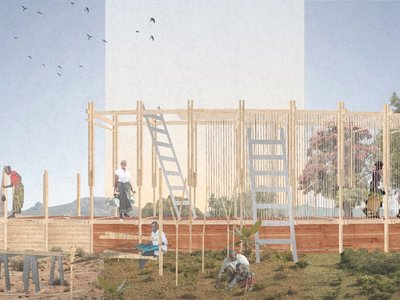
Healing Façade: Sustainable Architecture for Reforestation, Community, and Sacred Ecology in Ethiopia
Healing Façade reimagines sustainable architecture as a living wall that restores soil, catches water and renews Ethiopia's forest churches.


Urban Forest: A Vertical Ecosystem for 5,000 Workers in Singapore's Changi Business Park
Radially stacked pods and layered green decks turn a 7-acre plot into 47 acres of ecological workspace projected for 2040.

Explore Interior Design Competitions
Discover active competitions in this discipline




The Global Benchmark for Architecture Dissertation Awards


Challenge to design luxury tourism on rails

VR headsets Storefront design competition

Designing a staircase for a client
Comments (0)
Please login or sign up to add comments
No comments yet. Be the first to comment!