

El Hogar: Ephemeral Refugee Housing That Expands, Contracts and Dissolves on the Rio Grande
A shortlisted No Man's Land entry treats refugee housing as a process, pairing modular hexagonal units with a civic spine along the Rio Grande.


Most architecture at the border is built on a false assumption: that people will pass through quickly. Facilities sized for short processing stays end up housing families for weeks or months, and the result is overcrowding and infrastructural failure. El Hogar starts from that mismatch. It treats refugee housing as a process rather than an object, a system meant to appear, transform and dissolve as the pressures on it change.
Designed by Peaches Shipley and shortlisted in the No Man’s Land competition, the project sits along the Rio Grande on the United States–Mexico border, a site defined by environmental sensitivity and geopolitical tension. Shipley is clear about what architecture cannot do: it cannot write immigration policy. It can, however, shape humane and flexible environments that respond to real conditions. The proposal pairs a linear infrastructural spine across the site with modular living units, and it aims to change the sequence of immigration itself, linking refugees to surrounding communities instead of isolating them in detention-like spaces.
A Processing Space That Refuses to Feel Like Detention
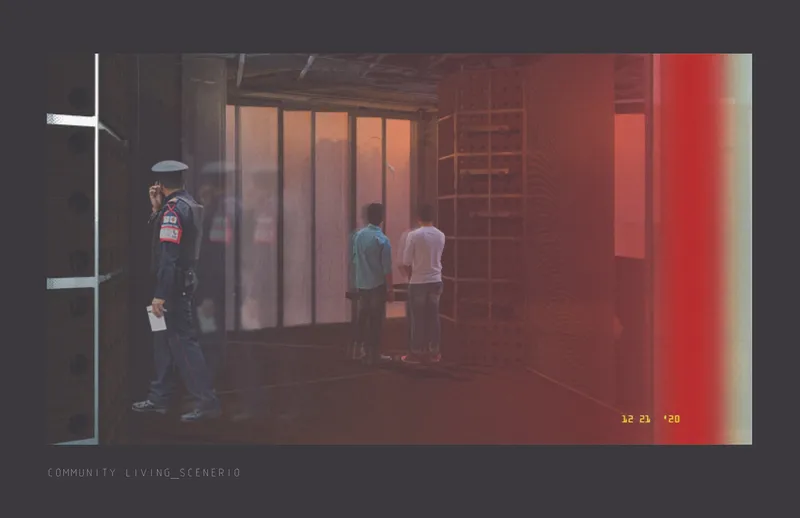
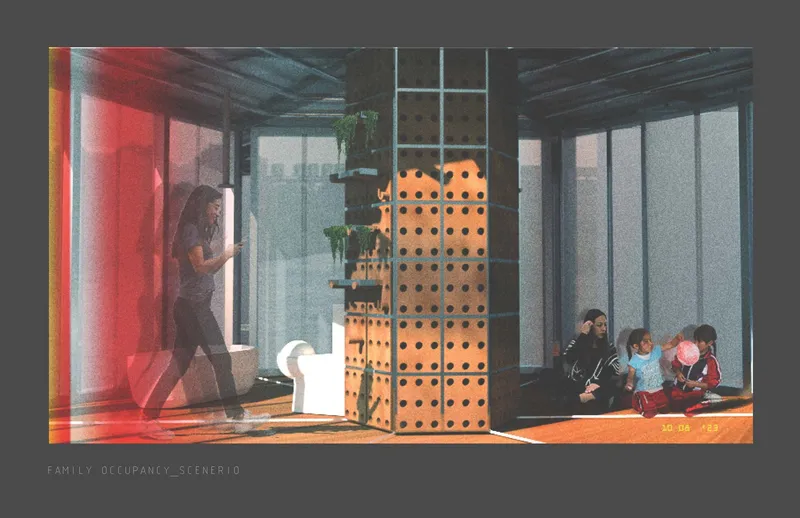
The first renders take on the most sensitive moment in the sequence. A uniformed officer walks past two men standing at a glazed wall, and the red dusk light makes the scene feel more like a waiting room than a holding cell. The perforated column carries much of the atmosphere. In the second view it turns orange and holds hanging planters, while children sit on the floor near the glass and a woman walks by. The officer is still there, so the institutional presence is not hidden, but it shares the room with ordinary domestic life.
This is where the project's argument becomes spatial. Shipley's analysis of the immigration timeline shows stays ranging from a few days to several months, stretched by delays in interviews, documentation and enforcement. A room built for that uncertainty has to support waiting as a form of living, and these interiors read as places where a child could spend an afternoon, not only places to be counted.
From Transit Hall to Hammock and Bathtub
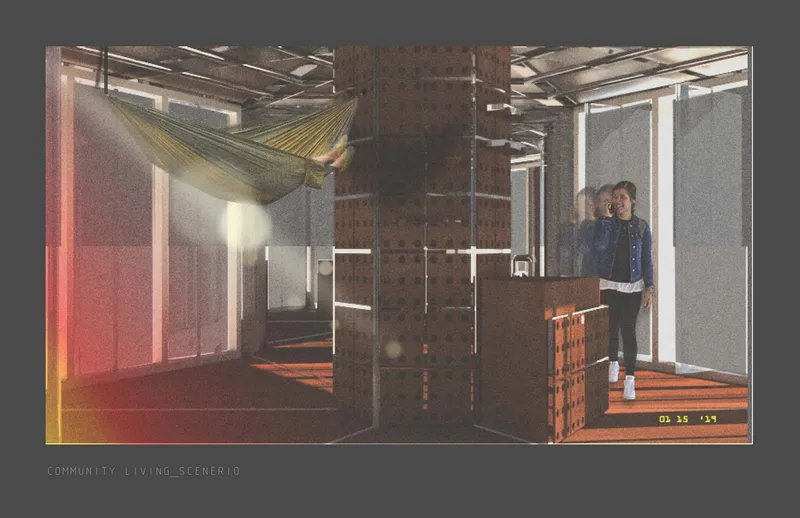
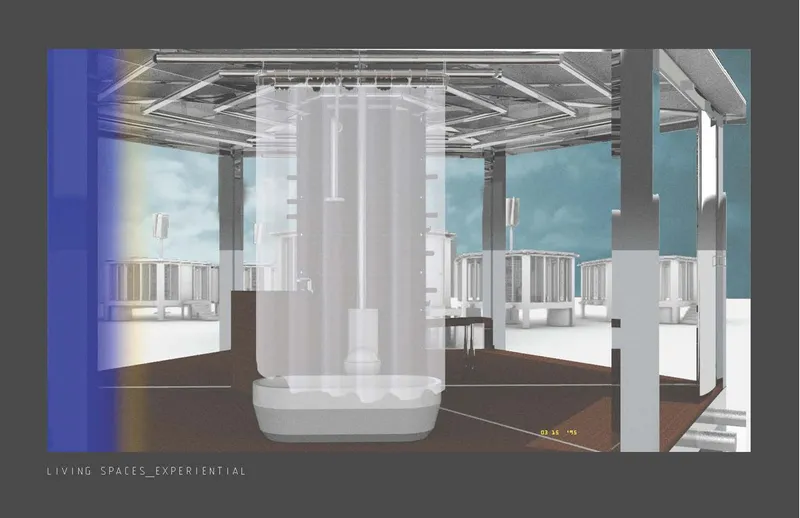
The sequence then shifts toward rest and privacy. A hammock hangs beside the glazing near a perforated column and counter, which is a quiet way of admitting that occupants will need to settle in. The next render goes further: inside a hexagonal pavilion, a translucent shower curtain wraps a bathtub, and the room opens to a cloudy sky with similar raised pavilions beyond. Bathing is one of the first dignities lost in overstretched facilities, and placing it at the centre of a unit says something about what Shipley considers essential.
The raised pavilions also show the ephemeral strategy at work. Lifted off the ground and repeated across the landscape, they read as light installations rather than permanent construction, which suits a site where the edge is meant to be a zone of interaction instead of a fixed boundary.
One Hexagon, Five Ways of Living
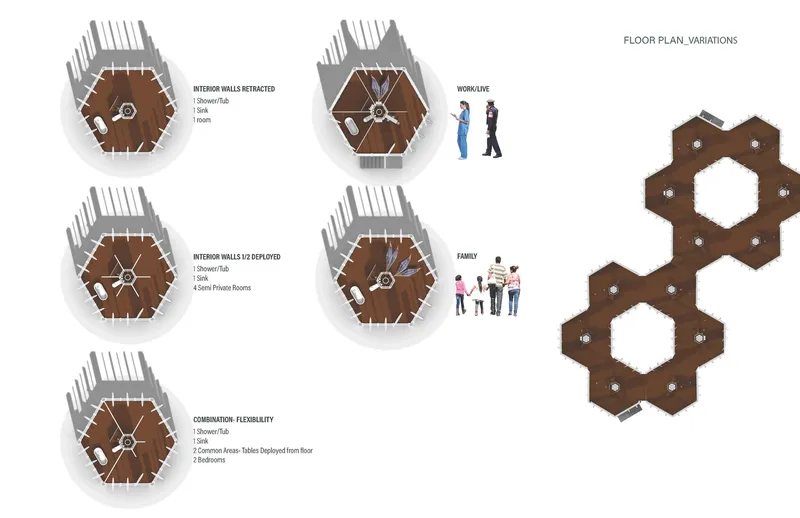
The plan drawing holds the project's most useful idea. A single hexagonal unit appears in five interior layouts, and a cluster of linked hexagons at the right shows how modules join. Small figures give scale and suggest how compact each cell is. The hexagon tessellates without leftover space, and it offers six faces for connection, so a group of units can grow in several directions as a family arrives or a population rises.
This is the expand, contract and reconfigure logic made legible. Instead of designing for an assumed length of stay, the unit anticipates fluctuation: the same shell supports different arrangements, and the cluster can absorb demand without falling into the overcrowding that rigid facilities produce.
The Column as Kit, the Site as Circle
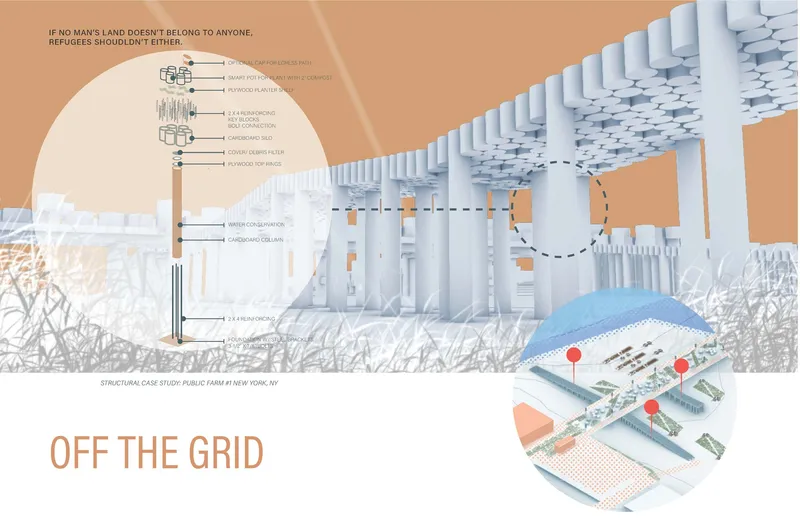
The final collage traces the structure back to its parts. An exploded axonometric breaks down a cardboard column, and next to it a cluster of tall pale columns stands under a canopy, with a circular site plan inset. The perforated columns seen in every interior turn out to be the project's basic building element: a component that can be assembled, gathered into groups and, by implication, removed. Its material and demountable construction suit an architecture meant to dissolve once it is no longer needed.
The site plan inset connects that element to the larger scheme, where the infrastructural spine turns the riverbank into a connective landscape. Housing, gathering and civic exchange share one framework, and neighbouring communities become participants instead of observers.
Why This Project Matters
El Hogar avoids two easy positions: the protest image that rejects the border outright, and the efficient shelter that accepts the processing logic without question. It finds a third role for architecture, responsive and modest, designed around the gap between how long people are supposed to stay and how long they actually do. That diagnosis, taken from a close reading of the immigration timeline, gives the formal choices their weight.
The renders make the case clearly. A child on the floor, a hammock by the glass and a bathtub under open sky are small things, but they show what a humane transitional environment looks like at the scale of the body. For a competition about contested ground, Shipley's proposal argues that the most radical step may be treating temporary residents as people who are, for now, living somewhere.
View the Full Project
About the Designers
Designer: Peaches Shipley
Enter a Design Competition on uni.xyz
uni.xyz runs architecture and design competitions year-round that reward proposals with spatial conviction and real site intelligence.
Project credits: El Hogar by Peaches Shipley No Man’s Land (uni.xyz).


Popular Articles
Popular articles from the community


Temporary Home for Dogs: A Reversed Zoo Rethinks Animal Shelter Architecture
In Bucharest, a sinuous corridor and freed landscape flip the logic of containment, designing a shelter that works to make itself unnecessary.

Faces of the Soviet Avant-Garde: Turning Moscow's Street Names into an Open-Air Museum
A network of sculptural installations across a Moscow residential district transforms forgotten architect names into spatial encounters with cultural memor

Singing Woman: An Opera House That Performs Before the Curtain Rises
Ovidiu Cristian Pavel's conceptual opera house translates Estonia's choral identity into a sculpted waterfront landmark facing the Baltic Sea.

Opera by the Sea Estonia: Three Shells Dissolving Architecture into Tallinn's Coastline
A winning opera house proposal replaces monumental form with interconnected shells that blur the boundary between building, park and Baltic Sea.

Similar Reads
You might also enjoy these articles

Healing Façade: A Modular Chapel System That Restores Ethiopia's Sacred Forests
Winner of the Eco-Chapel competition, this circular timber façade collects water from air to rebuild soil and reforest degraded Ethiopian landscapes.
Kaffeebühnen: Where Coffee Shop Architecture Becomes a Civic Stage in Vienna
A linear sequence of timber boxes, transparent shells, and open yards turns the Viennese café tradition into a public performance space.
Eco Chapel: A Modular Forest Pavilion That Grows Like the Landscape It Protects
Hexagonal timber modules weave through existing trees, turning a chapel into a living system for prayer, education, and reforestation.


Urban Forest: A Vertical Ecosystem for 5,000 Workers in Singapore's Changi Business Park
Radially stacked pods and layered green decks turn a 7-acre plot into 47 acres of ecological workspace projected for 2040.

Explore Architecture Competitions
Discover active competitions in this discipline

Challenge to design a portable theatre

Challenge to design a portable music platform

Challenge to design an open learning module for the elderly

Challenge to reimagine the Iron Throne
Comments (0)
Please login or sign up to add comments
No comments yet. Be the first to comment!