

Studio 10 Weaves a Village Elderly Daycare Center from Yao and Hakka Building Traditions in Northern Guangdong
In Ruyuan Yao Autonomous County, an ochre-toned complex of colonnades and courtyards reimagines rural elderly care as communal life.


Rural China's demographic inversion, where the young leave and the old stay, has turned village architecture into a question of civic urgency. In Yangbei Village, a Hakka community in Ruyuan Yao Autonomous County bisected by the S250 highway and hemmed by the Xinjie River, Studio 10 confronted this reality with a building that is simultaneously a daycare center, a clinic, a canteen, a public hall, and a rooftop garden. The Yangbei Village CCP Elderly Day-Care Center refuses to treat elderly care as a discreet, institutional function. Instead, it spreads its program across a loose constellation of earth-toned volumes stitched together by colonnades and semi-outdoor verandas that recall the "gray spaces" traditional to the region's mountain settlements.
What makes the project genuinely interesting is the way it draws from two distinct vernacular lineages, the rammed-earth and timber construction of Yao hilltop villages and the courtyard-oriented Hakka compounds of the plains, without lapsing into pastiche. The overhanging eaves, the hollow-brick louvers, the embossed glass windows: each element has a clear local precedent and a clear functional purpose. The result is a building that older villagers can read as familiar while younger visitors might recognize as something altogether new. It is a rare project where cultural continuity and spatial ambition genuinely reinforce each other.
A Village Setting Split by Highway and River

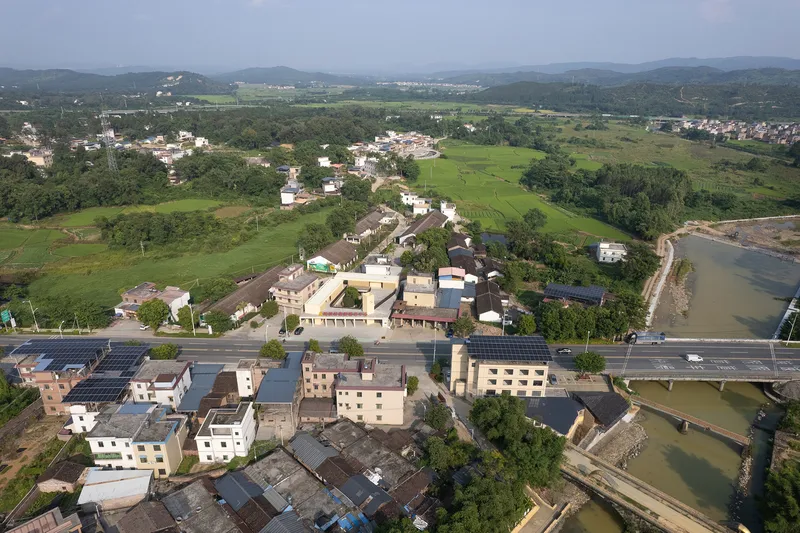

Seen from the air, Yangbei Village reads as a tight cluster of low-rise buildings pressed between rice paddies, a river bend, and a straight highway that slices the settlement in two. The daycare center sits within this grain, its yellow and white volumes no taller than the neighboring houses yet clearly articulated as something public. Studio 10's decision to stay within the existing building envelope, reusing a site that previously held a closed courtyard framed by temporary structures, is deliberate. Rather than imposing a new footprint on agricultural land, the project reclaims an underused civic parcel and opens it up.
The surrounding mountains and hazy valleys visible from every rooftop terrace are not just scenery. Northern Guangdong's hot, humid climate and mountainous topography shaped every passive design choice in the building, from the orientation of living quarters to the depth of the overhanging eaves.
Colonnades and Gray Spaces
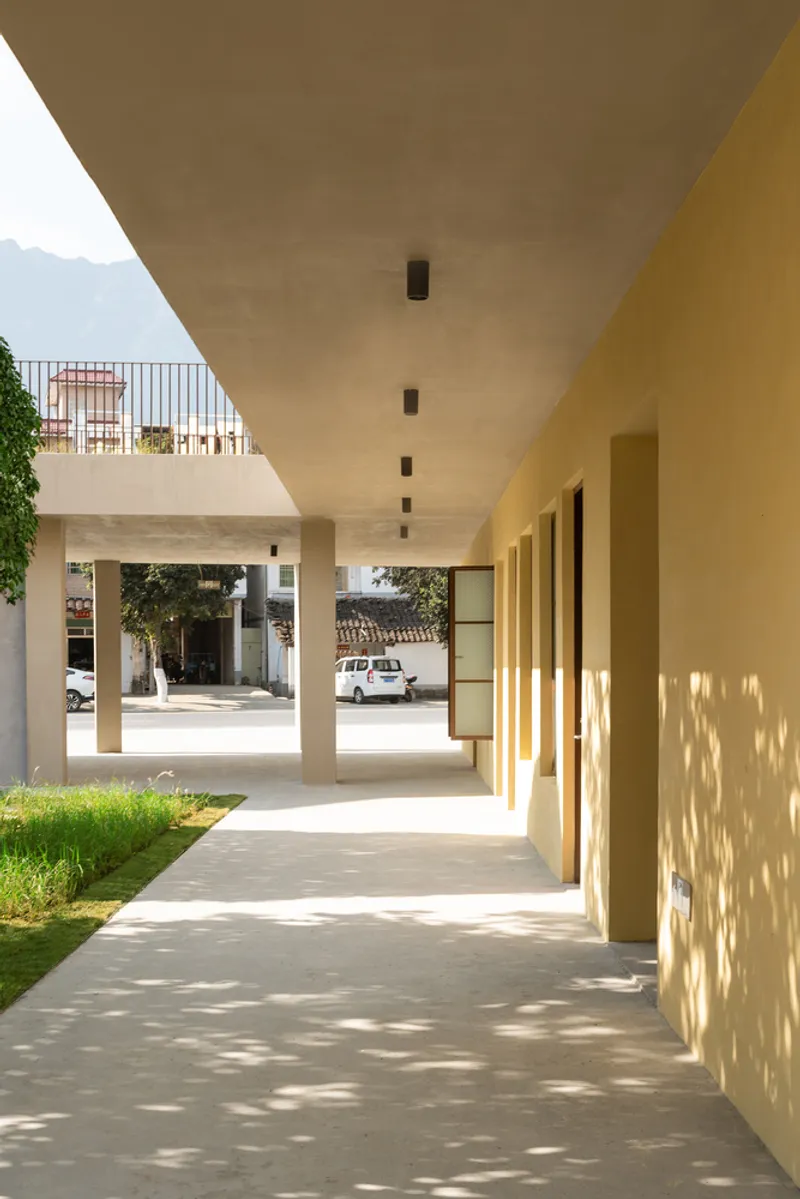
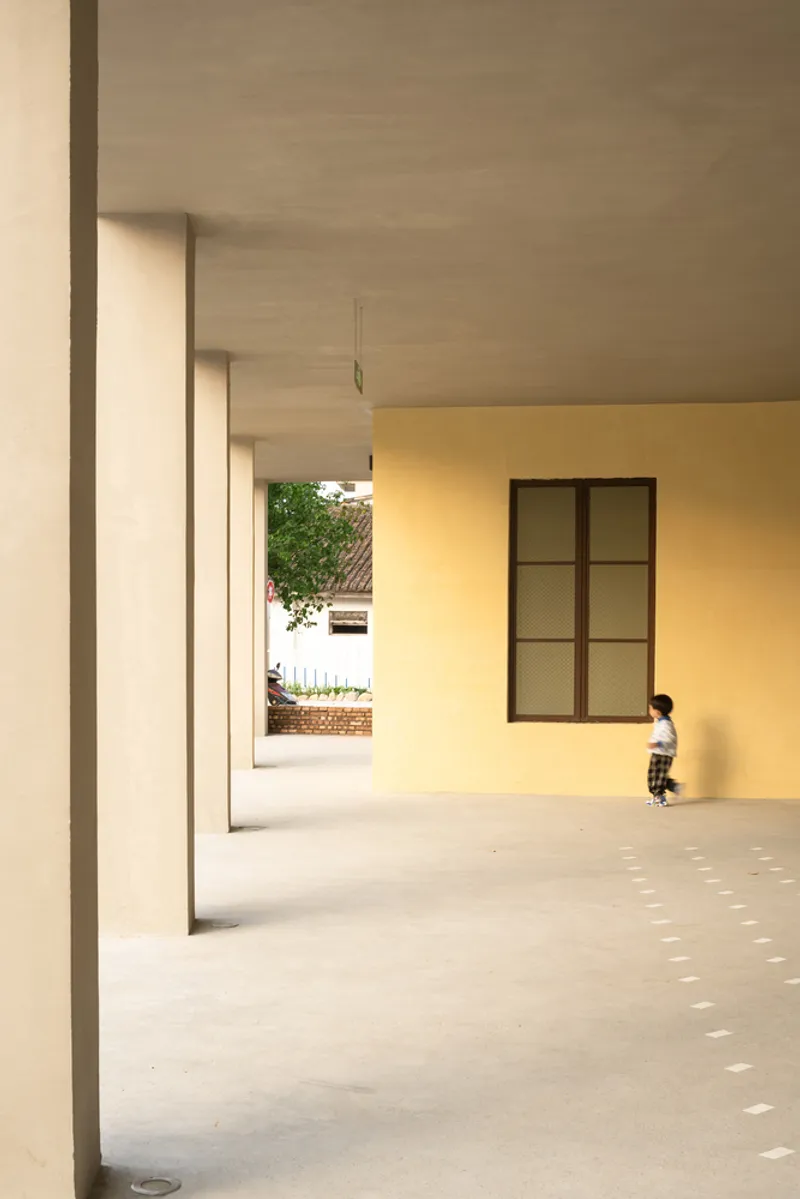
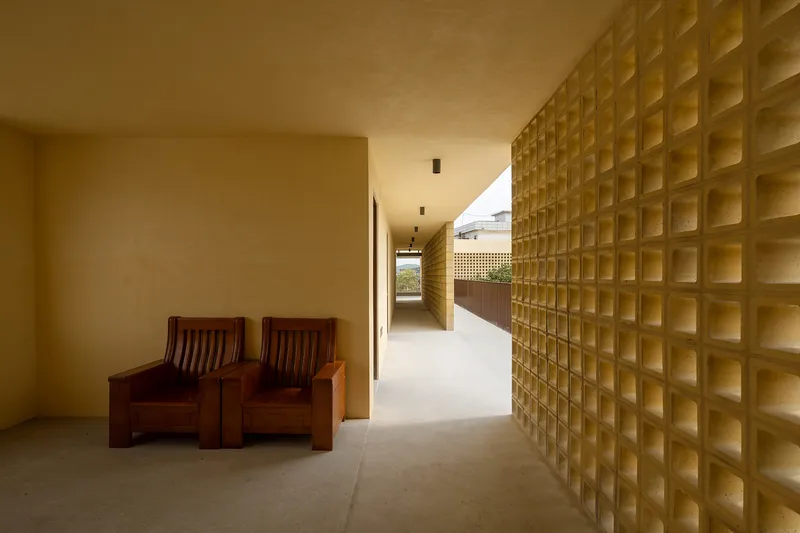
The defining spatial move is the colonnade. Rows of square concrete columns support deep overhanging roofs that create covered, open-air circulation on the ground level. These are the "gray spaces" characteristic of traditional Yao and Hakka architecture: neither fully inside nor fully outside, shaded from rain and sun, cool enough for gathering even on humid afternoons. Studio 10 has elevated this vernacular strategy into the project's primary organizing principle. Public activity and pedestrian movement flow through these colonnades, linking the center to the village's streets and pathways.
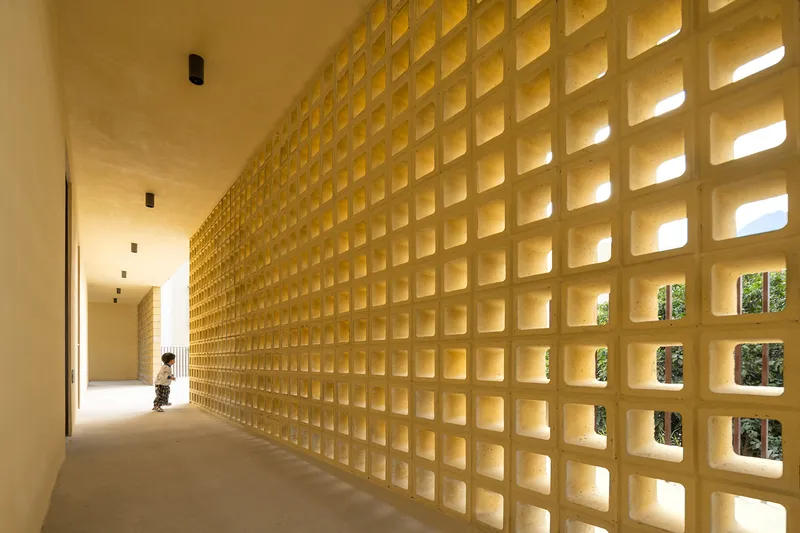
The effect at dusk is particularly striking. The concrete ceiling planes catch warm light while the columns cast rhythmic shadows across the paving. A child running through the colonnade is not an incidental detail; the building is designed to attract all ages, not quarantine the elderly. Multiple entrances from the courtyard side and the road side ensure that the center is permeable rather than fortress-like.
The Courtyard as Communal Heart
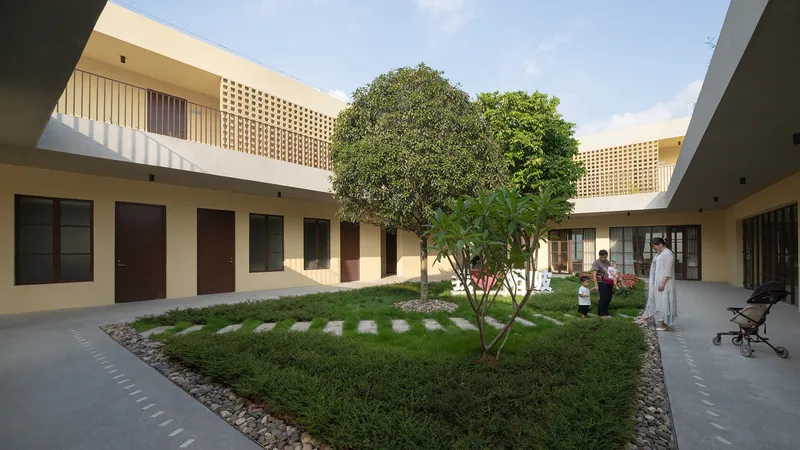
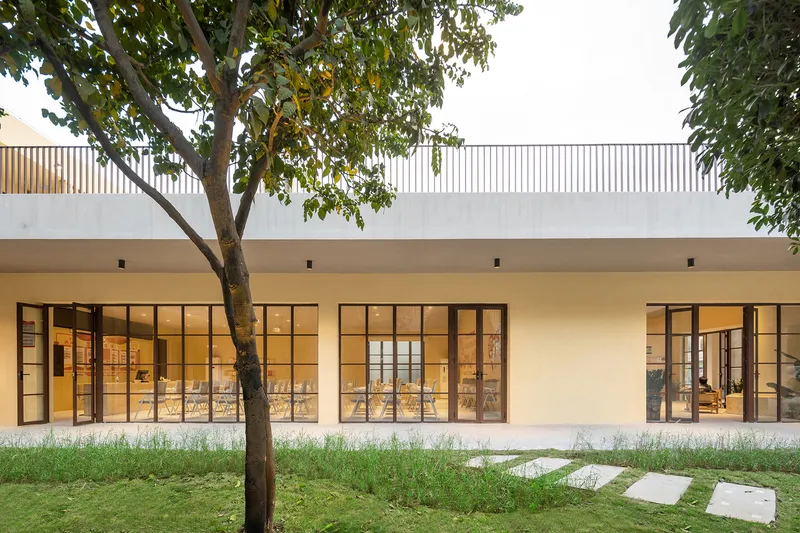

The original site's closed courtyard was a liability: introverted, hard to access, surrounded by structures that blocked light and air. Studio 10 broke this enclosure open. The new courtyard is planted with grass and a mature deciduous tree, crossed by diagonal stepping stones, and flanked by two-story wings with large windows and glass doors facing inward. South-facing orientation gives the elderly living quarters on the north wing optimal daylight and cross-ventilation, while the courtyard itself acts as a social commons where residents, staff, and visiting families overlap.
Privacy is handled not by enclosure but by calibration. Large courtyard-facing openings are paired with more restrained street-facing facades, acknowledging the proximity of residential neighbors. The courtyard is generous without being exposed.
Materiality: Earth Tones and Hollow Brick
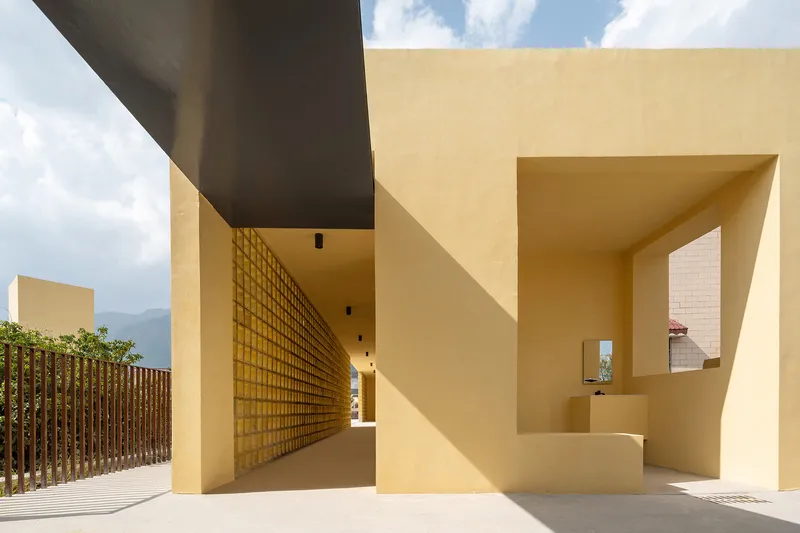

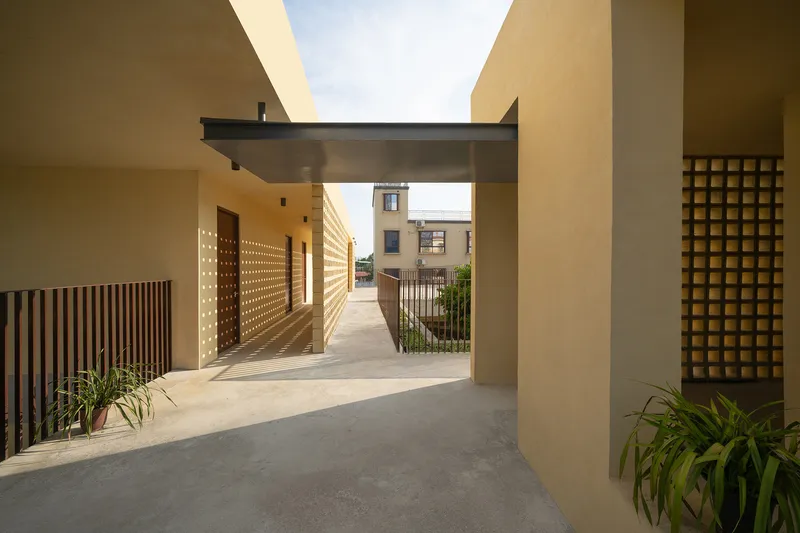
The building's ochre stucco finish is not decorative whimsy. It directly references the rammed-earth walls that define the Yao village vernacular, translating a heavy, labor-intensive material tradition into a lightweight rendered surface that reads with similar warmth. Each volume receives a slightly different treatment, so the complex registers as an assembly of parts rather than a monolith. Hollow bricks, a material with deep local roots in decorative screenwork, are used for louvers and visual partitions throughout. These perforated panels filter daylight, provide ventilation, and create a lace-like texture across the facade that softens the mass of the concrete structure behind.
Vintage embossed glass makes an appearance on the exterior windows, echoing the patterned wooden lattice windows of traditional homes. It is a small detail, but it signals that Studio 10 approached this project with a collector's eye for regional specificity rather than a generalized "local materials" gesture.
The Skylight Tower and Interior Light
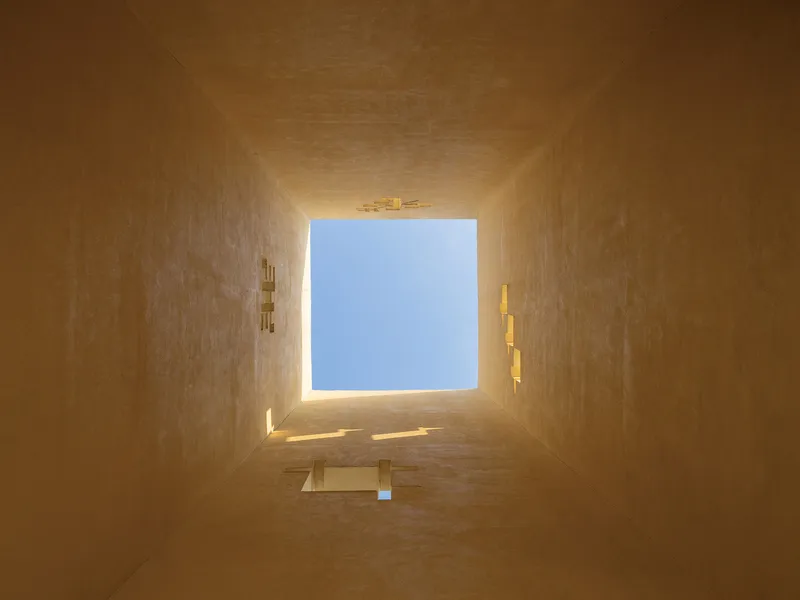

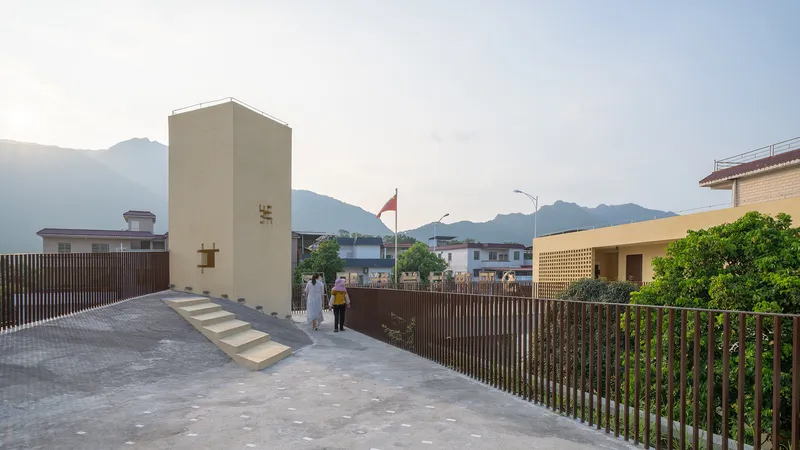
The tallest element in the composition is a square tower at the southwest corner of the public service hall. Inspired by Yao tribal totems, it functions as a skylight shaft, pulling natural light deep into the interior and casting shifting geometric shadows throughout the day. Seen from below, the ochre-rendered walls of the shaft glow with reflected daylight, creating a vertical room of pure color and atmosphere. From the rooftop terrace, the tower punctuates the skyline alongside vertical timber screens and the distant mountains.
This is the building's most overtly expressive moment, and it earns its drama by being functionally necessary. The public hall needs light, and a conventional clerestory would not reach the center of the deep plan. The tower solves a problem while also giving the complex an identifiable silhouette within the village.
Interior Programs: Dining, Reading, Living
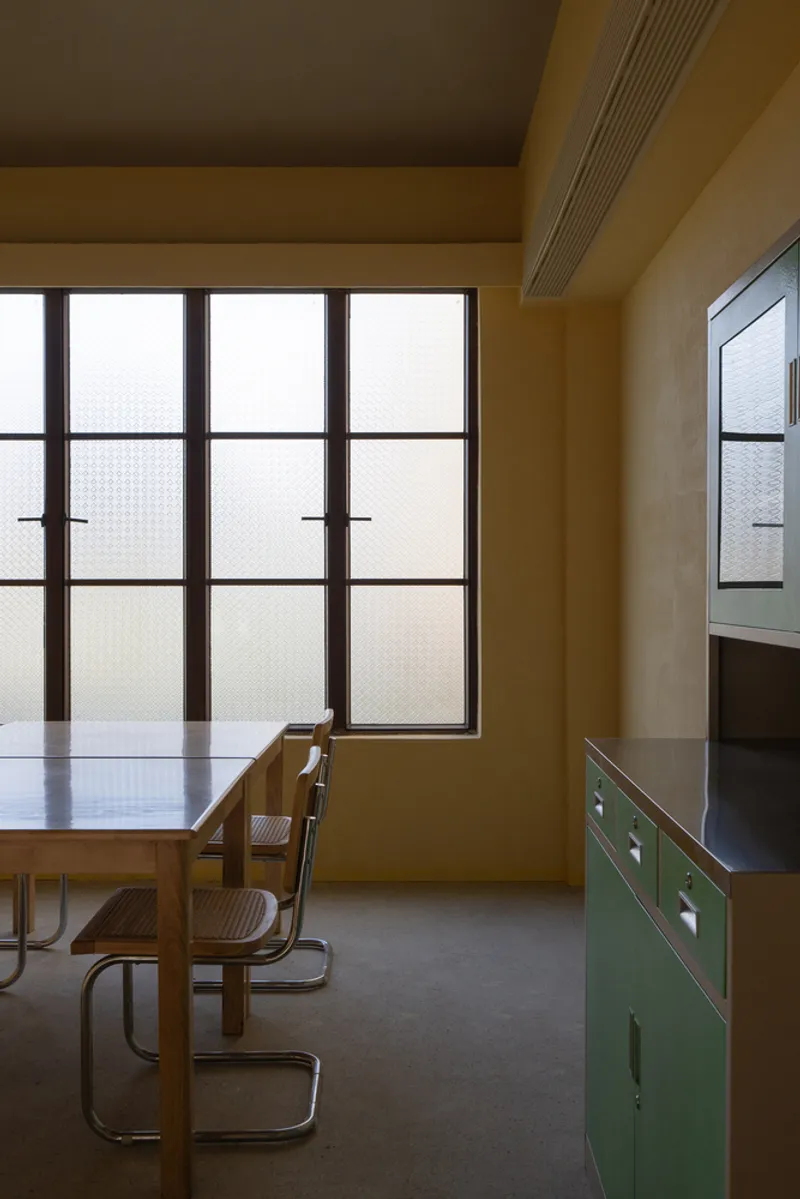

Inside, the daycare center is organized around a clear zoning logic. The north wing's ground floor is given over to private living quarters, bathrooms, and a clinic. The south side houses a multi-purpose room and public service hall accessible from both the courtyard and the road. The east wing bridges these two zones with shared daycare facilities and offices. A canteen with translucent gridded window panels and green metal cabinetry provides communal meals in a room that feels domestic rather than institutional.
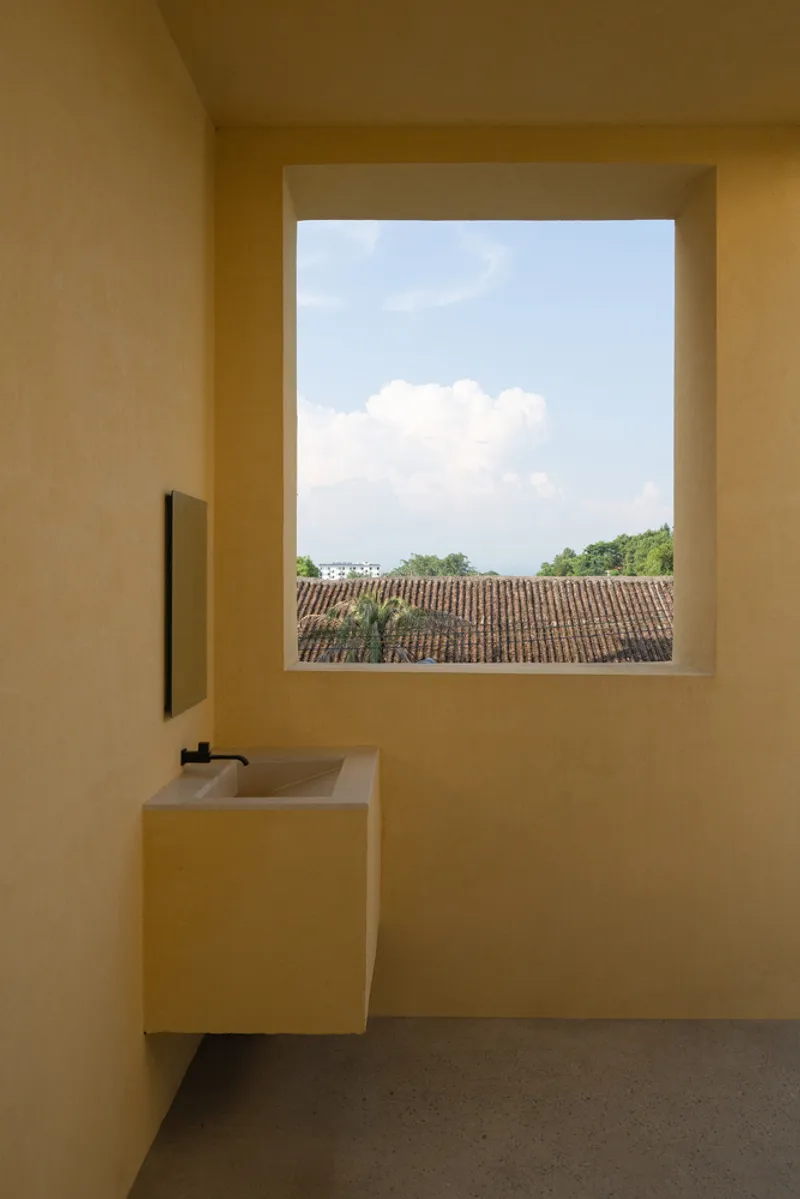
A library reading room with a timber table and recessed floor seating wells is among the most carefully detailed interiors. Gridded doors open directly onto the courtyard, blurring the line between study and garden. Even the bathrooms are treated with care: a yellow-plastered room with a square window framing clouds and tiled rooftops suggests that dignity in the smallest rooms was a design priority, not an afterthought.
Rooftop Gardens and Upper Terraces


The second floor accommodates offices, a rooftop garden, and public activity areas that extend the building's usable surface well beyond its footprint. Perforated brick screens at the terrace edges provide safety and privacy while framing views of neighboring rooftops and the mountain horizon. At dusk, the upper terraces become social spaces in their own right, with diagonal stepping stones on the courtyard terrace drawing visitors down into the colonnade below.
The planted rooftop is not merely ornamental. It helps insulate the concrete slab from direct solar gain in northern Guangdong's hot summers, contributing to the building's broader passive climate strategy alongside the deep eaves and cross-ventilation pathways.
Plans and Drawings
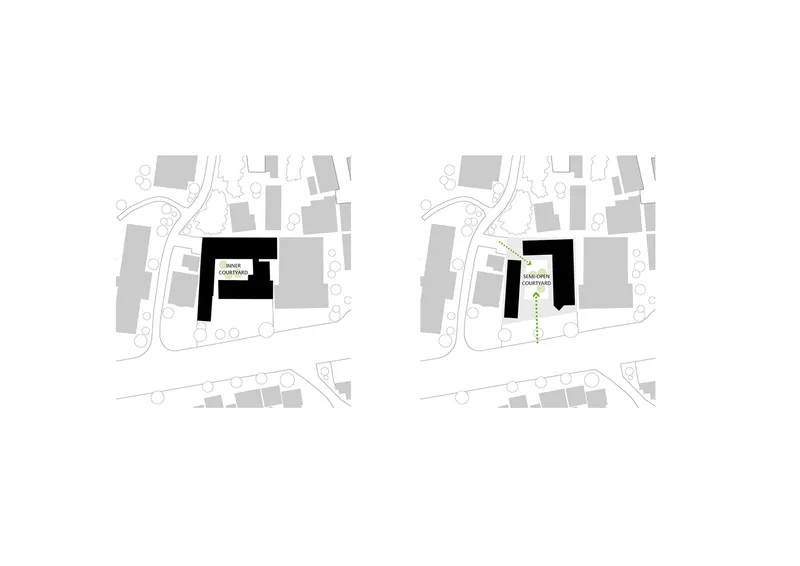


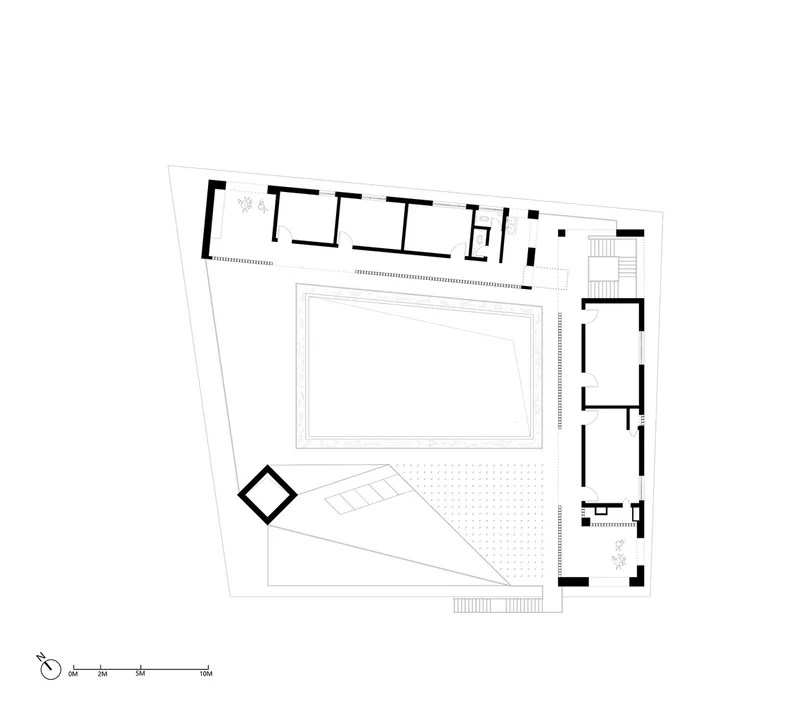

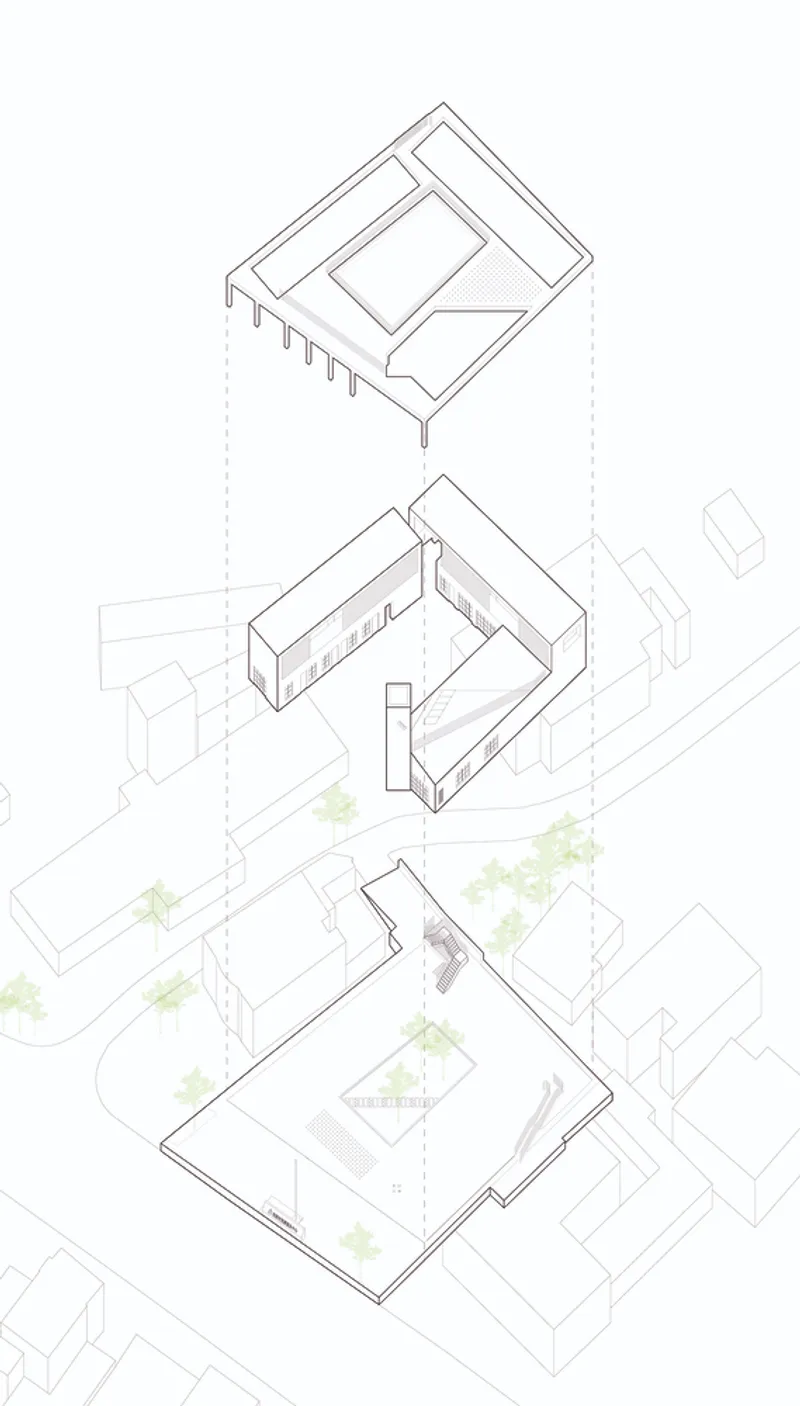
The site plan diagrams reveal the transformation most clearly. Before the intervention, the building footprint was a compact, closed rectangle. After, a U-shaped arrangement opens the courtyard toward the road and creates multiple points of entry. The ground floor plan shows the central courtyard pool flanked by the lecture hall to the south and the residential wing to the north, with a circulation spine running along the east edge. The upper floor plan features a triangular outdoor terrace and a row of rooms along the northern edge, confirming that even the building's geometry responds to solar orientation.
The section drawing is the most revealing: it cuts through the two-story volumes, the central courtyard with its tree canopies, and the tall skylight tower, showing how the building steps down from its highest point at the southwest to the lower residential wing at the north. The axonometric drawing places the three stacked volumes in their village context, making clear how tightly the project fits within the existing settlement fabric.
Street Presence and Village Integration
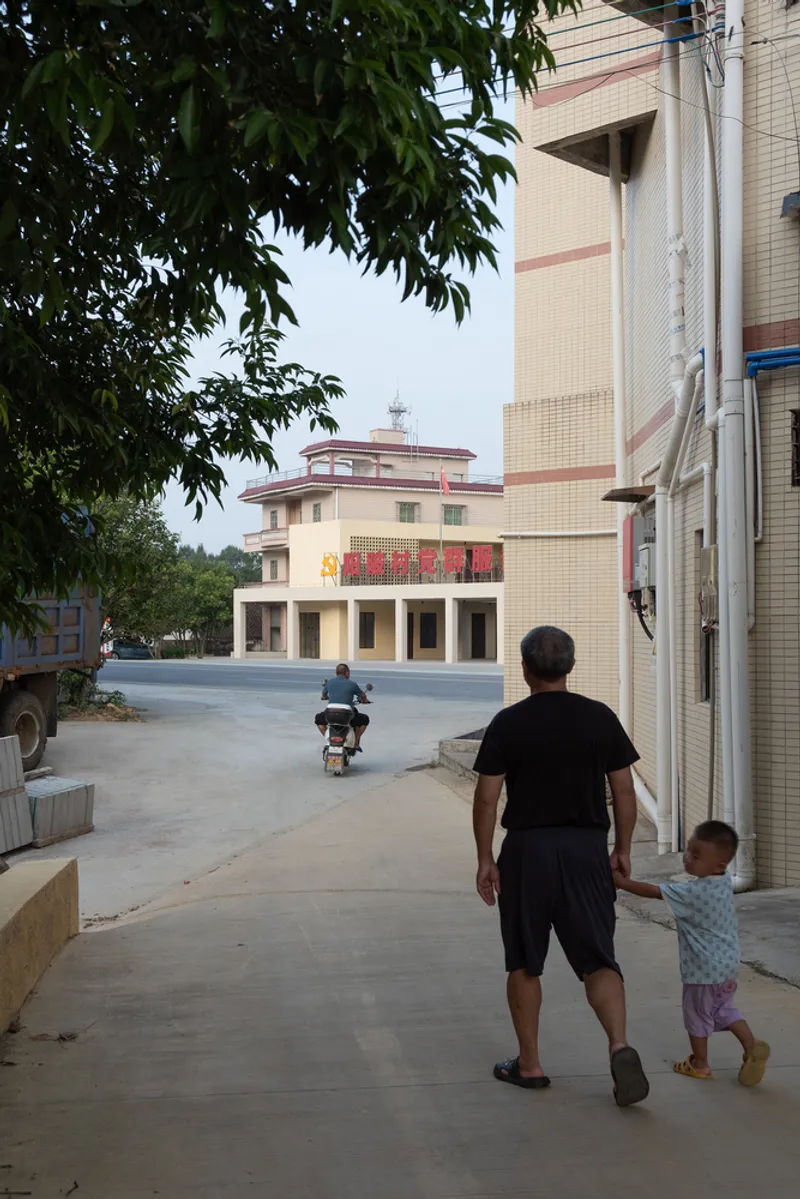
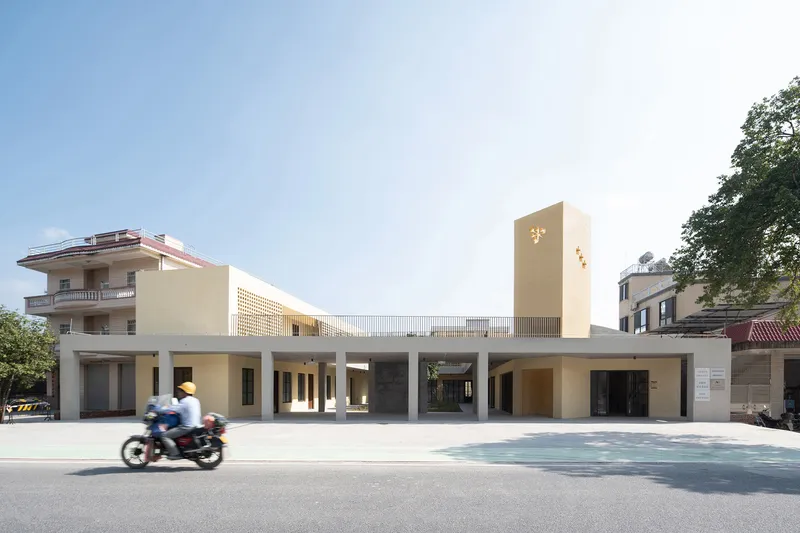
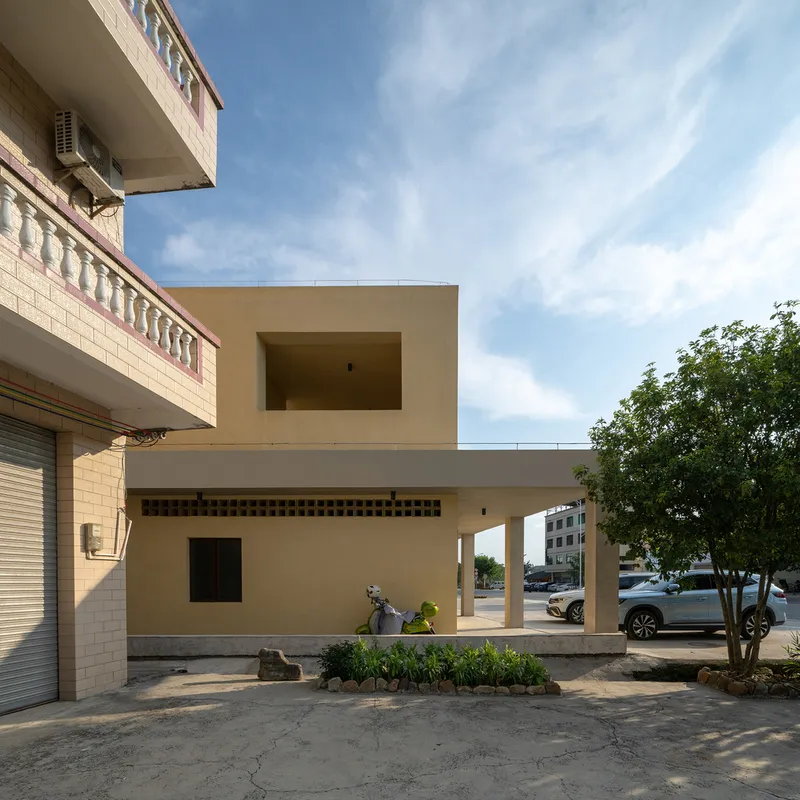
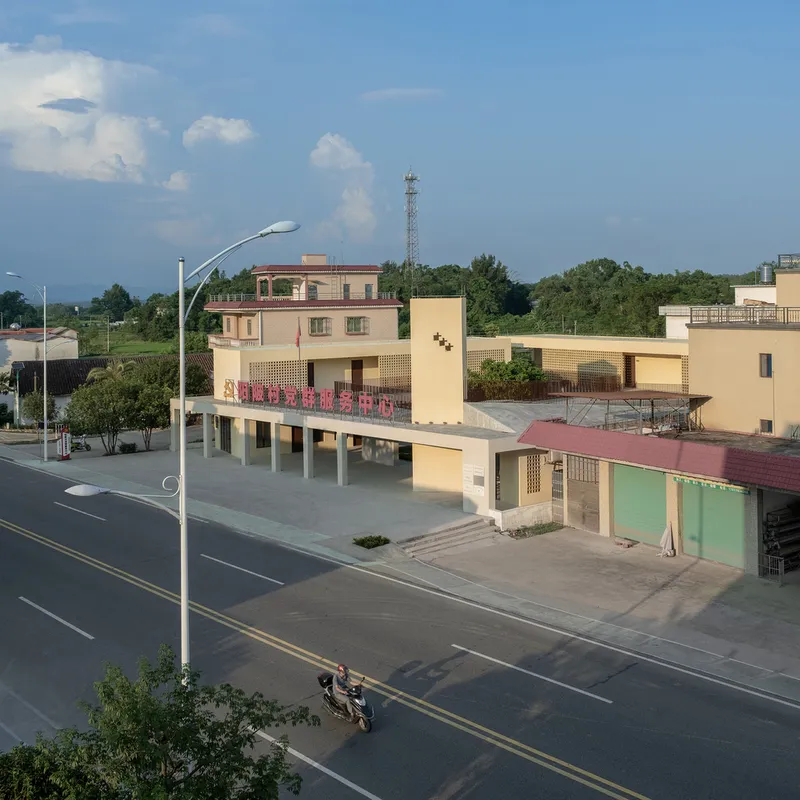
From the street, the building does not announce itself with grand gestures. A father and child walk toward the ochre colonnade under an overcast sky, and the building simply receives them. The elevated structure on concrete columns allows a motorcyclist to pass beneath on the road without interruption. A perforated brick screen above a covered entrance, planted beds, and parked vehicles: the building participates in the ordinary rhythms of village life rather than standing apart from them.
This is perhaps the project's most quietly radical quality. Elderly care architecture in rural China often defaults to institutional typologies borrowed from urban hospitals or suburban retirement communities. Studio 10 has instead produced something that belongs to its village, spatially and culturally, while operating at a level of architectural ambition that neither condescends to its context nor overwhelms it.
Why This Project Matters

The Yangbei Village Elderly Day-Care Center matters because it treats a demographic crisis as a design opportunity rather than a logistical problem. China's rural aging population needs buildings that are accessible, comfortable, and medically functional, but those requirements alone do not make architecture. What Studio 10 has added is spatial generosity: colonnades wide enough for conversation, courtyards bright enough for gathering, rooftop gardens quiet enough for solitude, and a skylight tower luminous enough to give the whole complex a sense of civic aspiration.
The project also demonstrates that vernacular reference does not require formal mimicry. Hollow bricks, earth-toned stucco, embossed glass, and deep eaves are deployed with precision and contemporary structural logic. They produce a building that reads as local without pretending to be old. For architects working in rapidly changing rural contexts anywhere in the world, this is a valuable lesson: respect for tradition is most convincing when it is expressed through spatial intelligence, not surface decoration.


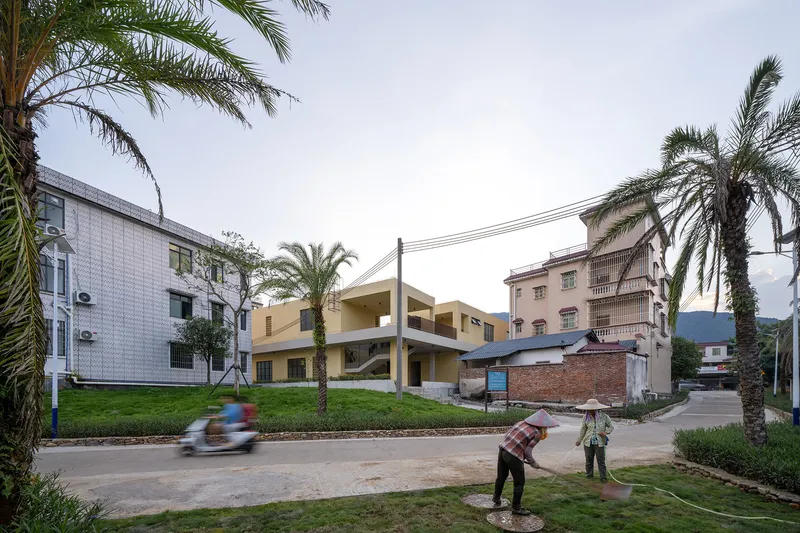
Yangbei Village CCP Elderly Day-Care Center by Studio 10. Ruyuan Yao Autonomous County, Shaoguan, Guangdong, China. Photography by Chao Zhang.
About the Studio
Share Your Own Work on uni.xyz
If projects like this are the kind of work you want to make, uni.xyz is a place to publish your own, find collaborators, and enter design competitions.


Popular Articles
Popular articles from the community

Opera by the Sea Estonia: Three Shells Dissolving Architecture into Tallinn's Coastline
A winning opera house proposal replaces monumental form with interconnected shells that blur the boundary between building, park and Baltic Sea.

Singing Woman: An Opera House That Performs Before the Curtain Rises
Ovidiu Cristian Pavel's conceptual opera house translates Estonia's choral identity into a sculpted waterfront landmark facing the Baltic Sea.
Tsunami Convergenics: Turning Catastrophic Ocean Forces into Underwater Housing Infrastructure
A speculative underwater settlement off the coast of Onagawa, Japan, treats tsunamis and typhoons as energy sources rather than threats.

Faces of the Soviet Avant-Garde: Turning Moscow's Street Names into an Open-Air Museum
A network of sculptural installations across a Moscow residential district transforms forgotten architect names into spatial encounters with cultural memor

Similar Reads
You might also enjoy these articles

Bamboo Housing Challenge 2026: Design Affordable, Sustainable Homes Using Bamboo
An international design competition by Bamboo U and IBUKU inviting architects and designers to reimagine affordable housing using bamboo — with the winning design built full-scale in Bali.

Computational Design & Education: Beegraphy Design Awards Introduces 7th Category (Featuring Jiyun's Innovative Approach)
Dive into Beegraphy’s 7th Design Awards category, where computational design meets education to create immersive, interactive learning tools, inspired by Jiyun’s work.
From Parametric Lighting to Urban Furniture: Join the 2nd Workshop in Beegraphy’s Computational Design Series
Dive into Cutting-Edge Design Techniques and Practical Applications with Industry Experts

Last Call: Unleash Your Architectural Genius in SHAK's Kindergarten Design Competition
Urgent call for architects to join SHAK's kindergarten design competition before the looming deadline

Explore Chinese Small Scale Architecture Competitions
Discover active competitions in this discipline

Challenge to reimagine the Iron Throne

Photograph architecture without architects

Illustrate the lost glory of Angkor Wat - Render Challenge

Design challenge to reuse E-waste
Comments (0)
Please login or sign up to add comments
No comments yet. Be the first to comment!