
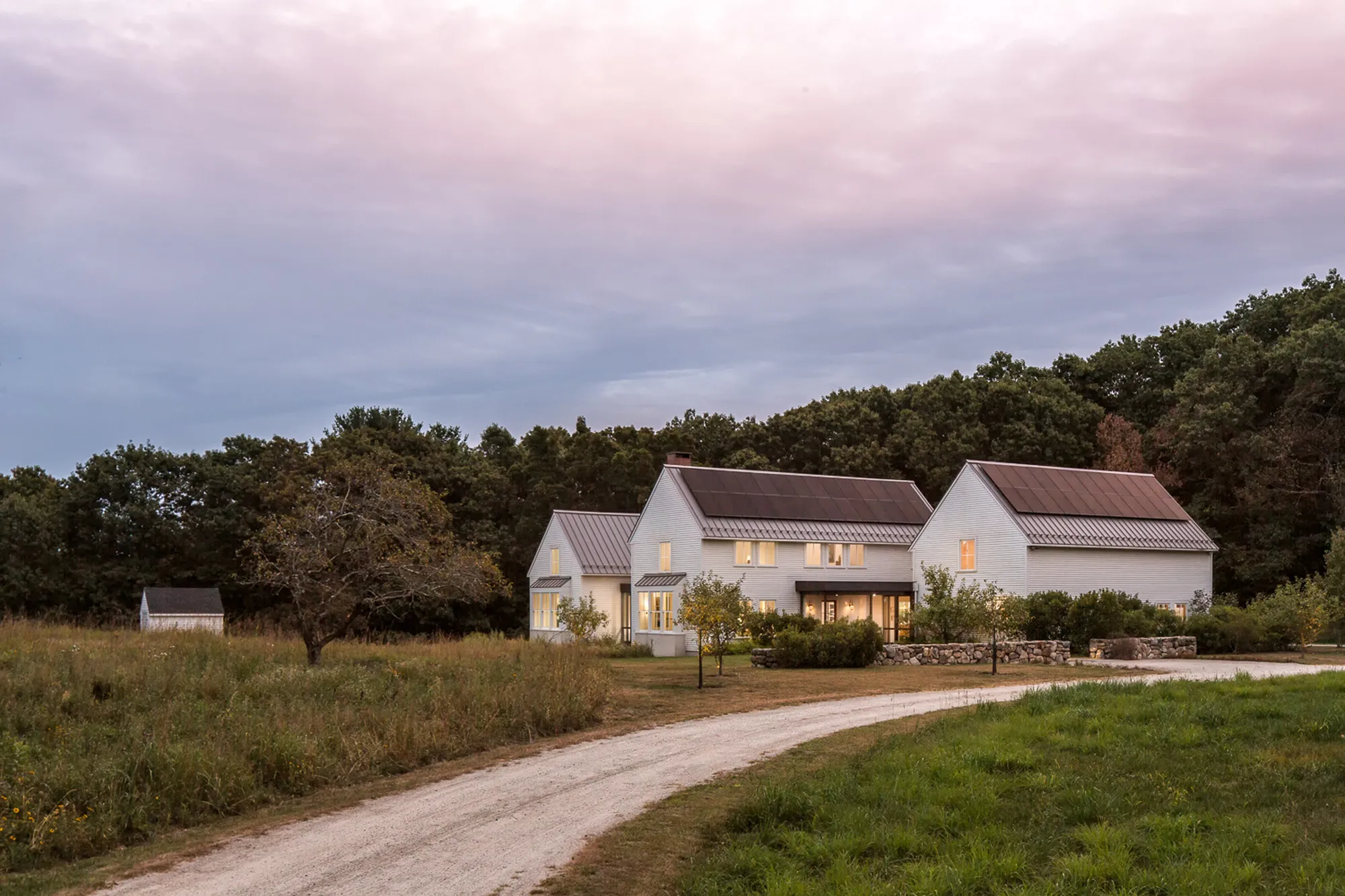
ElliottArchitects Splits a New England Farmstead into Three Gabled Volumes on a Wellesley Meadow
A 5,125-square-foot house in Wellesley reinterprets the connected farmstead typology with glass corridors, slate floors, and a six-acre landscape.


The connected farmstead is one of New England's most enduring residential typologies: a main house linked by a series of appendages to a summer kitchen and eventually a barn, so that farmers could move between chores without braving winter. ElliottArchitects, led by Isaac Robbins with Matt Elliott and Maggie Kirsch, takes that DNA and deliberately fractures it. Instead of a single linear chain, three distinct white clapboard volumes, each with its own gabled metal roof, are staggered across a six-acre property in Wellesley, Massachusetts. Glass-and-steel corridors stitch them together, turning what was once an efficiency strategy into a spatial sequence that puts the landscape at the center of daily life.
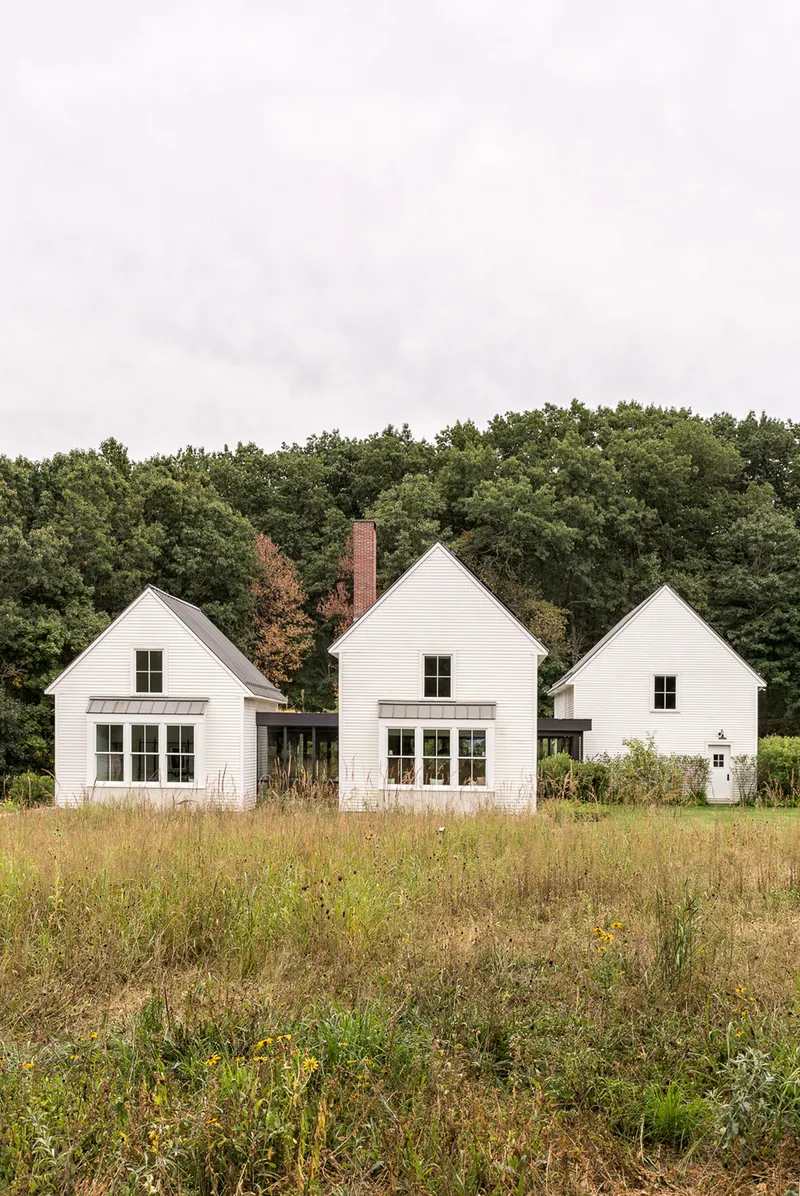
What makes this project genuinely interesting is not the farmhouse costume. It is the calibration of distance between the volumes. The gaps are wide enough to frame outdoor rooms, apple trees, and native grass meadows, yet narrow enough that the corridors feel like thresholds rather than hikes. The result is a 5,125-square-foot house that reads smaller than it is from any single vantage point and larger than it is from the inside, because every room borrows views through two or three layers of glass to the trees beyond.
Three Houses, One Address
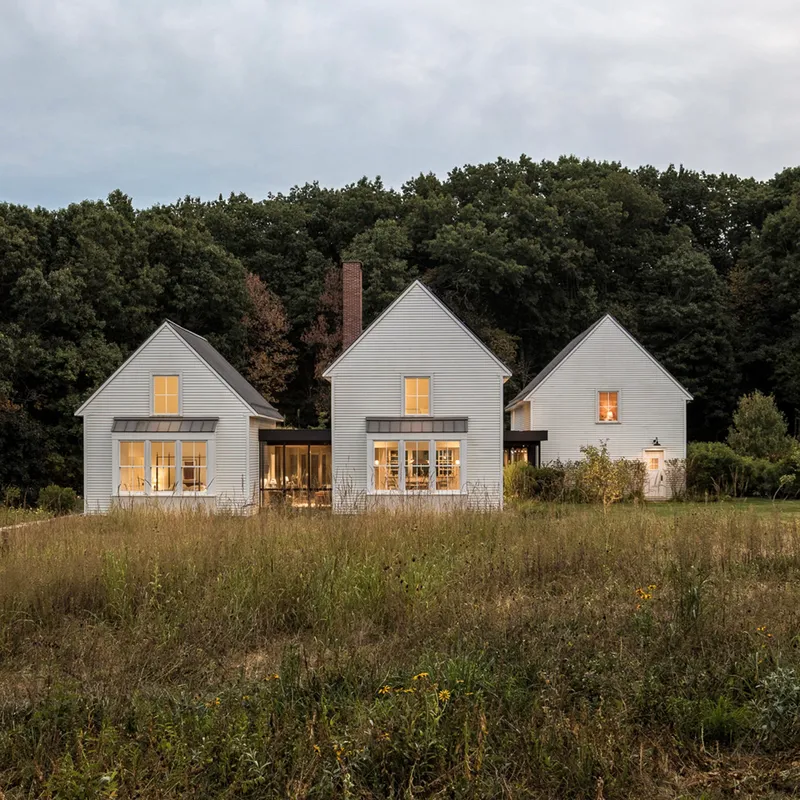
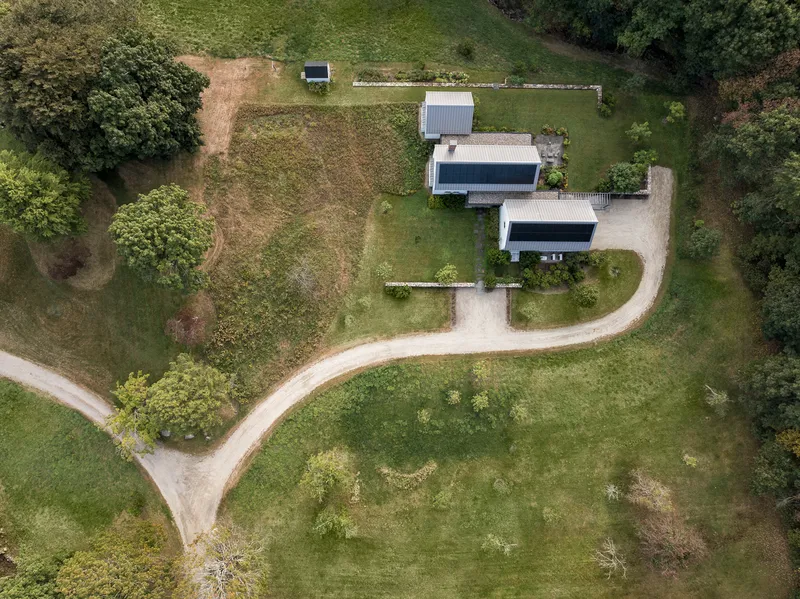
The hierarchy is direct. The tallest volume, the "big house," holds the public spaces on its ground floor and guest bedrooms above. The smallest volume, the "little house," contains the primary bedroom suite, granting it the quietest position on the site. The widest volume, the "barn," tucks the garage, laundry, and pantry at grade with a bunk room upstairs. From the air, the three roofs read like a small agrarian cluster. At ground level, the overlapping sight lines dissolve any impression of a single building mass.
The drive winds through the property and terminates at the barn volume in the rear, keeping cars out of the meadow view. It is a simple landscape move, but it means the house is always approached obliquely, revealing itself in stages rather than in a single frontal composition.
The Glass Corridors as Thresholds
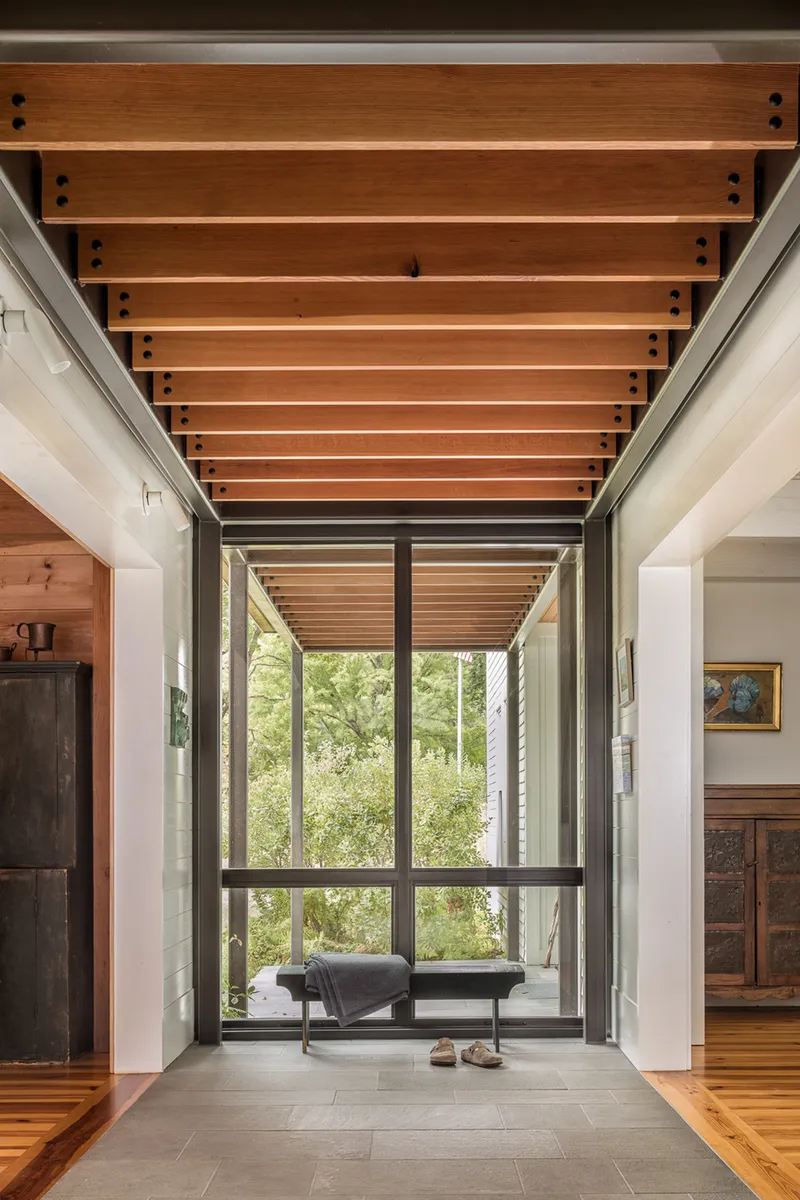
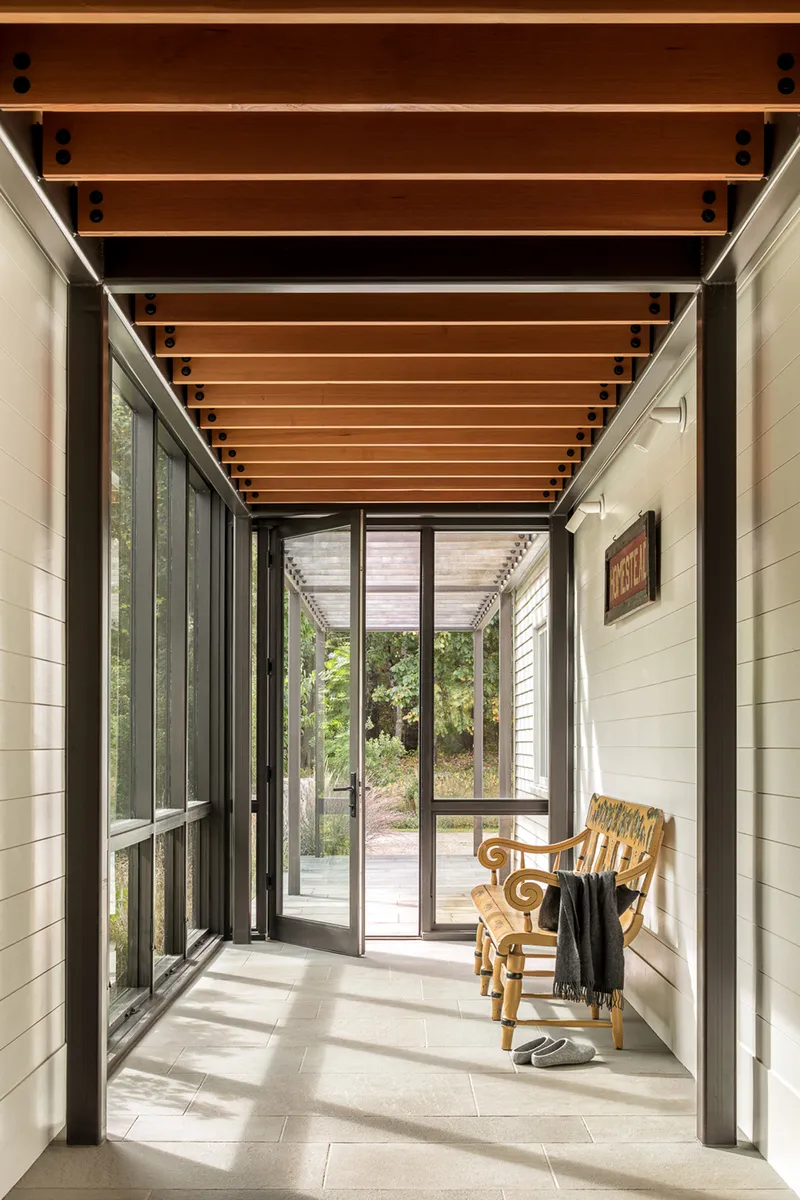
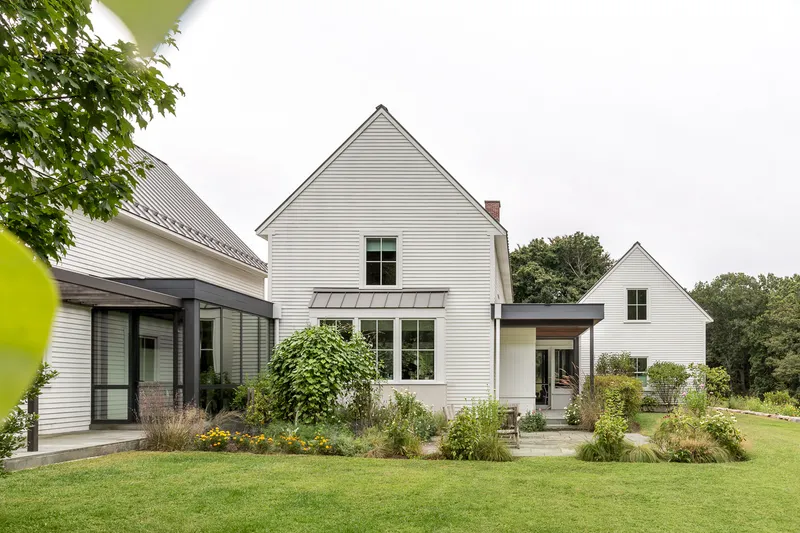
The corridors are the project's most technically resolved element. The entry sequence begins as an open timber trellis, casting shadow stripes across the clapboard, then transitions into an enclosed steel-and-glass passage with slate flooring underfoot and horizontal timber slats overhead. Dappled sunlight filters through the slats, and the material shift from slate to heart pine signals the move from circulation to inhabitation.
These are not simply hallways. They compress ceiling height and width so that arriving in the double-height big house feels like an expansion. They also force you to look sideways, into garden beds and stone walls, rather than straight ahead. The corridors slow you down, which is the whole point of separating the volumes in the first place.
Entry and Canopy
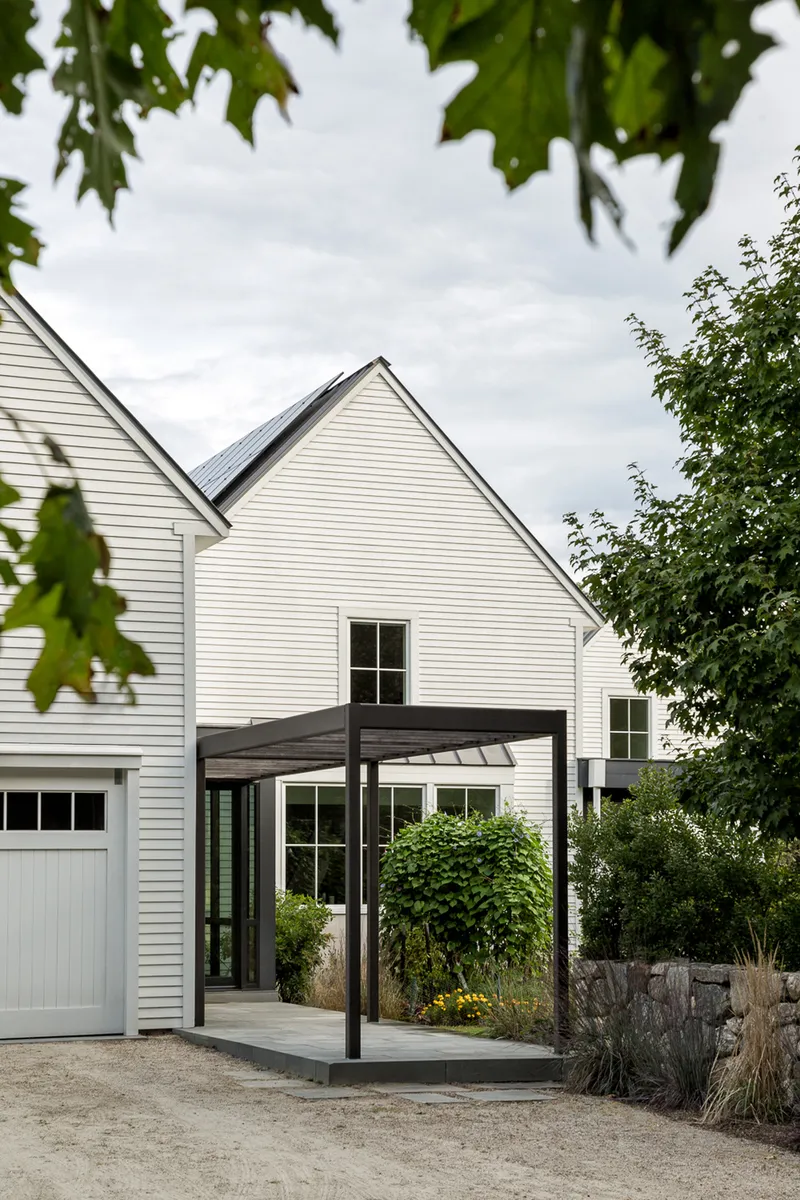
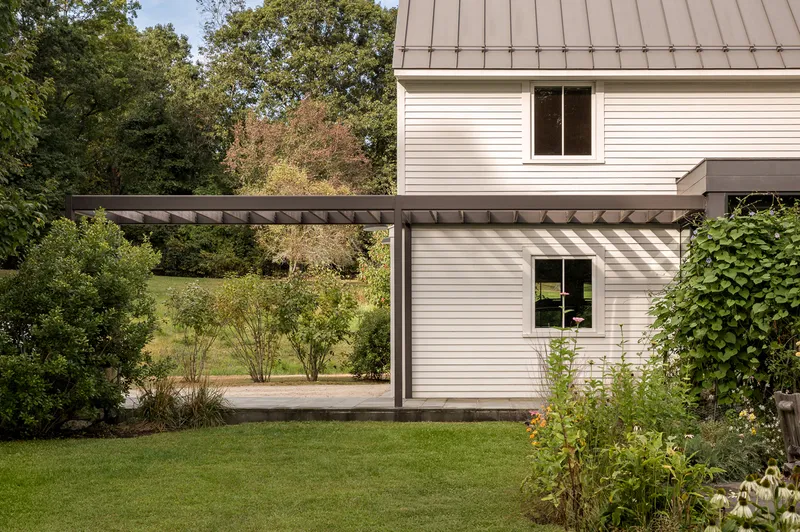
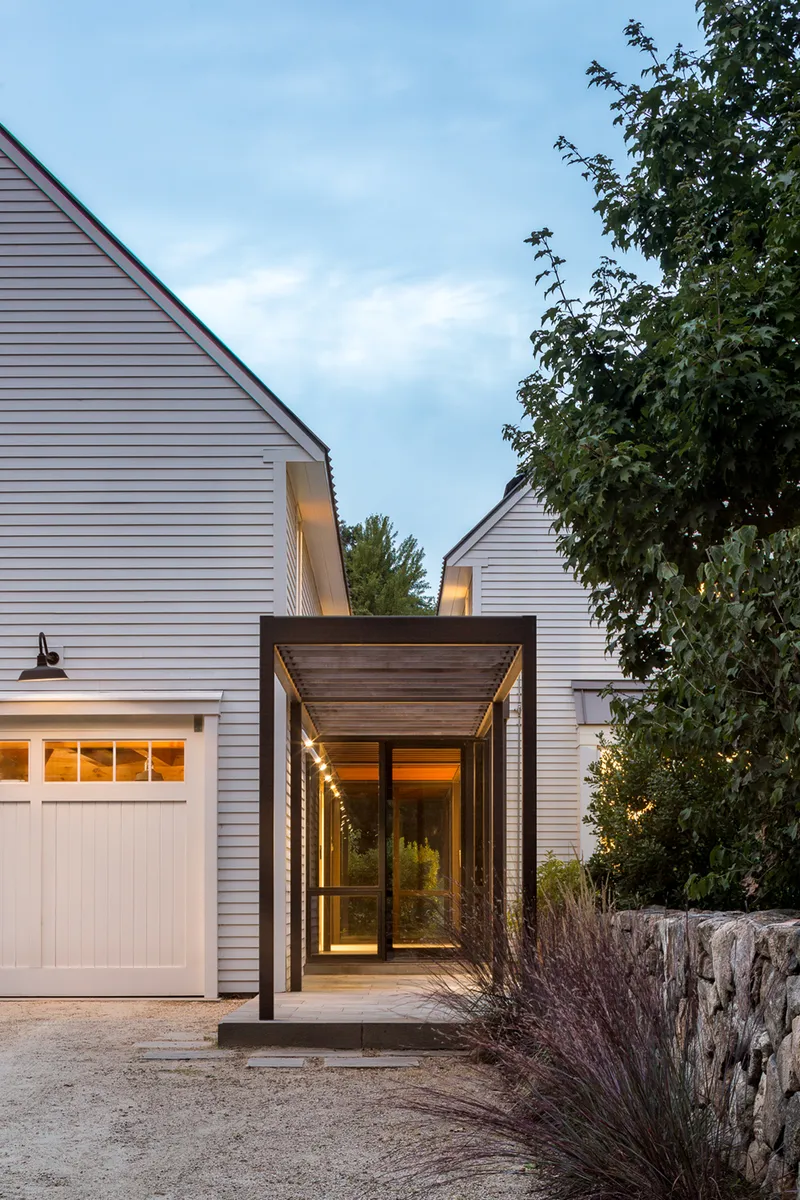
A timber-and-steel canopy marks the front door without shouting. Its exposed rafters and slender posts frame the approach between two white gabled walls, flanked by ornamental grasses that blur the line between cultivated garden and meadow. At twilight the canopy becomes a lantern, backlit by the warm glow spilling from the corridor behind it. The detailing here is restrained: no ornamental brackets, no exaggerated overhangs, just structure doing its job and looking good doing it.
The Big House Interior
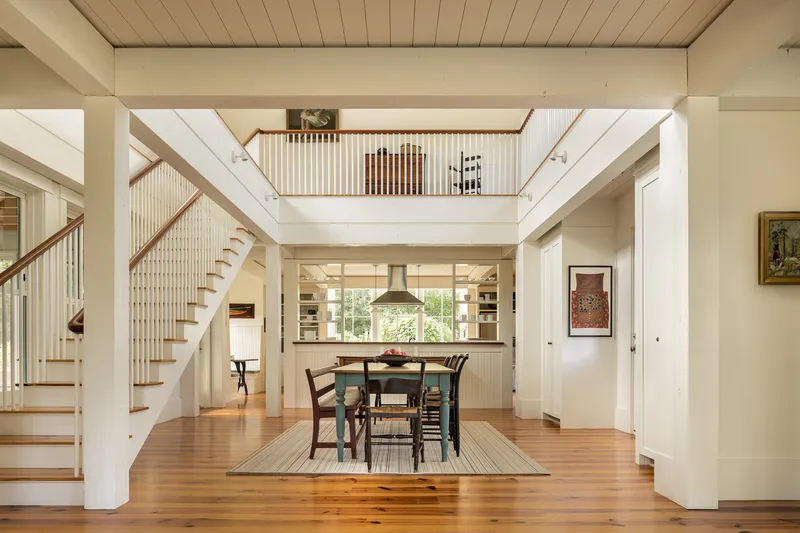
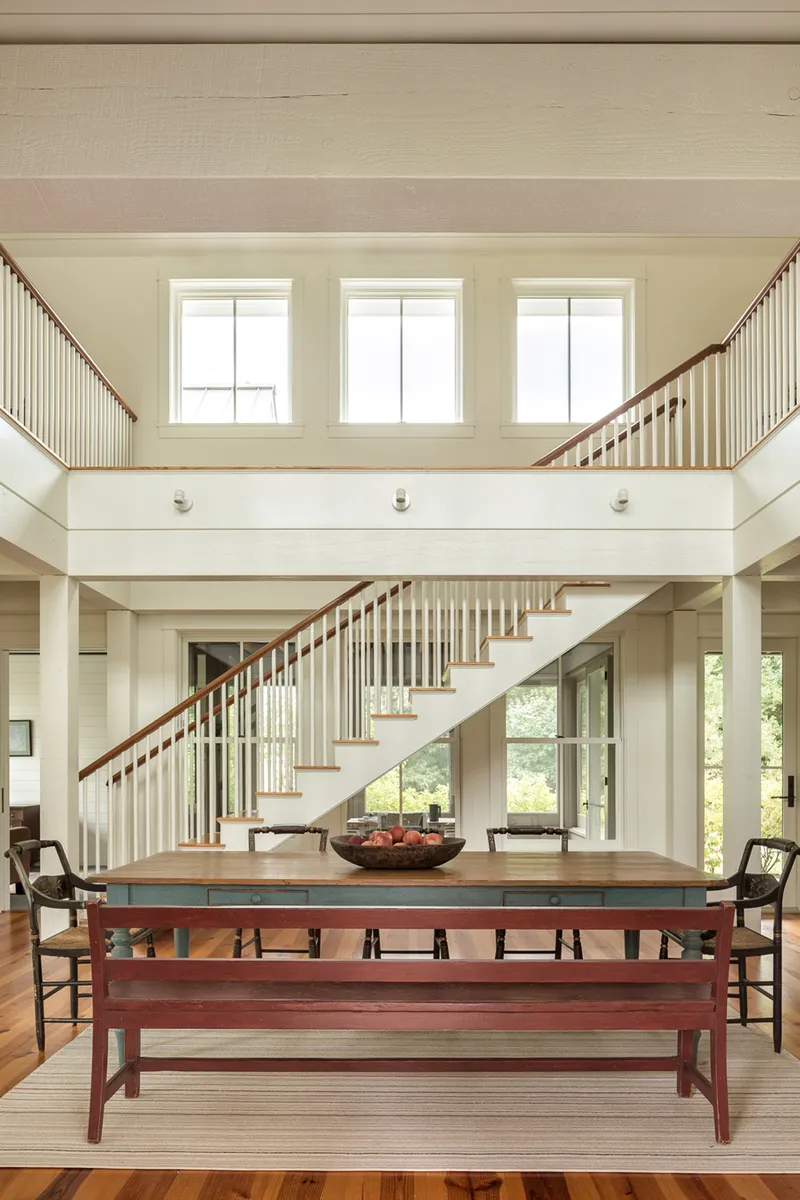
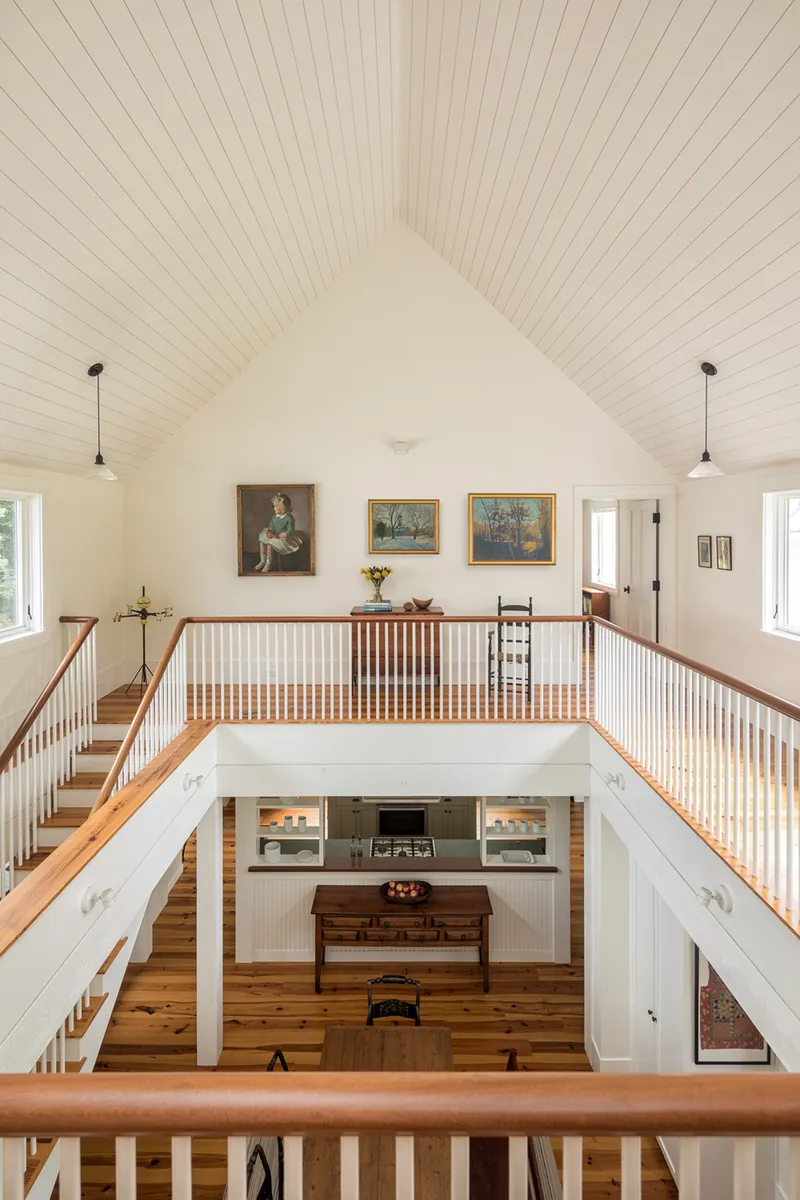
Inside the big house, a double-height dining space anchors the plan. An open staircase rises to an upper gallery with a tongue-and-groove vaulted ceiling, and clerestory windows pull light down into the center of the volume. The proportions recall a small New England church, except the congregation here gathers around a kitchen island with green slate countertops and wide-plank heart pine floors.
The mezzanine overlooks both the dining space and the entry hall below, connecting the two stairways and creating a circuit that keeps the upper level from feeling like a dead-end corridor. It is a generous move for a house of this size, trading potentially usable floor area for spatial drama and cross-ventilation.
Hearth, Kitchen, and Quiet Rooms
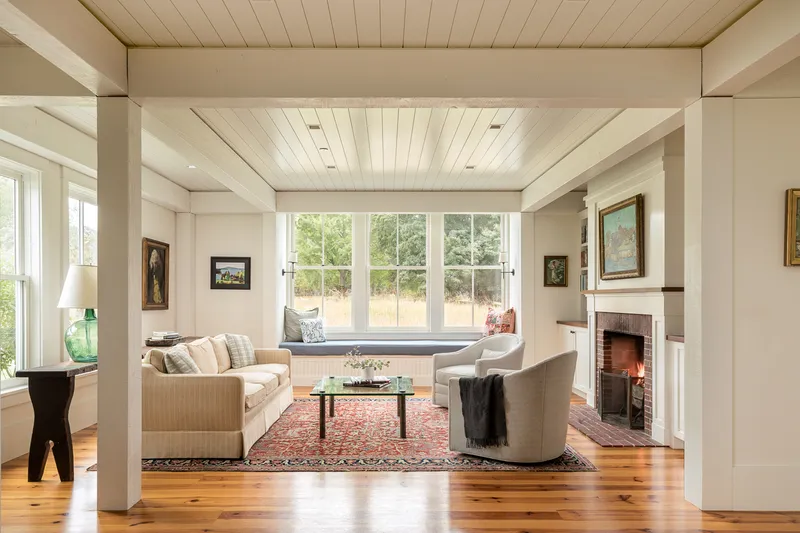
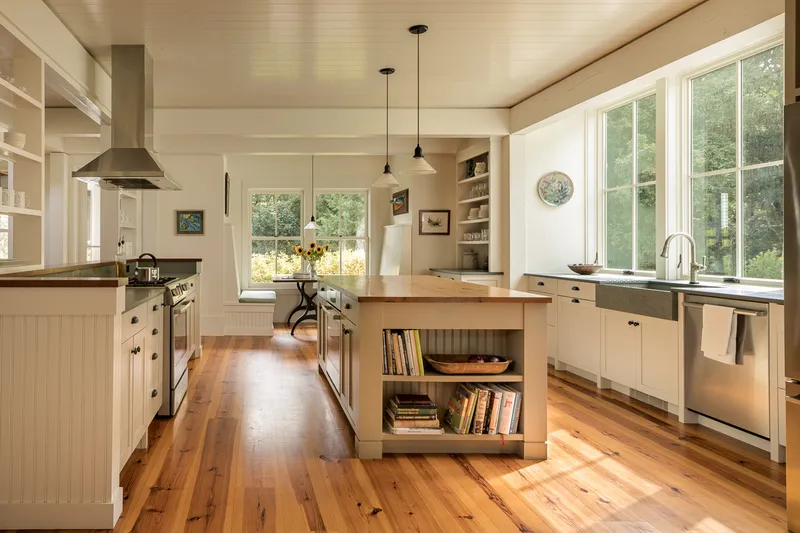
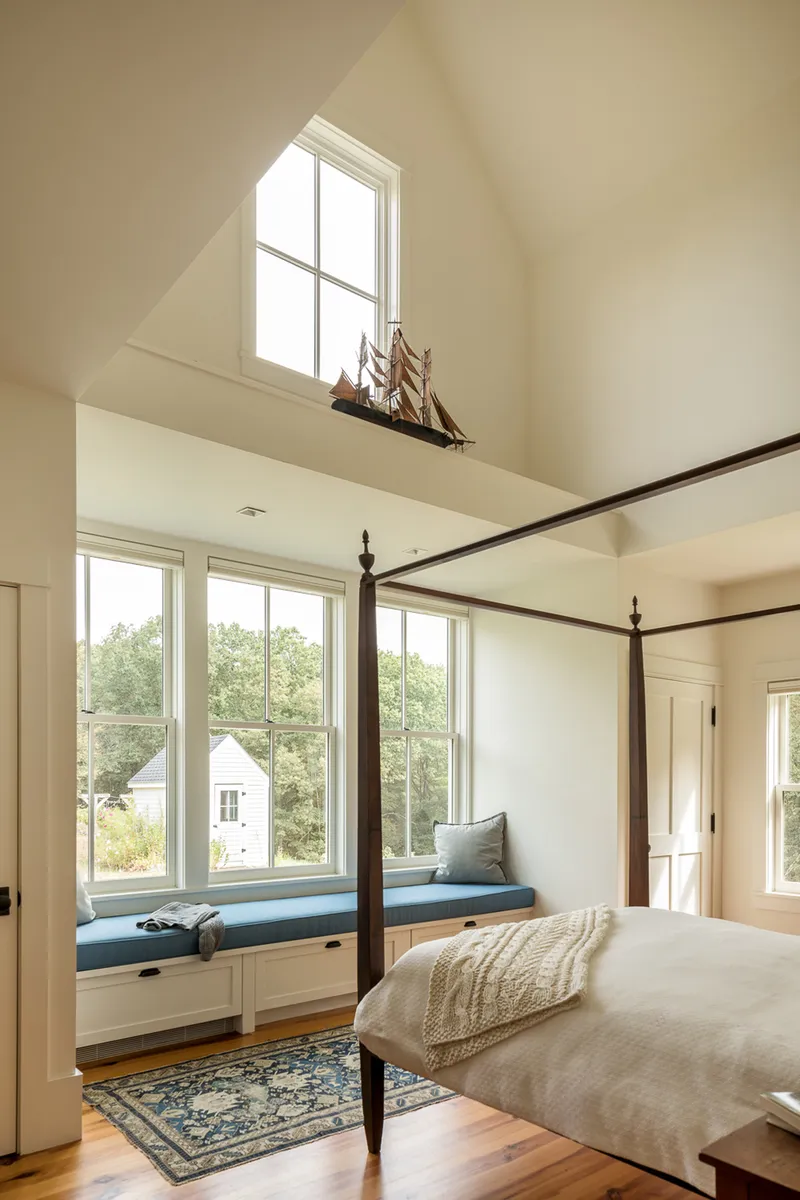
The living room pairs a fireplace with a built-in window seat beneath a wood ceiling supported by white columns. It is the kind of room that earns the word "cozy" without resorting to miniature scale; the ceiling pitch gives it height while the window seat pulls you to the perimeter. In the kitchen, butcher block islands, white cabinetry, and pendant lights create a workmanlike warmth. The bedroom in the little house is the quietest space in the composition, its tall windows framing nothing but summer canopy.
Throughout, the material palette stays narrow: white-painted trim, natural wood, slate, and glass. The discipline means that each room's character comes from proportion and light rather than surface variety.
Roofscape and Landscape
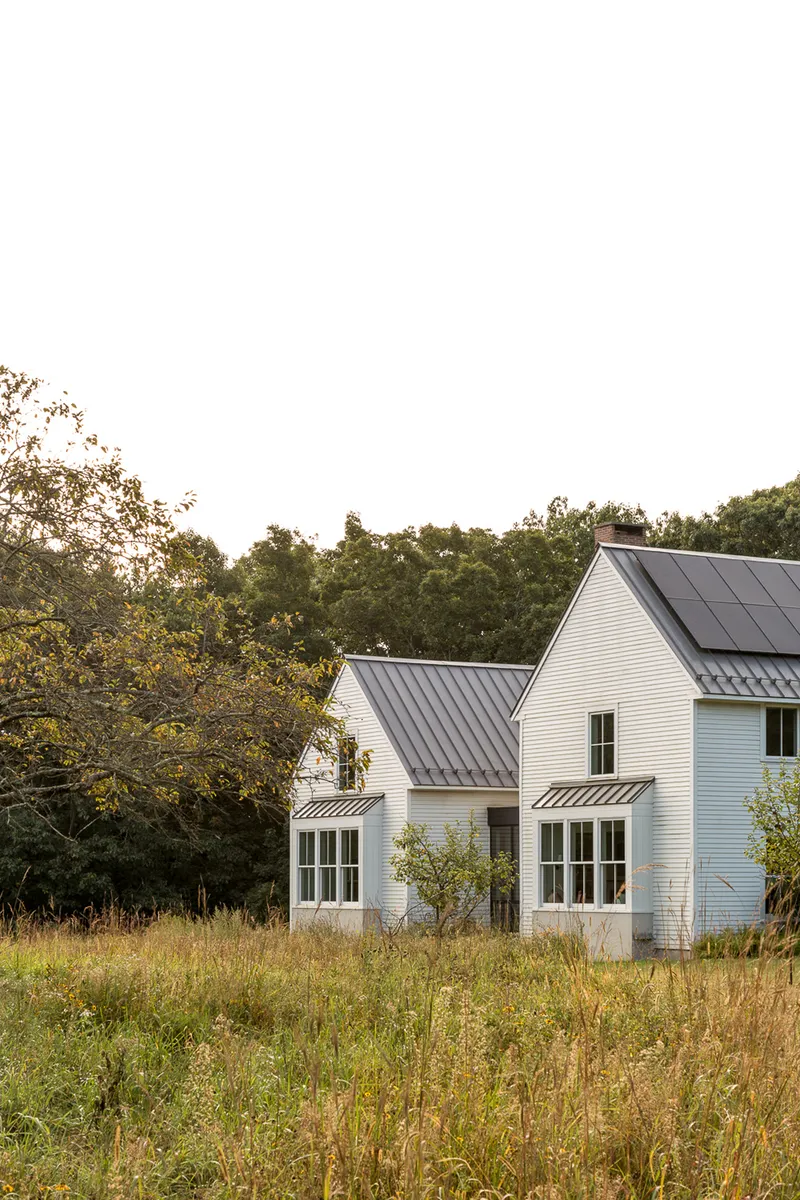
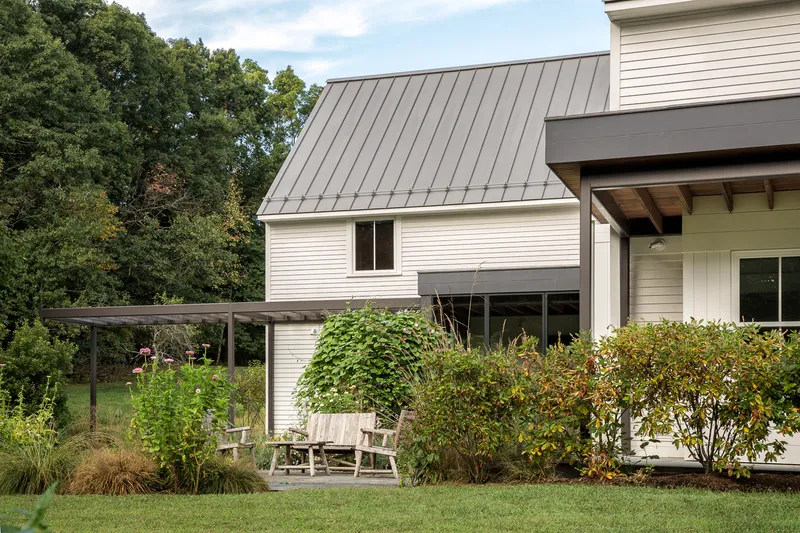
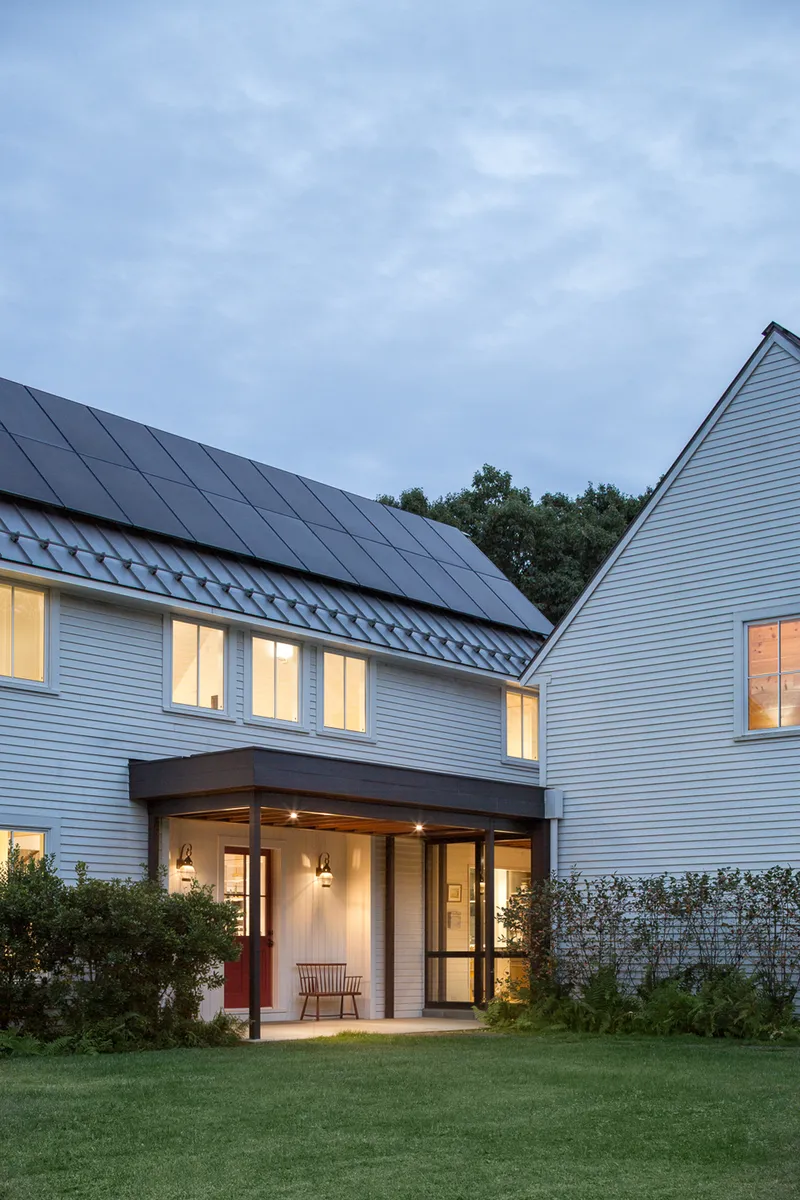
Standing seam metal roofs cap each volume, their uniform silver tone unifying the composition from the road. Solar panels sit on the barn's south-facing slope, visible but not prominent. Covered porches with timber posts provide sheltered outdoor living along the rear facades. The landscape, designed by Richardson & Associates, layers stone walls, low-maintenance native plantings, and an apple orchard (some trees existing, some newly planted) to reinforce the farmstead narrative without turning it into pastiche.
The rear elevation, with its brick chimney and horizontal siding catching the last light, is arguably the house's best face. It is the one the family sees most, and its informality compared to the more composed meadow facade gives it a lived-in quality from day one.
Dusk Portraits
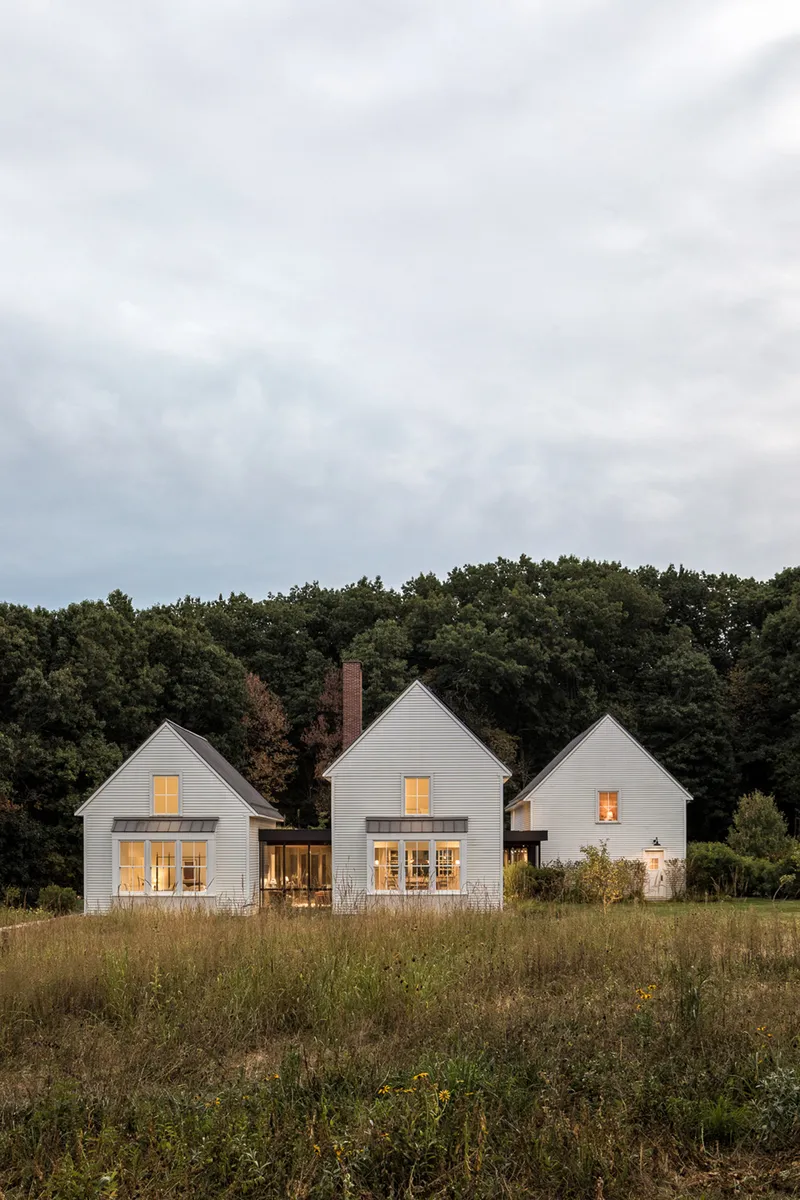
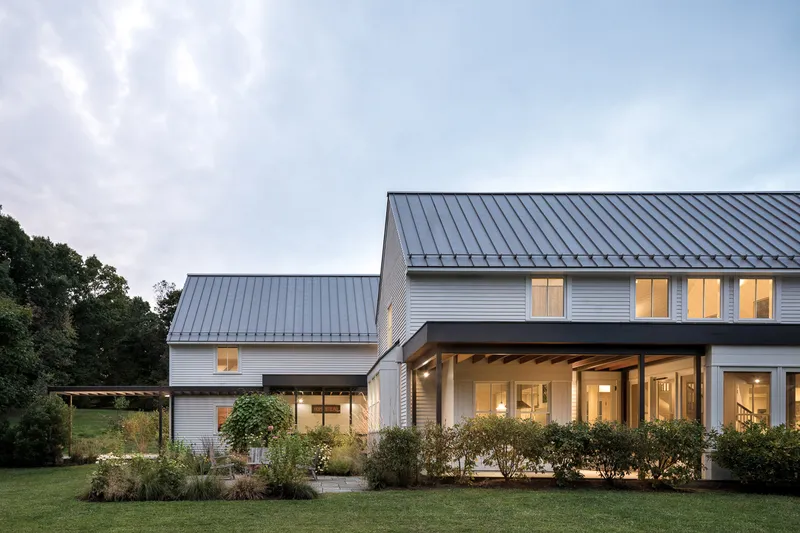
Photographed at dusk by Jeff Roberts, the house reveals its interior organization through its generously proportioned windows. The lit volumes glow against the darkening meadow, and the glass corridors register as thin lines of warm light connecting three independent lanterns. It is an image that makes the design argument more clearly than any diagram: this is a house that wants to be three things at once, held together by the landscape in between.
Plans and Drawings
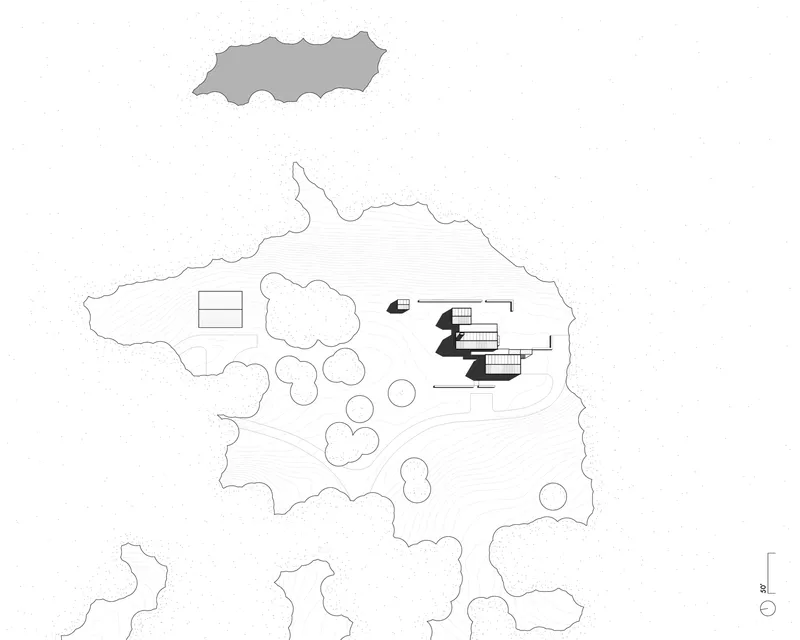
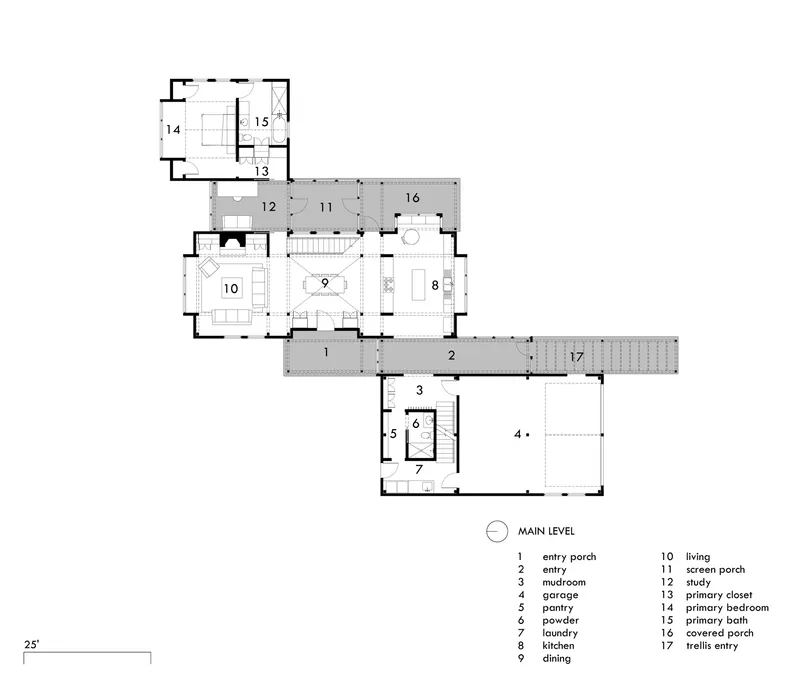
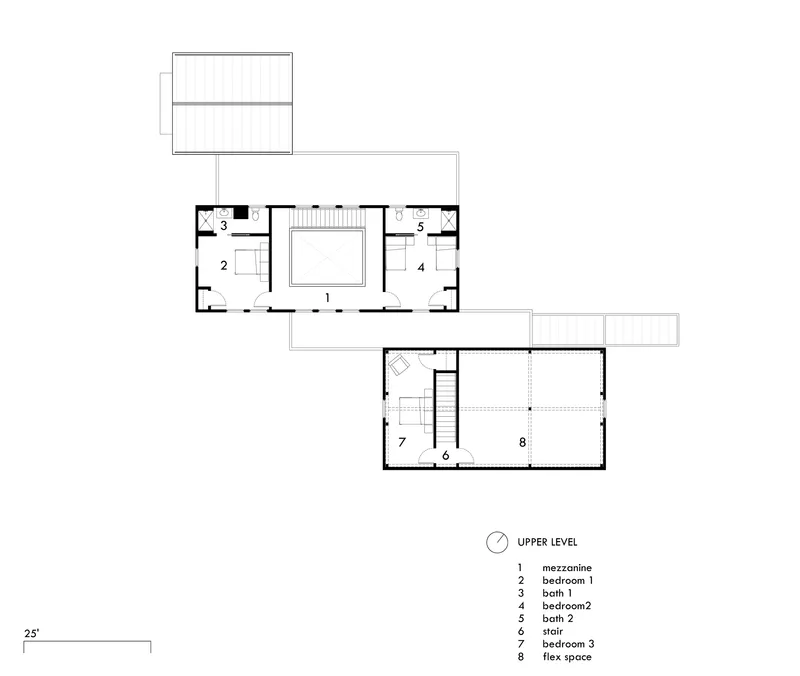
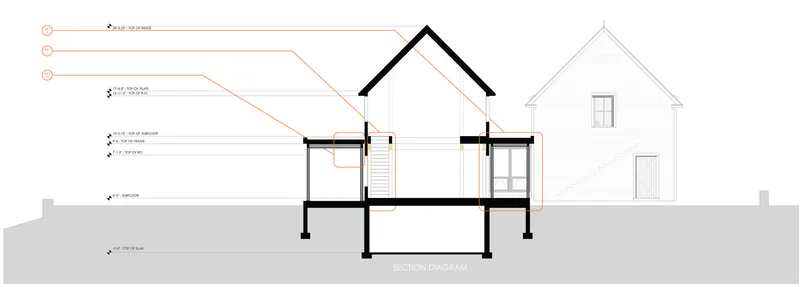
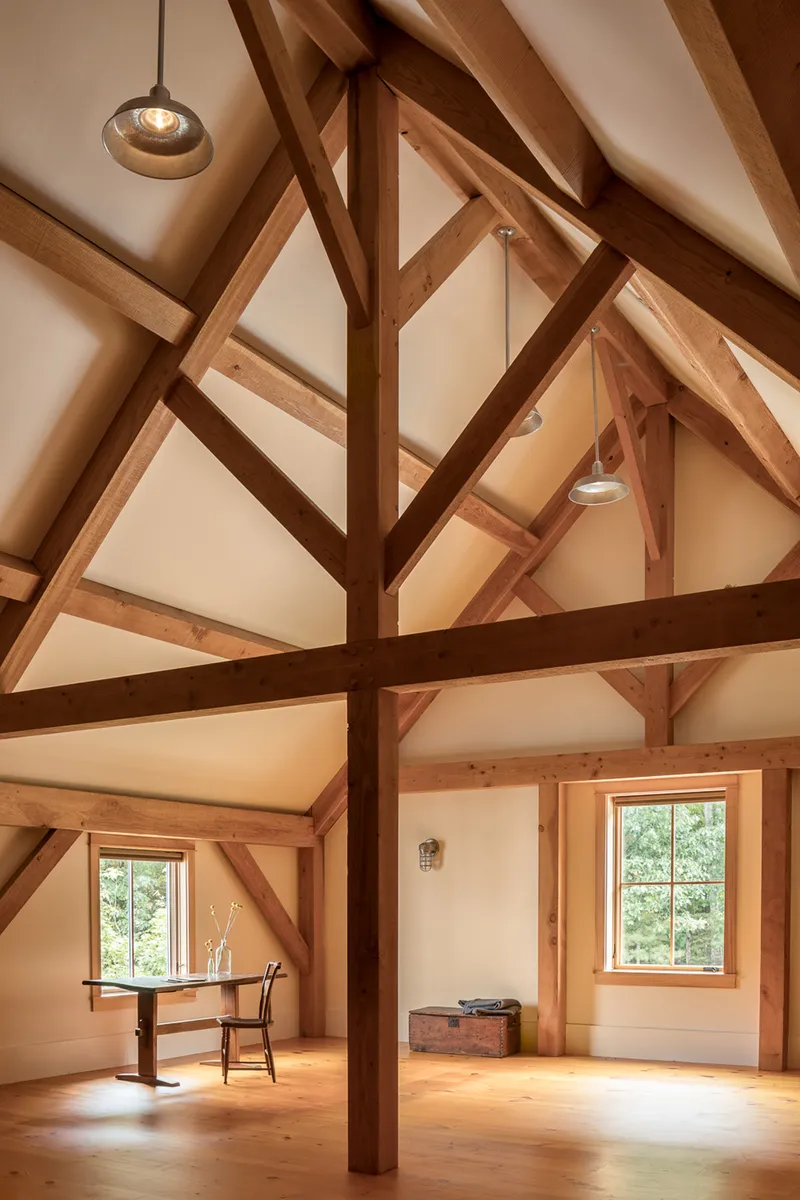
The site plan confirms what the aerial photo suggests: the three volumes are not arranged on a single axis but staggered along a gentle curve that follows the land's contour. The main level plan shows the entry corridor feeding into the big house's open living and dining spaces, with the little house and barn branching off at slight angles. Upstairs, the central mezzanine bridges to three bedrooms and a flex space. The building section cuts through the tallest gabled volume and reveals the king post trusses that structure the double-height dining hall, their exposed timber framing one of the few moments where structure becomes ornament.
Why This Project Matters
Houses that reference regional typologies risk two failures: too literal a copy, or too abstract a reinterpretation that loses the source material entirely. ElliottArchitects avoids both by keeping the farmstead logic (big house, little house, barn) completely legible while exploiting the gaps between volumes as the project's primary architectural move. The glass corridors are not connective tissue borrowed from a museum; they are an argument that a domestic threshold can be both weathertight and transparent to the seasons.
The broader lesson here is about scale management. At 5,125 square feet, this is not a small house, yet it never reads as a large one. Breaking the program into three distinct rooflines, each with its own silhouette against the tree line, keeps the building subordinate to its six-acre site. In suburban New England, where oversized colonials routinely flatten their lots, that restraint matters. The farmstead archetype is not just an aesthetic choice; it is a strategy for occupying land without dominating it.
Farmhouse in a Meadow by ElliottArchitects, lead architect Isaac Robbins with Matt Elliott and Maggie Kirsch. Wellesley, United States. 5,125 sq ft. Completed 2024. Photography by Jeff Roberts.
About the Studio
Share Your Own Work on uni.xyz
If projects like this are the kind of work you want to make, uni.xyz is a place to publish your own, find collaborators, and enter design competitions.




Popular Articles
Popular articles from the community


Co-Life: Senior Housing Design That Reconnects Older Adults With the City
Co-Life reimagines senior housing design through healing gardens, shared streets, workshops, and a sustainable community across generations.

Co-life: Sustainable Architecture for Age-Friendly Community Living
Co-life reimagines sustainable architecture for seniors through courtyards, rammed earth, shared gardens, and spaces designed for belonging.

The Earth Pod: 3D Printed Homes for Resilient Refugee Communities
The Earth Pod reimagines refugee housing through 3D printed homes made from clay, combining resilience, self-sufficiency, and rapid shelter.

The Musturak Paradise: Senior Living Architecture for a Connected Future in Temara, Morocco
The Musturak Paradise reimagines senior living architecture in Temara via private homes, social spaces, culture, community, and shared care.


Similar Reads
You might also enjoy these articles

Bao Huynh Watercolor Atelier: A Serene Art Retreat in Hội An
Bao Huynh Watercolor Atelier in Hội An blends multifunctional art spaces, sustainable design, local materials, and family-friendly living in a serene environment.

Atelier Macri Concept Store Interior Design by CASE-REAL
Atelier Macri store features a "ko" counter, walnut wood details, cork displays, blending retail, gallery, and seamless customer experiences.

Manuel Vargas Izquierdo Stadium and High-Performance Sports Center: Architectural Excellence in Jalpa de Méndez
The Manuel Vargas Izquierdo Stadium blends sustainable design, inclusive sports facilities, and cultural-inspired architecture, revitalizing Jalpa de Méndez’s public spaces.

KAKR Buluh Awar Hall: Revitalizing Community and Ecology Through Bamboo Architecture
Community built bamboo hall revitalizes Buluh Awar village, empowering youth, restoring ecology, celebrating vernacular craftsmanship through sustainable architecture and culture.




Comments (0)
Please login or sign up to add comments
No comments yet. Be the first to comment!